QUALITY BUILDINGS,
QUALITY CARE
How buildings contribute to improved
patient care and staff wellbeing
Healthcare
In association with
2
QUALITY BUILDINGS, QUALITY CARE NOVEMBER 2015
Contents
Foreword	3
Executive summary	 4
Introduction	5
	 The history of investment in healthcare real estate	 6
The impact of investment in healthcare real estate	 7
	 Measuring quality of care	 7
	 Impact of age of building on CQC rating	 9
	 Impact of age of building on staff and patients	 12
		Clinical benefits	 12
		Patient safety	 14
		Workforce benefits	 16
	Conclusion	 16
Better care by design	 17
	 Better patient experience	 19
	 Better patient outcomes	 20
	 Better staff experience	 21
Sustainable impact	 22
	 Sustainable development	 22
Conclusions	23
Appendix 1: Tailoring facilities to the needs of patients	 25
	 Design for autism	 25
	 Design for dementia	 25
Appendix 2: Key design elements for patient experience and outcome	 27
Data and bibliography	 28
3
QUALITY BUILDINGS, QUALITY CARE NOVEMBER 2015
Foreword
The last century has seen great leaps in our
understanding of the human body and mind.
As we approach the 70th anniversary of the creation of the NHS, we face
new challenges: ensuring that we all receive the care we need as medical
knowledge advances; facing demographic changes as the elderly make up
an increasing proportion of our population, leading to higher demand for
the services they need; and the economy returning to growth with a legacy of
deficit reduction.
Greater longevity is clearly to be welcomed, but is the healthcare estate
ready for these changes? NHS England1
agrees that investment in healthcare
infrastructure will be a vital part of the solution, and the real estate sector
stands ready to play its part in providing much-needed new premises – from
GP surgeries to hospitals to care homes.
Recently, we showed that investment in primary care could deliver patient
benefits and significant savings to the NHS2
, and that investment in care
homes could help to meet the complex care needs of the elderly3
. The same
is true of the wider healthcare estate; fitting treatment rooms for new and
novel treatments in existing buildings that were not designed for that purpose
presents real difficulties. Simply put, investment in healthcare real estate can
help to improve the care that patients receive – and deserve.
In a time of constrained public finances, investing in healthcare real estate
also represents value for money. Upfront investment in primary care would
lead to significant savings further down the line through reduced reliance
on A&E services and walk-in centres. And it is not just patients that will reap
the benefits: health workers deserve workplaces that allow them to care for
patients as effectively as possible, and working in an environment which aids
their own wellbeing helps achieve this.
This report adds to increasing evidence proving the benefits of modern,
purpose-built premises, and we look forward to working with all political
parties, local authorities and NHS bodies to fully realise these benefits.
Melanie Leech
Chief Executive
British Property Federation
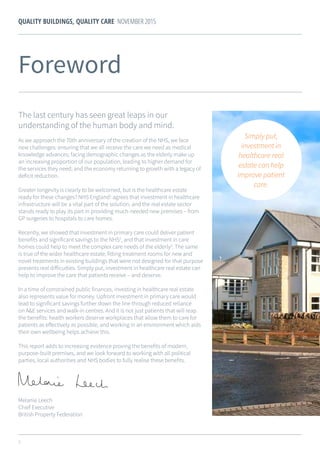
Simply put,
investment in
healthcare real
estate can help
improve patient
care.
4
Executive summary
This report shows that:
•	 In those reviewed to date, services provided from new healthcare
premises have been three to four times more likely to be rated
“Outstanding” by the Care Quality Commission than services
provided from older premises;
•	 There is lower turnover of staff in newly built hospitals, and staff take
fewer sick days. The difference in staff sickness absence is equivalent
to 900,000 working days per year if the median sickness absence rate
in newer buildings were replicated across all NHS Acute Trusts;
•	 Modern facilities are safer for patients, with 30% lower fall rates
and 10% lower overall patient harm in new hospitals, and similar
reductions in new care homes.
To ensure this continues it is critical that:
•	 Continuous investment in flexible, future-proofed buildings should be
encouraged, allowing design innovation to spread across the estate;
•	 Local plans should consider all healthcare facilities – from hospitals
to care homes to health centres – assessing fitness for purpose and
future needs;
•	 Local plans should ensure new healthcare buildings are conveniently
located to town centres, transport hubs, and existing medial
infrastructure (with care homes prioritised close to hospitals, for
example) to facilitate integrated care;
•	 Evidence based design should continue to be supported, promoting
the spread of best practice and achieving maximum benefit from
advances in design and technology;
•	 Building on the work of programmes such as ‘Enhancing the Healing
Environment’4
, commissioned by the Department of Health and led
by the King’s Fund, further systematic studies are needed to quantify
the wider impact of healthcare environments on quality of care and
further define best practice;
•	 The NHS should recognise, monitor and systematically report on the
wider benefits of healthcare infrastructure investment.
So far, we have only seen the above benefits within a proportion of the
healthcare estate. Rolling out proven technologies such as anti-microbial
surfaces, better lighting and layouts that reduce staff travel time to the
rest of the national healthcare portfolio would benefit both patients and
healthcare professionals. At present, investment has been undertaken at
irregular intervals which means that the portfolio is of varying quality.
Renewing and revitalising the estate will be better for patients, better for
the NHS and better for its workers.
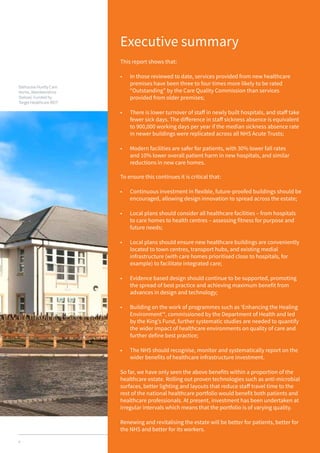
Balhousie Huntly Care
Home, Aberdeenshire
(below). Funded by
Target Healthcare REIT.
5
QUALITY BUILDINGS, QUALITY CARE NOVEMBER 2015
The success of modern healthcare has
paradoxically led to an increase in need
for services.
Whilst life expectancies have soared, the average person
in the UK now spends more than 15 years in poor health5
.
Increasing longevity and pioneering treatments mean that
on average, each of us alive today will spent around two
and a half years of our lives in a care home6
.
Across the population, there is a pressing need to support
increasing numbers of frail elderly patients, especially
those with both mental and physical conditions, and to
encourage self-management of long term conditions. This
pressure on elderly services must be addressed. Diabetes
cases have risen 60% in the past decade and currently
affect 3.3 million people7
; every year, 25% of people in the
UK will experience some kind of mental health difficulty8
and an estimated 25% of people accessing acute hospital
care also have dementia9
. 50% of women and 43% of men
now regularly take prescription drugs10
.
In the ‘Five Year Forward View’11
, the plan for the near
future of our health service, NHS England Chief Executive
Simon Stevens recognises the challenges of treating
longer-term conditions and calls for new models of care
to provide more integrated services to patients. As the
healthcare sector in the UK seeks to serve these patients,
a key question remains: is the healthcare estate in the UK
fit for purpose?
Many reports conclude that it is not. In December 2014,
Building Magazine reported12
20% of 1,545 practices
applying for Care Quality Commission (CQC) registration
failed on one aspect of their premises’ quality and a
third were not “safe and accessible”. In a 2013 report,
‘NHS buildings: obstacle or opportunity?’13
, the King’s
Fund concluded that a number of the current buildings
are out-of-date and impede the quality of care. Better
estate management processes and targeted strategic
investment to create flexible future-proofed buildings
were recommended to address this.
Introduction
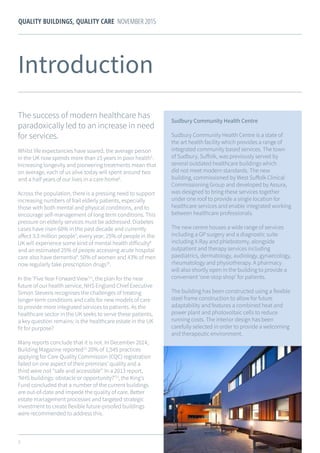
Sudbury Community Health Centre
Sudbury Community Health Centre is a state of
the art health facility which provides a range of
integrated community based services. The town
of Sudbury, Suffolk, was previously served by
several outdated healthcare buildings which
did not meet modern standards. The new
building, commissioned by West Suffolk Clinical
Commissioning Group and developed by Assura,
was designed to bring these services together
under one roof to provide a single location for
healthcare services and enable integrated working
between healthcare professionals.
The new centre houses a wide range of services
including a GP surgery and a diagnostic suite
including X-Ray and phlebotomy, alongside
outpatient and therapy services including
paediatrics, dermatology, audiology, gynaecology,
rheumatology and physiotherapy. A pharmacy
will also shortly open in the building to provide a
convenient ‘one-stop shop’ for patients.
The building has been constructed using a flexible
steel frame construction to allow for future
adaptability and features a combined heat and
power plant and photovoltaic cells to reduce
running costs. The interior design has been
carefully selected in order to provide a welcoming
and therapeutic environment.
6
QUALITY BUILDINGS, QUALITY CARE NOVEMBER 2015
The history of investment in
healthcare real estate
Throughout the years the estate has benefitted somewhat
unevenly from waves of investments into different sectors.
At the foundation of the NHS in 1948, the service inherited
more than 2,000 hospitals from local government and
voluntary organisations. One of the early innovations
in acute care was the District General Hospital model
developed in the 1960s. With the increasing importance
of outpatient departments and day cases, the number of
overnight hospital beds has been dramatically reduced. In
1988, there were nearly 300,000 overnight beds available
in England, and by 2014 this had reduced to less than half
that (136,000)14
. Around 20% of NHS buildings have been
built since 2005 – but 15% were built prior to 1948.
Primary care providers have become increasingly
consolidated. In 1948, GPs were employed by the NHS
on individual contracts and many practised in their
own homes. Successive investment programmes have
encouraged GPs to form larger practices: in 1966, the
NHS began to pay GPs’ rent and business rates, and
in the 1970s, local authorities began to build health
centres, co-locating GPs with other health services such
as dentists and health visitors. Government established
the Primary Care Infrastructure Fund in 2014 to accelerate
improvements in GP premises and infrastructure.
Demand for services to care for the elderly has increased
due to changing demographics. Care homes were
originally provided by local authorities, and saw a wave
of private investment in the 1980s and 1990s. In 1980,
local authorities provided 63% of places; but by 2002 this
had fallen to 17%15
. End of life care has also changed: the
modern hospice movement started with the foundation
of St Christopher’s Hospice by Dame Cicely Saunders in
1967, and today there are over 200 such services. Over
two thirds of these are funded by charities.
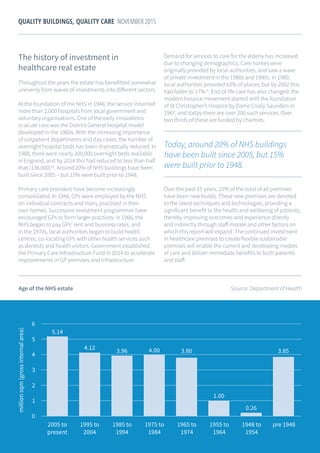
Age of the NHS estate
Today, around 20% of NHS buildings
have been built since 2005, but 15%
were built prior to 1948.
Over the past 15 years, 10% of the total of all premises
have been new builds. These new premises are devoted
to the latest techniques and technologies, providing a
significant benefit to the health and wellbeing of patients,
thereby improving outcomes and experience directly
and indirectly through staff morale and other factors on
which this report will expand. The continued investment
in healthcare premises to create flexible sustainable
premises will enable the current and developing models
of care and deliver immediate benefits to both patients
and staff.
Source: Department of Health
7
QUALITY BUILDINGS, QUALITY CARE NOVEMBER 2015
The impact of investment
in healthcare real estate
While the impact of specific aspects
of design on care provision has been
extensively investigated by academic
reports, their accumulated effect has
been analysed in less depth.
There is a large amount of data available on the quality of
care provided to patients, covering both NHS and non-
NHS facilities, for example the NHS Safety Thermometer
and the CQC ratings. The NHS also regularly publishes
information on staff experience, for example the NHS Staff
Survey. Quality of care can therefore be approached and
analysed from many different perspectives.
To understand the impact of investment on quality
of care, this data must be matched against data on
the age, quality and investment in premises. The
NHS publishes comprehensive data sets through
Estates Return Information Collection (ERIC) and the
Patient-Led Assessments of the Care Environment
(PLACE) programme. Data for non-NHS facilities is not
standardised and so a sample of facilities has been
analysed for this report.
Data has been collected for over 2,500 healthcare
premises across England. The 10% of buildings
constructed since 2000 have been grouped together to
compare to older sites.Comparing services provided in
new buildings to older buildings, there is a noticeable
impact on the overall quality of care, clinical outcomes
and staff engagement.
Measuring quality of care
While many metrics exist to measure aspects of care,
the CQC in England and the devolved inspectorates are
tasked with setting the required standards. In the CQC’s
own words, “we set out what good and outstanding care
looks like and we make sure services meet fundamental
standards below which care must never fall.” CQC ratings
therefore provide a consistent and comparable starting
point to investigate the impact of the healthcare estate on
quality of care.
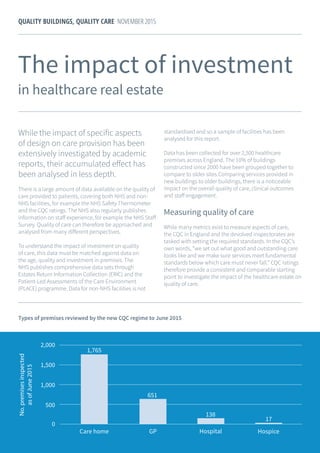
Types of premises reviewed by the new CQC regime to June 2015
8
•	 Hospices: End of life and palliative care facilities
mainly provided by voluntary organisations.
•	 Care homes: Nursing and residential care generally
focused on elderly care and mainly provided by
private companies.
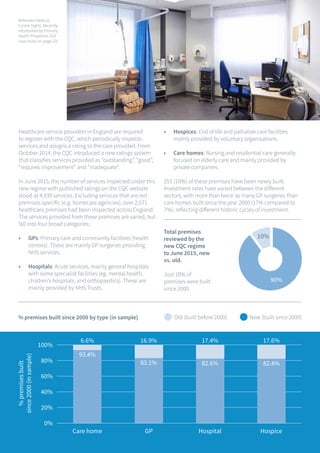
253 (10%) of these premises have been newly built.
Investment rates have varied between the different
sectors, with more than twice as many GP surgeries than
care homes built since the year 2000 (17% compared to
7%), reflecting different historic cycles of investment.
Total premises
reviewed by the
new CQC regime
to June 2015, new
vs. old.
Just 10% of
premises were built
since 2000.
Willesden Medical
Centre (right). Recently
refurbished by Primary
Health Properties (full
case study on page 22).
Healthcare service providers in England are required
to register with the CQC, which periodically inspects
services and assigns a rating to the care provided. From
October 2014, the CQC introduced a new ratings system
that classifies services provided as “outstanding”, “good”,
“requires improvement” and “inadequate”.
In June 2015, the number of services inspected under this
new regime with published ratings on the CQC website
stood at 4,939 services. Excluding services that are not
premises-specific (e.g. homecare agencies), over 2,571
healthcare premises had been inspected across England.
The services provided from these premises are varied, but
fall into four broad categories:
•	 GPs: Primary care and community facilities (health
centres). These are mainly GP surgeries providing
NHS services.
•	 Hospitals: Acute services, mainly general hospitals
with some specialist facilities (eg. mental health,
children’s hospitals, and orthopaedics). These are
mainly provided by NHS Trusts.
New (built since 2000)Old (built before 2000)% premises built since 2000 by type (in sample)
9
QUALITY BUILDINGS, QUALITY CARE NOVEMBER 2015
Impact of age of building on CQC rating
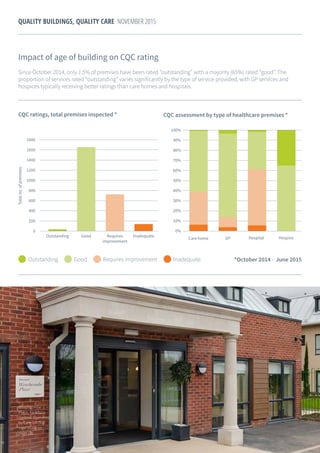
Since October 2014, only 1.5% of premises have been rated “outstanding” with a majority (65%) rated “good”. The
proportion of services rated “outstanding” varies significantly by the type of service provided, with GP services and
hospices typically receiving better ratings than care homes and hospitals.
CQC ratings, total premises inspected * CQC assessment by type of healthcare premises *
Good Requires improvement InadequateOutstanding *October 2014 – June 2015
Winchcombe
Place, Newbury
(below). Operated
by Care UK (full
case study on
page 13).
10
QUALITY BUILDINGS, QUALITY CARE NOVEMBER 2015
Ratings of premises inspected since October 2014
New buildings: % total vs % services rated “outstanding”
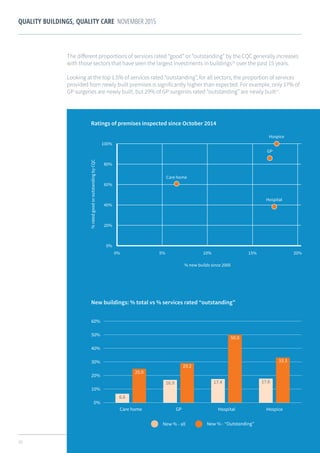
The different proportions of services rated “good” or “outstanding” by the CQC generally increases
with those sectors that have seen the largest investments in buildings16
over the past 15 years.
Looking at the top 1.5% of services rated “outstanding”, for all sectors, the proportion of services
provided from newly built premises is significantly higher than expected. For example, only 17% of
GP surgeries are newly built, but 29% of GP surgeries rated “outstanding” are newly built17
.
11
QUALITY BUILDINGS, QUALITY CARE NOVEMBER 2015
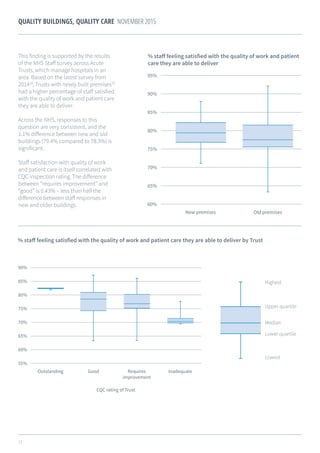
This finding is supported by the results
of the NHS Staff survey across Acute
Trusts, which manage hospitals in an
area. Based on the latest survey from
201418
, Trusts with newly built premises19
had a higher percentage of staff satisfied
with the quality of work and patient care
they are able to deliver.
Across the NHS, responses to this
question are very consistent, and the
1.1% difference between new and old
buildings (79.4% compared to 78.3%) is
significant.
Staff satisfaction with quality of work
and patient care is itself correlated with
CQC inspection rating. The difference
between “requires improvement” and
“good” is 0.43% – less than half the
difference between staff responses in
new and older buildings.
% staff feeling satisfied with the quality of work and patient
care they are able to deliver
% staff feeling satisfied with the quality of work and patient care they are able to deliver by Trust
Upper quartile
Lower quartile
Median
Highest
Lowest
12
QUALITY BUILDINGS, QUALITY CARE NOVEMBER 2015
Impact of age of building on staff and
patients
There are a wide variety of metrics published on
the quality of healthcare provision, covering patient
experience, staff engagement, clinical outcomes and
other metrics that contribute to the quality of service
provided. There are relatively few datasets available for
non-NHS services such as care homes, whereas NHS
Trust statistics are regularly collated and published by the
Health & Social Care Information Centre (HSCIC).
applicable to other healthcare sectors (as seen with
the patient safety data available within the NHS Safety
Thermometer data available for care homes).
Clinical benefits
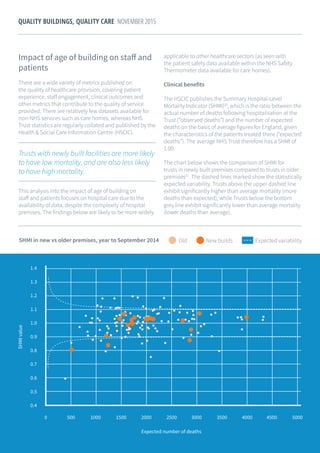
The HSCIC publishes the Summary Hospital-Level
Mortality Indicator (SHMI)20
, which is the ratio between the
actual number of deaths following hospitalisation at the
Trust (“observed deaths”) and the number of expected
deaths on the basis of average figures for England, given
the characteristics of the patients treated there (“expected
deaths”). The average NHS Trust therefore has a SHMI of
1.00.
The chart below shows the comparison of SHMI for
trusts in newly built premises compared to trusts in older
premises21
. The dashed lines marked show the statistically
expected variability. Trusts above the upper dashed line
exhibit significantly higher than average mortality (more
deaths than expected); while Trusts below the bottom
grey line exhibit significantly lower than average mortality
(lower deaths than average).
This analysis into the impact of age of building on
staff and patients focuses on hospital care due to the
availability of data, despite the complexity of hospital
premises. The findings below are likely to be more widely
SHMI in new vs older premises, year to September 2014
Trusts with newly built facilities are more likely
to have low mortality, and are also less likely
to have high mortality.
New buildsOld Expected variability
13
Trusts with newly built facilities are
more likely to have low mortality,
with three out of the 19 (16%)
Trusts incurring “significantly below
average” deaths, compared to 13
out of 118 Trusts (11%) with older
buildings.
They are also less likely to have high
mortality: zero out of the 19 Trusts
with newly built facilities included
incurring “significantly above
average” deaths, compared to nine
out of 118 (8%) of Trusts with older
buildings.
Whilst caution should be applied to
this analysis due to the mix of older
and newer buildings at Trusts, there
were 121 fewer observed deaths
than expected across the 19 Trusts
with new buildings (an SHMI of 0.99).
Applied across all NHS acute trusts,
this 1% reduction in mortality rate
would see a reduction in deaths of
2,900 deaths per annum.
The connection between reduced
mortality rates and investment in
healthcare facilities requires further
investigation, but the data suggests
there are potentially significant
clinical gains.
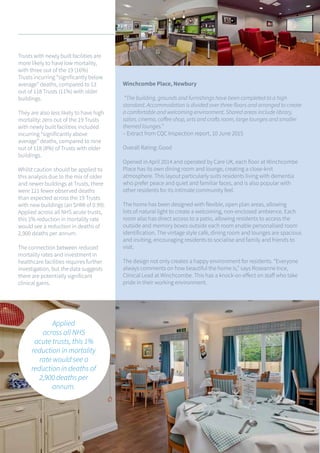
Winchcombe Place, Newbury
“The building, grounds and furnishings have been completed to a high
standard. Accommodation is divided over three floors and arranged to create
a comfortable and welcoming environment. Shared areas include library,
salon, cinema, coffee shop, arts and crafts room, large lounges and smaller
themed lounges.”
– Extract from CQC Inspection report, 10 June 2015
Overall Rating: Good
Opened in April 2014 and operated by Care UK, each floor at Winchcombe
Place has its own dining room and lounge, creating a close-knit
atmosphere. This layout particularly suits residents living with dementia
who prefer peace and quiet and familiar faces, and is also popular with
other residents for its intimate community feel.
The home has been designed with flexible, open plan areas, allowing
lots of natural light to create a welcoming, non-enclosed ambience. Each
room also has direct access to a patio, allowing residents to access the
outside and memory boxes outside each room enable personalised room
identification. The vintage style café, dining room and lounges are spacious
and inviting, encouraging residents to socialise and family and friends to
visit.
The design not only creates a happy environment for residents. “Everyone
always comments on how beautiful the home is,” says Roseanne Ince,
Clinical Lead at Winchcombe. This has a knock-on effect on staff who take
pride in their working environment.
Applied
across all NHS
acute trusts, this 1%
reduction in mortality
rate would see a
reduction in deaths of
2,900 deaths per
annum.
14
Patient safety
The NHS Safety Thermometer is
a monthly survey that assesses
the percentage of patients
receiving “harm-free care” and
those incurring various types of
harm, such as falls, during care.
It collates data from over 1,000
organisations including care
homes, private hospitals, Acute
Trusts and Community Trusts.
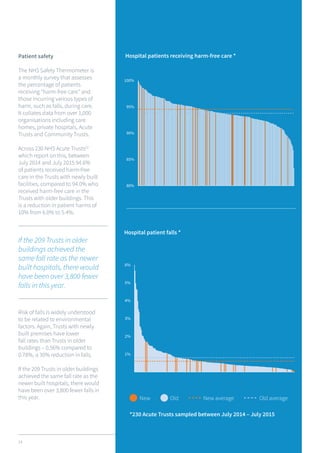
Across 230 NHS Acute Trusts22
which report on this, between
July 2014 and July 2015 94.6%
of patients received harm-free
care in the Trusts with newly built
facilities, compared to 94.0% who
received harm-free care in the
Trusts with older buildings. This
is a reduction in patient harms of
10% from 6.0% to 5.4%.
OldNew Old averageNew average
Hospital patients receiving harm-free care *
Hospital patient falls *
*230 Acute Trusts sampled between July 2014 – July 2015
Risk of falls is widely understood
to be related to environmental
factors. Again, Trusts with newly
built premises have lower
fall rates than Trusts in older
buildings – 0.56% compared to
0.78%, a 30% reduction in falls.
If the 209 Trusts in older buildings
achieved the same fall rate as the
newer built hospitals, there would
have been over 3,800 fewer falls in
this year.
If the 209 Trusts in older
buildings achieved the
same fall rate as the newer
built hospitals, there would
have been over 3,800 fewer
falls in this year.
15
OldNew Old averageNew average
Care home resident falls *
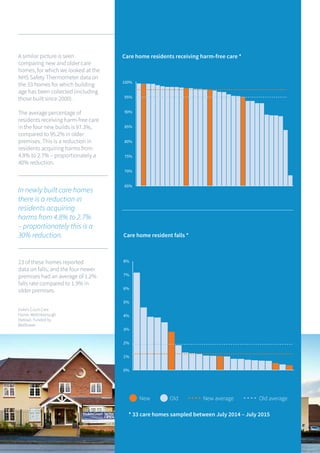
A similar picture is seen
comparing new and older care
homes, for which we looked at the
NHS Safety Thermometer data on
the 33 homes for which building
age has been collected (including
those built since 2000).
The average percentage of
residents receiving harm-free care
in the four new builds is 97.3%,
compared to 95.2% in older
premises. This is a reduction in
residents acquiring harms from
4.8% to 2.7% – proportionately a
40% reduction.
23 of these homes reported
data on falls, and the four newer
premises had an average of 1.2%
falls rate compared to 1.9% in
older premises.
Care home residents receiving harm-free care *
Duke’s Court Care
Home, Wellinborough
(below). Funded by
Welltower.
In newly built care homes
there is a reduction in
residents acquiring
harms from 4.8% to 2.7%
– proportionately this is a
30% reduction.
* 33 care homes sampled between July 2014 – July 2015
16
QUALITY BUILDINGS, QUALITY CARE NOVEMBER 2015
Workforce benefits
Staff engagement is acknowledged as a key determinant
in quality of care. A report for the King’s Fund23
notes that
higher levels of staff engagement are associated with
reductions in staff sickness absence rates, lower mortality
rates, fewer accidents and greater levels of innovation.
Where available, the data suggests that these benefits are
also associated with newly built hospitals.
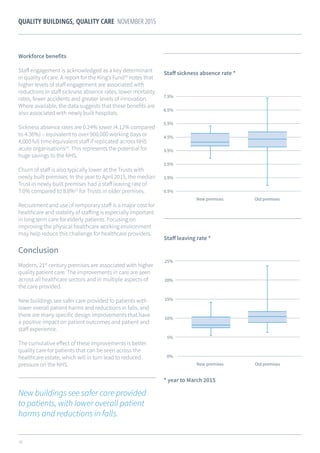
Sickness absence rates are 0.24% lower (4.12% compared
to 4.36%) – equivalent to over 900,000 working days or
4,000 full time equivalent staff if replicated across NHS
acute organisations24
. This represents the potential for
huge savings to the NHS.
Churn of staff is also typically lower at the Trusts with
newly built premises. In the year to April 2015, the median
Trust in newly built premises had a staff leaving rate of
7.0% compared to 8.8%25
for Trusts in older premises.
Recruitment and use of temporary staff is a major cost for
healthcare and stability of staffing is especially important
in long term care for elderly patients. Focusing on
improving the physical healthcare working environment
may help reduce this challenge for healthcare providers.
Conclusion
Modern, 21st
century premises are associated with higher
quality patient care. The improvements in care are seen
across all healthcare sectors and in multiple aspects of
the care provided.
New buildings see safer care provided to patients with
lower overall patient harms and reductions in falls, and
there are many specific design improvements that have
a positive impact on patient outcomes and patient and
staff experience.
The cumulative effect of these improvements is better
quality care for patients that can be seen across the
healthcare estate, which will in turn lead to reduced
pressure on the NHS.
Staff sickness absence rate *
Staff leaving rate *
* year to March 2015
New buildings see safer care provided
to patients, with lower overall patient
harms and reductions in falls.
17
QUALITY BUILDINGS, QUALITY CARE NOVEMBER 2015
Better care by design
Healthcare design has evolved
significantly over the years.
As far back as Florence Nightingale’s open ward, there
was recognition of the beneficial impact of design on
patients and staff. The purpose of design in healthcare
has transitioned from that of functional efficiency and
effectiveness in the 1950s and 1960s to the idea of
“people-centred design” and engaging users in design to
improve facilities today.
Academic research has clearly established a link between
the physical environment and patient outcomes
(for example fewer hospital-acquired infections and
medical errors). While the complex nature of building
developments and ongoing changes in operational use
can limit the ability to provide pure quantitative evidence
of the positive impact of design, the volume of evidence
(particularly since 2000) has been increasing.
Spreading design best practice throughout the healthcare
estate can be a complex process. Guidance such as the
Department of Health’s Health Technical Memoranda and
Health Building Notes provide advice on best practices
and the latest standards. Existing buildings have been
retrofitted for some innovations, for example the use of
colour to zone buildings.
However, other changes can be costly to incorporate
into older buildings. For new buildings, best practice
is followed and modern design incorporated into the
environment as standard. There is also a focus on
flexibility and future-proofing of facilities to allow new
innovations to be incorporated at a later date.
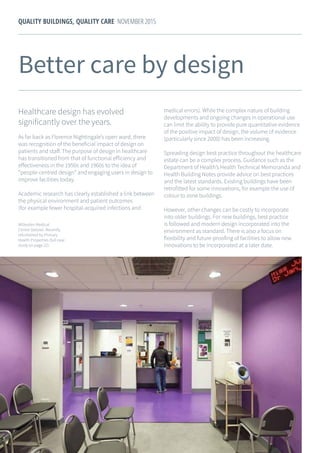
Willesden Medical
Centre (below). Recently
refurbished by Primary
Health Properties (full case
study on page 22).
18
QUALITY BUILDINGS, QUALITY CARE NOVEMBER 2015
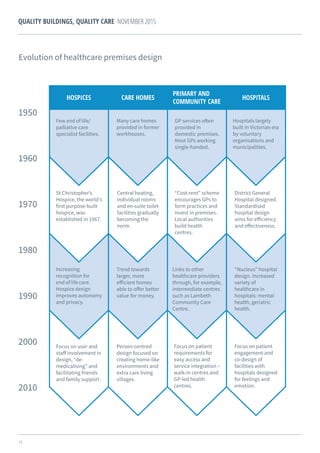
Evolution of healthcare premises design
19
QUALITY BUILDINGS, QUALITY CARE NOVEMBER 2015
Better patient experience
Hospitals and other healthcare facilities can be a daunting
environment for patients, particularly young or elderly
people. The advances in “person-centred” care have
highlighted that patient experience is an important factor
in healthcare provision.
The hospital environment can be a key component
of providing good patient experience and making
time spent in healthcare premises more comfortable.
Environmental satisfaction is second only to the
quality of nursing and clinical care in predicting overall
satisfaction26
.
Modern healthcare design aims to create welcoming,
supportive care environments that enable the patient to
feel calm, engaged, independent and sociable.
Single bed rooms in particular improve patients’ overall
satisfaction27
, as they not only improve confidentiality
and privacy, but they are also quieter, family and visitors
are found to stay longer and there are lower rates of
hospital acquired infection (as single rooms are easier to
decontaminate than multi-bed wards).
Academic research has also identified a variety of other
of features that can enhance patient experience of
healthcare facilities:
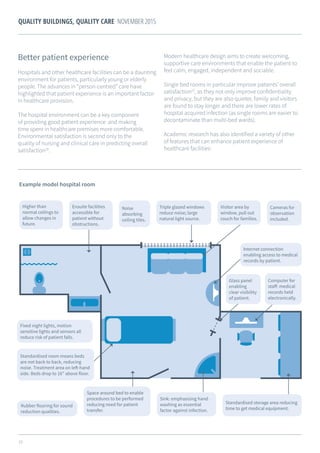
Fixed night lights, motion
sensitive lights and sensors all
reduce risk of patient falls.
Noise
absorbing
ceiling tiles.
Higher than
normal ceilings to
allow changes in
future.
Cameras for
observation
included.
Example model hospital room
Glass panel
enabling
clear visibility
of patient.
Standardised room means beds
are not back to back, reducing
noise. Treatment area on left-hand
side. Beds drop to 16” above floor.
Triple glazed windows
reduce noise; large
natural light source.
Ensuite facilities
accessible for
patient without
obstructions.
Visitor area by
window, pull out
couch for families.
Internet connection
enabling access to medical
records by patient.
Computer for
staff: medical
records held
electronically.
Rubber flooring for sound
reduction qualities.
Sink: emphasising hand
washing as essential
factor against infection.
Space around bed to enable
procedures to be performed
reducing need for patient
transfer.
Standardised storage area reducing
time to get medical equipment.
20
QUALITY BUILDINGS, QUALITY CARE NOVEMBER 2015
•	 Social areas can promote independence;
•	 Views of nature can lessen pain and stress for a variety
of conditions;
•	 Access to gardens can improve access to social
support and improve patient and family satisfaction
with care;
•	 Brightly lit rooms, especially east-facing with natural
early morning light can reduce length of stay, lessen
reliance on pain medication and improve outcomes,
especially in patients with depression, seasonal
affective disorders or dementia;
•	 Patients in well decorated, well appointed rooms
give higher ratings to their doctors, food and overall
standard of care than patients in standard rooms.
Advances in materials technology can also improve
patient experience, with noise reduction long ago
identified as a key concern for patient welfare. As well
as sleep loss and awakening, noise is associated with
increased heart rate and blood pressure, and using
suitable noise reducing materials can positively impact
patient care. A 2004 study28
showed cardiology patients
experienced less stress and reported that nurses gave
them better care in a ward with sound-absorbing ceiling
tiles compared to sound-reflecting ceiling tiles. There
were also indications of lower re-hospitalisation rates.
Better patient outcomes
Alongside better patient experience, there is a
considerable body of evidence showing that a good
environment can positively impact patient outcomes.
One such study29
found that patients were released 1.5
days earlier in refurbished environments compared to
unchanged ones and that time spent in an intensive
supervisory care area in a mental health unit was reduced
by 70%.
As well as improving recovery, hospital environments
can also reduce hospital-acquired infections and other
harms. For example, a well designed ventilation system
can reduce infection. HEPA filters and laminar airflow
rooms can be used to create ultraclean rooms particularly
for immuno-compromised patient suites and operating
theatres. A combination of single rooms and air filtration
has reduced infection and mortality in burn patients and
bone marrow transplant patients. Better use of lighting
and colour provides better visibility of obstacles leading
to fewer patient falls.
Detail on how design innovations that take into account
the specific patients served by a healthcare facility can be
found in Appendix 1: Tailoring Facilities to the Needs of
Patients.
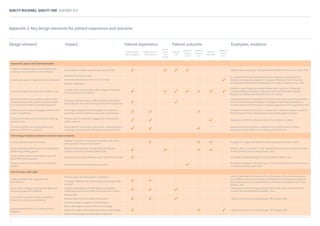
A more comprehensive list of key design features to
improve patient experience is given in Appendix 2: Key
design elements for patient experience and outcome.
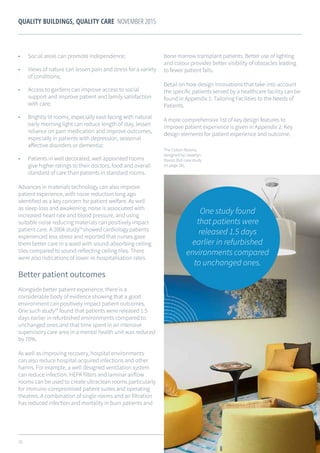
One study found
that patients were
released 1.5 days
earlier in refurbished
environments compared
to unchanged ones.
The Cotton Rooms,
designed by Llewelyn
Davies (full case study
on page 26).
21
QUALITY BUILDINGS, QUALITY CARE NOVEMBER 2015
Better staff experience
Good colour and lighting can make nurses and clinicians
work more efficiently, optimised layouts can reduce staff
fatigue, and standardisation can help minimise the risk of
human error. Surveys show that staff link the environment
with:
•	 Recruitment and retention;
•	 Improved morale;
•	 Accessibility and orientation;
•	 Privacy and security.
Well designed facilities can also increase productivity and
time for patient care. For example, the Virginia Mason
Production System increased nurse patient contact
time to 90% through reorganisation of working groups
including decentralising store cupboards. Steps walked
per day fell from 10,000 to roughly 1,20030
.
Design changes that positively impact patients have a
corresponding effect on staff. If the patient feels more
secure (through, for example, better visibility of staff),
this will reduce nurse call outs or possibly incidents of
aggression; design that improves visibility of obstacles
will also reduce the number of falls.
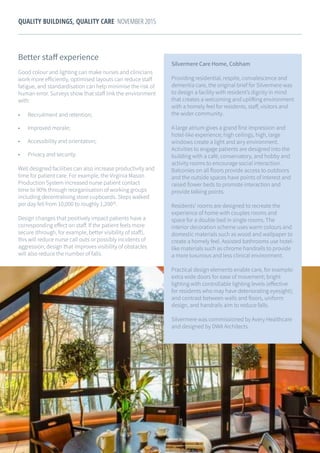
Silvermere Care Home, Cobham
Providing residential, respite, convalescence and
dementia care, the original brief for Silvermere was
to design a facility with resident’s dignity in mind
that creates a welcoming and uplifting environment
with a homely feel for residents, staff, visitors and
the wider community.
A large atrium gives a grand first impression and
hotel-like experience; high ceilings, high, large
windows create a light and airy environment.
Activities to engage patients are designed into the
building with a café, conservatory, and hobby and
activity rooms to encourage social interaction.
Balconies on all floors provide access to outdoors
and the outside spaces have points of interest and
raised flower beds to promote interaction and
provide talking points.
Residents’ rooms are designed to recreate the
experience of home with couples rooms and
space for a double bed in single rooms. The
interior decoration scheme uses warm colours and
domestic materials such as wood and wallpaper to
create a homely feel. Assisted bathrooms use hotel-
like materials such as chrome handrails to provide
a more luxurious and less clinical environment.
Practical design elements enable care, for example:
extra wide doors for ease of movement; bright
lighting with controllable lighting levels (effective
for residents who may have deteriorating eyesight);
and contrast between walls and floors, uniform
design, and handrails aim to reduce falls.
Silvermere was commissioned by Avery Healthcare
and designed by DWA Architects.
22
QUALITY BUILDINGS, QUALITY CARE NOVEMBER 2015
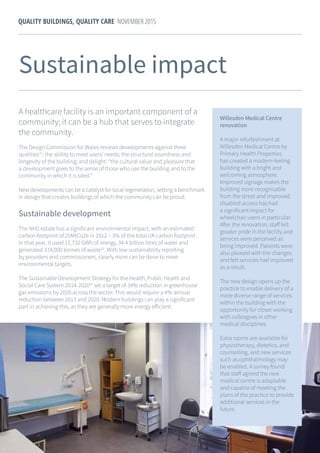
Willesden Medical Centre
renovation
A major refurbishment at
Willesden Medical Centre by
Primary Health Properties
has created a modern-feeling
building with a bright and
welcoming atmosphere.
Improved signage makes the
building more recognisable
from the street and improved
disabled access has had
a significant impact for
wheelchair users in particular.
After the renovation, staff felt
greater pride in the facility and
services were perceived as
being improved. Patients were
also pleased with the changes
and felt services had improved
as a result.
The new design opens up the
practice to enable delivery of a
more diverse range of services
within the building with the
opportunity for closer working
with colleagues in other
medical disciplines.
Extra rooms are available for
physiotherapy, dietetics, and
counselling, and new services
such as ophthalmology may
be enabled. A survey found
that staff agreed the new
medical centre is adaptable
and capable of meeting the
plans of the practice to provide
additional services in the
future.
Sustainable impact
A healthcare facility is an important component of a
community; it can be a hub that serves to integrate
the community.
The Design Commission for Wales reviews developments against three
qualities31
: the ability to meet users’ needs; the structural soundness and
longevity of the building; and delight: “the cultural value and pleasure that
a development gives to the sense of those who use the building and to the
community in which it is sited.”
New developments can be a catalyst for local regeneration, setting a benchmark
in design that creates buildings of which the community can be proud.
Sustainable development
The NHS estate has a significant environmental impact, with an estimated
carbon footprint of 25MtCo2e in 2012 – 3% of the total UK carbon footprint.
In that year, it used 11,732 GWh of energy, 34.4 billion litres of water and
generated 374,000 tonnes of waste32
. With low sustainability reporting
by providers and commissioners, clearly more can be done to meet
environmental targets.
The Sustainable Development Strategy for the Health, Public Health and
Social Care System 2014-202033
set a target of 34% reduction in greenhouse
gas emissions by 2020 across the sector. This would require a 4% annual
reduction between 2013 and 2020. Modern buildings can play a significant
part in achieving this, as they are generally more energy efficient.
23
QUALITY BUILDINGS, QUALITY CARE NOVEMBER 2015
Continued investment in healthcare premises across the UK is needed to
ensure the creation of flexible, future-proofed premises from which to provide
excellent care going forward. The private sector stands ready to play its part in
building these, with billions of pounds of capital ready to be invested to help
work with the NHS and politicians from all parties to create these premises,
and result in the UK’s healthcare infrastructure being truly fit for the 21st
century.
Theprivatesectorstandsreadytoplayitspartincreatingflexible,
future-proofedhealthcarepremises,withbillionsofpoundsof
capitalreadytobeinvested.
Conclusions
The buildings from which healthcare is provided are
important community assets that can contribute
positively or negatively to the care provided in them.
Much academic research has demonstrated that good design in healthcare
premises can assist diagnosis, reduce medical errors, reduce patient harms,
improve staff morale, reduce patient stress and improve recovery times.
The quantitative analysis of healthcare premises in England presented
here shows that investments in new build healthcare premises have had a
significant, measurable impact on the quality of care provided to patients.
They are also associated with reducing staff sickness and turnover, reducing
patient harms (particularly falls), and reducing mortality. At an overall level,
services are significantly more likely to be rated “outstanding” by the CQC.
In conclusion, it is clear from our findings that investment in healthcare real
estate brings a wide range of clinical benefits to patients. It also helps improve
their experience during what is often an extremely difficult time, and helps
doctors, nurses and other medical staff to work more effectively by improving
their wellbeing and working environment.
24
QUALITY BUILDINGS, QUALITY CARE NOVEMBER 2015
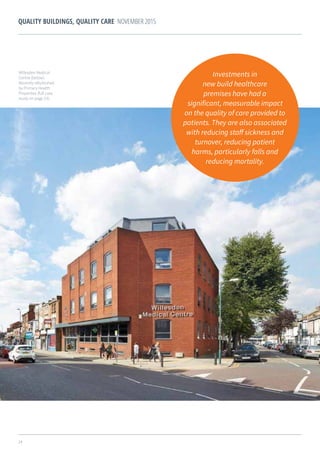
Investments in
new build healthcare
premises have had a
significant, measurable impact
on the quality of care provided to
patients. They are also associated
with reducing staff sickness and
turnover, reducing patient
harms, particularly falls and
reducing mortality.
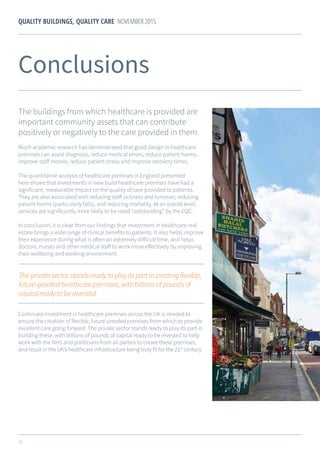
Willesden Medical
Centre (below).
Recently refurbished
by Primary Health
Properties (full case
study on page 23).
25
QUALITY BUILDINGS, QUALITY CARE NOVEMBER 2015
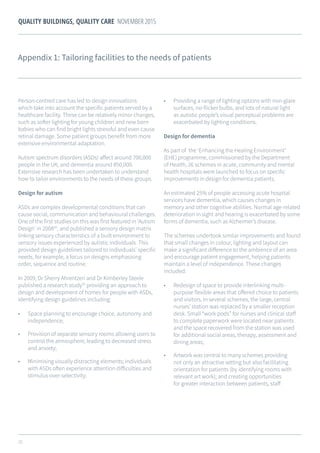
Appendix 1: Tailoring facilities to the needs of patients
Person-centred care has led to design innovations
which take into account the specific patients served by a
healthcare facility. These can be relatively minor changes,
such as softer lighting for young children and new born
babies who can find bright lights stressful and even cause
retinal damage. Some patient groups benefit from more
extensive environmental adaptation.
Autism spectrum disorders (ASDs) affect around 700,000
people in the UK, and dementia around 850,000.
Extensive research has been undertaken to understand
how to tailor environments to the needs of these groups.
Design for autism
ASDs are complex developmental conditions that can
cause social, communication and behavioural challenges.
One of the first studies on this was first featured in ‘Autism
Design’ in 200834
, and published a sensory design matrix
linking sensory characteristics of a built environment to
sensory issues experienced by autistic individuals. This
provided design guidelines tailored to individuals’ specific
needs, for example, a focus on designs emphasising
order, sequence and routine.
In 2009, Dr Sherry Ahrentzen and Dr Kimberley Steele
published a research study35
providing an approach to
design and development of homes for people with ASDs,
identifying design guidelines including:
•	 Space planning to encourage choice, autonomy and
independence;
•	 Provision of separate sensory rooms allowing users to
control the atmosphere, leading to decreased stress
and anxiety;
•	 Minimising visually distracting elements; individuals
with ASDs often experience attention difficulties and
stimulus over-selectivity;
•	 Providing a range of lighting options with non-glare
surfaces, no-flicker bulbs, and lots of natural light
as autistic people’s visual perceptual problems are
exacerbated by lighting conditions.
Design for dementia
As part of the ‘Enhancing the Healing Environment’
(EHE) programme, commissioned by the Department
of Health, 26 schemes in acute, community and mental
health hospitals were launched to focus on specific
improvements in design for dementia patients.
An estimated 25% of people accessing acute hospital
services have dementia, which causes changes in
memory and other cognitive abilities. Normal age-related
deterioration in sight and hearing is exacerbated by some
forms of dementia, such as Alzheimer’s disease.
The schemes undertook similar improvements and found
that small changes in colour, lighting and layout can
make a significant difference to the ambience of an area
and encourage patient engagement, helping patients
maintain a level of independence. These changes
included:
•	 Redesign of space to provide interlinking multi-
purpose flexible areas that offered choice to patients
and visitors. In several schemes, the large, central
nurses’ station was replaced by a smaller reception
desk. Small “work pods” for nurses and clinical staff
to complete paperwork were located near patients
and the space recovered from the station was used
for additional social areas, therapy, assessment and
dining areas;
•	 Artwork was central to many schemes providing
not only an attractive setting but also facilitating
orientation for patients (by identifying rooms with
relevant art work); and creating opportunities
for greater interaction between patients, staff
26
QUALITY BUILDINGS, QUALITY CARE NOVEMBER 2015
and visitors, with historical images providing
opportunities to reminisce;
•	 New garden developments, encouraging patients
to engage more in activities and maintain a
connection to the outside world as well as a level of
independence.
Quantitative evidence of the impact of the EHE
programme on fall reduction and incidents of aggression
and violence was inconclusive, but qualitative data
indicates there are benefits.
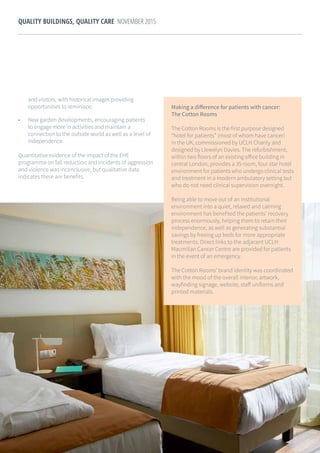
Making a difference for patients with cancer:
The Cotton Rooms
The Cotton Rooms is the first purpose designed
“hotel for patients” (most of whom have cancer)
in the UK, commissioned by UCLH Charity and
designed by Llewelyn Davies. The refurbishment,
within two floors of an existing office building in
central London, provides a 35 room, four star hotel
environment for patients who undergo clinical tests
and treatment in a modern ambulatory setting but
who do not need clinical supervision overnight.
Being able to move out of an institutional
environment into a quiet, relaxed and calming
environment has benefited the patients’ recovery
process enormously, helping them to retain their
independence, as well as generating substantial
savings by freeing up beds for more appropriate
treatments. Direct links to the adjacent UCLH
Macmillan Cancer Centre are provided for patients
in the event of an emergency.
The Cotton Rooms’ brand identity was coordinated
with the mood of the overall interior, artwork,
wayfinding signage, website, staff uniforms and
printed materials.
27
QUALITY BUILDINGS, QUALITY CARE NOVEMBER 2015
Design element Impact Patient experience Patient outcome Examples, evidence
Reduced stress,
fear and agitation
Engagement and
independence
Greater
privacy
and
dignity
Reduced
falls
Improved
infection
control
Reduced
length of
stay
Reduced
medication
Reduced
human
error
Improved Layout and Standardisation
Creation of adequate space around patient bed
enabling more procedures to be carried out
Fewer patient transfers required reducing risk of falls ✔ ✔ ✔ ✔ ‘Patient Safety and Quality’. US Department of Health and Human Services; 2008
Use of same layout in single bed rooms or theatres
Reduces risk of human error
✔
St Joseph’s Community Hospital Wisconsin designed in conjunction with
National Learning Labs programme. Institute of Medicine. ‘To Err is human:
building safer health system’. Washington DC: National Academy Press, 1999
Improves productivity as each room is familiar
Reduces staff fatigue
Creation of single bed rooms with variable acuity
Variable acuity rooms enable a wider range of procedures
to be conducted at the bedside ✔ ✔ ✔ ✔ ✔ ✔ ✔
Centre for Heath Design sponsored Pebble project review of US hospitals
including Methodist Hospital, Indianapolis, Bronson Methodist Hospital,
Michigan and Barbara Ann Karmanos Cancer Institute
Removal of central nurses station, replaced with
distributed areas within patient area (work pods)
for nurses/clinical staff to complete paperwork
Increased visibility between staff and patients resulting in
fewer falls, less nurse calls and improved patient satisfaction ✔ ✔
Royal Wolverhampton Hospitals NHS Trust dementia ward. Ipswich Hospital NHS
Trust 27 bed medical ward. Gadbois C, Bourgeois P, Goeh-Akue-Gad MM, et al.
‘Hospital design and the temporal and spatial organisation of nursing activity’, 1992
Creation of social areas encourages patients to be
active during the day
Encourages independence and engagement of patients
providing choice for patient location, diet, and activities ✔ ✔ ✔
Derbyshire County NHS Care trust – created inter-linked social spaces. Leicester
Partnership NHS trust - created kitchens for patients, staff and visitors
Creation of multisensory environments (MSE), eg.
sensory rooms
Provides calm environment, engaging for dementia and
autistic patients ✔ ✔ ✔ Maseda et al, 2014; Riley-Doucet & Dunn, 2013; Collier et al, 2010
Provision of patient accessible gardens and
greenery visible from ward beds
Keeps patients connected to outer world: improves sense of
wellbeing; relieves boredom;facilitates moves back home ✔ ✔ ✔
Several UK dementia facilities created access to garden areas including
Derbyshire County NHS Care Trust, Mersey Care NHS Trust
Technology Adoption & Material Science Improvements
Include internet access/TVs in room
Patients are shown to require less medication when they
take a positive interest in their health ✔ ✔ ✔ Douglas CH, Douglas MR. Patient-friendly hospital environments, 2004
Noise controlling measures such as triple glazing;
soft flooring, dividing panels
Reduced noise pollution has been found to improve
patients rest and can shorten patient’s stay ✔ ✔ ✔ ✔
Nelson C, West T, Goodman C. ‘The hospital built environment: what role might
funders of health services research play’, 2005
Use of natural colours and materials, eg. use of
wood effect flooring/panels
Improved environment ambience, less “institutionalised feel” ✔ ‘Principles of Hospice design’, Prince’s Foundation/King’s Fund
Adequate provision of ventilation and filtration
systems
Improved environment and infection control ✔
Henriksen K, Isaacson S, Sadler BL et al. ‘The role of the physical environment in
crossing the quality chasm’, 2007
Use of Colour and Light
Creating a better more supportive care
environment
Reduces stress, fear and agitation of patients
✔ ✔
Varni JW, Burwinkle TM, Dickinson P et al. Evaluation of the built environment
at a children’s convalescent hospital; development of the paediatric quality of
life inventory parent and staff satisfaction measures for paediatric health care
facilities. 2004
Increased satisfaction for users of space, including families
and staff
Use of colour coding and appropriate lighting to
improve signage and navigation
Improves orientation and wayfinding, meaning fewer
missed appointments and staff are not required to direct ✔ ✔ ✔
‘Lighting and colour for hospital design’. NHS Estates, 2004. Implemented at
Taunton and Somerset NHS Foundation Trust
Use of colour contrast to improve visibility of
obstacles, corridors, stairs toilets etc.
Reduces falls
✔ ✔ ✔ ‘Lighting and colour for hospital design’. NHS Estates, 2004Reduces wear and tear (trolleys hitting walls)
Improves patients navigation and orientation
Appropriate use of colour to improve clinical
treatment
Blue makes diagnosis more difficult in cardiology
✔ ✔ ✔ ‘Lighting and colour for hospital design’. NHS Estates, 2004Reds and oranges make patients feel itchy in dermatology
Yellow hinders diagnosis of jaundice in maternity
Appendix 2: Key design elements for patient experience and outcome
28
QUALITY BUILDINGS, QUALITY CARE NOVEMBER 2015
Data and bibliography
Data sources
Care Quality Commission (CQC) www.cqc.org.uk
Health and Social Care Information Centre (HSCIC) www.hscic.gov.uk
NHS Safety Thermometer https://www.safetythermometer.nhs.uk/
NHS Staff Survey www.nhsstaffsurveys.com
Open Government Licence http://www.nationalarchives.gov.uk/doc/open-government-licence/version/2/
Bibliography
1	
‘Five Year Forward View’, NHS England, 2014
2	
‘Unlocking Investment in Primary Care Infrastructure’, British Property Federation, 2014
3	
‘Investment in Care Homes’, British Property Federation, 2015
4	
Enhancing the Healing Environment, King’s Fund
5	
Social Trends Health 41 Report Table 1, Office for National Statistics, 2011
6	
‘What you need to know about care home fees’, Saga, 2015
7	
Diabetes UK, 2015
8	
Mental Health Foundation, 2015
9	
Enhancing the Healing Environment, King’s Fund
10	
‘Health Survey for England – 2013’, Health & Social Care Information Centre, 2014
11	
‘Five Year Forward View’, NHS England, 2014
12	
‘Just What the Doctor Ordered’, Building Magazine, 18 December 2014
13	
‘NHS Buildings: Obstacle or Opportunity?’, King’s Fund, 2013
14	
‘Bed Availability and Occupancy Data – Overnight’, NHS England, 2014
15	
‘The changing role of care homes’, Centre for Policy on Ageing and Bupa’, 2011
16	
Hospitals in the sample are those with more than 50% of gross internal area built since 2000. For GP premises, hospices and care homes 	
	 only full new builds are included.
17
	While we cannot say with certainty this is purely down to correlation, as there may be other influences (newer buildings receiving newer 	
	 medical equipment, for example), it is clearly a significant contributing factor.
18
	‘NHS Staff Survey 2014’, National NHS Staff Survey Co-ordination Centre, 2014
19
	Of the 21 Trusts surveyed, 11 Acute/specialist Trusts had greater than 50% gross internal area built since 2005 and a further 10 had greater 	
	 than 50% gross internal area estimated to be built since 2000, based on ERIC returns.
20
	Further detail on the SHMI can be found at http://www.hscic.gov.uk/SHMI
21	
Of the 19 Trusts included, 11 Acute Trusts had greater than 50% gross internal area built since 2005 and a further 10 had greater than 	50% 	
	 gross internal area estimated to be built since 2000, based on ERIC returns
22
	Over 300 acute care organisations were included in the survey data. 230 of these report ERIC data.
23
	‘Improving NHS Care by Engaging Staff and Devolving Decision-Making’, King’s Fund’, 2014
24	
In calculating this, we have used the median staff sickness rate as the most reliable method of calculation, as there are significant outliers 	
	 in the “old” data set with standard deviation being half as big again as the “new” data set. There is also a very large skew on the “new” 	
	 properties, meaning the average is larger than the median for these buildings but a less reliable finding. Ideally we would 	compare 		
	 sickness rates per site before build and after, but given that data is unavailable we have compared existing rates in older and newer 		
	buildings.
25	
Median was used here to exclude Trusts in older buildings with exceptionally high leaving rates
26	
‘A place to heal: Environmental sources of satisfaction among hospital patients’, Harris, PB., McBride, Ross and Curtis, Journal of 		
	 Applied Psychology, Vol. 32, Issue 6, 2002
27	
‘The Role of the Physical Environment in the Hospital of the 21st Century: A Once-in-a-lifetime Opportunity’, Ulrich, R., Zimring, C. et al, 	
	2004
28	
‘Acoustics and psychosocial environment in coronary intensive care’, Blomkvist, V. et al, Occupational and Environmental Medicine, 2004
29	
‘Architectural Environment and its Effect on Patient Health Outcomes’, Lawson, B. and Phiri M., University of Sheffield, 2002
30	
Virginia Mason Production System
31	
Primary Care Development: Design Guide, Welsh Health Estates
32	
‘NHS and sustainability, Briefing for the House of Commons Environmental Audit Committee’, National Audit Office, 2015
33	
‘Sustainable Development Strategy for the Health, Public Health and Social Care System 2014-2020’, Sustainable Development Unit, 2014
34	
‘An Architecture for Autism: concepts of design intervention for the autistic user’, Magda Mostafa, International Journal of Architectural 	
	 Research, Vol. 2, Issue 1, 2008
35	
‘Advancing Full Spectrum Housing: Design for Adults with Autism Spectrum Disorder’, Ahrentzen and Steele, Arizona State University, 2009
29
QUALITY BUILDINGS, QUALITY CARE NOVEMBER 2015
This report was produced by the British Property Federation and researched by Bolt Partners.
About the British Property Federation
The British Property Federation (BPF) represents companies owning, managing and investing in
real estate. This includes a broad range of businesses comprising commercial real estate owners,
the financial institutions and pension funds, corporate landlords, residential landlords, as well as
all those professions that support the industry.
The BPF represents the principal organisations engaged in the development of, or investment in,
healthcare property and real estate, including primary care premises, specialist facilities, acute
care, and care homes.
About Bolt Partners
Bolt Partners is a healthcare advisory firm with over 10 years’ experience of working across all
health sectors in the UK. Focused on delivering better use of resources and quality of care to
patients, Bolt has advised many of the largest healthcare organisations including both the public
and private providers.
Cover image: Aspen
Centre, Gloucester.
Developed by Assura.
OUR KNOWLEDGE AND ADVICE
ON NATIONAL POLICY IS
HELPING THE UK REAL ESTATE
SECTOR GROW AND THRIVE
British Property Federation
St Albans House
5th Floor, 57-59 Haymarket
London
SW1Y 4QX
T 020 7828 0111
info@bpf.org.uk
www.bpf.org.uk
Just one of the benefits of becoming a BPF member.
www.bpf.org.uk/membership

BPF-Quality-Buildings-Quality-Care-Nov-15-web_0

  • 1.
    QUALITY BUILDINGS, QUALITY CARE Howbuildings contribute to improved patient care and staff wellbeing Healthcare In association with
  • 2.
    2 QUALITY BUILDINGS, QUALITYCARE NOVEMBER 2015 Contents Foreword 3 Executive summary 4 Introduction 5 The history of investment in healthcare real estate 6 The impact of investment in healthcare real estate 7 Measuring quality of care 7 Impact of age of building on CQC rating 9 Impact of age of building on staff and patients 12 Clinical benefits 12 Patient safety 14 Workforce benefits 16 Conclusion 16 Better care by design 17 Better patient experience 19 Better patient outcomes 20 Better staff experience 21 Sustainable impact 22 Sustainable development 22 Conclusions 23 Appendix 1: Tailoring facilities to the needs of patients 25 Design for autism 25 Design for dementia 25 Appendix 2: Key design elements for patient experience and outcome 27 Data and bibliography 28
  • 3.
    3 QUALITY BUILDINGS, QUALITYCARE NOVEMBER 2015 Foreword The last century has seen great leaps in our understanding of the human body and mind. As we approach the 70th anniversary of the creation of the NHS, we face new challenges: ensuring that we all receive the care we need as medical knowledge advances; facing demographic changes as the elderly make up an increasing proportion of our population, leading to higher demand for the services they need; and the economy returning to growth with a legacy of deficit reduction. Greater longevity is clearly to be welcomed, but is the healthcare estate ready for these changes? NHS England1 agrees that investment in healthcare infrastructure will be a vital part of the solution, and the real estate sector stands ready to play its part in providing much-needed new premises – from GP surgeries to hospitals to care homes. Recently, we showed that investment in primary care could deliver patient benefits and significant savings to the NHS2 , and that investment in care homes could help to meet the complex care needs of the elderly3 . The same is true of the wider healthcare estate; fitting treatment rooms for new and novel treatments in existing buildings that were not designed for that purpose presents real difficulties. Simply put, investment in healthcare real estate can help to improve the care that patients receive – and deserve. In a time of constrained public finances, investing in healthcare real estate also represents value for money. Upfront investment in primary care would lead to significant savings further down the line through reduced reliance on A&E services and walk-in centres. And it is not just patients that will reap the benefits: health workers deserve workplaces that allow them to care for patients as effectively as possible, and working in an environment which aids their own wellbeing helps achieve this. This report adds to increasing evidence proving the benefits of modern, purpose-built premises, and we look forward to working with all political parties, local authorities and NHS bodies to fully realise these benefits. Melanie Leech Chief Executive British Property Federation Simply put, investment in healthcare real estate can help improve patient care.
  • 4.
    4 Executive summary This reportshows that: • In those reviewed to date, services provided from new healthcare premises have been three to four times more likely to be rated “Outstanding” by the Care Quality Commission than services provided from older premises; • There is lower turnover of staff in newly built hospitals, and staff take fewer sick days. The difference in staff sickness absence is equivalent to 900,000 working days per year if the median sickness absence rate in newer buildings were replicated across all NHS Acute Trusts; • Modern facilities are safer for patients, with 30% lower fall rates and 10% lower overall patient harm in new hospitals, and similar reductions in new care homes. To ensure this continues it is critical that: • Continuous investment in flexible, future-proofed buildings should be encouraged, allowing design innovation to spread across the estate; • Local plans should consider all healthcare facilities – from hospitals to care homes to health centres – assessing fitness for purpose and future needs; • Local plans should ensure new healthcare buildings are conveniently located to town centres, transport hubs, and existing medial infrastructure (with care homes prioritised close to hospitals, for example) to facilitate integrated care; • Evidence based design should continue to be supported, promoting the spread of best practice and achieving maximum benefit from advances in design and technology; • Building on the work of programmes such as ‘Enhancing the Healing Environment’4 , commissioned by the Department of Health and led by the King’s Fund, further systematic studies are needed to quantify the wider impact of healthcare environments on quality of care and further define best practice; • The NHS should recognise, monitor and systematically report on the wider benefits of healthcare infrastructure investment. So far, we have only seen the above benefits within a proportion of the healthcare estate. Rolling out proven technologies such as anti-microbial surfaces, better lighting and layouts that reduce staff travel time to the rest of the national healthcare portfolio would benefit both patients and healthcare professionals. At present, investment has been undertaken at irregular intervals which means that the portfolio is of varying quality. Renewing and revitalising the estate will be better for patients, better for the NHS and better for its workers. Balhousie Huntly Care Home, Aberdeenshire (below). Funded by Target Healthcare REIT.
  • 5.
    5 QUALITY BUILDINGS, QUALITYCARE NOVEMBER 2015 The success of modern healthcare has paradoxically led to an increase in need for services. Whilst life expectancies have soared, the average person in the UK now spends more than 15 years in poor health5 . Increasing longevity and pioneering treatments mean that on average, each of us alive today will spent around two and a half years of our lives in a care home6 . Across the population, there is a pressing need to support increasing numbers of frail elderly patients, especially those with both mental and physical conditions, and to encourage self-management of long term conditions. This pressure on elderly services must be addressed. Diabetes cases have risen 60% in the past decade and currently affect 3.3 million people7 ; every year, 25% of people in the UK will experience some kind of mental health difficulty8 and an estimated 25% of people accessing acute hospital care also have dementia9 . 50% of women and 43% of men now regularly take prescription drugs10 . In the ‘Five Year Forward View’11 , the plan for the near future of our health service, NHS England Chief Executive Simon Stevens recognises the challenges of treating longer-term conditions and calls for new models of care to provide more integrated services to patients. As the healthcare sector in the UK seeks to serve these patients, a key question remains: is the healthcare estate in the UK fit for purpose? Many reports conclude that it is not. In December 2014, Building Magazine reported12 20% of 1,545 practices applying for Care Quality Commission (CQC) registration failed on one aspect of their premises’ quality and a third were not “safe and accessible”. In a 2013 report, ‘NHS buildings: obstacle or opportunity?’13 , the King’s Fund concluded that a number of the current buildings are out-of-date and impede the quality of care. Better estate management processes and targeted strategic investment to create flexible future-proofed buildings were recommended to address this. Introduction Sudbury Community Health Centre Sudbury Community Health Centre is a state of the art health facility which provides a range of integrated community based services. The town of Sudbury, Suffolk, was previously served by several outdated healthcare buildings which did not meet modern standards. The new building, commissioned by West Suffolk Clinical Commissioning Group and developed by Assura, was designed to bring these services together under one roof to provide a single location for healthcare services and enable integrated working between healthcare professionals. The new centre houses a wide range of services including a GP surgery and a diagnostic suite including X-Ray and phlebotomy, alongside outpatient and therapy services including paediatrics, dermatology, audiology, gynaecology, rheumatology and physiotherapy. A pharmacy will also shortly open in the building to provide a convenient ‘one-stop shop’ for patients. The building has been constructed using a flexible steel frame construction to allow for future adaptability and features a combined heat and power plant and photovoltaic cells to reduce running costs. The interior design has been carefully selected in order to provide a welcoming and therapeutic environment.
  • 6.
    6 QUALITY BUILDINGS, QUALITYCARE NOVEMBER 2015 The history of investment in healthcare real estate Throughout the years the estate has benefitted somewhat unevenly from waves of investments into different sectors. At the foundation of the NHS in 1948, the service inherited more than 2,000 hospitals from local government and voluntary organisations. One of the early innovations in acute care was the District General Hospital model developed in the 1960s. With the increasing importance of outpatient departments and day cases, the number of overnight hospital beds has been dramatically reduced. In 1988, there were nearly 300,000 overnight beds available in England, and by 2014 this had reduced to less than half that (136,000)14 . Around 20% of NHS buildings have been built since 2005 – but 15% were built prior to 1948. Primary care providers have become increasingly consolidated. In 1948, GPs were employed by the NHS on individual contracts and many practised in their own homes. Successive investment programmes have encouraged GPs to form larger practices: in 1966, the NHS began to pay GPs’ rent and business rates, and in the 1970s, local authorities began to build health centres, co-locating GPs with other health services such as dentists and health visitors. Government established the Primary Care Infrastructure Fund in 2014 to accelerate improvements in GP premises and infrastructure. Demand for services to care for the elderly has increased due to changing demographics. Care homes were originally provided by local authorities, and saw a wave of private investment in the 1980s and 1990s. In 1980, local authorities provided 63% of places; but by 2002 this had fallen to 17%15 . End of life care has also changed: the modern hospice movement started with the foundation of St Christopher’s Hospice by Dame Cicely Saunders in 1967, and today there are over 200 such services. Over two thirds of these are funded by charities. Age of the NHS estate Today, around 20% of NHS buildings have been built since 2005, but 15% were built prior to 1948. Over the past 15 years, 10% of the total of all premises have been new builds. These new premises are devoted to the latest techniques and technologies, providing a significant benefit to the health and wellbeing of patients, thereby improving outcomes and experience directly and indirectly through staff morale and other factors on which this report will expand. The continued investment in healthcare premises to create flexible sustainable premises will enable the current and developing models of care and deliver immediate benefits to both patients and staff. Source: Department of Health
  • 7.
    7 QUALITY BUILDINGS, QUALITYCARE NOVEMBER 2015 The impact of investment in healthcare real estate While the impact of specific aspects of design on care provision has been extensively investigated by academic reports, their accumulated effect has been analysed in less depth. There is a large amount of data available on the quality of care provided to patients, covering both NHS and non- NHS facilities, for example the NHS Safety Thermometer and the CQC ratings. The NHS also regularly publishes information on staff experience, for example the NHS Staff Survey. Quality of care can therefore be approached and analysed from many different perspectives. To understand the impact of investment on quality of care, this data must be matched against data on the age, quality and investment in premises. The NHS publishes comprehensive data sets through Estates Return Information Collection (ERIC) and the Patient-Led Assessments of the Care Environment (PLACE) programme. Data for non-NHS facilities is not standardised and so a sample of facilities has been analysed for this report. Data has been collected for over 2,500 healthcare premises across England. The 10% of buildings constructed since 2000 have been grouped together to compare to older sites.Comparing services provided in new buildings to older buildings, there is a noticeable impact on the overall quality of care, clinical outcomes and staff engagement. Measuring quality of care While many metrics exist to measure aspects of care, the CQC in England and the devolved inspectorates are tasked with setting the required standards. In the CQC’s own words, “we set out what good and outstanding care looks like and we make sure services meet fundamental standards below which care must never fall.” CQC ratings therefore provide a consistent and comparable starting point to investigate the impact of the healthcare estate on quality of care. Types of premises reviewed by the new CQC regime to June 2015
  • 8.
    8 • Hospices: Endof life and palliative care facilities mainly provided by voluntary organisations. • Care homes: Nursing and residential care generally focused on elderly care and mainly provided by private companies. 253 (10%) of these premises have been newly built. Investment rates have varied between the different sectors, with more than twice as many GP surgeries than care homes built since the year 2000 (17% compared to 7%), reflecting different historic cycles of investment. Total premises reviewed by the new CQC regime to June 2015, new vs. old. Just 10% of premises were built since 2000. Willesden Medical Centre (right). Recently refurbished by Primary Health Properties (full case study on page 22). Healthcare service providers in England are required to register with the CQC, which periodically inspects services and assigns a rating to the care provided. From October 2014, the CQC introduced a new ratings system that classifies services provided as “outstanding”, “good”, “requires improvement” and “inadequate”. In June 2015, the number of services inspected under this new regime with published ratings on the CQC website stood at 4,939 services. Excluding services that are not premises-specific (e.g. homecare agencies), over 2,571 healthcare premises had been inspected across England. The services provided from these premises are varied, but fall into four broad categories: • GPs: Primary care and community facilities (health centres). These are mainly GP surgeries providing NHS services. • Hospitals: Acute services, mainly general hospitals with some specialist facilities (eg. mental health, children’s hospitals, and orthopaedics). These are mainly provided by NHS Trusts. New (built since 2000)Old (built before 2000)% premises built since 2000 by type (in sample)
  • 9.
    9 QUALITY BUILDINGS, QUALITYCARE NOVEMBER 2015 Impact of age of building on CQC rating Since October 2014, only 1.5% of premises have been rated “outstanding” with a majority (65%) rated “good”. The proportion of services rated “outstanding” varies significantly by the type of service provided, with GP services and hospices typically receiving better ratings than care homes and hospitals. CQC ratings, total premises inspected * CQC assessment by type of healthcare premises * Good Requires improvement InadequateOutstanding *October 2014 – June 2015 Winchcombe Place, Newbury (below). Operated by Care UK (full case study on page 13).
  • 10.
    10 QUALITY BUILDINGS, QUALITYCARE NOVEMBER 2015 Ratings of premises inspected since October 2014 New buildings: % total vs % services rated “outstanding” The different proportions of services rated “good” or “outstanding” by the CQC generally increases with those sectors that have seen the largest investments in buildings16 over the past 15 years. Looking at the top 1.5% of services rated “outstanding”, for all sectors, the proportion of services provided from newly built premises is significantly higher than expected. For example, only 17% of GP surgeries are newly built, but 29% of GP surgeries rated “outstanding” are newly built17 .
  • 11.
    11 QUALITY BUILDINGS, QUALITYCARE NOVEMBER 2015 This finding is supported by the results of the NHS Staff survey across Acute Trusts, which manage hospitals in an area. Based on the latest survey from 201418 , Trusts with newly built premises19 had a higher percentage of staff satisfied with the quality of work and patient care they are able to deliver. Across the NHS, responses to this question are very consistent, and the 1.1% difference between new and old buildings (79.4% compared to 78.3%) is significant. Staff satisfaction with quality of work and patient care is itself correlated with CQC inspection rating. The difference between “requires improvement” and “good” is 0.43% – less than half the difference between staff responses in new and older buildings. % staff feeling satisfied with the quality of work and patient care they are able to deliver % staff feeling satisfied with the quality of work and patient care they are able to deliver by Trust Upper quartile Lower quartile Median Highest Lowest
  • 12.
    12 QUALITY BUILDINGS, QUALITYCARE NOVEMBER 2015 Impact of age of building on staff and patients There are a wide variety of metrics published on the quality of healthcare provision, covering patient experience, staff engagement, clinical outcomes and other metrics that contribute to the quality of service provided. There are relatively few datasets available for non-NHS services such as care homes, whereas NHS Trust statistics are regularly collated and published by the Health & Social Care Information Centre (HSCIC). applicable to other healthcare sectors (as seen with the patient safety data available within the NHS Safety Thermometer data available for care homes). Clinical benefits The HSCIC publishes the Summary Hospital-Level Mortality Indicator (SHMI)20 , which is the ratio between the actual number of deaths following hospitalisation at the Trust (“observed deaths”) and the number of expected deaths on the basis of average figures for England, given the characteristics of the patients treated there (“expected deaths”). The average NHS Trust therefore has a SHMI of 1.00. The chart below shows the comparison of SHMI for trusts in newly built premises compared to trusts in older premises21 . The dashed lines marked show the statistically expected variability. Trusts above the upper dashed line exhibit significantly higher than average mortality (more deaths than expected); while Trusts below the bottom grey line exhibit significantly lower than average mortality (lower deaths than average). This analysis into the impact of age of building on staff and patients focuses on hospital care due to the availability of data, despite the complexity of hospital premises. The findings below are likely to be more widely SHMI in new vs older premises, year to September 2014 Trusts with newly built facilities are more likely to have low mortality, and are also less likely to have high mortality. New buildsOld Expected variability
  • 13.
    13 Trusts with newlybuilt facilities are more likely to have low mortality, with three out of the 19 (16%) Trusts incurring “significantly below average” deaths, compared to 13 out of 118 Trusts (11%) with older buildings. They are also less likely to have high mortality: zero out of the 19 Trusts with newly built facilities included incurring “significantly above average” deaths, compared to nine out of 118 (8%) of Trusts with older buildings. Whilst caution should be applied to this analysis due to the mix of older and newer buildings at Trusts, there were 121 fewer observed deaths than expected across the 19 Trusts with new buildings (an SHMI of 0.99). Applied across all NHS acute trusts, this 1% reduction in mortality rate would see a reduction in deaths of 2,900 deaths per annum. The connection between reduced mortality rates and investment in healthcare facilities requires further investigation, but the data suggests there are potentially significant clinical gains. Winchcombe Place, Newbury “The building, grounds and furnishings have been completed to a high standard. Accommodation is divided over three floors and arranged to create a comfortable and welcoming environment. Shared areas include library, salon, cinema, coffee shop, arts and crafts room, large lounges and smaller themed lounges.” – Extract from CQC Inspection report, 10 June 2015 Overall Rating: Good Opened in April 2014 and operated by Care UK, each floor at Winchcombe Place has its own dining room and lounge, creating a close-knit atmosphere. This layout particularly suits residents living with dementia who prefer peace and quiet and familiar faces, and is also popular with other residents for its intimate community feel. The home has been designed with flexible, open plan areas, allowing lots of natural light to create a welcoming, non-enclosed ambience. Each room also has direct access to a patio, allowing residents to access the outside and memory boxes outside each room enable personalised room identification. The vintage style café, dining room and lounges are spacious and inviting, encouraging residents to socialise and family and friends to visit. The design not only creates a happy environment for residents. “Everyone always comments on how beautiful the home is,” says Roseanne Ince, Clinical Lead at Winchcombe. This has a knock-on effect on staff who take pride in their working environment. Applied across all NHS acute trusts, this 1% reduction in mortality rate would see a reduction in deaths of 2,900 deaths per annum.
  • 14.
    14 Patient safety The NHSSafety Thermometer is a monthly survey that assesses the percentage of patients receiving “harm-free care” and those incurring various types of harm, such as falls, during care. It collates data from over 1,000 organisations including care homes, private hospitals, Acute Trusts and Community Trusts. Across 230 NHS Acute Trusts22 which report on this, between July 2014 and July 2015 94.6% of patients received harm-free care in the Trusts with newly built facilities, compared to 94.0% who received harm-free care in the Trusts with older buildings. This is a reduction in patient harms of 10% from 6.0% to 5.4%. OldNew Old averageNew average Hospital patients receiving harm-free care * Hospital patient falls * *230 Acute Trusts sampled between July 2014 – July 2015 Risk of falls is widely understood to be related to environmental factors. Again, Trusts with newly built premises have lower fall rates than Trusts in older buildings – 0.56% compared to 0.78%, a 30% reduction in falls. If the 209 Trusts in older buildings achieved the same fall rate as the newer built hospitals, there would have been over 3,800 fewer falls in this year. If the 209 Trusts in older buildings achieved the same fall rate as the newer built hospitals, there would have been over 3,800 fewer falls in this year.
  • 15.
    15 OldNew Old averageNewaverage Care home resident falls * A similar picture is seen comparing new and older care homes, for which we looked at the NHS Safety Thermometer data on the 33 homes for which building age has been collected (including those built since 2000). The average percentage of residents receiving harm-free care in the four new builds is 97.3%, compared to 95.2% in older premises. This is a reduction in residents acquiring harms from 4.8% to 2.7% – proportionately a 40% reduction. 23 of these homes reported data on falls, and the four newer premises had an average of 1.2% falls rate compared to 1.9% in older premises. Care home residents receiving harm-free care * Duke’s Court Care Home, Wellinborough (below). Funded by Welltower. In newly built care homes there is a reduction in residents acquiring harms from 4.8% to 2.7% – proportionately this is a 30% reduction. * 33 care homes sampled between July 2014 – July 2015
  • 16.
    16 QUALITY BUILDINGS, QUALITYCARE NOVEMBER 2015 Workforce benefits Staff engagement is acknowledged as a key determinant in quality of care. A report for the King’s Fund23 notes that higher levels of staff engagement are associated with reductions in staff sickness absence rates, lower mortality rates, fewer accidents and greater levels of innovation. Where available, the data suggests that these benefits are also associated with newly built hospitals. Sickness absence rates are 0.24% lower (4.12% compared to 4.36%) – equivalent to over 900,000 working days or 4,000 full time equivalent staff if replicated across NHS acute organisations24 . This represents the potential for huge savings to the NHS. Churn of staff is also typically lower at the Trusts with newly built premises. In the year to April 2015, the median Trust in newly built premises had a staff leaving rate of 7.0% compared to 8.8%25 for Trusts in older premises. Recruitment and use of temporary staff is a major cost for healthcare and stability of staffing is especially important in long term care for elderly patients. Focusing on improving the physical healthcare working environment may help reduce this challenge for healthcare providers. Conclusion Modern, 21st century premises are associated with higher quality patient care. The improvements in care are seen across all healthcare sectors and in multiple aspects of the care provided. New buildings see safer care provided to patients with lower overall patient harms and reductions in falls, and there are many specific design improvements that have a positive impact on patient outcomes and patient and staff experience. The cumulative effect of these improvements is better quality care for patients that can be seen across the healthcare estate, which will in turn lead to reduced pressure on the NHS. Staff sickness absence rate * Staff leaving rate * * year to March 2015 New buildings see safer care provided to patients, with lower overall patient harms and reductions in falls.
  • 17.
    17 QUALITY BUILDINGS, QUALITYCARE NOVEMBER 2015 Better care by design Healthcare design has evolved significantly over the years. As far back as Florence Nightingale’s open ward, there was recognition of the beneficial impact of design on patients and staff. The purpose of design in healthcare has transitioned from that of functional efficiency and effectiveness in the 1950s and 1960s to the idea of “people-centred design” and engaging users in design to improve facilities today. Academic research has clearly established a link between the physical environment and patient outcomes (for example fewer hospital-acquired infections and medical errors). While the complex nature of building developments and ongoing changes in operational use can limit the ability to provide pure quantitative evidence of the positive impact of design, the volume of evidence (particularly since 2000) has been increasing. Spreading design best practice throughout the healthcare estate can be a complex process. Guidance such as the Department of Health’s Health Technical Memoranda and Health Building Notes provide advice on best practices and the latest standards. Existing buildings have been retrofitted for some innovations, for example the use of colour to zone buildings. However, other changes can be costly to incorporate into older buildings. For new buildings, best practice is followed and modern design incorporated into the environment as standard. There is also a focus on flexibility and future-proofing of facilities to allow new innovations to be incorporated at a later date. Willesden Medical Centre (below). Recently refurbished by Primary Health Properties (full case study on page 22).
  • 18.
    18 QUALITY BUILDINGS, QUALITYCARE NOVEMBER 2015 Evolution of healthcare premises design
  • 19.
    19 QUALITY BUILDINGS, QUALITYCARE NOVEMBER 2015 Better patient experience Hospitals and other healthcare facilities can be a daunting environment for patients, particularly young or elderly people. The advances in “person-centred” care have highlighted that patient experience is an important factor in healthcare provision. The hospital environment can be a key component of providing good patient experience and making time spent in healthcare premises more comfortable. Environmental satisfaction is second only to the quality of nursing and clinical care in predicting overall satisfaction26 . Modern healthcare design aims to create welcoming, supportive care environments that enable the patient to feel calm, engaged, independent and sociable. Single bed rooms in particular improve patients’ overall satisfaction27 , as they not only improve confidentiality and privacy, but they are also quieter, family and visitors are found to stay longer and there are lower rates of hospital acquired infection (as single rooms are easier to decontaminate than multi-bed wards). Academic research has also identified a variety of other of features that can enhance patient experience of healthcare facilities: Fixed night lights, motion sensitive lights and sensors all reduce risk of patient falls. Noise absorbing ceiling tiles. Higher than normal ceilings to allow changes in future. Cameras for observation included. Example model hospital room Glass panel enabling clear visibility of patient. Standardised room means beds are not back to back, reducing noise. Treatment area on left-hand side. Beds drop to 16” above floor. Triple glazed windows reduce noise; large natural light source. Ensuite facilities accessible for patient without obstructions. Visitor area by window, pull out couch for families. Internet connection enabling access to medical records by patient. Computer for staff: medical records held electronically. Rubber flooring for sound reduction qualities. Sink: emphasising hand washing as essential factor against infection. Space around bed to enable procedures to be performed reducing need for patient transfer. Standardised storage area reducing time to get medical equipment.
  • 20.
    20 QUALITY BUILDINGS, QUALITYCARE NOVEMBER 2015 • Social areas can promote independence; • Views of nature can lessen pain and stress for a variety of conditions; • Access to gardens can improve access to social support and improve patient and family satisfaction with care; • Brightly lit rooms, especially east-facing with natural early morning light can reduce length of stay, lessen reliance on pain medication and improve outcomes, especially in patients with depression, seasonal affective disorders or dementia; • Patients in well decorated, well appointed rooms give higher ratings to their doctors, food and overall standard of care than patients in standard rooms. Advances in materials technology can also improve patient experience, with noise reduction long ago identified as a key concern for patient welfare. As well as sleep loss and awakening, noise is associated with increased heart rate and blood pressure, and using suitable noise reducing materials can positively impact patient care. A 2004 study28 showed cardiology patients experienced less stress and reported that nurses gave them better care in a ward with sound-absorbing ceiling tiles compared to sound-reflecting ceiling tiles. There were also indications of lower re-hospitalisation rates. Better patient outcomes Alongside better patient experience, there is a considerable body of evidence showing that a good environment can positively impact patient outcomes. One such study29 found that patients were released 1.5 days earlier in refurbished environments compared to unchanged ones and that time spent in an intensive supervisory care area in a mental health unit was reduced by 70%. As well as improving recovery, hospital environments can also reduce hospital-acquired infections and other harms. For example, a well designed ventilation system can reduce infection. HEPA filters and laminar airflow rooms can be used to create ultraclean rooms particularly for immuno-compromised patient suites and operating theatres. A combination of single rooms and air filtration has reduced infection and mortality in burn patients and bone marrow transplant patients. Better use of lighting and colour provides better visibility of obstacles leading to fewer patient falls. Detail on how design innovations that take into account the specific patients served by a healthcare facility can be found in Appendix 1: Tailoring Facilities to the Needs of Patients. A more comprehensive list of key design features to improve patient experience is given in Appendix 2: Key design elements for patient experience and outcome. One study found that patients were released 1.5 days earlier in refurbished environments compared to unchanged ones. The Cotton Rooms, designed by Llewelyn Davies (full case study on page 26).
  • 21.
    21 QUALITY BUILDINGS, QUALITYCARE NOVEMBER 2015 Better staff experience Good colour and lighting can make nurses and clinicians work more efficiently, optimised layouts can reduce staff fatigue, and standardisation can help minimise the risk of human error. Surveys show that staff link the environment with: • Recruitment and retention; • Improved morale; • Accessibility and orientation; • Privacy and security. Well designed facilities can also increase productivity and time for patient care. For example, the Virginia Mason Production System increased nurse patient contact time to 90% through reorganisation of working groups including decentralising store cupboards. Steps walked per day fell from 10,000 to roughly 1,20030 . Design changes that positively impact patients have a corresponding effect on staff. If the patient feels more secure (through, for example, better visibility of staff), this will reduce nurse call outs or possibly incidents of aggression; design that improves visibility of obstacles will also reduce the number of falls. Silvermere Care Home, Cobham Providing residential, respite, convalescence and dementia care, the original brief for Silvermere was to design a facility with resident’s dignity in mind that creates a welcoming and uplifting environment with a homely feel for residents, staff, visitors and the wider community. A large atrium gives a grand first impression and hotel-like experience; high ceilings, high, large windows create a light and airy environment. Activities to engage patients are designed into the building with a café, conservatory, and hobby and activity rooms to encourage social interaction. Balconies on all floors provide access to outdoors and the outside spaces have points of interest and raised flower beds to promote interaction and provide talking points. Residents’ rooms are designed to recreate the experience of home with couples rooms and space for a double bed in single rooms. The interior decoration scheme uses warm colours and domestic materials such as wood and wallpaper to create a homely feel. Assisted bathrooms use hotel- like materials such as chrome handrails to provide a more luxurious and less clinical environment. Practical design elements enable care, for example: extra wide doors for ease of movement; bright lighting with controllable lighting levels (effective for residents who may have deteriorating eyesight); and contrast between walls and floors, uniform design, and handrails aim to reduce falls. Silvermere was commissioned by Avery Healthcare and designed by DWA Architects.
  • 22.
    22 QUALITY BUILDINGS, QUALITYCARE NOVEMBER 2015 Willesden Medical Centre renovation A major refurbishment at Willesden Medical Centre by Primary Health Properties has created a modern-feeling building with a bright and welcoming atmosphere. Improved signage makes the building more recognisable from the street and improved disabled access has had a significant impact for wheelchair users in particular. After the renovation, staff felt greater pride in the facility and services were perceived as being improved. Patients were also pleased with the changes and felt services had improved as a result. The new design opens up the practice to enable delivery of a more diverse range of services within the building with the opportunity for closer working with colleagues in other medical disciplines. Extra rooms are available for physiotherapy, dietetics, and counselling, and new services such as ophthalmology may be enabled. A survey found that staff agreed the new medical centre is adaptable and capable of meeting the plans of the practice to provide additional services in the future. Sustainable impact A healthcare facility is an important component of a community; it can be a hub that serves to integrate the community. The Design Commission for Wales reviews developments against three qualities31 : the ability to meet users’ needs; the structural soundness and longevity of the building; and delight: “the cultural value and pleasure that a development gives to the sense of those who use the building and to the community in which it is sited.” New developments can be a catalyst for local regeneration, setting a benchmark in design that creates buildings of which the community can be proud. Sustainable development The NHS estate has a significant environmental impact, with an estimated carbon footprint of 25MtCo2e in 2012 – 3% of the total UK carbon footprint. In that year, it used 11,732 GWh of energy, 34.4 billion litres of water and generated 374,000 tonnes of waste32 . With low sustainability reporting by providers and commissioners, clearly more can be done to meet environmental targets. The Sustainable Development Strategy for the Health, Public Health and Social Care System 2014-202033 set a target of 34% reduction in greenhouse gas emissions by 2020 across the sector. This would require a 4% annual reduction between 2013 and 2020. Modern buildings can play a significant part in achieving this, as they are generally more energy efficient.
  • 23.
    23 QUALITY BUILDINGS, QUALITYCARE NOVEMBER 2015 Continued investment in healthcare premises across the UK is needed to ensure the creation of flexible, future-proofed premises from which to provide excellent care going forward. The private sector stands ready to play its part in building these, with billions of pounds of capital ready to be invested to help work with the NHS and politicians from all parties to create these premises, and result in the UK’s healthcare infrastructure being truly fit for the 21st century. Theprivatesectorstandsreadytoplayitspartincreatingflexible, future-proofedhealthcarepremises,withbillionsofpoundsof capitalreadytobeinvested. Conclusions The buildings from which healthcare is provided are important community assets that can contribute positively or negatively to the care provided in them. Much academic research has demonstrated that good design in healthcare premises can assist diagnosis, reduce medical errors, reduce patient harms, improve staff morale, reduce patient stress and improve recovery times. The quantitative analysis of healthcare premises in England presented here shows that investments in new build healthcare premises have had a significant, measurable impact on the quality of care provided to patients. They are also associated with reducing staff sickness and turnover, reducing patient harms (particularly falls), and reducing mortality. At an overall level, services are significantly more likely to be rated “outstanding” by the CQC. In conclusion, it is clear from our findings that investment in healthcare real estate brings a wide range of clinical benefits to patients. It also helps improve their experience during what is often an extremely difficult time, and helps doctors, nurses and other medical staff to work more effectively by improving their wellbeing and working environment.
  • 24.
    24 QUALITY BUILDINGS, QUALITYCARE NOVEMBER 2015 Investments in new build healthcare premises have had a significant, measurable impact on the quality of care provided to patients. They are also associated with reducing staff sickness and turnover, reducing patient harms, particularly falls and reducing mortality. Willesden Medical Centre (below). Recently refurbished by Primary Health Properties (full case study on page 23).
  • 25.
    25 QUALITY BUILDINGS, QUALITYCARE NOVEMBER 2015 Appendix 1: Tailoring facilities to the needs of patients Person-centred care has led to design innovations which take into account the specific patients served by a healthcare facility. These can be relatively minor changes, such as softer lighting for young children and new born babies who can find bright lights stressful and even cause retinal damage. Some patient groups benefit from more extensive environmental adaptation. Autism spectrum disorders (ASDs) affect around 700,000 people in the UK, and dementia around 850,000. Extensive research has been undertaken to understand how to tailor environments to the needs of these groups. Design for autism ASDs are complex developmental conditions that can cause social, communication and behavioural challenges. One of the first studies on this was first featured in ‘Autism Design’ in 200834 , and published a sensory design matrix linking sensory characteristics of a built environment to sensory issues experienced by autistic individuals. This provided design guidelines tailored to individuals’ specific needs, for example, a focus on designs emphasising order, sequence and routine. In 2009, Dr Sherry Ahrentzen and Dr Kimberley Steele published a research study35 providing an approach to design and development of homes for people with ASDs, identifying design guidelines including: • Space planning to encourage choice, autonomy and independence; • Provision of separate sensory rooms allowing users to control the atmosphere, leading to decreased stress and anxiety; • Minimising visually distracting elements; individuals with ASDs often experience attention difficulties and stimulus over-selectivity; • Providing a range of lighting options with non-glare surfaces, no-flicker bulbs, and lots of natural light as autistic people’s visual perceptual problems are exacerbated by lighting conditions. Design for dementia As part of the ‘Enhancing the Healing Environment’ (EHE) programme, commissioned by the Department of Health, 26 schemes in acute, community and mental health hospitals were launched to focus on specific improvements in design for dementia patients. An estimated 25% of people accessing acute hospital services have dementia, which causes changes in memory and other cognitive abilities. Normal age-related deterioration in sight and hearing is exacerbated by some forms of dementia, such as Alzheimer’s disease. The schemes undertook similar improvements and found that small changes in colour, lighting and layout can make a significant difference to the ambience of an area and encourage patient engagement, helping patients maintain a level of independence. These changes included: • Redesign of space to provide interlinking multi- purpose flexible areas that offered choice to patients and visitors. In several schemes, the large, central nurses’ station was replaced by a smaller reception desk. Small “work pods” for nurses and clinical staff to complete paperwork were located near patients and the space recovered from the station was used for additional social areas, therapy, assessment and dining areas; • Artwork was central to many schemes providing not only an attractive setting but also facilitating orientation for patients (by identifying rooms with relevant art work); and creating opportunities for greater interaction between patients, staff
  • 26.
    26 QUALITY BUILDINGS, QUALITYCARE NOVEMBER 2015 and visitors, with historical images providing opportunities to reminisce; • New garden developments, encouraging patients to engage more in activities and maintain a connection to the outside world as well as a level of independence. Quantitative evidence of the impact of the EHE programme on fall reduction and incidents of aggression and violence was inconclusive, but qualitative data indicates there are benefits. Making a difference for patients with cancer: The Cotton Rooms The Cotton Rooms is the first purpose designed “hotel for patients” (most of whom have cancer) in the UK, commissioned by UCLH Charity and designed by Llewelyn Davies. The refurbishment, within two floors of an existing office building in central London, provides a 35 room, four star hotel environment for patients who undergo clinical tests and treatment in a modern ambulatory setting but who do not need clinical supervision overnight. Being able to move out of an institutional environment into a quiet, relaxed and calming environment has benefited the patients’ recovery process enormously, helping them to retain their independence, as well as generating substantial savings by freeing up beds for more appropriate treatments. Direct links to the adjacent UCLH Macmillan Cancer Centre are provided for patients in the event of an emergency. The Cotton Rooms’ brand identity was coordinated with the mood of the overall interior, artwork, wayfinding signage, website, staff uniforms and printed materials.
  • 27.
    27 QUALITY BUILDINGS, QUALITYCARE NOVEMBER 2015 Design element Impact Patient experience Patient outcome Examples, evidence Reduced stress, fear and agitation Engagement and independence Greater privacy and dignity Reduced falls Improved infection control Reduced length of stay Reduced medication Reduced human error Improved Layout and Standardisation Creation of adequate space around patient bed enabling more procedures to be carried out Fewer patient transfers required reducing risk of falls ✔ ✔ ✔ ✔ ‘Patient Safety and Quality’. US Department of Health and Human Services; 2008 Use of same layout in single bed rooms or theatres Reduces risk of human error ✔ St Joseph’s Community Hospital Wisconsin designed in conjunction with National Learning Labs programme. Institute of Medicine. ‘To Err is human: building safer health system’. Washington DC: National Academy Press, 1999 Improves productivity as each room is familiar Reduces staff fatigue Creation of single bed rooms with variable acuity Variable acuity rooms enable a wider range of procedures to be conducted at the bedside ✔ ✔ ✔ ✔ ✔ ✔ ✔ Centre for Heath Design sponsored Pebble project review of US hospitals including Methodist Hospital, Indianapolis, Bronson Methodist Hospital, Michigan and Barbara Ann Karmanos Cancer Institute Removal of central nurses station, replaced with distributed areas within patient area (work pods) for nurses/clinical staff to complete paperwork Increased visibility between staff and patients resulting in fewer falls, less nurse calls and improved patient satisfaction ✔ ✔ Royal Wolverhampton Hospitals NHS Trust dementia ward. Ipswich Hospital NHS Trust 27 bed medical ward. Gadbois C, Bourgeois P, Goeh-Akue-Gad MM, et al. ‘Hospital design and the temporal and spatial organisation of nursing activity’, 1992 Creation of social areas encourages patients to be active during the day Encourages independence and engagement of patients providing choice for patient location, diet, and activities ✔ ✔ ✔ Derbyshire County NHS Care trust – created inter-linked social spaces. Leicester Partnership NHS trust - created kitchens for patients, staff and visitors Creation of multisensory environments (MSE), eg. sensory rooms Provides calm environment, engaging for dementia and autistic patients ✔ ✔ ✔ Maseda et al, 2014; Riley-Doucet & Dunn, 2013; Collier et al, 2010 Provision of patient accessible gardens and greenery visible from ward beds Keeps patients connected to outer world: improves sense of wellbeing; relieves boredom;facilitates moves back home ✔ ✔ ✔ Several UK dementia facilities created access to garden areas including Derbyshire County NHS Care Trust, Mersey Care NHS Trust Technology Adoption & Material Science Improvements Include internet access/TVs in room Patients are shown to require less medication when they take a positive interest in their health ✔ ✔ ✔ Douglas CH, Douglas MR. Patient-friendly hospital environments, 2004 Noise controlling measures such as triple glazing; soft flooring, dividing panels Reduced noise pollution has been found to improve patients rest and can shorten patient’s stay ✔ ✔ ✔ ✔ Nelson C, West T, Goodman C. ‘The hospital built environment: what role might funders of health services research play’, 2005 Use of natural colours and materials, eg. use of wood effect flooring/panels Improved environment ambience, less “institutionalised feel” ✔ ‘Principles of Hospice design’, Prince’s Foundation/King’s Fund Adequate provision of ventilation and filtration systems Improved environment and infection control ✔ Henriksen K, Isaacson S, Sadler BL et al. ‘The role of the physical environment in crossing the quality chasm’, 2007 Use of Colour and Light Creating a better more supportive care environment Reduces stress, fear and agitation of patients ✔ ✔ Varni JW, Burwinkle TM, Dickinson P et al. Evaluation of the built environment at a children’s convalescent hospital; development of the paediatric quality of life inventory parent and staff satisfaction measures for paediatric health care facilities. 2004 Increased satisfaction for users of space, including families and staff Use of colour coding and appropriate lighting to improve signage and navigation Improves orientation and wayfinding, meaning fewer missed appointments and staff are not required to direct ✔ ✔ ✔ ‘Lighting and colour for hospital design’. NHS Estates, 2004. Implemented at Taunton and Somerset NHS Foundation Trust Use of colour contrast to improve visibility of obstacles, corridors, stairs toilets etc. Reduces falls ✔ ✔ ✔ ‘Lighting and colour for hospital design’. NHS Estates, 2004Reduces wear and tear (trolleys hitting walls) Improves patients navigation and orientation Appropriate use of colour to improve clinical treatment Blue makes diagnosis more difficult in cardiology ✔ ✔ ✔ ‘Lighting and colour for hospital design’. NHS Estates, 2004Reds and oranges make patients feel itchy in dermatology Yellow hinders diagnosis of jaundice in maternity Appendix 2: Key design elements for patient experience and outcome
  • 28.
    28 QUALITY BUILDINGS, QUALITYCARE NOVEMBER 2015 Data and bibliography Data sources Care Quality Commission (CQC) www.cqc.org.uk Health and Social Care Information Centre (HSCIC) www.hscic.gov.uk NHS Safety Thermometer https://www.safetythermometer.nhs.uk/ NHS Staff Survey www.nhsstaffsurveys.com Open Government Licence http://www.nationalarchives.gov.uk/doc/open-government-licence/version/2/ Bibliography 1 ‘Five Year Forward View’, NHS England, 2014 2 ‘Unlocking Investment in Primary Care Infrastructure’, British Property Federation, 2014 3 ‘Investment in Care Homes’, British Property Federation, 2015 4 Enhancing the Healing Environment, King’s Fund 5 Social Trends Health 41 Report Table 1, Office for National Statistics, 2011 6 ‘What you need to know about care home fees’, Saga, 2015 7 Diabetes UK, 2015 8 Mental Health Foundation, 2015 9 Enhancing the Healing Environment, King’s Fund 10 ‘Health Survey for England – 2013’, Health & Social Care Information Centre, 2014 11 ‘Five Year Forward View’, NHS England, 2014 12 ‘Just What the Doctor Ordered’, Building Magazine, 18 December 2014 13 ‘NHS Buildings: Obstacle or Opportunity?’, King’s Fund, 2013 14 ‘Bed Availability and Occupancy Data – Overnight’, NHS England, 2014 15 ‘The changing role of care homes’, Centre for Policy on Ageing and Bupa’, 2011 16 Hospitals in the sample are those with more than 50% of gross internal area built since 2000. For GP premises, hospices and care homes only full new builds are included. 17 While we cannot say with certainty this is purely down to correlation, as there may be other influences (newer buildings receiving newer medical equipment, for example), it is clearly a significant contributing factor. 18 ‘NHS Staff Survey 2014’, National NHS Staff Survey Co-ordination Centre, 2014 19 Of the 21 Trusts surveyed, 11 Acute/specialist Trusts had greater than 50% gross internal area built since 2005 and a further 10 had greater than 50% gross internal area estimated to be built since 2000, based on ERIC returns. 20 Further detail on the SHMI can be found at http://www.hscic.gov.uk/SHMI 21 Of the 19 Trusts included, 11 Acute Trusts had greater than 50% gross internal area built since 2005 and a further 10 had greater than 50% gross internal area estimated to be built since 2000, based on ERIC returns 22 Over 300 acute care organisations were included in the survey data. 230 of these report ERIC data. 23 ‘Improving NHS Care by Engaging Staff and Devolving Decision-Making’, King’s Fund’, 2014 24 In calculating this, we have used the median staff sickness rate as the most reliable method of calculation, as there are significant outliers in the “old” data set with standard deviation being half as big again as the “new” data set. There is also a very large skew on the “new” properties, meaning the average is larger than the median for these buildings but a less reliable finding. Ideally we would compare sickness rates per site before build and after, but given that data is unavailable we have compared existing rates in older and newer buildings. 25 Median was used here to exclude Trusts in older buildings with exceptionally high leaving rates 26 ‘A place to heal: Environmental sources of satisfaction among hospital patients’, Harris, PB., McBride, Ross and Curtis, Journal of Applied Psychology, Vol. 32, Issue 6, 2002 27 ‘The Role of the Physical Environment in the Hospital of the 21st Century: A Once-in-a-lifetime Opportunity’, Ulrich, R., Zimring, C. et al, 2004 28 ‘Acoustics and psychosocial environment in coronary intensive care’, Blomkvist, V. et al, Occupational and Environmental Medicine, 2004 29 ‘Architectural Environment and its Effect on Patient Health Outcomes’, Lawson, B. and Phiri M., University of Sheffield, 2002 30 Virginia Mason Production System 31 Primary Care Development: Design Guide, Welsh Health Estates 32 ‘NHS and sustainability, Briefing for the House of Commons Environmental Audit Committee’, National Audit Office, 2015 33 ‘Sustainable Development Strategy for the Health, Public Health and Social Care System 2014-2020’, Sustainable Development Unit, 2014 34 ‘An Architecture for Autism: concepts of design intervention for the autistic user’, Magda Mostafa, International Journal of Architectural Research, Vol. 2, Issue 1, 2008 35 ‘Advancing Full Spectrum Housing: Design for Adults with Autism Spectrum Disorder’, Ahrentzen and Steele, Arizona State University, 2009
  • 29.
    29 QUALITY BUILDINGS, QUALITYCARE NOVEMBER 2015 This report was produced by the British Property Federation and researched by Bolt Partners. About the British Property Federation The British Property Federation (BPF) represents companies owning, managing and investing in real estate. This includes a broad range of businesses comprising commercial real estate owners, the financial institutions and pension funds, corporate landlords, residential landlords, as well as all those professions that support the industry. The BPF represents the principal organisations engaged in the development of, or investment in, healthcare property and real estate, including primary care premises, specialist facilities, acute care, and care homes. About Bolt Partners Bolt Partners is a healthcare advisory firm with over 10 years’ experience of working across all health sectors in the UK. Focused on delivering better use of resources and quality of care to patients, Bolt has advised many of the largest healthcare organisations including both the public and private providers. Cover image: Aspen Centre, Gloucester. Developed by Assura.
  • 30.
    OUR KNOWLEDGE ANDADVICE ON NATIONAL POLICY IS HELPING THE UK REAL ESTATE SECTOR GROW AND THRIVE British Property Federation St Albans House 5th Floor, 57-59 Haymarket London SW1Y 4QX T 020 7828 0111 info@bpf.org.uk www.bpf.org.uk Just one of the benefits of becoming a BPF member. www.bpf.org.uk/membership