Fernando Botero
“Art is a permanent
   accusation”
    Laura Orozco
      HUM 2461
Fernando Botero...

Botero is a Colombian artist known for depicting a women’s

beauty differently than many other’s would. The popular work of

Latin America's most celebrated living artist, Fernando Botero,

is instantly recognizable. His paintings, sculptures, drawings and

prints have been exhibited around the world. Two of Botero's

bronze nudes decorate the entrance hall of the Time-Warner Center

in New York City, and a multi-ton cat of his prowls outside an

apartment building further uptown. Several major museums have

purchased his works for their permanent collections, and his

paintings of circus life were displayed in Venice and in Zurich.
•   On April 19th, 1932 Fernando Botero was born in Medellin, Capital of the department of Antioquia in Colombia.

    His parents were David Botero (1895-1936) and Flora Angulo De Botero (1898-1972). His father, David, was an

    energetic businessman who traveled around the neighboring provinces on horseback. ("Bio True Story")His

    mother, Flora, was a creative women known for her skill at handcrafts. An uncle took a major role in his life.

    Although isolated from art as presented in museums and other cultural institutes, Botero was influenced by the

    Baroque style of the colonial churches and then the rich life of the city. Botero studied in the Ateneo Antioqueno

    primary school and attended the Boliviarana high school. He also attended the Liceo San Jose and the Normal de

    Marinilla high schools. He paid for most of his education by drawing for the sunday supplement of El Colombiano

    newspaper. Botero, as did many artists of the time, decided to go to Europe to study the work of the Master’s. He

    studied in Madrid, Spain, at the Academy of San Fernando, where he created work in the style of Velazquea and

    Goya, as well as in Florence, Italy, where he learned the fresco techniques of the Italian masters. In 1956 he taught

    at the School of Fine Arts at the University of Bogota, Colombia and traveled to Mexico City to study the work of

    Rivera and Orozco. There, his experience with Muralism greatly influenced his future direction as an artist.
Mona Lisa (1953)
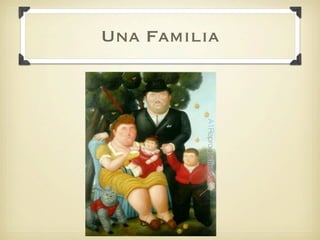
Una Familia
The First Lady (1989)
The Widow (1997)
Pablo Escobar’s Death
El Centro en Medellin,
      Colombia
Masacre de Mejor
 Esquina (1997)

Botero powerpoint

  • 1.
    Fernando Botero “Art isa permanent accusation” Laura Orozco HUM 2461
  • 3.
    Fernando Botero... Botero isa Colombian artist known for depicting a women’s beauty differently than many other’s would. The popular work of Latin America's most celebrated living artist, Fernando Botero, is instantly recognizable. His paintings, sculptures, drawings and prints have been exhibited around the world. Two of Botero's bronze nudes decorate the entrance hall of the Time-Warner Center in New York City, and a multi-ton cat of his prowls outside an apartment building further uptown. Several major museums have purchased his works for their permanent collections, and his paintings of circus life were displayed in Venice and in Zurich.
  • 4.
    On April 19th, 1932 Fernando Botero was born in Medellin, Capital of the department of Antioquia in Colombia. His parents were David Botero (1895-1936) and Flora Angulo De Botero (1898-1972). His father, David, was an energetic businessman who traveled around the neighboring provinces on horseback. ("Bio True Story")His mother, Flora, was a creative women known for her skill at handcrafts. An uncle took a major role in his life. Although isolated from art as presented in museums and other cultural institutes, Botero was influenced by the Baroque style of the colonial churches and then the rich life of the city. Botero studied in the Ateneo Antioqueno primary school and attended the Boliviarana high school. He also attended the Liceo San Jose and the Normal de Marinilla high schools. He paid for most of his education by drawing for the sunday supplement of El Colombiano newspaper. Botero, as did many artists of the time, decided to go to Europe to study the work of the Master’s. He studied in Madrid, Spain, at the Academy of San Fernando, where he created work in the style of Velazquea and Goya, as well as in Florence, Italy, where he learned the fresco techniques of the Italian masters. In 1956 he taught at the School of Fine Arts at the University of Bogota, Colombia and traveled to Mexico City to study the work of Rivera and Orozco. There, his experience with Muralism greatly influenced his future direction as an artist.
  • 5.
  • 6.
  • 7.
  • 8.
  • 9.
  • 10.
    El Centro enMedellin, Colombia
  • 11.
    Masacre de Mejor Esquina (1997)

Editor's Notes