Botany
Botany is the study of plant life,
including sunflowers
What is Botany?
• Botany, also called plant science or plant
biology, is the science of plant life and is part
of biology
• A scientist who studies plants can be called a
‘botanist’ or a ‘plant scientist’
• “Botanical” is an adjective used to describe
something related to botany
• Botany began thousands of years ago as
herbalism (the study and use of plants as
medicine)
Why Study Plants?
• Plants are used as food and give humans and
other animals the energy they need to live
• Plants also make many medicines and
products for people
• The more people know about plants, the
better we can keep them and use them
The food we eat comes
directly or indirectly from
plants such as rice.
Early Botany
• Examples of early botanical texts have been
found in texts from India from before 1100 BC,
and from China before 221 BC
• The ancient Greeks started botany in Europe
• The ancient Greek
philosopher
Theophrastus (371–287
BC) is sometimes called
the "Father of Botany"
Discoveries
• Many important biological discoveries started
with plants. Here are two:
In 1665 Robert Hooke discovered the basic
unit of living things, cells, in plants
In the 1800s Gregor Mendel did experiments
with pea plants that showed how the
characteristics of living things are passed from
parents to children (genetics)
A drawing of cells by Hooke
Botanical Gardens
• A botanical garden is an area with many
different plants used for research and
education
• European botanical gardens started as gardens
for plants to be used as medicine
• Today, most botanical gardens are open to the
public
Some plants in the
University of California
botanical garden
What do I know about plants?
True or False
1. All plants do photosynthesis.
2. All plants need water and nutrients.
3. All plants make flowers.
4. All plants make seeds.
F
T
F
F
4 Main Groups of Plants
• Nonvascular plants
– lack transport & seeds
• Seedless vascular plants
– have transport, lack seeds
• Gymnosperms (vascular)
- have seeds, but not in shells
• Angiosperms (vascular)
- seeds in shells, flowers
“Vascular” means
that the plant has a
transport system.
“Transport” means
tubes that can carry
water and nutrients.
Ginko trees have seeds
but no flowers. What
group does it belong to?
Botany Today
• Modern botany is a big subject with many
different areas of research
• Botanical research is useful in providing foods,
chemicals, energy, medicine, and materials for
construction
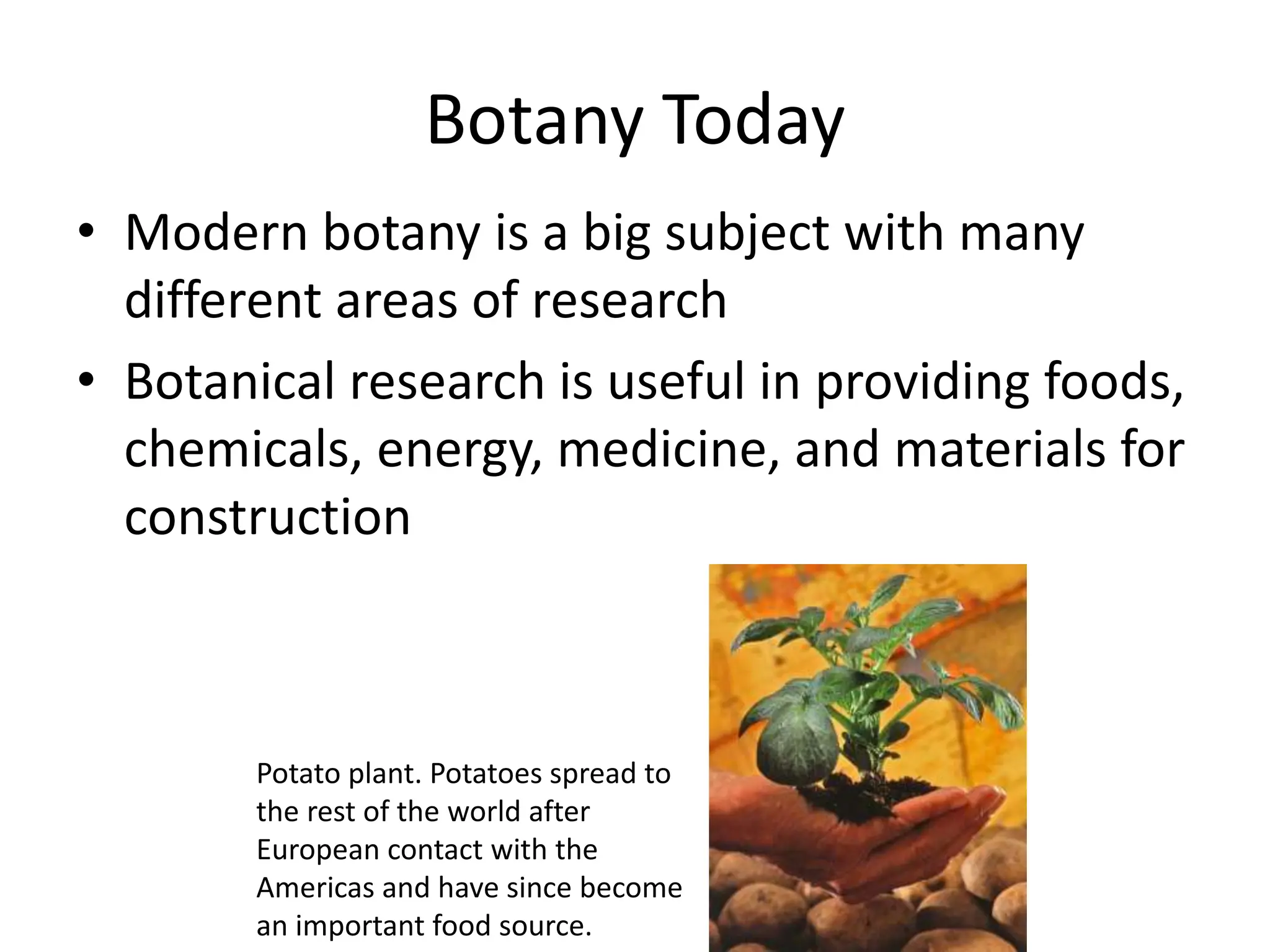
Potato plant. Potatoes spread to
the rest of the world after
European contact with the
Americas and have since become
an important food source.

Botany Botany Botany Botany Botanical gardens.pptx

  • 1.
    Botany Botany is thestudy of plant life, including sunflowers
  • 2.
    What is Botany? •Botany, also called plant science or plant biology, is the science of plant life and is part of biology • A scientist who studies plants can be called a ‘botanist’ or a ‘plant scientist’ • “Botanical” is an adjective used to describe something related to botany • Botany began thousands of years ago as herbalism (the study and use of plants as medicine)
  • 3.
    Why Study Plants? •Plants are used as food and give humans and other animals the energy they need to live • Plants also make many medicines and products for people • The more people know about plants, the better we can keep them and use them The food we eat comes directly or indirectly from plants such as rice.
  • 4.
    Early Botany • Examplesof early botanical texts have been found in texts from India from before 1100 BC, and from China before 221 BC • The ancient Greeks started botany in Europe • The ancient Greek philosopher Theophrastus (371–287 BC) is sometimes called the "Father of Botany"
  • 5.
    Discoveries • Many importantbiological discoveries started with plants. Here are two: In 1665 Robert Hooke discovered the basic unit of living things, cells, in plants In the 1800s Gregor Mendel did experiments with pea plants that showed how the characteristics of living things are passed from parents to children (genetics) A drawing of cells by Hooke
  • 6.
    Botanical Gardens • Abotanical garden is an area with many different plants used for research and education • European botanical gardens started as gardens for plants to be used as medicine • Today, most botanical gardens are open to the public Some plants in the University of California botanical garden
  • 7.
    What do Iknow about plants? True or False 1. All plants do photosynthesis. 2. All plants need water and nutrients. 3. All plants make flowers. 4. All plants make seeds. F T F F
  • 8.
    4 Main Groupsof Plants • Nonvascular plants – lack transport & seeds • Seedless vascular plants – have transport, lack seeds • Gymnosperms (vascular) - have seeds, but not in shells • Angiosperms (vascular) - seeds in shells, flowers “Vascular” means that the plant has a transport system. “Transport” means tubes that can carry water and nutrients. Ginko trees have seeds but no flowers. What group does it belong to?
  • 9.
    Botany Today • Modernbotany is a big subject with many different areas of research • Botanical research is useful in providing foods, chemicals, energy, medicine, and materials for construction Potato plant. Potatoes spread to the rest of the world after European contact with the Americas and have since become an important food source.