In Partnership with

Born to Succeed
Women’s Conference 2013

Accenture Women’s
Mentorship Programme
Welcome Message

Welcome
About the Conference
Happenings of the Day
As a Participant
House Rules
Social Media
Motto of the Day
2
Brief Overview of the Mentoring Program

The South African Accenture Women’s Network Forum would like to introduce a mentoring program
linked to the Born to Succeed Conference.
The Women’s Network hopes to:

•

equip young women with the skills necessary to succeed in the world of work, and

•

take action against South Africa’s high levels of unemployment among women

The unemployment rate for women has remained approximately 27.1% since 2008, which is above the
national average of approximately 25% (Stats SA, 2012). Therefore, the very success of this nation may
in fact lie with the education and upliftment of its women.
As the wise adage reads;
“If you educate a woman, you educate a nation,” Dr. Kwegyir Aggrey.

3
Description of a Mentoring Year
•

The mentoring program will span a year, beginning in September of a particular year to August of
the following year. This program is projected to launch on the 1st of September 2013 and end on
the 31st of August 2014.

•

This will be one month after the Born to Succeed Conference, held in conjunction with the
Accenture Women’s Network Forum.

•

The mentoring year will both begin and end with Accenture sponsored events. A description of the
events sponsored will follow…

4
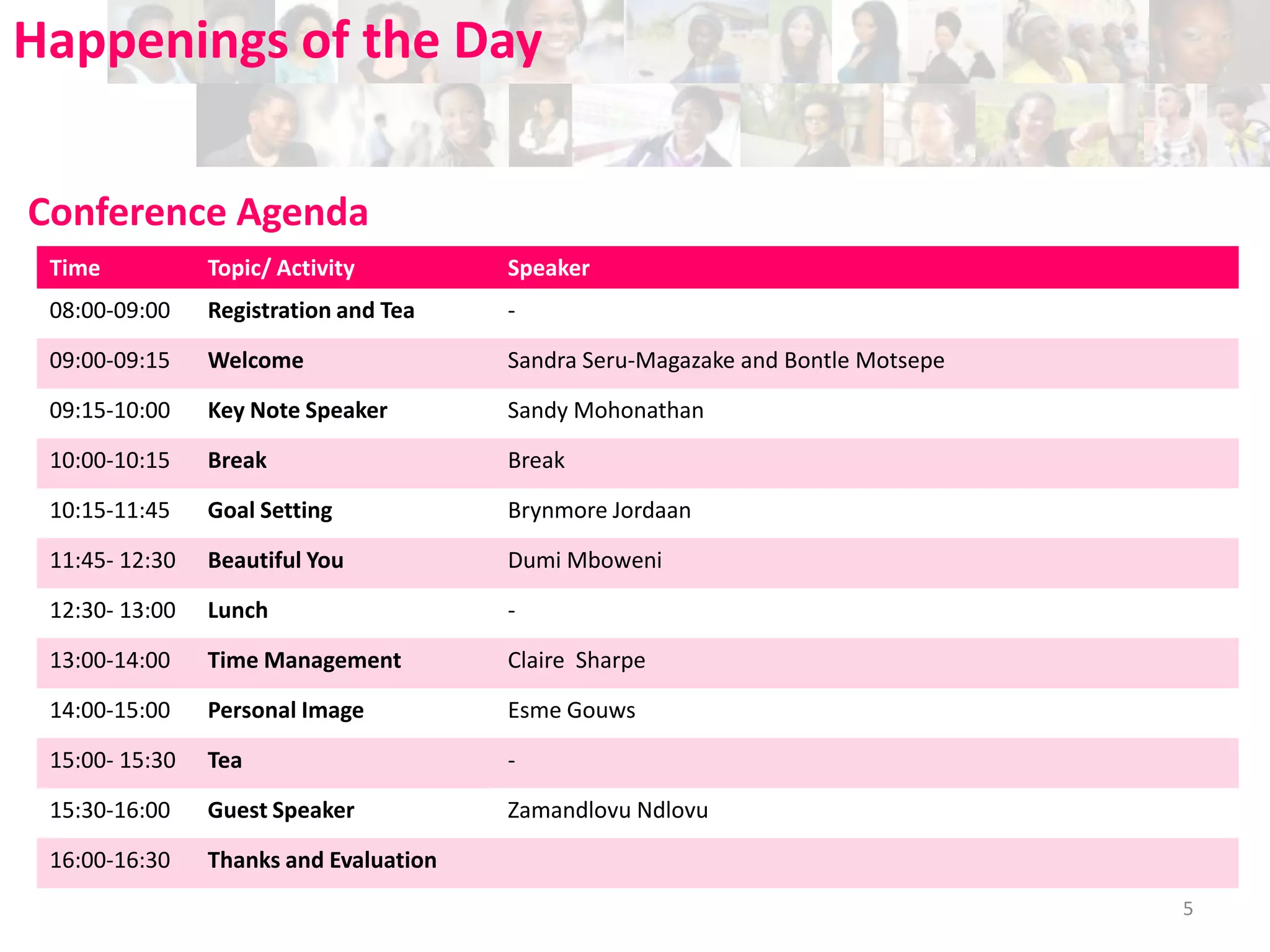
Happenings of the Day
Conference Agenda
Time

Topic/ Activity

Speaker

08:00-09:00

Registration and Tea

-

09:00-09:15

Welcome

Sandra Seru-Magazake and Bontle Motsepe

09:15-10:00

Key Note Speaker

Sandy Mohonathan

10:00-10:15

Break

Break

10:15-11:45

Goal Setting

Brynmore Jordaan

11:45- 12:30

Beautiful You

Dumi Mboweni

12:30- 13:00

Lunch

-

13:00-14:00

Time Management

Claire Sharpe

14:00-15:00

Personal Image

Esme Gouws

15:00- 15:30

Tea

-

15:30-16:00

Guest Speaker

Zamandlovu Ndlovu

16:00-16:30

Thanks and Evaluation
5
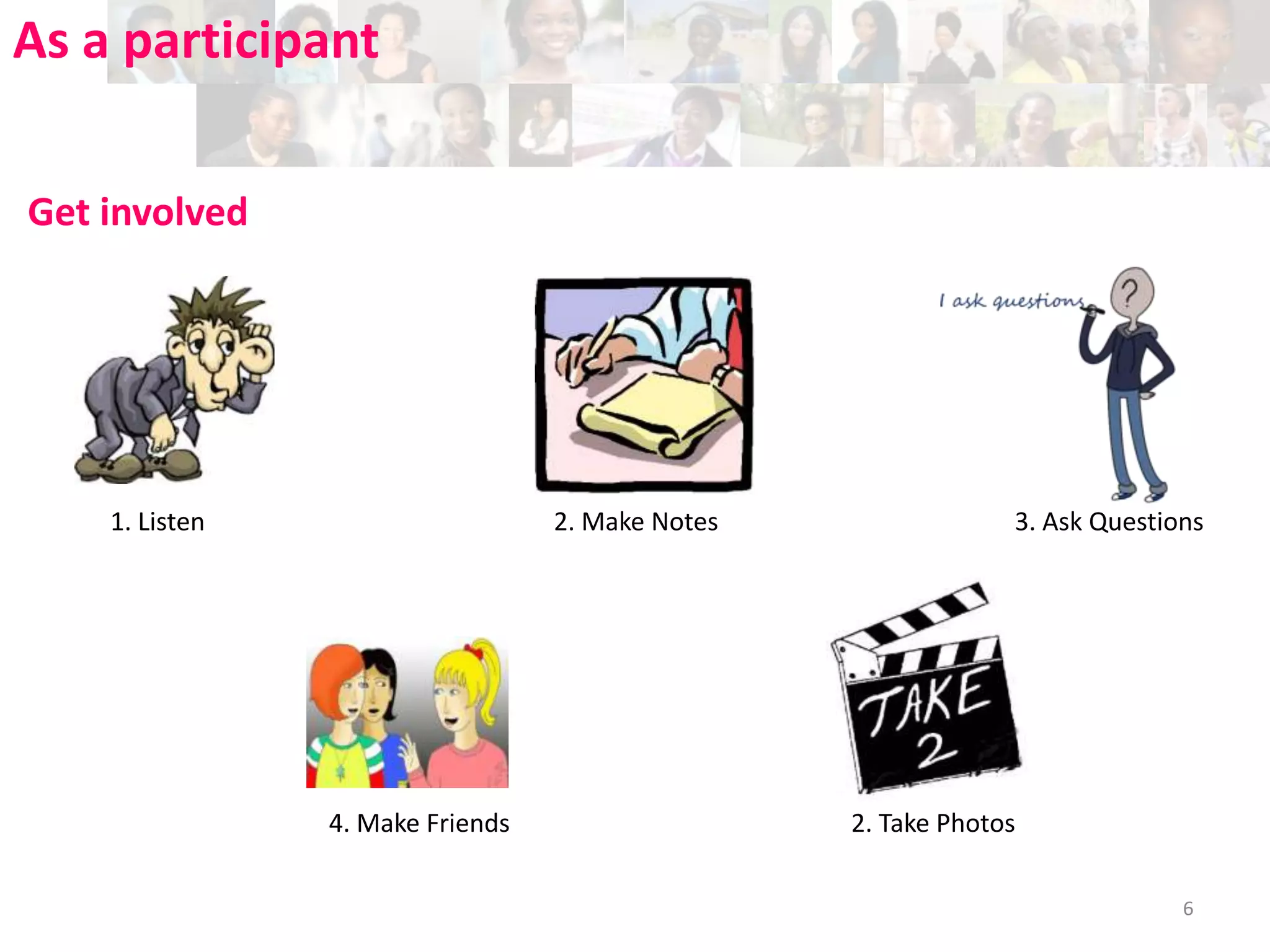
As a participant
Get involved

1. Listen

2. Make Notes

4. Make Friends

3. Ask Questions

2. Take Photos
6
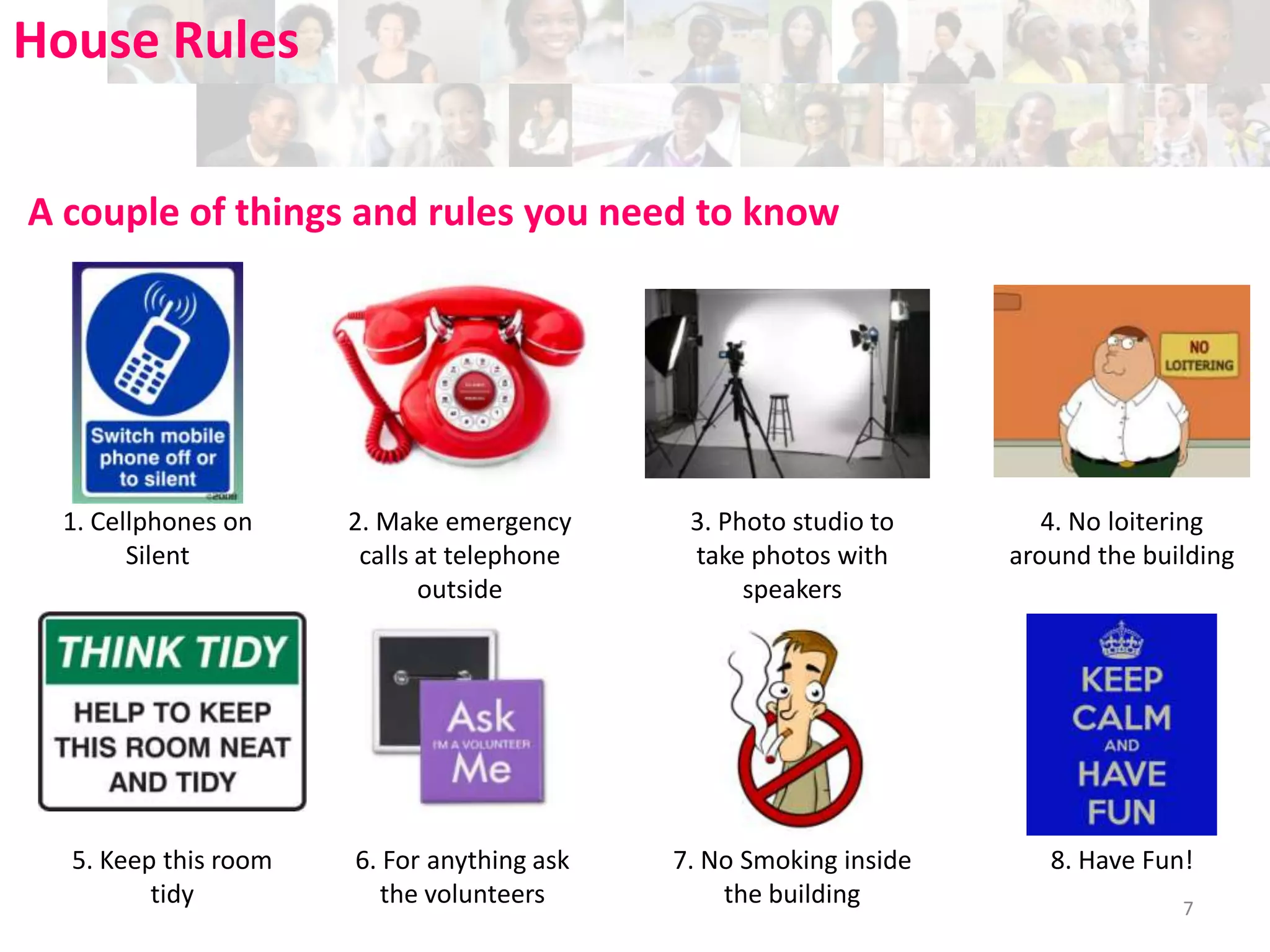
House Rules
A couple of things and rules you need to know

1. Cellphones on
Silent

5. Keep this room
tidy

2. Make emergency
calls at telephone
outside

3. Photo studio to
take photos with
speakers

4. No loitering
around the building

6. For anything ask
the volunteers

7. No Smoking inside
the building

8. Have Fun!
7
Social Media
Do the Following

Born to Succeed

@BorntoSucceedZA
#BorntoSucceed2013
8
Motto of the Day

You are Born to Succeed.

9
Motto of the Day

You are Born to Succeed.

10
11
Key Note Speaker

Sandy
Mohonathan
HR Director
Accenture SA

Sandy Mohonathan joined Accenture in 1996; however she briefly worked
for Microsoft SA in HR, to return to Accenture SA & Accenture USA, to finally
to take on the leadership role of HR/Enterprise/Talent and Human Capita in
Accenture SA in 2013.
Sandy’s career has taken her through some exciting challenges and
experiences in HR, across Africa and globally. She is passionate about
developing human potential, and is known for her professionalism, and
commitment to mentoring, among other things. She is constantly driving to
attract and retain the best talent in the industry by providing an
environment where they can deliver on their potential professionally and
develop and grow.
Sandy holds a degree in Psychology and a Higher Diploma in Human
Resources, a Masters Certificate in Human Resources and various HR
leadership and business courses.
Sandy continues to strive for success in her personal and professional
journey- having established credibility as a wife, mother, mentor, leader in
the HR market and leader at Accenture.
Sandy is an active member of the Institute of Personnel Management in
South Africa. Sandy is an active member of the Institute of Personnel
Management in South Africa. She also sits as an HR Advisor for a number of
12
local and international Organisations.
In Partnership with

Born to Succeed
Women’s Conference 2013
Key Note Speaker-Sandy
Mohonathan
Leaders Teaching Leaders of the
FUTURE
Sandy Mohonathan
TPOV
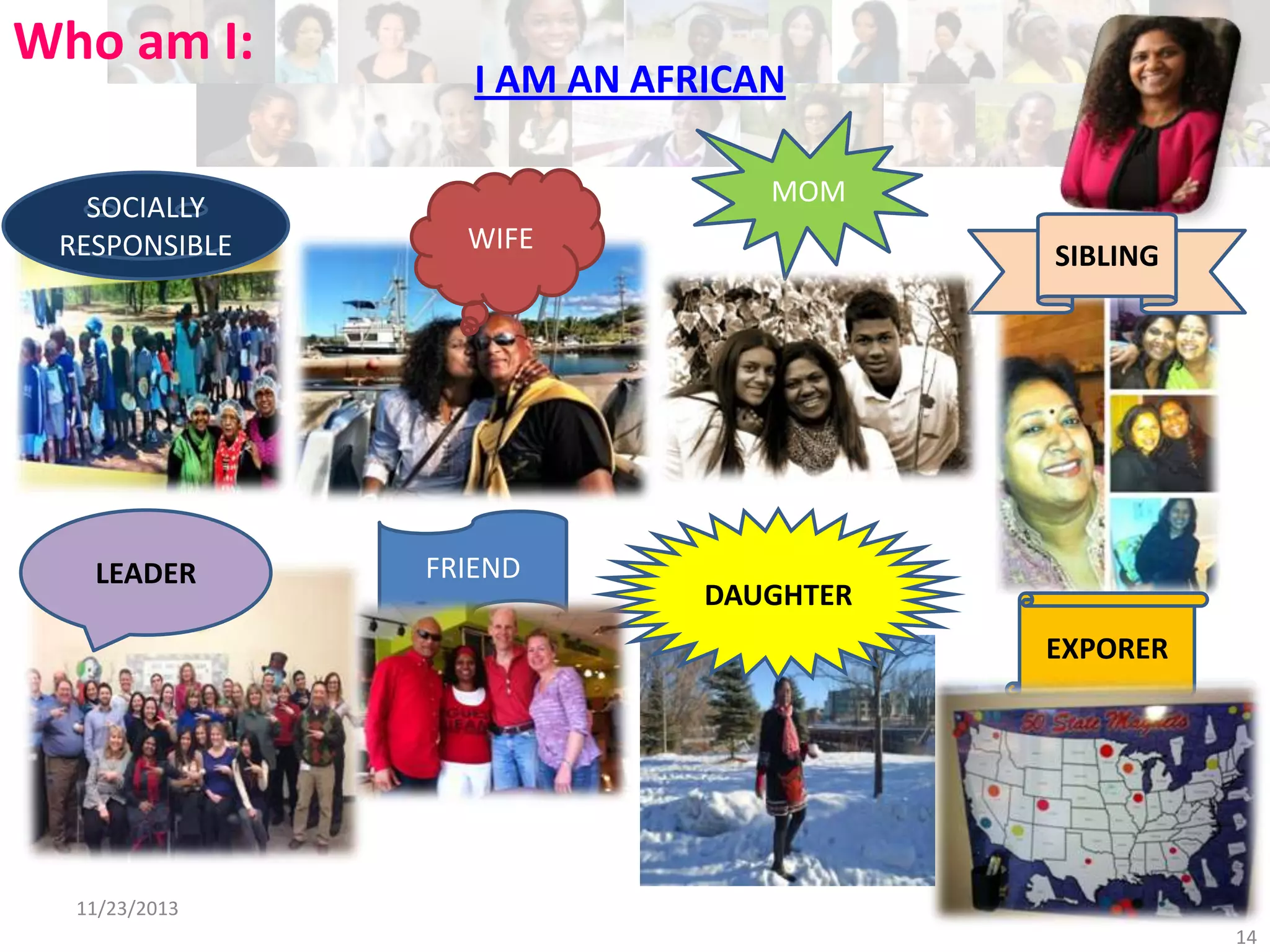
Who am I:
SOCIALLY
RESPONSIBLE

LEADER

I AM AN AFRICAN
MOM
WIFE

FRIEND

SIBLING

DAUGHTER
EXPORER

11/23/2013
14
Formative Years : Growth Through Adversity
……1983
Inspiration

Story / Song

Leadership Lessons

Gandhi: You have to stand against the
whole world although you may have to
stand alone. You have to stare in the face
the whole world although the world may
look at you with blood-shot eyes. Do not
fear. (Gandhi)

Story: Hunger in the belly
Song: Struggle Song: We
Shall Overcome Some Day

•
•
•
•

Humility
Paying it Forward
Drive
Determination

We Shall Overcome
(this song was sung by the people
participating in the March for the
Rights of Blacks led by Martin
Luther King. that time they
At
celebrated a freedom that did not
exist and may not exist today)

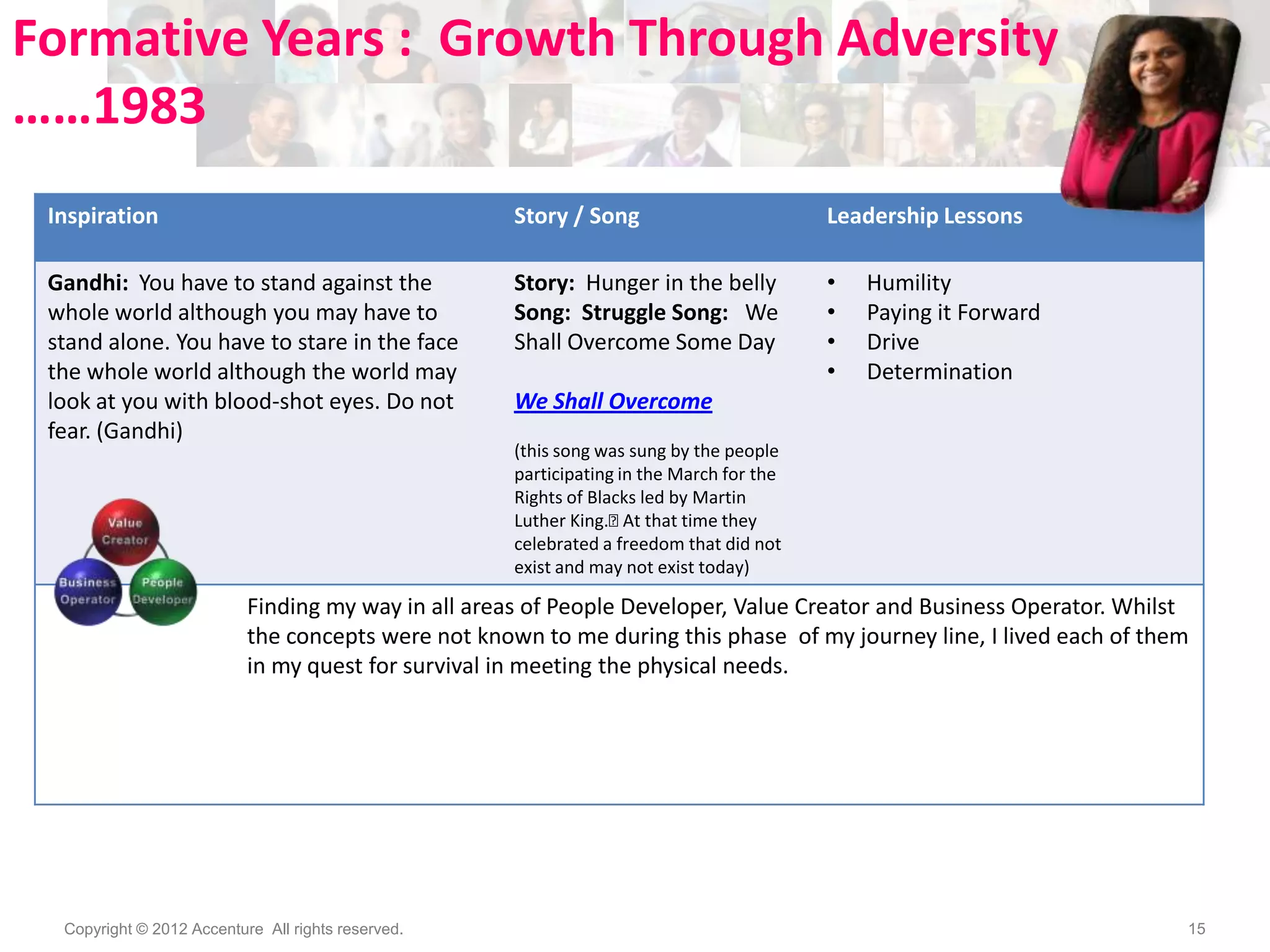
Finding my way in all areas of People Developer, Value Creator and Business Operator. Whilst
the concepts were not known to me during this phase of my journey line, I lived each of them
in my quest for survival in meeting the physical needs.

Copyright © 2012 Accenture All rights reserved.

15
Adult: Out the Nest – 1983 - 2006
Inspiration

Story / Song

Leadership Lessons

•
•

Story: Death of Dad
Song: Celine Dion – Because
you Loved Me

•
•
•
•
•
•

Gandhi: I have never lost my optimism
Nelson Mandela: Courage is not the
absence of fear — it's inspiring others
to move beyond it

Because You Love Me

Independence
Responsibility
Accountability
Power of the Team
Decisiveness
Trustworthiness

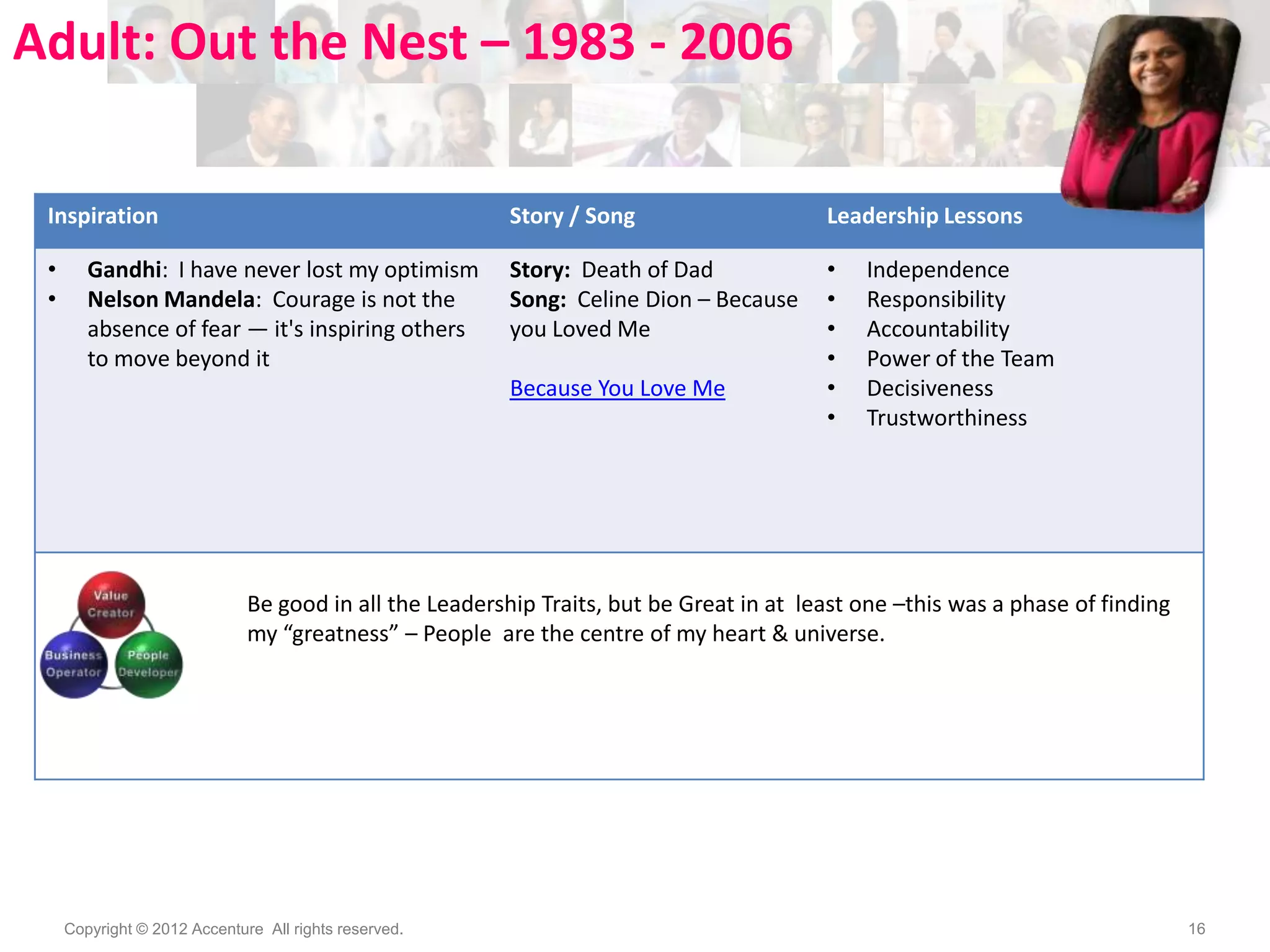
Be good in all the Leadership Traits, but be Great in at least one –this was a phase of finding
my “greatness” – People are the centre of my heart & universe.

Copyright © 2012 Accenture All rights reserved.

16
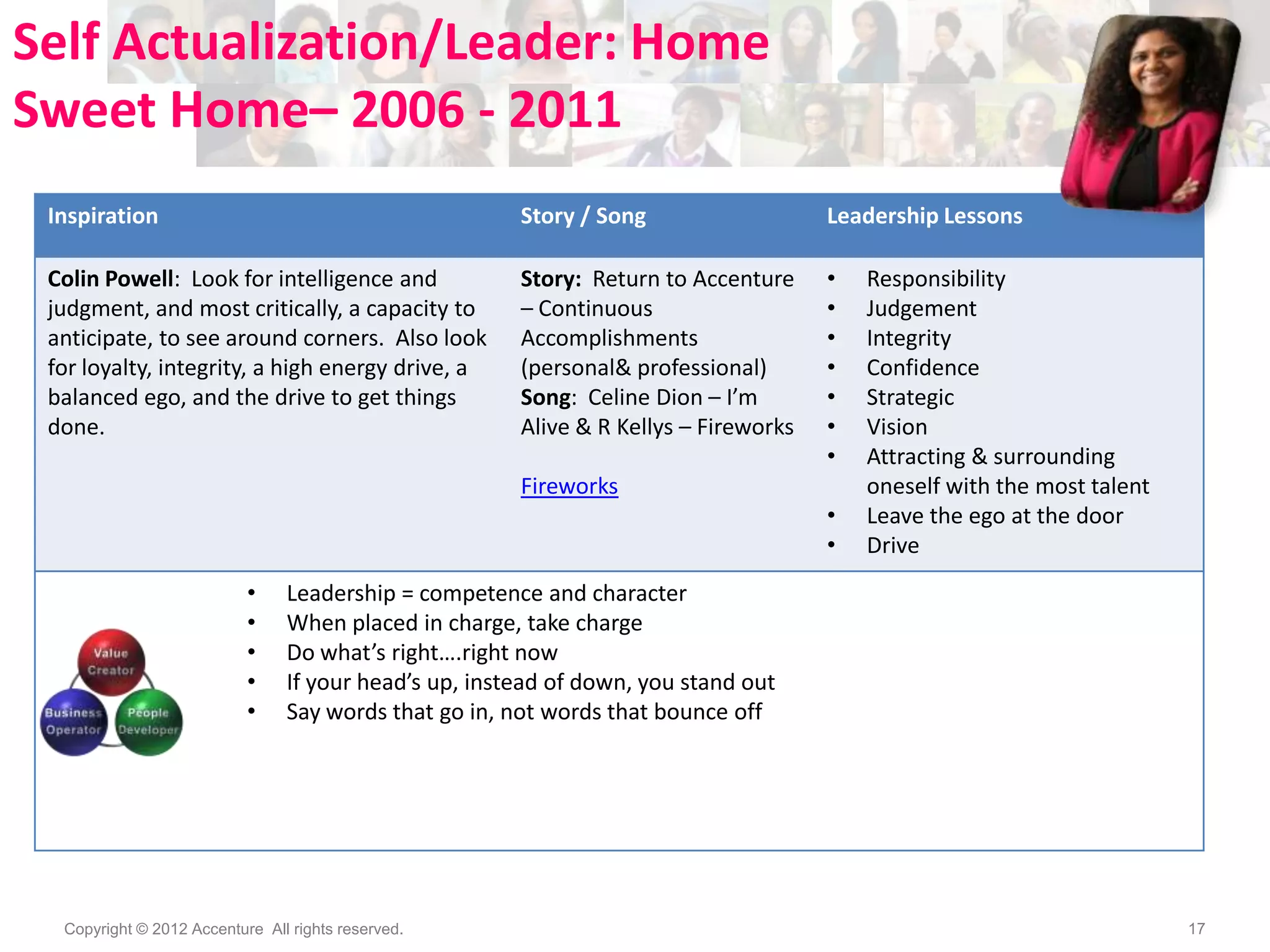
Self Actualization/Leader: Home
Sweet Home– 2006 - 2011
Inspiration

Story / Song

Leadership Lessons

Colin Powell: Look for intelligence and
judgment, and most critically, a capacity to
anticipate, to see around corners. Also look
for loyalty, integrity, a high energy drive, a
balanced ego, and the drive to get things
done.

Story: Return to Accenture
– Continuous
Accomplishments
(personal& professional)
Song: Celine Dion – I’m
Alive & R Kellys – Fireworks

•
•
•
•
•
•
•

Fireworks
•
•
•
•
•
•
•

Responsibility
Judgement
Integrity
Confidence
Strategic
Vision
Attracting & surrounding
oneself with the most talent
Leave the ego at the door
Drive

Leadership = competence and character
When placed in charge, take charge
Do what’s right….right now
If your head’s up, instead of down, you stand out
Say words that go in, not words that bounce off

Copyright © 2012 Accenture All rights reserved.

17
Self Actualization/ Leader: Explorer
/Global Relevance - 2011 - 2013
Inspiration

Story / Song

Leadership Lessons

•

Story: Life Abroad –
turning discomfort into
comfort
Song: I will never Give
up – Jason Maraz

•
•
•
•
•
•
•
•
•
•

•
•
•

Chinese Proverb: Vision without action is a daydream.
Action without vision is a nightmare.
Randy Pausch “The Last Lecture: Time is all you have.
And you may find one day that you have less than you
think.
Anonymous: Remember that great love and great
achievements involve great risk
Marilyn Ferguson- Courtesy of Jean Becker. It's not so
much that we're afraid of change or so in love with the
old ways, but it's that place in between that we fear... It's
like being between trapezes. It's Linus when his blanket
is in the dryer. There's nothing to hold on to.

I won't give up

Independence
Responsibility
Accountability
Power of the Team
Decisiveness
Trustworthiness
Leading without a title
Resourcefulness
Diversity
Comfort in Differences

•
•
•
•

I do not believe in the freedom to fail. I believe in the latitude learn
Hard work matters - Most of us fail to make the grade if we fail to make the effort
We can't get ahead by standing still
You're not getting anywhere if there's no one in your way
[Bobby Kennedy]
• Be brave in assembling a team
• Don't be afraid to gather the best. Take the initiative
• The times I regret are those I was afraid to speak up
Copyright © 2012 Accenture All rights reserved.

18
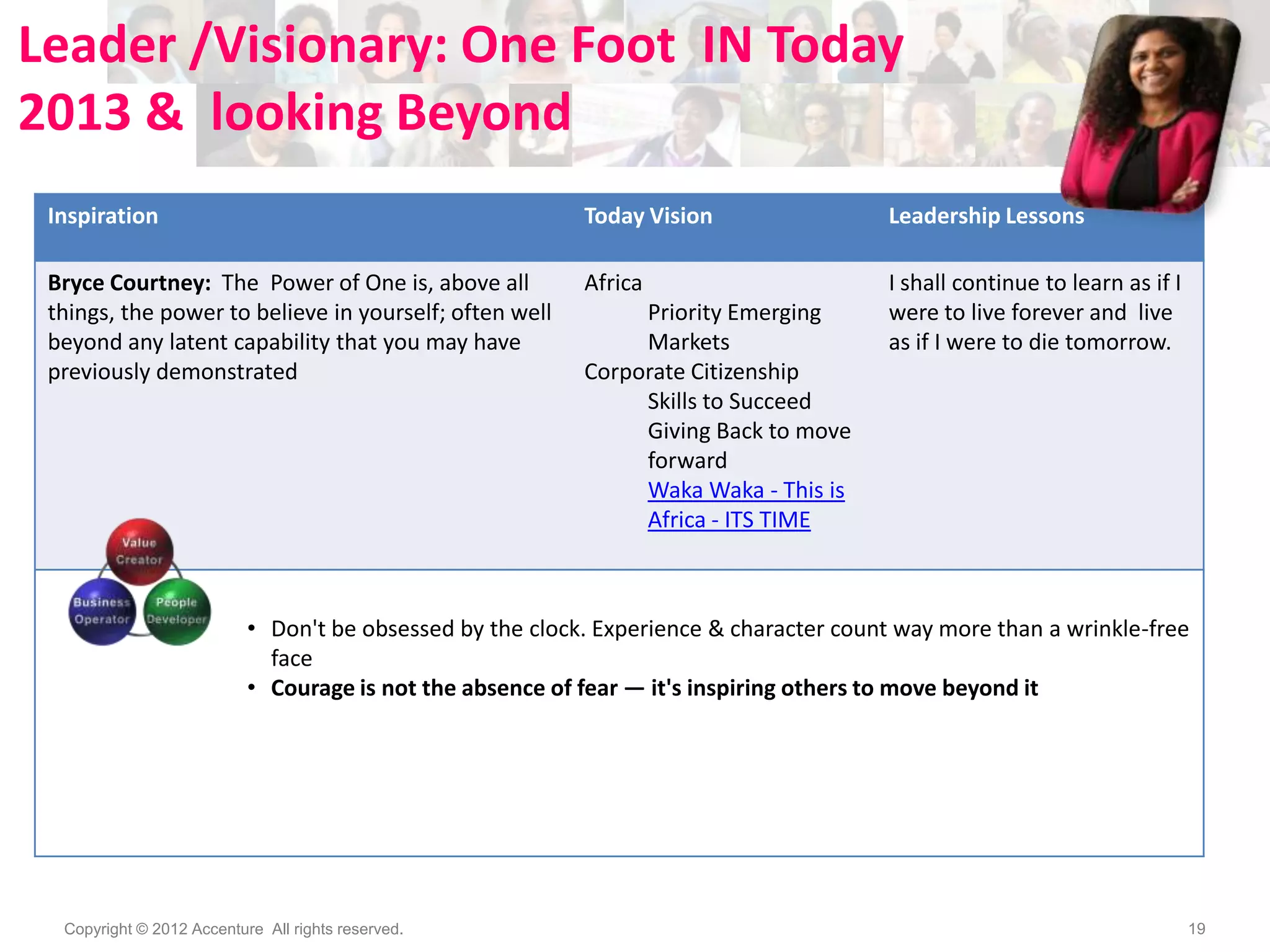
Leader /Visionary: One Foot IN Today
2013 & looking Beyond
Inspiration

Today Vision

Leadership Lessons

Bryce Courtney: The Power of One is, above all
things, the power to believe in yourself; often well
beyond any latent capability that you may have
previously demonstrated

Africa

I shall continue to learn as if I
were to live forever and live
as if I were to die tomorrow.

Priority Emerging
Markets
Corporate Citizenship
Skills to Succeed
Giving Back to move
forward
Waka Waka - This is
Africa - ITS TIME

• Don't be obsessed by the clock. Experience & character count way more than a wrinkle-free
face
• Courage is not the absence of fear — it's inspiring others to move beyond it

Copyright © 2012 Accenture All rights reserved.

19
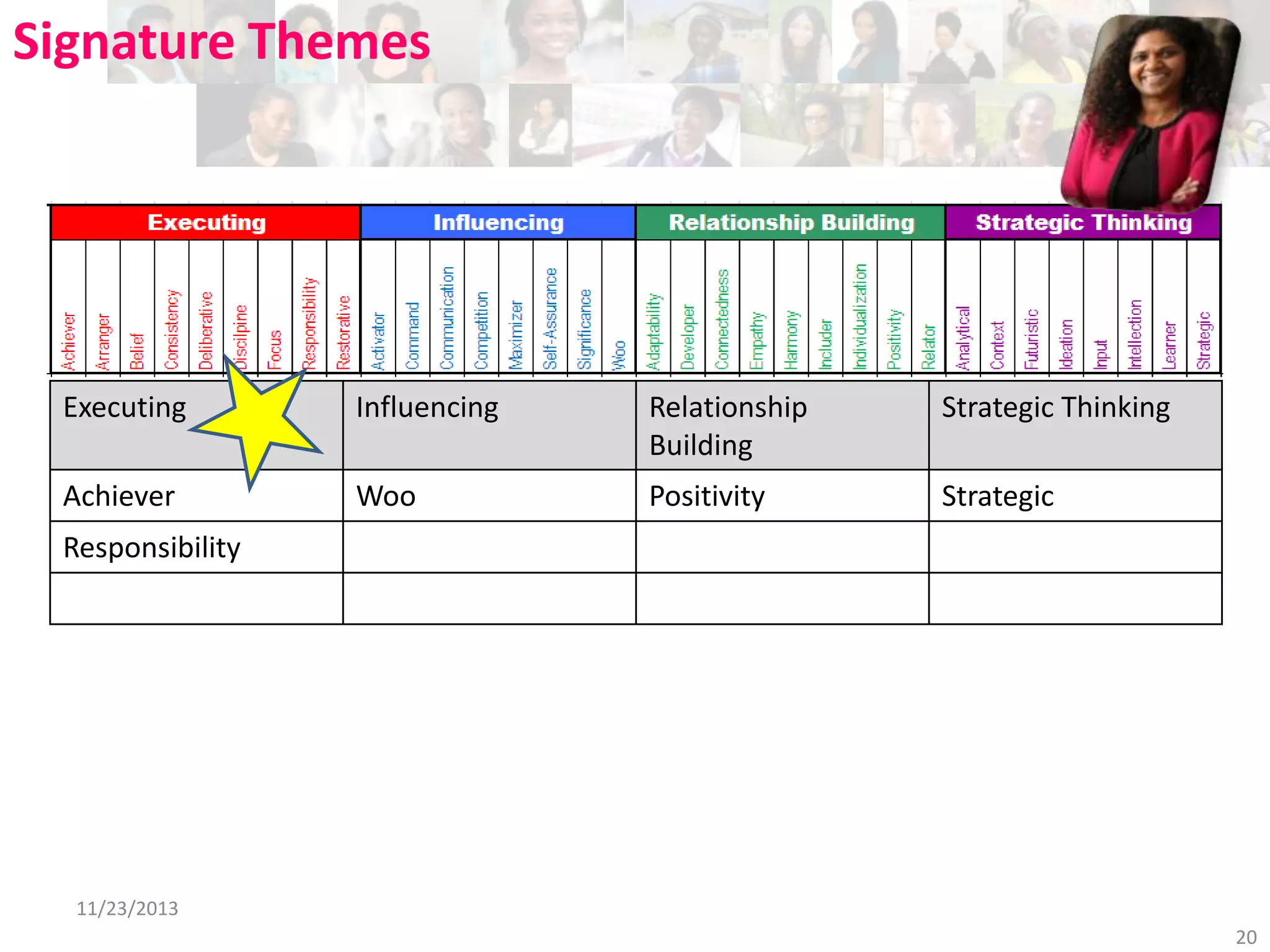
Signature Themes

Executing

Influencing

Relationship
Building

Strategic Thinking

Achiever

Woo

Positivity

Strategic

Responsibility

11/23/2013
20
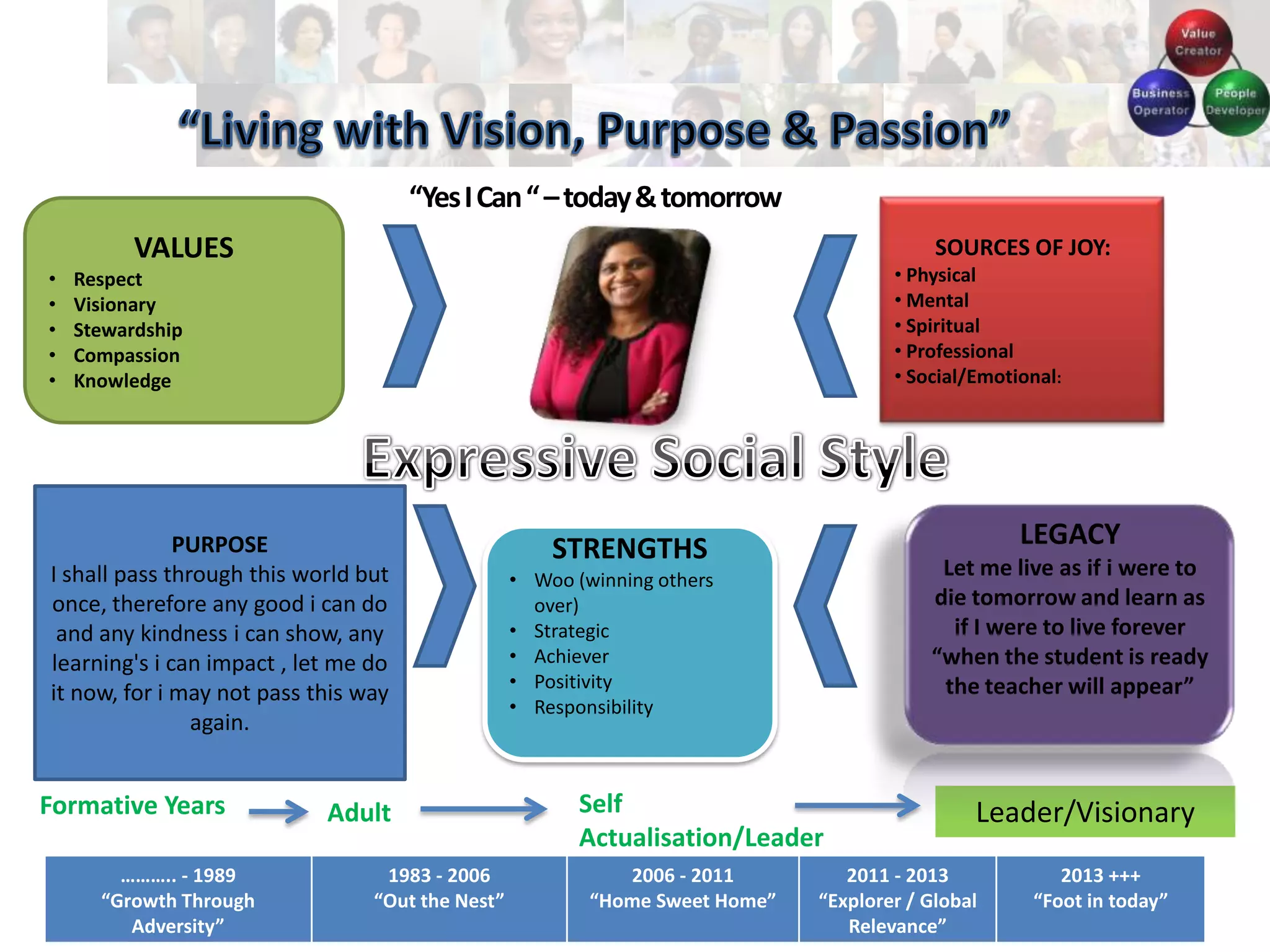
“Yes I Can “ – today & tomorrow
VALUES
•
•
•
•
•

SOURCES OF JOY:
• Physical
• Mental
• Spiritual
• Professional
• Social/Emotional:

Respect
Visionary
Stewardship
Compassion
Knowledge

PURPOSE
I shall pass through this world but
once, therefore any good i can do
and any kindness i can show, any
learning's i can impact , let me do
it now, for i may not pass this way
again.

Formative Years
……….. - 1989
“Growth Through
11/23/2013
Adversity”

Adult
1983 - 2006
“Out the Nest”

LEGACY

STRENGTHS

Let me live as if i were to
die tomorrow and learn as
if I were to live forever
“when the student is ready
the teacher will appear”

• Woo (winning others
over)
• Strategic
• Achiever
• Positivity
• Responsibility

Self
Actualisation/Leader
2006 - 2011
“Home Sweet Home”

Leader/Visionary

2011 - 2013
“Explorer / Global
Relevance”

2013 +++
“Foot in today”
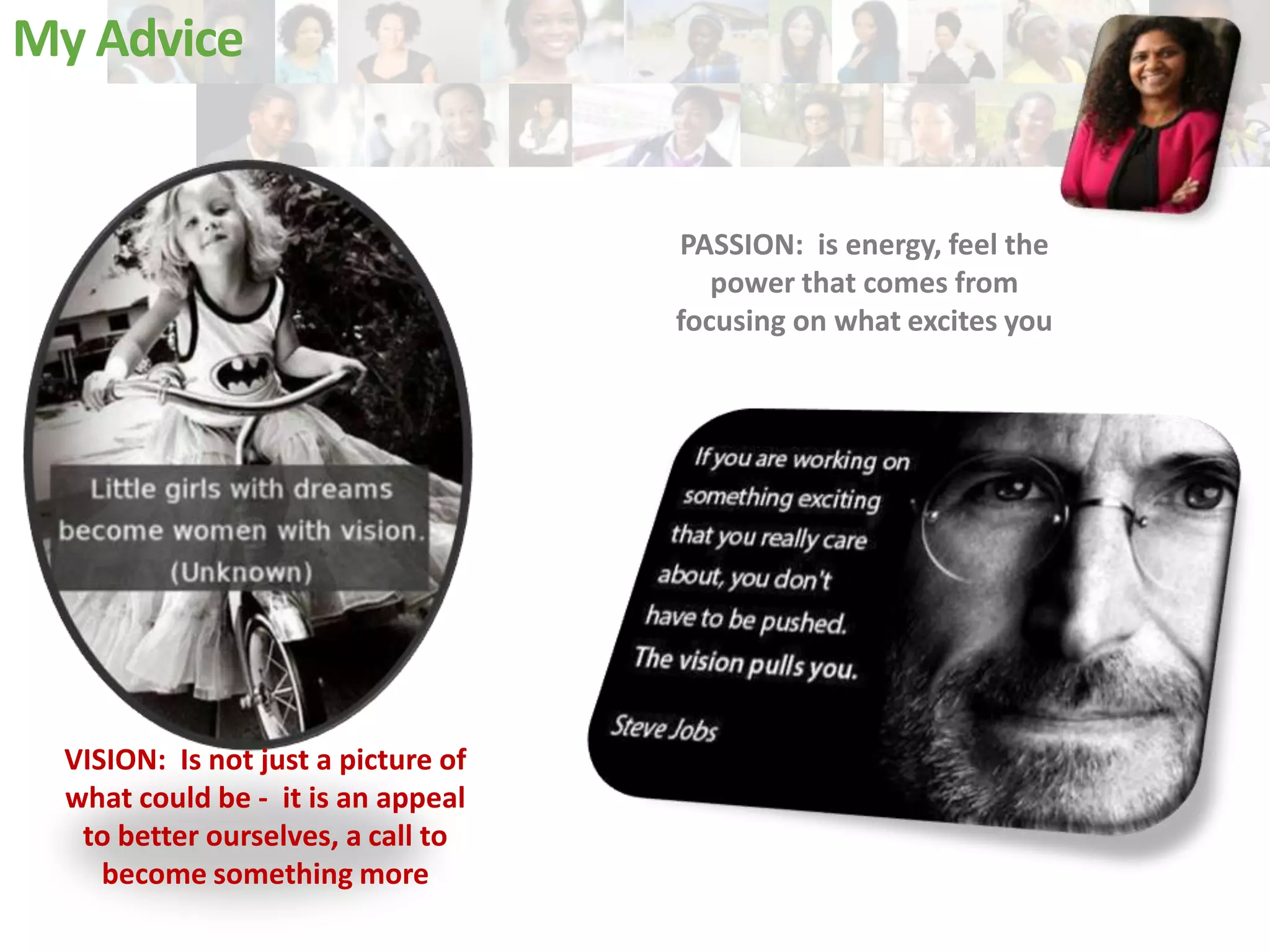
My Advice

PASSION: is energy, feel the
power that comes from
focusing on what excites you

VISION: Is not just a picture of
what could be - it is an appeal
to better ourselves, a call to
become something more
23
In Partnership with

Born to Succeed
Women’s Conference 2013
Goal Setting– Brynmore Jordaan
25
In Partnership with

Born to Succeed
Women’s Conference 2013
Beautiful You- Dumi Mboweni
27
In Partnership with

Born to Succeed
Women’s Conference 2013
Time Management – Claire Sharpe
29
Speaker

Claire Sharpe
Management
Consultant &
Dreamer of Big
Dreams

Claire Sharpe, Accenture Management Consultant specialises in Human
Capital Management. Claire is inspired by development. She pushes for the
best and is a believer that you are in charge of your destiny. Claire graduated
from the University of Cape Town in 2006 with a BSocSci Honours in Social
Work. She since has completed various short courses in Project
Management, Negotiation Skills, Communication Skills , Financial
Management and a couple of others. Claire is involved in mentorship at
various levels internal and external to Accenture. She is actively involved in
her church and thanks “the Man” upstairs for all her blessings.
Claire loves to spend her time outdoors with family and friends and contrary
to most women – avoids malls at all costs!

30
In Partnership with

Born to Succeed
Women’s Conference 2013
Time Management – Claire Sharpe
Time Management

32
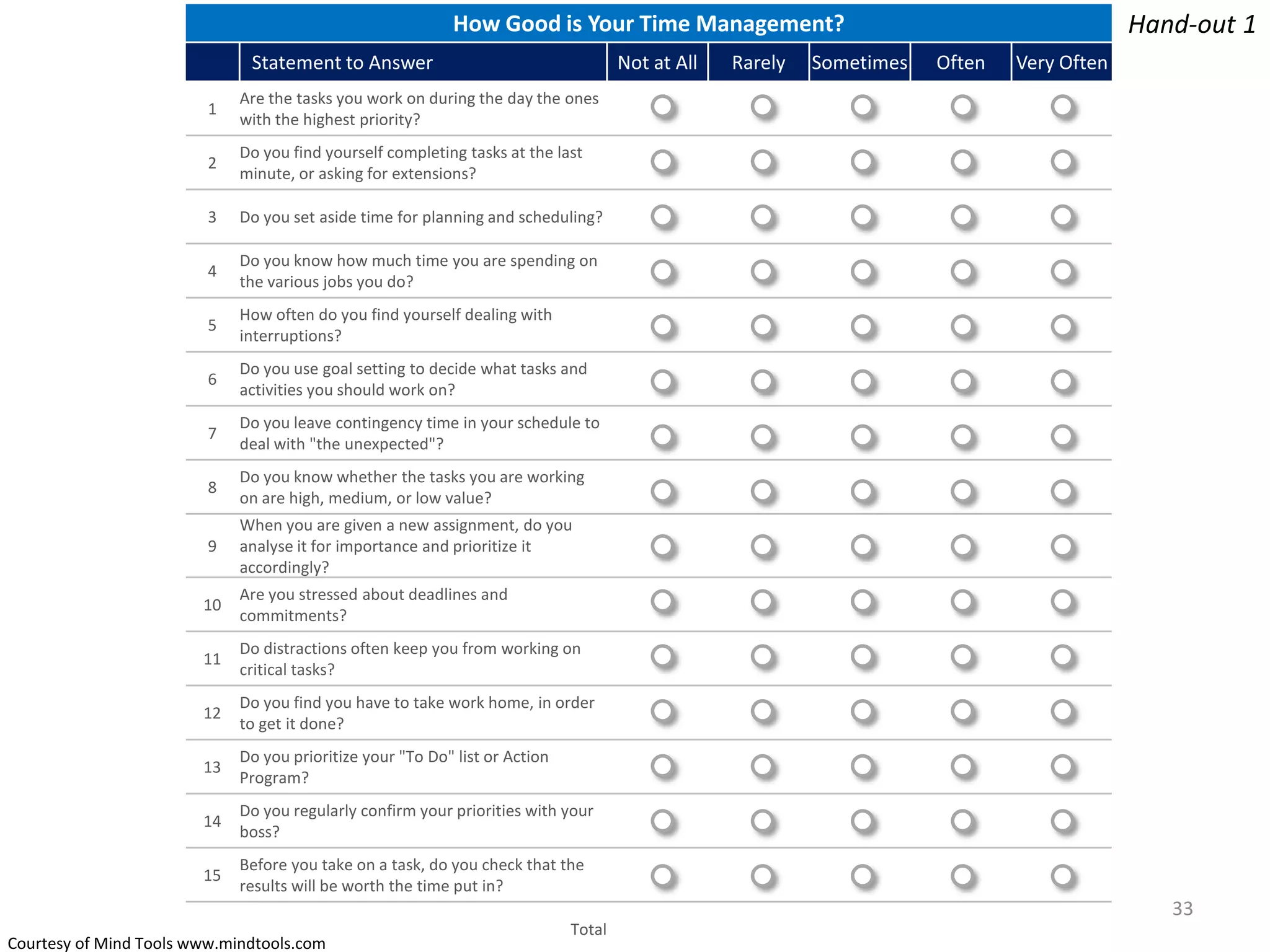
Hand-out 1

How Good is Your Time Management?
Statement to Answer

Not at All

1

Do you know how much time you are spending on
the various jobs you do?

5

How often do you find yourself dealing with
interruptions?

6

Do you use goal setting to decide what tasks and
activities you should work on?

7

Do you leave contingency time in your schedule to
deal with "the unexpected"?

8

Do you know whether the tasks you are working
on are high, medium, or low value?

9

When you are given a new assignment, do you
analyse it for importance and prioritize it
accordingly?

10

Are you stressed about deadlines and
commitments?

11

Do distractions often keep you from working on
critical tasks?

12

Do you find you have to take work home, in order
to get it done?

13

Do you prioritize your "To Do" list or Action
Program?

14

Do you regularly confirm your priorities with your
boss?

15

Very Often

Do you set aside time for planning and scheduling?

4

Often

Do you find yourself completing tasks at the last
minute, or asking for extensions?

3

Sometimes

Are the tasks you work on during the day the ones
with the highest priority?

2

Rarely

Before you take on a task, do you check that the
results will be worth the time put in?

33
Courtesy of Mind Tools www.mindtools.com

Total
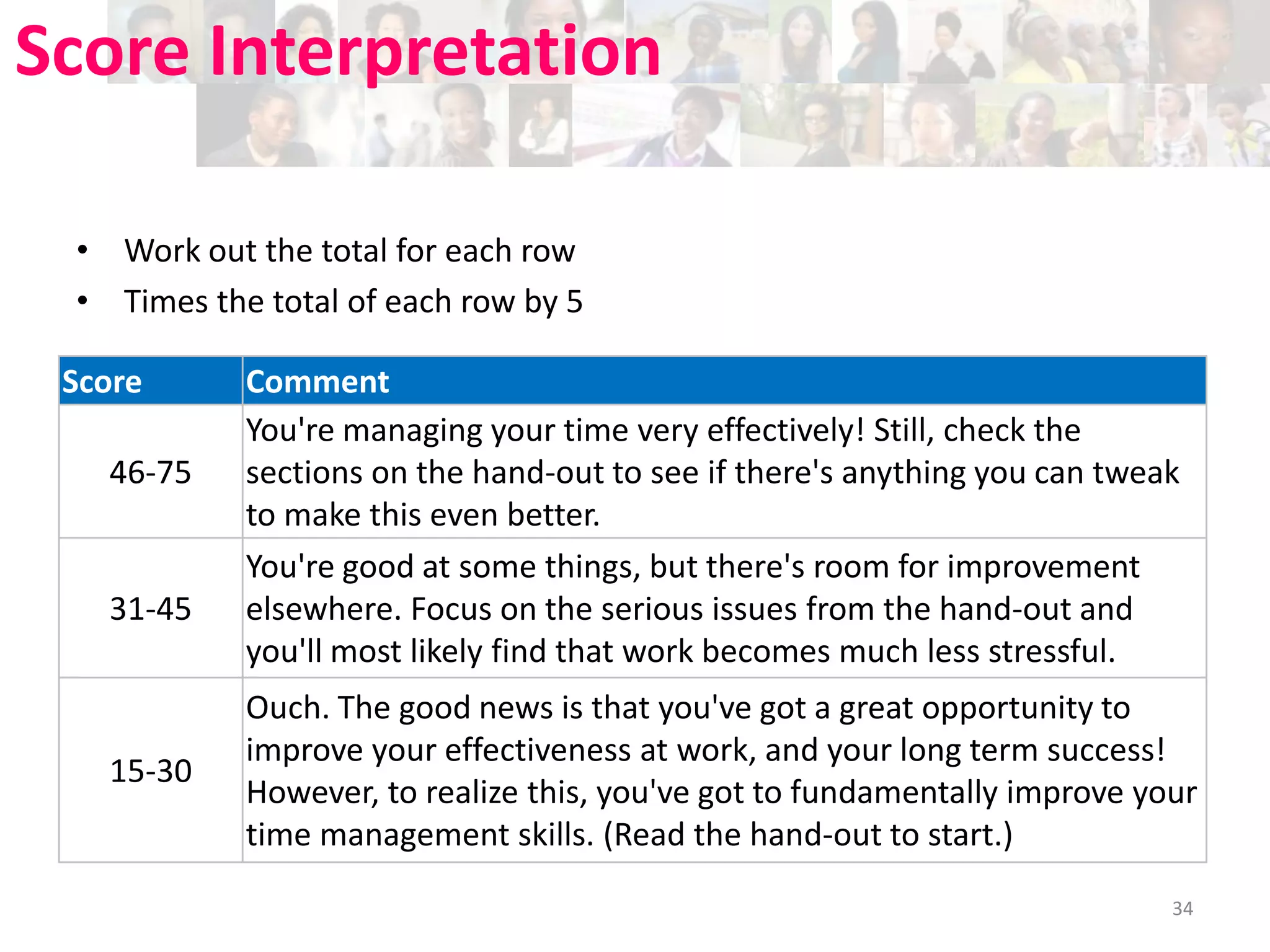
Score Interpretation
• Work out the total for each row
• Times the total of each row by 5
Score
46-75

31-45

15-30

Comment
You're managing your time very effectively! Still, check the
sections on the hand-out to see if there's anything you can tweak
to make this even better.
You're good at some things, but there's room for improvement
elsewhere. Focus on the serious issues from the hand-out and
you'll most likely find that work becomes much less stressful.
Ouch. The good news is that you've got a great opportunity to
improve your effectiveness at work, and your long term success!
However, to realize this, you've got to fundamentally improve your
time management skills. (Read the hand-out to start.)
34
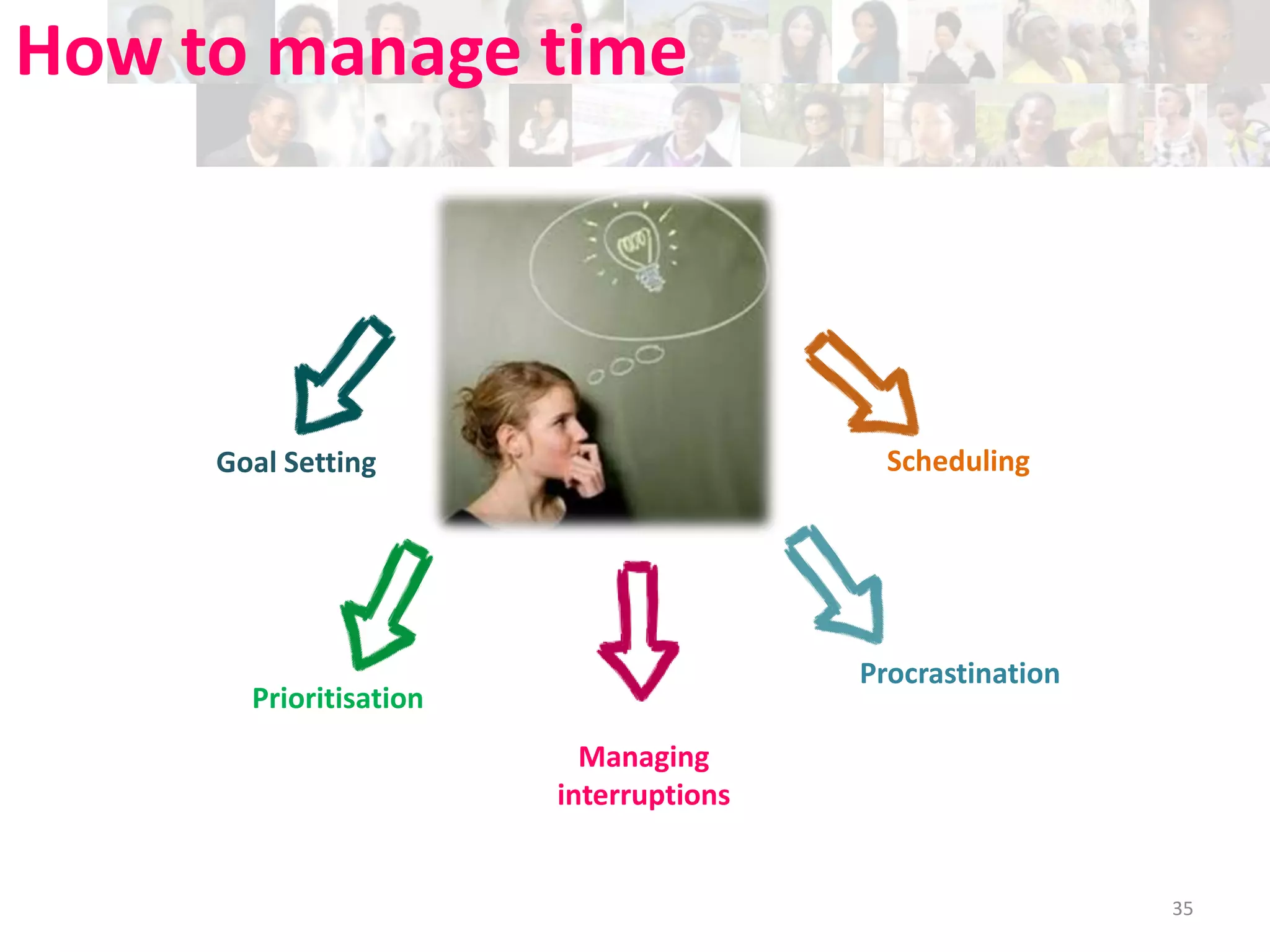
How to manage time

Scheduling

Goal Setting

Procrastination

Prioritisation

Managing
interruptions

35
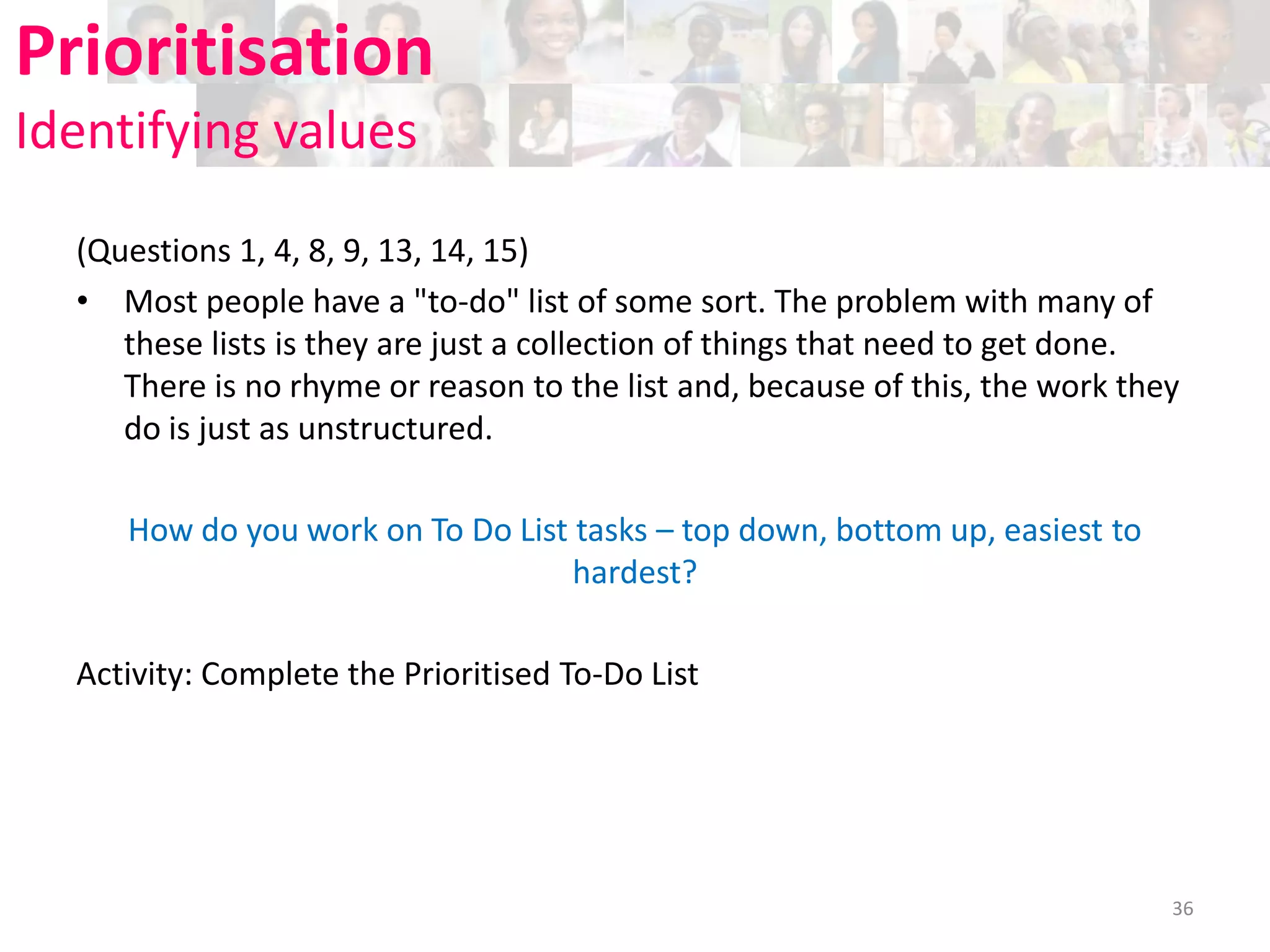
Prioritisation
Identifying values
(Questions 1, 4, 8, 9, 13, 14, 15)
• Most people have a "to-do" list of some sort. The problem with many of
these lists is they are just a collection of things that need to get done.
There is no rhyme or reason to the list and, because of this, the work they
do is just as unstructured.
How do you work on To Do List tasks – top down, bottom up, easiest to
hardest?
Activity: Complete the Prioritised To-Do List

36
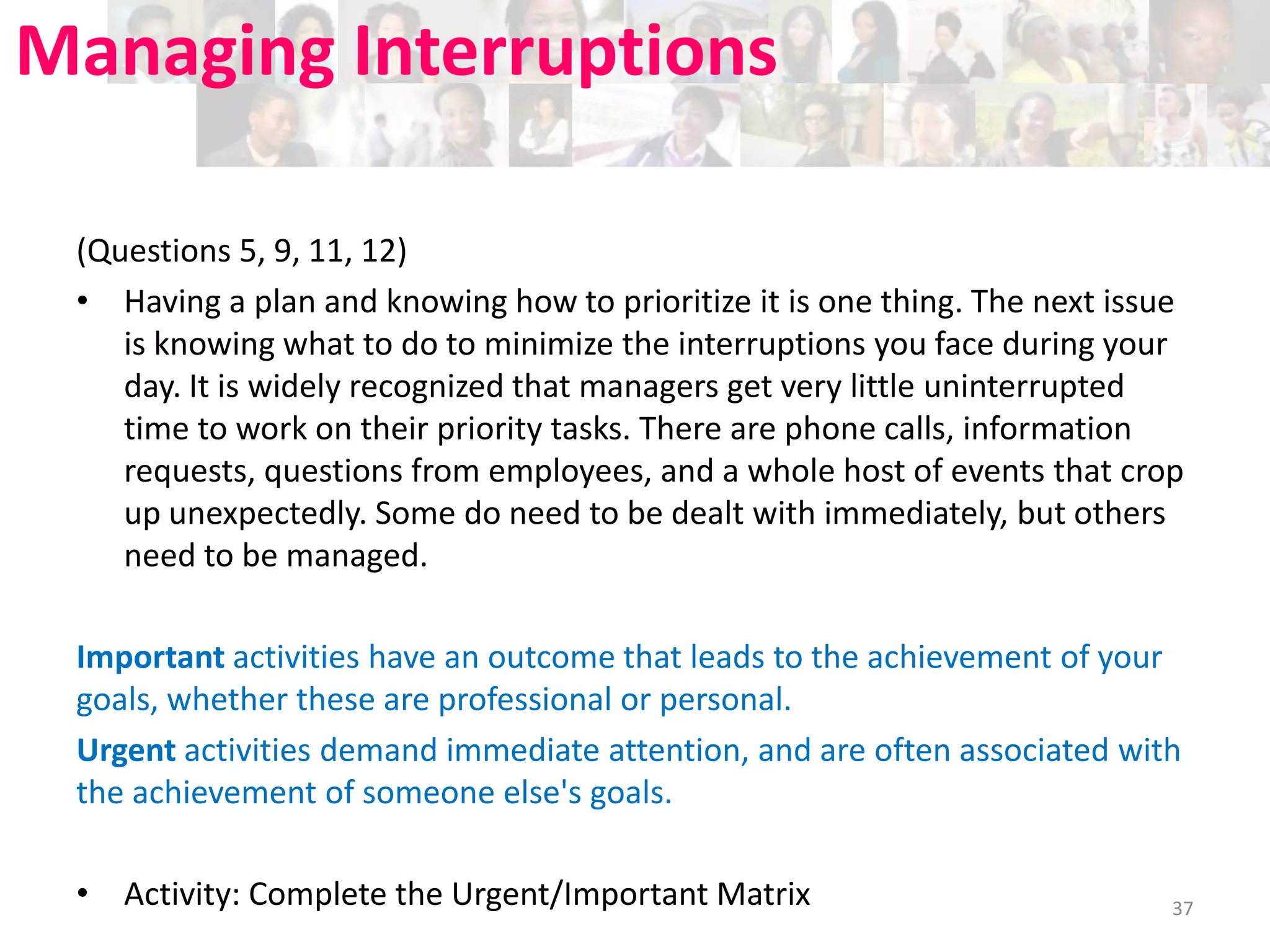
Managing Interruptions
(Questions 5, 9, 11, 12)
• Having a plan and knowing how to prioritize it is one thing. The next issue
is knowing what to do to minimize the interruptions you face during your
day. It is widely recognized that managers get very little uninterrupted
time to work on their priority tasks. There are phone calls, information
requests, questions from employees, and a whole host of events that crop
up unexpectedly. Some do need to be dealt with immediately, but others
need to be managed.
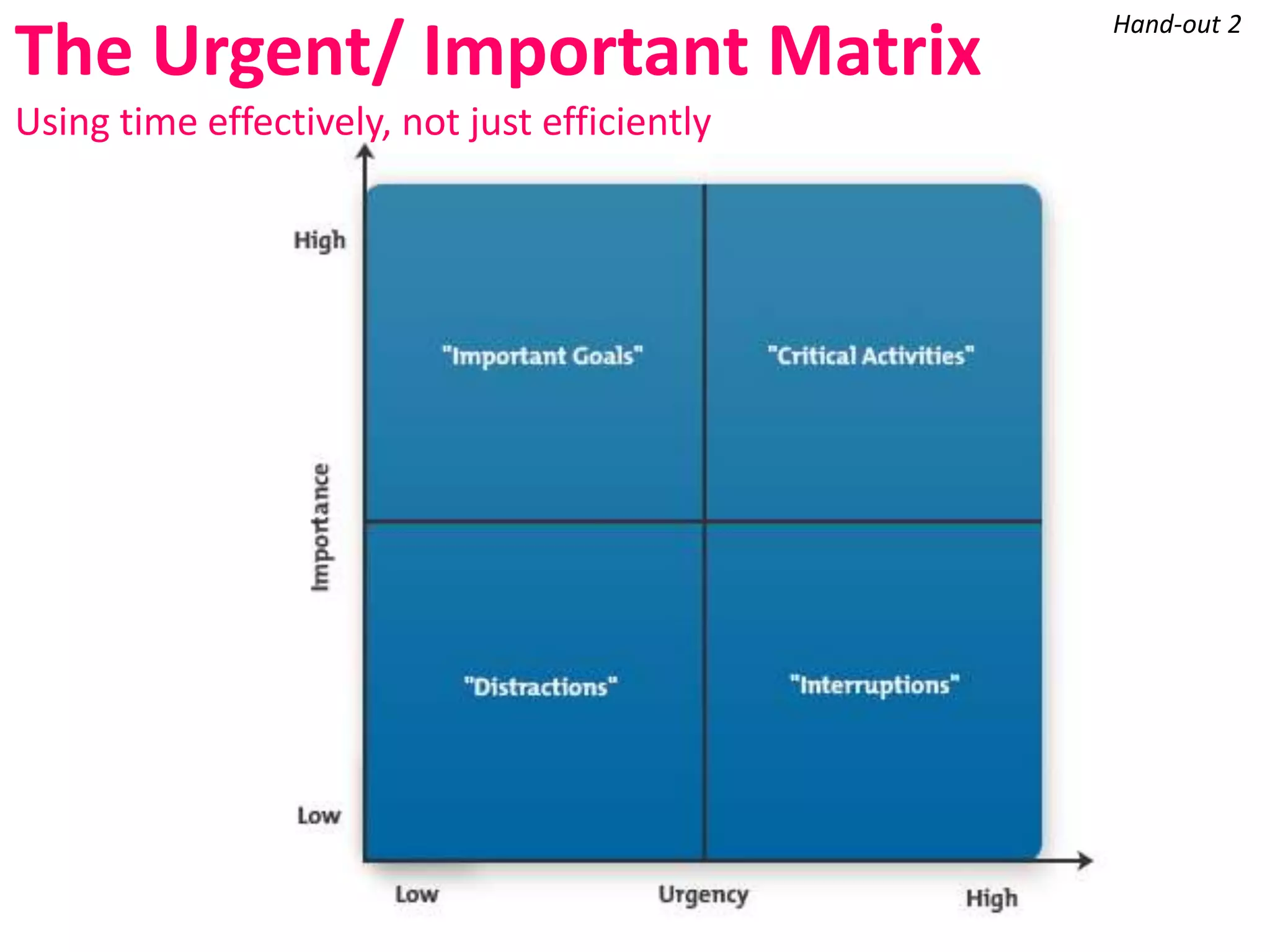
Important activities have an outcome that leads to the achievement of your
goals, whether these are professional or personal.
Urgent activities demand immediate attention, and are often associated with
the achievement of someone else's goals.
• Activity: Complete the Urgent/Important Matrix

37
The Urgent/ Important Matrix
Using time effectively, not just efficiently

Hand-out 2
Procrastination
(Questions 2, 10, 12)
• "I'll get to it later" has led to the downfall of many a good employees.
After too many "laters" the work piles up so high that any task seems
insurmountable. Procrastination is as tempting as it is deadly. The best
way to beat it is to recognize that you do indeed procrastinate. Then you
need to figure out why. Perhaps you are afraid of failing? (And some
people are actually afraid of success!)
How to recognise that you are procrastinating?
Scheduling
Planning your week
(Questions 3, 7, 12)
• Much of time management comes down to effective scheduling of your
time. When you know what your goals and priorities are, you then need to
know how to go about creating a schedule that keeps you on track, and
protects you from stress.
Choose big rocks.
41
In Partnership with

Born to Succeed
Women’s Conference 2013
Personal Image– Esme Gouws
43
In Partnership with

Born to Succeed
Women’s Conference 2013
Guest Speaker- Zamandlovu Ndlovu
45

Bornto succeedpresentationfordayoct2013

  • 1.
    In Partnership with Bornto Succeed Women’s Conference 2013 Accenture Women’s Mentorship Programme
  • 2.
    Welcome Message Welcome About theConference Happenings of the Day As a Participant House Rules Social Media Motto of the Day 2
  • 3.
    Brief Overview ofthe Mentoring Program The South African Accenture Women’s Network Forum would like to introduce a mentoring program linked to the Born to Succeed Conference. The Women’s Network hopes to: • equip young women with the skills necessary to succeed in the world of work, and • take action against South Africa’s high levels of unemployment among women The unemployment rate for women has remained approximately 27.1% since 2008, which is above the national average of approximately 25% (Stats SA, 2012). Therefore, the very success of this nation may in fact lie with the education and upliftment of its women. As the wise adage reads; “If you educate a woman, you educate a nation,” Dr. Kwegyir Aggrey. 3
  • 4.
    Description of aMentoring Year • The mentoring program will span a year, beginning in September of a particular year to August of the following year. This program is projected to launch on the 1st of September 2013 and end on the 31st of August 2014. • This will be one month after the Born to Succeed Conference, held in conjunction with the Accenture Women’s Network Forum. • The mentoring year will both begin and end with Accenture sponsored events. A description of the events sponsored will follow… 4
  • 5.
    Happenings of theDay Conference Agenda Time Topic/ Activity Speaker 08:00-09:00 Registration and Tea - 09:00-09:15 Welcome Sandra Seru-Magazake and Bontle Motsepe 09:15-10:00 Key Note Speaker Sandy Mohonathan 10:00-10:15 Break Break 10:15-11:45 Goal Setting Brynmore Jordaan 11:45- 12:30 Beautiful You Dumi Mboweni 12:30- 13:00 Lunch - 13:00-14:00 Time Management Claire Sharpe 14:00-15:00 Personal Image Esme Gouws 15:00- 15:30 Tea - 15:30-16:00 Guest Speaker Zamandlovu Ndlovu 16:00-16:30 Thanks and Evaluation 5
  • 6.
    As a participant Getinvolved 1. Listen 2. Make Notes 4. Make Friends 3. Ask Questions 2. Take Photos 6
  • 7.
    House Rules A coupleof things and rules you need to know 1. Cellphones on Silent 5. Keep this room tidy 2. Make emergency calls at telephone outside 3. Photo studio to take photos with speakers 4. No loitering around the building 6. For anything ask the volunteers 7. No Smoking inside the building 8. Have Fun! 7
  • 8.
    Social Media Do theFollowing Born to Succeed @BorntoSucceedZA #BorntoSucceed2013 8
  • 9.
    Motto of theDay You are Born to Succeed. 9
  • 10.
    Motto of theDay You are Born to Succeed. 10
  • 11.
  • 12.
    Key Note Speaker Sandy Mohonathan HRDirector Accenture SA Sandy Mohonathan joined Accenture in 1996; however she briefly worked for Microsoft SA in HR, to return to Accenture SA & Accenture USA, to finally to take on the leadership role of HR/Enterprise/Talent and Human Capita in Accenture SA in 2013. Sandy’s career has taken her through some exciting challenges and experiences in HR, across Africa and globally. She is passionate about developing human potential, and is known for her professionalism, and commitment to mentoring, among other things. She is constantly driving to attract and retain the best talent in the industry by providing an environment where they can deliver on their potential professionally and develop and grow. Sandy holds a degree in Psychology and a Higher Diploma in Human Resources, a Masters Certificate in Human Resources and various HR leadership and business courses. Sandy continues to strive for success in her personal and professional journey- having established credibility as a wife, mother, mentor, leader in the HR market and leader at Accenture. Sandy is an active member of the Institute of Personnel Management in South Africa. Sandy is an active member of the Institute of Personnel Management in South Africa. She also sits as an HR Advisor for a number of 12 local and international Organisations.
  • 13.
    In Partnership with Bornto Succeed Women’s Conference 2013 Key Note Speaker-Sandy Mohonathan Leaders Teaching Leaders of the FUTURE Sandy Mohonathan TPOV
  • 14.
    Who am I: SOCIALLY RESPONSIBLE LEADER IAM AN AFRICAN MOM WIFE FRIEND SIBLING DAUGHTER EXPORER 11/23/2013 14
  • 15.
    Formative Years :Growth Through Adversity ……1983 Inspiration Story / Song Leadership Lessons Gandhi: You have to stand against the whole world although you may have to stand alone. You have to stare in the face the whole world although the world may look at you with blood-shot eyes. Do not fear. (Gandhi) Story: Hunger in the belly Song: Struggle Song: We Shall Overcome Some Day • • • • Humility Paying it Forward Drive Determination We Shall Overcome (this song was sung by the people participating in the March for the Rights of Blacks led by Martin Luther King. that time they At celebrated a freedom that did not exist and may not exist today) Finding my way in all areas of People Developer, Value Creator and Business Operator. Whilst the concepts were not known to me during this phase of my journey line, I lived each of them in my quest for survival in meeting the physical needs. Copyright © 2012 Accenture All rights reserved. 15
  • 16.
    Adult: Out theNest – 1983 - 2006 Inspiration Story / Song Leadership Lessons • • Story: Death of Dad Song: Celine Dion – Because you Loved Me • • • • • • Gandhi: I have never lost my optimism Nelson Mandela: Courage is not the absence of fear — it's inspiring others to move beyond it Because You Love Me Independence Responsibility Accountability Power of the Team Decisiveness Trustworthiness Be good in all the Leadership Traits, but be Great in at least one –this was a phase of finding my “greatness” – People are the centre of my heart & universe. Copyright © 2012 Accenture All rights reserved. 16
  • 17.
    Self Actualization/Leader: Home SweetHome– 2006 - 2011 Inspiration Story / Song Leadership Lessons Colin Powell: Look for intelligence and judgment, and most critically, a capacity to anticipate, to see around corners. Also look for loyalty, integrity, a high energy drive, a balanced ego, and the drive to get things done. Story: Return to Accenture – Continuous Accomplishments (personal& professional) Song: Celine Dion – I’m Alive & R Kellys – Fireworks • • • • • • • Fireworks • • • • • • • Responsibility Judgement Integrity Confidence Strategic Vision Attracting & surrounding oneself with the most talent Leave the ego at the door Drive Leadership = competence and character When placed in charge, take charge Do what’s right….right now If your head’s up, instead of down, you stand out Say words that go in, not words that bounce off Copyright © 2012 Accenture All rights reserved. 17
  • 18.
    Self Actualization/ Leader:Explorer /Global Relevance - 2011 - 2013 Inspiration Story / Song Leadership Lessons • Story: Life Abroad – turning discomfort into comfort Song: I will never Give up – Jason Maraz • • • • • • • • • • • • • Chinese Proverb: Vision without action is a daydream. Action without vision is a nightmare. Randy Pausch “The Last Lecture: Time is all you have. And you may find one day that you have less than you think. Anonymous: Remember that great love and great achievements involve great risk Marilyn Ferguson- Courtesy of Jean Becker. It's not so much that we're afraid of change or so in love with the old ways, but it's that place in between that we fear... It's like being between trapezes. It's Linus when his blanket is in the dryer. There's nothing to hold on to. I won't give up Independence Responsibility Accountability Power of the Team Decisiveness Trustworthiness Leading without a title Resourcefulness Diversity Comfort in Differences • • • • I do not believe in the freedom to fail. I believe in the latitude learn Hard work matters - Most of us fail to make the grade if we fail to make the effort We can't get ahead by standing still You're not getting anywhere if there's no one in your way [Bobby Kennedy] • Be brave in assembling a team • Don't be afraid to gather the best. Take the initiative • The times I regret are those I was afraid to speak up Copyright © 2012 Accenture All rights reserved. 18
  • 19.
    Leader /Visionary: OneFoot IN Today 2013 & looking Beyond Inspiration Today Vision Leadership Lessons Bryce Courtney: The Power of One is, above all things, the power to believe in yourself; often well beyond any latent capability that you may have previously demonstrated Africa I shall continue to learn as if I were to live forever and live as if I were to die tomorrow. Priority Emerging Markets Corporate Citizenship Skills to Succeed Giving Back to move forward Waka Waka - This is Africa - ITS TIME • Don't be obsessed by the clock. Experience & character count way more than a wrinkle-free face • Courage is not the absence of fear — it's inspiring others to move beyond it Copyright © 2012 Accenture All rights reserved. 19
  • 20.
  • 21.
    “Yes I Can“ – today & tomorrow VALUES • • • • • SOURCES OF JOY: • Physical • Mental • Spiritual • Professional • Social/Emotional: Respect Visionary Stewardship Compassion Knowledge PURPOSE I shall pass through this world but once, therefore any good i can do and any kindness i can show, any learning's i can impact , let me do it now, for i may not pass this way again. Formative Years ……….. - 1989 “Growth Through 11/23/2013 Adversity” Adult 1983 - 2006 “Out the Nest” LEGACY STRENGTHS Let me live as if i were to die tomorrow and learn as if I were to live forever “when the student is ready the teacher will appear” • Woo (winning others over) • Strategic • Achiever • Positivity • Responsibility Self Actualisation/Leader 2006 - 2011 “Home Sweet Home” Leader/Visionary 2011 - 2013 “Explorer / Global Relevance” 2013 +++ “Foot in today”
  • 22.
    My Advice PASSION: isenergy, feel the power that comes from focusing on what excites you VISION: Is not just a picture of what could be - it is an appeal to better ourselves, a call to become something more
  • 23.
  • 24.
    In Partnership with Bornto Succeed Women’s Conference 2013 Goal Setting– Brynmore Jordaan
  • 25.
  • 26.
    In Partnership with Bornto Succeed Women’s Conference 2013 Beautiful You- Dumi Mboweni
  • 27.
  • 28.
    In Partnership with Bornto Succeed Women’s Conference 2013 Time Management – Claire Sharpe
  • 29.
  • 30.
    Speaker Claire Sharpe Management Consultant & Dreamerof Big Dreams Claire Sharpe, Accenture Management Consultant specialises in Human Capital Management. Claire is inspired by development. She pushes for the best and is a believer that you are in charge of your destiny. Claire graduated from the University of Cape Town in 2006 with a BSocSci Honours in Social Work. She since has completed various short courses in Project Management, Negotiation Skills, Communication Skills , Financial Management and a couple of others. Claire is involved in mentorship at various levels internal and external to Accenture. She is actively involved in her church and thanks “the Man” upstairs for all her blessings. Claire loves to spend her time outdoors with family and friends and contrary to most women – avoids malls at all costs! 30
  • 31.
    In Partnership with Bornto Succeed Women’s Conference 2013 Time Management – Claire Sharpe
  • 32.
  • 33.
    Hand-out 1 How Goodis Your Time Management? Statement to Answer Not at All 1 Do you know how much time you are spending on the various jobs you do? 5 How often do you find yourself dealing with interruptions? 6 Do you use goal setting to decide what tasks and activities you should work on? 7 Do you leave contingency time in your schedule to deal with "the unexpected"? 8 Do you know whether the tasks you are working on are high, medium, or low value? 9 When you are given a new assignment, do you analyse it for importance and prioritize it accordingly? 10 Are you stressed about deadlines and commitments? 11 Do distractions often keep you from working on critical tasks? 12 Do you find you have to take work home, in order to get it done? 13 Do you prioritize your "To Do" list or Action Program? 14 Do you regularly confirm your priorities with your boss? 15 Very Often Do you set aside time for planning and scheduling? 4 Often Do you find yourself completing tasks at the last minute, or asking for extensions? 3 Sometimes Are the tasks you work on during the day the ones with the highest priority? 2 Rarely Before you take on a task, do you check that the results will be worth the time put in? 33 Courtesy of Mind Tools www.mindtools.com Total
  • 34.
    Score Interpretation • Workout the total for each row • Times the total of each row by 5 Score 46-75 31-45 15-30 Comment You're managing your time very effectively! Still, check the sections on the hand-out to see if there's anything you can tweak to make this even better. You're good at some things, but there's room for improvement elsewhere. Focus on the serious issues from the hand-out and you'll most likely find that work becomes much less stressful. Ouch. The good news is that you've got a great opportunity to improve your effectiveness at work, and your long term success! However, to realize this, you've got to fundamentally improve your time management skills. (Read the hand-out to start.) 34
  • 35.
    How to managetime Scheduling Goal Setting Procrastination Prioritisation Managing interruptions 35
  • 36.
    Prioritisation Identifying values (Questions 1,4, 8, 9, 13, 14, 15) • Most people have a "to-do" list of some sort. The problem with many of these lists is they are just a collection of things that need to get done. There is no rhyme or reason to the list and, because of this, the work they do is just as unstructured. How do you work on To Do List tasks – top down, bottom up, easiest to hardest? Activity: Complete the Prioritised To-Do List 36
  • 37.
    Managing Interruptions (Questions 5,9, 11, 12) • Having a plan and knowing how to prioritize it is one thing. The next issue is knowing what to do to minimize the interruptions you face during your day. It is widely recognized that managers get very little uninterrupted time to work on their priority tasks. There are phone calls, information requests, questions from employees, and a whole host of events that crop up unexpectedly. Some do need to be dealt with immediately, but others need to be managed. Important activities have an outcome that leads to the achievement of your goals, whether these are professional or personal. Urgent activities demand immediate attention, and are often associated with the achievement of someone else's goals. • Activity: Complete the Urgent/Important Matrix 37
  • 38.
    The Urgent/ ImportantMatrix Using time effectively, not just efficiently Hand-out 2
  • 39.
    Procrastination (Questions 2, 10,12) • "I'll get to it later" has led to the downfall of many a good employees. After too many "laters" the work piles up so high that any task seems insurmountable. Procrastination is as tempting as it is deadly. The best way to beat it is to recognize that you do indeed procrastinate. Then you need to figure out why. Perhaps you are afraid of failing? (And some people are actually afraid of success!) How to recognise that you are procrastinating?
  • 40.
    Scheduling Planning your week (Questions3, 7, 12) • Much of time management comes down to effective scheduling of your time. When you know what your goals and priorities are, you then need to know how to go about creating a schedule that keeps you on track, and protects you from stress. Choose big rocks.
  • 41.
  • 42.
    In Partnership with Bornto Succeed Women’s Conference 2013 Personal Image– Esme Gouws
  • 43.
  • 44.
    In Partnership with Bornto Succeed Women’s Conference 2013 Guest Speaker- Zamandlovu Ndlovu
  • 45.

Editor's Notes

  • #15 Facilitator Notes: Strengths FinderFacilitator to write in his/her strengths in the areas they fall into aboveFacilitator share how he/she has used this information to be a more effective leader. Ex. Surround himself/herself with a leadership team that compliments his/her strengths.
  • #16 Growth through the days of Apartheid
  • #21 Facilitator Notes: Strengths FinderFacilitator to write in his/her strengths in the areas they fall into aboveFacilitator share how he/she has used this information to be a more effective leader. Ex. Surround himself/herself with a leadership team that compliments his/her strengths.
  • #33 “I'm sorry that I haven't been pulling my weight and helping you with the planning, I've been feeling a bit overwhelmed with everything that has been going on in my head and I haven't yet mastered any time managements skills.”Time management is not a once off skill. It’s a constant behaviour that one needs to develop to ensure you continuously practice a daily self discipline towards achieving your goals. Yes, there are “tricks” to help you manage your time well – but even these are actions you need to continuously practice.How often do you find yourself running out of time? Weekly, daily, hourly? For many, it seems that there's just never enough time in the day to get everything done.When you know how to manage your time you gain control. Rather than busily working here, there, and everywhere (and not getting much done anywhere), effective time management helps you to choose what to work on and when. This is essential if you're to achieve anything of any real worth.
  • #36 Time management is an essential skill that helps you keep your work under control, at the same time that it helps you keep stress to a minimum.We would all love to have an extra couple of hours in every day. Seeing as that is impossible, we need to work smarter on things that have the highest priority, and then creating a schedule that reflects our work and personal priorities.With this in place, we can work in a focused and effective way, and really start achieving those goals, dreams and ambitions we care so much about.
  • #37 Prioritizing what needs to be done is especially important. Without it, you may work very hard, but you won't be achieving the results you desire because what you are working on is not of strategic importance.To work efficiently you need to work on the most important, highest value tasks. This way you won't get caught scrambling to get something critical done as the deadline approaches. How do you work on To Do List tasks – top down, bottom up, easiest to hardest?Step 1:Write down all of the tasks that you need to complete. If they're large tasks, break out the first action step, and write this down with the larger task. (Ideally, tasks or action steps should take no longer than 1-2 hours to complete.)Note:You may find it easier to compile several lists (personal, study, and workplace To-Do Lists, for example). Try different approaches and use the best for your own situation.Step 2:Run through these tasks allocating priorities from A (very important, or very urgent) to F (unimportant, or not at all urgent).If too many tasks have a high priority, run through the list again and demote the less important ones. Once you have done this, rewrite the list in priority order.Using Your To-Do ListsTo use your To-Do List, simply work your way through it in order, dealing with the A priority tasks first, then the Bs, then the Cs, and so on. As you complete tasks, tick them off or strike them through.You can use To-Do Lists in different ways in different situations. For instance, if you're in a sales-type role, a good way to motivate yourself is to keep your To-Do List relatively short, and aim to complete it every day.In you're in an operational role, or if tasks are large or dependent on too many other people, then it may be better to focus on a longer-term list, and "chip away" at it day-by-day.Many people find it helpful to spend, say, 10 minutes at the end of the day, organizing tasks on their To-Do List for the next day.
  • #38 Great time management means being effective as well as efficient. Managing time effectively, and achieving the things that you want to achieve, means spending your time on things that are important and not just urgent. To do this, and to minimize the stress of having too many tight deadlines, it's important to understand this distinction:Important activities have an outcome that leads to the achievement of your goals, whether these are professional or personal.Urgent activities demand immediate attention, and are often associated with the achievement of someone else's goals.Urgent activities are often the ones we concentrate on; they demand attention because the consequences of not dealing with them are immediate.US President Eisenhower’s quote, "What is important is seldom urgent and what is urgent is seldom important,“How to Use the ToolThe Urgent/Important Matrix is a powerful way of thinking about priorities. Using it helps you overcome the natural tendency to focus on urgent activities, so that you can keep clear enough time to focus on what's really important. This is the way you move from "firefighting" into a position where you can grow your business and your career.Here's how it works:The matrix can be drawn as shown in figure 1, with the dimensions of Importance and Urgency.The first step is to list all the activities and projects that you feel you have to do. Try to include everything that takes up your time at work, however unimportant. (If you manage your time using a To-Do List   or Action Program  , you should have done this already.)Next, on a scale of 1 to 5, assign importance to each of the activities. Remember, this is a measure of how important the activity is in helping you meet your goals and objectives. Try not to worry about urgency at this stage.Once you've assigned an importance value to each activity, evaluate its urgency. As you do this, plot each item on the matrix according to the values that you've given it.Now study the matrix using the strategies described below to schedule your priorities.Strategies for Different Quadrants of the MatrixUrgent and ImportantThere are two distinct types of urgent and important activities: Ones that you could not foresee, and others that you've left to the last minute.You can avoid last-minute activities by planning ahead and avoiding procrastination.Issues and crises, on the other hand, cannot always be foreseen or avoided. Here, the best approach is to leave some time in your schedule to handle unexpected issues and unplanned important activities. (If a major crisis arises, then you'll need to reschedule other events.)If you have a lot of urgent and important activities, identify which of these could have been foreseen, and think about how you could schedule similar activities ahead of time, so that they don't become urgent.Urgent and Not ImportantUrgent but not important activities are things that stop you achieving your goals, and prevent you from completing your work. Ask yourself whether these tasks can be rescheduled, or whether you can delegate them.A common source of such interruptions is from other people in your office. Sometimes it's appropriate to say "No" to people politely, or to encourage them to solve the problem themselves (our article "'Yes' to the Person, 'No' to the Task"   will help here ). Alternatively, try scheduling time when you are available, so that people know that they can interrupt you at these times (a good way of doing this is to schedule a regular meeting, so that all issues can be dealt with at the same time.) By doing this, you'll be able to concentrate on your important activities for longer periods of time.Not Urgent, but ImportantThese are the activities that help you achieve your personal and professional goals, and complete important work. Make sure that you have plenty of time to do these things properly, so that they do not become urgent. And remember to leave enough time in your schedule to deal with unforeseen problems. This will maximize your chances of keeping on schedule, and help you avoid the stress of work becoming more urgent than necessary.Not Urgent and Not ImportantThese activities are just a distraction, and should be avoided if possible. Some can simply be ignored or cancelled. Others are activities that other people may want you to do, but they do not contribute to your own desired outcomes. Again, say "No" politely, if you can.If people see you are clear about your objectives and boundaries, they will often not ask you to do "not important" activities in the future.
  • #40 How to Overcome ProcrastinationFollow these steps to deal with and control procrastination:Step 1: Recognize That You're ProcrastinatingHere are some useful indicators that will help you know when you’re procrastinating:Filling your day with low priority tasks from your To Do List.Reading e-mails several times without starting work on them or deciding what you’re going to do with them.Sitting down to start a high-priority task, and almost immediately going off to make a cup of coffee.Leaving an item on your To Do list for a long time, even though you know it's important.Regularly saying "Yes" to unimportant tasks that others ask you to do, and filling your time with these instead of getting on with the important tasks already on your list.Waiting for the “right mood” or the “right time” to tackle the important task at hand.Notes:Putting off an unimportant task isn't necessarily procrastination: it may just be good prioritization!Putting off an important task for a short period because you’re feeling particularly tired isn’t necessarily procrastination either, so long as you don’t delay starting the task for more than a day or so, and this is only an occasional event. If you have a genuine good reason for rescheduling something important, then you’re not necessarily procrastinating. But if you’re simply “making an excuse” because you really just don’t want to do it, then you are.In his 1986 article “At Last, My Research Article on Procrastination”, published in the Journal of Research on Personality, Lay noted that procrastinatorybehavior is independent of need for achievement, energy, or self-esteem. In other words, you may be a procrastinator even if you’re confident in your own abilities, energetic, and enjoy achieving things.Step 2: Work Out WHY You're ProcrastinatingWhy you procrastinate can depend on both you and the task. But it's important to understand which of the two is relevant in a given situation, so that you can select the best approach for overcoming your reluctance to get going.One reason for procrastination is that people find a particular job unpleasant, and try to avoid it because of that. Most jobs have unpleasant or boring aspects to them, and often the best way of dealing with these is to get them over and done with quickly, so that you can focus on the more enjoyable aspects of the job.Another cause is that people are disorganized. Organized people manage to fend of the temptation to procrastinate, because they will have things like prioritized to-do lists   and schedules   which emphasize how important the piece work is, and identify precisely when it’s due. They’ll also have planned how long a task will take to do, and will have worked back from that point to identify when they need to get started in order to avoid it being late. Organized people are also better placed to avoid procrastination, because they know how to break the work down into manageable “next steps”.Even if you’re organized, you can feel overwhelmed by the task. You may doubt that you have the skills or resources you think you need, so you seek comfort in doing tasks you know you're capable of completing. Unfortunately, the big task isn't going to go away – truly important tasks rarely do. You may also fear success as much as failure. For example, you may think that success will lead to you being swamped with more requests to do this type of task, or that you’ll be pushed to take on things that you feel are beyond you.Surprisingly, perfectionists are often procrastinators, as they can tend to think "I don't have the right skills or resources to do this perfectly now, so I won't do it at all."One final major cause of procrastination is having underdeveloped decision-making skills. If you simply can’t decide what to do, you’re likely to put off taking action in case you do the wrong thing.Step 3: Adopt Anti-Procrastination StrategiesProcrastination is a habit – a deeply ingrained pattern of behavior. That means that you won’t just break it overnight. Habits only stop being habits when you have persistently stopped practising them, so use as many approaches as possible to maximize your chances of beating procrastination. Some tips will work better for some people than for others, and for some tasks than others. And, sometimes, you may simply need to try a fresh approach to beat the “procrastination peril”!These general tips will help motivate you to get moving:Make up your own rewards. For example, promise yourself a piece of tasty flapjack at lunchtime if you've completed a certain task. And make sure you notice how good it feels to finish things!Ask someone else to check up on you. Peer pressure works! This is the principle behind slimming and other self-help groups, and it is widely recognized as a highly effective approach.Identify the unpleasant consequences of NOT doing the task.Work out the cost of your time   to your employer. As your employers are paying you to do the things that they think are important, you're not delivering value for money if you're not doing those things. Shame yourself into getting going!If you're pocrastinating because you're disorganized, here's how to get organized!Keep a To-Do list   so that you can’t “conveniently” forget about unpleasant or overwhelming tasks.Use an Urgent/Important Matrix   to help prioritize your to-do list so that you can’t try to kid yourself that it would be acceptable to put off doing something on the grounds that it’s unimportant, or that you have many urgent things which ought to be done first when, in reality, you’re procrastinating.Become a master of scheduling   and project planning, so that you know when to start those all-important projects.Set yourself time-bound goals  : that way, you’ll have no time for procrastination!Focus on one task at a time.If you're putting off starting a project because you find it overwhelming, you need to take a different approach. Here are some tips:Break the project into a set of smaller, more manageable tasks. You may find it helpful to create an action plan  .Start with some quick, small tasks if you can, even if these aren't the logical first actions. You'll feel that you're achieving things, and so perhaps the whole project won't be so overwhelming after all.If you’re procrastinating because you find the task unpleasant:Many procrastinators overestimate the unpleasantness of a task. So give it a try! You may find that it’s not as bad as you thought!Hold the unpleasant consequences of not doing the work at the front of your mind.Reward yourself for doing the task.Finally, if you’re procrastinating because you can’t decide what action to take, and are putting off making a decision because you’re nervous about making the wrong choice, see our decision-making section. This teaches a range of powerful and effective decision-making techniques.Remember: the longer you can spend without procrastinating, the greater your chances of breaking this destructive habit for good!- See more at: http://www.mindtools.com/pages/article/newHTE_96.htm#sthash.cZ2dE0RM.dpuf
  • #41 Scheduling is the process by which you plan your use of time. By scheduling effectively, you can both reduce stress and maximize your effectiveness.Before you can schedule efficiently, you need an effective scheduling system. This can be a diary, calendar, paper-based organizer, PDA or a software package like MS Outlook. The best solution depends entirely on your circumstances.Scheduling is then a five-step process:Identify the time you have available.Block in the essential tasks you must carry out to succeed in your job.Schedule in high priority urgent tasks and vital "house-keeping" activities.Block in appropriate contingency time to handle unpredictable interruptions.In the time that remains, schedule the activities that address your priorities and personal goals.If you have little or no discretionary time left by the time you reach step five, then revisit the assumptions you have made in steps one to four.- See more at: http://www.mindtools.com/pages/article/newHTE_07.htm#sthash.24YVGbF5.dpuf