ACHARYA BANGALORE B 
SCHOOL 
SUBJECT:ENTREPRENEURSHIP 
TOPIC :BOOTSRAP 
PRESENTED BY 
MANIKANTA.M
BOOTSTRAP
DEFINITION OF BOOTSTRAP 
(OFTEN THROUGH IMPROVISED MEANS) 
 ENTREPRENEUR STARTS A COMPANY WITH A 
LITTLE CAPITAL.AN INDIVIDUAL IS SAID TO BE 
BOOT STRAPPING WHEN HE OR SHE ATTEMPTS 
TO FOUND AND BUILD A COMPANY FROM 
PESONAL FINANCES OR FROM THE OPERATING 
REVENUES OF THE NEW COMPANY
7 TIPS FOR BOOTSRAPPING YOUR STARTUP 
 Test the Market 
 Efficiency 
 Keep the Team Small 
 Interns 
 Marketing 
 Outsourcing 
 Social Networks
LIVE EXAMPLE OF BOOTSTRAPPING 
 In fact, as Gammalink’s founders learned, an 
entrepreneur’s time is rarely well spent courting 
investors. Despite a well-written business plan and 
excellent contacts, Lutz and his partner failed to 
attract venture capital in a year of trying. Eventually, 
they contributed $12,500 each to launch 
Gammalink. Years later, after their company was a 
proven success, it attracted $800,000 in unsolicited 
venture capital
TYPES OF BOOTSTRAP FINANCING 
 Factoring 
 Trade credit 
 Customers 
 Real estate 
 Leasing
Factoring 
 Using accounts receivable to generate cash flow by 
selling them to a ‘factor’ at a discount,in exchange for 
cash.
Trade credit 
 If your business can find a vedor or supplier 
to extend trade credit and allow you to order goods 
on net 30, 60, or 90 day terms, that is another form 
of bootstrap financing you could use. If your 
business is able to sell the goods before the payment 
is due, then you just generated cashflow without 
using any of your companies own cash.
Customers 
 Your business can use a letter of credit from your 
customer to purchase materials without using any 
company resources. Just like when a contractor has 
their customer pay up front and then uses that 
money to buy the materials they need to complete 
the job.
Real estate 
 Leasing, refinancing, and borrowing against equity is 
a great way for a company to generate capital by 
using its own assets.
Leasing 
 Free up cash by leasing equipment rather than 
purchasing outright.
Bootsrapping options 
 Product development 
 Business development 
 Minimization of capital needed 
 Meeting the need for capital.
Product development 
 Prepaid licenses, royalties, or advances from 
customers 
 Special deals on access to product hardware 
 Development of product at night and on weekends 
while working elsewhere 
 Customer-funded research and development 
 Free or subsidized access to general hardware 
 Turning a consultant project into a commercial 
product.
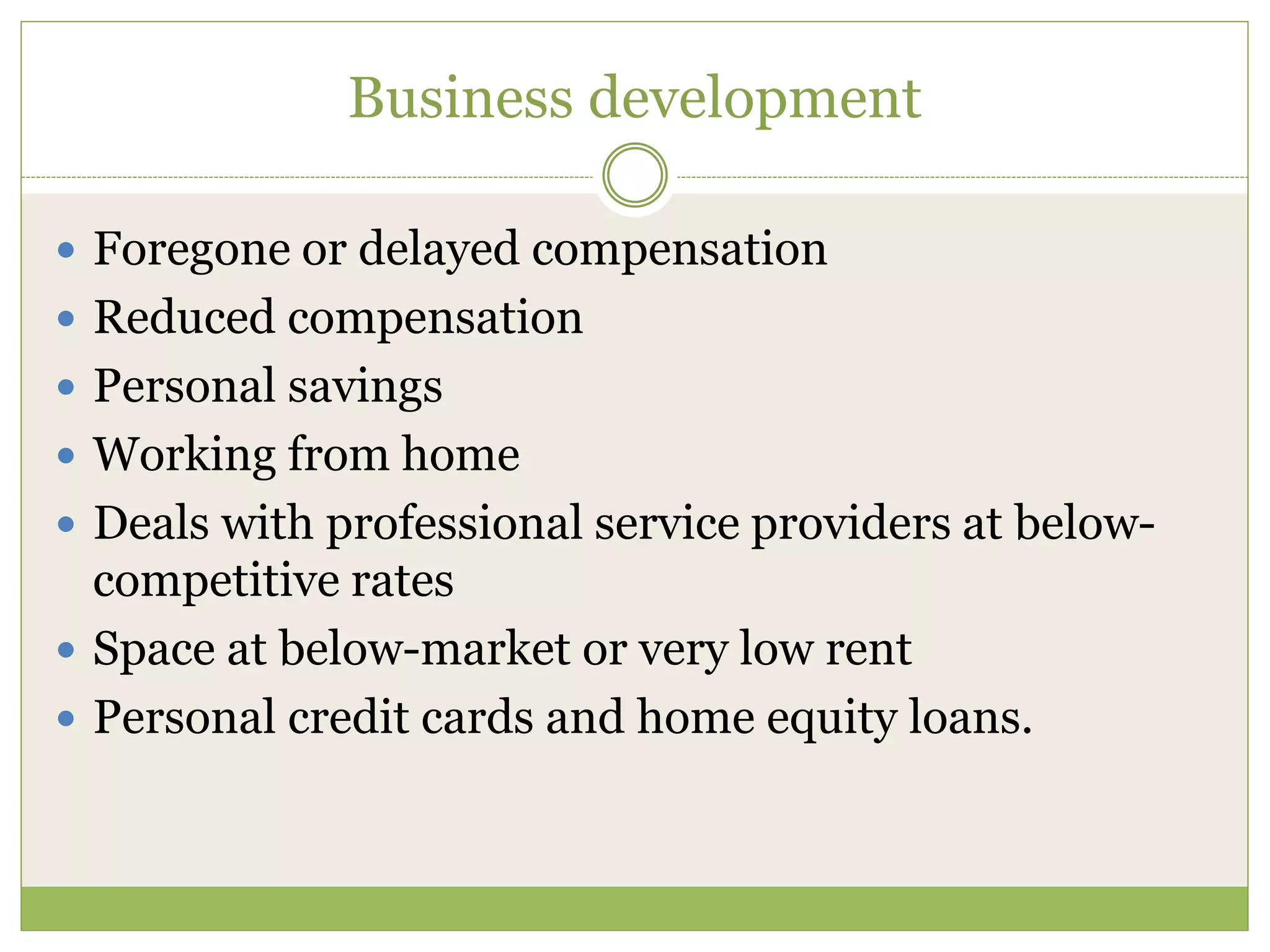
Business development 
 Foregone or delayed compensation 
 Reduced compensation 
 Personal savings 
 Working from home 
 Deals with professional service providers at below-competitive 
rates 
 Space at below-market or very low rent 
 Personal credit cards and home equity loans.
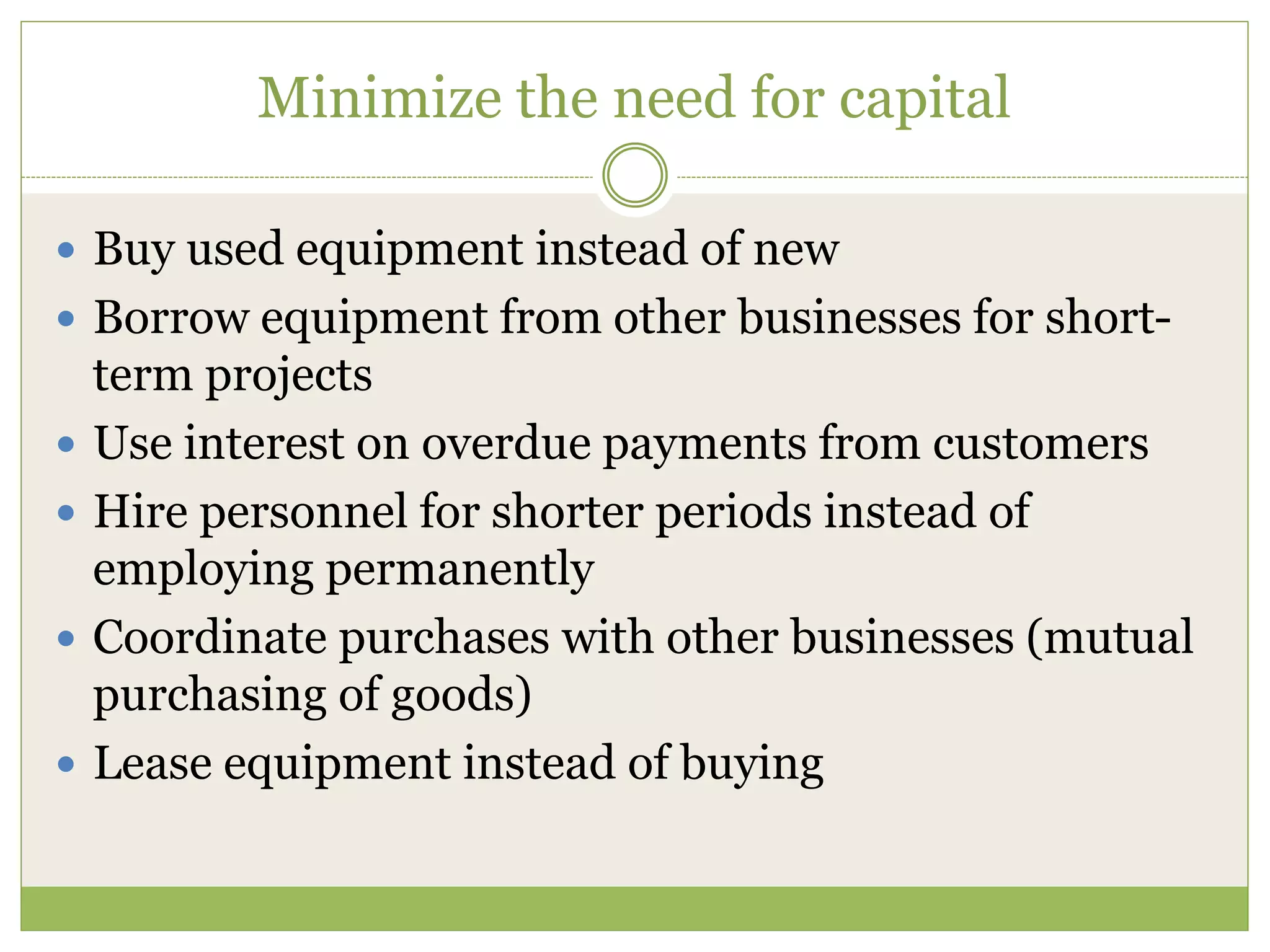
Minimize the need for capital 
 Buy used equipment instead of new 
 Borrow equipment from other businesses for short-term 
projects 
 Use interest on overdue payments from customers 
 Hire personnel for shorter periods instead of 
employing permanently 
 Coordinate purchases with other businesses (mutual 
purchasing of goods) 
 Lease equipment instead of buying
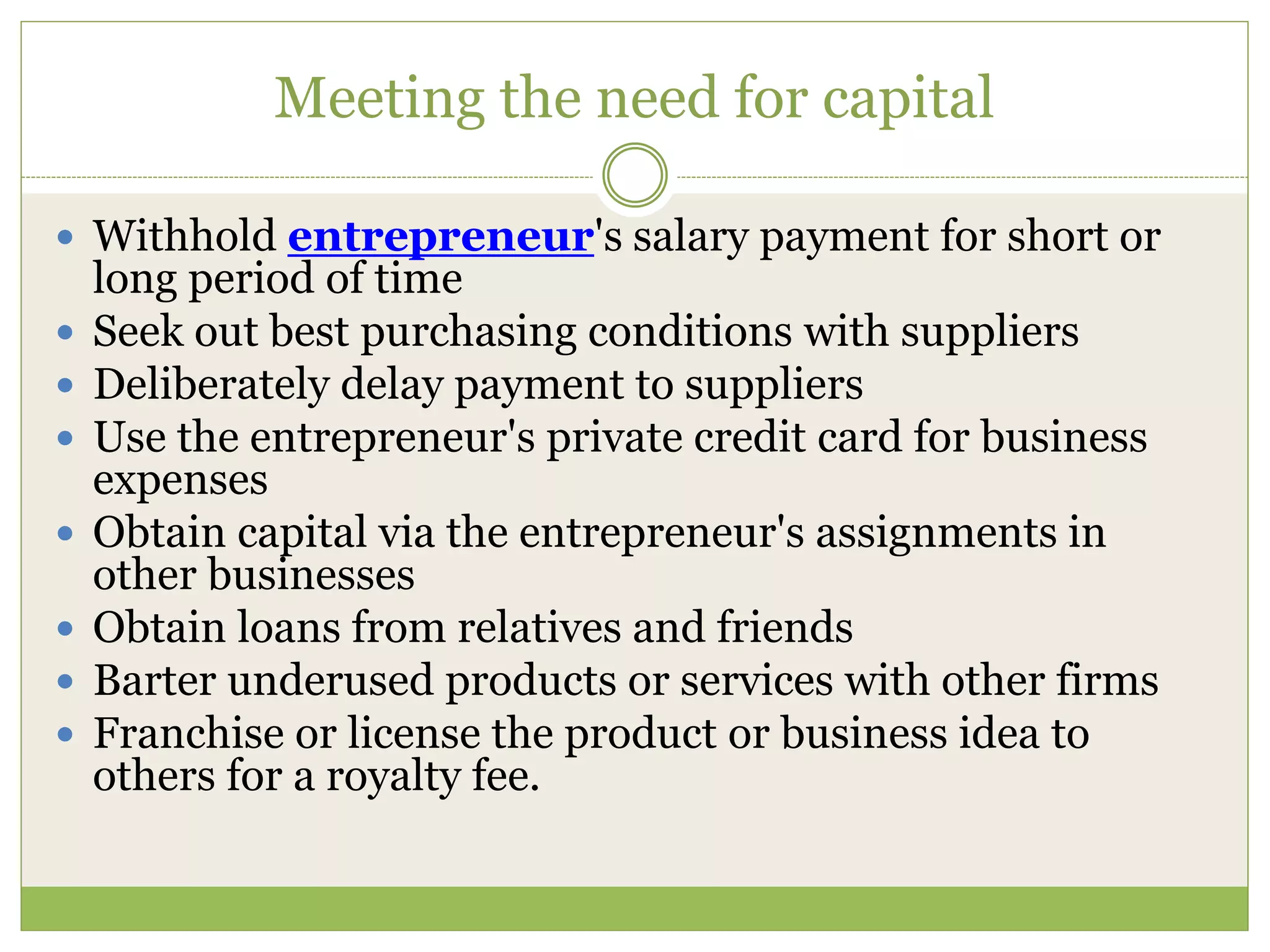
Meeting the need for capital 
 Withhold entrepreneur's salary payment for short or 
long period of time 
 Seek out best purchasing conditions with suppliers 
 Deliberately delay payment to suppliers 
 Use the entrepreneur's private credit card for business 
expenses 
 Obtain capital via the entrepreneur's assignments in 
other businesses 
 Obtain loans from relatives and friends 
 Barter underused products or services with other firms 
 Franchise or license the product or business idea to 
others for a royalty fee.
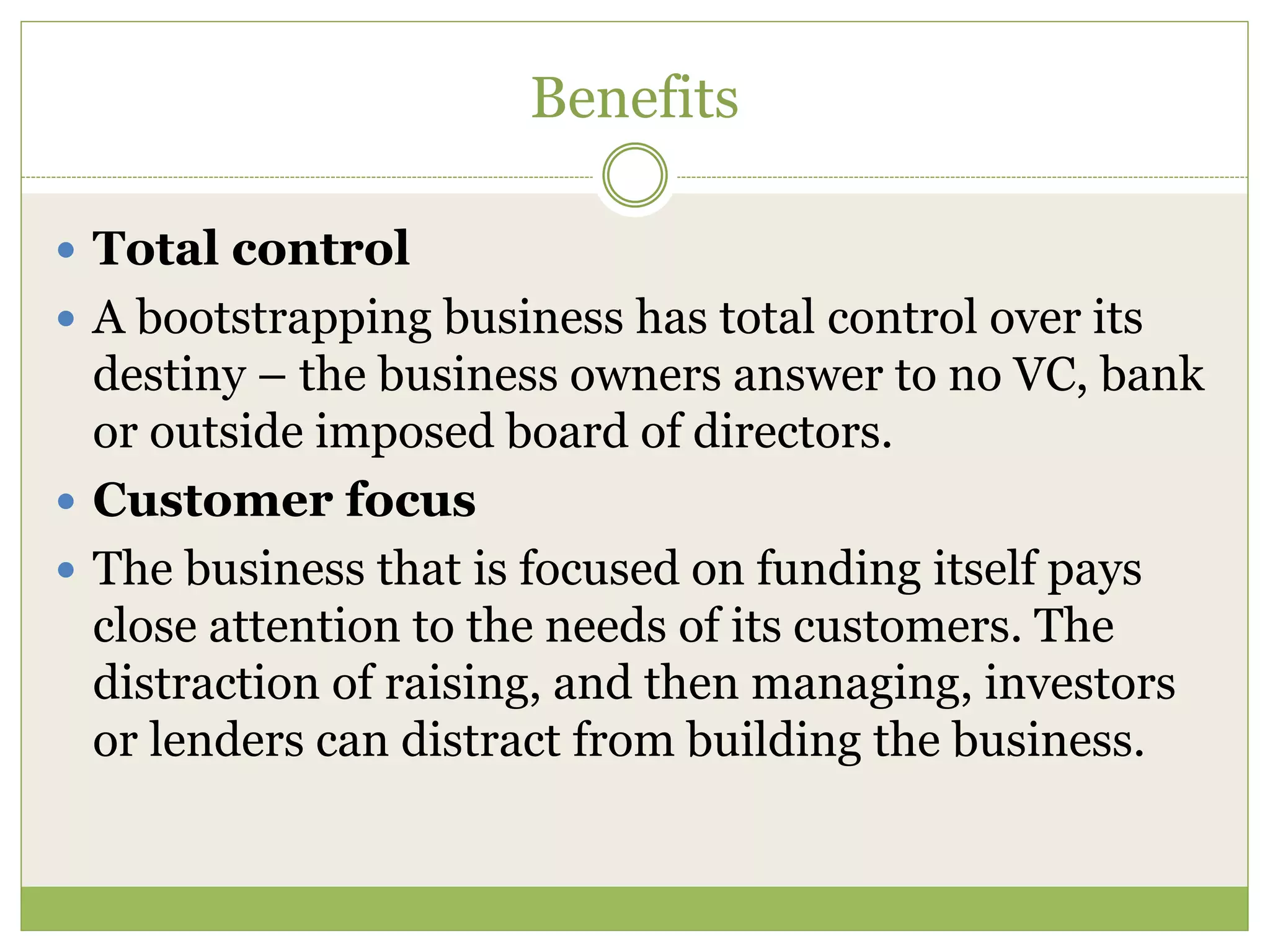
Benefits 
 Total control 
 A bootstrapping business has total control over its 
destiny – the business owners answer to no VC, bank 
or outside imposed board of directors. 
 Customer focus 
 The business that is focused on funding itself pays 
close attention to the needs of its customers. The 
distraction of raising, and then managing, investors 
or lenders can distract from building the business.
 Validating the business model 
 A successful business that has grown through 
funding itself is has, by definition, a valid and 
profitable business model. This is not necessarily 
true of VC or debt funded enterprises. 
 Overcapitalisition 
 “raise as much money as you can.”
DISADVNTAGES 
 Undercapitalisation 
 One of the main reasons for business failures is under 
capitalisation; simply not enough money to grow the 
enterprise or to put it on a sustainable footing. This is a 
constant risk for bootstrapped businesses. 
 Inability to focus 
 Many owners or managers of bootstrapped businessese 
focused on making sales so they can pay the rent and 
make payroll; this distracts management from executing 
the longer term aims of the business.
 Expertise 
 In taking an equity partner – either in private equity, 
venture capital or angel investor – the founders get the 
benefit of the investors’ expertise. 
 A good investor who has similar objectives to the 
founders can add real value and complement the original 
team’s strengths and weaknesses. 
 No one size fits all businesses 
 Overall there’s no black and white to bootstrapping 
versus borrowing money or finding an equity partner; all 
of them have their risks and benefits.
Flying on Empty 
 1. Get operational quickly. 
 2. Look for quick break-even, cash-generating projects. 
 3. Offer high-value products or services that can sustain 
direct personal selling. 
 4. Keep growth in check. Start-ups that failed because 
they could not fund their growth are legion 
 5. Focus on cash, not on profits, market share, or 
anything else 
 6. Cultivate banks before the business becomes 
creditworthy
Swot analysis 
 Strengths&Weaknesses 
 It's one thing to be able to sniff out opportunities, 
having the competencies to take advantage of them is 
just as important. You don't have to correct all of 
your business's weaknesses (that's usually 
impossible). The big question is whether or not you 
should stick to opportunities where your company 
has the necessary strengths, or whether your 
company should acquire or develop new strengths.
Opportunities &Threats 
 Opportunities are areas of buyer need where your 
company can perform profitably. The best opportunities 
are the ones that are relatively easy for the company to 
pursue and that have a high probability of success. 
 Threats are the challenges posed by unfavourable 
developments or trends that could lead to reduced 
profits. Examples of threats could include the 
development of a superior product by a competitor, a 
high chance of a prolonged economic depression or 
unfavourable government legislation. Of course, there 
could be many more.
Bootstrap (finance)

Bootstrap (finance)

  • 1.
    ACHARYA BANGALORE B SCHOOL SUBJECT:ENTREPRENEURSHIP TOPIC :BOOTSRAP PRESENTED BY MANIKANTA.M
  • 2.
  • 3.
    DEFINITION OF BOOTSTRAP (OFTEN THROUGH IMPROVISED MEANS)  ENTREPRENEUR STARTS A COMPANY WITH A LITTLE CAPITAL.AN INDIVIDUAL IS SAID TO BE BOOT STRAPPING WHEN HE OR SHE ATTEMPTS TO FOUND AND BUILD A COMPANY FROM PESONAL FINANCES OR FROM THE OPERATING REVENUES OF THE NEW COMPANY
  • 4.
    7 TIPS FORBOOTSRAPPING YOUR STARTUP  Test the Market  Efficiency  Keep the Team Small  Interns  Marketing  Outsourcing  Social Networks
  • 5.
    LIVE EXAMPLE OFBOOTSTRAPPING  In fact, as Gammalink’s founders learned, an entrepreneur’s time is rarely well spent courting investors. Despite a well-written business plan and excellent contacts, Lutz and his partner failed to attract venture capital in a year of trying. Eventually, they contributed $12,500 each to launch Gammalink. Years later, after their company was a proven success, it attracted $800,000 in unsolicited venture capital
  • 7.
    TYPES OF BOOTSTRAPFINANCING  Factoring  Trade credit  Customers  Real estate  Leasing
  • 8.
    Factoring  Usingaccounts receivable to generate cash flow by selling them to a ‘factor’ at a discount,in exchange for cash.
  • 9.
    Trade credit If your business can find a vedor or supplier to extend trade credit and allow you to order goods on net 30, 60, or 90 day terms, that is another form of bootstrap financing you could use. If your business is able to sell the goods before the payment is due, then you just generated cashflow without using any of your companies own cash.
  • 10.
    Customers  Yourbusiness can use a letter of credit from your customer to purchase materials without using any company resources. Just like when a contractor has their customer pay up front and then uses that money to buy the materials they need to complete the job.
  • 11.
    Real estate Leasing, refinancing, and borrowing against equity is a great way for a company to generate capital by using its own assets.
  • 12.
    Leasing  Freeup cash by leasing equipment rather than purchasing outright.
  • 13.
    Bootsrapping options Product development  Business development  Minimization of capital needed  Meeting the need for capital.
  • 14.
    Product development Prepaid licenses, royalties, or advances from customers  Special deals on access to product hardware  Development of product at night and on weekends while working elsewhere  Customer-funded research and development  Free or subsidized access to general hardware  Turning a consultant project into a commercial product.
  • 15.
    Business development Foregone or delayed compensation  Reduced compensation  Personal savings  Working from home  Deals with professional service providers at below-competitive rates  Space at below-market or very low rent  Personal credit cards and home equity loans.
  • 16.
    Minimize the needfor capital  Buy used equipment instead of new  Borrow equipment from other businesses for short-term projects  Use interest on overdue payments from customers  Hire personnel for shorter periods instead of employing permanently  Coordinate purchases with other businesses (mutual purchasing of goods)  Lease equipment instead of buying
  • 17.
    Meeting the needfor capital  Withhold entrepreneur's salary payment for short or long period of time  Seek out best purchasing conditions with suppliers  Deliberately delay payment to suppliers  Use the entrepreneur's private credit card for business expenses  Obtain capital via the entrepreneur's assignments in other businesses  Obtain loans from relatives and friends  Barter underused products or services with other firms  Franchise or license the product or business idea to others for a royalty fee.
  • 18.
    Benefits  Totalcontrol  A bootstrapping business has total control over its destiny – the business owners answer to no VC, bank or outside imposed board of directors.  Customer focus  The business that is focused on funding itself pays close attention to the needs of its customers. The distraction of raising, and then managing, investors or lenders can distract from building the business.
  • 19.
     Validating thebusiness model  A successful business that has grown through funding itself is has, by definition, a valid and profitable business model. This is not necessarily true of VC or debt funded enterprises.  Overcapitalisition  “raise as much money as you can.”
  • 20.
    DISADVNTAGES  Undercapitalisation  One of the main reasons for business failures is under capitalisation; simply not enough money to grow the enterprise or to put it on a sustainable footing. This is a constant risk for bootstrapped businesses.  Inability to focus  Many owners or managers of bootstrapped businessese focused on making sales so they can pay the rent and make payroll; this distracts management from executing the longer term aims of the business.
  • 21.
     Expertise In taking an equity partner – either in private equity, venture capital or angel investor – the founders get the benefit of the investors’ expertise.  A good investor who has similar objectives to the founders can add real value and complement the original team’s strengths and weaknesses.  No one size fits all businesses  Overall there’s no black and white to bootstrapping versus borrowing money or finding an equity partner; all of them have their risks and benefits.
  • 22.
    Flying on Empty  1. Get operational quickly.  2. Look for quick break-even, cash-generating projects.  3. Offer high-value products or services that can sustain direct personal selling.  4. Keep growth in check. Start-ups that failed because they could not fund their growth are legion  5. Focus on cash, not on profits, market share, or anything else  6. Cultivate banks before the business becomes creditworthy
  • 23.
    Swot analysis Strengths&Weaknesses  It's one thing to be able to sniff out opportunities, having the competencies to take advantage of them is just as important. You don't have to correct all of your business's weaknesses (that's usually impossible). The big question is whether or not you should stick to opportunities where your company has the necessary strengths, or whether your company should acquire or develop new strengths.
  • 24.
    Opportunities &Threats Opportunities are areas of buyer need where your company can perform profitably. The best opportunities are the ones that are relatively easy for the company to pursue and that have a high probability of success.  Threats are the challenges posed by unfavourable developments or trends that could lead to reduced profits. Examples of threats could include the development of a superior product by a competitor, a high chance of a prolonged economic depression or unfavourable government legislation. Of course, there could be many more.