BOOM AND BUST CYCLE
BEHAVIORAL INDICATORS
Submitted to-: Prof. Nirali Madam
THE TEAM
WHAT IS BOOM AND BUST?
• During the boom the economy grows, jobs
are plentiful and the market brings high
returns to investors. In the subsequent bust
the economy shrinks, people lose their jobs
and investors lose money. Boom-bust
cycles last for varying lengths of time; they
also vary in severity.
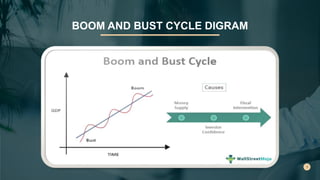
• The boom and bust cycle is a
process of economic expansion
and contraction that occurs
repeatedly.
The boom and bust cycle is a
key characteristic of capitalist
economies and is sometimes
synonymous with the business
cycle.
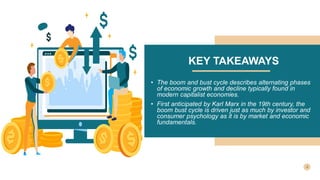
KEY TAKEAWAYS
• The boom and bust cycle describes alternating phases
of economic growth and decline typically found in
modern capitalist economies.
• First anticipated by Karl Marx in the 19th century, the
boom bust cycle is driven just as much by investor and
consumer psychology as it is by market and economic
fundamentals.
BOOM AND BUST CYCLE DIGRAM
WHAT ARE BEHAVIOURAL INDICATORS?
• Behavioural finance is the study of the influence of psychology
on the behaviour of investors or financial analysts. It also
includes the subsequent effects on the markets. It focuses on
the fact that investors are not always rational, have limits to
their self-control, and are influenced by their own biases
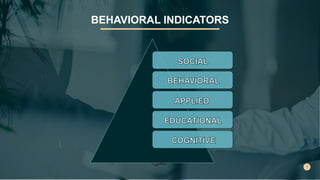
BEHAVIORAL INDICATORS
BEHAVIORAL INDICATORS OF COGNITIVE
Cognitive biases generally involve decision making based on
established concepts that may or may not be accurate. Think
of a cognitive bias as a rule of thumb that may or may not be
factual.
We’ve all seen movies where a thief wears a police uniform
to pass through a security checkpoint. The real police officers
assume that because the person is wearing a uniform like
theirs, he must be a real police officer. That’s an example of
a cognitive bias.
BEHAVIORAL INDICATORS OF SOCIAL FACTORS
While much of behavioural economics has been driven by cognitive
psychology, economic sociology indicates that there are also supra-
individual forces at work that drive investor behaviour. For instance, people
are more conservative when making investment decisions on behalf of
close others. Moreover, investors became even more conservative with
investments made in accounts that had culturally-salient labels such as
"retirement" or "college savings.“
BEHAVIORAL INDICATORS OF BEHAVIORAL
Investors are treated as “normal” not “rational”
They actually have limits to their self-control
Investors are influenced by their own biases
Investors make cognitive errors that can lead to wrong
decisions
THANK YOU!

BOOM AND BUST CYCLE 1 (1).pptx

  • 1.
    BOOM AND BUSTCYCLE BEHAVIORAL INDICATORS Submitted to-: Prof. Nirali Madam
  • 2.
  • 3.
    WHAT IS BOOMAND BUST? • During the boom the economy grows, jobs are plentiful and the market brings high returns to investors. In the subsequent bust the economy shrinks, people lose their jobs and investors lose money. Boom-bust cycles last for varying lengths of time; they also vary in severity. • The boom and bust cycle is a process of economic expansion and contraction that occurs repeatedly. The boom and bust cycle is a key characteristic of capitalist economies and is sometimes synonymous with the business cycle.
  • 4.
    KEY TAKEAWAYS • Theboom and bust cycle describes alternating phases of economic growth and decline typically found in modern capitalist economies. • First anticipated by Karl Marx in the 19th century, the boom bust cycle is driven just as much by investor and consumer psychology as it is by market and economic fundamentals.
  • 5.
    BOOM AND BUSTCYCLE DIGRAM
  • 6.
    WHAT ARE BEHAVIOURALINDICATORS? • Behavioural finance is the study of the influence of psychology on the behaviour of investors or financial analysts. It also includes the subsequent effects on the markets. It focuses on the fact that investors are not always rational, have limits to their self-control, and are influenced by their own biases
  • 7.
  • 8.
    BEHAVIORAL INDICATORS OFCOGNITIVE Cognitive biases generally involve decision making based on established concepts that may or may not be accurate. Think of a cognitive bias as a rule of thumb that may or may not be factual. We’ve all seen movies where a thief wears a police uniform to pass through a security checkpoint. The real police officers assume that because the person is wearing a uniform like theirs, he must be a real police officer. That’s an example of a cognitive bias.
  • 9.
    BEHAVIORAL INDICATORS OFSOCIAL FACTORS While much of behavioural economics has been driven by cognitive psychology, economic sociology indicates that there are also supra- individual forces at work that drive investor behaviour. For instance, people are more conservative when making investment decisions on behalf of close others. Moreover, investors became even more conservative with investments made in accounts that had culturally-salient labels such as "retirement" or "college savings.“
  • 10.
    BEHAVIORAL INDICATORS OFBEHAVIORAL Investors are treated as “normal” not “rational” They actually have limits to their self-control Investors are influenced by their own biases Investors make cognitive errors that can lead to wrong decisions
  • 11.