Basic Biostatistics
Statistics for Public Health Practice
B. Burt Gerstman
Professor
Department of Health Science
San Jose State University
San Jose, California
35809_FM_i-xviii.qxd 7/6/07 4:07 PM Page i
© Jones and Bartlett Publishers. NOT FOR SALE OR DISTRIBUTION
World Headquarters
Jones and Bartlett Publishers
40 Tall Pine Drive
Sudbury, MA 01776
978-443-5000
info@jbpub.com
www.jbpub.com
Jones and Bartlett’s books and products are available through most bookstores and online booksellers. To
contact Jones and Bartlett Publishers directly, call 800-832-0034, fax 978-443-8000, or visit our website
www.jbpub.com.
Substantial discounts on bulk quantities of Jones and Bartlett’s publications are available to corpora-
tions, professional associations, and other qualified organizations. For details and specific discount
information, contact the special sales department at Jones and Bartlett via the above contact informa-
tion or send an email to specialsales@jbpub.com.
Copyright © 2008 by Jones and Bartlett Publishers, Inc.
All rights reserved. No part of the material protected by this copyright may be reproduced or utilized in
any form, electronic or mechanical, including photocopying, recording, or by any information storage
and retrieval system, without written permission from the copyright owner.
This publication is designed to provide accurate and authoritative information in regard to the Subject
Matter covered. It is sold with the understanding that the publisher is not engaged in rendering legal,
accounting, or other professional service. If legal advice or other expert assistance is required, the service
of a competent professional person should be sought.
Production Credits
Publisher: Michael Brown
Associate Editor: Katey Birtcher
Production Director: Amy Rose
Production Editor: Tracey Chapman
Associate Production Editor: Rachel Rossi
Marketing Manager: Sophie Fleck
Manufacturing Buyer: Therese Connell
Library of Congress Cataloging-in-Publication Data
Gerstman, B. Burt.
Basic biostatistics : statistics for public health practice / B. Burt Gerstman.
p. ; cm.
Includes index.
ISBN-13: 978-0-7637-3580-7 (alk. paper)
ISBN-10: 0-7637-3580-9 (alk. paper)
1. Medical statistics. 2. Biometry. 3. Public health—Statistical methods. I. Title.
[DNLM: 1. Biometry—methods. 2. Public Health Practice. WA 950 G383b 2008]
RA409.G47 2008
362.1072'7—dc22
2007003334
6048
Printed in the United States of America
11 10 09 08 07 10 9 8 7 6 5 4 3 2 1
Composition: Graphic World, Inc.
Cover Design: Kristin E. Ohlin
Cover Image: © Sebastian Kaulitzki/
ShutterStock, Inc.; © Li Wa/ShutterStock, Inc.
Printing and Binding: Malloy, Inc
Cover Printing: Malloy, Inc
Jones and Bartlett Publishers
International
Barb House, Barb Mews
London W6 7PA
United Kingdom
Jones and Bartlett Publishers
Canada
6339 Ormindale Way
Mississauga, Ontario L5V 1J2
Canada
35809_FM_i-xviii.qxd 7/6/07 4:07 PM Page ii
© Jones and Bartlett Publishers. NOT FOR SALE OR DISTRIBUTION
To my mother, Bernadine, and in memory of my father, Joseph.
35809_FM_i-xviii.qxd 7/6/07 4:07 PM Page iii
© Jones and Bartlett Publishers. NOT FOR SALE OR DISTRIBUTION
35809_FM_i-xviii.qxd 7/6/07 4:07 PM Page iv
© Jones and Bartlett Publishers. NOT FOR SALE OR DISTRIBUTION
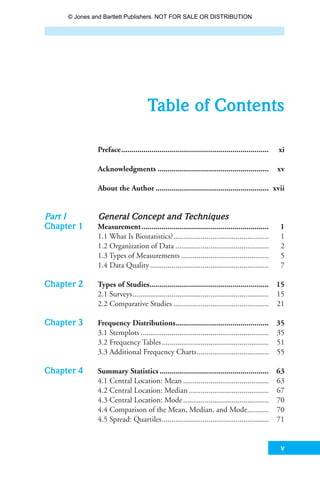
v
Preface......................................................................... xi
Acknowledgments ....................................................... xv
About the Author ........................................................ xvii
Part I General Concept and Techniques
Chapter 1 Measurement............................................................... 1
1.1 What Is Biostatistics?................................................. 1
1.2 Organization of Data ................................................ 2
1.3 Types of Measurements ............................................. 5
1.4 Data Quality............................................................. 7
Chapter 2 Types of Studies........................................................... 15
2.1 Surveys...................................................................... 15
2.2 Comparative Studies ................................................. 21
Chapter 3 Frequency Distributions.............................................. 35
3.1 Stemplots .................................................................. 35
3.2 Frequency Tables....................................................... 51
3.3 Additional Frequency Charts..................................... 55
Chapter 4 Summary Statistics...................................................... 63
4.1 Central Location: Mean ............................................ 63
4.2 Central Location: Median ......................................... 67
4.3 Central Location: Mode............................................ 70
4.4 Comparison of the Mean, Median, and Mode........... 70
4.5 Spread: Quartiles....................................................... 71
Table of Contents
35809_FM_i-xviii.qxd 7/6/07 4:07 PM Page v
© Jones and Bartlett Publishers. NOT FOR SALE OR DISTRIBUTION
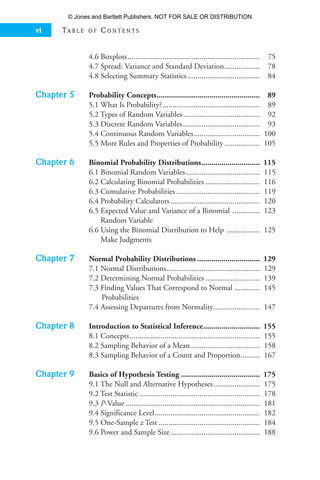
4.6 Boxplots.................................................................... 75
4.7 Spread: Variance and Standard Deviation.................. 78
4.8 Selecting Summary Statistics ..................................... 84
Chapter 5 Probability Concepts................................................... 89
5.1 What Is Probability?.................................................. 89
5.2 Types of Random Variables ....................................... 92
5.3 Discrete Random Variables........................................ 93
5.4 Continuous Random Variables.................................. 100
5.5 More Rules and Properties of Probability .................. 105
Chapter 6 Binomial Probability Distributions............................. 115
6.1 Binomial Random Variables...................................... 115
6.2 Calculating Binomial Probabilities ............................ 116
6.3 Cumulative Probabilities ........................................... 119
6.4 Probability Calculators.............................................. 120
6.5 Expected Value and Variance of a Binomial .............. 123
Random Variable
6.6 Using the Binomial Distribution to Help ................. 125
Make Judgments
Chapter 7 Normal Probability Distributions ............................... 129
7.1 Normal Distributions................................................ 129
7.2 Determining Normal Probabilities ............................ 139
7.3 Finding Values That Correspond to Normal ............. 145
Probabilities
7.4 Assessing Departures from Normality........................ 147
Chapter 8 Introduction to Statistical Inference............................ 155
8.1 Concepts................................................................... 155
8.2 Sampling Behavior of a Mean.................................... 158
8.3 Sampling Behavior of a Count and Proportion.......... 167
Chapter 9 Basics of Hypothesis Testing ....................................... 175
9.1 The Null and Alternative Hypotheses........................ 175
9.2 Test Statistic .............................................................. 178
9.3 P-Value ..................................................................... 181
9.4 Significance Level...................................................... 182
9.5 One-Sample z Test .................................................... 184
9.6 Power and Sample Size.............................................. 188
vi TA B L E O F C O N T E N T S
35809_FM_i-xviii.qxd 7/6/07 4:07 PM Page vi
© Jones and Bartlett Publishers. NOT FOR SALE OR DISTRIBUTION
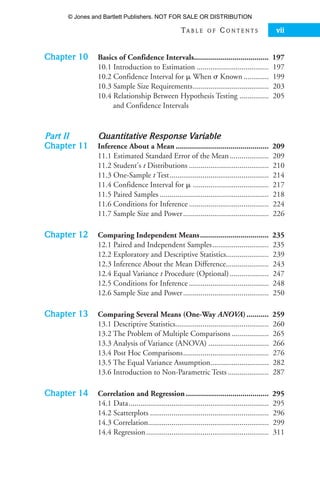
Chapter 10 Basics of Confidence Intervals..................................... 197
10.1 Introduction to Estimation ..................................... 197
10.2 Confidence Interval for  When  Known............. 199
10.3 Sample Size Requirements....................................... 203
10.4 Relationship Between Hypothesis Testing ............... 205
and Confidence Intervals
Part II Quantitative Response Variable
Chapter 11 Inference About a Mean .............................................. 209
11.1 Estimated Standard Error of the Mean .................... 209
11.2 Student's t Distributions ......................................... 210
11.3 One-Sample t Test................................................... 214
11.4 Confidence Interval for  ....................................... 217
11.5 Paired Samples ........................................................ 218
11.6 Conditions for Inference ......................................... 224
11.7 Sample Size and Power............................................ 226
Chapter 12 Comparing Independent Means.................................. 235
12.1 Paired and Independent Samples............................. 235
12.2 Exploratory and Descriptive Statistics...................... 239
12.3 Inference About the Mean Difference...................... 243
12.4 Equal Variance t Procedure (Optional).................... 247
12.5 Conditions for Inference ......................................... 248
12.6 Sample Size and Power............................................ 250
Chapter 13 Comparing Several Means (One-Way ANOVA)........... 259
13.1 Descriptive Statistics................................................ 260
13.2 The Problem of Multiple Comparisons ................... 265
13.3 Analysis of Variance (ANOVA) ............................... 266
13.4 Post Hoc Comparisons............................................ 276
13.5 The Equal Variance Assumption.............................. 282
13.6 Introduction to Non-Parametric Tests ..................... 287
Chapter 14 Correlation and Regression......................................... 295
14.1 Data........................................................................ 295
14.2 Scatterplots ............................................................. 296
14.3 Correlation.............................................................. 299
14.4 Regression............................................................... 311
TA B L E O F C O N T E N T S vii
35809_FM_i-xviii.qxd 7/6/07 4:07 PM Page vii
© Jones and Bartlett Publishers. NOT FOR SALE OR DISTRIBUTION
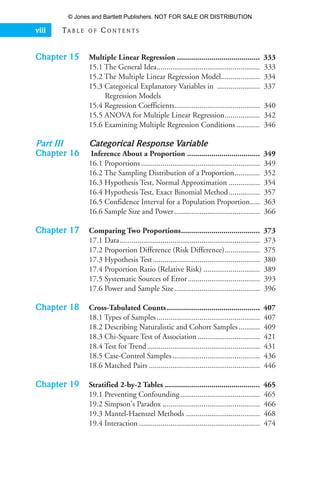
viii TA B L E O F C O N T E N T S
Chapter 15 Multiple Linear Regression ......................................... 333
15.1 The General Idea..................................................... 333
15.2 The Multiple Linear Regression Model.................... 334
15.3 Categorical Explanatory Variables in ...................... 337
Regression Models
15.4 Regression Coefficients............................................ 340
15.5 ANOVA for Multiple Linear Regression.................. 342
15.6 Examining Multiple Regression Conditions ............ 346
Part III Categorical Response Variable
Chapter 16 Inference About a Proportion .................................... 349
16.1 Proportions ............................................................. 349
16.2 The Sampling Distribution of a Proportion............. 352
16.3 Hypothesis Test, Normal Approximation ................ 354
16.4 Hypothesis Test, Exact Binomial Method................ 357
16.5 Confidence Interval for a Population Proportion..... 363
16.6 Sample Size and Power............................................ 366
Chapter 17 Comparing Two Proportions....................................... 373
17.1 Data........................................................................ 373
17.2 Proportion Difference (Risk Difference).................. 375
17.3 Hypothesis Test....................................................... 380
17.4 Proportion Ratio (Relative Risk) ............................. 389
17.5 Systematic Sources of Error..................................... 393
17.6 Power and Sample Size............................................ 396
Chapter 18 Cross-Tabulated Counts.............................................. 407
18.1 Types of Samples..................................................... 407
18.2 Describing Naturalistic and Cohort Samples........... 409
18.3 Chi-Square Test of Association................................ 421
18.4 Test for Trend.......................................................... 431
18.5 Case-Control Samples............................................. 436
18.6 Matched Pairs ......................................................... 446
Chapter 19 Stratified 2-by-2 Tables ............................................... 465
19.1 Preventing Confounding......................................... 465
19.2 Simpson's Paradox .................................................. 466
19.3 Mantel-Haenszel Methods ...................................... 468
19.4 Interaction .............................................................. 474
35809_FM_i-xviii.qxd 7/6/07 4:07 PM Page viii
© Jones and Bartlett Publishers. NOT FOR SALE OR DISTRIBUTION
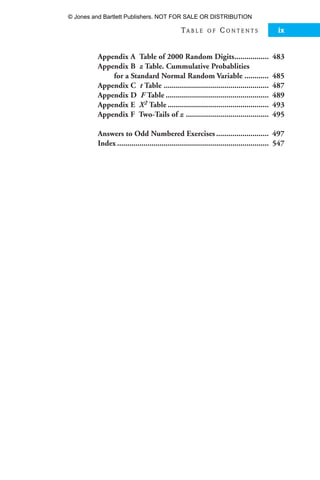
Appendix A Table of 2000 Random Digits................. 483
Appendix B z Table. Cummulative Probablities
for a Standard Normal Random Variable ............ 485
Appendix C t Table .................................................... 487
Appendix D F Table ................................................... 489
Appendix E X2 Table .................................................. 493
Appendix F Two-Tails of z ......................................... 495
Answers to Odd Numbered Exercises .......................... 497
Index ........................................................................... 547
TA B L E O F C O N T E N T S ix
35809_FM_i-xviii.qxd 7/6/07 4:07 PM Page ix
© Jones and Bartlett Publishers. NOT FOR SALE OR DISTRIBUTION
35809_FM_i-xviii.qxd 7/6/07 4:07 PM Page x
© Jones and Bartlett Publishers. NOT FOR SALE OR DISTRIBUTION
xi
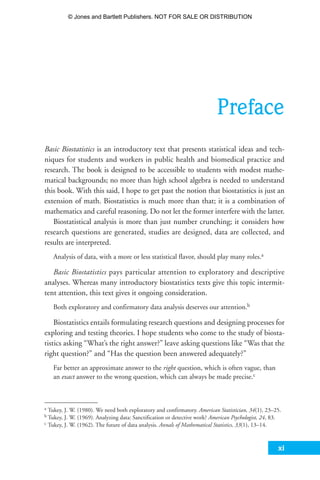
Preface
Basic Biostatistics is an introductory text that presents statistical ideas and tech-
niques for students and workers in public health and biomedical practice and
research. The book is designed to be accessible to students with modest mathe-
matical backgrounds; no more than high school algebra is needed to understand
this book. With this said, I hope to get past the notion that biostatistics is just an
extension of math. Biostatistics is much more than that; it is a combination of
mathematics and careful reasoning. Do not let the former interfere with the latter.
Biostatistical analysis is more than just number crunching; it considers how
research questions are generated, studies are designed, data are collected, and
results are interpreted.
Analysis of data, with a more or less statistical flavor, should play many roles.a
Basic Biostatistics pays particular attention to exploratory and descriptive
analyses. Whereas many introductory biostatistics texts give this topic intermit-
tent attention, this text gives it ongoing consideration.
Both exploratory and confirmatory data analysis deserves our attention.b
Biostatistics entails formulating research questions and designing processes for
exploring and testing theories. I hope students who come to the study of biosta-
tistics asking “What’s the right answer?” leave asking questions like “Was that the
right question?” and “Has the question been answered adequately?”
Far better an approximate answer to the right question, which is often vague, than
an exact answer to the wrong question, which can always be made precise.c
xi
a Tukey, J. W. (1980). We need both exploratory and confirmatory. American Statistician, 34(1), 23–25.
b Tukey, J. W. (1969). Analyzing data: Sanctification or detective work? American Psychologist, 24, 83.
c Tukey, J. W. (1962). The future of data analysis. Annals of Mathematical Statistics, 33(1), 13–14.
35809_FM_i-xviii.qxd 7/6/07 4:07 PM Page xi
© Jones and Bartlett Publishers. NOT FOR SALE OR DISTRIBUTION
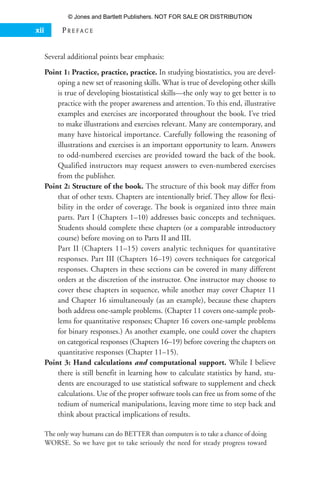
Several additional points bear emphasis:
Point 1: Practice, practice, practice. In studying biostatistics, you are devel-
oping a new set of reasoning skills. What is true of developing other skills
is true of developing biostatistical skills—the only way to get better is to
practice with the proper awareness and attention. To this end, illustrative
examples and exercises are incorporated throughout the book. I’ve tried
to make illustrations and exercises relevant. Many are contemporary, and
many have historical importance. Carefully following the reasoning of
illustrations and exercises is an important opportunity to learn. Answers
to odd-numbered exercises are provided toward the back of the book.
Qualified instructors may request answers to even-numbered exercises
from the publisher.
Point 2: Structure of the book. The structure of this book may differ from
that of other texts. Chapters are intentionally brief. They allow for flexi-
bility in the order of coverage. The book is organized into three main
parts. Part I (Chapters 1–10) addresses basic concepts and techniques.
Students should complete these chapters (or a comparable introductory
course) before moving on to Parts II and III.
Part II (Chapters 11–15) covers analytic techniques for quantitative
responses. Part III (Chapters 16–19) covers techniques for categorical
responses. Chapters in these sections can be covered in many different
orders at the discretion of the instructor. One instructor may choose to
cover these chapters in sequence, while another may cover Chapter 11
and Chapter 16 simultaneously (as an example), because these chapters
both address one-sample problems. (Chapter 11 covers one-sample prob-
lems for quantitative responses; Chapter 16 covers one-sample problems
for binary responses.) As another example, one could cover the chapters
on categorical responses (Chapters 16–19) before covering the chapters on
quantitative responses (Chapter 11–15).
Point 3: Hand calculations and computational support. While I believe
there is still benefit in learning how to calculate statistics by hand, stu-
dents are encouraged to use statistical software to supplement and check
calculations. Use of the proper software tools can free us from some of the
tedium of numerical manipulations, leaving more time to step back and
think about practical implications of results.
The only way humans can do BETTER than computers is to take a chance of doing
WORSE. So we have got to take seriously the need for steady progress toward
xii P R E F A C E
35809_FM_i-xviii.qxd 7/6/07 4:07 PM Page xii
© Jones and Bartlett Publishers. NOT FOR SALE OR DISTRIBUTION
teaching routine procedures to computers rather than to people. That will leave the
teachers of people with only things hard to teach, but this is our proper fate.d
The book is not tied to any particular software package, but does make fre-
quent use of these three programs: StaTable, SPSS, and WinPepi.
● StaTablee is a freeware program that provides access to 25 commonly used
statistical distributions. It is runs on Windows, Palm, and Web-browser
(Java) platforms. This utility eliminates the need to look up probabilities in
hard-copy tables. It also allows for more exact interpolations for probabili-
ties, especially for continuous random variables. The website for this book
includess a link to the StaTable website.
● SPSSf is a commercial software package with versions that run on Windows
and MacIntosh computers. A student version of the program can be pur-
chased at most campus bookstores. It can also be purchased online at
www.journeyed.com. An economical alternative to purchasing the product
is to lease it for short-term use through the Web site www.e-academy.com.
● WinPepig stands for WINdows Programs for EPIdemiologists. This is a
series of computer programs written by Joe Abramson of the Hebrew
University–Hadassah School of Public Health and Community Medicine,
(Jerusalem, Israel) and Paul Gahlinger (University of Utah in Salt Lake
City). The programs are designed for use in practice, but are also excellent
learning aids. WinPepi is free and can be downloaded from the website for
this book: http://publichealth.jbpub.com/book/gerstman.
P R E F A C E xiii
d Tukey, J. W. (1980). We need both exploratory and confirmatory. American Statistician, 34, 23–25.
e www.cytel.com/Products/StaTable/, Cytel Inc., 675 Massachusetts Ave., Cambridge, Massachusetts
02139.
f SPSS, Inc., Chicago, IL.
g Abramson, J. H. (2004). WINPEPI (PEPI-for-Windows): Computer programs for epidemiologists.
Epidemiologic Perspectives  Innovations, 1(1), 6.
35809_FM_i-xviii.qxd 7/6/07 4:07 PM Page xiii
© Jones and Bartlett Publishers. NOT FOR SALE OR DISTRIBUTION
35809_FM_i-xviii.qxd 7/6/07 4:07 PM Page xiv
© Jones and Bartlett Publishers. NOT FOR SALE OR DISTRIBUTION
xv
Acknowledgments
I wish to express my appreciation to San Jose State University for affording me
the leave to work on this book. I would especially like to thank the chair of my
department, Kathleen Roe, and dean of my college, Inger Sagatun-Edwards, for
administrative support in this regard. I am grateful to the colleagues in my
department who taught many of my classes during my absence, especially Jane
Pham, Dan Perales, Jenny McNeill, and to those who covered other duties,
including Ramani Rangavajhula, Nancy Hikoyeda, Polly Bith-Melander, and
Edward Mamary. I greatly appreciate the artistic and technical support of Jean
Shiota of the Center for Faculty Development for her work in preparing illustra-
tions for the text. Thanks, Jean. Finally, I wish to express my thanks to those
many students in my classes over the years who have provided me with helpful
comments, encouragement, and camaraderie.
While writing this book, I had many constructive discussions with Joe
Abramson of the Department of Social Medicine, Hebrew University–Hadassah
School of Public Health and Community Medicine. I thank Joe for sharing his
insights generously. I also greatly appreciate his careful work in developing
WINdows Programs for EPIdemiologists.i This is really an exceptional set of
programs for public health workers. Along these same lines, Paul Gahlinger
(University of Utah) deserves credit for conceiving and creating the progenitor of
WinPepi, PEPI (Programs for EPIdemiologists).j I also wish to express my thanks
to Mads Haahr (University of Dublin, Trinity College, Ireland) for creating his
true random number generator at www.random.org and to John C. Pezzullo
xv
i Abramson, J. H. (2004). WINPEPI (PEPI-for-Windows): Computer programs for epidemiologists.
Epidemiologic Perspectives  Innovations, 1(1), 6.
j Abramson, J. H.,  Gahlinger, P. M. (2001). Computer Programs for Epidemiologic Analyses: PEPI
v. 4.0. Salt Lake City, UT: Sagebrush Press.
35809_FM_i-xviii.qxd 7/6/07 4:07 PM Page xv
© Jones and Bartlett Publishers. NOT FOR SALE OR DISTRIBUTION
(Georgetown University) for his helpful compilation of web pages that perform
statistical calculations at www.statpages.org.
Finally, I would like to acknowledge the contributions of my wife, who has
been patient, understanding, supportative, and encouraging throughout the
work on this marathon project. As Ralph Kramden (Jackie Gleason) used to tell
his wife Alice (Audrey Meadows), “[Honey], you’re the greatest!”
xvi A C K N O W L E D G M E N T S
35809_FM_i-xviii.qxd 7/6/07 4:07 PM Page xvi
© Jones and Bartlett Publishers. NOT FOR SALE OR DISTRIBUTION
xvii
About the Author
Dr. Gerstman did his undergraduate work at Harpur College (State University of
New York, Binghamton). He later received a doctor of veterinary medicine
(Cornell University), a masters of public health (University of California at
Berkeley), and a doctor of philosophy degree (University of California, Davis).
He has been a U.S. Public Health Service Epidemiology Fellow and epidemiolo-
gist at the U.S. Food and Drug Administration and was an instructor at the
National Institutes of Health Foundation Graduate School. Since 1990, Dr.
Gerstman has been a professor in the Department of Health Science at San Jose
State University where he teaches epidemiology, biostatistics, and general educa-
tion courses. Dr. Gerstman’s research interests are in the areas of epidemiologic
methods, the history of public health, drug safety, and medical and public health
record linkage.
35809_FM_i-xviii.qxd 7/6/07 4:07 PM Page xvii
© Jones and Bartlett Publishers. NOT FOR SALE OR DISTRIBUTION
35809_FM_i-xviii.qxd 7/6/07 4:07 PM Page xviii
© Jones and Bartlett Publishers. NOT FOR SALE OR DISTRIBUTION

Book ON Basic type of Biostatistics.pdf

  • 1.
    Basic Biostatistics Statistics forPublic Health Practice B. Burt Gerstman Professor Department of Health Science San Jose State University San Jose, California 35809_FM_i-xviii.qxd 7/6/07 4:07 PM Page i © Jones and Bartlett Publishers. NOT FOR SALE OR DISTRIBUTION
  • 2.
    World Headquarters Jones andBartlett Publishers 40 Tall Pine Drive Sudbury, MA 01776 978-443-5000 info@jbpub.com www.jbpub.com Jones and Bartlett’s books and products are available through most bookstores and online booksellers. To contact Jones and Bartlett Publishers directly, call 800-832-0034, fax 978-443-8000, or visit our website www.jbpub.com. Substantial discounts on bulk quantities of Jones and Bartlett’s publications are available to corpora- tions, professional associations, and other qualified organizations. For details and specific discount information, contact the special sales department at Jones and Bartlett via the above contact informa- tion or send an email to specialsales@jbpub.com. Copyright © 2008 by Jones and Bartlett Publishers, Inc. All rights reserved. No part of the material protected by this copyright may be reproduced or utilized in any form, electronic or mechanical, including photocopying, recording, or by any information storage and retrieval system, without written permission from the copyright owner. This publication is designed to provide accurate and authoritative information in regard to the Subject Matter covered. It is sold with the understanding that the publisher is not engaged in rendering legal, accounting, or other professional service. If legal advice or other expert assistance is required, the service of a competent professional person should be sought. Production Credits Publisher: Michael Brown Associate Editor: Katey Birtcher Production Director: Amy Rose Production Editor: Tracey Chapman Associate Production Editor: Rachel Rossi Marketing Manager: Sophie Fleck Manufacturing Buyer: Therese Connell Library of Congress Cataloging-in-Publication Data Gerstman, B. Burt. Basic biostatistics : statistics for public health practice / B. Burt Gerstman. p. ; cm. Includes index. ISBN-13: 978-0-7637-3580-7 (alk. paper) ISBN-10: 0-7637-3580-9 (alk. paper) 1. Medical statistics. 2. Biometry. 3. Public health—Statistical methods. I. Title. [DNLM: 1. Biometry—methods. 2. Public Health Practice. WA 950 G383b 2008] RA409.G47 2008 362.1072'7—dc22 2007003334 6048 Printed in the United States of America 11 10 09 08 07 10 9 8 7 6 5 4 3 2 1 Composition: Graphic World, Inc. Cover Design: Kristin E. Ohlin Cover Image: © Sebastian Kaulitzki/ ShutterStock, Inc.; © Li Wa/ShutterStock, Inc. Printing and Binding: Malloy, Inc Cover Printing: Malloy, Inc Jones and Bartlett Publishers International Barb House, Barb Mews London W6 7PA United Kingdom Jones and Bartlett Publishers Canada 6339 Ormindale Way Mississauga, Ontario L5V 1J2 Canada 35809_FM_i-xviii.qxd 7/6/07 4:07 PM Page ii © Jones and Bartlett Publishers. NOT FOR SALE OR DISTRIBUTION
  • 3.
    To my mother,Bernadine, and in memory of my father, Joseph. 35809_FM_i-xviii.qxd 7/6/07 4:07 PM Page iii © Jones and Bartlett Publishers. NOT FOR SALE OR DISTRIBUTION
  • 4.
    35809_FM_i-xviii.qxd 7/6/07 4:07PM Page iv © Jones and Bartlett Publishers. NOT FOR SALE OR DISTRIBUTION
  • 5.
    v Preface......................................................................... xi Acknowledgments .......................................................xv About the Author ........................................................ xvii Part I General Concept and Techniques Chapter 1 Measurement............................................................... 1 1.1 What Is Biostatistics?................................................. 1 1.2 Organization of Data ................................................ 2 1.3 Types of Measurements ............................................. 5 1.4 Data Quality............................................................. 7 Chapter 2 Types of Studies........................................................... 15 2.1 Surveys...................................................................... 15 2.2 Comparative Studies ................................................. 21 Chapter 3 Frequency Distributions.............................................. 35 3.1 Stemplots .................................................................. 35 3.2 Frequency Tables....................................................... 51 3.3 Additional Frequency Charts..................................... 55 Chapter 4 Summary Statistics...................................................... 63 4.1 Central Location: Mean ............................................ 63 4.2 Central Location: Median ......................................... 67 4.3 Central Location: Mode............................................ 70 4.4 Comparison of the Mean, Median, and Mode........... 70 4.5 Spread: Quartiles....................................................... 71 Table of Contents 35809_FM_i-xviii.qxd 7/6/07 4:07 PM Page v © Jones and Bartlett Publishers. NOT FOR SALE OR DISTRIBUTION
  • 6.
    4.6 Boxplots.................................................................... 75 4.7Spread: Variance and Standard Deviation.................. 78 4.8 Selecting Summary Statistics ..................................... 84 Chapter 5 Probability Concepts................................................... 89 5.1 What Is Probability?.................................................. 89 5.2 Types of Random Variables ....................................... 92 5.3 Discrete Random Variables........................................ 93 5.4 Continuous Random Variables.................................. 100 5.5 More Rules and Properties of Probability .................. 105 Chapter 6 Binomial Probability Distributions............................. 115 6.1 Binomial Random Variables...................................... 115 6.2 Calculating Binomial Probabilities ............................ 116 6.3 Cumulative Probabilities ........................................... 119 6.4 Probability Calculators.............................................. 120 6.5 Expected Value and Variance of a Binomial .............. 123 Random Variable 6.6 Using the Binomial Distribution to Help ................. 125 Make Judgments Chapter 7 Normal Probability Distributions ............................... 129 7.1 Normal Distributions................................................ 129 7.2 Determining Normal Probabilities ............................ 139 7.3 Finding Values That Correspond to Normal ............. 145 Probabilities 7.4 Assessing Departures from Normality........................ 147 Chapter 8 Introduction to Statistical Inference............................ 155 8.1 Concepts................................................................... 155 8.2 Sampling Behavior of a Mean.................................... 158 8.3 Sampling Behavior of a Count and Proportion.......... 167 Chapter 9 Basics of Hypothesis Testing ....................................... 175 9.1 The Null and Alternative Hypotheses........................ 175 9.2 Test Statistic .............................................................. 178 9.3 P-Value ..................................................................... 181 9.4 Significance Level...................................................... 182 9.5 One-Sample z Test .................................................... 184 9.6 Power and Sample Size.............................................. 188 vi TA B L E O F C O N T E N T S 35809_FM_i-xviii.qxd 7/6/07 4:07 PM Page vi © Jones and Bartlett Publishers. NOT FOR SALE OR DISTRIBUTION
  • 7.
    Chapter 10 Basicsof Confidence Intervals..................................... 197 10.1 Introduction to Estimation ..................................... 197 10.2 Confidence Interval for When Known............. 199 10.3 Sample Size Requirements....................................... 203 10.4 Relationship Between Hypothesis Testing ............... 205 and Confidence Intervals Part II Quantitative Response Variable Chapter 11 Inference About a Mean .............................................. 209 11.1 Estimated Standard Error of the Mean .................... 209 11.2 Student's t Distributions ......................................... 210 11.3 One-Sample t Test................................................... 214 11.4 Confidence Interval for ....................................... 217 11.5 Paired Samples ........................................................ 218 11.6 Conditions for Inference ......................................... 224 11.7 Sample Size and Power............................................ 226 Chapter 12 Comparing Independent Means.................................. 235 12.1 Paired and Independent Samples............................. 235 12.2 Exploratory and Descriptive Statistics...................... 239 12.3 Inference About the Mean Difference...................... 243 12.4 Equal Variance t Procedure (Optional).................... 247 12.5 Conditions for Inference ......................................... 248 12.6 Sample Size and Power............................................ 250 Chapter 13 Comparing Several Means (One-Way ANOVA)........... 259 13.1 Descriptive Statistics................................................ 260 13.2 The Problem of Multiple Comparisons ................... 265 13.3 Analysis of Variance (ANOVA) ............................... 266 13.4 Post Hoc Comparisons............................................ 276 13.5 The Equal Variance Assumption.............................. 282 13.6 Introduction to Non-Parametric Tests ..................... 287 Chapter 14 Correlation and Regression......................................... 295 14.1 Data........................................................................ 295 14.2 Scatterplots ............................................................. 296 14.3 Correlation.............................................................. 299 14.4 Regression............................................................... 311 TA B L E O F C O N T E N T S vii 35809_FM_i-xviii.qxd 7/6/07 4:07 PM Page vii © Jones and Bartlett Publishers. NOT FOR SALE OR DISTRIBUTION
  • 8.
    viii TA BL E O F C O N T E N T S Chapter 15 Multiple Linear Regression ......................................... 333 15.1 The General Idea..................................................... 333 15.2 The Multiple Linear Regression Model.................... 334 15.3 Categorical Explanatory Variables in ...................... 337 Regression Models 15.4 Regression Coefficients............................................ 340 15.5 ANOVA for Multiple Linear Regression.................. 342 15.6 Examining Multiple Regression Conditions ............ 346 Part III Categorical Response Variable Chapter 16 Inference About a Proportion .................................... 349 16.1 Proportions ............................................................. 349 16.2 The Sampling Distribution of a Proportion............. 352 16.3 Hypothesis Test, Normal Approximation ................ 354 16.4 Hypothesis Test, Exact Binomial Method................ 357 16.5 Confidence Interval for a Population Proportion..... 363 16.6 Sample Size and Power............................................ 366 Chapter 17 Comparing Two Proportions....................................... 373 17.1 Data........................................................................ 373 17.2 Proportion Difference (Risk Difference).................. 375 17.3 Hypothesis Test....................................................... 380 17.4 Proportion Ratio (Relative Risk) ............................. 389 17.5 Systematic Sources of Error..................................... 393 17.6 Power and Sample Size............................................ 396 Chapter 18 Cross-Tabulated Counts.............................................. 407 18.1 Types of Samples..................................................... 407 18.2 Describing Naturalistic and Cohort Samples........... 409 18.3 Chi-Square Test of Association................................ 421 18.4 Test for Trend.......................................................... 431 18.5 Case-Control Samples............................................. 436 18.6 Matched Pairs ......................................................... 446 Chapter 19 Stratified 2-by-2 Tables ............................................... 465 19.1 Preventing Confounding......................................... 465 19.2 Simpson's Paradox .................................................. 466 19.3 Mantel-Haenszel Methods ...................................... 468 19.4 Interaction .............................................................. 474 35809_FM_i-xviii.qxd 7/6/07 4:07 PM Page viii © Jones and Bartlett Publishers. NOT FOR SALE OR DISTRIBUTION
  • 9.
    Appendix A Tableof 2000 Random Digits................. 483 Appendix B z Table. Cummulative Probablities for a Standard Normal Random Variable ............ 485 Appendix C t Table .................................................... 487 Appendix D F Table ................................................... 489 Appendix E X2 Table .................................................. 493 Appendix F Two-Tails of z ......................................... 495 Answers to Odd Numbered Exercises .......................... 497 Index ........................................................................... 547 TA B L E O F C O N T E N T S ix 35809_FM_i-xviii.qxd 7/6/07 4:07 PM Page ix © Jones and Bartlett Publishers. NOT FOR SALE OR DISTRIBUTION
  • 10.
    35809_FM_i-xviii.qxd 7/6/07 4:07PM Page x © Jones and Bartlett Publishers. NOT FOR SALE OR DISTRIBUTION
  • 11.
    xi Preface Basic Biostatistics isan introductory text that presents statistical ideas and tech- niques for students and workers in public health and biomedical practice and research. The book is designed to be accessible to students with modest mathe- matical backgrounds; no more than high school algebra is needed to understand this book. With this said, I hope to get past the notion that biostatistics is just an extension of math. Biostatistics is much more than that; it is a combination of mathematics and careful reasoning. Do not let the former interfere with the latter. Biostatistical analysis is more than just number crunching; it considers how research questions are generated, studies are designed, data are collected, and results are interpreted. Analysis of data, with a more or less statistical flavor, should play many roles.a Basic Biostatistics pays particular attention to exploratory and descriptive analyses. Whereas many introductory biostatistics texts give this topic intermit- tent attention, this text gives it ongoing consideration. Both exploratory and confirmatory data analysis deserves our attention.b Biostatistics entails formulating research questions and designing processes for exploring and testing theories. I hope students who come to the study of biosta- tistics asking “What’s the right answer?” leave asking questions like “Was that the right question?” and “Has the question been answered adequately?” Far better an approximate answer to the right question, which is often vague, than an exact answer to the wrong question, which can always be made precise.c xi a Tukey, J. W. (1980). We need both exploratory and confirmatory. American Statistician, 34(1), 23–25. b Tukey, J. W. (1969). Analyzing data: Sanctification or detective work? American Psychologist, 24, 83. c Tukey, J. W. (1962). The future of data analysis. Annals of Mathematical Statistics, 33(1), 13–14. 35809_FM_i-xviii.qxd 7/6/07 4:07 PM Page xi © Jones and Bartlett Publishers. NOT FOR SALE OR DISTRIBUTION
  • 12.
    Several additional pointsbear emphasis: Point 1: Practice, practice, practice. In studying biostatistics, you are devel- oping a new set of reasoning skills. What is true of developing other skills is true of developing biostatistical skills—the only way to get better is to practice with the proper awareness and attention. To this end, illustrative examples and exercises are incorporated throughout the book. I’ve tried to make illustrations and exercises relevant. Many are contemporary, and many have historical importance. Carefully following the reasoning of illustrations and exercises is an important opportunity to learn. Answers to odd-numbered exercises are provided toward the back of the book. Qualified instructors may request answers to even-numbered exercises from the publisher. Point 2: Structure of the book. The structure of this book may differ from that of other texts. Chapters are intentionally brief. They allow for flexi- bility in the order of coverage. The book is organized into three main parts. Part I (Chapters 1–10) addresses basic concepts and techniques. Students should complete these chapters (or a comparable introductory course) before moving on to Parts II and III. Part II (Chapters 11–15) covers analytic techniques for quantitative responses. Part III (Chapters 16–19) covers techniques for categorical responses. Chapters in these sections can be covered in many different orders at the discretion of the instructor. One instructor may choose to cover these chapters in sequence, while another may cover Chapter 11 and Chapter 16 simultaneously (as an example), because these chapters both address one-sample problems. (Chapter 11 covers one-sample prob- lems for quantitative responses; Chapter 16 covers one-sample problems for binary responses.) As another example, one could cover the chapters on categorical responses (Chapters 16–19) before covering the chapters on quantitative responses (Chapter 11–15). Point 3: Hand calculations and computational support. While I believe there is still benefit in learning how to calculate statistics by hand, stu- dents are encouraged to use statistical software to supplement and check calculations. Use of the proper software tools can free us from some of the tedium of numerical manipulations, leaving more time to step back and think about practical implications of results. The only way humans can do BETTER than computers is to take a chance of doing WORSE. So we have got to take seriously the need for steady progress toward xii P R E F A C E 35809_FM_i-xviii.qxd 7/6/07 4:07 PM Page xii © Jones and Bartlett Publishers. NOT FOR SALE OR DISTRIBUTION
  • 13.
    teaching routine proceduresto computers rather than to people. That will leave the teachers of people with only things hard to teach, but this is our proper fate.d The book is not tied to any particular software package, but does make fre- quent use of these three programs: StaTable, SPSS, and WinPepi. ● StaTablee is a freeware program that provides access to 25 commonly used statistical distributions. It is runs on Windows, Palm, and Web-browser (Java) platforms. This utility eliminates the need to look up probabilities in hard-copy tables. It also allows for more exact interpolations for probabili- ties, especially for continuous random variables. The website for this book includess a link to the StaTable website. ● SPSSf is a commercial software package with versions that run on Windows and MacIntosh computers. A student version of the program can be pur- chased at most campus bookstores. It can also be purchased online at www.journeyed.com. An economical alternative to purchasing the product is to lease it for short-term use through the Web site www.e-academy.com. ● WinPepig stands for WINdows Programs for EPIdemiologists. This is a series of computer programs written by Joe Abramson of the Hebrew University–Hadassah School of Public Health and Community Medicine, (Jerusalem, Israel) and Paul Gahlinger (University of Utah in Salt Lake City). The programs are designed for use in practice, but are also excellent learning aids. WinPepi is free and can be downloaded from the website for this book: http://publichealth.jbpub.com/book/gerstman. P R E F A C E xiii d Tukey, J. W. (1980). We need both exploratory and confirmatory. American Statistician, 34, 23–25. e www.cytel.com/Products/StaTable/, Cytel Inc., 675 Massachusetts Ave., Cambridge, Massachusetts 02139. f SPSS, Inc., Chicago, IL. g Abramson, J. H. (2004). WINPEPI (PEPI-for-Windows): Computer programs for epidemiologists. Epidemiologic Perspectives Innovations, 1(1), 6. 35809_FM_i-xviii.qxd 7/6/07 4:07 PM Page xiii © Jones and Bartlett Publishers. NOT FOR SALE OR DISTRIBUTION
  • 14.
    35809_FM_i-xviii.qxd 7/6/07 4:07PM Page xiv © Jones and Bartlett Publishers. NOT FOR SALE OR DISTRIBUTION
  • 15.
    xv Acknowledgments I wish toexpress my appreciation to San Jose State University for affording me the leave to work on this book. I would especially like to thank the chair of my department, Kathleen Roe, and dean of my college, Inger Sagatun-Edwards, for administrative support in this regard. I am grateful to the colleagues in my department who taught many of my classes during my absence, especially Jane Pham, Dan Perales, Jenny McNeill, and to those who covered other duties, including Ramani Rangavajhula, Nancy Hikoyeda, Polly Bith-Melander, and Edward Mamary. I greatly appreciate the artistic and technical support of Jean Shiota of the Center for Faculty Development for her work in preparing illustra- tions for the text. Thanks, Jean. Finally, I wish to express my thanks to those many students in my classes over the years who have provided me with helpful comments, encouragement, and camaraderie. While writing this book, I had many constructive discussions with Joe Abramson of the Department of Social Medicine, Hebrew University–Hadassah School of Public Health and Community Medicine. I thank Joe for sharing his insights generously. I also greatly appreciate his careful work in developing WINdows Programs for EPIdemiologists.i This is really an exceptional set of programs for public health workers. Along these same lines, Paul Gahlinger (University of Utah) deserves credit for conceiving and creating the progenitor of WinPepi, PEPI (Programs for EPIdemiologists).j I also wish to express my thanks to Mads Haahr (University of Dublin, Trinity College, Ireland) for creating his true random number generator at www.random.org and to John C. Pezzullo xv i Abramson, J. H. (2004). WINPEPI (PEPI-for-Windows): Computer programs for epidemiologists. Epidemiologic Perspectives Innovations, 1(1), 6. j Abramson, J. H., Gahlinger, P. M. (2001). Computer Programs for Epidemiologic Analyses: PEPI v. 4.0. Salt Lake City, UT: Sagebrush Press. 35809_FM_i-xviii.qxd 7/6/07 4:07 PM Page xv © Jones and Bartlett Publishers. NOT FOR SALE OR DISTRIBUTION
  • 16.
    (Georgetown University) forhis helpful compilation of web pages that perform statistical calculations at www.statpages.org. Finally, I would like to acknowledge the contributions of my wife, who has been patient, understanding, supportative, and encouraging throughout the work on this marathon project. As Ralph Kramden (Jackie Gleason) used to tell his wife Alice (Audrey Meadows), “[Honey], you’re the greatest!” xvi A C K N O W L E D G M E N T S 35809_FM_i-xviii.qxd 7/6/07 4:07 PM Page xvi © Jones and Bartlett Publishers. NOT FOR SALE OR DISTRIBUTION
  • 17.
    xvii About the Author Dr.Gerstman did his undergraduate work at Harpur College (State University of New York, Binghamton). He later received a doctor of veterinary medicine (Cornell University), a masters of public health (University of California at Berkeley), and a doctor of philosophy degree (University of California, Davis). He has been a U.S. Public Health Service Epidemiology Fellow and epidemiolo- gist at the U.S. Food and Drug Administration and was an instructor at the National Institutes of Health Foundation Graduate School. Since 1990, Dr. Gerstman has been a professor in the Department of Health Science at San Jose State University where he teaches epidemiology, biostatistics, and general educa- tion courses. Dr. Gerstman’s research interests are in the areas of epidemiologic methods, the history of public health, drug safety, and medical and public health record linkage. 35809_FM_i-xviii.qxd 7/6/07 4:07 PM Page xvii © Jones and Bartlett Publishers. NOT FOR SALE OR DISTRIBUTION
  • 18.
    35809_FM_i-xviii.qxd 7/6/07 4:07PM Page xviii © Jones and Bartlett Publishers. NOT FOR SALE OR DISTRIBUTION