MEN WILL BE MEN……
DENTIN ADHESION
Mineral
Water
Oraganic
50%
25%
25%
CHALLENGES IN DENTIN
BONDING
• Dentin -highly permeable tissue
• Diameter of tubules - Pulp=2.5u
DEJ =0.8u
• No. of tubules
pulp = 45,000/Sq.mm
dej = 20,000/Sq.mm
• Dentin is intrinsically hydrated tissue
• Dentinal fluid is under outward pressure
• Age changes-sclerosis and reparative dentin
• RDT-bond strength decreases with depth
SMEAR LAYER
solid phase: denatured collagen
liquid phase: fluid filled channels
Barrier to the penetration of resin , multiplication of bacteria
Barrier against bacterial & toxin penetration
Acid etched dentin
• Opens the dentin tubules
• Intertubular collagen exposed
Mechanism of dentin
bonding
M- R- X
M- Methacrylate group
R- spacer
X- Reactive group; bonds to dentin
E P B
Evolution
I generation
• NPG GMA- Primer
• Chelating action with surface dentin
• Bond strength – 2.8 Mpa
Ex: Cervident (SS White)
II Gen DBA
• Phosphate esters of BisGMA or HEMA
• Smear layer weakest link
• Ex: Clearfil F(Kuraray)
Scotch Bond
Prisma Universal
• Bond strength – 2-7 Mpa
III Gen DBA
• Modify or remove smear layer
• Conditioning & priming
• Bond strength= 9-15 Mpa
• I system- FNP ,Tenure
Scotch Bond -2
• Retention decreases with time
• Resin did not penetrate the smear layer
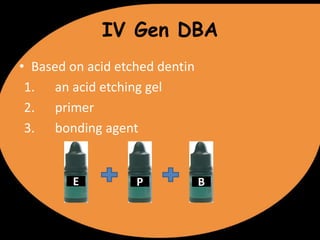
IV Gen DBA
• Based on acid etched dentin
1. an acid etching gel
2. primer
3. bonding agent
E P B
• Ex: All bond -2(21.4 MPa)
• Scotch bond Multipurpose (21 MPa)
• Clearfil Liner bond 2 (kuraray)- 20-28 MPa
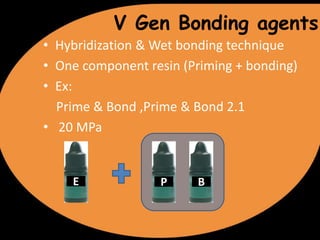
V Gen Bonding agents
• Hybridization & Wet bonding technique
• One component resin (Priming + bonding)
• Ex:
Prime & Bond ,Prime & Bond 2.1
• 20 MPa
E P B
Advantages
• Bond strength sufficient
• Some agents incorporate Fluoride
• Time saving
Disadvantage
• Solution must be refreshed
VI Gen Bonding agents-
SE
TYPE I
• SE Primer & Adhesive
• Primer applied to tooth
followed by adhesive.
Ex: Clearfil SE
Nano Bond
Optibond
Prompt L Pop
TYPE II
• Primer & Self-
etching adhesive
• Mixed & applied.
• Ex: Xeno III
B
E P
E
P B
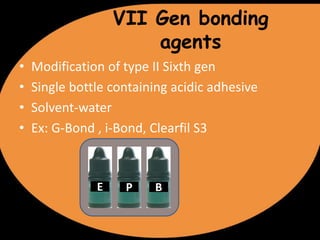
VII Gen bonding
agents
• Modification of type II Sixth gen
• Single bottle containing acidic adhesive
• Solvent-water
• Ex: G-Bond , i-Bond, Clearfil S3
E P B
Self etching primers
• Introduced in Japan
• Phosphonated resin molecule
Priming
• No rinsing & drying steps
• Less variation in degree of substrate moisture
Etching
• Advantage
Less technique sensitive
Demineralize and infiltrate simultaneously
Less Post Op. sensitivity
• Disadvantage
do not etch the enamel
seal at enamel margins compromised
SEP’s classified into 3 categories:
1. Strong : Ph of 1 or below
2. Mild-SE systems: Ph of around 2
3. Intermediary strong : Ph is about 1.5
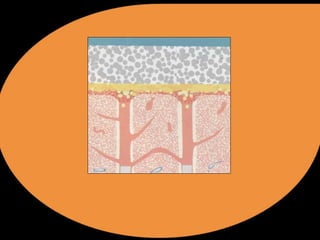
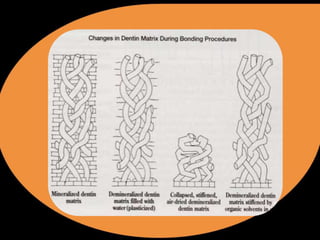
HYBRID LAYER
bonding agents.pptx

bonding agents.pptx

  • 2.
    MEN WILL BEMEN……
  • 4.
  • 5.
  • 7.
    CHALLENGES IN DENTIN BONDING •Dentin -highly permeable tissue • Diameter of tubules - Pulp=2.5u DEJ =0.8u • No. of tubules pulp = 45,000/Sq.mm dej = 20,000/Sq.mm
  • 8.
    • Dentin isintrinsically hydrated tissue • Dentinal fluid is under outward pressure • Age changes-sclerosis and reparative dentin • RDT-bond strength decreases with depth
  • 9.
    SMEAR LAYER solid phase:denatured collagen liquid phase: fluid filled channels
  • 10.
    Barrier to thepenetration of resin , multiplication of bacteria Barrier against bacterial & toxin penetration
  • 11.
    Acid etched dentin •Opens the dentin tubules • Intertubular collagen exposed
  • 12.
    Mechanism of dentin bonding M-R- X M- Methacrylate group R- spacer X- Reactive group; bonds to dentin
  • 15.
  • 17.
    Evolution I generation • NPGGMA- Primer • Chelating action with surface dentin • Bond strength – 2.8 Mpa Ex: Cervident (SS White)
  • 18.
    II Gen DBA •Phosphate esters of BisGMA or HEMA • Smear layer weakest link • Ex: Clearfil F(Kuraray) Scotch Bond Prisma Universal • Bond strength – 2-7 Mpa
  • 19.
    III Gen DBA •Modify or remove smear layer • Conditioning & priming • Bond strength= 9-15 Mpa • I system- FNP ,Tenure Scotch Bond -2
  • 20.
    • Retention decreaseswith time • Resin did not penetrate the smear layer
  • 21.
    IV Gen DBA •Based on acid etched dentin 1. an acid etching gel 2. primer 3. bonding agent E P B
  • 22.
    • Ex: Allbond -2(21.4 MPa) • Scotch bond Multipurpose (21 MPa) • Clearfil Liner bond 2 (kuraray)- 20-28 MPa
  • 23.
    V Gen Bondingagents • Hybridization & Wet bonding technique • One component resin (Priming + bonding) • Ex: Prime & Bond ,Prime & Bond 2.1 • 20 MPa E P B
  • 24.
    Advantages • Bond strengthsufficient • Some agents incorporate Fluoride • Time saving Disadvantage • Solution must be refreshed
  • 25.
    VI Gen Bondingagents- SE TYPE I • SE Primer & Adhesive • Primer applied to tooth followed by adhesive. Ex: Clearfil SE Nano Bond Optibond Prompt L Pop TYPE II • Primer & Self- etching adhesive • Mixed & applied. • Ex: Xeno III
  • 26.
  • 27.
    VII Gen bonding agents •Modification of type II Sixth gen • Single bottle containing acidic adhesive • Solvent-water • Ex: G-Bond , i-Bond, Clearfil S3 E P B
  • 28.
    Self etching primers •Introduced in Japan • Phosphonated resin molecule Priming • No rinsing & drying steps • Less variation in degree of substrate moisture Etching
  • 29.
    • Advantage Less techniquesensitive Demineralize and infiltrate simultaneously Less Post Op. sensitivity • Disadvantage do not etch the enamel seal at enamel margins compromised
  • 30.
    SEP’s classified into3 categories: 1. Strong : Ph of 1 or below 2. Mild-SE systems: Ph of around 2 3. Intermediary strong : Ph is about 1.5
  • 32.

Editor's Notes