1
CHEMICAL BONDING (IKATAN KIMIA)
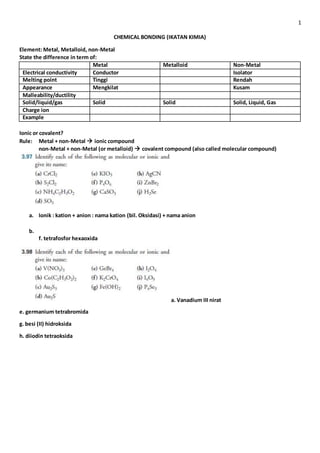
Element: Metal, Metalloid, non-Metal
State the difference in term of:
Metal Metalloid Non-Metal
Electrical conductivity Conductor Isolator
Melting point Tinggi Rendah
Appearance Mengkilat Kusam
Malleability/ductility
Solid/liquid/gas Solid Solid Solid, Liquid, Gas
Charge ion
Example
Ionic or covalent?
Rule: Metal + non-Metal  ionic compound
non-Metal + non-Metal (or metalloid)  covalent compound (also called molecular compound)
a. Ionik : kation + anion : nama kation (bil. Oksidasi) + nama anion
b.
f. tetrafosfor hexaoxida
a. Vanadium III nirat
e. germanium tetrabromida
g. besi (II) hidroksida
h. diiodin tetraoksida
2
3
4
5
6
7
BondLengthand Bond Energy

Bond the basic

  • 1.
    1 CHEMICAL BONDING (IKATANKIMIA) Element: Metal, Metalloid, non-Metal State the difference in term of: Metal Metalloid Non-Metal Electrical conductivity Conductor Isolator Melting point Tinggi Rendah Appearance Mengkilat Kusam Malleability/ductility Solid/liquid/gas Solid Solid Solid, Liquid, Gas Charge ion Example Ionic or covalent? Rule: Metal + non-Metal  ionic compound non-Metal + non-Metal (or metalloid)  covalent compound (also called molecular compound) a. Ionik : kation + anion : nama kation (bil. Oksidasi) + nama anion b. f. tetrafosfor hexaoxida a. Vanadium III nirat e. germanium tetrabromida g. besi (II) hidroksida h. diiodin tetraoksida
  • 2.
  • 3.
  • 4.
  • 5.
  • 6.
  • 7.