COMISION COLOMBIANA DE J URISTAS
                          Organización no gubernamental con status consultivo ante la ONU
                Filial de la Comisión Andina de Juristas (Lima) y de la Comisión Internacional de Juristas (Ginebra).


Bulletin No. 2: Series on economic, social, and cultural rights


A year after its publication, compliance with the Constitutional Court’s ruling
    on respect, protection and guarantee of the right to health is still uncertain


On July 31, 2008, the Constitutional Court issued the most ambitious ruling
regarding respect, protection, and guarantee of the right to health in Colombia,
ordering a reformulation of public policy on health. However, a year after this
pronouncement, there has been no effective or full compliance by the national
government with this ruling; in particular, there has been no implementation of that
tribunal’s orders to update, unify, and render in a timely manner the medical
services included in the Compulsory Health Plan (POS, its acronym in Spanish).


     1. The directives contained in Sentence T-760 of 2008


In view of the high number of tutela actions filed for the protection of the right to
health, the Constitutional Court decided two years ago to monitor the type of
complaints that the users present through this particular judicial mechanism.1 The
decision to carry out such monitoring arose from the case of a man with kidney
disease, whose tutela action for the treatment he required was denied years ago.
By the time the Court reviewed the tutela action and decided favorably on it, it was
too late: the patient died waiting to be treated. “This led us to look globally at the
tutela actions we get for health services and we found a persistent pattern,” pointed
out the leading magistrate Manuel José Cepeda Espinosa as he recounted the
thought process that led to Sentence T-760 of 2008.


1
 In this regard, and on the basis of a report by the Defensoría del Pueblo, the Court points out that
56,4% of the tutela actions filed in the period 2003-2005 deal with requests for health services to
which the patients have a right, both legally and according to the norms, but which the responsible
health providers do not render. Constitutional Court, Sentence T-760 of 2008.

                                       1
      ___________________________________________________________________
                      Personería jurídica: resolución 1060, Agosto de 1988, Alcaldía Mayor de Bogotá
                       Calle 72 No. 12- 65 Piso 7 Tel: (571) 3768200 - 3434710 Fax: (571) 3768230
                             E-mail: ccj@col.net.co Apartado Aéreo 58533 Bogotá, Colombia
Through this sentence the Court ruled on twenty-two tutela actions filed demanding
respect, protection, and guarantee of the right to health, identifying seven
administrative barriers that result from state “flaws” in the regulation and oversight
of the health system:


“On the basis of the cases and the evidence gathered by this Court, do the flaws in
regulation ascertained in the present sentence represent a violation of the
constitutional obligations of the competent authorities to respect, protect, and
guarantee the right to health in order to ensure its full exercise? The answer to this
question is found to be positive and the necessary court directives are issued for
overcoming the regulatory flaws detected. The orders are given within the
framework of the system enshrined in the Constitution and developed through Law
100 of 1993 and subsequent norms, as it would exceed the competence of this
Court to order the design of a different system; such a decision is incumbent upon
the legislator. Orders will be issued to the legally competent bodies to adopt
decisions aimed at overcoming the regulatory flaws that have resulted in a lack of
protection of the right to health, evidenced in the tutela actions that have become
more and more frequent in the past several years, as will be analyzed later on.”


In accordance with the above statement, the Court issued three types of orders
related to: (1) the service plan of the Compulsory Health Plan (POS), for both its
contributive and subsidized systems; (2) the flow of resources within the system;
and (3) the complementary measures needed to guarantee an effective exercise of
the right to health, such as the right to information and universal coverage of the
health system by January 2010.


2. Prospects of compliance with the Constitutional Court’s orders related to
the service plans


Below is a brief appraisal of the prospects of compliance with the first type of
orders, relating to the service plans and concerning (1) the update of the POS; (2)


                                          2
the unification of the POS; (3) the adoption of measures to prevent a denial or a
delay in rendering medical services included in the POS.


a) Update of the POS


In its Sentence T-760 of 2008, the Constitutional Court ordered the “adoption of
measures to eliminate the uncertainty regarding the content of the benefit plans
and carry out a periodic update of such plans,” and the deadline to do so was set
for February 1, 2009.


In this regard, the update of the service plans has not been carried out yet,
although the national government had promised to do so by the end of July 2009
after missing the initial deadline set by the Court. Up to now, it has become known
only that “from the present 6,300 procedures contained in the present POS, at
least 100 would be omitted that are no longer used by health professionals, and
1,000 would be included.” 2 However, only this past July 23 the Ministry of Social
Protection opened a consultation process that will continue through August 23 to
gather the opinions of the users of the health system regarding which medical
services should be included in the update of the POS.


Therefore, what has been done thus far is to define the “methodology” of the
process of updating the POS, in order to then proceed to carry it out through a
resolution that must be approved by the Regulatory Commission on Health, made
up of the Ministers of Finance and of Social Protection, and five members elected
by the President of the Republic.3


b) Unification of the POS

2
  “Minprotección señalará quién se va del régimen subsidiado”, (Ministry of Social Protection will
determine who leaves the subsidized regime) El Tiempo daily on-line, July 25, 2009.
3
 , In accordance with Law 1122 of 2007, the new Regulatory Commission on Health (CRES in
Spanish), made up strictly of government agencies, will take on the greater part of the functions that
the National Council on Health Social Security used to perform, which is made up of representatives
of territorial entities, employers, employees, the Social Security Institute, health-care professionals
and users of health services. In future, the Council will take on an advisory role.


                                                  3
At present, the provision of health services in Colombia is organized depending on
the capacity of persons to pay; the medical services to which the patients have
access depend on the type of affiliation.


        Type of                             Description                           Number of
   Affiliation to the                                                               users
        System
   1. Special           Those who have a differentiated service plan 2 million
   system               according to the type of work they do, such as
                        teachers or members of the state security forces.
   2. Contributive      Those who are formally employed and contribute 18.7
   system               to the health care system (contribution equivalent million
                        to 12.5% of income or basic salary, 8.5% covered
                        by the employer and 4% by the employee).
   3. Subsidized        Those who are at levels 1 and 2 of the System of 19 million
   system               Identification of Potential Beneficiaries of Social
                        Programs (SISBEN in Spanish) and have no
                        financial capacity to contribute on their own to the
                        contributive regime.
   4. Partial           Those assigned to Level 3 of SISBEN who benefit 1.1. million
   subsidies            from a partial contribution by the State to receive
                        care under the subsidized system (who have the
                        right to a service plan below that offered to those
                        who are “fully” part of the subsidized system).
   5. “Linked”          Lastly, those who are not part of any of the 3.7 million
   (“Vinculados”)       previously described systems and who, when they
                        face a situation that affects their health, turn to the
                        network of public hospitals. Paradoxically, in the
                        official reports and the literature on the health
                        system, these persons are called “vinculados”
                        (“linked”).


                                               4
4
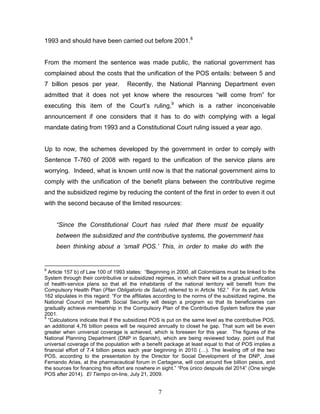
Source: CCJ based on data from the Ministry for Social Protection


                        TYPES OF AFFILIATION TO THE HEALTH-CARE SYSTEM


       Special systems
       Contributive system
       Subsidized system
       Partial subsidies
       Linked (“vinculados”)
                      Source: CCJ based on data from the Ministry for Social Protection


Thus, the present health system, organized through Law 100 of 1993 according to
the financial capacity of the patients, is highly segmented, inequitable and
discriminatory. Indeed, in Colombia there are five different medical care plans.
According to this, nearly 5% of Colombia’s population has access to a package of
health services beyond what is foreseen in the contributive system (special
systems), 42% has access to the contributive system, while 53.4% of the

4
 “Minprotección señalará quién se va del régimen subsidiado”, (Ministry of Social Protection will
determine who leaves the subsidized regime) El Tiempo daily on-line, July 25, 2009.


                                                     5
population has access to a service plan inferior to the POS of the contributive
system (subsidized system, partial subsidies, and “linked” population).


This distinction among health-care systems is also present in the UPC (Unit of
Payment by Capitation), which is the amount that the General System of Health
Security grants the Health Service Providing Enterprises (EPS in Spanish) for each
affiliate or beneficiary for organizing and guaranteeing the provision of the services
included in the POS.5 This amount varies according to the system the user is
affiliated to and constitutes a financial contribution to different service plans. At
present, the amount of the UPC for the contributive system is Colombian Pesos
$467.078, while in the subsidized system it is $267.678 pesos, “which is equivalent
to a difference of 42.7 percent.” 6 Thus, the difference in the content of the service
plans offered through the various systems is reflected in the institutional framework
itself in the distribution of resources of the health-care system.


Thus, the Constitutional Court ordered that the necessary measures be taken
toward “the unification of benefit plans for the contributive and subsidized
systems,” and called on the Health Regulatory Commission in particular to “adopt a
program and a timetable for the gradual and sustainable unification of the benefit
plans of the contributive system and of the subsidized system.”7 Through this
order, the Court is simply demanding that a legal mandate be obeyed, since the
unification had already been contemplated in Articles 157 and 162 of Law 100 of


5
  The UPC was established by the National Council on Health Social Security for annual periods, for
age groups, genders, and geographic areas. According to Law 1122 of 2007, the UPC will be
established by the Regulatory Commission on Health (CRES in Spanish).
6
  “Pos único después del 2014”, (Single Pos after 2014) El Tiempo on-line, July 21, 2009.
7
   Constitutional Court Sentence T-760, 2008, Paragraphs 16, 21 and 22 of the part regarding
“resolves.”


                                                6
1993 and should have been carried out before 2001.8


From the moment the sentence was made public, the national government has
complained about the costs that the unification of the POS entails: between 5 and
7 billion pesos per year.           Recently, the National Planning Department even
admitted that it does not yet know where the resources “will come from” for
executing this item of the Court’s ruling,9 which is a rather inconceivable
announcement if one considers that it has to do with complying with a legal
mandate dating from 1993 and a Constitutional Court ruling issued a year ago.


Up to now, the schemes developed by the government in order to comply with
Sentence T-760 of 2008 with regard to the unification of the service plans are
worrying. Indeed, what is known until now is that the national government aims to
comply with the unification of the benefit plans between the contributive regime
and the subsidized regime by reducing the content of the first in order to even it out
with the second because of the limited resources:


     “Since the Constitutional Court has ruled that there must be equality
     between the subsidized and the contributive systems, the government has
     been thinking about a „small POS.‟ This, in order to make do with the


8
  Article 157 b) of Law 100 of 1993 states: “Beginning in 2000, all Colombians must be linked to the
System through their contributive or subsidized regimes, in which there will be a gradual unification
of health-service plans so that all the inhabitants of the national territory will benefit from the
Compulsory Health Plan (Plan Obligatorio de Salud) referred to in Article 162.” For its part, Article
162 stipulates in this regard: “For the affiliates according to the norms of the subsidized regime, the
National Council on Health Social Security will design a program so that its beneficiaries can
gradually achieve membership in the Compulsory Plan of the Contributive System before the year
2001.
9
  “Calculations indicate that if the subsidized POS is put on the same level as the contributive POS,
an additional 4,76 billion pesos will be required annually to closet he gap. That sum will be even
greater when universal coverage is achieved, which is foreseen for this year. The figures of the
National Planning Department (DNP in Spanish), which are being reviewed today, point out that
universal coverage of the population with a benefit package at least equal to that of POS implies a
financial effort of 7.4 billion pesos each year beginning in 2010 (…). The leveling off of the two
POS, according to the presentation by the Director for Social Development of the DNP, José
Fernando Arias, at the pharmaceutical forum in Cartagena, will cost around five billion pesos, and
the sources for financing this effort are nowhere in sight.” “Pos único después del 2014” (One single
POS after 2014). El Tiempo on-line, July 21, 2009.


                                                  7
money available. There might be some additional services for those who
     contribute to the system.” 10


The formula that would offer a universal “small POS” would mean a backward step
in the right to health for the 18, 7 million persons who contribute to the system,
whose medical services – to which they have a right – would be reduced.
On the other hand, if the idea is to “level off” the POS so that it is “affordable,” but
also to offer some additional services to those who contribute, in the end it means
maintaining the statu quo in the health insurance system, since the difference in
health services would be maintained while at the same time giving the appearance
of complying with the Constitutional Court’s ruling.


In this way, the government would be complying formally with the sentence, but
through such measures it would be disregarding the true sense of the ruling, which
is to make progress toward the unification of the various systems (as the principle
of progressiveness and Article 162 of Law 100 of 1993 demands), so that the
benefits plan of the subsidized system are increased and improved on the basis of
what is included in the contributive system.             As Mauricio Santamaría, Deputy
Director of Fedesarrollo, has pointed out, unifying the POS “so that its costs do not
exceed the present total cost” is a “deceitful” alternative as a response to the
Constitutional Court’s ruling. 11


Lastly, even more worrying than the government’s hesitations regarding the form
and the resources to comply with the unification of the POS, is the fact that the
executive is considering carrying it out beginning only after 2014 – six years after
the publication of Sentence T-760 of 2008.12


10
   “No todas las enfermedades cabrán en el nuevo plan obligatorio de salud” (Not all diseases will
be covered by the new compulsory health-services plan), El Tiempo on-line, March 10 2009.
11
   Mauricio Santamaría, “El fallo de la Corte sobre salud ¿Cuánto y qué nos falta para cumplirlo?”
(The Court ruling on health: How long and how much do we need to comply with it?) El Espectador
on line, November 9, 2008.


                                                8
c) Measures to prevent denial or delay in health services


Por último, la Corte ordenó también adoptar las medidas para evitar que se
rechace o se demore la prestación de los servicios médicos que sí se encuentran
en el POS o que se requieren con necesidad, identificando a las EPS e
Instituciones Prestadoras de Salud (IPS) que con mayor frecuencia incurren en
este tipo de conducta.


Finally, the Court ordered also that measures be adopted to prevent that the
provision of medical services that are included in the POS or are required urgently
be refused or delayed, identifying the EPS and Health Provider Institutions (IPS in
Spanish) that most often carry out such types of conduct.


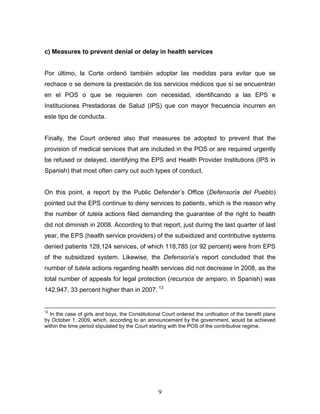
On this point, a report by the Public Defender’s Office (Defensoría del Pueblo)
pointed out the EPS continue to deny services to patients, which is the reason why
the number of tutela actions filed demanding the guarantee of the right to health
did not diminish in 2008. According to that report, just during the last quarter of last
year, the EPS (health service providers) of the subsidized and contributive systems
denied patients 129,124 services, of which 118,785 (or 92 percent) were from EPS
of the subsidized system. Likewise, the Defensoría’s report concluded that the
number of tutela actions regarding health services did not decrease in 2008, as the
total number of appeals for legal protection (recursos de amparo, in Spanish) was
142.947, 33 percent higher than in 2007. 13


12
  In the case of girls and boys, the Constitutional Court ordered the unification of the benefit plans
by October 1, 2009, which, according to an announcement by the government, would be achieved
within the time period stipulated by the Court starting with the POS of the contributive regime.


                                                  9
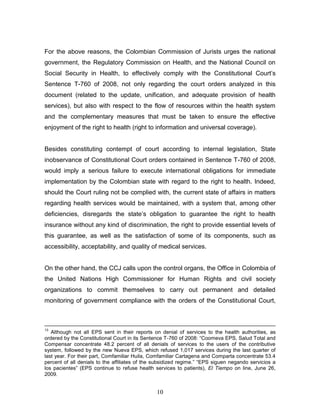
For the above reasons, the Colombian Commission of Jurists urges the national
government, the Regulatory Commission on Health, and the National Council on
Social Security in Health, to effectively comply with the Constitutional Court’s
Sentence T-760 of 2008, not only regarding the court orders analyzed in this
document (related to the update, unification, and adequate provision of health
services), but also with respect to the flow of resources within the health system
and the complementary measures that must be taken to ensure the effective
enjoyment of the right to health (right to information and universal coverage).


Besides constituting contempt of court according to internal legislation, State
inobservance of Constitutional Court orders contained in Sentence T-760 of 2008,
would imply a serious failure to execute international obligations for immediate
implementation by the Colombian state with regard to the right to health. Indeed,
should the Court ruling not be complied with, the current state of affairs in matters
regarding health services would be maintained, with a system that, among other
deficiencies, disregards the state’s obligation to guarantee the right to health
insurance without any kind of discrimination, the right to provide essential levels of
this guarantee, as well as the satisfaction of some of its components, such as
accessibility, acceptability, and quality of medical services.


On the other hand, the CCJ calls upon the control organs, the Office in Colombia of
the United Nations High Commissioner for Human Rights and civil society
organizations to commit themselves to carry out permanent and detailed
monitoring of government compliance with the orders of the Constitutional Court,


13
   Although not all EPS sent in their reports on denial of services to the health authorities, as
ordered by the Constitutional Court in its Sentence T-760 of 2008: “Coomeva EPS, Salud Total and
Compensar concentrate 48.2 percent of all denials of services to the users of the contributive
system, followed by the new Nueva EPS, which refused 1,017 services during the last quarter of
last year. For their part, Comfamiliar Huila, Comfamiliar Cartagena and Comparta concentrate 53.4
percent of all denials to the affiliates of the subsidized regime.” “EPS siguen negando servicios a
los pacientes” (EPS continue to refuse health services to patients), El Tiempo on line, June 26,
2009.


                                                10
with the purpose of watching over the respect, protection, and guarantee of the
human right to health.


For further information, please contact: Felipe Galvis Castro, Researcher in economic, social,
and cultural rights, DESC, CCJ (Tel. 571-376 8200, ext. 129),


Bogotá, August 24 2009


                                                11

A year after its publication, compliance with the Constitutional Court’s ruling on respect, protection and guarantee of the right to health is still uncertain

  • 1.
    COMISION COLOMBIANA DEJ URISTAS Organización no gubernamental con status consultivo ante la ONU Filial de la Comisión Andina de Juristas (Lima) y de la Comisión Internacional de Juristas (Ginebra). Bulletin No. 2: Series on economic, social, and cultural rights A year after its publication, compliance with the Constitutional Court’s ruling on respect, protection and guarantee of the right to health is still uncertain On July 31, 2008, the Constitutional Court issued the most ambitious ruling regarding respect, protection, and guarantee of the right to health in Colombia, ordering a reformulation of public policy on health. However, a year after this pronouncement, there has been no effective or full compliance by the national government with this ruling; in particular, there has been no implementation of that tribunal’s orders to update, unify, and render in a timely manner the medical services included in the Compulsory Health Plan (POS, its acronym in Spanish). 1. The directives contained in Sentence T-760 of 2008 In view of the high number of tutela actions filed for the protection of the right to health, the Constitutional Court decided two years ago to monitor the type of complaints that the users present through this particular judicial mechanism.1 The decision to carry out such monitoring arose from the case of a man with kidney disease, whose tutela action for the treatment he required was denied years ago. By the time the Court reviewed the tutela action and decided favorably on it, it was too late: the patient died waiting to be treated. “This led us to look globally at the tutela actions we get for health services and we found a persistent pattern,” pointed out the leading magistrate Manuel José Cepeda Espinosa as he recounted the thought process that led to Sentence T-760 of 2008. 1 In this regard, and on the basis of a report by the Defensoría del Pueblo, the Court points out that 56,4% of the tutela actions filed in the period 2003-2005 deal with requests for health services to which the patients have a right, both legally and according to the norms, but which the responsible health providers do not render. Constitutional Court, Sentence T-760 of 2008. 1 ___________________________________________________________________ Personería jurídica: resolución 1060, Agosto de 1988, Alcaldía Mayor de Bogotá Calle 72 No. 12- 65 Piso 7 Tel: (571) 3768200 - 3434710 Fax: (571) 3768230 E-mail: ccj@col.net.co Apartado Aéreo 58533 Bogotá, Colombia
  • 2.
    Through this sentencethe Court ruled on twenty-two tutela actions filed demanding respect, protection, and guarantee of the right to health, identifying seven administrative barriers that result from state “flaws” in the regulation and oversight of the health system: “On the basis of the cases and the evidence gathered by this Court, do the flaws in regulation ascertained in the present sentence represent a violation of the constitutional obligations of the competent authorities to respect, protect, and guarantee the right to health in order to ensure its full exercise? The answer to this question is found to be positive and the necessary court directives are issued for overcoming the regulatory flaws detected. The orders are given within the framework of the system enshrined in the Constitution and developed through Law 100 of 1993 and subsequent norms, as it would exceed the competence of this Court to order the design of a different system; such a decision is incumbent upon the legislator. Orders will be issued to the legally competent bodies to adopt decisions aimed at overcoming the regulatory flaws that have resulted in a lack of protection of the right to health, evidenced in the tutela actions that have become more and more frequent in the past several years, as will be analyzed later on.” In accordance with the above statement, the Court issued three types of orders related to: (1) the service plan of the Compulsory Health Plan (POS), for both its contributive and subsidized systems; (2) the flow of resources within the system; and (3) the complementary measures needed to guarantee an effective exercise of the right to health, such as the right to information and universal coverage of the health system by January 2010. 2. Prospects of compliance with the Constitutional Court’s orders related to the service plans Below is a brief appraisal of the prospects of compliance with the first type of orders, relating to the service plans and concerning (1) the update of the POS; (2) 2
  • 3.
    the unification ofthe POS; (3) the adoption of measures to prevent a denial or a delay in rendering medical services included in the POS. a) Update of the POS In its Sentence T-760 of 2008, the Constitutional Court ordered the “adoption of measures to eliminate the uncertainty regarding the content of the benefit plans and carry out a periodic update of such plans,” and the deadline to do so was set for February 1, 2009. In this regard, the update of the service plans has not been carried out yet, although the national government had promised to do so by the end of July 2009 after missing the initial deadline set by the Court. Up to now, it has become known only that “from the present 6,300 procedures contained in the present POS, at least 100 would be omitted that are no longer used by health professionals, and 1,000 would be included.” 2 However, only this past July 23 the Ministry of Social Protection opened a consultation process that will continue through August 23 to gather the opinions of the users of the health system regarding which medical services should be included in the update of the POS. Therefore, what has been done thus far is to define the “methodology” of the process of updating the POS, in order to then proceed to carry it out through a resolution that must be approved by the Regulatory Commission on Health, made up of the Ministers of Finance and of Social Protection, and five members elected by the President of the Republic.3 b) Unification of the POS 2 “Minprotección señalará quién se va del régimen subsidiado”, (Ministry of Social Protection will determine who leaves the subsidized regime) El Tiempo daily on-line, July 25, 2009. 3 , In accordance with Law 1122 of 2007, the new Regulatory Commission on Health (CRES in Spanish), made up strictly of government agencies, will take on the greater part of the functions that the National Council on Health Social Security used to perform, which is made up of representatives of territorial entities, employers, employees, the Social Security Institute, health-care professionals and users of health services. In future, the Council will take on an advisory role. 3
  • 4.
    At present, theprovision of health services in Colombia is organized depending on the capacity of persons to pay; the medical services to which the patients have access depend on the type of affiliation. Type of Description Number of Affiliation to the users System 1. Special Those who have a differentiated service plan 2 million system according to the type of work they do, such as teachers or members of the state security forces. 2. Contributive Those who are formally employed and contribute 18.7 system to the health care system (contribution equivalent million to 12.5% of income or basic salary, 8.5% covered by the employer and 4% by the employee). 3. Subsidized Those who are at levels 1 and 2 of the System of 19 million system Identification of Potential Beneficiaries of Social Programs (SISBEN in Spanish) and have no financial capacity to contribute on their own to the contributive regime. 4. Partial Those assigned to Level 3 of SISBEN who benefit 1.1. million subsidies from a partial contribution by the State to receive care under the subsidized system (who have the right to a service plan below that offered to those who are “fully” part of the subsidized system). 5. “Linked” Lastly, those who are not part of any of the 3.7 million (“Vinculados”) previously described systems and who, when they face a situation that affects their health, turn to the network of public hospitals. Paradoxically, in the official reports and the literature on the health system, these persons are called “vinculados” (“linked”). 4
  • 5.
    4 Source: CCJ basedon data from the Ministry for Social Protection TYPES OF AFFILIATION TO THE HEALTH-CARE SYSTEM  Special systems  Contributive system  Subsidized system  Partial subsidies  Linked (“vinculados”) Source: CCJ based on data from the Ministry for Social Protection Thus, the present health system, organized through Law 100 of 1993 according to the financial capacity of the patients, is highly segmented, inequitable and discriminatory. Indeed, in Colombia there are five different medical care plans. According to this, nearly 5% of Colombia’s population has access to a package of health services beyond what is foreseen in the contributive system (special systems), 42% has access to the contributive system, while 53.4% of the 4 “Minprotección señalará quién se va del régimen subsidiado”, (Ministry of Social Protection will determine who leaves the subsidized regime) El Tiempo daily on-line, July 25, 2009. 5
  • 6.
    population has accessto a service plan inferior to the POS of the contributive system (subsidized system, partial subsidies, and “linked” population). This distinction among health-care systems is also present in the UPC (Unit of Payment by Capitation), which is the amount that the General System of Health Security grants the Health Service Providing Enterprises (EPS in Spanish) for each affiliate or beneficiary for organizing and guaranteeing the provision of the services included in the POS.5 This amount varies according to the system the user is affiliated to and constitutes a financial contribution to different service plans. At present, the amount of the UPC for the contributive system is Colombian Pesos $467.078, while in the subsidized system it is $267.678 pesos, “which is equivalent to a difference of 42.7 percent.” 6 Thus, the difference in the content of the service plans offered through the various systems is reflected in the institutional framework itself in the distribution of resources of the health-care system. Thus, the Constitutional Court ordered that the necessary measures be taken toward “the unification of benefit plans for the contributive and subsidized systems,” and called on the Health Regulatory Commission in particular to “adopt a program and a timetable for the gradual and sustainable unification of the benefit plans of the contributive system and of the subsidized system.”7 Through this order, the Court is simply demanding that a legal mandate be obeyed, since the unification had already been contemplated in Articles 157 and 162 of Law 100 of 5 The UPC was established by the National Council on Health Social Security for annual periods, for age groups, genders, and geographic areas. According to Law 1122 of 2007, the UPC will be established by the Regulatory Commission on Health (CRES in Spanish). 6 “Pos único después del 2014”, (Single Pos after 2014) El Tiempo on-line, July 21, 2009. 7 Constitutional Court Sentence T-760, 2008, Paragraphs 16, 21 and 22 of the part regarding “resolves.” 6
  • 7.
    1993 and shouldhave been carried out before 2001.8 From the moment the sentence was made public, the national government has complained about the costs that the unification of the POS entails: between 5 and 7 billion pesos per year. Recently, the National Planning Department even admitted that it does not yet know where the resources “will come from” for executing this item of the Court’s ruling,9 which is a rather inconceivable announcement if one considers that it has to do with complying with a legal mandate dating from 1993 and a Constitutional Court ruling issued a year ago. Up to now, the schemes developed by the government in order to comply with Sentence T-760 of 2008 with regard to the unification of the service plans are worrying. Indeed, what is known until now is that the national government aims to comply with the unification of the benefit plans between the contributive regime and the subsidized regime by reducing the content of the first in order to even it out with the second because of the limited resources: “Since the Constitutional Court has ruled that there must be equality between the subsidized and the contributive systems, the government has been thinking about a „small POS.‟ This, in order to make do with the 8 Article 157 b) of Law 100 of 1993 states: “Beginning in 2000, all Colombians must be linked to the System through their contributive or subsidized regimes, in which there will be a gradual unification of health-service plans so that all the inhabitants of the national territory will benefit from the Compulsory Health Plan (Plan Obligatorio de Salud) referred to in Article 162.” For its part, Article 162 stipulates in this regard: “For the affiliates according to the norms of the subsidized regime, the National Council on Health Social Security will design a program so that its beneficiaries can gradually achieve membership in the Compulsory Plan of the Contributive System before the year 2001. 9 “Calculations indicate that if the subsidized POS is put on the same level as the contributive POS, an additional 4,76 billion pesos will be required annually to closet he gap. That sum will be even greater when universal coverage is achieved, which is foreseen for this year. The figures of the National Planning Department (DNP in Spanish), which are being reviewed today, point out that universal coverage of the population with a benefit package at least equal to that of POS implies a financial effort of 7.4 billion pesos each year beginning in 2010 (…). The leveling off of the two POS, according to the presentation by the Director for Social Development of the DNP, José Fernando Arias, at the pharmaceutical forum in Cartagena, will cost around five billion pesos, and the sources for financing this effort are nowhere in sight.” “Pos único después del 2014” (One single POS after 2014). El Tiempo on-line, July 21, 2009. 7
  • 8.
    money available. Theremight be some additional services for those who contribute to the system.” 10 The formula that would offer a universal “small POS” would mean a backward step in the right to health for the 18, 7 million persons who contribute to the system, whose medical services – to which they have a right – would be reduced. On the other hand, if the idea is to “level off” the POS so that it is “affordable,” but also to offer some additional services to those who contribute, in the end it means maintaining the statu quo in the health insurance system, since the difference in health services would be maintained while at the same time giving the appearance of complying with the Constitutional Court’s ruling. In this way, the government would be complying formally with the sentence, but through such measures it would be disregarding the true sense of the ruling, which is to make progress toward the unification of the various systems (as the principle of progressiveness and Article 162 of Law 100 of 1993 demands), so that the benefits plan of the subsidized system are increased and improved on the basis of what is included in the contributive system. As Mauricio Santamaría, Deputy Director of Fedesarrollo, has pointed out, unifying the POS “so that its costs do not exceed the present total cost” is a “deceitful” alternative as a response to the Constitutional Court’s ruling. 11 Lastly, even more worrying than the government’s hesitations regarding the form and the resources to comply with the unification of the POS, is the fact that the executive is considering carrying it out beginning only after 2014 – six years after the publication of Sentence T-760 of 2008.12 10 “No todas las enfermedades cabrán en el nuevo plan obligatorio de salud” (Not all diseases will be covered by the new compulsory health-services plan), El Tiempo on-line, March 10 2009. 11 Mauricio Santamaría, “El fallo de la Corte sobre salud ¿Cuánto y qué nos falta para cumplirlo?” (The Court ruling on health: How long and how much do we need to comply with it?) El Espectador on line, November 9, 2008. 8
  • 9.
    c) Measures toprevent denial or delay in health services Por último, la Corte ordenó también adoptar las medidas para evitar que se rechace o se demore la prestación de los servicios médicos que sí se encuentran en el POS o que se requieren con necesidad, identificando a las EPS e Instituciones Prestadoras de Salud (IPS) que con mayor frecuencia incurren en este tipo de conducta. Finally, the Court ordered also that measures be adopted to prevent that the provision of medical services that are included in the POS or are required urgently be refused or delayed, identifying the EPS and Health Provider Institutions (IPS in Spanish) that most often carry out such types of conduct. On this point, a report by the Public Defender’s Office (Defensoría del Pueblo) pointed out the EPS continue to deny services to patients, which is the reason why the number of tutela actions filed demanding the guarantee of the right to health did not diminish in 2008. According to that report, just during the last quarter of last year, the EPS (health service providers) of the subsidized and contributive systems denied patients 129,124 services, of which 118,785 (or 92 percent) were from EPS of the subsidized system. Likewise, the Defensoría’s report concluded that the number of tutela actions regarding health services did not decrease in 2008, as the total number of appeals for legal protection (recursos de amparo, in Spanish) was 142.947, 33 percent higher than in 2007. 13 12 In the case of girls and boys, the Constitutional Court ordered the unification of the benefit plans by October 1, 2009, which, according to an announcement by the government, would be achieved within the time period stipulated by the Court starting with the POS of the contributive regime. 9
  • 10.
    For the abovereasons, the Colombian Commission of Jurists urges the national government, the Regulatory Commission on Health, and the National Council on Social Security in Health, to effectively comply with the Constitutional Court’s Sentence T-760 of 2008, not only regarding the court orders analyzed in this document (related to the update, unification, and adequate provision of health services), but also with respect to the flow of resources within the health system and the complementary measures that must be taken to ensure the effective enjoyment of the right to health (right to information and universal coverage). Besides constituting contempt of court according to internal legislation, State inobservance of Constitutional Court orders contained in Sentence T-760 of 2008, would imply a serious failure to execute international obligations for immediate implementation by the Colombian state with regard to the right to health. Indeed, should the Court ruling not be complied with, the current state of affairs in matters regarding health services would be maintained, with a system that, among other deficiencies, disregards the state’s obligation to guarantee the right to health insurance without any kind of discrimination, the right to provide essential levels of this guarantee, as well as the satisfaction of some of its components, such as accessibility, acceptability, and quality of medical services. On the other hand, the CCJ calls upon the control organs, the Office in Colombia of the United Nations High Commissioner for Human Rights and civil society organizations to commit themselves to carry out permanent and detailed monitoring of government compliance with the orders of the Constitutional Court, 13 Although not all EPS sent in their reports on denial of services to the health authorities, as ordered by the Constitutional Court in its Sentence T-760 of 2008: “Coomeva EPS, Salud Total and Compensar concentrate 48.2 percent of all denials of services to the users of the contributive system, followed by the new Nueva EPS, which refused 1,017 services during the last quarter of last year. For their part, Comfamiliar Huila, Comfamiliar Cartagena and Comparta concentrate 53.4 percent of all denials to the affiliates of the subsidized regime.” “EPS siguen negando servicios a los pacientes” (EPS continue to refuse health services to patients), El Tiempo on line, June 26, 2009. 10
  • 11.
    with the purposeof watching over the respect, protection, and guarantee of the human right to health. For further information, please contact: Felipe Galvis Castro, Researcher in economic, social, and cultural rights, DESC, CCJ (Tel. 571-376 8200, ext. 129), Bogotá, August 24 2009 11