1

© 2010 South-Western, a part of Cengage Learning   PowerPoint Presentation by Charlie Cook
All rights reserved.                                      The University of West Alabama
Chapter Objectives
After studying this chapter, you should be able to

           Identify how firms gain a sustainable competitive
           advantage through people.
           Explain how globalization is influencing human
           resources management.
           Describe the impact of information technology on
           managing people.
           Identify the importance of change management.
           Describe HR’s role in developing intellectual
           capital.
© 2010 South-Western, a part of
Cengage Learning. All rights
reserved.                                   1–2
Chapter Objectives (cont’d)
After studying this chapter, you should be able to

           Explain how TQM, Six Sigma, and reengineering
           affect HR systems.
           Discuss how cost pressures affect HR policies.
           Discuss the primary demographic and employee
           concerns pertaining to HRM.
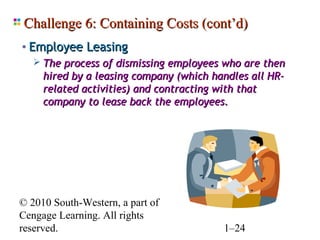
           Provide examples of the roles and competencies
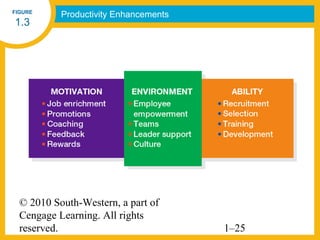
           of today’s HR managers.


© 2010 South-Western, a part of
Cengage Learning. All rights
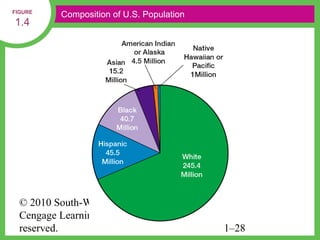
reserved.                                   1–3
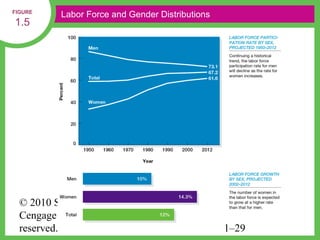
Why Study Human Resources Management
 • Human Resources Management (HRM)
     The process of managing human resources (human
      capital and intellectual assets) to achieve an
      organization’s objectives.
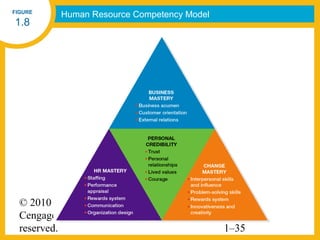
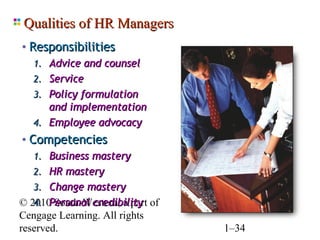
 • “Why Study HRM?”
     Staffing the organization, designing jobs and teams,
      developing skillful employees, identifying
      approaches for improving their performance, and
      rewarding employee successes—all typically labeled
      HRM issues—are as relevant to line managers as they
      are to managers in the HR department.
© 2010 South-Western, a part of
Cengage Learning. All rights
reserved.                                    1–4
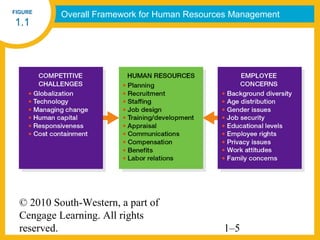
FIGURE
           Overall Framework for Human Resources Management
1.1


  © 2010 South-Western, a part of
  Cengage Learning. All rights
  reserved.                                   1–5
Competitive Challenges and
Human Resources Management
• The most pressing competitive issues facing
  firms:
    Competing, recruiting, and staffing globally
    Embracing new technology
    Managing change
    Managing talent, or human capital
    Responding to the market
    Containing costs


© 2010 South-Western, a part of
Cengage Learning. All rights
reserved.                                 1–6
Challenge 1: Competing, Recruiting, and
Staffing Globally
• Globalization
    The trend toward opening up foreign markets to
     international trade and investment
• Impact of Globalization
    “Anything, anytime, anywhere” markets
    Partnerships with foreign firms
    Lower trade and tariff barriers
         NAFTA, EU, APEC trade agreements
         WTO and GATT
© 2010 South-Western, a part of
Cengage Learning. All rights
reserved.                                    1–7
Challenge 1…(cont’d)
• Corporate Social Responsibility (CSR)
    The responsibility of the firm to act in the best
     interests of the people and communities affected by
     its activities
• Globalization’s Impact on HRM
    Different geographies, cultures, laws, and business
     practices
    Issues:
       Identifying capable managers and workers
      Developing foreign culture and work practice training
        programs.
      Adjusting compensation plans for overseas work
© 2010 South-Western, a part of
Cengage Learning. All rights
reserved.                                        1–8
1
     A Guide to HR Internet Sites

      HR professionals can access the following Web sites for current information related
      to human resources.
      Codes of Conduct
      Asia-Pacific Economic Cooperation Forum Business Code of Conduct
      (http://www.cauxroundtable.org/
      APECForumBusinessCodeofConduct.html)
      Caux Round Table Principles for Business (http://www.cauxroundtable.org/principles.html)
      Fair Labor Association Workshop Code of Conduct (http://www.fairlabor.org)
      Global Sullivan Principles (http://www.thegsp.org)
      ILO Tripartite Declaration of Principles Concerning Multinational Enterprises and Social
      Policy (http://www.ilo.org)
      OECD Guidelines for Multinational Enterprises (www.oecd.org/daf/investment/guidelines)
      OECD, Principles of Corporate Governance (http://www.oecd.org)

© 2010 South-Western, aand Bribery in International Business Transactions
     Rules of Conduct on Extortion part of
     (International Chamber of Commerce, http://www.iccwbo.org)
Cengage Learning. All rights of Human Rights (http://www.un.org)
     United Nations Universal Declaration
reserved.                                                       1–9
1
      A Guide to HR Internet Sites (cont’d)

       General
       AFL-CIO (http://www.aflcio.org/home.htm)—Union news, issue papers, press releases, links to
       labor sites.
       American Management Association (http://www.amanet.org/index.htm)—AMA membership,
       programs, training, and so on.
       FedWorld (http://www.fedworld.gov)—A gateway to many government Web sites.
       HR Professional’s Gateway to the Internet (http://www.hrprosgateway.com)—Links to HR-related
       Web pages.
       Occupational Safety and Health Resources (http://www.osh.net)—OSHA-related sites,
       government pages, resources, and so on.
       Society for Human Resource Management (http://www.shrm.org)—Current events, information,
       connections, and articles.
       Telecommuting, Telework, and Alternative Officing (http://www.gilgordon.com)—Telecommuting
       and flexible hours.
       Training & Development Resource Center (http://www.thetrainingworld.com)—Job mart, training
       links, and T&D electronic mailing list links.
© 2010 South-Western, a part of
     U.S. Department of Labor (http://www.dol.gov)—Job bank, labor statistics, press releases,
Cengage Learning.information.
     grants, and contract All rights

reserved.                                                           1–10
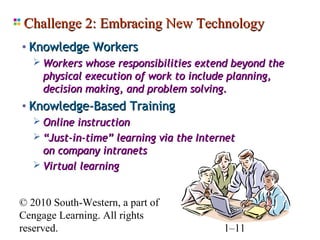
Challenge 2: Embracing New Technology
• Knowledge Workers
    Workers whose responsibilities extend beyond the
     physical execution of work to include planning,
     decision making, and problem solving.
• Knowledge-Based Training
    Online instruction
    “Just-in-time” learning via the Internet
     on company intranets
    Virtual learning


© 2010 South-Western, a part of
Cengage Learning. All rights
reserved.                               1–11
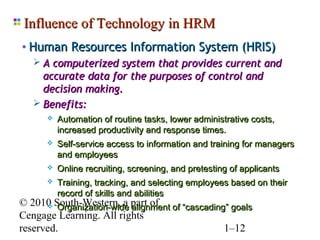
Influence of Technology in HRM
• Human Resources Information System (HRIS)
    A computerized system that provides current and
     accurate data for the purposes of control and
     decision making.
    Benefits:
         Automation of routine tasks, lower administrative costs,
          increased productivity and response times.
         Self-service access to information and training for managers
          and employees
         Online recruiting, screening, and pretesting of applicants
         Training, tracking, and selecting employees based on their
          record of skills and abilities
© 2010 South-Western, a part of of “cascading” goals
       Organization-wide alignment
Cengage Learning. All rights
reserved.                                    1–12
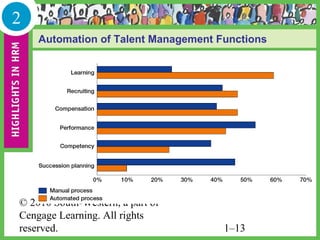
2
    Automation of Talent Management Functions


© 2010 South-Western, a part of
Cengage Learning. All rights
reserved.                            1–13
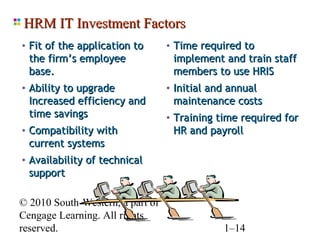
HRM IT Investment Factors
• Fit of the application to       • Time required to
  the firm’s employee              implement and train staff
  base.                            members to use HRIS
• Ability to upgrade              • Initial and annual
  Increased efficiency and         maintenance costs
  time savings                    • Training time required for
• Compatibility with               HR and payroll
  current systems
• Availability of technical
  support

© 2010 South-Western, a part of
Cengage Learning. All rights
reserved.                                     1–14
Challenge 3: Managing Change
• Types of Change
    Reactive change
         Change that occurs after external forces have already
          affected performance
    Proactive change
         Change initiated to take advantage of targeted opportunities
• Managing Change through HR
   Formal change management programs help to keep
    employees focused on the success of the business.


© 2010 South-Western, a part of
Cengage Learning. All rights
reserved.                                           1–15
Challenge 3: Managing Change (cont’d)
• Why Change Efforts Fail:
   Not establishing a sense of urgency.
   Not creating a powerful coalition to guide the
     effort.
   Lacking leaders who have a vision.
   Lacking leaders who communicate the vision.
   Not removing obstacles to the new vision.
   Not systematically planning for and creating short-
     term “wins.”
   Declaring victory too soon.
© 2010 South-Western, a part of the corporate culture.
    Not anchoring changes in
Cengage Learning. All rights
reserved.                                  1–16
Challenge 4: Managing Talent, or Human Capital
• Human Capital
    The knowledge, skills, and capabilities of individuals
     that have economic value to an organization.
    Valuable because capital:
         is based on company-specific skills.
         is gained through long-term experience.
         can be expanded through development.


© 2010 South-Western, a part of
Cengage Learning. All rights
reserved.                                           1–17
Challenge 5: Responding to the Market
• Total Quality Management (TQM)
    A set of principles and practices whose core ideas
     include understanding customer needs, doing things
     right the first time, and striving for continuous
     improvement.
• Six Sigma
    A process used to translate customer needs into a
     set of optimal tasks that are performed in concert
     with one another.
         HR facilitates organizational development of Six Sigma.
          HR helps balance the opposing needs for order and control
© 2010    South-Western, a growth and creativity.
           with the needs for part of
Cengage Learning. All rights
reserved.                                          1–18
Challenge 5: Responding to the Market
(cont’d)
• Reengineering and HRM
    Fundamental rethinking and radical redesign of
     business processes to achieve dramatic
     improvements in cost, quality, service, and speed.
         Requires that managers create an environment for change.
         Depends on effective leadership and communication
          processes.
         Requires that administrative systems be reviewed and
          modified.


© 2010 South-Western, a part of
Cengage Learning. All rights
reserved.                                         1–19
Challenge 6: Containing Costs
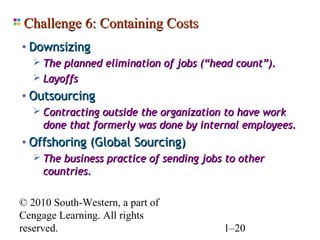
• Downsizing
    The planned elimination of jobs (“head count”).
    Layoffs
• Outsourcing
    Contracting outside the organization to have work
     done that formerly was done by internal employees.
• Offshoring (Global Sourcing)
    The business practice of sending jobs to other
     countries.

© 2010 South-Western, a part of
Cengage Learning. All rights
reserved.                               1–20
Challenge 6: Containing Costs (cont’d)
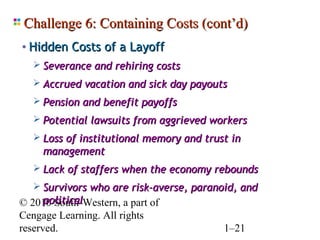
• Hidden Costs of a Layoff
    Severance and rehiring costs
    Accrued vacation and sick day payouts
    Pension and benefit payoffs
    Potential lawsuits from aggrieved workers
    Loss of institutional memory and trust in
     management
    Lack of staffers when the economy rebounds
    Survivors who are risk-averse, paranoid, and
      political
© 2010 South-Western, a part of
Cengage Learning. All rights
reserved.                                 1–21
Challenge 6: Containing Costs (cont’d)
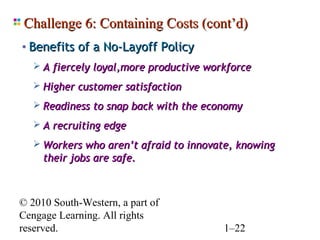
• Benefits of a No-Layoff Policy
    A fiercely loyal,more productive workforce

    Higher customer satisfaction

    Readiness to snap back with the economy

    A recruiting edge

    Workers who aren’t afraid to innovate, knowing
     their jobs are safe.


© 2010 South-Western, a part of
Cengage Learning. All rights
reserved.                                1–22
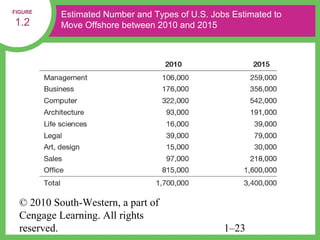
FIGURE
           Estimated Number and Types of U.S. Jobs Estimated to
1.2        Move Offshore between 2010 and 2015


  © 2010 South-Western, a part of
  Cengage Learning. All rights
  reserved.                                      1–23
Challenge 6: Containing Costs (cont’d)
• Employee Leasing
    The process of dismissing employees who are then
     hired by a leasing company (which handles all HR-
     related activities) and contracting with that
     company to lease back the employees.


© 2010 South-Western, a part of
Cengage Learning. All rights
reserved.                                1–24
FIGURE
           Productivity Enhancements
1.3


  © 2010 South-Western, a part of
  Cengage Learning. All rights
  reserved.                            1–25
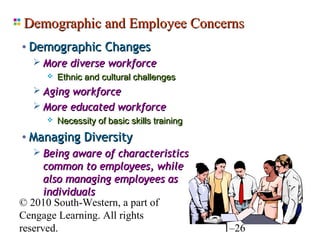
Demographic and Employee Concerns
• Demographic Changes
    More diverse workforce
        Ethnic and cultural challenges
   Aging workforce
   More educated workforce
        Necessity of basic skills training
 • Managing Diversity
    Being aware of characteristics
      common to employees, while
      also managing employees as
      individuals
© 2010 South-Western, a part of
Cengage Learning. All rights
reserved.                                     1–26
3
     Social Issues in HRM
     Changing Demographics: The coming decades will bring a more diverse and aging workforce to
     developed countries such as the United States. This has major implications for all aspects of HRM
     because it alters traditional experience and expectations regarding the labor pool. Among the
     issues in this area are:
     • Globalization                                 • Diversity strategies
     • Shrinking pool of skilled entry-level workers • Social Security and retirement issues
     • Rising health care costs for employees        • Continual skills development and retraining
     • Outsourcing, offshoring, and the use of temporary and part-time employees

     Employer/Employee Rights: This area reflects the shift toward organizations and individuals
     attempting to define rights, obligations, and responsibilities. Among the issues here are:
     • Relationship employment versus transactional-based employment
     • Concern for the privacy of employees      • Whistle-blowing   • Comparable worth
     • Employer-employee ethics                  • Legal compliance   • Mandated benefits

     Attitudes toward Work and Family: Because of the increase of working women as well as
     employee mobility and a growing concern about family issues, there is demand for recognizing
     and supporting family-related concerns. Among the issues are:
© 2010 South-Western, a part of leave
     • Day care and elder care
     • Alternative work schedules
                                  • Parental
                                  • Job sharing
                                                            • Flextime
                                                            • Job rotation
                                                                              • Telecommuting

Cengage Learning. All rights
reserved.                                                                1–27
FIGURE
           Composition of U.S. Population
1.4


  © 2010 South-Western, a part of
  Cengage Learning. All rights
  reserved.                                 1–28
FIGURE
           Labor Force and Gender Distributions
1.5


  © 2010 South-Western, a part of
  Cengage Learning. All rights
  reserved.                                       1–29
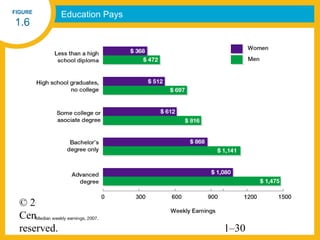
FIGURE
           Education Pays
1.6


  © 2010 South-Western, a part of
  Cengage Learning. All rights
  reserved.                         1–30
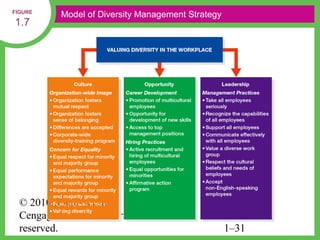
FIGURE
           Model of Diversity Management Strategy
1.7


  © 2010 South-Western, a part of
  Cengage Learning. All rights
  reserved.                                         1–31
4
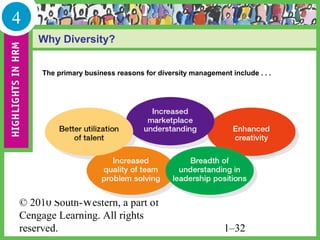
    Why Diversity?


     The primary business reasons for diversity management include . . .


© 2010 South-Western, a part of
Cengage Learning. All rights
reserved.                                                 1–32
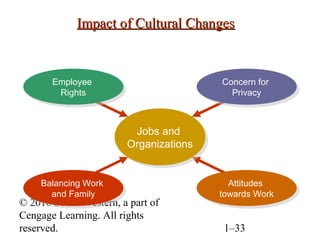
Impact of Cultural Changes


       Employee
       Employee                        Concern for
                                       Concern for
        Rights
         Rights                          Privacy
                                         Privacy


                        Jobs and
                         Jobs and
                       Organizations
                       Organizations


    Balancing Work
    Balancing Work                        Attitudes
                                          Attitudes
      and Family
       and Family                      towards Work
                                        towards Work
© 2010 South-Western, a part of
Cengage Learning. All rights
reserved.                               1–33
Qualities of HR Managers
 • Responsibilities
    1. Advice and counsel
    2. Service
    3. Policy formulation
       and implementation
    4. Employee advocacy
 • Competencies
    1. Business mastery
    2. HR mastery
    3. Change mastery
    4. Personal credibility
© 2010 South-Western, a part of
Cengage Learning. All rights
reserved.                         1–34
FIGURE
           Human Resource Competency Model
1.8


  © 2010 South-Western, a part of
  Cengage Learning. All rights
  reserved.                                  1–35
5
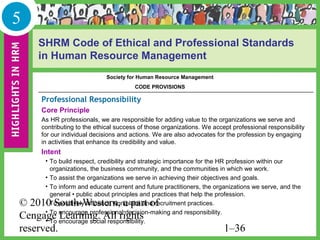
    SHRM Code of Ethical and Professional Standards
    in Human Resource Management
                           Society for Human Resource Management
                                      CODE PROVISIONS

    Professional Responsibility
    Core Principle
    As HR professionals, we are responsible for adding value to the organizations we serve and
    contributing to the ethical success of those organizations. We accept professional responsibility
    for our individual decisions and actions. We are also advocates for the profession by engaging
    in activities that enhance its credibility and value.
    Intent
     • To build respect, credibility and strategic importance for the HR profession within our
       organizations, the business community, and the communities in which we work.
     • To assist the organizations we serve in achieving their objectives and goals.
     • To inform and educate current and future practitioners, the organizations we serve, and the
       general • public about principles and practices that help the profession.
© 2010 South-Western, a part of
     • To positively influence workplace and recruitment practices.
     • To encourage professional decision-making and responsibility.
Cengage Learning. All rights
     • To encourage social responsibility.
reserved.                                                              1–36
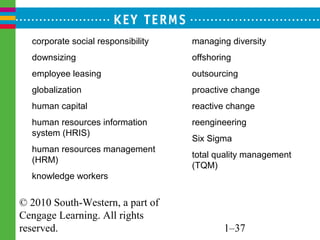
corporate social responsibility   managing diversity
  downsizing                        offshoring
  employee leasing                  outsourcing
  globalization                     proactive change
  human capital                     reactive change
  human resources information       reengineering
  system (HRIS)
                                    Six Sigma
  human resources management
                                    total quality management
  (HRM)
                                    (TQM)
  knowledge workers


© 2010 South-Western, a part of
Cengage Learning. All rights
reserved.                                   1–37

Bohlander15e ch01

  • 1.
    1 © 2010 South-Western,a part of Cengage Learning PowerPoint Presentation by Charlie Cook All rights reserved. The University of West Alabama
  • 2.
    Chapter Objectives After studyingthis chapter, you should be able to Identify how firms gain a sustainable competitive advantage through people. Explain how globalization is influencing human resources management. Describe the impact of information technology on managing people. Identify the importance of change management. Describe HR’s role in developing intellectual capital. © 2010 South-Western, a part of Cengage Learning. All rights reserved. 1–2
  • 3.
    Chapter Objectives (cont’d) Afterstudying this chapter, you should be able to Explain how TQM, Six Sigma, and reengineering affect HR systems. Discuss how cost pressures affect HR policies. Discuss the primary demographic and employee concerns pertaining to HRM. Provide examples of the roles and competencies of today’s HR managers. © 2010 South-Western, a part of Cengage Learning. All rights reserved. 1–3
  • 4.
    Why Study HumanResources Management • Human Resources Management (HRM)  The process of managing human resources (human capital and intellectual assets) to achieve an organization’s objectives. • “Why Study HRM?”  Staffing the organization, designing jobs and teams, developing skillful employees, identifying approaches for improving their performance, and rewarding employee successes—all typically labeled HRM issues—are as relevant to line managers as they are to managers in the HR department. © 2010 South-Western, a part of Cengage Learning. All rights reserved. 1–4
  • 5.
    FIGURE Overall Framework for Human Resources Management 1.1 © 2010 South-Western, a part of Cengage Learning. All rights reserved. 1–5
  • 6.
    Competitive Challenges and HumanResources Management • The most pressing competitive issues facing firms:  Competing, recruiting, and staffing globally  Embracing new technology  Managing change  Managing talent, or human capital  Responding to the market  Containing costs © 2010 South-Western, a part of Cengage Learning. All rights reserved. 1–6
  • 7.
    Challenge 1: Competing,Recruiting, and Staffing Globally • Globalization  The trend toward opening up foreign markets to international trade and investment • Impact of Globalization  “Anything, anytime, anywhere” markets  Partnerships with foreign firms  Lower trade and tariff barriers  NAFTA, EU, APEC trade agreements  WTO and GATT © 2010 South-Western, a part of Cengage Learning. All rights reserved. 1–7
  • 8.
    Challenge 1…(cont’d) • CorporateSocial Responsibility (CSR)  The responsibility of the firm to act in the best interests of the people and communities affected by its activities • Globalization’s Impact on HRM  Different geographies, cultures, laws, and business practices  Issues:  Identifying capable managers and workers  Developing foreign culture and work practice training programs.  Adjusting compensation plans for overseas work © 2010 South-Western, a part of Cengage Learning. All rights reserved. 1–8
  • 9.
    1 A Guide to HR Internet Sites HR professionals can access the following Web sites for current information related to human resources. Codes of Conduct Asia-Pacific Economic Cooperation Forum Business Code of Conduct (http://www.cauxroundtable.org/ APECForumBusinessCodeofConduct.html) Caux Round Table Principles for Business (http://www.cauxroundtable.org/principles.html) Fair Labor Association Workshop Code of Conduct (http://www.fairlabor.org) Global Sullivan Principles (http://www.thegsp.org) ILO Tripartite Declaration of Principles Concerning Multinational Enterprises and Social Policy (http://www.ilo.org) OECD Guidelines for Multinational Enterprises (www.oecd.org/daf/investment/guidelines) OECD, Principles of Corporate Governance (http://www.oecd.org) © 2010 South-Western, aand Bribery in International Business Transactions Rules of Conduct on Extortion part of (International Chamber of Commerce, http://www.iccwbo.org) Cengage Learning. All rights of Human Rights (http://www.un.org) United Nations Universal Declaration reserved. 1–9
  • 10.
    1 A Guide to HR Internet Sites (cont’d) General AFL-CIO (http://www.aflcio.org/home.htm)—Union news, issue papers, press releases, links to labor sites. American Management Association (http://www.amanet.org/index.htm)—AMA membership, programs, training, and so on. FedWorld (http://www.fedworld.gov)—A gateway to many government Web sites. HR Professional’s Gateway to the Internet (http://www.hrprosgateway.com)—Links to HR-related Web pages. Occupational Safety and Health Resources (http://www.osh.net)—OSHA-related sites, government pages, resources, and so on. Society for Human Resource Management (http://www.shrm.org)—Current events, information, connections, and articles. Telecommuting, Telework, and Alternative Officing (http://www.gilgordon.com)—Telecommuting and flexible hours. Training & Development Resource Center (http://www.thetrainingworld.com)—Job mart, training links, and T&D electronic mailing list links. © 2010 South-Western, a part of U.S. Department of Labor (http://www.dol.gov)—Job bank, labor statistics, press releases, Cengage Learning.information. grants, and contract All rights reserved. 1–10
  • 11.
    Challenge 2: EmbracingNew Technology • Knowledge Workers  Workers whose responsibilities extend beyond the physical execution of work to include planning, decision making, and problem solving. • Knowledge-Based Training  Online instruction  “Just-in-time” learning via the Internet on company intranets  Virtual learning © 2010 South-Western, a part of Cengage Learning. All rights reserved. 1–11
  • 12.
    Influence of Technologyin HRM • Human Resources Information System (HRIS)  A computerized system that provides current and accurate data for the purposes of control and decision making.  Benefits:  Automation of routine tasks, lower administrative costs, increased productivity and response times.  Self-service access to information and training for managers and employees  Online recruiting, screening, and pretesting of applicants  Training, tracking, and selecting employees based on their record of skills and abilities © 2010 South-Western, a part of of “cascading” goals  Organization-wide alignment Cengage Learning. All rights reserved. 1–12
  • 13.
    2 Automation of Talent Management Functions © 2010 South-Western, a part of Cengage Learning. All rights reserved. 1–13
  • 14.
    HRM IT InvestmentFactors • Fit of the application to • Time required to the firm’s employee implement and train staff base. members to use HRIS • Ability to upgrade • Initial and annual Increased efficiency and maintenance costs time savings • Training time required for • Compatibility with HR and payroll current systems • Availability of technical support © 2010 South-Western, a part of Cengage Learning. All rights reserved. 1–14
  • 15.
    Challenge 3: ManagingChange • Types of Change  Reactive change  Change that occurs after external forces have already affected performance  Proactive change  Change initiated to take advantage of targeted opportunities • Managing Change through HR  Formal change management programs help to keep employees focused on the success of the business. © 2010 South-Western, a part of Cengage Learning. All rights reserved. 1–15
  • 16.
    Challenge 3: ManagingChange (cont’d) • Why Change Efforts Fail:  Not establishing a sense of urgency.  Not creating a powerful coalition to guide the effort.  Lacking leaders who have a vision.  Lacking leaders who communicate the vision.  Not removing obstacles to the new vision.  Not systematically planning for and creating short- term “wins.”  Declaring victory too soon. © 2010 South-Western, a part of the corporate culture.  Not anchoring changes in Cengage Learning. All rights reserved. 1–16
  • 17.
    Challenge 4: ManagingTalent, or Human Capital • Human Capital  The knowledge, skills, and capabilities of individuals that have economic value to an organization.  Valuable because capital:  is based on company-specific skills.  is gained through long-term experience.  can be expanded through development. © 2010 South-Western, a part of Cengage Learning. All rights reserved. 1–17
  • 18.
    Challenge 5: Respondingto the Market • Total Quality Management (TQM)  A set of principles and practices whose core ideas include understanding customer needs, doing things right the first time, and striving for continuous improvement. • Six Sigma  A process used to translate customer needs into a set of optimal tasks that are performed in concert with one another.  HR facilitates organizational development of Six Sigma.  HR helps balance the opposing needs for order and control © 2010 South-Western, a growth and creativity. with the needs for part of Cengage Learning. All rights reserved. 1–18
  • 19.
    Challenge 5: Respondingto the Market (cont’d) • Reengineering and HRM  Fundamental rethinking and radical redesign of business processes to achieve dramatic improvements in cost, quality, service, and speed.  Requires that managers create an environment for change.  Depends on effective leadership and communication processes.  Requires that administrative systems be reviewed and modified. © 2010 South-Western, a part of Cengage Learning. All rights reserved. 1–19
  • 20.
    Challenge 6: ContainingCosts • Downsizing  The planned elimination of jobs (“head count”).  Layoffs • Outsourcing  Contracting outside the organization to have work done that formerly was done by internal employees. • Offshoring (Global Sourcing)  The business practice of sending jobs to other countries. © 2010 South-Western, a part of Cengage Learning. All rights reserved. 1–20
  • 21.
    Challenge 6: ContainingCosts (cont’d) • Hidden Costs of a Layoff  Severance and rehiring costs  Accrued vacation and sick day payouts  Pension and benefit payoffs  Potential lawsuits from aggrieved workers  Loss of institutional memory and trust in management  Lack of staffers when the economy rebounds  Survivors who are risk-averse, paranoid, and political © 2010 South-Western, a part of Cengage Learning. All rights reserved. 1–21
  • 22.
    Challenge 6: ContainingCosts (cont’d) • Benefits of a No-Layoff Policy  A fiercely loyal,more productive workforce  Higher customer satisfaction  Readiness to snap back with the economy  A recruiting edge  Workers who aren’t afraid to innovate, knowing their jobs are safe. © 2010 South-Western, a part of Cengage Learning. All rights reserved. 1–22
  • 23.
    FIGURE Estimated Number and Types of U.S. Jobs Estimated to 1.2 Move Offshore between 2010 and 2015 © 2010 South-Western, a part of Cengage Learning. All rights reserved. 1–23
  • 24.
    Challenge 6: ContainingCosts (cont’d) • Employee Leasing  The process of dismissing employees who are then hired by a leasing company (which handles all HR- related activities) and contracting with that company to lease back the employees. © 2010 South-Western, a part of Cengage Learning. All rights reserved. 1–24
  • 25.
    FIGURE Productivity Enhancements 1.3 © 2010 South-Western, a part of Cengage Learning. All rights reserved. 1–25
  • 26.
    Demographic and EmployeeConcerns • Demographic Changes  More diverse workforce  Ethnic and cultural challenges  Aging workforce  More educated workforce  Necessity of basic skills training • Managing Diversity  Being aware of characteristics common to employees, while also managing employees as individuals © 2010 South-Western, a part of Cengage Learning. All rights reserved. 1–26
  • 27.
    3 Social Issues in HRM Changing Demographics: The coming decades will bring a more diverse and aging workforce to developed countries such as the United States. This has major implications for all aspects of HRM because it alters traditional experience and expectations regarding the labor pool. Among the issues in this area are: • Globalization • Diversity strategies • Shrinking pool of skilled entry-level workers • Social Security and retirement issues • Rising health care costs for employees • Continual skills development and retraining • Outsourcing, offshoring, and the use of temporary and part-time employees Employer/Employee Rights: This area reflects the shift toward organizations and individuals attempting to define rights, obligations, and responsibilities. Among the issues here are: • Relationship employment versus transactional-based employment • Concern for the privacy of employees • Whistle-blowing • Comparable worth • Employer-employee ethics • Legal compliance • Mandated benefits Attitudes toward Work and Family: Because of the increase of working women as well as employee mobility and a growing concern about family issues, there is demand for recognizing and supporting family-related concerns. Among the issues are: © 2010 South-Western, a part of leave • Day care and elder care • Alternative work schedules • Parental • Job sharing • Flextime • Job rotation • Telecommuting Cengage Learning. All rights reserved. 1–27
  • 28.
    FIGURE Composition of U.S. Population 1.4 © 2010 South-Western, a part of Cengage Learning. All rights reserved. 1–28
  • 29.
    FIGURE Labor Force and Gender Distributions 1.5 © 2010 South-Western, a part of Cengage Learning. All rights reserved. 1–29
  • 30.
    FIGURE Education Pays 1.6 © 2010 South-Western, a part of Cengage Learning. All rights reserved. 1–30
  • 31.
    FIGURE Model of Diversity Management Strategy 1.7 © 2010 South-Western, a part of Cengage Learning. All rights reserved. 1–31
  • 32.
    4 Why Diversity? The primary business reasons for diversity management include . . . © 2010 South-Western, a part of Cengage Learning. All rights reserved. 1–32
  • 33.
    Impact of CulturalChanges Employee Employee Concern for Concern for Rights Rights Privacy Privacy Jobs and Jobs and Organizations Organizations Balancing Work Balancing Work Attitudes Attitudes and Family and Family towards Work towards Work © 2010 South-Western, a part of Cengage Learning. All rights reserved. 1–33
  • 34.
    Qualities of HRManagers • Responsibilities 1. Advice and counsel 2. Service 3. Policy formulation and implementation 4. Employee advocacy • Competencies 1. Business mastery 2. HR mastery 3. Change mastery 4. Personal credibility © 2010 South-Western, a part of Cengage Learning. All rights reserved. 1–34
  • 35.
    FIGURE Human Resource Competency Model 1.8 © 2010 South-Western, a part of Cengage Learning. All rights reserved. 1–35
  • 36.
    5 SHRM Code of Ethical and Professional Standards in Human Resource Management Society for Human Resource Management CODE PROVISIONS Professional Responsibility Core Principle As HR professionals, we are responsible for adding value to the organizations we serve and contributing to the ethical success of those organizations. We accept professional responsibility for our individual decisions and actions. We are also advocates for the profession by engaging in activities that enhance its credibility and value. Intent • To build respect, credibility and strategic importance for the HR profession within our organizations, the business community, and the communities in which we work. • To assist the organizations we serve in achieving their objectives and goals. • To inform and educate current and future practitioners, the organizations we serve, and the general • public about principles and practices that help the profession. © 2010 South-Western, a part of • To positively influence workplace and recruitment practices. • To encourage professional decision-making and responsibility. Cengage Learning. All rights • To encourage social responsibility. reserved. 1–36
  • 37.
    corporate social responsibility managing diversity downsizing offshoring employee leasing outsourcing globalization proactive change human capital reactive change human resources information reengineering system (HRIS) Six Sigma human resources management total quality management (HRM) (TQM) knowledge workers © 2010 South-Western, a part of Cengage Learning. All rights reserved. 1–37