Understanding
Body Language
Lekha Sishta
Global Talent Strategist and Business Advisor
Agenda
 Components of Communication
 Types of non-verbal communication
 Each type
 Tips for Trainers/ Presenters/Teachers
 Next?
30-07-2021
Body language - Lekha Sishta
2
Communication
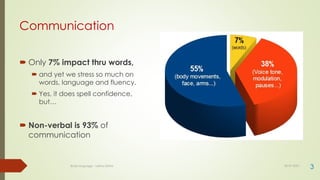
 Only 7% impact thru words,
 and yet we stress so much on
words, language and fluency.
 Yes, it does spell confidence,
but…
 Non-verbal is 93% of
communication
30-07-2021
Body language - Lekha Sishta
3
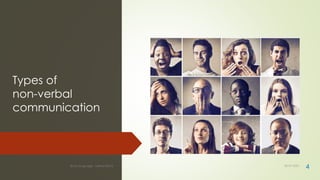
Types of
non-verbal
communication
30-07-2021
Body language - Lekha Sishta
4
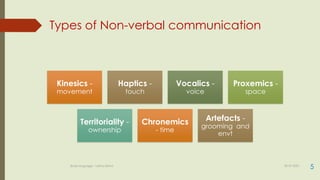
Types of Non-verbal communication
Kinesics -
movement
Haptics -
touch
Vocalics -
voice
Proxemics -
space
Territoriality -
ownership
Chronemics
- time
Artefacts -
grooming and
envt
30-07-2021
Body language - Lekha Sishta
5
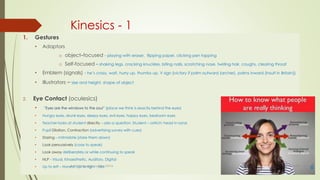
Kinesics - 1
1. Gestures
• Adaptors
o object–focused - playing with eraser, flipping paper, clicking pen tapping
o Self-focused – shaking legs, cracking knuckles, biting nails, scratching nose, twirling hair, coughs, clearing throat
• Emblem (signals) - he’s crazy, wait, hurry up, thumbs up, V sign {victory if palm outward (archer), palms inward (insult in Britain)}
• Illustrators – size and height, shape of object
2. Eye Contact (oculesics)
• ”Eyes are the windows to the soul” (place we think is exactly behind the eyes)
• Hungry eyes, drunk eyes, sleepy eyes, evil eyes, happy eyes, bedroom eyes
• Teacher looks at student directly – asks a question. Student – ostrich: head in sand.
• Pupil Dilation, Contraction (advertising survey with cues)
• Staring – Intimidate (stare them down)
• Look persuasively (coax to speak)
• Look away deliberately or while continuing to speak
• NLP - Visual, Kinaesthetic, Auditory, Digital
• Up to left – Honest, Up to right - Lies 30-07-2021
Body language - Lekha Sishta
6
Kinesics - 2
3. Head movements
• Head nod/shake – Hyd?
• Head up, Head down, Head tilt (submission –
expose the neck)
4. Postures
• Sitting, Standing, Lying down, Squatting, Kneeling
• Leaning back, leaning forward, sitting on edge of chair, lounging, straddling the chair
• Hands on hips: thumbs in front, thumbs behind, elbows akimbo, hands in pocket: thumbs in, fingers in.
5. Facial Expressions
• Pandemic times – Smiling with eyes above mask.
• Humorous story – smile, lift brows, light up eyes
• Serious data – furrowed brows, tighter mouth, slight head nod
• Facial expressions and content must match, else loss of credibility
30-07-2021
Body language - Lekha Sishta
7
30-07-2021
Body language - Lekha Sishta 8
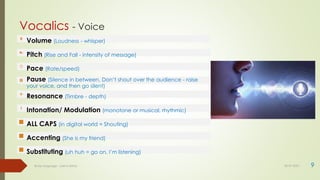
Vocalics - Voice
9
Body language - Lekha Sishta 30-07-2021
Volume (Loudness - whisper)
Pitch (Rise and Fall - intensity of message)
Pace (Rate/speed)
Pause (Silence in between. Don’t shout over the audience - raise
your voice, and then go silent)
Resonance (Timbre - depth)
Intonation/ Modulation (monotone or musical, rhythmic)
ALL CAPS (in digital world = Shouting)
Accenting (She is my friend)
Substituting (uh huh = go on, I’m listening)
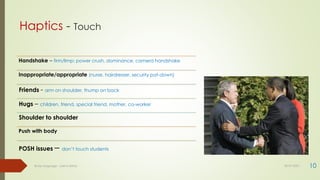
Haptics - Touch
10
Body language - Lekha Sishta 30-07-2021
Handshake – firm/limp; power crush, dominance, camera handshake
Inappropriate/appropriate (nurse, hairdresser, security pat-down)
Friends - arm on shoulder, thump on back
Hugs – children, friend, special friend, mother, co-worker
Shoulder to shoulder
Push with body
POSH issues – don’t touch students
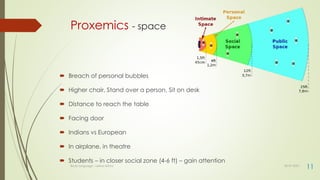
Proxemics - space
 Breach of personal bubbles
 Higher chair, Stand over a person, Sit on desk
 Distance to reach the table
 Facing door
 Indians vs European
 In airplane, in theatre
 Students – in closer social zone (4-6 ft) – gain attention
30-07-2021
Body language - Lekha Sishta
11
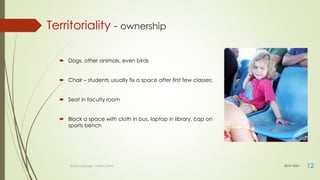
Territoriality - ownership
12
 Dogs, other animals, even birds
 Chair – students usually fix a space after first few classes;
 Seat in faculty room
 Block a space with cloth in bus, laptop in library, cap on
sports bench
Body language - Lekha Sishta 30-07-2021
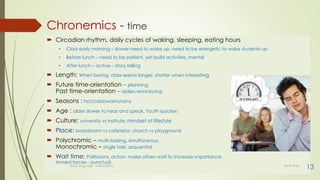
Chronemics - time
 Circadian rhythm, daily cycles of waking, sleeping, eating hours
• Class early morning – slower need to wake up, need to be energetic to wake students up
• Before lunch – need to be patient, yet build activities, mental
• After lunch – active – story-telling
 Length: When boring, class seems longer, shorter when interesting
 Future time-orientation – planning;
Past time-orientation – elders reminiscing
 Seasons : hot/cold/warm/rainy
 Age : older slower to hear and speak, Youth quicker;
 Culture: university vs institute; mindset of lifestyle
 Place: boardroom vs cafeteria; church vs playground
 Polychromic – multi-tasking, simultaneous;
Monochromic – single task, sequential
 Wait time: Politicians, actors- make others wait to increase importance;
Armed forces - punctual
30-07-2021
Body language - Lekha Sishta
13
Artefacts
14
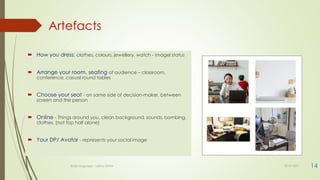
 How you dress: clothes, colours, jewellery, watch - imagel status
 Arrange your room, seating of audience – classroom,
conference, casual round tables
 Choose your seat - on same side of decision-maker, between
screen and the person
 Online - Things around you, clean background, sounds, bombing,
clothes, (not top half alone)
 Your DP/ Avatar - represents your social image
Body language - Lekha Sishta 30-07-2021
12 points For Presenters /teachers - 1
- adapted from Simon Sinek’s Public speaking skills
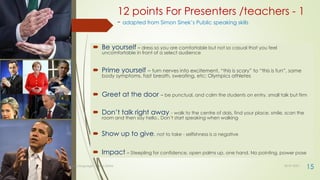
 Be yourself – dress so you are comfortable but not so casual that you feel
uncomfortable in front of a select audience
 Prime yourself – turn nerves into excitement, “this is scary” to “this is fun”, same
body symptoms, fast breath, sweating, etc; Olympics athletes
 Greet at the door – be punctual, and calm the students on entry, small talk but firm
 Don’t talk right away - walk to the centre of dais, find your place, smile, scan the
room and then say hello.. Don’t start speaking when walking
 Show up to give, not to take - selfishness is a negative
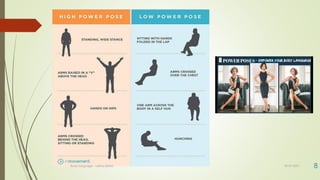
 Impact – Steepling for confidence, open palms up, one hand. No pointing, power pose
30-07-2021
Body language - Lekha Sishta
15
12 points For Presenters /teachers - 2
- adapted from Simon Sinek’s Public speaking skills
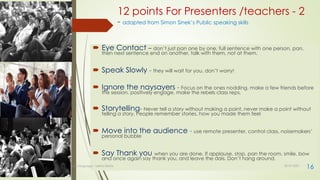
 Eye Contact – don’t just pan one by one, full sentence with one person, pan,
then next sentence end on another, talk with them, not at them.
 Speak Slowly - they will wait for you, don’t worry!
 Ignore the naysayers - Focus on the ones nodding, make a few friends before
the session, positively engage, make the rebels class reps,
 Storytelling- Never tell a story without making a point, never make a point without
telling a story, People remember stories, how you made them feel
 Move into the audience - use remote presenter, control class, noisemakers’
personal bubble
 Say Thank you when you are done. If applause, stop, pan the room, smile, bow
and once again say thank you, and leave the dais. Don’t hang around.
30-07-2021
Body language - Lekha Sishta
16
Next:
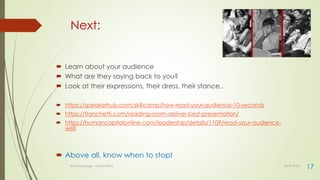
 Learn about your audience
 What are they saying back to you?
 Look at their expressions, their dress, their stance..
 https://speakerhub.com/skillcamp/how-read-your-audience-10-seconds
 https://franchetti.com/reading-room-deliver-best-presentation/
 https://humancapitalonline.com/leadership/details/1109/read-your-audience-
well
 Above all, know when to stop!
30-07-2021
Body language - Lekha Sishta
17
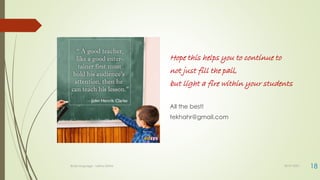
Hope this helps you to continue to
not just fill the pail,
but light a fire within your students
All the best!
tekhahr@gmail.com
30-07-2021
Body language - Lekha Sishta 18

Body Language for TeachersPresenters.pdf

  • 1.
    Understanding Body Language Lekha Sishta GlobalTalent Strategist and Business Advisor
  • 2.
    Agenda  Components ofCommunication  Types of non-verbal communication  Each type  Tips for Trainers/ Presenters/Teachers  Next? 30-07-2021 Body language - Lekha Sishta 2
  • 3.
    Communication  Only 7%impact thru words,  and yet we stress so much on words, language and fluency.  Yes, it does spell confidence, but…  Non-verbal is 93% of communication 30-07-2021 Body language - Lekha Sishta 3
  • 4.
  • 5.
    Types of Non-verbalcommunication Kinesics - movement Haptics - touch Vocalics - voice Proxemics - space Territoriality - ownership Chronemics - time Artefacts - grooming and envt 30-07-2021 Body language - Lekha Sishta 5
  • 6.
    Kinesics - 1 1.Gestures • Adaptors o object–focused - playing with eraser, flipping paper, clicking pen tapping o Self-focused – shaking legs, cracking knuckles, biting nails, scratching nose, twirling hair, coughs, clearing throat • Emblem (signals) - he’s crazy, wait, hurry up, thumbs up, V sign {victory if palm outward (archer), palms inward (insult in Britain)} • Illustrators – size and height, shape of object 2. Eye Contact (oculesics) • ”Eyes are the windows to the soul” (place we think is exactly behind the eyes) • Hungry eyes, drunk eyes, sleepy eyes, evil eyes, happy eyes, bedroom eyes • Teacher looks at student directly – asks a question. Student – ostrich: head in sand. • Pupil Dilation, Contraction (advertising survey with cues) • Staring – Intimidate (stare them down) • Look persuasively (coax to speak) • Look away deliberately or while continuing to speak • NLP - Visual, Kinaesthetic, Auditory, Digital • Up to left – Honest, Up to right - Lies 30-07-2021 Body language - Lekha Sishta 6
  • 7.
    Kinesics - 2 3.Head movements • Head nod/shake – Hyd? • Head up, Head down, Head tilt (submission – expose the neck) 4. Postures • Sitting, Standing, Lying down, Squatting, Kneeling • Leaning back, leaning forward, sitting on edge of chair, lounging, straddling the chair • Hands on hips: thumbs in front, thumbs behind, elbows akimbo, hands in pocket: thumbs in, fingers in. 5. Facial Expressions • Pandemic times – Smiling with eyes above mask. • Humorous story – smile, lift brows, light up eyes • Serious data – furrowed brows, tighter mouth, slight head nod • Facial expressions and content must match, else loss of credibility 30-07-2021 Body language - Lekha Sishta 7
  • 8.
  • 9.
    Vocalics - Voice 9 Bodylanguage - Lekha Sishta 30-07-2021 Volume (Loudness - whisper) Pitch (Rise and Fall - intensity of message) Pace (Rate/speed) Pause (Silence in between. Don’t shout over the audience - raise your voice, and then go silent) Resonance (Timbre - depth) Intonation/ Modulation (monotone or musical, rhythmic) ALL CAPS (in digital world = Shouting) Accenting (She is my friend) Substituting (uh huh = go on, I’m listening)
  • 10.
    Haptics - Touch 10 Bodylanguage - Lekha Sishta 30-07-2021 Handshake – firm/limp; power crush, dominance, camera handshake Inappropriate/appropriate (nurse, hairdresser, security pat-down) Friends - arm on shoulder, thump on back Hugs – children, friend, special friend, mother, co-worker Shoulder to shoulder Push with body POSH issues – don’t touch students
  • 11.
    Proxemics - space Breach of personal bubbles  Higher chair, Stand over a person, Sit on desk  Distance to reach the table  Facing door  Indians vs European  In airplane, in theatre  Students – in closer social zone (4-6 ft) – gain attention 30-07-2021 Body language - Lekha Sishta 11
  • 12.
    Territoriality - ownership 12 Dogs, other animals, even birds  Chair – students usually fix a space after first few classes;  Seat in faculty room  Block a space with cloth in bus, laptop in library, cap on sports bench Body language - Lekha Sishta 30-07-2021
  • 13.
    Chronemics - time Circadian rhythm, daily cycles of waking, sleeping, eating hours • Class early morning – slower need to wake up, need to be energetic to wake students up • Before lunch – need to be patient, yet build activities, mental • After lunch – active – story-telling  Length: When boring, class seems longer, shorter when interesting  Future time-orientation – planning; Past time-orientation – elders reminiscing  Seasons : hot/cold/warm/rainy  Age : older slower to hear and speak, Youth quicker;  Culture: university vs institute; mindset of lifestyle  Place: boardroom vs cafeteria; church vs playground  Polychromic – multi-tasking, simultaneous; Monochromic – single task, sequential  Wait time: Politicians, actors- make others wait to increase importance; Armed forces - punctual 30-07-2021 Body language - Lekha Sishta 13
  • 14.
    Artefacts 14  How youdress: clothes, colours, jewellery, watch - imagel status  Arrange your room, seating of audience – classroom, conference, casual round tables  Choose your seat - on same side of decision-maker, between screen and the person  Online - Things around you, clean background, sounds, bombing, clothes, (not top half alone)  Your DP/ Avatar - represents your social image Body language - Lekha Sishta 30-07-2021
  • 15.
    12 points ForPresenters /teachers - 1 - adapted from Simon Sinek’s Public speaking skills  Be yourself – dress so you are comfortable but not so casual that you feel uncomfortable in front of a select audience  Prime yourself – turn nerves into excitement, “this is scary” to “this is fun”, same body symptoms, fast breath, sweating, etc; Olympics athletes  Greet at the door – be punctual, and calm the students on entry, small talk but firm  Don’t talk right away - walk to the centre of dais, find your place, smile, scan the room and then say hello.. Don’t start speaking when walking  Show up to give, not to take - selfishness is a negative  Impact – Steepling for confidence, open palms up, one hand. No pointing, power pose 30-07-2021 Body language - Lekha Sishta 15
  • 16.
    12 points ForPresenters /teachers - 2 - adapted from Simon Sinek’s Public speaking skills  Eye Contact – don’t just pan one by one, full sentence with one person, pan, then next sentence end on another, talk with them, not at them.  Speak Slowly - they will wait for you, don’t worry!  Ignore the naysayers - Focus on the ones nodding, make a few friends before the session, positively engage, make the rebels class reps,  Storytelling- Never tell a story without making a point, never make a point without telling a story, People remember stories, how you made them feel  Move into the audience - use remote presenter, control class, noisemakers’ personal bubble  Say Thank you when you are done. If applause, stop, pan the room, smile, bow and once again say thank you, and leave the dais. Don’t hang around. 30-07-2021 Body language - Lekha Sishta 16
  • 17.
    Next:  Learn aboutyour audience  What are they saying back to you?  Look at their expressions, their dress, their stance..  https://speakerhub.com/skillcamp/how-read-your-audience-10-seconds  https://franchetti.com/reading-room-deliver-best-presentation/  https://humancapitalonline.com/leadership/details/1109/read-your-audience- well  Above all, know when to stop! 30-07-2021 Body language - Lekha Sishta 17
  • 18.
    Hope this helpsyou to continue to not just fill the pail, but light a fire within your students All the best! tekhahr@gmail.com 30-07-2021 Body language - Lekha Sishta 18