Understanding Body
Mass Index (BMI)
Date:20XX.X.XX Respondent:
Wen Duoduo
Introduction to BMI
1 BMI Categories
2
How to Calculate BMI
3 Limitations of BMI
4
CONTENTS
Table
of
Conte
nts
The Importance of BMI
5 Conclusion and Recommendations
6
Introduction to BMI
01
Importance of BMI
Understanding your BMI can offer insights
into potential health risks associated with
being underweight, overweight, or obese. It
serves as a guideline for health professionals
to assess and recommend lifestyle
adjustments for better health outcomes.
General Overview
BMI is not a direct measure of body fat but
relies on a mathematical relationship between
weight and height. It provides a quick and
simple way to understand weight relative to
height and is essential in public health
assessments.
Definition of BMI
Body Mass Index (BMI) is a widely
used screening tool that calculates a
person's body fat based on height and
weight. It categorizes individuals into
various weight classes which can be
indicative of their overall health
status.
SUMMARY OF WEEKLY WORK REPORT
What is BMI?
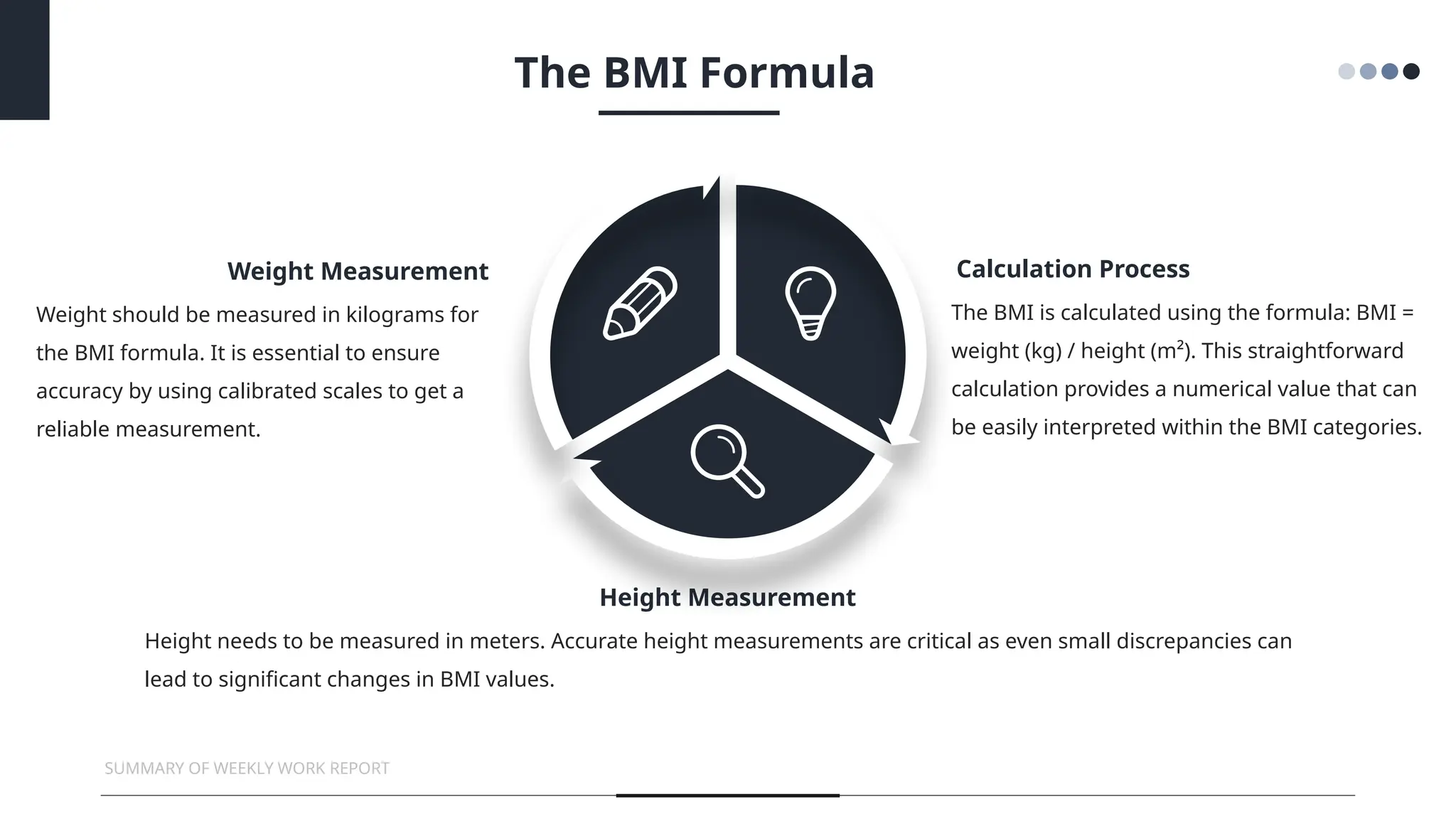
The BMI is calculated using the formula: BMI =
weight (kg) / height (m²). This straightforward
calculation provides a numerical value that can
be easily interpreted within the BMI categories.
Calculation Process
Weight should be measured in kilograms for
the BMI formula. It is essential to ensure
accuracy by using calibrated scales to get a
reliable measurement.
Weight Measurement
Height needs to be measured in meters. Accurate height measurements are critical as even small discrepancies can
lead to significant changes in BMI values.
Height Measurement
SUMMARY OF WEEKLY WORK REPORT
The BMI Formula
BMI Categories
02
Overweight Category
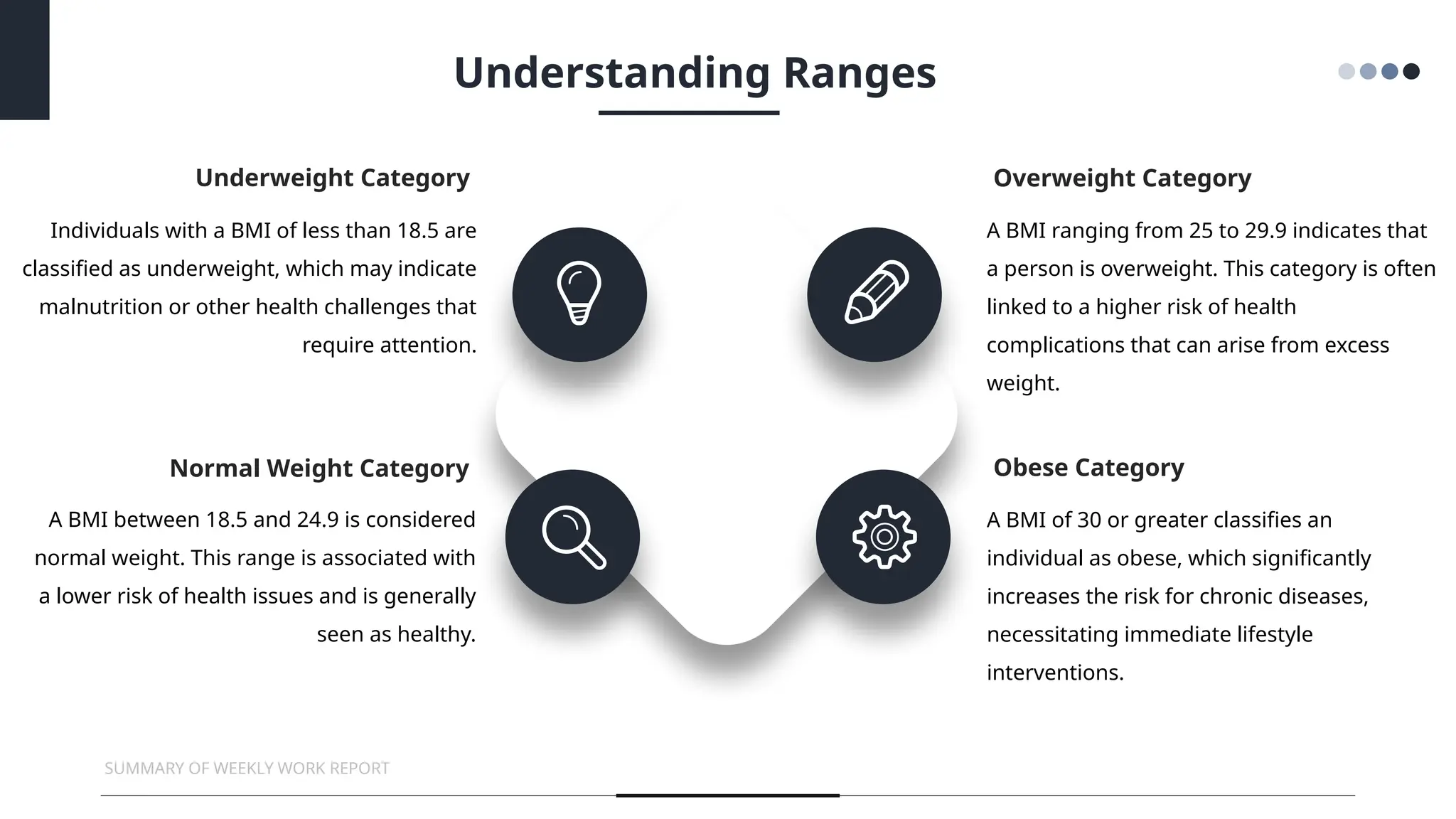
A BMI ranging from 25 to 29.9 indicates that
a person is overweight. This category is often
linked to a higher risk of health
complications that can arise from excess
weight.
Obese Category
A BMI of 30 or greater classifies an
individual as obese, which significantly
increases the risk for chronic diseases,
necessitating immediate lifestyle
interventions.
Underweight Category
Individuals with a BMI of less than 18.5 are
classified as underweight, which may indicate
malnutrition or other health challenges that
require attention.
Normal Weight Category
A BMI between 18.5 and 24.9 is considered
normal weight. This range is associated with
a lower risk of health issues and is generally
seen as healthy.
SUMMARY OF WEEKLY WORK REPORT
Understanding Ranges
Chronic Diseases
Higher BMI values are associated with increased risks for
diseases such as heart disease, stroke, type 2 diabetes, and
certain cancers, highlighting the critical need for
maintaining a healthy weight.
Importance for Health
Professionals
BMI categories help healthcare professionals identify
patients who may benefit from weight management
strategies. These classifications are crucial for developing
preventive health measures.
SUMMARY OF WEEKLY WORK REPORT
Health Risks Associated
How to Calculate BMI
03
80%
Steps to Calculate
To calculate BMI manually, first measure
weight in kilograms and height in meters.
Then use the formula: BMI = weight (kg) /
height² (m²) to find the BMI value.
300000
Formula Recap
Remember the formula: BMI = weight
(kg) / height² (m²). This basic arithmetic
allows individuals to quickly assess their
weight status based on height and weight
measurements.
SUMMARY OF WEEKLY WORK REPORT
Manual Calculation
BMI charts provide a visual representation of BMI
values across various height and weight
combinations, making it easy to find out where you
fall within the categories at a glance.
01
Advantages of BMI Charts
To read a BMI chart, locate your height on the
vertical axis and your weight on the horizontal axis.
The point where these two values intersect
indicates your BMI category.
02
How to Read a Chart
SUMMARY OF WEEKLY WORK REPORT
Using a BMI Chart
Limitations of BMI
04
BMI does not differentiate between muscle mass and fat. Thus,
athletes or muscular individuals may be misclassified as
overweight or obese despite having low body fat percentages.
BMI does not account for fat distribution in the body. Fat
accumulation in certain areas, such as the abdomen, may pose
greater health risks than overall BMI suggests.
Muscle vs. Fat
Fat Distribution
SUMMARY OF WEEKLY WORK REPORT
Factors Overlooked by BMI
Age Effects
Age can influence body composition and fat distribution.
For example, older adults may have a higher percentage of
body fat than younger adults at the same BMI.
Gender Differences
Gender differences in body fat distribution and
composition mean that BMI may not accurately reflect
body fat levels in men versus women.
SUMMARY OF WEEKLY WORK REPORT
Cultural and Biological Differences
The Importance of BMI
05
Maintaining a healthy BMI is crucial in preventing
chronic conditions such as cardiovascular diseases,
diabetes, and certain cancers, underscoring the
need for awareness and proactive management.
01
Chronic Conditions Overview
Monitoring BMI helps individuals take charge of
their health by making informed lifestyle decisions
and implementing early interventions if their
weight status changes.
02
Proactive Weight Management
SUMMARY OF WEEKLY WORK REPORT
Why BMI is Relevant
80%
Goal Setting
BMI data assists individuals in setting
realistic weight loss or maintenance goals
based on their current categories.
Establishing targets can motivate and
guide lifestyle changes effectively.
300000
Personalized Health Plans
Healthcare professionals use BMI
information to create tailored diet and
exercise plans that cater to individuals'
specific needs, ensuring effective weight
management strategies.
SUMMARY OF WEEKLY WORK REPORT
Applications of BMI
Conclusion and
Recommendations
06
Regularly monitoring BMI along with other health markers
helps individuals maintain a healthy lifestyle and identify
potential health risks early.
For personalized advice regarding weight management and
health, individuals should seek guidance from healthcare
professionals who can provide a comprehensive assessment
beyond BMI.
Importance of Monitoring
Consulting Healthcare Professionals
SUMMARY OF WEEKLY WORK REPORT
Summary of BMI's Significance
Encouragement for
Healthy Lifestyles
It's essential to embrace healthier lifestyles, focusing on
balanced diets and physical activities while being mindful
of BMI as a helpful tool in this journey.
Importance of Holistic
Health Assessments
A broader understanding of health involves considering
various factors, including metabolic markers and overall
fitness levels, rather than relying solely on BMI.
SUMMARY OF WEEKLY WORK REPORT
Final Thoughts
Thank you to all the
experts for your
critiques and
corrections.
T H A N K Y O U F O R T H E C R I T I C I S M O F T H E E X P E R T S
Date:20XX.X.XX Respondent:
Wen Duoduo

BMI Chart: Understand Your Body Mass Index at a Glance

  • 1.
    Understanding Body Mass Index(BMI) Date:20XX.X.XX Respondent: Wen Duoduo
  • 2.
    Introduction to BMI 1BMI Categories 2 How to Calculate BMI 3 Limitations of BMI 4 CONTENTS Table of Conte nts The Importance of BMI 5 Conclusion and Recommendations 6
  • 3.
  • 4.
    Importance of BMI Understandingyour BMI can offer insights into potential health risks associated with being underweight, overweight, or obese. It serves as a guideline for health professionals to assess and recommend lifestyle adjustments for better health outcomes. General Overview BMI is not a direct measure of body fat but relies on a mathematical relationship between weight and height. It provides a quick and simple way to understand weight relative to height and is essential in public health assessments. Definition of BMI Body Mass Index (BMI) is a widely used screening tool that calculates a person's body fat based on height and weight. It categorizes individuals into various weight classes which can be indicative of their overall health status. SUMMARY OF WEEKLY WORK REPORT What is BMI?
  • 5.
    The BMI iscalculated using the formula: BMI = weight (kg) / height (m²). This straightforward calculation provides a numerical value that can be easily interpreted within the BMI categories. Calculation Process Weight should be measured in kilograms for the BMI formula. It is essential to ensure accuracy by using calibrated scales to get a reliable measurement. Weight Measurement Height needs to be measured in meters. Accurate height measurements are critical as even small discrepancies can lead to significant changes in BMI values. Height Measurement SUMMARY OF WEEKLY WORK REPORT The BMI Formula
  • 6.
  • 7.
    Overweight Category A BMIranging from 25 to 29.9 indicates that a person is overweight. This category is often linked to a higher risk of health complications that can arise from excess weight. Obese Category A BMI of 30 or greater classifies an individual as obese, which significantly increases the risk for chronic diseases, necessitating immediate lifestyle interventions. Underweight Category Individuals with a BMI of less than 18.5 are classified as underweight, which may indicate malnutrition or other health challenges that require attention. Normal Weight Category A BMI between 18.5 and 24.9 is considered normal weight. This range is associated with a lower risk of health issues and is generally seen as healthy. SUMMARY OF WEEKLY WORK REPORT Understanding Ranges
  • 8.
    Chronic Diseases Higher BMIvalues are associated with increased risks for diseases such as heart disease, stroke, type 2 diabetes, and certain cancers, highlighting the critical need for maintaining a healthy weight. Importance for Health Professionals BMI categories help healthcare professionals identify patients who may benefit from weight management strategies. These classifications are crucial for developing preventive health measures. SUMMARY OF WEEKLY WORK REPORT Health Risks Associated
  • 9.
  • 10.
    80% Steps to Calculate Tocalculate BMI manually, first measure weight in kilograms and height in meters. Then use the formula: BMI = weight (kg) / height² (m²) to find the BMI value. 300000 Formula Recap Remember the formula: BMI = weight (kg) / height² (m²). This basic arithmetic allows individuals to quickly assess their weight status based on height and weight measurements. SUMMARY OF WEEKLY WORK REPORT Manual Calculation
  • 11.
    BMI charts providea visual representation of BMI values across various height and weight combinations, making it easy to find out where you fall within the categories at a glance. 01 Advantages of BMI Charts To read a BMI chart, locate your height on the vertical axis and your weight on the horizontal axis. The point where these two values intersect indicates your BMI category. 02 How to Read a Chart SUMMARY OF WEEKLY WORK REPORT Using a BMI Chart
  • 12.
  • 13.
    BMI does notdifferentiate between muscle mass and fat. Thus, athletes or muscular individuals may be misclassified as overweight or obese despite having low body fat percentages. BMI does not account for fat distribution in the body. Fat accumulation in certain areas, such as the abdomen, may pose greater health risks than overall BMI suggests. Muscle vs. Fat Fat Distribution SUMMARY OF WEEKLY WORK REPORT Factors Overlooked by BMI
  • 14.
    Age Effects Age caninfluence body composition and fat distribution. For example, older adults may have a higher percentage of body fat than younger adults at the same BMI. Gender Differences Gender differences in body fat distribution and composition mean that BMI may not accurately reflect body fat levels in men versus women. SUMMARY OF WEEKLY WORK REPORT Cultural and Biological Differences
  • 15.
  • 16.
    Maintaining a healthyBMI is crucial in preventing chronic conditions such as cardiovascular diseases, diabetes, and certain cancers, underscoring the need for awareness and proactive management. 01 Chronic Conditions Overview Monitoring BMI helps individuals take charge of their health by making informed lifestyle decisions and implementing early interventions if their weight status changes. 02 Proactive Weight Management SUMMARY OF WEEKLY WORK REPORT Why BMI is Relevant
  • 17.
    80% Goal Setting BMI dataassists individuals in setting realistic weight loss or maintenance goals based on their current categories. Establishing targets can motivate and guide lifestyle changes effectively. 300000 Personalized Health Plans Healthcare professionals use BMI information to create tailored diet and exercise plans that cater to individuals' specific needs, ensuring effective weight management strategies. SUMMARY OF WEEKLY WORK REPORT Applications of BMI
  • 18.
  • 19.
    Regularly monitoring BMIalong with other health markers helps individuals maintain a healthy lifestyle and identify potential health risks early. For personalized advice regarding weight management and health, individuals should seek guidance from healthcare professionals who can provide a comprehensive assessment beyond BMI. Importance of Monitoring Consulting Healthcare Professionals SUMMARY OF WEEKLY WORK REPORT Summary of BMI's Significance
  • 20.
    Encouragement for Healthy Lifestyles It'sessential to embrace healthier lifestyles, focusing on balanced diets and physical activities while being mindful of BMI as a helpful tool in this journey. Importance of Holistic Health Assessments A broader understanding of health involves considering various factors, including metabolic markers and overall fitness levels, rather than relying solely on BMI. SUMMARY OF WEEKLY WORK REPORT Final Thoughts
  • 21.
    Thank you toall the experts for your critiques and corrections. T H A N K Y O U F O R T H E C R I T I C I S M O F T H E E X P E R T S Date:20XX.X.XX Respondent: Wen Duoduo