‹#›
Britta Weber
5/11/2016
BM25 Demystified
2
What is BM25?
“Oh! BM25 is that probabilistic approach to scoring!”
3
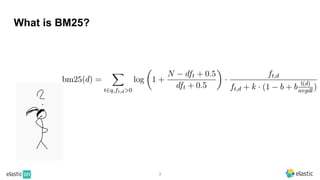
What is BM25?
4
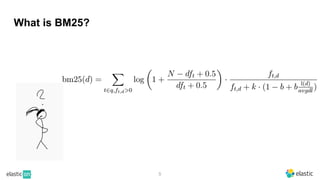
What is BM25?
5
What is BM25?
Why is this so complicated?
6
Usually when you use elasticsearch
you will have clear search criteria
• categories
• timestamps
• age
• ids …
7
Searching in natural language text
"_source": {
"oder-nr": 1234,
"items": [3,5,7],
"price": 30.85,
"customer": "Jon Doe",
"date": "2015-01-01"
}
Tweets mails, articles,… are fuzzy
• language is ambivalent, verbose
and many topics in one doc
• no clear way to formulate your
query
8
Searching in natural language text
"_source": {
"titles": "guru of everything",
"programming_languages": [
"java",
"python",
"FORTRAN"
],
"age": 32,
"name": "Jon Doe",
"date": "2015-01-01",
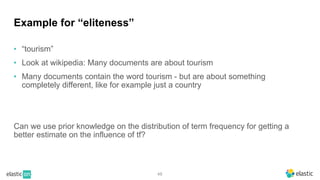
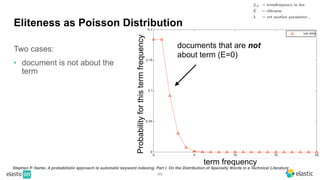
"self-description": "I am a
hard-working self-motivated expert
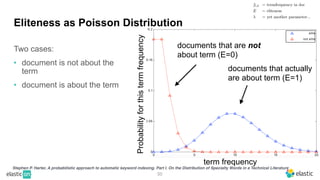
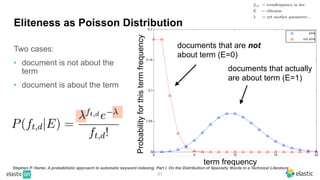
in everything. High performance is
not just an empty word for me..."
}
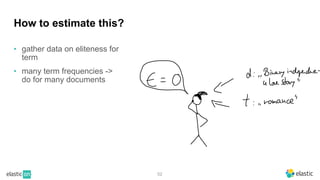
9
A free text search is a very inaccurate description of
our information need
What you want:
• quick learner
• works hard
• reliable
• enduring
• …
"_source": {
"titles": "guru of everything",
"programming_languages": [
"java",
"python",
"FORTRAN"
],
"age": 32,
"name": "Jon Doe",
"date": "2015-01-01",
"self-description": "I am a
hard-working self-motivated expert
in everything. High performance is
not just an empty word for me..."
}
10
A free text search is a very inaccurate description of
our information need
What you want:
• quick learner
• works hard
• reliable
• enduring
• …
But you type :
“hard-working, self-motivated, masochist”
"_source": {
"titles": "guru of everything",
"programming_languages": [
"java",
"python",
"FORTRAN"
],
"age": 32,
"name": "Jon Doe",
"date": "2015-01-01",
"self-description": "I am a
hard-working self-motivated expert
in everything. High performance is
not just an empty word for me..."
}
By the end of this talk you should
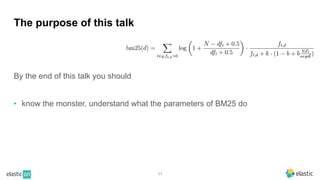
• know the monster, understand what the parameters of BM25 do
11
The purpose of this talk
12
The purpose of this talk
By the end of this talk you should
• know the monster, understand what the parameters of BM25 do
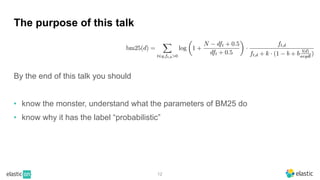
• know why it has the label “probabilistic”
13
The purpose of this talk
By the end of this talk you should
• know the monster, understand what the parameters of BM25 do
• know why it has the label “probabilistic”
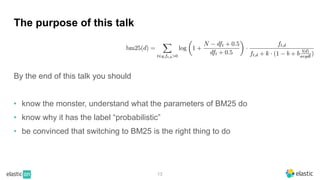
• be convinced that switching to BM25 is the right thing to do
14
The purpose of this talk
By the end of this talk you should
• know the monster, understand what the parameters of BM25 do
• know why it has the label “probabilistic”
• be convinced that switching to BM25 is the right thing to do
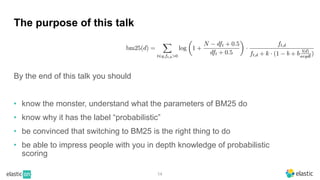
• be able to impress people with you in depth knowledge of probabilistic
scoring
The current default - TF/IDF
15
16
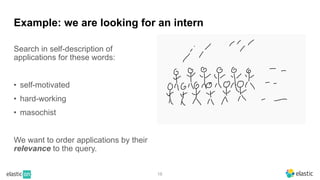
Example: we are looking for an intern
Search in self-description of
applications for these words:
• self-motivated
• hard-working
• masochist
We want to order applications by their
relevance to the query.
17
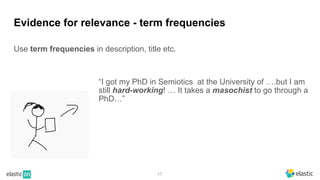
Evidence for relevance - term frequencies
Use term frequencies in description, title etc.
“I got my PhD in Semiotics at the University of ….but I am
still hard-working! … It takes a masochist to go through a
PhD…”
18
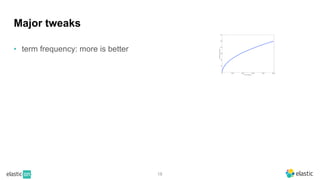
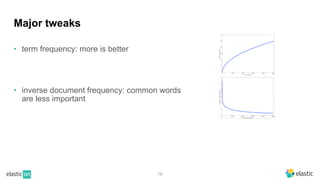
Major tweaks
• term frequency: more is better
19
Major tweaks
• term frequency: more is better
• inverse document frequency: common words
are less important
20
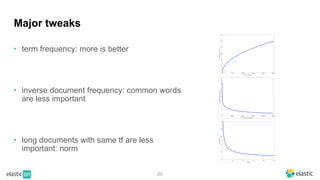
Major tweaks
• term frequency: more is better
• inverse document frequency: common words
are less important
• long documents with same tf are less
important: norm
21
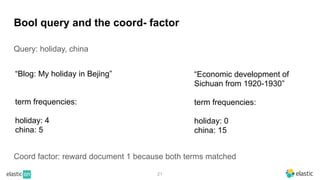
Bool query and the coord- factor
Query: holiday, china
“Blog: My holiday in Bejing”
term frequencies:
holiday: 4
china: 5
“Economic development of
Sichuan from 1920-1930”
term frequencies:
holiday: 0
china: 15
Coord factor: reward document 1 because both terms matched
22
TF/IDF
• Successful since the beginning of Lucene
• Well studied
• Easy to understand
• One size fits most
23
What is wrong with TF/IDF?
It is a heuristic that makes sense intuitively but it is somewhat a guess. (Ad
hoc.)
So…can we do better?
Probabilistic ranking and how it led to
BM25
24
25
The root of BM25: Probability ranking principle
(abridged)
“If retrieved documents are ordered by
decreasing probability of relevance on the
data available, then the system’s
effectiveness is the best that can be
obtained for the data.”
K. Sparck Jones, S. Walker, and S. E. Robertson, “A probabilistic model of information retrieval: Development and comparative experiments. Part 1,”
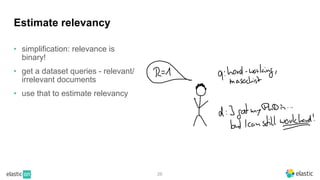
• simplification: relevance is
binary!
• get a dataset queries - relevant/
irrelevant documents
• use that to estimate relevancy
26
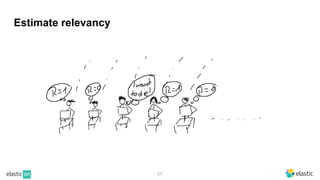
Estimate relevancy
27
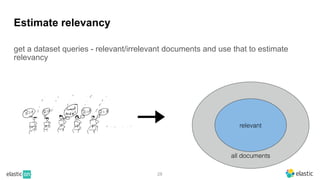
Estimate relevancy
get a dataset queries - relevant/irrelevant documents and use that to estimate
relevancy
28
Estimate relevancy
relevant
all documents
29
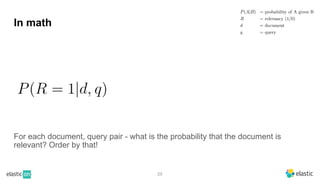
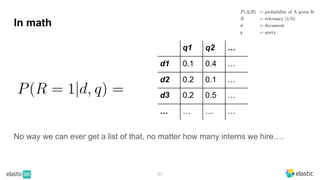
In math
For each document, query pair - what is the probability that the document is
relevant? Order by that!
30
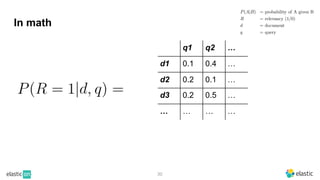
In math
q1 q2 …
d1 0.1 0.4 …
d2 0.2 0.1 …
d3 0.2 0.5 …
… … … …
31
In math
No way we can ever get a list of that, no matter how many interns we hire….
q1 q2 …
d1 0.1 0.4 …
d2 0.2 0.1 …
d3 0.2 0.5 …
… … … …
…here be math…
32
33
34
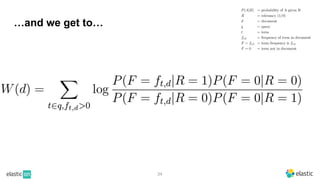
…and we get to…
35
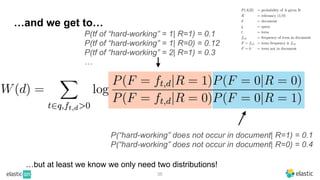
…and we get to…
…but at least we know we only need two distributions!
P(tf of “hard-working” = 1| R=1) = 0.1
P(tf of “hard-working” = 1| R=0) = 0.12
P(tf of “hard-working” = 2| R=1) = 0.3
…
P(“hard-working” does not occur in document| R=1) = 0.1
P(“hard-working” does not occur in document| R=0) = 0.4
How to estimate all these probabilities
36
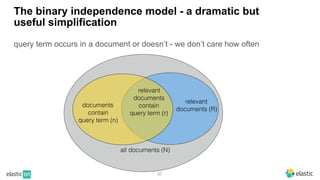
query term occurs in a document or doesn’t - we don’t care how often
37
The binary independence model - a dramatic but
useful simplification
relevant
documents (R)
relevant
documents
contain
query term (r)
documents
contain
query term (n)
all documents (N)
38
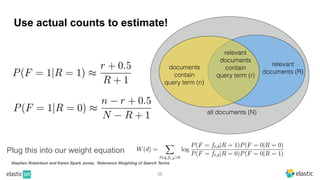
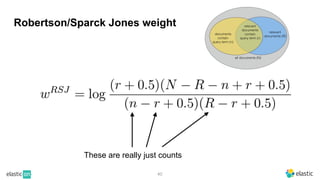
Use actual counts to estimate!
Plug this into our weight equation
relevant
documents (R)
relevant
documents
contain
query term (r)
documents
contain
query term (n)
all documents (N)
Stephen Robertson and Karen Spark Jones, Relevance Weighting of Search Terms
39
Use actual counts to estimate!
Plug this into our weight equation
relevant
documents (R)
relevant
documents
contain
query term (r)
documents
contain
query term (n)
all documents (N)
Stephen Robertson and Karen Spark Jones, Relevance Weighting of Search Terms
40
Robertson/Sparck Jones weight
These are really just counts
41
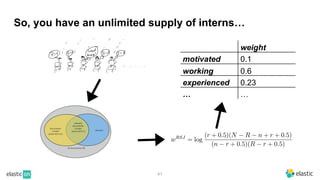
So, you have an unlimited supply of interns…
relevant
relevant
documents
contain
query term (r)
documents
contain
query term (n)
all documents (N)
weight
motivated 0.1
working 0.6
experienced 0.23
… …
42
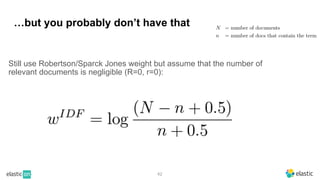
…but you probably don’t have that
Still use Robertson/Sparck Jones weight but assume that the number of
relevant documents is negligible (R=0, r=0):
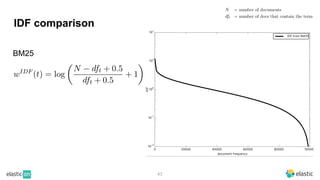
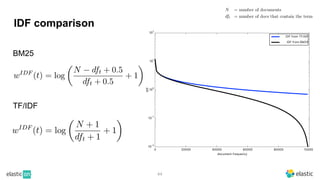
IDF comparison
43
BM25
IDF comparison
44
BM25
TF/IDF
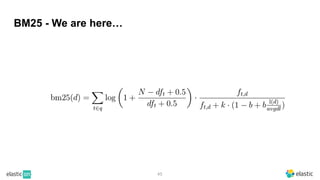
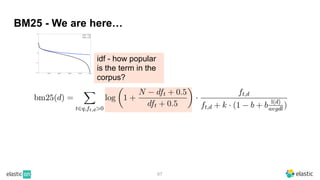
BM25 - We are here…
45
BM25 - We are here…
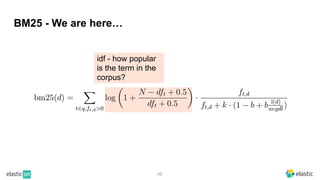
46
idf - how popular
is the term in the
corpus?
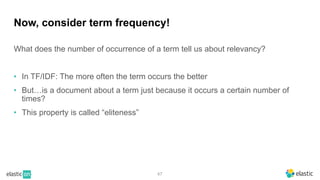
47
Now, consider term frequency!
What does the number of occurrence of a term tell us about relevancy?
• In TF/IDF: The more often the term occurs the better
• But…is a document about a term just because it occurs a certain number of
times?
• This property is called “eliteness”
48
Example for “eliteness”
• “tourism”
• Look at wikipedia: Many documents are about tourism
• Many documents contain the word tourism - but are about something
completely different, like for example just a country
Can we use prior knowledge on the distribution of term frequency for getting a
better estimate on the influence of tf?
Two cases:
• document is not about the
term
49
Eliteness as Poisson Distribution
Stephen P. Harter, A probabilistic approach to automatic keyword indexing. Part I. On the Distribution of Specialty Words in a Technical Literature
term frequency
Probability
for
this
term
frequency
documents that are not
about term (E=0)
Two cases:
• document is not about the
term
• document is about the term
50
Eliteness as Poisson Distribution
Stephen P. Harter, A probabilistic approach to automatic keyword indexing. Part I. On the Distribution of Specialty Words in a Technical Literature
term frequency
Probability
for
this
term
frequency
documents that actually
are about term (E=1)
documents that are not
about term (E=0)
Two cases:
• document is not about the
term
• document is about the term
51
Eliteness as Poisson Distribution
Stephen P. Harter, A probabilistic approach to automatic keyword indexing. Part I. On the Distribution of Specialty Words in a Technical Literature
term frequency
Probability
for
this
term
frequency
documents that actually
are about term (E=1)
documents that are not
about term (E=0)
52
How to estimate this?
• gather data on eliteness for
term
• many term frequencies ->
do for many documents
53
We need even more interns!
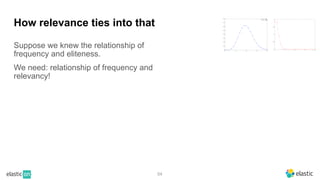
Suppose we knew the relationship of
frequency and eliteness.
We need: relationship of frequency and
relevancy!
54
How relevance ties into that
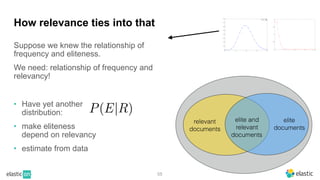
Suppose we knew the relationship of
frequency and eliteness.
We need: relationship of frequency and
relevancy!
• Have yet another
distribution:
• make eliteness
depend on relevancy
• estimate from data
55
How relevance ties into that
elite
documents
elite and
relevant
documents
relevant
documents
56
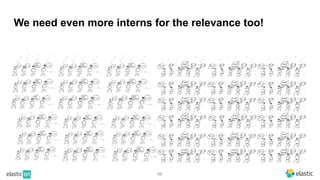
We need even more interns for the relevance too!
57
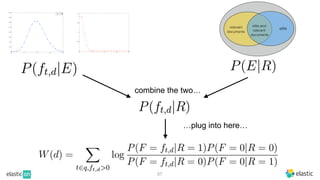
elite
elite and
relevant
documents
relevant
documents
combine the two…
…plug into here…
…here be math…
58
59
…and we get to….
60
…and we get to….
Stephen Robertson and Hugo Zaragoza, The Probabilistic Relevance Framework: BM25 and Beyond
61
“This is a somewhat messy formula, and furthermore we do not in general
know the values of these three parameters, or have any easy way of
estimating them.”
62
“…they took a leap of faith…”
Victor Lavrenko, Probabilistic model 9: BM25 and 2-poisson, youtube
63
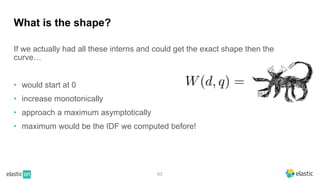
What is the shape?
If we actually had all these interns and could get the exact shape then the
curve…
• would start at 0
• increase monotonically
• approach a maximum asymptotically
• maximum would be the IDF we computed before!
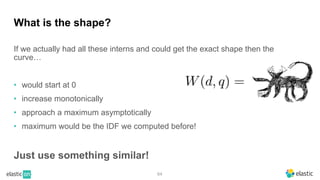
64
What is the shape?
If we actually had all these interns and could get the exact shape then the
curve…
• would start at 0
• increase monotonically
• approach a maximum asymptotically
• maximum would be the IDF we computed before!
Just use something similar!
65
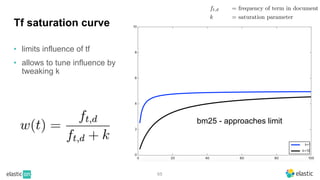
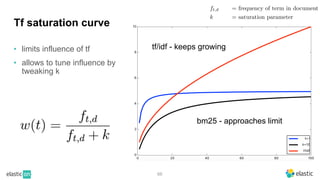
Tf saturation curve
• limits influence of tf
• allows to tune influence by
tweaking k
bm25 - approaches limit
ft,d = frequency of term in document
k = saturation parameter
66
Tf saturation curve
• limits influence of tf
• allows to tune influence by
tweaking k
bm25 - approaches limit
tf/idf - keeps growing
ft,d = frequency of term in document
k = saturation parameter
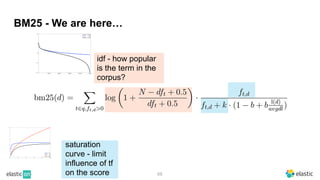
BM25 - We are here…
67
idf - how popular
is the term in the
corpus?
BM25 - We are here…
68
idf - how popular
is the term in the
corpus?
saturation
curve - limit
influence of tf
on the score
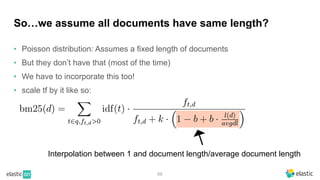
• Poisson distribution: Assumes a fixed length of documents
• But they don’t have that (most of the time)
• We have to incorporate this too!
• scale tf by it like so:
69
So…we assume all documents have same length?
Interpolation between 1 and document length/average document length
70
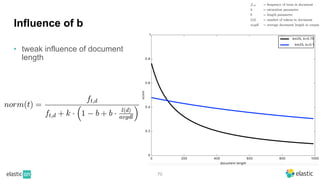
Influence of b
• tweak influence of document
length
ft,d = frequency of term in document
k = saturation parameter
b = length parameter
l(d) = number of tokens in document
avgdl = average document length in corpus
71
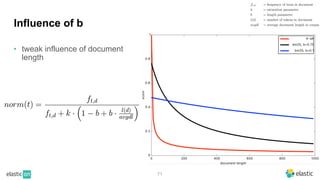
Influence of b
• tweak influence of document
length
ft,d = frequency of term in document
k = saturation parameter
b = length parameter
l(d) = number of tokens in document
avgdl = average document length in corpus
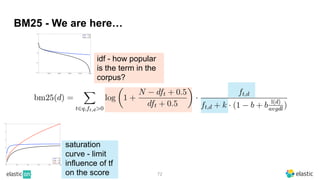
BM25 - We are here…
72
idf - how popular
is the term in the
corpus?
saturation
curve - limit
influence of tf
on the score
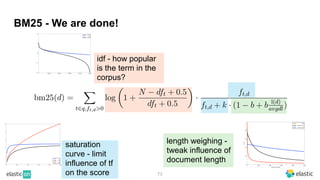
BM25 - We are done!
73
idf - how popular
is the term in the
corpus?
saturation
curve - limit
influence of tf
on the score
length weighing -
tweak influence of
document length
74
Is BM25 probabilistic?
• many approximations
• really hard to get the probabilities right even with unlimited data
BM25 is “inspired” by probabilistic ranking.
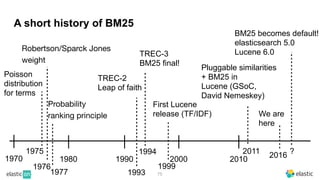
A short history of BM25
75
Probability
ranking principle
TREC-3
BM25 final!
Poisson
distribution
for terms
1970 1980 1990 2000 2010
1975 1994
1977
TREC-2
Leap of faith
1993
1976
Robertson/Sparck Jones
weight
Pluggable similarities
+ BM25 in
Lucene (GSoC,
David Nemeskey)
BM25 becomes default!
elasticsearch 5.0
Lucene 6.0
First Lucene
release (TF/IDF)
1999
2011
We are
here
?
2016
So…will I get a better scoring with BM25?
76
77
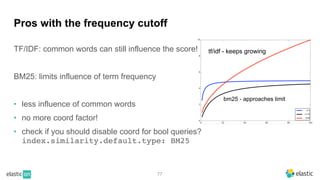
Pros with the frequency cutoff
TF/IDF: common words can still influence the score!
BM25: limits influence of term frequency
• less influence of common words
• no more coord factor!
• check if you should disable coord for bool queries?
index.similarity.default.type: BM25
bm25 - approaches limit
tf/idf - keeps growing
78
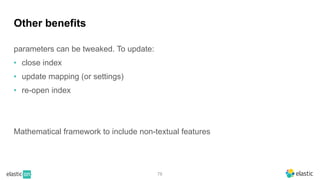
Other benefits
parameters can be tweaked. To update:
• close index
• update mapping (or settings)
• re-open index
Mathematical framework to include non-textual features
79
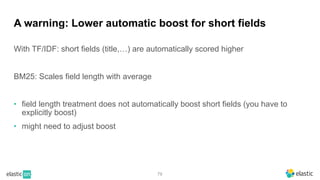
A warning: Lower automatic boost for short fields
With TF/IDF: short fields (title,…) are automatically scored higher
BM25: Scales field length with average
• field length treatment does not automatically boost short fields (you have to
explicitly boost)
• might need to adjust boost
80
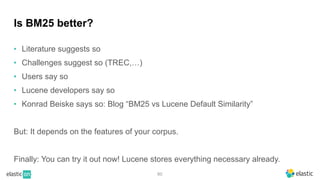
Is BM25 better?
• Literature suggests so
• Challenges suggest so (TREC,…)
• Users say so
• Lucene developers say so
• Konrad Beiske says so: Blog “BM25 vs Lucene Default Similarity”
But: It depends on the features of your corpus.
Finally: You can try it out now! Lucene stores everything necessary already.
81
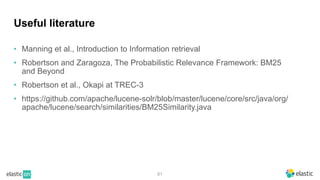
Useful literature
• Manning et al., Introduction to Information retrieval
• Robertson and Zaragoza, The Probabilistic Relevance Framework: BM25
and Beyond
• Robertson et al., Okapi at TREC-3
• https://github.com/apache/lucene-solr/blob/master/lucene/core/src/java/org/
apache/lucene/search/similarities/BM25Similarity.java
82
Thank you!

bm25 demystified

  • 1.
  • 2.
    2 What is BM25? “Oh!BM25 is that probabilistic approach to scoring!”
  • 3.
  • 4.
  • 5.
  • 6.
    Why is thisso complicated? 6
  • 7.
    Usually when youuse elasticsearch you will have clear search criteria • categories • timestamps • age • ids … 7 Searching in natural language text "_source": { "oder-nr": 1234, "items": [3,5,7], "price": 30.85, "customer": "Jon Doe", "date": "2015-01-01" }
  • 8.
    Tweets mails, articles,…are fuzzy • language is ambivalent, verbose and many topics in one doc • no clear way to formulate your query 8 Searching in natural language text "_source": { "titles": "guru of everything", "programming_languages": [ "java", "python", "FORTRAN" ], "age": 32, "name": "Jon Doe", "date": "2015-01-01", "self-description": "I am a hard-working self-motivated expert in everything. High performance is not just an empty word for me..." }
  • 9.
    9 A free textsearch is a very inaccurate description of our information need What you want: • quick learner • works hard • reliable • enduring • … "_source": { "titles": "guru of everything", "programming_languages": [ "java", "python", "FORTRAN" ], "age": 32, "name": "Jon Doe", "date": "2015-01-01", "self-description": "I am a hard-working self-motivated expert in everything. High performance is not just an empty word for me..." }
  • 10.
    10 A free textsearch is a very inaccurate description of our information need What you want: • quick learner • works hard • reliable • enduring • … But you type : “hard-working, self-motivated, masochist” "_source": { "titles": "guru of everything", "programming_languages": [ "java", "python", "FORTRAN" ], "age": 32, "name": "Jon Doe", "date": "2015-01-01", "self-description": "I am a hard-working self-motivated expert in everything. High performance is not just an empty word for me..." }
  • 11.
    By the endof this talk you should • know the monster, understand what the parameters of BM25 do 11 The purpose of this talk
  • 12.
    12 The purpose ofthis talk By the end of this talk you should • know the monster, understand what the parameters of BM25 do • know why it has the label “probabilistic”
  • 13.
    13 The purpose ofthis talk By the end of this talk you should • know the monster, understand what the parameters of BM25 do • know why it has the label “probabilistic” • be convinced that switching to BM25 is the right thing to do
  • 14.
    14 The purpose ofthis talk By the end of this talk you should • know the monster, understand what the parameters of BM25 do • know why it has the label “probabilistic” • be convinced that switching to BM25 is the right thing to do • be able to impress people with you in depth knowledge of probabilistic scoring
  • 15.
  • 16.
    16 Example: we arelooking for an intern Search in self-description of applications for these words: • self-motivated • hard-working • masochist We want to order applications by their relevance to the query.
  • 17.
    17 Evidence for relevance- term frequencies Use term frequencies in description, title etc. “I got my PhD in Semiotics at the University of ….but I am still hard-working! … It takes a masochist to go through a PhD…”
  • 18.
    18 Major tweaks • termfrequency: more is better
  • 19.
    19 Major tweaks • termfrequency: more is better • inverse document frequency: common words are less important
  • 20.
    20 Major tweaks • termfrequency: more is better • inverse document frequency: common words are less important • long documents with same tf are less important: norm
  • 21.
    21 Bool query andthe coord- factor Query: holiday, china “Blog: My holiday in Bejing” term frequencies: holiday: 4 china: 5 “Economic development of Sichuan from 1920-1930” term frequencies: holiday: 0 china: 15 Coord factor: reward document 1 because both terms matched
  • 22.
    22 TF/IDF • Successful sincethe beginning of Lucene • Well studied • Easy to understand • One size fits most
  • 23.
    23 What is wrongwith TF/IDF? It is a heuristic that makes sense intuitively but it is somewhat a guess. (Ad hoc.) So…can we do better?
  • 24.
    Probabilistic ranking andhow it led to BM25 24
  • 25.
    25 The root ofBM25: Probability ranking principle (abridged) “If retrieved documents are ordered by decreasing probability of relevance on the data available, then the system’s effectiveness is the best that can be obtained for the data.” K. Sparck Jones, S. Walker, and S. E. Robertson, “A probabilistic model of information retrieval: Development and comparative experiments. Part 1,”
  • 26.
    • simplification: relevanceis binary! • get a dataset queries - relevant/ irrelevant documents • use that to estimate relevancy 26 Estimate relevancy
  • 27.
  • 28.
    get a datasetqueries - relevant/irrelevant documents and use that to estimate relevancy 28 Estimate relevancy relevant all documents
  • 29.
    29 In math For eachdocument, query pair - what is the probability that the document is relevant? Order by that!
  • 30.
    30 In math q1 q2… d1 0.1 0.4 … d2 0.2 0.1 … d3 0.2 0.5 … … … … …
  • 31.
    31 In math No waywe can ever get a list of that, no matter how many interns we hire…. q1 q2 … d1 0.1 0.4 … d2 0.2 0.1 … d3 0.2 0.5 … … … … …
  • 32.
  • 33.
  • 34.
  • 35.
    35 …and we getto… …but at least we know we only need two distributions! P(tf of “hard-working” = 1| R=1) = 0.1 P(tf of “hard-working” = 1| R=0) = 0.12 P(tf of “hard-working” = 2| R=1) = 0.3 … P(“hard-working” does not occur in document| R=1) = 0.1 P(“hard-working” does not occur in document| R=0) = 0.4
  • 36.
    How to estimateall these probabilities 36
  • 37.
    query term occursin a document or doesn’t - we don’t care how often 37 The binary independence model - a dramatic but useful simplification relevant documents (R) relevant documents contain query term (r) documents contain query term (n) all documents (N)
  • 38.
    38 Use actual countsto estimate! Plug this into our weight equation relevant documents (R) relevant documents contain query term (r) documents contain query term (n) all documents (N) Stephen Robertson and Karen Spark Jones, Relevance Weighting of Search Terms
  • 39.
    39 Use actual countsto estimate! Plug this into our weight equation relevant documents (R) relevant documents contain query term (r) documents contain query term (n) all documents (N) Stephen Robertson and Karen Spark Jones, Relevance Weighting of Search Terms
  • 40.
  • 41.
    41 So, you havean unlimited supply of interns… relevant relevant documents contain query term (r) documents contain query term (n) all documents (N) weight motivated 0.1 working 0.6 experienced 0.23 … …
  • 42.
    42 …but you probablydon’t have that Still use Robertson/Sparck Jones weight but assume that the number of relevant documents is negligible (R=0, r=0):
  • 43.
  • 44.
  • 45.
    BM25 - Weare here… 45
  • 46.
    BM25 - Weare here… 46 idf - how popular is the term in the corpus?
  • 47.
    47 Now, consider termfrequency! What does the number of occurrence of a term tell us about relevancy? • In TF/IDF: The more often the term occurs the better • But…is a document about a term just because it occurs a certain number of times? • This property is called “eliteness”
  • 48.
    48 Example for “eliteness” •“tourism” • Look at wikipedia: Many documents are about tourism • Many documents contain the word tourism - but are about something completely different, like for example just a country Can we use prior knowledge on the distribution of term frequency for getting a better estimate on the influence of tf?
  • 49.
    Two cases: • documentis not about the term 49 Eliteness as Poisson Distribution Stephen P. Harter, A probabilistic approach to automatic keyword indexing. Part I. On the Distribution of Specialty Words in a Technical Literature term frequency Probability for this term frequency documents that are not about term (E=0)
  • 50.
    Two cases: • documentis not about the term • document is about the term 50 Eliteness as Poisson Distribution Stephen P. Harter, A probabilistic approach to automatic keyword indexing. Part I. On the Distribution of Specialty Words in a Technical Literature term frequency Probability for this term frequency documents that actually are about term (E=1) documents that are not about term (E=0)
  • 51.
    Two cases: • documentis not about the term • document is about the term 51 Eliteness as Poisson Distribution Stephen P. Harter, A probabilistic approach to automatic keyword indexing. Part I. On the Distribution of Specialty Words in a Technical Literature term frequency Probability for this term frequency documents that actually are about term (E=1) documents that are not about term (E=0)
  • 52.
    52 How to estimatethis? • gather data on eliteness for term • many term frequencies -> do for many documents
  • 53.
    53 We need evenmore interns!
  • 54.
    Suppose we knewthe relationship of frequency and eliteness. We need: relationship of frequency and relevancy! 54 How relevance ties into that
  • 55.
    Suppose we knewthe relationship of frequency and eliteness. We need: relationship of frequency and relevancy! • Have yet another distribution: • make eliteness depend on relevancy • estimate from data 55 How relevance ties into that elite documents elite and relevant documents relevant documents
  • 56.
    56 We need evenmore interns for the relevance too!
  • 57.
  • 58.
  • 59.
  • 60.
  • 61.
    Stephen Robertson andHugo Zaragoza, The Probabilistic Relevance Framework: BM25 and Beyond 61 “This is a somewhat messy formula, and furthermore we do not in general know the values of these three parameters, or have any easy way of estimating them.”
  • 62.
    62 “…they took aleap of faith…” Victor Lavrenko, Probabilistic model 9: BM25 and 2-poisson, youtube
  • 63.
    63 What is theshape? If we actually had all these interns and could get the exact shape then the curve… • would start at 0 • increase monotonically • approach a maximum asymptotically • maximum would be the IDF we computed before!
  • 64.
    64 What is theshape? If we actually had all these interns and could get the exact shape then the curve… • would start at 0 • increase monotonically • approach a maximum asymptotically • maximum would be the IDF we computed before! Just use something similar!
  • 65.
    65 Tf saturation curve •limits influence of tf • allows to tune influence by tweaking k bm25 - approaches limit ft,d = frequency of term in document k = saturation parameter
  • 66.
    66 Tf saturation curve •limits influence of tf • allows to tune influence by tweaking k bm25 - approaches limit tf/idf - keeps growing ft,d = frequency of term in document k = saturation parameter
  • 67.
    BM25 - Weare here… 67 idf - how popular is the term in the corpus?
  • 68.
    BM25 - Weare here… 68 idf - how popular is the term in the corpus? saturation curve - limit influence of tf on the score
  • 69.
    • Poisson distribution:Assumes a fixed length of documents • But they don’t have that (most of the time) • We have to incorporate this too! • scale tf by it like so: 69 So…we assume all documents have same length? Interpolation between 1 and document length/average document length
  • 70.
    70 Influence of b •tweak influence of document length ft,d = frequency of term in document k = saturation parameter b = length parameter l(d) = number of tokens in document avgdl = average document length in corpus
  • 71.
    71 Influence of b •tweak influence of document length ft,d = frequency of term in document k = saturation parameter b = length parameter l(d) = number of tokens in document avgdl = average document length in corpus
  • 72.
    BM25 - Weare here… 72 idf - how popular is the term in the corpus? saturation curve - limit influence of tf on the score
  • 73.
    BM25 - Weare done! 73 idf - how popular is the term in the corpus? saturation curve - limit influence of tf on the score length weighing - tweak influence of document length
  • 74.
    74 Is BM25 probabilistic? •many approximations • really hard to get the probabilities right even with unlimited data BM25 is “inspired” by probabilistic ranking.
  • 75.
    A short historyof BM25 75 Probability ranking principle TREC-3 BM25 final! Poisson distribution for terms 1970 1980 1990 2000 2010 1975 1994 1977 TREC-2 Leap of faith 1993 1976 Robertson/Sparck Jones weight Pluggable similarities + BM25 in Lucene (GSoC, David Nemeskey) BM25 becomes default! elasticsearch 5.0 Lucene 6.0 First Lucene release (TF/IDF) 1999 2011 We are here ? 2016
  • 76.
    So…will I geta better scoring with BM25? 76
  • 77.
    77 Pros with thefrequency cutoff TF/IDF: common words can still influence the score! BM25: limits influence of term frequency • less influence of common words • no more coord factor! • check if you should disable coord for bool queries? index.similarity.default.type: BM25 bm25 - approaches limit tf/idf - keeps growing
  • 78.
    78 Other benefits parameters canbe tweaked. To update: • close index • update mapping (or settings) • re-open index Mathematical framework to include non-textual features
  • 79.
    79 A warning: Lowerautomatic boost for short fields With TF/IDF: short fields (title,…) are automatically scored higher BM25: Scales field length with average • field length treatment does not automatically boost short fields (you have to explicitly boost) • might need to adjust boost
  • 80.
    80 Is BM25 better? •Literature suggests so • Challenges suggest so (TREC,…) • Users say so • Lucene developers say so • Konrad Beiske says so: Blog “BM25 vs Lucene Default Similarity” But: It depends on the features of your corpus. Finally: You can try it out now! Lucene stores everything necessary already.
  • 81.
    81 Useful literature • Manninget al., Introduction to Information retrieval • Robertson and Zaragoza, The Probabilistic Relevance Framework: BM25 and Beyond • Robertson et al., Okapi at TREC-3 • https://github.com/apache/lucene-solr/blob/master/lucene/core/src/java/org/ apache/lucene/search/similarities/BM25Similarity.java
  • 82.