
ENTREPRENEURSHIPPROF. Jorge SaguinsinANGELICA O. HIZON
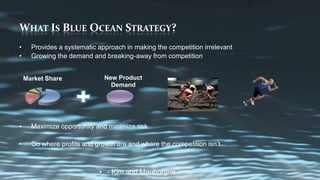
What Is Blue Ocean Strategy?Provides a systematic approach in making the competition irrelevantGrowing the demand and breaking-away from competitionMaximize opportunity and minimize riskGo where profits and growth are and where the competition isn’t- Kim and Mauborgne-
CIRQUE DU SOLEIL
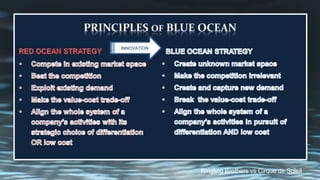
PRINCIPLES of BLUE OCEANRED OCEAN STRATEGYCompete in existing market spaceBeat the competitionExploit existing demandMake the value-cost trade-offAlign the whole system of a company’s activities with its strategic choice of differentiation OR low cost BLUE OCEAN STRATEGYINNOVATIONCreate unknown market spaceMake the competition irrelevantCreate and capture new demandBreak  the value-cost trade-offAlign the whole system of a company’s activities in pursuit of differentiation AND low cost Ringling Brothers vs Cirque de Soleil
ANALYTICAL TOOLS and FRAMEWORKS
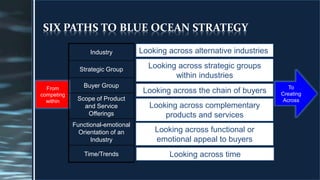
SIX PATHS TO BLUE OCEAN STRATEGYFocusing on competing within an industryLooking across alternative industries A company confining itself to established strategic groupsLooking across strategic groups within industriesTo Creating AcrossFocusing on the same buyer group as the rest of the industryFrom competing withinLooking across the chain of buyersA company limiting itself to the scope of an industry's products and servicesLooking across complementary products and servicesAccepting an industry's functional or emotional orientationLooking across functional or emotional appeal to buyersFocusing on the same point in time as the rest of the industryLooking across time
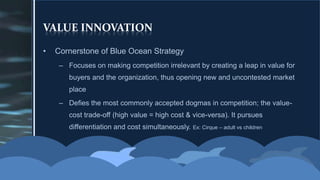
VALUE INNOVATIONCornerstone of Blue Ocean StrategyFocuses on making competition irrelevant by creating a leap in value for buyers and the organization, thus opening new and uncontested market placeDefies the most commonly accepted dogmas in competition; the value-cost trade-off (high value = high cost & vice-versa). It pursues differentiation and cost simultaneously. Ex: Cirque – adult vs children
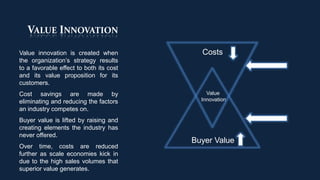
Value InnovationCostsValue innovation is created when the organization’s strategy results to a favorable effect to both its cost and its value proposition for its customers.Cost savings are made by eliminating and reducing the factors an industry competes on.  Buyer value is lifted by raising and creating elements the industry has never offered.  Over time, costs are reduced further as scale economies kick in due to the high sales volumes that superior value generates.EliminateReduceValue InnovationRaiseCreateBuyer Value
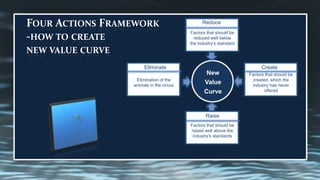
Four Actions Framework-how to create new value curveReduceFactors that should be reduced well below the industry’s standardNewValue CurveCreateEliminateFactors that should be created, which the industry has never offered Elimination of the animals in the circusRaiseFactors that should be raised well above the industry’s standards
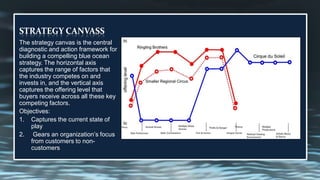
STRATEGY CANVASSThe strategy canvas is the central diagnostic and action framework for building a compelling blue ocean strategy. The horizontal axis captures the range of factors that the industry competes on and invests in, and the vertical axis captures the offering level that buyers receive across all these key competing factors.Objectives:Captures the current state of playGears an organization’s focus from customers to non-customers
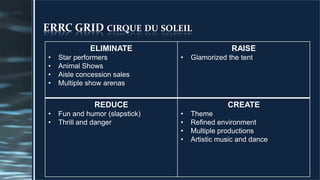
ERRC GRID cirque du soleilERRC GRID Pampanga’s Best TOCINOKapampangan market only
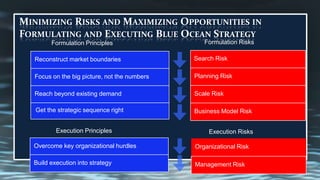
Minimizing Risks and Maximizing Opportunities in Formulating and Executing Blue Ocean StrategyFormulation PrinciplesFormulation Risks  Search Risk  Reconstruct market boundaries  Planning Risk  Focus on the big picture, not the numbers  Scale Risk  Reach beyond existing demand  Get the strategic sequence right  Business Model RiskExecution PrinciplesExecution Risks  Organizational Risk  Overcome key organizational hurdles  Build execution into strategy  Management Risk
Is BLUE OCEAN STRATEGY NEW?Although the term blue oceans is new, their existence is not. They are a feature of business life, past and present. Look back one hundred years and ask yourself, How many of today's industries were then unknown? The answer: Many industries as basic as automobiles, music recording, aviation, petrochemicals, health care, and management consulting were unheard of or had just begun to emerge at the time. Now turn the clock back only thirty years. Again, a plethora of multibillion-dollar industries jumps out - mutual funds, cell phones, gas-fired electricity plants, biotechnology, discount retail, express delivery, minivans, snowboards, coffee bars, and home videos to name a few. Just three decades ago, none of these industries existed in a meaningful way.
How durable is the advantage associated with a blue ocean strategy and what is the process for defending it?Creating blue oceans is not a static achievement but a dynamic process. Once a company creates a blue ocean and its powerful performance consequences are known, sooner or later imitators appear on the horizon. However, a blue ocean strategy brings with it considerable barriers to imitation. Some of these are cognitive, and others are operational.The first barrier is often cognitive. Competitors are often blocked from imitating because of brand image conflicts, or the blue ocean strategy just does not fit conventional strategic logic. For many years CNN, for example, was ridiculed by the industry as chicken noodle news by established players. The second barrier is organizational. Because imitation often requires companies to make substantial changes to their existing business practices, politics often kick in, delaying for years a company's commitment to imitate a blue ocean strategy. The third level includes the economic forces of blue oceans. The high volume generated by a value innovation leads to rapid cost advantages, placing potential imitators at an ongoing cost disadvantage.By heightening these barriers to imitation, companies can defend the blue oceans they created for some time. However, it should be noted that creating a blue ocean is not a static strategy process, but a dynamic one.By: Authors - Kim & Mauborgne
Referenceswww.blueoceanstrategy.comSome Images were copied from the website of Blue Ocean StrategyFile video of Cirque du Soleil is from YoutubeFAQ’s are from the authors

Blue ocean strategy

  • 1.
  • 2.
    What Is BlueOcean Strategy?Provides a systematic approach in making the competition irrelevantGrowing the demand and breaking-away from competitionMaximize opportunity and minimize riskGo where profits and growth are and where the competition isn’t- Kim and Mauborgne-
  • 3.
  • 4.
    PRINCIPLES of BLUEOCEANRED OCEAN STRATEGYCompete in existing market spaceBeat the competitionExploit existing demandMake the value-cost trade-offAlign the whole system of a company’s activities with its strategic choice of differentiation OR low cost BLUE OCEAN STRATEGYINNOVATIONCreate unknown market spaceMake the competition irrelevantCreate and capture new demandBreak the value-cost trade-offAlign the whole system of a company’s activities in pursuit of differentiation AND low cost Ringling Brothers vs Cirque de Soleil
  • 5.
  • 6.
    SIX PATHS TOBLUE OCEAN STRATEGYFocusing on competing within an industryLooking across alternative industries A company confining itself to established strategic groupsLooking across strategic groups within industriesTo Creating AcrossFocusing on the same buyer group as the rest of the industryFrom competing withinLooking across the chain of buyersA company limiting itself to the scope of an industry's products and servicesLooking across complementary products and servicesAccepting an industry's functional or emotional orientationLooking across functional or emotional appeal to buyersFocusing on the same point in time as the rest of the industryLooking across time
  • 7.
    VALUE INNOVATIONCornerstone ofBlue Ocean StrategyFocuses on making competition irrelevant by creating a leap in value for buyers and the organization, thus opening new and uncontested market placeDefies the most commonly accepted dogmas in competition; the value-cost trade-off (high value = high cost & vice-versa). It pursues differentiation and cost simultaneously. Ex: Cirque – adult vs children
  • 8.
    Value InnovationCostsValue innovationis created when the organization’s strategy results to a favorable effect to both its cost and its value proposition for its customers.Cost savings are made by eliminating and reducing the factors an industry competes on. Buyer value is lifted by raising and creating elements the industry has never offered. Over time, costs are reduced further as scale economies kick in due to the high sales volumes that superior value generates.EliminateReduceValue InnovationRaiseCreateBuyer Value
  • 9.
    Four Actions Framework-howto create new value curveReduceFactors that should be reduced well below the industry’s standardNewValue CurveCreateEliminateFactors that should be created, which the industry has never offered Elimination of the animals in the circusRaiseFactors that should be raised well above the industry’s standards
  • 10.
    STRATEGY CANVASSThe strategycanvas is the central diagnostic and action framework for building a compelling blue ocean strategy. The horizontal axis captures the range of factors that the industry competes on and invests in, and the vertical axis captures the offering level that buyers receive across all these key competing factors.Objectives:Captures the current state of playGears an organization’s focus from customers to non-customers
  • 11.
    ERRC GRID cirquedu soleilERRC GRID Pampanga’s Best TOCINOKapampangan market only
  • 12.
    Minimizing Risks andMaximizing Opportunities in Formulating and Executing Blue Ocean StrategyFormulation PrinciplesFormulation Risks Search Risk Reconstruct market boundaries Planning Risk Focus on the big picture, not the numbers Scale Risk Reach beyond existing demand Get the strategic sequence right Business Model RiskExecution PrinciplesExecution Risks Organizational Risk Overcome key organizational hurdles Build execution into strategy Management Risk
  • 13.
    Is BLUE OCEANSTRATEGY NEW?Although the term blue oceans is new, their existence is not. They are a feature of business life, past and present. Look back one hundred years and ask yourself, How many of today's industries were then unknown? The answer: Many industries as basic as automobiles, music recording, aviation, petrochemicals, health care, and management consulting were unheard of or had just begun to emerge at the time. Now turn the clock back only thirty years. Again, a plethora of multibillion-dollar industries jumps out - mutual funds, cell phones, gas-fired electricity plants, biotechnology, discount retail, express delivery, minivans, snowboards, coffee bars, and home videos to name a few. Just three decades ago, none of these industries existed in a meaningful way.
  • 14.
    How durable isthe advantage associated with a blue ocean strategy and what is the process for defending it?Creating blue oceans is not a static achievement but a dynamic process. Once a company creates a blue ocean and its powerful performance consequences are known, sooner or later imitators appear on the horizon. However, a blue ocean strategy brings with it considerable barriers to imitation. Some of these are cognitive, and others are operational.The first barrier is often cognitive. Competitors are often blocked from imitating because of brand image conflicts, or the blue ocean strategy just does not fit conventional strategic logic. For many years CNN, for example, was ridiculed by the industry as chicken noodle news by established players. The second barrier is organizational. Because imitation often requires companies to make substantial changes to their existing business practices, politics often kick in, delaying for years a company's commitment to imitate a blue ocean strategy. The third level includes the economic forces of blue oceans. The high volume generated by a value innovation leads to rapid cost advantages, placing potential imitators at an ongoing cost disadvantage.By heightening these barriers to imitation, companies can defend the blue oceans they created for some time. However, it should be noted that creating a blue ocean is not a static strategy process, but a dynamic one.By: Authors - Kim & Mauborgne
  • 15.
    Referenceswww.blueoceanstrategy.comSome Images werecopied from the website of Blue Ocean StrategyFile video of Cirque du Soleil is from YoutubeFAQ’s are from the authors

Editor's Notes

  • #2 This template is in widescreen format and demonstrates how transitions, animations, and multimedia choreography can be used to enrich a presentation.
  • #10 In order to break the trade-off between differentiation and low cost and create a new value curve…