BLUE OCEAN STRATEGY
GROUP-1
CONTENTS
1. INTRODUCTION
2. BLUE OCEAN VS RED OCEAN
3. BLUE OCEAN TOOLS
4. STRENGTHS
5. RISKS
6. EXAMPLES
7. BLUE OCEAN STRATEGY: BLESSING OR
CURSE IN DEVELOPING COUNTRIES?
8. CONCLUSION
01
INTRODUCTION
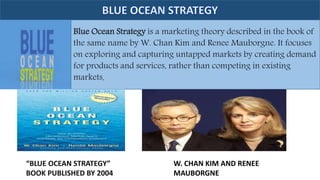
Blue Ocean Strategy is a marketing theory described in the book of
the same name by W. Chan Kim and Renee Mauborgne. It focuses
on exploring and capturing untapped markets by creating demand
for products and services, rather than competing in existing
markets.
“BLUE OCEAN STRATEGY”
BOOK PUBLISHED BY 2004
W. CHAN KIM AND RENEE
MAUBORGNE
02
BLUE OCEAN VS RED OCEAN
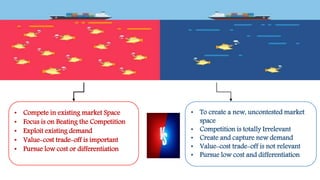
• To create a new, uncontested market
space
• Competition is totally Irrelevant
• Create and capture new demand
• Value-cost trade-off is not relevant
• Pursue low cost and differentiation
• Compete in existing market Space
• Focus is on Beating the Competition
• Exploit existing demand
• Value-cost trade-off is important
• Pursue low cost or differentiation
03
BLUE OCEAN TOOLS
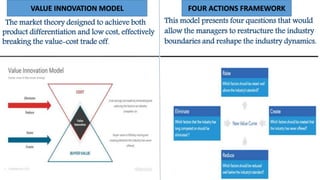
VALUE INNOVATION MODEL
The market theory designed to achieve both
product differentiation and low cost, effectively
breaking the value-cost trade off.
FOUR ACTIONS FRAMEWORK
This model presents four questions that would
allow the managers to restructure the industry
boundaries and reshape the industry dynamics.
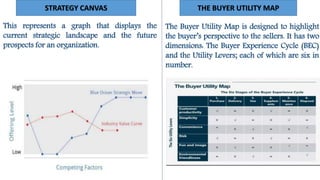
STRATEGY CANVAS THE BUYER UTILITY MAP
This represents a graph that displays the
current strategic landscape and the future
prospects for an organization.
The Buyer Utility Map is designed to highlight
the buyer’s perspective to the sellers. It has two
dimensions: The Buyer Experience Cycle (BEC)
and the Utility Levers; each of which are six in
number.
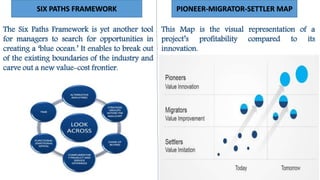
SIX PATHS FRAMEWORK PIONEER-MIGRATOR-SETTLER MAP
The Six Paths Framework is yet another tool
for managers to search for opportunities in
creating a ‘blue ocean.’ It enables to break out
of the existing boundaries of the industry and
carve out a new value-cost frontier.
This Map is the visual representation of a
project’s profitability compared to its
innovation.
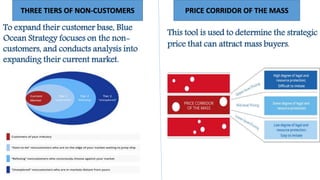
THREE TIERS OF NON-CUSTOMERS PRICE CORRIDOR OF THE MASS
To expand their customer base, Blue
Ocean Strategy focuses on the non-
customers, and conducts analysis into
expanding their current market.
This tool is used to determine the strategic
price that can attract mass buyers.
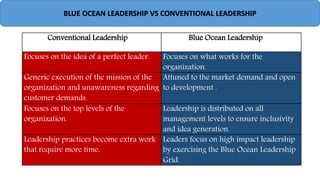
BLUE OCEAN LEADERSHIP VS CONVENTIONAL LEADERSHIP
Conventional Leadership Blue Ocean Leadership
Focuses on the idea of a perfect leader. Focuses on what works for the
organization.
Generic execution of the mission of the
organization and unawareness regarding
customer demands.
Attuned to the market demand and open
to development .
Focuses on the top levels of the
organization.
Leadership is distributed on all
management levels to ensure inclusivity
and idea generation.
Leadership practices become extra work
that require more time.
Leaders focus on high impact leadership
by exercising the Blue Ocean Leadership
Grid.
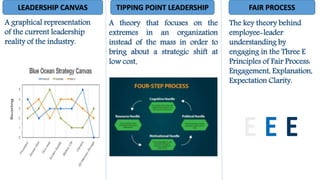
LEADERSHIP CANVAS TIPPING POINT LEADERSHIP FAIR PROCESS
A theory that focuses on the
extremes in an organization
instead of the mass in order to
bring about a strategic shift at
low cost.
The key theory behind
employee-leader
understanding by
engaging in the Three E
Principles of Fair Process:
Engagement, Explanation,
Expectation Clarity.
A graphical representation
of the current leadership
reality of the industry.
04
STRENGTHS
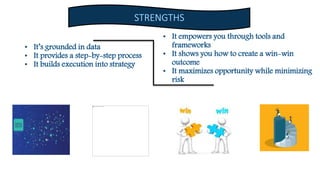
• It’s grounded in data
• It provides a step-by-step process
• It builds execution into strategy
• It empowers you through tools and
frameworks
• It shows you how to create a win-win
outcome
• It maximizes opportunity while minimizing
risk
05
RISKS
1. Finding the right blue ocean
2. Being too different, too new
3. Strategy Execution
4. Strategic Clarity and Corporate Mindset
5. Trust and patience
6. Defensibility
06
EXAMPLES
 Cirque du Soleil: 1980, Canada, Circus Industry
 Netflix: 1997, USA, Entertainment Industry
 Canon: 1985, USA, Electronic Industry
IMPLEMENTATION OF BLUE OCEAN
STRATEGY BY CHALDAL
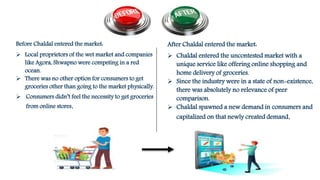
Before Chaldal entered the market:
 Local proprietors of the wet market and companies
like Agora, Shwapno were competing in a red
ocean.
 There was no other option for consumers to get
groceries other than going to the market physically.
 Consumers didn’t feel the necessity to get groceries
from online stores.
After Chaldal entered the market:
 Chaldal entered the uncontested market with a
unique service like offering online shopping and
home delivery of groceries.
 Since the industry were in a state of non-existence,
there was absolutely no relevance of peer
comparison.
 Chaldal spawned a new demand in consumers and
capitalized on that newly created demand.
BLUE OCEAN STRATEGY: BLESSING
OR CURSE IN DEVELOPING
COUNTRIES?
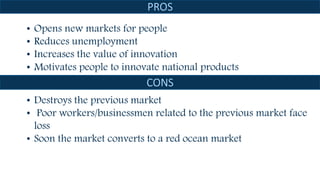
• Opens new markets for people
• Reduces unemployment
• Increases the value of innovation
• Motivates people to innovate national products
• Destroys the previous market
• Poor workers/businessmen related to the previous market face
loss
• Soon the market converts to a red ocean market
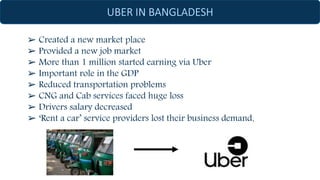
➢ Created a new market place
➢ Provided a new job market
➢ More than 1 million started earning via Uber
➢ Important role in the GDP
➢ Reduced transportation problems
➢ CNG and Cab services faced huge loss
➢ Drivers salary decreased
➢ ‘Rent a car’ service providers lost their business demand.
THANK YOU !

BLUE OCEAN STRATEGY.pptx

  • 1.
  • 2.
    CONTENTS 1. INTRODUCTION 2. BLUEOCEAN VS RED OCEAN 3. BLUE OCEAN TOOLS 4. STRENGTHS 5. RISKS 6. EXAMPLES 7. BLUE OCEAN STRATEGY: BLESSING OR CURSE IN DEVELOPING COUNTRIES? 8. CONCLUSION
  • 3.
  • 4.
    Blue Ocean Strategyis a marketing theory described in the book of the same name by W. Chan Kim and Renee Mauborgne. It focuses on exploring and capturing untapped markets by creating demand for products and services, rather than competing in existing markets. “BLUE OCEAN STRATEGY” BOOK PUBLISHED BY 2004 W. CHAN KIM AND RENEE MAUBORGNE
  • 5.
  • 6.
    • To createa new, uncontested market space • Competition is totally Irrelevant • Create and capture new demand • Value-cost trade-off is not relevant • Pursue low cost and differentiation • Compete in existing market Space • Focus is on Beating the Competition • Exploit existing demand • Value-cost trade-off is important • Pursue low cost or differentiation
  • 7.
  • 8.
    VALUE INNOVATION MODEL Themarket theory designed to achieve both product differentiation and low cost, effectively breaking the value-cost trade off. FOUR ACTIONS FRAMEWORK This model presents four questions that would allow the managers to restructure the industry boundaries and reshape the industry dynamics.
  • 9.
    STRATEGY CANVAS THEBUYER UTILITY MAP This represents a graph that displays the current strategic landscape and the future prospects for an organization. The Buyer Utility Map is designed to highlight the buyer’s perspective to the sellers. It has two dimensions: The Buyer Experience Cycle (BEC) and the Utility Levers; each of which are six in number.
  • 10.
    SIX PATHS FRAMEWORKPIONEER-MIGRATOR-SETTLER MAP The Six Paths Framework is yet another tool for managers to search for opportunities in creating a ‘blue ocean.’ It enables to break out of the existing boundaries of the industry and carve out a new value-cost frontier. This Map is the visual representation of a project’s profitability compared to its innovation.
  • 11.
    THREE TIERS OFNON-CUSTOMERS PRICE CORRIDOR OF THE MASS To expand their customer base, Blue Ocean Strategy focuses on the non- customers, and conducts analysis into expanding their current market. This tool is used to determine the strategic price that can attract mass buyers.
  • 12.
    BLUE OCEAN LEADERSHIPVS CONVENTIONAL LEADERSHIP Conventional Leadership Blue Ocean Leadership Focuses on the idea of a perfect leader. Focuses on what works for the organization. Generic execution of the mission of the organization and unawareness regarding customer demands. Attuned to the market demand and open to development . Focuses on the top levels of the organization. Leadership is distributed on all management levels to ensure inclusivity and idea generation. Leadership practices become extra work that require more time. Leaders focus on high impact leadership by exercising the Blue Ocean Leadership Grid.
  • 13.
    LEADERSHIP CANVAS TIPPINGPOINT LEADERSHIP FAIR PROCESS A theory that focuses on the extremes in an organization instead of the mass in order to bring about a strategic shift at low cost. The key theory behind employee-leader understanding by engaging in the Three E Principles of Fair Process: Engagement, Explanation, Expectation Clarity. A graphical representation of the current leadership reality of the industry.
  • 14.
  • 15.
    • It’s groundedin data • It provides a step-by-step process • It builds execution into strategy • It empowers you through tools and frameworks • It shows you how to create a win-win outcome • It maximizes opportunity while minimizing risk
  • 16.
  • 17.
    1. Finding theright blue ocean 2. Being too different, too new 3. Strategy Execution 4. Strategic Clarity and Corporate Mindset 5. Trust and patience 6. Defensibility
  • 18.
  • 19.
     Cirque duSoleil: 1980, Canada, Circus Industry  Netflix: 1997, USA, Entertainment Industry  Canon: 1985, USA, Electronic Industry
  • 20.
    IMPLEMENTATION OF BLUEOCEAN STRATEGY BY CHALDAL
  • 21.
    Before Chaldal enteredthe market:  Local proprietors of the wet market and companies like Agora, Shwapno were competing in a red ocean.  There was no other option for consumers to get groceries other than going to the market physically.  Consumers didn’t feel the necessity to get groceries from online stores. After Chaldal entered the market:  Chaldal entered the uncontested market with a unique service like offering online shopping and home delivery of groceries.  Since the industry were in a state of non-existence, there was absolutely no relevance of peer comparison.  Chaldal spawned a new demand in consumers and capitalized on that newly created demand.
  • 22.
    BLUE OCEAN STRATEGY:BLESSING OR CURSE IN DEVELOPING COUNTRIES?
  • 23.
    • Opens newmarkets for people • Reduces unemployment • Increases the value of innovation • Motivates people to innovate national products • Destroys the previous market • Poor workers/businessmen related to the previous market face loss • Soon the market converts to a red ocean market
  • 24.
    ➢ Created anew market place ➢ Provided a new job market ➢ More than 1 million started earning via Uber ➢ Important role in the GDP ➢ Reduced transportation problems ➢ CNG and Cab services faced huge loss ➢ Drivers salary decreased ➢ ‘Rent a car’ service providers lost their business demand.
  • 25.