Parable of Employee Engagement 
BLUE OCEAN LEADERSHIP 
Source : http://www.blueoceanstrategy.com/blue-ocean-lead1ership/
The Problem 
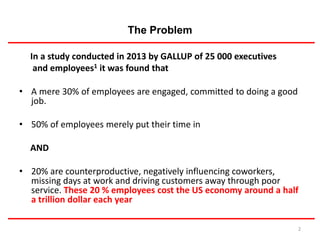
In a study conducted in 2013 by GALLUP of 25 000 executives 
and employees1 it was found that 
• A mere 30% of employees are engaged, committed to doing a good 
job. 
• 50% of employees merely put their time in 
AND 
• 20% are counterproductive, negatively influencing coworkers, 
missing days at work and driving customers away through poor 
service. These 20 % employees cost the US economy around a half 
a trillion dollar each year 
2
DIAGNOSIS 
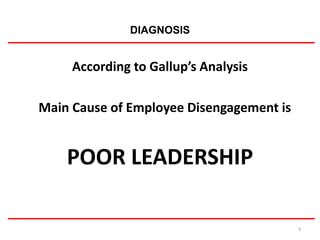
According to Gallup’s Analysis 
Main Cause of Employee Disengagement is 
POOR LEADERSHIP 
3
BIG IDEA BEHIND BLUE OCEAN LEADERSHIP 
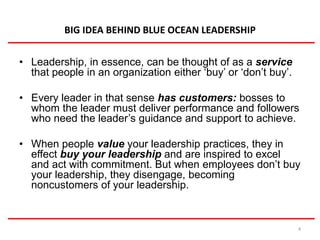
• Leadership, in essence, can be thought of as a service 
that people in an organization either ‘buy’ or ‘don’t buy’. 
• Every leader in that sense has customers: bosses to 
whom the leader must deliver performance and followers 
who need the leader’s guidance and support to achieve. 
• When people value your leadership practices, they in 
effect buy your leadership and are inspired to excel 
and act with commitment. But when employees don’t buy 
your leadership, they disengage, becoming 
noncustomers of your leadership. 
4
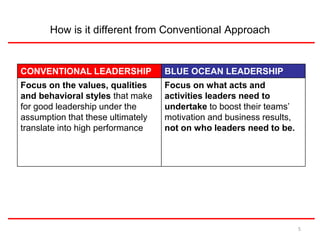
How is it different from Conventional Approach 
CONVENTIONAL LEADERSHIP BLUE OCEAN LEADERSHIP 
Focus on the values, qualities 
and behavioral styles that make 
for good leadership under the 
assumption that these ultimately 
translate into high performance 
Focus on what acts and 
activities leaders need to 
undertake to boost their teams’ 
motivation and business results, 
not on who leaders need to be. 
5
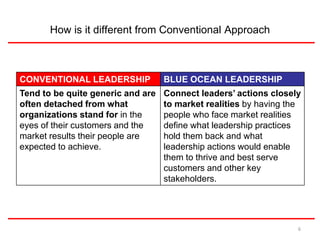
How is it different from Conventional Approach 
CONVENTIONAL LEADERSHIP BLUE OCEAN LEADERSHIP 
Tend to be quite generic and are 
often detached from what 
organizations stand for in the 
eyes of their customers and the 
market results their people are 
expected to achieve. 
Connect leaders’ actions closely 
to market realities by having the 
people who face market realities 
define what leadership practices 
hold them back and what 
leadership actions would enable 
them to thrive and best serve 
customers and other key 
stakeholders. 
6
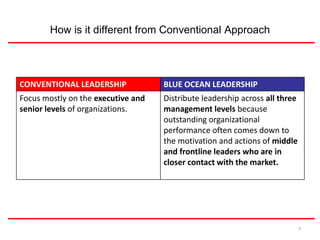
How is it different from Conventional Approach 
CONVENTIONAL LEADERSHIP BLUE OCEAN LEADERSHIP 
Focus mostly on the executive and 
senior levels of organizations. 
Distribute leadership across all three 
management levels because 
outstanding organizational 
performance often comes down to 
the motivation and actions of middle 
and frontline leaders who are in 
closer contact with the market. 
7
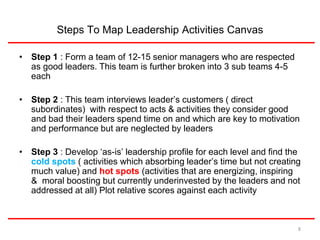
Steps To Map Leadership Activities Canvas 
• Step 1 : Form a team of 12-15 senior managers who are respected 
as good leaders. This team is further broken into 3 sub teams 4-5 
each 
• Step 2 : This team interviews leader’s customers ( direct 
subordinates) with respect to acts & activities they consider good 
and bad their leaders spend time on and which are key to motivation 
and performance but are neglected by leaders 
• Step 3 : Develop ‘as-is’ leadership profile for each level and find the 
cold spots ( activities which absorbing leader’s time but not creating 
much value) and hot spots (activities that are energizing, inspiring 
& moral boosting but currently underinvested by the leaders and not 
addressed at all) Plot relative scores against each activity 
8
Steps To Map Leadership Activities Canvas 
• Step 4 : Select to be leadership profiles which customers would 
want their leaders to exhibit in addition to what is collated in step 2 
• Step 5 : Apply BLUE OCEAN GRID and Complete the Canvas 
• Step 6 : Action planning by leaders through leadership coaching & 
mentoring ( External Help Or Development of Internal Coach) 
• Step 7 : Institutionalize new leadership practices 
9
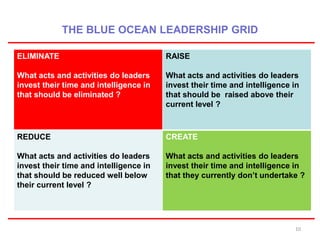
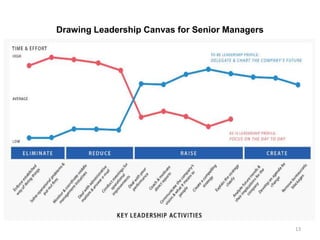
THE BLUE OCEAN LEADERSHIP GRID 
ELIMINATE 
What acts and activities do leaders 
invest their time and intelligence in 
that should be eliminated ? 
RAISE 
What acts and activities do leaders 
invest their time and intelligence in 
that should be raised above their 
current level ? 
REDUCE 
What acts and activities do leaders 
invest their time and intelligence in 
that should be reduced well below 
their current level ? 
CREATE 
What acts and activities do leaders 
invest their time and intelligence in 
that they currently don’t undertake ? 
10
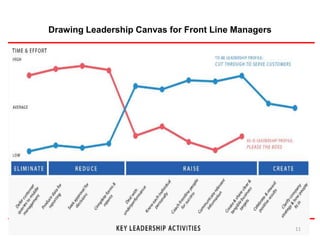
Drawing Leadership Canvas for Front Line Managers 
11
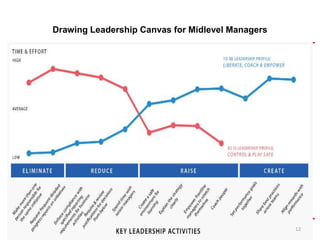
Drawing Leadership Canvas for Midlevel Managers 
12
Drawing Leadership Canvas for Senior Managers 
13
Results of this Transformative Initiative for 
British Retail Group 
• Employee turnover of its 10,000 plus frontline employees dropped 
from about 40% to 11%. 
• Recruitment and training costs reduced by 50%. 
• Customer satisfaction rose by over 30%. 
• And the group saved more than $50 million 
14

Blue Ocean Leadership

  • 1.
    Parable of EmployeeEngagement BLUE OCEAN LEADERSHIP Source : http://www.blueoceanstrategy.com/blue-ocean-lead1ership/
  • 2.
    The Problem Ina study conducted in 2013 by GALLUP of 25 000 executives and employees1 it was found that • A mere 30% of employees are engaged, committed to doing a good job. • 50% of employees merely put their time in AND • 20% are counterproductive, negatively influencing coworkers, missing days at work and driving customers away through poor service. These 20 % employees cost the US economy around a half a trillion dollar each year 2
  • 3.
    DIAGNOSIS According toGallup’s Analysis Main Cause of Employee Disengagement is POOR LEADERSHIP 3
  • 4.
    BIG IDEA BEHINDBLUE OCEAN LEADERSHIP • Leadership, in essence, can be thought of as a service that people in an organization either ‘buy’ or ‘don’t buy’. • Every leader in that sense has customers: bosses to whom the leader must deliver performance and followers who need the leader’s guidance and support to achieve. • When people value your leadership practices, they in effect buy your leadership and are inspired to excel and act with commitment. But when employees don’t buy your leadership, they disengage, becoming noncustomers of your leadership. 4
  • 5.
    How is itdifferent from Conventional Approach CONVENTIONAL LEADERSHIP BLUE OCEAN LEADERSHIP Focus on the values, qualities and behavioral styles that make for good leadership under the assumption that these ultimately translate into high performance Focus on what acts and activities leaders need to undertake to boost their teams’ motivation and business results, not on who leaders need to be. 5
  • 6.
    How is itdifferent from Conventional Approach CONVENTIONAL LEADERSHIP BLUE OCEAN LEADERSHIP Tend to be quite generic and are often detached from what organizations stand for in the eyes of their customers and the market results their people are expected to achieve. Connect leaders’ actions closely to market realities by having the people who face market realities define what leadership practices hold them back and what leadership actions would enable them to thrive and best serve customers and other key stakeholders. 6
  • 7.
    How is itdifferent from Conventional Approach CONVENTIONAL LEADERSHIP BLUE OCEAN LEADERSHIP Focus mostly on the executive and senior levels of organizations. Distribute leadership across all three management levels because outstanding organizational performance often comes down to the motivation and actions of middle and frontline leaders who are in closer contact with the market. 7
  • 8.
    Steps To MapLeadership Activities Canvas • Step 1 : Form a team of 12-15 senior managers who are respected as good leaders. This team is further broken into 3 sub teams 4-5 each • Step 2 : This team interviews leader’s customers ( direct subordinates) with respect to acts & activities they consider good and bad their leaders spend time on and which are key to motivation and performance but are neglected by leaders • Step 3 : Develop ‘as-is’ leadership profile for each level and find the cold spots ( activities which absorbing leader’s time but not creating much value) and hot spots (activities that are energizing, inspiring & moral boosting but currently underinvested by the leaders and not addressed at all) Plot relative scores against each activity 8
  • 9.
    Steps To MapLeadership Activities Canvas • Step 4 : Select to be leadership profiles which customers would want their leaders to exhibit in addition to what is collated in step 2 • Step 5 : Apply BLUE OCEAN GRID and Complete the Canvas • Step 6 : Action planning by leaders through leadership coaching & mentoring ( External Help Or Development of Internal Coach) • Step 7 : Institutionalize new leadership practices 9
  • 10.
    THE BLUE OCEANLEADERSHIP GRID ELIMINATE What acts and activities do leaders invest their time and intelligence in that should be eliminated ? RAISE What acts and activities do leaders invest their time and intelligence in that should be raised above their current level ? REDUCE What acts and activities do leaders invest their time and intelligence in that should be reduced well below their current level ? CREATE What acts and activities do leaders invest their time and intelligence in that they currently don’t undertake ? 10
  • 11.
    Drawing Leadership Canvasfor Front Line Managers 11
  • 12.
    Drawing Leadership Canvasfor Midlevel Managers 12
  • 13.
    Drawing Leadership Canvasfor Senior Managers 13
  • 14.
    Results of thisTransformative Initiative for British Retail Group • Employee turnover of its 10,000 plus frontline employees dropped from about 40% to 11%. • Recruitment and training costs reduced by 50%. • Customer satisfaction rose by over 30%. • And the group saved more than $50 million 14