A W H I T E P A P E R B Y
Carol Yang
to perform
P O W E R
Build leaders who can influence, thrive and perform
under the pressure of complexity and change
‘ P E O P L E B U Y I N T O
T H E L E A D E R ,
B E F O R E T H E Y B U Y
I N T O T H E V I S I O N .’
John C. Maxwell
C A R O L YA N G
3
Increasing diversity, rapid speed of change,
globalisation – right now, you and your business
are faced with a trifecta of issues that are
competing for your attention and your people.
While globalisation opens up greater market
opportunities, it also brings increased complexity
and puts enormous pressure on your leaders to
be more agile and adaptive in their approach.
Volatility is now the business norm.
So if it’s imperative for your leaders to step up
to these challenges, why are they faltering?
P R E S S U R E
to Perform Gallup’s 2013 State of Global Workplace Report shows that
in Australia, only 19% of employees in leadership positions
are engaged in their jobs. This means only two out of 10
leaders in your organisation are enthusiastic and committed
to their work, and looking for new and better ways to
achieve their outcomes.
This has a flow-on effect to your whole organisation. Gallup
also reports six out of 10 employees in Australia currently
lack motivation in their work. In addition, in Deloitte’s Global
Human Capital Trends 2014 Survey, 65% of executives rated the
‘overwhelmed’ employee as an urgent trend.
Deloitte estimates thatthis constant overload and frenetic
level of activity costs mid-size
companies up to $10 million a year.
C A R O L YA N G
4
So how can your leaders be more resilient to change and be
equipped to deal with today’s challenges? What can you do to
have greater confidence that your team can deliver your current
and future business goals?
First, you must understand where the real problem lays.
What you are saying:
•	 ‘Why aren’t they stepping up/taking the initiative/being
more innovative/more flexible?’
•	 ‘I’m tired of everyone coming to me with people
problems. Can’t they figure this out on their own?’
•	 ‘Why are they not doing what I want?’
•	 ‘Why aren’t they performing like they used to?’
4
HOW DO YOU MANAGE
LEADERS WHO REPORT
THEY FEEL OVERWHELMED?
Many of your leaders lack the necessary leadership
competencies and depth of people skills to navigate today’s
growing complexity. They struggle to manage and motivate
increasingly diverse and geographically spread-out teams.
They are inefficient and slow to innovate. This leads to poor
results and lost opportunities and market share for you and
your organisation as a whole.
It takes precious time away from higher leverage strategy
work and stakeholder management – the real critical areas that
require your attention.
of your organisation, is now much
harder for you are frequently stepping
in to solve day-to-day business and
people issues.
Your life, your job as the head
HOW DO YOU INCREASE YOUR
ORGANISATION’S PERFORMANCE
AND DRIVE BETTER RESULTS?
C A R O L YA N G
5
On the surface it appears that your people
problems are due to a lack of engagement,
but this actually has to do with your team’s
lack of confidence due to inexperience or
a skill gap.
What your leaders are saying:
•	 ‘I’m out of my depth. I’ve never done this before.’
•	 ‘There are so many more people and stakeholders,
virtual and diverse teams to deal with than before.
I can’t keep up.’
•	 ‘I’m trying my best to adapt but I don’t know how.
I’m failing and I’m getting discouraged.’
Leadership development is traditionally focused on
building functional and technical skills, and your leaders
are often left to develop the more complex people and
collaboration skills, all while learning on the job. As a
result, success is hit-and-miss based on trial and error,
leading to unproductive conflict and lack lustre results.
While you no doubt have strong potential within your
leadership team, there is a significant gap between your
business needs and the current leadership capabilities
within your organisation.
Your workforce is stretching the capabilities of your leadership
team as they struggle with matrix structures, and engaging
teams that are geographically dispersed, and with gender,
generational and cultural diversity. Yet key soft skills, which
are critical for senior leaders to manage these issues, are
sorely lacking – and this is having an impact on morale
and productivity.
P R O B L E M
The underlying
and breadth of leadership and people skills
to meet your increasing business demands.
Your leaders lack the depth
C A R O L YA N G
6
•	 Interpersonal influencing – to secure
necessary resources and commitment
from multiple stakeholders and move
important initiatives ahead
•	 People management – specifically
their empathy and leadership
flexibility to inspire and motivate
an increasingly diverse workforce
that has very different approaches
to hierarchy, decision making
and communication
•	 Leading and influencing without
direct authority - as they work in
cross functional teams to deliver
business objectives
•	 Collaboration – to develop a sense
of shared purpose vital to creating
productive and cohesive teams that
are spread out across different
functions and locations
To keep up with your business needs, your leaders need to sharpen their skills in:
•	 Relationship building – to be
more attuned to, and confidently
navigate the different hierarchical,
social and political agendas inherent
in matrix organisations
•	 Mental toughness – to cope with
the increasing pressure on them to
perform under difficult conditions
competencies in place,
your bottom-line is at risk.
Without these leadership
C A R O L YA N G
7
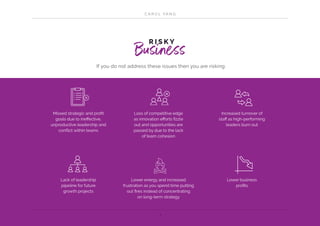
If you do not address these issues then you are risking:
Missed strategic and profit
goals due to ineffective,
unproductive leadership and
conflict within teams
Loss of competitive edge
as innovation efforts fizzle
out and opportunities are
passed by due to the lack
of team cohesion
Increased turnover of
staff as high-performing
leaders burn out
Lack of leadership
pipeline for future
growth projects
Lower energy and increased
frustration as you spend time putting
out fires instead of concentrating
on long-term strategy
Lower business
profits
R I S K Y
Business
C A R O L YA N G
8
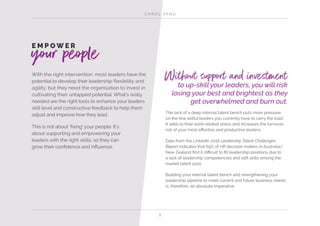
With the right intervention, most leaders have the
potential to develop their leadership flexibility and
agility, but they need the organisation to invest in
cultivating their untapped potential. What’s really
needed are the right tools to enhance your leaders
skill level and constructive feedback to help them
adjust and improve how they lead.
This is not about ‘fixing’ your people. It’s
about supporting and empowering your
leaders with the right skills, so they can
grow their confidence and influence.
E M P O W E R
your people
The lack of a deep internal talent bench puts more pressure
on the few skilful leaders you currently have to carry the load.
It adds to their work-related stress and increases the turnover
risk of your most effective and productive leaders.
Data from the LinkedIn 2016 Leadership Talent Challenges
Report indicates that 69% of HR decision makers in Australia/
New Zealand find it difficult to fill leadership positions due to
a lack of leadership competencies and soft skills among the
market talent pool.
Building your internal talent bench and strengthening your
leadership pipeline to meet current and future business needs
is, therefore, an absolute imperative.
to up-skill your leaders, you will risk
losing your best and brightest as they
get overwhelmed and burn out.
Without support and investment
COMPETITION FOR THE
LIMITED POOL OF QUALIFIED
TALENT IS FIERCE;
FILLING LEADERSHIP GAPS
THROUGH EXTERNAL
RECRUITMENT IS CHALLENGING.
THIS IS NOT THE ANSWER.
C A R O L YA N G
1 0
F R O M D I S E N G A G E D
to power performance
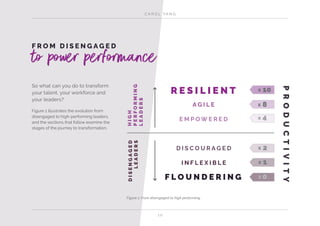
So what can you do to transform
your talent, your workforce and
your leaders?
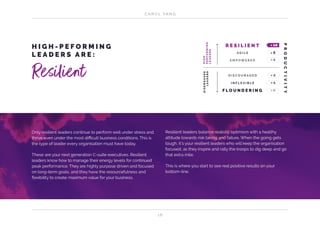
Figure 1 illustrates the evolution from
disengaged to high-performing leaders,
and the sections that follow examine the
stages of the journey to transformation.
Figure 1: From disengaged to high performing
R E S I L I E N T
DISENGAGED
LEADERS
x 10
A G I L E
E M P O W E R E D
D I S C O U R A G E D
I N F L E X I B L E
F L O U N D E R I N G
x 8
x 4
x 2
x 1
x 0
HIGH
PERFORMING
LEADERS
PRODUCTIVITY
C A R O L YA N G
1 1
Y O U R D I S E N G A G E D
L E A D E R S A R E :
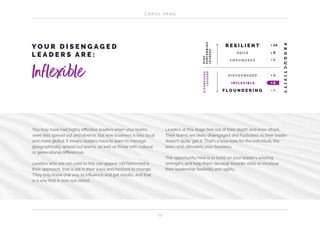
Floundering
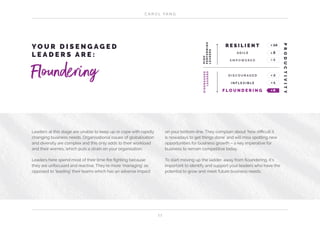
Leaders at this stage are unable to keep up or cope with rapidly
changing business needs. Organisational issues of globalisation
and diversity are complex and this only adds to their workload
and their worries, which puts a strain on your organisation.
Leaders here spend most of their time fire fighting because
they are unfocused and reactive. They’re more ‘managing’ as
opposed to ‘leading’ their teams which has an adverse impact
on your bottom-line. They complain about ‘how difficult it
is nowadays to get things done’ and will miss spotting new
opportunities for business growth – a key imperative for
business to remain competitive today.
To start moving up the ladder, away from floundering, it’s
important to identify and support your leaders who have the
potential to grow and meet future business needs.
R E S I L I E N T
DISENGAGED
LEADERS
x 10
A G I L E
E M P O W E R E D
D I S C O U R A G E D
I N F L E X I B L E
F L O U N D E R I N G
x 8
x 4
x 2
x 1
x 0
HIGH
PERFORMING
LEADERS
PRODUCTIVITY
C A R O L YA N G
1 2
You may have had highly effective leaders when your teams
were less spread out and diverse; but now business is less local
and more global. It means leaders have to learn to manage
geographically spread out teams, as well as those with cultural
or generational differences.
Leaders who are not used to this can appear old fashioned in
their approach, that is set in their ways and hesitant to change.
They only know one way to influence and get results, and that
is a way that is now out-dated.
Y O U R D I S E N G A G E D
L E A D E R S A R E :
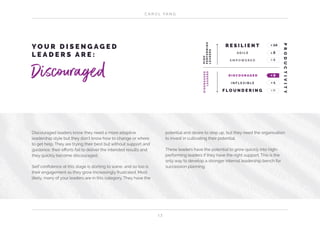
Inflexible
Leaders at this stage feel out of their depth and even afraid.
Their teams are likely disengaged and frustrated as their leader
doesn’t quite ‘get it’. That’s a lose-lose for the individual, the
team and ultimately your business.
The opportunity here is to build on your leader’s existing
strengths and help them develop broader skills to increase
their leadership flexibility and agility.
R E S I L I E N T
DISENGAGED
LEADERS
x 10
A G I L E
E M P O W E R E D
D I S C O U R A G E D
I N F L E X I B L E
F L O U N D E R I N G
x 8
x 4
x 2
x 1
x 0
HIGH
PERFORMING
LEADERS
PRODUCTIVITY
C A R O L YA N G
1 3
Discouraged leaders know they need a more adaptive
leadership style but they don’t know how to change or where
to get help. They are trying their best but without support and
guidance, their efforts fail to deliver the intended results and
they quickly become discouraged.
Self confidence at this stage is starting to wane, and so too is
their engagement as they grow increasingly frustrated. Most
likely, many of your leaders are in this category. They have the
Y O U R D I S E N G A G E D
L E A D E R S A R E :
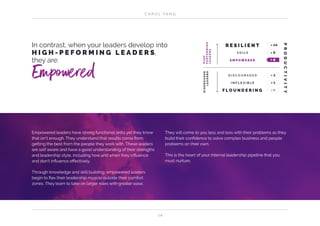
Discouraged
potential and desire to step up, but they need the organisation
to invest in cultivating their potential.
These leaders have the potential to grow quickly into high-
performing leaders if they have the right support. This is the
only way to develop a stronger internal leadership bench for
succession planning.
R E S I L I E N T
DISENGAGED
LEADERS
x 10
A G I L E
E M P O W E R E D
D I S C O U R A G E D
I N F L E X I B L E
F L O U N D E R I N G
x 8
x 4
x 2
x 1
x 0
HIGH
PERFORMING
LEADERS
PRODUCTIVITY
C A R O L YA N G
1 4
In contrast, when your leaders develop into
H I G H - P E F O R M I N G L E A D E R S,
they are:
Empowered
Empowered leaders have strong functional skills yet they know
that isn’t enough. They understand that results come from
getting the best from the people they work with. These leaders
are self aware and have a good understanding of their strengths
and leadership style, including how and when they influence
and don’t influence effectively.
Through knowledge and skill building, empowered leaders
begin to flex their leadership muscle outside their comfort
zones. They learn to take on larger roles with greater ease.
They will come to you less and less with their problems as they
build their confidence to solve complex business and people
problems on their own.
This is the heart of your internal leadership pipeline that you
must nurture.
R E S I L I E N T
DISENGAGED
LEADERS
x 10
A G I L E
E M P O W E R E D
D I S C O U R A G E D
I N F L E X I B L E
F L O U N D E R I N G
x 8
x 4
x 2
x 1
x 0
HIGH
PERFORMING
LEADERS
PRODUCTIVITY
C A R O L YA N G
1 5
At this stage, innovation begins to spark. Agile leaders
adapt and respond quickly to changes; and can spot hidden
opportunities in problems.
Importantly, they have the leadership flexibility to influence
across diverse and multiple stakeholders to achieve business
goals even under challenging conditions. Grounded by a clear
understanding of who they are as a leader, they have a strong
H I G H - P E F O R M I N G
L E A D E R S A R E :
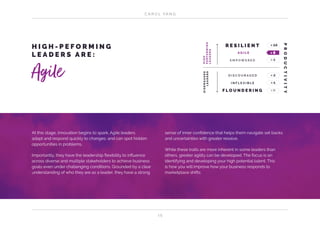
Agile
sense of inner confidence that helps them navigate set backs
and uncertainties with greater resolve.
While these traits are more inherent in some leaders than
others, greater agility can be developed. The focus is on
identifying and developing your high potential talent. This
is how you will improve how your business responds to
marketplace shifts.
R E S I L I E N T
DISENGAGED
LEADERS
x 10
A G I L E
E M P O W E R E D
D I S C O U R A G E D
I N F L E X I B L E
F L O U N D E R I N G
x 8
x 4
x 2
x 1
x 0
HIGH
PERFORMING
LEADERS
PRODUCTIVITY
C A R O L YA N G
1 6
Only resilient leaders continue to perform well under stress and
thrive even under the most difficult business conditions. This is
the type of leader every organisation must have today.
These are your next generation C-suite executives. Resilient
leaders know how to manage their energy levels for continued
peak performance. They are highly purpose driven and focused
on long-term goals, and they have the resourcefulness and
flexibility to create maximum value for your business.
H I G H - P E F O R M I N G
L E A D E R S A R E :
Resilient
Resilient leaders balance realistic optimism with a healthy
attitude towards risk taking and failure. When the going gets
tough, it’s your resilient leaders who will keep the organisation
focused, as they inspire and rally the troops to dig deep and go
that extra mile.
This is where you start to see real positive results on your
bottom-line.
R E S I L I E N T
DISENGAGED
LEADERS
x 10
A G I L E
E M P O W E R E D
D I S C O U R A G E D
I N F L E X I B L E
F L O U N D E R I N G
x 8
x 4
x 2
x 1
x 0
HIGH
PERFORMING
LEADERS
PRODUCTIVITY
C A R O L YA N G
1 7
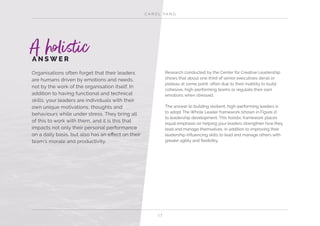
A holisticA N S W E R
Organisations often forget that their leaders
are humans driven by emotions and needs,
not by the work of the organisation itself. In
addition to having functional and technical
skills, your leaders are individuals with their
own unique motivations, thoughts and
behaviours while under stress. They bring all
of this to work with them, and it is this that
impacts not only their personal performance
on a daily basis, but also has an effect on their
team’s morale and productivity.
Research conducted by the Center for Creative Leadership
shows that about one third of senior executives derail or
plateau at some point, often due to their inability to build
cohesive, high-performing teams or regulate their own
emotions when stressed.
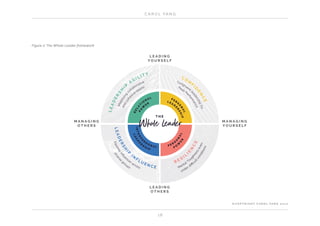
The answer to building resilient, high-performing leaders is
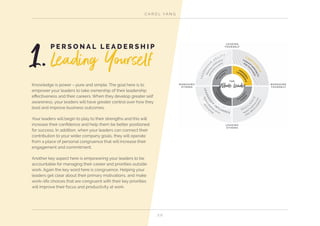
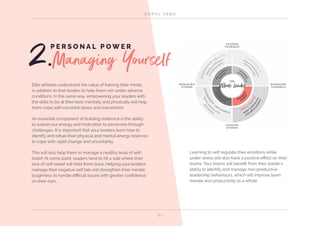
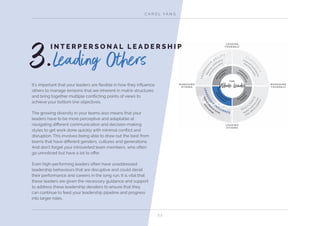
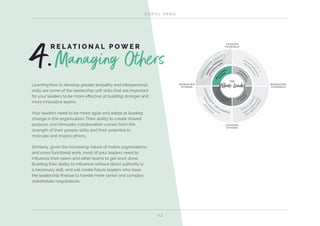
to adopt The Whole Leader framework (shown in Figure 2)
to leadership development. This holistic framework places
equal emphasis on helping your leaders strengthen how they
lead and manage themselves, in addition to improving their
leadership influencing skills to lead and manage others with
greater agility and flexibility.
C A R O L YA N G
1 8
Figure 2: The Whole Leader framework
© C O P Y R I G H T C A R O L YA N G 2 0 1 7
LEADERSH
IP
IN
F L U E N C E
LEADERS
H
IP
A
G I L I T Y
Mental Tou
ghnesseven
under difficu
ltconditions
C O
N
F
I
D
E
N
CE
Mobilising
collaborative
andcohe
sive
teams
R E S I L
I
E
N
CE
Congruent l
eadershipfor
Peak
Pe
rform
ance
M A N A G I N G
O T H E R S
M A N A G I N G
Y O U R S E L F
L E A D I N G
O T H E R S
RELA
T
IO
N A L
P O
W
E
R
P E R
S
O
N
AL
PO
W
E R
Flexible
influ
encer across
diverse
groups
LEA
D
E
R
S
H I P
INTERP
ER
S O N A L P E R
S
O
N
AL
L E A D
E
R
SHIP
L E A D I N G
Y O U R S E L F
T H E
Whole Leader
C A R O L YA N G
1 9
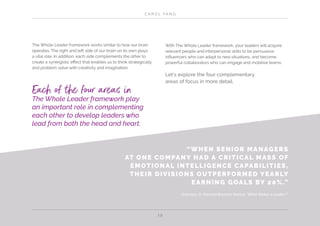
The Whole Leader framework works similar to how our brain
operates. The right and left side of our brain on its own plays
a vital role. In addition, each side complements the other to
create a synergistic effect that enables us to think strategically
and problem solve with creativity and imagination.
“WHEN SENIOR MANAGERS
AT ONE COMPANY HAD A CRITICAL MASS OF
EMOTIONAL INTELLIGENCE CAPABILITIES,
THEIR DIVISIONS OUTPERFORMED YEARLY
EARNING GOALS BY 20%.”
Goleman, D, Harvard Business Review, ‘What Makes a Leader?’
The Whole Leader framework play
an important role in complementing
each other to develop leaders who
lead from both the head and heart.
Each of the four areas in
With The Whole Leader framework, your leaders will acquire
relevant people and interpersonal skills to be persuasive
influencers who can adapt to new situations, and become
powerful collaborators who can engage and mobilise teams.
Let’s explore the four complementary
areas of focus in more detail.
C A R O L YA N G
2 0
Knowledge is power – pure and simple. The goal here is to
empower your leaders to take ownership of their leadership
effectiveness and their careers. When they develop greater self
awareness, your leaders will have greater control over how they
lead and improve business outcomes.
Your leaders will begin to play to their strengths and this will
increase their confidence and help them be better positioned
for success. In addition, when your leaders can connect their
contribution to your wider company goals, they will operate
from a place of personal congruence that will increase their
engagement and commitment.
Another key aspect here is empowering your leaders to be
accountable for managing their career and priorities outside
work. Again the key word here is congruence. Helping your
leaders get clear about their primary motivations, and make
work–life choices that are congruent with their key priorities
will improve their focus and productivity at work.
Leading Yourself
P E R S O N A L L E A D E R S H I P
1.
LEADERSH
IP
IN
F L U E N C E
LEADERS
H
IP
A
G I L I T Y
Mental Tou
ghnesseven
under difficu
ltconditions
C O
N
F
I
D
E
N
CE
Mobilising
collaborative
andcohe
sive
teams
R E S I L
I
E
N
CE
Congruent l
eadershipfor
Peak
Pe
rform
ance
M A N A G I N G
O T H E R S
M A N A G I N G
Y O U R S E L F
L E A D I N G
O T H E R S
RELA
T
IO
N A L
P O
W
E
R
P E R
S
O
N
AL
PO
W
E R
Flexible
influ
encer across
diverse
groups
LEA
D
E
R
S
H I P
INTERP
E
R
S O N A L P E R
S
O
N
AL
L E A D
E
R
SHIP
L E A D I N G
Y O U R S E L F
T H E
Whole Leader
C A R O L YA N G
2 1
Elite athletes understand the value of training their minds,
in addition to their bodies to help them win under adverse
conditions. In the same way, empowering your leaders with
the skills to be at their best mentally and physically will help
them cope with constant stress and overwhelm.
An essential component of building resilience is the ability
to sustain our energy and motivation to persevere through
challenges. It is important that your leaders learn how to
identify and refuel their physical and mental energy reserves
to cope with rapid change and uncertainty.
This will also help them to manage a healthy level of self-
belief. At some point, leaders tend to hit a wall where their
lack of self-belief will hold them back. Helping your leaders
manage their negative self talk will strengthen their mental
toughness to handle difficult issues with greater confidence
on their own.
LEADERSH
IP
IN
F L U E N C E
LEADERS
H
IP
A
G I L I T Y
Mental Tou
ghnesseven
under difficu
ltconditions
C O
N
F
I
D
E
N
CE
Mobilising
collaborative
andcohe
sive
teams
R E S I L
I
E
N
CE
Congruent l
eadershipfor
Peak
Pe
rform
ance
M A N A G I N G
O T H E R S
M A N A G I N G
Y O U R S E L F
L E A D I N G
O T H E R S
RELA
T
IO
N A L
P O
W
E
R
P E R
S
O
N
AL
PO
W
E R
Flexible
influ
encer across
diverse
groups
LEA
D
E
R
S
H I P
INTERP
E
R
S O N A L P E R
S
O
N
AL
L E A D
E
R
SHIP
L E A D I N G
Y O U R S E L F
T H E
Whole Leader
Managing Yourself
P E R S O N A L P O W E R
2.
Learning to self regulate their emotions while
under stress will also have a positive effect on their
teams. Your teams will benefit from their leader’s
ability to identify and manage non-productive
leadership behaviours, which will improve team
morale and productivity as a whole.
C A R O L YA N G
2 2
3.It’s important that your leaders are flexible in how they influence
others to manage tensions that are inherent in matrix structures
and bring together multiple conflicting points of views to
achieve your bottom line objectives.
The growing diversity in your teams also means that your
leaders have to be more perceptive and adaptable at
navigating different communication and decision-making
styles to get work done quickly with minimal conflict and
disruption. This involves being able to draw out the best from
teams that have different genders, cultures and generations.
And don’t forget your introverted team members, who often
go unnoticed but have a lot to offer.
Even high-performing leaders often have unaddressed
leadership behaviours that are disruptive and could derail
their performance and careers in the long run. It is vital that
these leaders are given the necessary guidance and support
to address these leadership derailers to ensure that they
can continue to feed your leadership pipeline and progress
into larger roles.
LEADERSH
IP
IN
F L U E N C E
LEADERS
H
IP
A
G I L I T Y
Mental Tou
ghnesseven
under difficu
ltconditions
C O
N
F
I
D
E
N
CE
Mobilising
collaborative
andcohe
sive
teams
R E S I L
I
E
N
CE
Congruent l
eadershipfor
Peak
Pe
rform
ance
M A N A G I N G
O T H E R S
M A N A G I N G
Y O U R S E L F
L E A D I N G
O T H E R S
RELA
T
IO
N A L
P O
W
E
R
P E R
S
O
N
AL
PO
W
E R
Flexible
influ
encer across
diverse
groups
LEA
D
E
R
S
H I P
INTERP
E
R
S O N A L P E R
S
O
N
AL
L E A D
E
R
SHIP
L E A D I N G
Y O U R S E L F
T H E
Whole Leader
Leading Others
I N T E R P E R S O N A L L E A D E R S H I P
C A R O L YA N G
2 3
4.
LEADERSH
IP
IN
F L U E N C E
LEADERS
H
IP
A
G I L I T Y
Mental Tou
ghnesseven
under difficu
ltconditions
C O
N
F
I
D
E
N
CE
Mobilising
collaborative
andcohe
sive
teams
R E S I L
I
E
N
CE
Congruent l
eadershipfor
Peak
Pe
rform
ance
M A N A G I N G
O T H E R S
M A N A G I N G
Y O U R S E L F
L E A D I N G
O T H E R S
RELA
T
IO
N A L
P O
W
E
R
P E R
S
O
N
AL
PO
W
E R
Flexible
influ
encer across
diverse
groups
LEA
D
E
R
S
H I P
INTERP
E
R
S O N A L P E R
S
O
N
AL
L E A D
E
R
SHIP
L E A D I N G
Y O U R S E L F
T H E
Whole Leader
Managing Others
R E L AT I O N A L P O W E R
Learning how to develop greater empathy and interpersonal
skills are some of the leadership soft skills that are important
for your leaders to be more effective at building stronger and
more innovative teams.
Your leaders need to be more agile and adept at leading
change in the organisation. Their ability to create shared
purpose and stimulate collaboration comes from the
strength of their people skills and their potential to
motivate and inspire others.
Similarly, given the increasing nature of matrix organisations
and cross functional work, most of your leaders need to
influence their peers and other teams to get work done.
Building their ability to influence without direct authority is
a necessary skill, and will create future leaders who have
the leadership finesse to handle more senior and complex
stakeholder negotiations.
C A R O L YA N G
2 4
In combination, the knowledge and skills acquired
through working on the four areas in the Whole
Leader framework – Personal Leadership, Personal
Power, Interpersonal Leadership, Relational Power
- will equip your leaders with the capabilities
they need to manage the pressures of increasing
diversity, rapid speed of change and globalisation.
W H AT
next? It is only by doing this that you will strengthen
your leadership pipeline, increase your team’s
productivity and performance, and power into
the future.
one-size-fits all solution.
It requires you to invest in the leaders
you have today, not necessarily to look
for talent outside of your organisation.
There is no quick-fix,
C A R O L YA N G
2 5
I understand the complex challenges that your leaders
face everyday. I also know that most leaders do not have a
confidante they can turn to for advice and guidance. As a result,
I’ve seen many talented leaders leave because they did not
have the right skills or support to succeed on their own terms.
That is turnover that could have been prevented and is a huge
lose-lose for both the organisation and the individual.
That’s why I offer customised one-on-one mentoring and
coaching, and corporate training programs to help your leaders
bring out the best of themselves to be successful at work and
in their personal lives. I help organisations harness untapped
potential, improve performance and productivity, and develop
a strong internal talent bench that will feed your leadership
pipeline into the future.
I have over 20 years of corporate experience, mainly in
senior leadership roles with large global corporates like
Procter & Gamble and The Timberland Company. I’ve also
worked in the US, Japan, Singapore and Australia; which
has provided me with a wealth of insights into working
cross culturally.
The bulk of my experience has been in leading large
global and regional teams. During that time, I’ve delivered
business objectives while managing multiple and diverse
stakeholder needs which included balancing global vs local
priorities, strategic vs operational needs and navigating
disparate functional motivations.
I am a firm believer that helping your leaders unlock their
leadership potential is where you achieve great business
and personal success.
I look forward to hearing how I can help you.
H O W I C A N help
C O N TA C T M E F O R H E L P :
Carol Yang
springforward.com.au
carol@springforward.com.au
+61 405 538 288
S O U R C E S
Gallup, State of Global Workplace Report 2013
Deloitte Consulting LLP, Global Human Capital Trends 2014 Survey
Waters, C 2014. ‘Distracted and overwhelmed employees are costing your business’, Smart Company
LinkedIn Talent Solutions, 2016 Leadership Talent Challenges in Australia/New Zealand
Bunker, K, Kram, K and Ting, S 2002. ‘The Young and Clueless’, Harvard Business Review
Goleman, D 1996. ‘What Makes a Leader?’, Harvard Business Review
A W H I T E P A P E R B Y
Carol Yang
© C O P Y R I G H T C A R O L YA N G 2 0 1 7
You have permission to post, email, print and pass along this white paper for free to anyone you like, as long as you make no changes
or edits to its content or digital format. To reproduce the content in any form, electronic or otherwise, you must have the permission
of the author. We reserve the right to publish this material in other forms and formats for distribution or re-sale.

White Paper - Power to Perform

  • 1.
    A W HI T E P A P E R B Y Carol Yang to perform P O W E R Build leaders who can influence, thrive and perform under the pressure of complexity and change
  • 2.
    ‘ P EO P L E B U Y I N T O T H E L E A D E R , B E F O R E T H E Y B U Y I N T O T H E V I S I O N .’ John C. Maxwell
  • 3.
    C A RO L YA N G 3 Increasing diversity, rapid speed of change, globalisation – right now, you and your business are faced with a trifecta of issues that are competing for your attention and your people. While globalisation opens up greater market opportunities, it also brings increased complexity and puts enormous pressure on your leaders to be more agile and adaptive in their approach. Volatility is now the business norm. So if it’s imperative for your leaders to step up to these challenges, why are they faltering? P R E S S U R E to Perform Gallup’s 2013 State of Global Workplace Report shows that in Australia, only 19% of employees in leadership positions are engaged in their jobs. This means only two out of 10 leaders in your organisation are enthusiastic and committed to their work, and looking for new and better ways to achieve their outcomes. This has a flow-on effect to your whole organisation. Gallup also reports six out of 10 employees in Australia currently lack motivation in their work. In addition, in Deloitte’s Global Human Capital Trends 2014 Survey, 65% of executives rated the ‘overwhelmed’ employee as an urgent trend. Deloitte estimates thatthis constant overload and frenetic level of activity costs mid-size companies up to $10 million a year.
  • 4.
    C A RO L YA N G 4 So how can your leaders be more resilient to change and be equipped to deal with today’s challenges? What can you do to have greater confidence that your team can deliver your current and future business goals? First, you must understand where the real problem lays. What you are saying: • ‘Why aren’t they stepping up/taking the initiative/being more innovative/more flexible?’ • ‘I’m tired of everyone coming to me with people problems. Can’t they figure this out on their own?’ • ‘Why are they not doing what I want?’ • ‘Why aren’t they performing like they used to?’ 4 HOW DO YOU MANAGE LEADERS WHO REPORT THEY FEEL OVERWHELMED? Many of your leaders lack the necessary leadership competencies and depth of people skills to navigate today’s growing complexity. They struggle to manage and motivate increasingly diverse and geographically spread-out teams. They are inefficient and slow to innovate. This leads to poor results and lost opportunities and market share for you and your organisation as a whole. It takes precious time away from higher leverage strategy work and stakeholder management – the real critical areas that require your attention. of your organisation, is now much harder for you are frequently stepping in to solve day-to-day business and people issues. Your life, your job as the head HOW DO YOU INCREASE YOUR ORGANISATION’S PERFORMANCE AND DRIVE BETTER RESULTS?
  • 5.
    C A RO L YA N G 5 On the surface it appears that your people problems are due to a lack of engagement, but this actually has to do with your team’s lack of confidence due to inexperience or a skill gap. What your leaders are saying: • ‘I’m out of my depth. I’ve never done this before.’ • ‘There are so many more people and stakeholders, virtual and diverse teams to deal with than before. I can’t keep up.’ • ‘I’m trying my best to adapt but I don’t know how. I’m failing and I’m getting discouraged.’ Leadership development is traditionally focused on building functional and technical skills, and your leaders are often left to develop the more complex people and collaboration skills, all while learning on the job. As a result, success is hit-and-miss based on trial and error, leading to unproductive conflict and lack lustre results. While you no doubt have strong potential within your leadership team, there is a significant gap between your business needs and the current leadership capabilities within your organisation. Your workforce is stretching the capabilities of your leadership team as they struggle with matrix structures, and engaging teams that are geographically dispersed, and with gender, generational and cultural diversity. Yet key soft skills, which are critical for senior leaders to manage these issues, are sorely lacking – and this is having an impact on morale and productivity. P R O B L E M The underlying and breadth of leadership and people skills to meet your increasing business demands. Your leaders lack the depth
  • 6.
    C A RO L YA N G 6 • Interpersonal influencing – to secure necessary resources and commitment from multiple stakeholders and move important initiatives ahead • People management – specifically their empathy and leadership flexibility to inspire and motivate an increasingly diverse workforce that has very different approaches to hierarchy, decision making and communication • Leading and influencing without direct authority - as they work in cross functional teams to deliver business objectives • Collaboration – to develop a sense of shared purpose vital to creating productive and cohesive teams that are spread out across different functions and locations To keep up with your business needs, your leaders need to sharpen their skills in: • Relationship building – to be more attuned to, and confidently navigate the different hierarchical, social and political agendas inherent in matrix organisations • Mental toughness – to cope with the increasing pressure on them to perform under difficult conditions competencies in place, your bottom-line is at risk. Without these leadership
  • 7.
    C A RO L YA N G 7 If you do not address these issues then you are risking: Missed strategic and profit goals due to ineffective, unproductive leadership and conflict within teams Loss of competitive edge as innovation efforts fizzle out and opportunities are passed by due to the lack of team cohesion Increased turnover of staff as high-performing leaders burn out Lack of leadership pipeline for future growth projects Lower energy and increased frustration as you spend time putting out fires instead of concentrating on long-term strategy Lower business profits R I S K Y Business
  • 8.
    C A RO L YA N G 8 With the right intervention, most leaders have the potential to develop their leadership flexibility and agility, but they need the organisation to invest in cultivating their untapped potential. What’s really needed are the right tools to enhance your leaders skill level and constructive feedback to help them adjust and improve how they lead. This is not about ‘fixing’ your people. It’s about supporting and empowering your leaders with the right skills, so they can grow their confidence and influence. E M P O W E R your people The lack of a deep internal talent bench puts more pressure on the few skilful leaders you currently have to carry the load. It adds to their work-related stress and increases the turnover risk of your most effective and productive leaders. Data from the LinkedIn 2016 Leadership Talent Challenges Report indicates that 69% of HR decision makers in Australia/ New Zealand find it difficult to fill leadership positions due to a lack of leadership competencies and soft skills among the market talent pool. Building your internal talent bench and strengthening your leadership pipeline to meet current and future business needs is, therefore, an absolute imperative. to up-skill your leaders, you will risk losing your best and brightest as they get overwhelmed and burn out. Without support and investment
  • 9.
    COMPETITION FOR THE LIMITEDPOOL OF QUALIFIED TALENT IS FIERCE; FILLING LEADERSHIP GAPS THROUGH EXTERNAL RECRUITMENT IS CHALLENGING. THIS IS NOT THE ANSWER.
  • 10.
    C A RO L YA N G 1 0 F R O M D I S E N G A G E D to power performance So what can you do to transform your talent, your workforce and your leaders? Figure 1 illustrates the evolution from disengaged to high-performing leaders, and the sections that follow examine the stages of the journey to transformation. Figure 1: From disengaged to high performing R E S I L I E N T DISENGAGED LEADERS x 10 A G I L E E M P O W E R E D D I S C O U R A G E D I N F L E X I B L E F L O U N D E R I N G x 8 x 4 x 2 x 1 x 0 HIGH PERFORMING LEADERS PRODUCTIVITY
  • 11.
    C A RO L YA N G 1 1 Y O U R D I S E N G A G E D L E A D E R S A R E : Floundering Leaders at this stage are unable to keep up or cope with rapidly changing business needs. Organisational issues of globalisation and diversity are complex and this only adds to their workload and their worries, which puts a strain on your organisation. Leaders here spend most of their time fire fighting because they are unfocused and reactive. They’re more ‘managing’ as opposed to ‘leading’ their teams which has an adverse impact on your bottom-line. They complain about ‘how difficult it is nowadays to get things done’ and will miss spotting new opportunities for business growth – a key imperative for business to remain competitive today. To start moving up the ladder, away from floundering, it’s important to identify and support your leaders who have the potential to grow and meet future business needs. R E S I L I E N T DISENGAGED LEADERS x 10 A G I L E E M P O W E R E D D I S C O U R A G E D I N F L E X I B L E F L O U N D E R I N G x 8 x 4 x 2 x 1 x 0 HIGH PERFORMING LEADERS PRODUCTIVITY
  • 12.
    C A RO L YA N G 1 2 You may have had highly effective leaders when your teams were less spread out and diverse; but now business is less local and more global. It means leaders have to learn to manage geographically spread out teams, as well as those with cultural or generational differences. Leaders who are not used to this can appear old fashioned in their approach, that is set in their ways and hesitant to change. They only know one way to influence and get results, and that is a way that is now out-dated. Y O U R D I S E N G A G E D L E A D E R S A R E : Inflexible Leaders at this stage feel out of their depth and even afraid. Their teams are likely disengaged and frustrated as their leader doesn’t quite ‘get it’. That’s a lose-lose for the individual, the team and ultimately your business. The opportunity here is to build on your leader’s existing strengths and help them develop broader skills to increase their leadership flexibility and agility. R E S I L I E N T DISENGAGED LEADERS x 10 A G I L E E M P O W E R E D D I S C O U R A G E D I N F L E X I B L E F L O U N D E R I N G x 8 x 4 x 2 x 1 x 0 HIGH PERFORMING LEADERS PRODUCTIVITY
  • 13.
    C A RO L YA N G 1 3 Discouraged leaders know they need a more adaptive leadership style but they don’t know how to change or where to get help. They are trying their best but without support and guidance, their efforts fail to deliver the intended results and they quickly become discouraged. Self confidence at this stage is starting to wane, and so too is their engagement as they grow increasingly frustrated. Most likely, many of your leaders are in this category. They have the Y O U R D I S E N G A G E D L E A D E R S A R E : Discouraged potential and desire to step up, but they need the organisation to invest in cultivating their potential. These leaders have the potential to grow quickly into high- performing leaders if they have the right support. This is the only way to develop a stronger internal leadership bench for succession planning. R E S I L I E N T DISENGAGED LEADERS x 10 A G I L E E M P O W E R E D D I S C O U R A G E D I N F L E X I B L E F L O U N D E R I N G x 8 x 4 x 2 x 1 x 0 HIGH PERFORMING LEADERS PRODUCTIVITY
  • 14.
    C A RO L YA N G 1 4 In contrast, when your leaders develop into H I G H - P E F O R M I N G L E A D E R S, they are: Empowered Empowered leaders have strong functional skills yet they know that isn’t enough. They understand that results come from getting the best from the people they work with. These leaders are self aware and have a good understanding of their strengths and leadership style, including how and when they influence and don’t influence effectively. Through knowledge and skill building, empowered leaders begin to flex their leadership muscle outside their comfort zones. They learn to take on larger roles with greater ease. They will come to you less and less with their problems as they build their confidence to solve complex business and people problems on their own. This is the heart of your internal leadership pipeline that you must nurture. R E S I L I E N T DISENGAGED LEADERS x 10 A G I L E E M P O W E R E D D I S C O U R A G E D I N F L E X I B L E F L O U N D E R I N G x 8 x 4 x 2 x 1 x 0 HIGH PERFORMING LEADERS PRODUCTIVITY
  • 15.
    C A RO L YA N G 1 5 At this stage, innovation begins to spark. Agile leaders adapt and respond quickly to changes; and can spot hidden opportunities in problems. Importantly, they have the leadership flexibility to influence across diverse and multiple stakeholders to achieve business goals even under challenging conditions. Grounded by a clear understanding of who they are as a leader, they have a strong H I G H - P E F O R M I N G L E A D E R S A R E : Agile sense of inner confidence that helps them navigate set backs and uncertainties with greater resolve. While these traits are more inherent in some leaders than others, greater agility can be developed. The focus is on identifying and developing your high potential talent. This is how you will improve how your business responds to marketplace shifts. R E S I L I E N T DISENGAGED LEADERS x 10 A G I L E E M P O W E R E D D I S C O U R A G E D I N F L E X I B L E F L O U N D E R I N G x 8 x 4 x 2 x 1 x 0 HIGH PERFORMING LEADERS PRODUCTIVITY
  • 16.
    C A RO L YA N G 1 6 Only resilient leaders continue to perform well under stress and thrive even under the most difficult business conditions. This is the type of leader every organisation must have today. These are your next generation C-suite executives. Resilient leaders know how to manage their energy levels for continued peak performance. They are highly purpose driven and focused on long-term goals, and they have the resourcefulness and flexibility to create maximum value for your business. H I G H - P E F O R M I N G L E A D E R S A R E : Resilient Resilient leaders balance realistic optimism with a healthy attitude towards risk taking and failure. When the going gets tough, it’s your resilient leaders who will keep the organisation focused, as they inspire and rally the troops to dig deep and go that extra mile. This is where you start to see real positive results on your bottom-line. R E S I L I E N T DISENGAGED LEADERS x 10 A G I L E E M P O W E R E D D I S C O U R A G E D I N F L E X I B L E F L O U N D E R I N G x 8 x 4 x 2 x 1 x 0 HIGH PERFORMING LEADERS PRODUCTIVITY
  • 17.
    C A RO L YA N G 1 7 A holisticA N S W E R Organisations often forget that their leaders are humans driven by emotions and needs, not by the work of the organisation itself. In addition to having functional and technical skills, your leaders are individuals with their own unique motivations, thoughts and behaviours while under stress. They bring all of this to work with them, and it is this that impacts not only their personal performance on a daily basis, but also has an effect on their team’s morale and productivity. Research conducted by the Center for Creative Leadership shows that about one third of senior executives derail or plateau at some point, often due to their inability to build cohesive, high-performing teams or regulate their own emotions when stressed. The answer to building resilient, high-performing leaders is to adopt The Whole Leader framework (shown in Figure 2) to leadership development. This holistic framework places equal emphasis on helping your leaders strengthen how they lead and manage themselves, in addition to improving their leadership influencing skills to lead and manage others with greater agility and flexibility.
  • 18.
    C A RO L YA N G 1 8 Figure 2: The Whole Leader framework © C O P Y R I G H T C A R O L YA N G 2 0 1 7 LEADERSH IP IN F L U E N C E LEADERS H IP A G I L I T Y Mental Tou ghnesseven under difficu ltconditions C O N F I D E N CE Mobilising collaborative andcohe sive teams R E S I L I E N CE Congruent l eadershipfor Peak Pe rform ance M A N A G I N G O T H E R S M A N A G I N G Y O U R S E L F L E A D I N G O T H E R S RELA T IO N A L P O W E R P E R S O N AL PO W E R Flexible influ encer across diverse groups LEA D E R S H I P INTERP ER S O N A L P E R S O N AL L E A D E R SHIP L E A D I N G Y O U R S E L F T H E Whole Leader
  • 19.
    C A RO L YA N G 1 9 The Whole Leader framework works similar to how our brain operates. The right and left side of our brain on its own plays a vital role. In addition, each side complements the other to create a synergistic effect that enables us to think strategically and problem solve with creativity and imagination. “WHEN SENIOR MANAGERS AT ONE COMPANY HAD A CRITICAL MASS OF EMOTIONAL INTELLIGENCE CAPABILITIES, THEIR DIVISIONS OUTPERFORMED YEARLY EARNING GOALS BY 20%.” Goleman, D, Harvard Business Review, ‘What Makes a Leader?’ The Whole Leader framework play an important role in complementing each other to develop leaders who lead from both the head and heart. Each of the four areas in With The Whole Leader framework, your leaders will acquire relevant people and interpersonal skills to be persuasive influencers who can adapt to new situations, and become powerful collaborators who can engage and mobilise teams. Let’s explore the four complementary areas of focus in more detail.
  • 20.
    C A RO L YA N G 2 0 Knowledge is power – pure and simple. The goal here is to empower your leaders to take ownership of their leadership effectiveness and their careers. When they develop greater self awareness, your leaders will have greater control over how they lead and improve business outcomes. Your leaders will begin to play to their strengths and this will increase their confidence and help them be better positioned for success. In addition, when your leaders can connect their contribution to your wider company goals, they will operate from a place of personal congruence that will increase their engagement and commitment. Another key aspect here is empowering your leaders to be accountable for managing their career and priorities outside work. Again the key word here is congruence. Helping your leaders get clear about their primary motivations, and make work–life choices that are congruent with their key priorities will improve their focus and productivity at work. Leading Yourself P E R S O N A L L E A D E R S H I P 1. LEADERSH IP IN F L U E N C E LEADERS H IP A G I L I T Y Mental Tou ghnesseven under difficu ltconditions C O N F I D E N CE Mobilising collaborative andcohe sive teams R E S I L I E N CE Congruent l eadershipfor Peak Pe rform ance M A N A G I N G O T H E R S M A N A G I N G Y O U R S E L F L E A D I N G O T H E R S RELA T IO N A L P O W E R P E R S O N AL PO W E R Flexible influ encer across diverse groups LEA D E R S H I P INTERP E R S O N A L P E R S O N AL L E A D E R SHIP L E A D I N G Y O U R S E L F T H E Whole Leader
  • 21.
    C A RO L YA N G 2 1 Elite athletes understand the value of training their minds, in addition to their bodies to help them win under adverse conditions. In the same way, empowering your leaders with the skills to be at their best mentally and physically will help them cope with constant stress and overwhelm. An essential component of building resilience is the ability to sustain our energy and motivation to persevere through challenges. It is important that your leaders learn how to identify and refuel their physical and mental energy reserves to cope with rapid change and uncertainty. This will also help them to manage a healthy level of self- belief. At some point, leaders tend to hit a wall where their lack of self-belief will hold them back. Helping your leaders manage their negative self talk will strengthen their mental toughness to handle difficult issues with greater confidence on their own. LEADERSH IP IN F L U E N C E LEADERS H IP A G I L I T Y Mental Tou ghnesseven under difficu ltconditions C O N F I D E N CE Mobilising collaborative andcohe sive teams R E S I L I E N CE Congruent l eadershipfor Peak Pe rform ance M A N A G I N G O T H E R S M A N A G I N G Y O U R S E L F L E A D I N G O T H E R S RELA T IO N A L P O W E R P E R S O N AL PO W E R Flexible influ encer across diverse groups LEA D E R S H I P INTERP E R S O N A L P E R S O N AL L E A D E R SHIP L E A D I N G Y O U R S E L F T H E Whole Leader Managing Yourself P E R S O N A L P O W E R 2. Learning to self regulate their emotions while under stress will also have a positive effect on their teams. Your teams will benefit from their leader’s ability to identify and manage non-productive leadership behaviours, which will improve team morale and productivity as a whole.
  • 22.
    C A RO L YA N G 2 2 3.It’s important that your leaders are flexible in how they influence others to manage tensions that are inherent in matrix structures and bring together multiple conflicting points of views to achieve your bottom line objectives. The growing diversity in your teams also means that your leaders have to be more perceptive and adaptable at navigating different communication and decision-making styles to get work done quickly with minimal conflict and disruption. This involves being able to draw out the best from teams that have different genders, cultures and generations. And don’t forget your introverted team members, who often go unnoticed but have a lot to offer. Even high-performing leaders often have unaddressed leadership behaviours that are disruptive and could derail their performance and careers in the long run. It is vital that these leaders are given the necessary guidance and support to address these leadership derailers to ensure that they can continue to feed your leadership pipeline and progress into larger roles. LEADERSH IP IN F L U E N C E LEADERS H IP A G I L I T Y Mental Tou ghnesseven under difficu ltconditions C O N F I D E N CE Mobilising collaborative andcohe sive teams R E S I L I E N CE Congruent l eadershipfor Peak Pe rform ance M A N A G I N G O T H E R S M A N A G I N G Y O U R S E L F L E A D I N G O T H E R S RELA T IO N A L P O W E R P E R S O N AL PO W E R Flexible influ encer across diverse groups LEA D E R S H I P INTERP E R S O N A L P E R S O N AL L E A D E R SHIP L E A D I N G Y O U R S E L F T H E Whole Leader Leading Others I N T E R P E R S O N A L L E A D E R S H I P
  • 23.
    C A RO L YA N G 2 3 4. LEADERSH IP IN F L U E N C E LEADERS H IP A G I L I T Y Mental Tou ghnesseven under difficu ltconditions C O N F I D E N CE Mobilising collaborative andcohe sive teams R E S I L I E N CE Congruent l eadershipfor Peak Pe rform ance M A N A G I N G O T H E R S M A N A G I N G Y O U R S E L F L E A D I N G O T H E R S RELA T IO N A L P O W E R P E R S O N AL PO W E R Flexible influ encer across diverse groups LEA D E R S H I P INTERP E R S O N A L P E R S O N AL L E A D E R SHIP L E A D I N G Y O U R S E L F T H E Whole Leader Managing Others R E L AT I O N A L P O W E R Learning how to develop greater empathy and interpersonal skills are some of the leadership soft skills that are important for your leaders to be more effective at building stronger and more innovative teams. Your leaders need to be more agile and adept at leading change in the organisation. Their ability to create shared purpose and stimulate collaboration comes from the strength of their people skills and their potential to motivate and inspire others. Similarly, given the increasing nature of matrix organisations and cross functional work, most of your leaders need to influence their peers and other teams to get work done. Building their ability to influence without direct authority is a necessary skill, and will create future leaders who have the leadership finesse to handle more senior and complex stakeholder negotiations.
  • 24.
    C A RO L YA N G 2 4 In combination, the knowledge and skills acquired through working on the four areas in the Whole Leader framework – Personal Leadership, Personal Power, Interpersonal Leadership, Relational Power - will equip your leaders with the capabilities they need to manage the pressures of increasing diversity, rapid speed of change and globalisation. W H AT next? It is only by doing this that you will strengthen your leadership pipeline, increase your team’s productivity and performance, and power into the future. one-size-fits all solution. It requires you to invest in the leaders you have today, not necessarily to look for talent outside of your organisation. There is no quick-fix,
  • 25.
    C A RO L YA N G 2 5 I understand the complex challenges that your leaders face everyday. I also know that most leaders do not have a confidante they can turn to for advice and guidance. As a result, I’ve seen many talented leaders leave because they did not have the right skills or support to succeed on their own terms. That is turnover that could have been prevented and is a huge lose-lose for both the organisation and the individual. That’s why I offer customised one-on-one mentoring and coaching, and corporate training programs to help your leaders bring out the best of themselves to be successful at work and in their personal lives. I help organisations harness untapped potential, improve performance and productivity, and develop a strong internal talent bench that will feed your leadership pipeline into the future. I have over 20 years of corporate experience, mainly in senior leadership roles with large global corporates like Procter & Gamble and The Timberland Company. I’ve also worked in the US, Japan, Singapore and Australia; which has provided me with a wealth of insights into working cross culturally. The bulk of my experience has been in leading large global and regional teams. During that time, I’ve delivered business objectives while managing multiple and diverse stakeholder needs which included balancing global vs local priorities, strategic vs operational needs and navigating disparate functional motivations. I am a firm believer that helping your leaders unlock their leadership potential is where you achieve great business and personal success. I look forward to hearing how I can help you. H O W I C A N help C O N TA C T M E F O R H E L P : Carol Yang springforward.com.au carol@springforward.com.au +61 405 538 288
  • 26.
    S O UR C E S Gallup, State of Global Workplace Report 2013 Deloitte Consulting LLP, Global Human Capital Trends 2014 Survey Waters, C 2014. ‘Distracted and overwhelmed employees are costing your business’, Smart Company LinkedIn Talent Solutions, 2016 Leadership Talent Challenges in Australia/New Zealand Bunker, K, Kram, K and Ting, S 2002. ‘The Young and Clueless’, Harvard Business Review Goleman, D 1996. ‘What Makes a Leader?’, Harvard Business Review A W H I T E P A P E R B Y Carol Yang © C O P Y R I G H T C A R O L YA N G 2 0 1 7 You have permission to post, email, print and pass along this white paper for free to anyone you like, as long as you make no changes or edits to its content or digital format. To reproduce the content in any form, electronic or otherwise, you must have the permission of the author. We reserve the right to publish this material in other forms and formats for distribution or re-sale.