IELTS Writing Task1
Essential Information
1- People doing the academic test will write a report on a data
set, map, or process.
2- You must write 150 words or more.
3- You should spend around 20 minutes on this part of the test.
4- Task 1 is worth 1/3 of your total mark on the Writing test.
3.
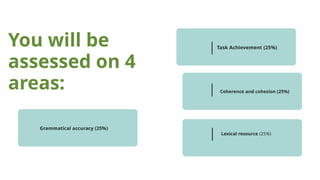
You will be
assessedon 4
areas:
Task Achievement (25%)
Coherence and cohesion (25%)
Lexical resource (25%)
Coherence and cohesion (25%)
Grammatical accuracy (25%)
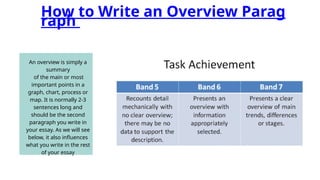
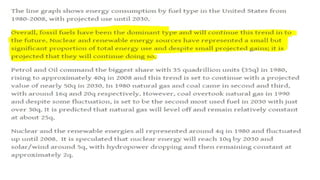
How to Writean Overview Parag
raph
An overview is simply a
summary
of the main or most
important points in a
graph, chart, process or
map. It is normally 2-3
sentences long and
should be the second
paragraph you write in
your essay. As we will see
below, it also influences
what you write in the rest
of your essay
6.
How do Iselect
the correct
features?
To understand this we have to
think about the different types of
graphs and charts we might see.
There are generally two different
kinds of charts and graphs:
dynamic and static.
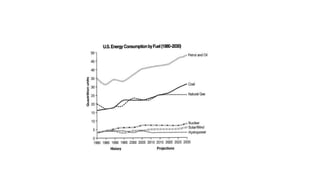
Dynamic charts show data over time and static
charts show data at just one point in time. This
will affect the type of data we select.
static graphs represent data or relationships
between data that dosn’t change over time .
7.
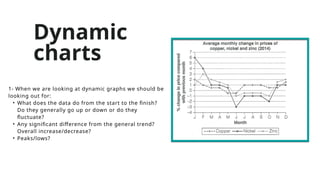
1- When weare looking at dynamic graphs we should be
looking out for:
• What does the data do from the start to the finish?
Do they generally go up or down or do they
fluctuate?
• Any significant difference from the general trend?
Overall increase/decrease?
• Peaks/lows?
Dynamic
charts
8.
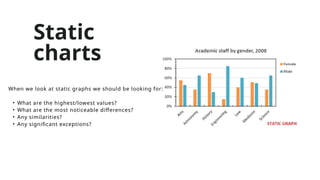
When we lookat static graphs we should be looking for:
• What are the highest/lowest values?
• What are the most noticeable differences?
• Any similarities?
• Any significant exceptions?
Static
charts
9.
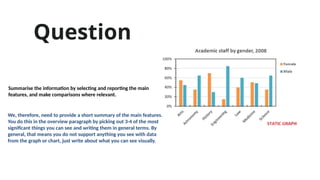
Summarise the informationby selecting and reporting the main
features, and make comparisons where relevant.
Question
We, therefore, need to provide a short summary of the main features.
You do this in the overview paragraph by picking out 3-4 of the most
significant things you can see and writing them in general terms. By
general, that means you do not support anything you see with data
from the graph or chart, just write about what you can see visually.
10.
Is there anyspecial grammar?
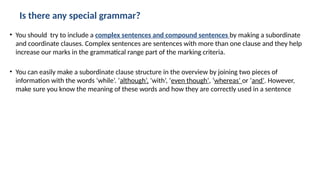
• You should try to include a complex sentences and compound sentences by making a subordinate
and coordinate clauses. Complex sentences are sentences with more than one clause and they help
increase our marks in the grammatical range part of the marking criteria.
• You can easily make a subordinate clause structure in the overview by joining two pieces of
information with the words ‘while’. ‘although’, ‘with’, ‘even though’, ‘whereas’ or ‘and’. However,
make sure you know the meaning of these words and how they are correctly used in a sentence
11.
Should I writea conclusion?
•
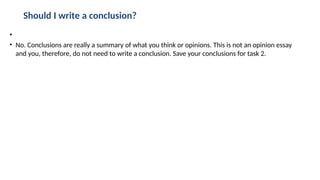
• No. Conclusions are really a summary of what you think or opinions. This is not an opinion essay
and you, therefore, do not need to write a conclusion. Save your conclusions for task 2.
14.
Tips!
Use correct synonymsin your writing.
» Use a range of vocabulary.
» Do not repeat words and phrases from
the exam question unless there is no alternative.
» Use less common vocabulary
» Do not use the same word more than once/twice
» Use precise and accurate words in a sentence.


![2-What's in the bag ESL [Autosaved].pptx](https://cdn.slidesharecdn.com/ss_thumbnails/2-whatsinthebagautosaved-251128142031-637d3dc2-thumbnail.jpg?width=640&height=640&fit=bounds)


