By Ylexa Jham Gallano
ECOLOGY
What does ecology have to do with
me?
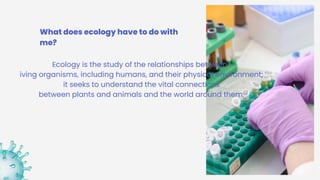
Ecology is the study of the relationships between l
iving organisms, including humans, and their physical environment;
it seeks to understand the vital connections
between plants and animals and the world around them.
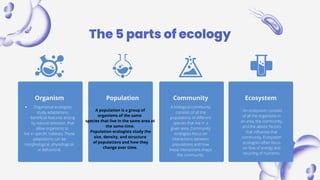
The 5 parts of ecology
Organismal ecologists
study adaptations,
beneficial features arising
by natural selection, that
allow organisms to
live in specific habitats. These
adaptations can be
morphological, physiological,
or behavioral.
Organism Population
A biological community
consists of all the
populations of different
species that live in a
given area. Community
ecologists focus on
interactions between
populations and how
these interactions shape
the community.
Community
: An ecosystem consists
of all the organisms in
an area, the community,
and the abiotic factors
that influence that
community. Ecosystem
ecologists often focus
on flow of energy and
recycling of nutrients.
Ecosystem
A population is a group of
organisms of the same
species that live in the same area at
the same time.
Population ecologists study the
size, density, and structure
of populations and how they
change over time.
The biosphere is planet Earth, viewed as an ecological system. Ecologists working at the biosphere level
may study global patterns—for example, climate or species distribution—interactions among ecosystems,
and phenomena that affect the entire globe, such as climate change.
The five levels of ecology are listed above from small to large. They build
progressively—populations are made up of individuals; communities are made up of
populations; ecosystems are made up of a community plus its environment; and so
forth.
Each level of organization has emergent properties, new properties that are not
present in the level's component parts but emerge from from these parts'
interactions and relationships.
The Role of Ecology in
Our Lives
We can learn more about the environment around
us thanks to the different disciplines under
ecology, including statistical, marine, and
vegetation ecology. Additionally, this knowledge
can assist us in managing our natural resources,
enhancing the environment, and safeguarding
public health. The examples that follow show only
a few of the positive effects that ecological
knowledge has had on our daily lives.
Reference
https://www.esa.org/publications/issues/
01
02
03
05
04
Thank you
4 4 4 4

Blue and White Professional Science Project Presentation.pdf

  • 1.
    By Ylexa JhamGallano ECOLOGY
  • 2.
    What does ecologyhave to do with me? Ecology is the study of the relationships between l iving organisms, including humans, and their physical environment; it seeks to understand the vital connections between plants and animals and the world around them.
  • 3.
    The 5 partsof ecology Organismal ecologists study adaptations, beneficial features arising by natural selection, that allow organisms to live in specific habitats. These adaptations can be morphological, physiological, or behavioral. Organism Population A biological community consists of all the populations of different species that live in a given area. Community ecologists focus on interactions between populations and how these interactions shape the community. Community : An ecosystem consists of all the organisms in an area, the community, and the abiotic factors that influence that community. Ecosystem ecologists often focus on flow of energy and recycling of nutrients. Ecosystem A population is a group of organisms of the same species that live in the same area at the same time. Population ecologists study the size, density, and structure of populations and how they change over time.
  • 4.
    The biosphere isplanet Earth, viewed as an ecological system. Ecologists working at the biosphere level may study global patterns—for example, climate or species distribution—interactions among ecosystems, and phenomena that affect the entire globe, such as climate change.
  • 5.
    The five levelsof ecology are listed above from small to large. They build progressively—populations are made up of individuals; communities are made up of populations; ecosystems are made up of a community plus its environment; and so forth. Each level of organization has emergent properties, new properties that are not present in the level's component parts but emerge from from these parts' interactions and relationships.
  • 6.
    The Role ofEcology in Our Lives We can learn more about the environment around us thanks to the different disciplines under ecology, including statistical, marine, and vegetation ecology. Additionally, this knowledge can assist us in managing our natural resources, enhancing the environment, and safeguarding public health. The examples that follow show only a few of the positive effects that ecological knowledge has had on our daily lives.
  • 7.
  • 8.
  • 9.
  • 10.