











모바일 헬스케어
특허 동향 및 권리화 전략
2017. 11. 21.
BLT특허법률사무소
김성현 파트너변리사
제2회 모바일 헬스케어 심포지엄
Korean Patent Attorney
김성현 변리사
BLT특허법률사무소 파트너변리사/IP본부장
변리사(2010~), 기술가치평가사(2014~)
삼성전자의료기기사업부/종합기술원, 서울아산병원, 삼성서울병원, 헬스케어 스타트업 등 사건 담당
조달청 우수제품 지정 심사위원
정보통신산업진흥원 정보통신/방송연구개발 평가위원
한국콘텐츠진흥원 콘텐츠비즈니스 자문위원
미래창조과학부 K-Global 프로젝트 평가위원 2
들어가며
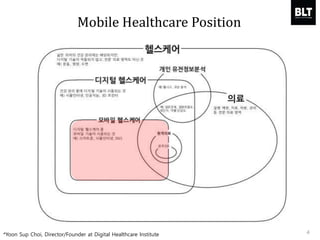
*Yoon Sup Choi, Director/Founder at Digital Healthcare Institute
Mobile Healthcare Position
4
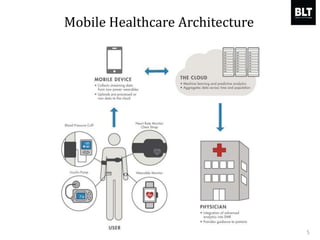
Mobile Healthcare Architecture
5
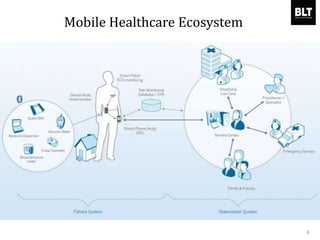
Mobile Healthcare Ecosystem
6
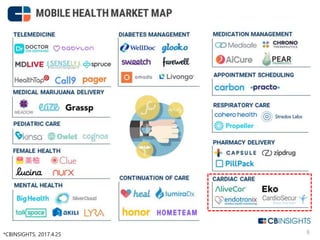
mHealth Market / Startup
*CBINSIGHTS, 2017.4.25 8
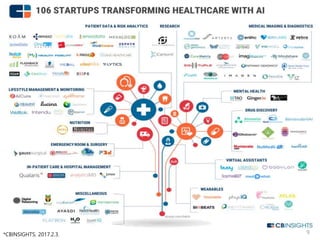
*CBINSIGHTS, 2017.2.3. 9
*CBINSIGHTS, 2015.6.19. 10
*STARTUP ALLIANCE, 2017.11.14
11
Patent Strategy
for mHealth
13
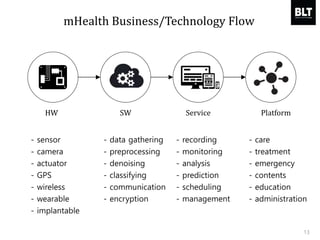
mHealth Business/Technology Flow
HW SW PlatformService
- sensor
- camera
- actuator
- GPS
- wireless
- wearable
- implantable
- data gathering
- preprocessing
- denoising
- classifying
- communication
- encryption
- recording
- monitoring
- analysis
- prediction
- scheduling
- management
- care
- treatment
- emergency
- contents
- education
- administration
14
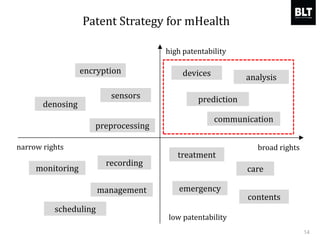
Patent Strategy for mHealth
broad rightsnarrow rights
high patentability
low patentability
sensors
scheduling
monitoring
emergency
communication
devices
preprocessing
treatment
denosing
prediction
encryption
recording
analysis
contents
management
care
Examples of
Patented mHealth
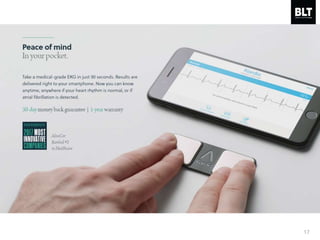
1. Alivecor, Inc.
17
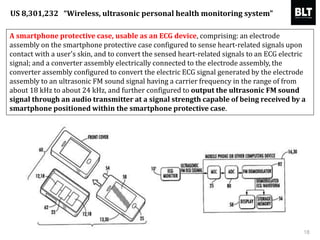
A smartphone protective case, usable as an ECG device, comprising: an electrode
assembly on the smartphone protective case configured to sense heart-related signals upon
contact with a user's skin, and to convert the sensed heart-related signals to an ECG electric
signal; and a converter assembly electrically connected to the electrode assembly, the
converter assembly configured to convert the electric ECG signal generated by the electrode
assembly to an ultrasonic FM sound signal having a carrier frequency in the range of from
about 18 kHz to about 24 kHz, and further configured to output the ultrasonic FM sound
signal through an audio transmitter at a signal strength capable of being received by a
smartphone positioned within the smartphone protective case.
18
US 8,301,232 “Wireless, ultrasonic personal health monitoring system”
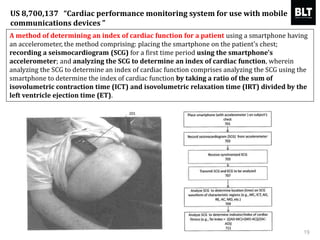
A method of determining an index of cardiac function for a patient using a smartphone having
an accelerometer, the method comprising: placing the smartphone on the patient's chest;
recording a seismocardiogram (SCG) for a first time period using the smartphone's
accelerometer; and analyzing the SCG to determine an index of cardiac function, wherein
analyzing the SCG to determine an index of cardiac function comprises analyzing the SCG using the
smartphone to determine the index of cardiac function by taking a ratio of the sum of
isovolumetric contraction time (ICT) and isovolumetric relaxation time (IRT) divided by the
left ventricle ejection time (ET).
19
US 8,700,137 “Cardiac performance monitoring system for use with mobile
communications devices ”
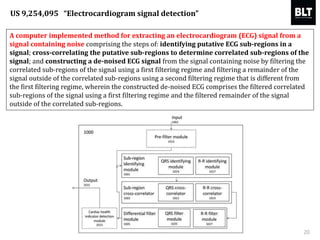
A computer implemented method for extracting an electrocardiogram (ECG) signal from a
signal containing noise comprising the steps of: identifying putative ECG sub-regions in a
signal; cross-correlating the putative sub-regions to determine correlated sub-regions of the
signal; and constructing a de-noised ECG signal from the signal containing noise by filtering the
correlated sub-regions of the signal using a first filtering regime and filtering a remainder of the
signal outside of the correlated sub-regions using a second filtering regime that is different from
the first filtering regime, wherein the constructed de-noised ECG comprises the filtered correlated
sub-regions of the signal using a first filtering regime and the filtered remainder of the signal
outside of the correlated sub-regions.
20
US 9,254,095 “Electrocardiogram signal detection”
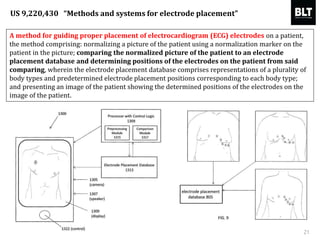
A method for guiding proper placement of electrocardiogram (ECG) electrodes on a patient,
the method comprising: normalizing a picture of the patient using a normalization marker on the
patient in the picture; comparing the normalized picture of the patient to an electrode
placement database and determining positions of the electrodes on the patient from said
comparing, wherein the electrode placement database comprises representations of a plurality of
body types and predetermined electrode placement positions corresponding to each body type;
and presenting an image of the patient showing the determined positions of the electrodes on the
image of the patient.
21
US 9,220,430 “Methods and systems for electrode placement”
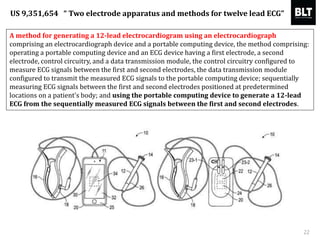
A method for generating a 12-lead electrocardiogram using an electrocardiograph
comprising an electrocardiograph device and a portable computing device, the method comprising:
operating a portable computing device and an ECG device having a first electrode, a second
electrode, control circuitry, and a data transmission module, the control circuitry configured to
measure ECG signals between the first and second electrodes, the data transmission module
configured to transmit the measured ECG signals to the portable computing device; sequentially
measuring ECG signals between the first and second electrodes positioned at predetermined
locations on a patient's body; and using the portable computing device to generate a 12-lead
ECG from the sequentially measured ECG signals between the first and second electrodes.
22
US 9,351,654 “ Two electrode apparatus and methods for twelve lead ECG”
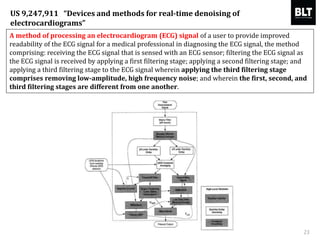
A method of processing an electrocardiogram (ECG) signal of a user to provide improved
readability of the ECG signal for a medical professional in diagnosing the ECG signal, the method
comprising: receiving the ECG signal that is sensed with an ECG sensor; filtering the ECG signal as
the ECG signal is received by applying a first filtering stage; applying a second filtering stage; and
applying a third filtering stage to the ECG signal wherein applying the third filtering stage
comprises removing low-amplitude, high frequency noise; and wherein the first, second, and
third filtering stages are different from one another.
23
US 9,247,911 “Devices and methods for real-time denoising of
electrocardiograms”
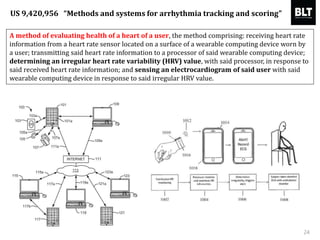
A method of evaluating health of a heart of a user, the method comprising: receiving heart rate
information from a heart rate sensor located on a surface of a wearable computing device worn by
a user; transmitting said heart rate information to a processor of said wearable computing device;
determining an irregular heart rate variability (HRV) value, with said processor, in response to
said received heart rate information; and sensing an electrocardiogram of said user with said
wearable computing device in response to said irregular HRV value.
24
US 9,420,956 “Methods and systems for arrhythmia tracking and scoring”
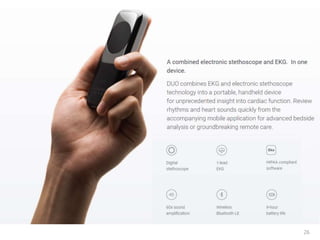
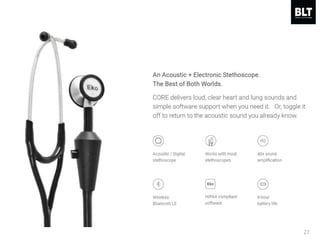
2. Eko Devices, Inc.
26
27
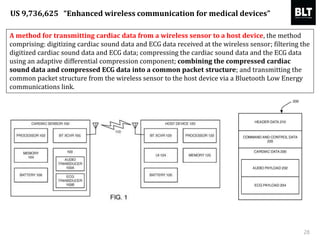
A method for transmitting cardiac data from a wireless sensor to a host device, the method
comprising: digitizing cardiac sound data and ECG data received at the wireless sensor; filtering the
digitized cardiac sound data and ECG data; compressing the cardiac sound data and the ECG data
using an adaptive differential compression component; combining the compressed cardiac
sound data and compressed ECG data into a common packet structure; and transmitting the
common packet structure from the wireless sensor to the host device via a Bluetooth Low Energy
communications link.
28
US 9,736,625 “Enhanced wireless communication for medical devices”
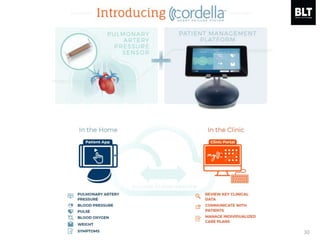
3. Endotronix, Inc.
30
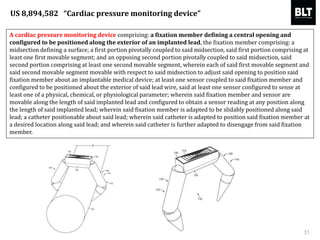
A cardiac pressure monitoring device comprising: a fixation member defining a central opening and
configured to be positioned along the exterior of an implanted lead, the fixation member comprising: a
midsection defining a surface; a first portion pivotally coupled to said midsection, said first portion comprising at
least one first movable segment; and an opposing second portion pivotally coupled to said midsection, said
second portion comprising at least one second movable segment, wherein each of said first movable segment and
said second movable segment movable with respect to said midsection to adjust said opening to position said
fixation member about an implantable medical device; at least one sensor coupled to said fixation member and
configured to be positioned about the exterior of said lead wire, said at least one sensor configured to sense at
least one of a physical, chemical, or physiological parameter; wherein said fixation member and sensor are
movable along the length of said implanted lead and configured to obtain a sensor reading at any position along
the length of said implanted lead; wherein said fixation member is adapted to be slidably positioned along said
lead; a catheter positionable about said lead; wherein said catheter is adapted to position said fixation member at
a desired location along said lead; and wherein said catheter is further adapted to disengage from said fixation
member.
31
US 8,894,582 “Cardiac pressure monitoring device”
THANK YOU
For More Information
02-514-0104, shkim@BLT.kr

[WeFocus] 모바일헬스케어심포지엄_김성현_20171121_v1

  • 1.
    모바일 헬스케어 특허 동향및 권리화 전략 2017. 11. 21. BLT특허법률사무소 김성현 파트너변리사 제2회 모바일 헬스케어 심포지엄
  • 2.
    Korean Patent Attorney 김성현변리사 BLT특허법률사무소 파트너변리사/IP본부장 변리사(2010~), 기술가치평가사(2014~) 삼성전자의료기기사업부/종합기술원, 서울아산병원, 삼성서울병원, 헬스케어 스타트업 등 사건 담당 조달청 우수제품 지정 심사위원 정보통신산업진흥원 정보통신/방송연구개발 평가위원 한국콘텐츠진흥원 콘텐츠비즈니스 자문위원 미래창조과학부 K-Global 프로젝트 평가위원 2
  • 3.
  • 4.
    *Yoon Sup Choi,Director/Founder at Digital Healthcare Institute Mobile Healthcare Position 4
  • 5.
  • 6.
  • 7.
  • 8.
  • 9.
  • 10.
  • 11.
  • 12.
  • 13.
    13 mHealth Business/Technology Flow HWSW PlatformService - sensor - camera - actuator - GPS - wireless - wearable - implantable - data gathering - preprocessing - denoising - classifying - communication - encryption - recording - monitoring - analysis - prediction - scheduling - management - care - treatment - emergency - contents - education - administration
  • 14.
    14 Patent Strategy formHealth broad rightsnarrow rights high patentability low patentability sensors scheduling monitoring emergency communication devices preprocessing treatment denosing prediction encryption recording analysis contents management care
  • 15.
  • 16.
  • 17.
  • 18.
    A smartphone protectivecase, usable as an ECG device, comprising: an electrode assembly on the smartphone protective case configured to sense heart-related signals upon contact with a user's skin, and to convert the sensed heart-related signals to an ECG electric signal; and a converter assembly electrically connected to the electrode assembly, the converter assembly configured to convert the electric ECG signal generated by the electrode assembly to an ultrasonic FM sound signal having a carrier frequency in the range of from about 18 kHz to about 24 kHz, and further configured to output the ultrasonic FM sound signal through an audio transmitter at a signal strength capable of being received by a smartphone positioned within the smartphone protective case. 18 US 8,301,232 “Wireless, ultrasonic personal health monitoring system”
  • 19.
    A method ofdetermining an index of cardiac function for a patient using a smartphone having an accelerometer, the method comprising: placing the smartphone on the patient's chest; recording a seismocardiogram (SCG) for a first time period using the smartphone's accelerometer; and analyzing the SCG to determine an index of cardiac function, wherein analyzing the SCG to determine an index of cardiac function comprises analyzing the SCG using the smartphone to determine the index of cardiac function by taking a ratio of the sum of isovolumetric contraction time (ICT) and isovolumetric relaxation time (IRT) divided by the left ventricle ejection time (ET). 19 US 8,700,137 “Cardiac performance monitoring system for use with mobile communications devices ”
  • 20.
    A computer implementedmethod for extracting an electrocardiogram (ECG) signal from a signal containing noise comprising the steps of: identifying putative ECG sub-regions in a signal; cross-correlating the putative sub-regions to determine correlated sub-regions of the signal; and constructing a de-noised ECG signal from the signal containing noise by filtering the correlated sub-regions of the signal using a first filtering regime and filtering a remainder of the signal outside of the correlated sub-regions using a second filtering regime that is different from the first filtering regime, wherein the constructed de-noised ECG comprises the filtered correlated sub-regions of the signal using a first filtering regime and the filtered remainder of the signal outside of the correlated sub-regions. 20 US 9,254,095 “Electrocardiogram signal detection”
  • 21.
    A method forguiding proper placement of electrocardiogram (ECG) electrodes on a patient, the method comprising: normalizing a picture of the patient using a normalization marker on the patient in the picture; comparing the normalized picture of the patient to an electrode placement database and determining positions of the electrodes on the patient from said comparing, wherein the electrode placement database comprises representations of a plurality of body types and predetermined electrode placement positions corresponding to each body type; and presenting an image of the patient showing the determined positions of the electrodes on the image of the patient. 21 US 9,220,430 “Methods and systems for electrode placement”
  • 22.
    A method forgenerating a 12-lead electrocardiogram using an electrocardiograph comprising an electrocardiograph device and a portable computing device, the method comprising: operating a portable computing device and an ECG device having a first electrode, a second electrode, control circuitry, and a data transmission module, the control circuitry configured to measure ECG signals between the first and second electrodes, the data transmission module configured to transmit the measured ECG signals to the portable computing device; sequentially measuring ECG signals between the first and second electrodes positioned at predetermined locations on a patient's body; and using the portable computing device to generate a 12-lead ECG from the sequentially measured ECG signals between the first and second electrodes. 22 US 9,351,654 “ Two electrode apparatus and methods for twelve lead ECG”
  • 23.
    A method ofprocessing an electrocardiogram (ECG) signal of a user to provide improved readability of the ECG signal for a medical professional in diagnosing the ECG signal, the method comprising: receiving the ECG signal that is sensed with an ECG sensor; filtering the ECG signal as the ECG signal is received by applying a first filtering stage; applying a second filtering stage; and applying a third filtering stage to the ECG signal wherein applying the third filtering stage comprises removing low-amplitude, high frequency noise; and wherein the first, second, and third filtering stages are different from one another. 23 US 9,247,911 “Devices and methods for real-time denoising of electrocardiograms”
  • 24.
    A method ofevaluating health of a heart of a user, the method comprising: receiving heart rate information from a heart rate sensor located on a surface of a wearable computing device worn by a user; transmitting said heart rate information to a processor of said wearable computing device; determining an irregular heart rate variability (HRV) value, with said processor, in response to said received heart rate information; and sensing an electrocardiogram of said user with said wearable computing device in response to said irregular HRV value. 24 US 9,420,956 “Methods and systems for arrhythmia tracking and scoring”
  • 25.
  • 26.
  • 27.
  • 28.
    A method fortransmitting cardiac data from a wireless sensor to a host device, the method comprising: digitizing cardiac sound data and ECG data received at the wireless sensor; filtering the digitized cardiac sound data and ECG data; compressing the cardiac sound data and the ECG data using an adaptive differential compression component; combining the compressed cardiac sound data and compressed ECG data into a common packet structure; and transmitting the common packet structure from the wireless sensor to the host device via a Bluetooth Low Energy communications link. 28 US 9,736,625 “Enhanced wireless communication for medical devices”
  • 29.
  • 30.
  • 31.
    A cardiac pressuremonitoring device comprising: a fixation member defining a central opening and configured to be positioned along the exterior of an implanted lead, the fixation member comprising: a midsection defining a surface; a first portion pivotally coupled to said midsection, said first portion comprising at least one first movable segment; and an opposing second portion pivotally coupled to said midsection, said second portion comprising at least one second movable segment, wherein each of said first movable segment and said second movable segment movable with respect to said midsection to adjust said opening to position said fixation member about an implantable medical device; at least one sensor coupled to said fixation member and configured to be positioned about the exterior of said lead wire, said at least one sensor configured to sense at least one of a physical, chemical, or physiological parameter; wherein said fixation member and sensor are movable along the length of said implanted lead and configured to obtain a sensor reading at any position along the length of said implanted lead; wherein said fixation member is adapted to be slidably positioned along said lead; a catheter positionable about said lead; wherein said catheter is adapted to position said fixation member at a desired location along said lead; and wherein said catheter is further adapted to disengage from said fixation member. 31 US 8,894,582 “Cardiac pressure monitoring device”
  • 32.
    THANK YOU For MoreInformation 02-514-0104, shkim@BLT.kr