ed
ur
ct
ru s
St te
No

ar
Ye
13
20

nd
E

w
ie
ev
R
01.09.14 www.bloombergbriefs.com	

Bloomberg Brief | Structured Notes

2

year in review
By Richard Bedard

The story of 2013 that had the biggest
impact can’t be pinned to a time, place
or person. Rather, it was the steady and
seemingly inexorable rise in major stock
markets around the globe. Plenty of structured note investors gladly went along for
the ride: They bought one-year autocallables tied to everything from U.S. Steel
Corp. to Lululemon Athletica Inc., 20year securities that pay monthly coupons
if major stock indexes don’t plummet, and
a variety of other products.
The stock gains helped take the sting
out of other not-so-favorable trends.
Interest rates began the year near record
lows. Volatility was subdued, with the VIX
Index in 2013 about 50 percent below its
long-term average. Bank risk improved,
reducing funding costs. Thus issuers
found themselves squeezed in trying to
create alluring terms on notes, whether in
coupons or buffers or leveraged gains.

They still found ways to wring out yield,
such as by pushing out maturities. About
5 percent of U.S. equity-tied notes had
maturities of 10 years or longer, compared
with less than 2 percent in 2012. Banks
also turned to selling notes that tracked
baskets of stocks, with returns based on
the worst performer. By July, issuance
of such “worst of” securities had almost
doubled from the year before.
Apart from equity-tied notes, the issuance picture was generally grim. Ratelinked sales dropped — who wanted
to get caught on the wrong side of the
Fed’s eventual withdrawal from monetary
easing? Commodity-tied notes fared
badly, as the price of grains and precious
metals tumbled. Globally, there were also
declines in the volume of securities linked
to credit and inflation.
Beyond the ebb and flow of sales numbers, regulatory issues again weighed on
the industry. In the U.S., banks complied

Contents
OUTLOOK
Industry executives share their
opinions on 2013’s biggest
story and try to predict what’s
in store this year.
Page 3
top 10 stories
A look at the 10 biggest stories
that appeared on the newsletter’s front pages last year.
Page 4
asset class breakdown
While other note categories
lost market share, investors
couldn’t seem to get enough
securities linked to stocks.
Page 5
top 10 notes
The year’s largest notes were
tied to Libor, constant-maturity
swaps and the Dow Jones

with the Securities and Exchange Commission’s request that they begin disclosing the initial value of their securities. That
allowed investors, for the first time ever,
to see exactly what that $1,000 note they
just bought was worth at the moment it
changed hands.
In Europe, regulators considered similar
measures, as they also pushed for
greater transparency. The International
Organization of Securities Commissions
published a report in April containing
proposals that aimed to improve sales
practices and disclosures.
In the end, some banks decided issuing structured notes wasn’t worth it.
Rabobank Groep closed its equity derivatives unit in March and Royal Bank
of Scotland Group Plc announced in
June it was shuttering its structured
products business.

Bloomberg Brief Structured Notes

Industrial Average.
Page 5
monthly sales trends
While global sales dropped
to the lowest in a decade, in
the U.S., equity-linked volume
pushed last year’s issuance
above 2012’s.
Page 6
noteworthy images
What would a structured note
prospectus look like, distilled
to one image? Take a look.
Page 7
Quiz
Six structured notes, with
four different valuations for
each. Can you guess which
is correct?
Page 7

top 100 U.S. note holders
The 100-biggest holders of
the largest structured notes
that have been issued in the
U.S. since 2010.
Page 8
a closer look at holders
An in-depth look at who holds
the U.S. structured notes
in our sample and which
underlyings and maturities
they prefer.
Page 9
rankings by asset class
Our tables rank issuers in
Europe and the U.S., showing
who climbed a few rungs from
2012 and who dropped a few.
Pages 10, 11

A GUIDE TO OUR DATA
* U.S. notes are securities issued in the U.S. that are registered with the SEC.
** Global notes exclude U.S. securities and also “variable-principal redemption” notes, such as
reverse convertibles.
*** European notes are issued in Europe and exclude “variable-principal redemption” notes, such as
reverse convertibles.
Quiz answers from page 7: 1.(a) 2.(d) 3.(a) 4.(c) 5.(b) 6.(d)

 1 2 3 4 5 6 7 8 9 10 11 

	Newsletter	 Ted Merz
	 Executive Editor	tmerz@bloomberg.net
		212-617-2309
	 Bloomberg News	 Robert Burgess		
	 Managing Editor	bburgess@bloomberg.net
		212-617-2945
	 Structured Notes	 Richard Bedard		
	 Newsletter Editor	rbedard2@bloomberg.net
		212-617-8761
	
Reporters	 Alastair Marsh
		amarsh25@bloomberg.net
		+44-203-525-8767
		 Kevin Dugan
		kdugan4@bloomberg.net
		212-617-2035
		
	Newsletter	 Nick Ferris
	Business Manager	nferris2@bloomberg.net
		212-617-6975
	
Advertising	 Jeff Maniatty
		jmaniatty@bloomberg.net
		+1-203-550-2446
	
Reprints &	 Lori Husted
	
Permissions	lori.husted@theygsgroup.com
		717-505-9701
To subscribe via the Bloomberg Terminal type BRIEF
<GO> or on the web at www.bloombergbriefs.com.
© 2014 Bloomberg LP All rights reserved.
.
This newsletter and its contents may not be
forwarded or redistributed without the prior consent
of Bloomberg. Please contact our reprints and
permissions group listed above for more information.
01.09.14 www.bloombergbriefs.com	

Bloomberg Brief | Structured Notes

3

outlook
What was this year’s biggest story? What do you think will be the biggest surprise of 2014?
U.S.
Serge Troyanovsky, managing director and head of retail distribution in North America
BNP Paribas SA
A: The biggest story of 2013 is the performance of equity markets. We saw many structured products follow
the lead. In addition, we have also seen a change in focus from income-generating structures to more growthoriented. This is reflective of the more bullish outlook on the equity markets. I think that the biggest surprise in
2014 will be investors buying more notes that use bespoke strategies, that come from a research-based basket
of equities, or a dynamic index designed to adjust its exposure based on market conditions.
Tom Layton, director of structured products
Raymond James & Associates Inc.
A: The biggest story for our clients has been the shift to a rising interest rate environment. The dramatic interest
rate move in May and June caused investors to re-think fixed-income allocations. Our firm has positioned certain
structured products as an attractive alternative. It’s tough to say what would be the biggest surprise, but we feel
investors have put less attention on credit risk over the past year as equity markets rallied. If rates rise quickly
and/or equities pull back, we could see focus quickly shift to mitigating both credit and market-related risk.
Mathias Strasser, chief executive officer
WallStreetDocs Ltd.
A: From an automation perspective, we’ve seen issuers focusing to streamline the offering process. This trend
continues to be driven by cost pressures and regulatory requirements. For 2014, I expect further convergence in
regulatory requirements between Europe and the United States. I also expect that the fast-growing use of mobile
devices will be felt in the structured products space. This will affect the way investors access information about
structured products and how deals are marketed.
EUROPE
Marc El Asmar, global head of sales in cross-asset solutions
Societe Generale SA
A: 2013 was a good year for structured products, particularly for listed products and credit-linked products.
Basically, anything with a coupon was well received. People were looking for yield. Next year the focus will be
on rising rates, on when and by how much they will go up. Investors will be looking for products to hedge or take
advantage of that. Keep an eye on longevity-based trades [longevity bonds pay a coupon based on “survivorship” of a population group], as we expect see more of that.
Shane Edwards, global head of equities structuring
UBS AG
A: 2013 will be regarded as a great year for equities. Japan was the standout market in terms of returns and
international attention. Also interesting: the pronounced outperformance of developed versus emerging market
equities. In 2014, we expect a continuation in demand for yield products, but a preference for floating-rate coupons rather than fixed-income. We may see demand increase for growth-oriented products, if the momentum in
equities and economic recovery continues.
Josef Mehkri, head of institutional and private banking sales
SEB AB
A: We saw investors move away from a focus only on credit to look at more equity products as they wanted
to benefit from the rally in equities. There is a lot less juice left in credit as spreads have tightened. European
high yield has tightened a lot; some banks predict it could come in by a further 100 basis points. Next year, an
increase in rates driven by the Fed could be a double-edged sword. Investors in existing notes will suffer mark-tomarket losses, while higher rates will allow new notes to be issued with more attractive coupons.

 1 2 3 4 5 6 7 8 9 10 11 
01.09.14 www.bloombergbriefs.com	

TOP 10 STORIES

To view interactive feature click

Bloomberg Brief | Structured Notes

4

below.

We took a look at all our front pages from 2013 and selected what we thought were the 10 stories that best captured the trends and issues for the year.
1) EQUITY NOTE SALES SIGNAL
POSSIBLE “GREAT ROTATION”
Bullishness about stocks, and losses on
bonds, made equity-tied notes the year’s
biggest bet. In the U.S., such securities
(including reverse convertibles) accounted
for almost four-fifths of all issuance.
2) FIXED-INCOME FLIGHT SENDS
SALES TO 11-YEAR LOW
Sales of rate-tied products were poor all
year long. For one, the low interest rate
environment made coupons on the securities unappealing. Also the possibility that
rates would soon start to rise damped
enthusiasm for fixed-income notes.
3) LOWEST VOLATILITY SINCE 2007
REDUCES NOTE RETURNS
Low volatility bedeviled investors seeking
high coupons on structured notes. The
VIX Index averaged less than 15 for the
year and ended above 20 on only three
days, in June and October.
4) LIBOR-TIED NOTE SALES JUMP ON
EXPECTED RATE RISE
The Federal Reserve’s plans for the stimulus taper – when would it begin and by how

much?– kept investors guessing for much
of the year. Note buyers responded by purchasing more products tied to Libor where
coupons would adjust when rates climbed.
5) INVESTORS SEEK LONGER MATURITIES TO BOOST YIELDS
Low interest rates, declining funding costs
for banks and less stock volatility hurt note
terms. One way issuers responded: they
extended maturities to create some yield.
6) ETN ASSETS SURGE ON DIVIDENDS, HIGHER LIQUIDITY
U.S. exchange-traded note holdings had
soared about 34 percent by September,
while structured note sales were down
slightly at the time. Some investors favored ETNs for being more liquid and able
to access stock dividends.
7) COMMODITY-TIED NOTE SALES
SLUMP TO NINE-YEAR LOW
Issuance of notes tied to commodities fell
sharply. Gold and silver were victims of
Fed Chairman Ben S. Bernanke’s plan to
slow bond purchases, while other materials such as copper suffered as growth in
China’s economy slowed.

 1 2 3 4 5 6 7 8 9 10 11 

8) U.S. NOTES TIED TO EURO STOXX
50 SURGE ON VOLATILITY
Concern about Europe faded as investors took comfort in the European Central
Bank president’s pledge to save the euro,
whatever it took. Meanwhile the Euro
Stoxx 50 Index’s volatility stayed higher
than that for U.S. stock benchmarks, allowing issuers to create securities tied to
the gauge that paid better returns.
9) GOLD PLUNGE RISKS LOSSES ON
$1.1 BILLION OF NOTES
A drop in the price of gold put in peril hundreds of millons of dollars of U.S. structured notes. The precious metal declined
for the first time since 2000, when it was
trading at less than $280 an ounce.
10) BUYERS SNAP UP NOTES TIED TO
SINGLE STOCKS
Among the signs in 2013 of growing risk
appetite: Investors bought a higher percentage of notes tied to single stocks. The
securities often had higher volatility than
those linked to indexes, which meant issuers could offer more attractive features.
01.09.14 www.bloombergbriefs.com	

Bloomberg Brief | Structured Notes

5

ASSET CLASS BREAKDOWN
Equity-Tied Notes Soar in U.S. as Credit-Linked Drops Globally
2013 U.S.

Other, 3.2%

Other, 3.0%

2012 U.S.

Hybrid, 2.5%

Hybrid, 1.5%

Reverse
Convertible, 6.0%

Commodity, 3.3%
Reverse
Convertible, 3.8%

Commodity, 6.7%

Equity, 75.3%
Rates, 11.7%

Equity, 64.3%

Rates, 14.7%

FX, 1.5%

FX, 2.5%

Source: Bloomberg LP

Source: Bloomberg LP

Investors had a huge appetite for notes linked to stocks, while most other
categories shrank. Commodity-tied fell by half, to 3.3 percent.

Sales were better distributed in 2012, with four categories over $2 billion
(equity, rates, commodity, reverse convertibles), compared to two in 2013.

2012 Global

2013 Global
Inflation, 2.4%
Other, 8.8%

Credit, 55.2%

Other, 3.0%

Rates, 35.0%

Inflation, 2.8%

Credit, 53.8%

Rates, 39.0%

Source: Bloomberg LP

Source: Bloomberg LP

Market share dipped for notes in three major categories. On an absolute
basis, credit-tied dropped 15 percent to $38 billion.

Top 10 U.S. Notes					
iSSUER
Bank of America
Morgan Stanley
Toyota
JPMorgan
Bank of America
Bank of America
BMO
Morgan Stanley
Credit Suisse
Bank of America

DESCRIPTION
5 yr., tied to Dow Jones Industrial Average
2 yr., fixed to floating rate
18 mo., fixed to floating rate
5 yr., tied to JPMorgan commodity index
3 yr., tied to Euro Stoxx 50 Index
1 yr., tied to Raymond James stock picks
3 yr., fixed to floating rate
1 yr., tied to Hang Seng China Enter. Index
5 yr., tied to Dow Jones Industrial Average

AMT. (MLN $)
284.5
250.0
250.0
239.7
229.8
196.4
185.0
175.0
171.4
166.3

Source: Bloomberg LP					

The rate-tied and credit-linked categories combined made up almost 95
percent of volume in 2012.

Top 10 Global Notes (Outside U.S.)
ISSUER
Volkswagen Intl. Fin. NV
Cassa Depositi Prestiti
Palladium Securities 1 SA
Landessparkas Olden.
MAF Global Securities
Banca IMI SpA
Mediobanca SpA
Cie Financement Foncier
Mediobanca SpA
Palladium Securities 1 SA

DESCRIPTION
Perpetual, fixed to floating rate over CMS
10 yr., floating rate over CMS
10 yr., tied to CMS with cap, floor
4 yr., credit-linked note also tied to Euribor
Perpetual, fixed to floating rate over CMS
4 yr., fixed to digital coupon tied to Euribor
6 yr., fixed to digital coupon tied to Euro Stoxx 50
20 yr., fixed to CMS rate with cap
5.5 yr., fixed to floating rate over Italy's CPI
6.5 yr., tied to CMS with cap, floor

Source: Bloomberg LP

 1 2 3 4 5 6 7 8 9 10 11 

AMT. (mln $)
993.1
687.1
655.6
506.9
500.0
392.8
270.4
269.5
261.9
257.6
01.09.14 www.bloombergbriefs.com	

6

Bloomberg Brief | Structured Notes

monthly sales trends
U.S. Sales Recover After Sagging in Mid-Year
Sales (left)

4.5

Offerings (right)

4.0
3.5

1000
900

800
3.91
3.67 3.39

3.0
2.5

3.66

3.05

3.05 3.01

3.48 3.44 3.29
3.38

700

600
2.91

500

2.0

400

1.5

300

1.0

200

0.5

100

0.0

Number of Notes

Sales proved steadier in 2013 than the
year before, when issuance ranged from
$2.19 billion in December to $4.54 billion
in March. There were five months of less
than $3 billion of volume in 2012; last year
there was only one. The size of the typical
deal crept higher: $4.9 million on average,
up from $4.79 million in 2012, after declining from $6.27 million in 2011.

5.0

Billions of $

Issuance in the U.S. started out the
year strong, then immediately began to
slide. Sales in April, June and July barely
eclipsed $3 billion for each month. Then
the rebound got under way, propelled by
a large amount of stock-tied sales: $2.87
million in August, or more than 82 percent
of the overall.

0

Jan. Feb. Mar. April May June July Aug. Sept. Oct. Nov. Dec.
Source: Bloomberg LP

Global Sales Decline Throughout Year

DZ Bank AG was one of the few major
issuers that gained sales, climbing to
$18.1 billion from $17.1 billion, making the
German bank No. 1 again. Those that fell
included Deutsche Bank AG, UBS AG and
Credit Suisse Group AG.

10
8

7
6
5
4

Sales (left)

Offerings (right)

8.86

400
350
300

7.75

7.59
6.52

6.05

250
5.86

200

5.55

4.85 4.81

3

4.02

4.73

150
3.57

2

100

1

50

0

0

Jan. Feb. Mar. April May June July Aug. Sept. Oct. Nov. Dec.
Source: Bloomberg LP

 1 2 3 4 5 6 7 8 9 10 11 

Number of Notes

9

Billions of $

Global issuance, which excludes the
U.S. and equity-linked notes, ticked lower
almost every month, ending the year at
$70.6 billion, the lowest since 2002. A
jump to $7.59 billion in May turned out to
be no more than a “false spring,” as sales
resumed their decline in June. The $4.03
billion of volume in September was less
than half the sales of the same month in
2008 — a time when Lehman Brothers
Holdings Inc. went bankrupt and the financial system appeared to be coming apart
— and the worst September since 2002.
01.09.14 www.bloombergbriefs.com	

Bloomberg Brief | Structured Notes

7

noteworthy images
A Structured Note Prospectus Made Visual
We decided to distill the essence of a typical prospectus — with all its explanations, definitions, examples and risk warnings — into one
simple word cloud. Below is what the offering document for Credit Suisse AG’s $4.44 million of leveraged buffered notes tied to the MSCI
EAFE Index, sold on Nov. 15, looks like.

QUIZ

answers on pg 2.

Banks now disclose the inital value for their U.S. structured notes. Can you guess how much each of the following was worth in
cents on the dollar?
I’m a 12-year
callable range
accrual, tied to
Libor and the
S&P 500, paying
up to 7.4% annually, and sold in
August 2012 by
Goldman Sachs.
a) 88.0

I’m a 2-year note
paying 19.5% or
more if the rupee
gains against
the dollar, with
10% of principal
at risk, sold by
Bank of America
in January.
a) 92.0

I’m a 3-month
reverse convertible, tied to
Apollo Group,
with a 15.5%
annual coupon
and 20% buffer,
sold by JPMorgan in May.
a) 96.2

I’m a 9-year
callable range
accrual tied to
Libor and the
Russell 2000,
paying up to
7.7% annually,
and sold in May
by Citigroup.
a) 82.2

I’m a 5-year autocallable tied to
Ford with a 7.5%
annual contingent coupon
and 33% buffer,
sold in May by
Barclays.
a) 97.2

I’m a 1-year
autocallable tied
to the S&P 500,
paying up to
7.56% annually,
with no buffer,
sold in April by
Royal Bank of
Canada.
a) 90.2

b) 91.4

b) 85.0

b) 98.8

b) 96.9

b) 94.5

d) 95.6

c) 98.6

c) 99.4

c) 90.9

c) 90.9

c) 88.7

c) 96.7

d) 97.3

d) 97.0

d) 97.1

d) 93.8

d) 95.5

d) 98.0

1 23456
 1 2 3 4 5 6 7 8 9 10 11 
01.09.14 www.bloombergbriefs.com	

Bloomberg Brief | Structured Notes

8

top 100 declared holders of largest u.s notes
We looked at who owns the largest U.S. SEC-registered structured notes, according to the most recent public filings. We examined the
1,000 biggest notes for each year from 2010 to 2013. We found $1.69 billion of declared holdings for 353 securities. The holdings in the
table below are based on notional amounts of the securities, not current values. The last column shows the number of different securities owned. Note: Because of data limitations, some figures may not be exact.
To view interactive feature click

below.

name
Auto Owners Group
FMR LLC
Woodmen World Life Ins. Soc.
Alfa Ins. Grp.
Prudential of America Group
Texas Permanent School Fund
Wellesley Investment Advisors
Credit Suisse AG
Allianz Global Investors
CareSource
American Equity Invest. Life Ins.
State Auto Property & Casualty
Waddell & Reed Financial Inc.
Mercury General Group
American National Insurance Comp.
Protective Life Insurance Group
Principal Financial Group Inc.
Toa Reinsurance Co. of America
Valic Co.
Berkley Ins. Co.
EMC Insurance Company Group
Miller Investment Trust
Highmark Group
AIC Holdings Group
Citizens Group
Kentucky Farm Bureau Group
BCBS of Alabama Group
Federated Investors Inc.
Oppenheimerfunds Incorporated
Allianz Asset Management AG
Brinton Eaton Associates Inc.
Modern Woodmen of Amer.
Nationwide Fund Advisors
MGIC Group
Statistical Science Incorporated
EMC Natl. Life Co.
Landesbank Berlin Investment GMB
Country Ins. & Fin. Svc. Group
Portfolio Strategies Inc.
IAT Reinsurance Company Group
Arbella Insurance Group
Deutsche Bank AG
Greek Catholic Union of the USA
Mackenzie Financial Corporation
Berkley Regional Insurance Co.
BSI SA
Government Personnel Mutual Life
Huntington Trust Company
Goldman Sachs Group Inc.
Donegal Group

holdings ($)
159,600,000
120,000,000
120,000,000
101,725,000
93,000,000
80,000,000
67,243,000
65,900,000
61,337,483
60,500,000
38,500,000
37,300,000
35,300,000
32,798,000
25,000,000
24,000,000
23,940,000
21,500,000
20,753,000
20,000,000
18,000,000
17,000,000
16,486,000
14,607,000
13,250,000
13,000,000
11,750,000
10,321,424
10,273,061
10,000,000
10,000,000
10,000,000
9,800,000
9,700,000
9,582,000
9,000,000
8,650,000
8,227,000
8,000,000
7,868,000
7,000,000
7,000,000
6,500,000
6,268,000
5,000,000
5,000,000
5,000,000
5,000,000
4,195,000
4,127,000

# of notes
7
9
8
13
1
5
2
2
8
13
2
6
1
9
3
1
3
11
9
2
3
2
15
8
3
4
7
2
2
1
1
1
1
4
1
3
3
5
1
5
2
1
7
1
2
1
3
2
2
3

name
Charter Insurance Group
FFVA Mutual Insurance Company
Grange Mutual Casualty Group
Mairs & Power Incorporated
Mutual of Omaha Group
Franklin Resources
Investors Capital Advisory Svcs.
Tricadia Holdings Group
Physicians Professional Liab. RRG
Pax World Management LLC
First American Title Group
Ameriprime Funds
American National Financial Group
Ameritas Mutual Holding Group
GuideOne Insurance Group
Marysville Mutual Insurance Co.
Meridian Security Insurance Co.
City National Bank
Catholic Order of Foresters
Guard Insurance Co. Group
ProAssurance Ind. Co. Inc.
Rockhill Ins Co.
SPJST
Van Enterprises Group
Western Fraternal Life Assoc.
National Farm Life Insurance Co.
Sons of Norway
American Eqty. Investment Life
Texas Farm Bureau Mutual Group
Viva Health Inc.
Physicians Reciprocal Insurers
Amerco Corporation Group
Everett Mutual Group
Thompson Investment Management
Countrywide Ins. Co.
EMC Reinsurance Company
Grinnell Mutual Group
North Star Company Group
WesBanco Trust & Investments
Pioneer
Western National Mutual Group
Florida Peninsula Ins. Co.
Zazove Associates LLC
Indiana Farm Bureau Group
RLI Insurance Group
Pilco Cos. Group
Premier Fund Managers Ltd.
Florida Family Ins. Co.
Guaranty Income Life Insurance
Transamerica Investment Services
Source: Bloomberg LP

 1 2 3 4 5 6 7 8 9 10 11 

holdings ($)
4,100,000
4,000,000
4,000,000
4,000,000
4,000,000
3,950,000
3,697,000
3,650,000
3,295,000
3,177,000
3,100,000
3,098,000
3,000,000
3,000,000
3,000,000
3,000,000
2,650,000
2,505,000
2,500,000
2,500,000
2,500,000
2,500,000
2,500,000
2,500,000
2,500,000
2,375,000
2,300,000
2,250,000
2,250,000
2,210,000
2,200,000
2,190,000
2,100,000
2,045,000
2,000,000
2,000,000
2,000,000
2,000,000
2,000,000
1,995,000
1,850,000
1,760,000
1,760,000
1,700,000
1,700,000
1,550,000
1,550,000
1,500,000
1,500,000
1,500,000

# of notes
18
6
3
6
1
2
2
11
3
2
2
5
1
1
2
22
2
2
5
3
2
1
3
3
3
5
3
2
4
3
5
2
5
6
1
1
3
2
3
5
2
1
1
1
1
1
1
3
3
1
01.09.14 www.bloombergbriefs.com	

9

Bloomberg Brief | Structured Notes

Top holders
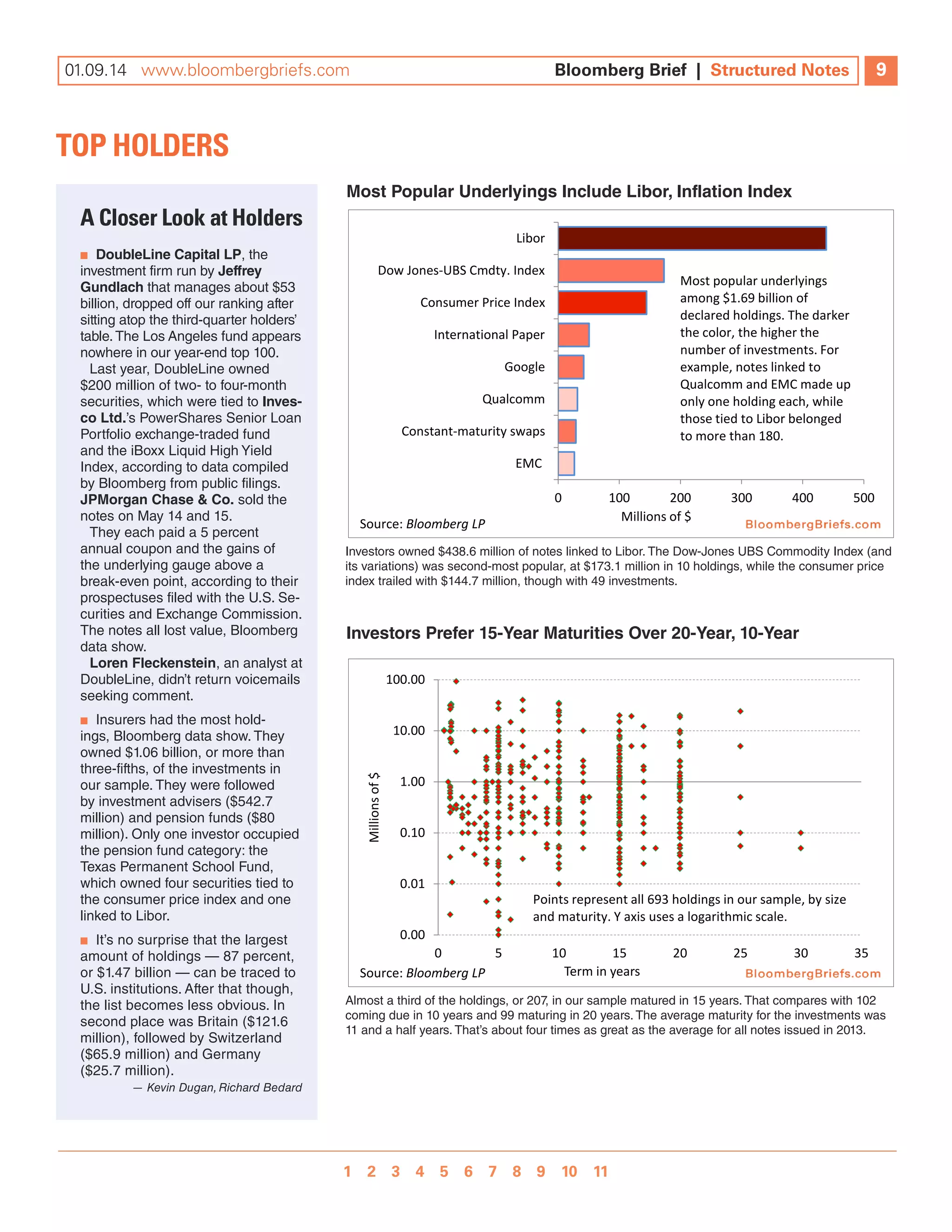
Most Popular Underlyings Include Libor, Inflation Index

A Closer Look at Holders
DoubleLine Capital LP, the
investment firm run by Jeffrey
Gundlach that manages about $53
billion, dropped off our ranking after
sitting atop the third-quarter holders’
table. The Los Angeles fund appears
nowhere in our year-end top 100.
Last year, DoubleLine owned
$200 million of two- to four-month
securities, which were tied to Invesco Ltd.’s PowerShares Senior Loan
Portfolio exchange-traded fund
and the iBoxx Liquid High Yield
Index, according to data compiled
by Bloomberg from public filings.
JPMorgan Chase & Co. sold the
notes on May 14 and 15.
They each paid a 5 percent
annual coupon and the gains of
the underlying gauge above a
break-even point, according to their
prospectuses filed with the U.S. Securities and Exchange Commission.
The notes all lost value, Bloomberg
data show.
Loren Fleckenstein, an analyst at
DoubleLine, didn’t return voicemails
seeking comment.

Libor

■■

Insurers had the most holdings, Bloomberg data show. They
owned $1.06 billion, or more than
three-fifths, of the investments in
our sample. They were followed
by investment advisers ($542.7
million) and pension funds ($80
million). Only one investor occupied
the pension fund category: the
Texas Permanent School Fund,
which owned four securities tied to
the consumer price index and one
linked to Libor.

Dow Jones-UBS Cmdty. Index
Consumer Price Index
International Paper
Google
Qualcomm
Constant-maturity swaps
EMC
0
Source: Bloomberg LP

It’s no surprise that the largest
amount of holdings — 87 percent,
or $1.47 billion — can be traced to
U.S. institutions. After that though,
the list becomes less obvious. In
second place was Britain ($121.6
million), followed by Switzerland
($65.9 million) and Germany
($25.7 million).

100
200
Millions of $

300

400

500

Investors owned $438.6 million of notes linked to Libor. The Dow-Jones UBS Commodity Index (and
its variations) was second-most popular, at $173.1 million in 10 holdings, while the consumer price
index trailed with $144.7 million, though with 49 investments.

Investors Prefer 15-Year Maturities Over 20-Year, 10-Year
100.00

■■

■■

Most popular underlyings
among $1.69 billion of
declared holdings. The darker
the color, the higher the
number of investments. For
example, notes linked to
Qualcomm and EMC made up
only one holding each, while
those tied to Libor belonged
to more than 180.

Millions of $

10.00
1.00
0.10
0.01

Points represent all 693 holdings in our sample, by size
and maturity. Y axis uses a logarithmic scale.

0.00
0
5
Source: Bloomberg LP

10
15
Term in years

20

25

30

35

Almost a third of the holdings, or 207, in our sample matured in 15 years. That compares with 102
coming due in 10 years and 99 maturing in 20 years. The average maturity for the investments was
11 and a half years. That’s about four times as great as the average for all notes issued in 2013.

— Kevin Dugan, Richard Bedard

 1 2 3 4 5 6 7 8 9 10 11 
01.09.14 www.bloombergbriefs.com	

10

Bloomberg Brief | Structured Notes

U.S. Rankings by asset class
All Asset Classes

Interest Rate-Linked
2013

Sec-registered
structured Note issuers*
Bank of America
JPMorgan
Barclays
Morgan Stanley
Goldman Sachs
HSBC
RBC
Credit Suisse
UBS
Deutsche Bank
Citigroup
Wells Fargo
Scotiabank
Toyota
SEK
BMO
Lloyds
SunTrust
Nomura
CIBC
TOTAL (Jan. 1 to Dec. 31, 2013)

Rank
⬆
⬆
⬇
⬇
⬆
⬇
⬇

⬆
⬆
⬇
⬇
⬆
⬆
⬆
⬆

2012
Rank

market
share

1
2
3
4
5
6
7
8
9
10
11
12
13
14
15
16
17
18
19
20
20

1
4
3
8
2
5
7
10
6
9
11
12
17
16
13
15
18
19
—
—
21

15.6%
11.7%
11.0%
10.5%
9.3%
7.8%
7.6%
6.6%
5.9%
3.8%
3.8%
1.7%
1.5%
1.2%
1.0%
0.8%
0.2%
0.1%
0.0%
0.0%
100.0%

volume
usd
(MLN)
6,328.2
4,721.7
4,470.0
4,249.5
3,785.7
3,155.5
3,059.7
2,655.4
2,381.6
1,553.9
1,528.2
683.1
595.4
495.5
405.5
323.2
60.9
36.0
10.0
3.3
40,502.2

Equity-Linked

1

1

20.8%

volume
usd
(MLN)
989.8

Morgan Stanley

⬆

2

6

11.9%

564.1

RBC

⬆

3

5

10.8%

511.6

Toyota

⬆

4

9

10.4%

495.5

Barclays

⬇

5

3

10.2%

482.7

Citigroup

⬆

6

10

9.9%

471.9

JPMorgan

⬆

7

8

9.6%

457.9

Wells Fargo

⬇

8

7

6.0%

285.2

Scotiabank

⬆

9

16

3.4%

163.4

HSBC

⬆

10

11

2.3%

110.7

Bank of America

⬇

11

2

2.0%

97.1

Lloyds

12

12

0.9%

40.9

SunTrust

13

13

0.8%

36.0

Rank

Goldman Sachs

2012
Rank

market
share

Deutsche Bank

⬆

14

18

0.5%

26.1

Nomura

⬆

15

—

0.2%

10.0

BMO

⬆

16

17

0.1%

5.4

Credit Suisse

⬆

17

—

0.1%

2.6

17

18

100.0%

4,750.9

TOTAL (Jan. 1 to Dec. 31, 2013)

Commodity-Linked
2013

Sec-registered
structured Note issuers*

1

1

19.4%

volume
usd
(MLN)
5,911.5

Barclays

⬆

2

6

11.0%

3,348.5

Morgan Stanley

⬆

3

7

10.8%

3,302.9

4

4

10.0%

3,049.4

3

8.9%

Rank

Bank of America

JPMorgan

2012
Rank

market
share

market
share

volume
usd
(MLN)

1

Barclays

2012
Rank
1

27.4%

363.5

2

8

14.5%

192.7

Bank of America

⬇

3

2

13.5%

179.2

2,716.7

Deutsche Bank

⬇

4

3

11.4%

150.9

Morgan Stanley

⬆

5

9

7.8%

104.2

6

6

7.8%

103.0

5

Goldman Sachs

⬇

6

2

8.1%

2,468.0

Credit Suisse

⬆

7

10

7.8%

2,365.1

8

8

6.7%

2,029.0

Goldman Sachs
SEK

⬇

7

4

5.5%

73.0

UBS

⬇

8

7

5.0%

66.3

781.8

Citigroup

⬆

9

10

3.5%

46.9

430.6

HSBC

⬇

10

5

2.2%

29.3

RBC

11

11

0.7%

9.6

316.7

Credit Suisse

12

12

0.5%

6.4

0.0%

3.3

Wells Fargo

13

13

0.2%

2.7

100.0%

30,498.4

tOTAL (Jan. 1 to Dec. 31, 2013)

13

14

100.0%

1,327.5

UBS

⬇

9

5

6.6%

2,003.3

Deutsche Bank

⬇

10

9

3.4%

1,048.1

11

11

2.6%

Scotiabank

⬆

12

15

1.4%

Wells Fargo

⬇

13

12

1.3%

395.3

SEK

⬇

14

13

1.1%

328.2

BMO

⬇

15

14

1.0%

CIBC

⬆

16

—

16

16

Citigroup

Rank

⬆

⬇

RBC

2013

Sec-registered
structured Note issuers*

JPMorgan

HSBC

TOTAL (Jan. 1 to Dec. 31, 2013)

2013

Sec-registered
structured Note issuers*

* Based on data compiled by Bloomberg from SEC filings.

 1 2 3 4 5 6 7 8 9 10 11 
01.09.14 www.bloombergbriefs.com	

Bloomberg Brief | Structured Notes

11

european Rankings by asset class
All Asset Classes

Interest Rate-Linked
2013
Rank

structured Note issuers*
DZ Bank AG
LBBW
Societe Generale SA
Deutsche Bank AG
Credit Agricole Groupe
Nordea Bank AB
Barclays PLC
BayernLB Holdings AG
Standard Chartered PLC
BNP Paribas SA
Sparkassen- und Giroverband
Porsche Automobil Holding SE
HSBC Holdings PLC
WGZ Beteiligungs GmbH
JPMorgan Chase & Co
Mediobanca SpA
Credit Suisse Group AG
DekaBank Deutsche Giroz.
ING Groep NV
Cassa Depositi e Prestiti
TOTAL (Jan. 1 to Dec. 31, 2013)

⬆
⬆
⬇
⬆
⬆
⬆
⬆
⬆
⬆
⬆
⬆
⬆
⬆
⬆
⬇
⬆
⬇
⬆

2012
Rank

market
share

1
2
3
4
5
6
7
8
9
10
11
12
13
14
15
16
17
18
19
20
120

1
4
5
2
12
19
7
39
10
13
69
—
17
26
23
42
9
88
8
76
118

28.9%
8.9%
7.5%
7.4%
2.6%
2.6%
2.4%
2.2%
2.1%
1.9%
1.9%
1.7%
1.6%
1.6%
1.6%
1.4%
1.4%
1.2%
1.2%
1.1%
100.0%

2013
volume
usd
(MLN)
17,330.55
5,307.55
4,481.18
4,457.31
1,565.39
1,554.03
1,437.72
1,332.49
1,275.45
1,164.27
1,109.21
993.08
968.59
944.15
933.31
859.24
836.49
734.30
703.59
687.09
59,924.52

Credit-Linked

structured Note issuers*
DZ Bank AG
Deutsche Bank AG
Sparkassen- und Giroverband
Porsche Automobil Holding SE
WGZ Beteiligungs GmbH
Societe Generale SA
Cassa Depositi e Prestiti SpA
Barclays PLC
Credit Agricole Groupe
Intesa Sanpaolo SpA
Muenchener Hypothekenbank
HSBC Holdings PLC
HSH Finanzfonds AoeR
BNP Paribas SA
Goldman Sachs Group Inc.
Standard Chartered PLC
ING Groep NV
Banque et Caisse d'Epargne
Kommunekredit
BayernLB Holdings AG
TOTAL (Jan. 1 to Dec. 31, 2013)

Rank

⬆
⬆
⬆
⬇
⬆
⬆
⬆
⬇
⬆
⬆
⬇
⬇
⬆
⬆
⬇
⬆
⬆
⬆

2012
Rank

market
share

1
2
3
4
5
6
7
8
9
10
11
12
13
14
15
16
17
18
19
20
69

1
2
63
—
13
5
—
19
29
3
35
52
8
6
76
61
10
56
—
21
82

27.5%
6.6%
6.1%
5.7%
5.4%
5.3%
3.9%
3.9%
3.4%
2.9%
2.7%
2.6%
1.7%
1.7%
1.6%
1.5%
1.4%
0.9%
0.9%
0.7%
100.0%

Inflation-Linked
2013
Rank

structured Note issuers*
DZ Bank AG
LBBW
Societe Generale SA
Deutsche Bank AG
Nordea Bank AB
Standard Chartered PLC
JPMorgan Chase & Co
BNP Paribas SA
DekaBank Deutsche Giroz.
Barclays PLC
Credit Suisse Group AG
UniCredit SpA
Landessparkasse zu Olden.
Credit Agricole Groupe
ING Groep NV
HSBC Holdings PLC
VIS Finance SA
Erste Group Bank AG
Skandinaviska Enskilda Banken
Banco Espirito Santo SA
TOTAL (Jan. 1 to Dec. 31, 2013)

volume
usd
(MLN)
4,796.43
1,154.27
1,063.96
993.08
944.15
932.17
687.09
674.48
600.49
503.37
466.38
454.18
298.21
290.58
278.93
253.01
251.05
164.28
150.00
130.64
17,425.34

⬆
⬆
⬆
⬆
⬆
⬇
⬇
⬇
⬆
⬆
⬇
⬇
⬆
⬇
⬆
⬆

2012
Rank

market
share

1
2
3
4
5
6
7
8
9
10
11
12
13
14
15
16
17
18
19
20
63

1
2
9
4
13
6
16
19
43
5
7
8
—
18
10
15
23
11
20
22
54

36.8%
14.9%
8.2%
5.8%
4.6%
2.7%
2.5%
2.0%
2.0%
1.9%
1.8%
1.6%
1.5%
1.5%
1.3%
1.3%
1.2%
0.8%
0.7%
0.7%
100.0%

2013
volume
usd
(MLN)
12,467.51
5,030.79
2,765.21
1,950.03
1,554.03
924.37
848.86
693.16
667.88
642.00
598.54
553.38
522.18
496.60
452.55
449.74
411.52
259.32
248.39
238.56
33,871.25

Rank

structured Note issuers*
Raiffeisen Landesbanken
Mediobanca SpA
LBBW
Societe Generale SA
BayernLB Holdings AG
HSH Finanzfonds AoeR
Deutsche Bank AG
BNP Paribas SA
Enel SpA
Junta de Extremadura
Sparkassen- und Giroverband
Van Lanschot NV
Banco Santander SA
UK Financial Investments Ltd
Credit Mutuel-CIC Group
Credit Agricole Groupe
Banque et Caisse d'Epargne
Volksbanken Holding eingetrag.
Nordea Bank AB
KBC Groep NV
TOTAL (Jan. 1 to Dec. 31, 2013)

* Based on data compiled by Bloomberg that excludes variable-principal redemption notes.

 1 2 3 4 5 6 7 8 9 10 11 

⬆
⬆
⬆
⬇
⬆
⬆
⬇
⬆
⬇
⬆
⬆
⬆
⬆
⬆
⬇
⬆
⬆
⬇
⬇

2012
Rank

market
share

1
2
3
4
5
6
7
8
9
10
11
12
13
14
15
16
17
18
19
20
21

2
11
6
3
—
8
5
13
7
—
16
23
20
14
—
4
—
27
15
17
34

18.2%
18.1%
15.9%
8.7%
8.2%
6.3%
5.1%
4.7%
4.0%
2.5%
2.0%
1.5%
1.2%
1.0%
0.8%
0.8%
0.4%
0.2%
0.2%
0.1%
100.0%

volume
usd
(MLN)
295.62
294.27
258.87
140.67
133.06
102.36
83.25
76.65
64.49
41.33
32.34
24.64
20.00
16.28
13.00
12.28
6.65
3.99
2.65
1.37
1,624.22

Structured Notes 2013 Year End Review

  • 1.
  • 2.
    01.09.14 www.bloombergbriefs.com Bloomberg Brief| Structured Notes 2 year in review By Richard Bedard The story of 2013 that had the biggest impact can’t be pinned to a time, place or person. Rather, it was the steady and seemingly inexorable rise in major stock markets around the globe. Plenty of structured note investors gladly went along for the ride: They bought one-year autocallables tied to everything from U.S. Steel Corp. to Lululemon Athletica Inc., 20year securities that pay monthly coupons if major stock indexes don’t plummet, and a variety of other products. The stock gains helped take the sting out of other not-so-favorable trends. Interest rates began the year near record lows. Volatility was subdued, with the VIX Index in 2013 about 50 percent below its long-term average. Bank risk improved, reducing funding costs. Thus issuers found themselves squeezed in trying to create alluring terms on notes, whether in coupons or buffers or leveraged gains. They still found ways to wring out yield, such as by pushing out maturities. About 5 percent of U.S. equity-tied notes had maturities of 10 years or longer, compared with less than 2 percent in 2012. Banks also turned to selling notes that tracked baskets of stocks, with returns based on the worst performer. By July, issuance of such “worst of” securities had almost doubled from the year before. Apart from equity-tied notes, the issuance picture was generally grim. Ratelinked sales dropped — who wanted to get caught on the wrong side of the Fed’s eventual withdrawal from monetary easing? Commodity-tied notes fared badly, as the price of grains and precious metals tumbled. Globally, there were also declines in the volume of securities linked to credit and inflation. Beyond the ebb and flow of sales numbers, regulatory issues again weighed on the industry. In the U.S., banks complied Contents OUTLOOK Industry executives share their opinions on 2013’s biggest story and try to predict what’s in store this year. Page 3 top 10 stories A look at the 10 biggest stories that appeared on the newsletter’s front pages last year. Page 4 asset class breakdown While other note categories lost market share, investors couldn’t seem to get enough securities linked to stocks. Page 5 top 10 notes The year’s largest notes were tied to Libor, constant-maturity swaps and the Dow Jones with the Securities and Exchange Commission’s request that they begin disclosing the initial value of their securities. That allowed investors, for the first time ever, to see exactly what that $1,000 note they just bought was worth at the moment it changed hands. In Europe, regulators considered similar measures, as they also pushed for greater transparency. The International Organization of Securities Commissions published a report in April containing proposals that aimed to improve sales practices and disclosures. In the end, some banks decided issuing structured notes wasn’t worth it. Rabobank Groep closed its equity derivatives unit in March and Royal Bank of Scotland Group Plc announced in June it was shuttering its structured products business. Bloomberg Brief Structured Notes Industrial Average. Page 5 monthly sales trends While global sales dropped to the lowest in a decade, in the U.S., equity-linked volume pushed last year’s issuance above 2012’s. Page 6 noteworthy images What would a structured note prospectus look like, distilled to one image? Take a look. Page 7 Quiz Six structured notes, with four different valuations for each. Can you guess which is correct? Page 7 top 100 U.S. note holders The 100-biggest holders of the largest structured notes that have been issued in the U.S. since 2010. Page 8 a closer look at holders An in-depth look at who holds the U.S. structured notes in our sample and which underlyings and maturities they prefer. Page 9 rankings by asset class Our tables rank issuers in Europe and the U.S., showing who climbed a few rungs from 2012 and who dropped a few. Pages 10, 11 A GUIDE TO OUR DATA * U.S. notes are securities issued in the U.S. that are registered with the SEC. ** Global notes exclude U.S. securities and also “variable-principal redemption” notes, such as reverse convertibles. *** European notes are issued in Europe and exclude “variable-principal redemption” notes, such as reverse convertibles. Quiz answers from page 7: 1.(a) 2.(d) 3.(a) 4.(c) 5.(b) 6.(d)  1 2 3 4 5 6 7 8 9 10 11  Newsletter Ted Merz Executive Editor tmerz@bloomberg.net 212-617-2309 Bloomberg News Robert Burgess Managing Editor bburgess@bloomberg.net 212-617-2945 Structured Notes Richard Bedard Newsletter Editor rbedard2@bloomberg.net 212-617-8761 Reporters Alastair Marsh amarsh25@bloomberg.net +44-203-525-8767 Kevin Dugan kdugan4@bloomberg.net 212-617-2035 Newsletter Nick Ferris Business Manager nferris2@bloomberg.net 212-617-6975 Advertising Jeff Maniatty jmaniatty@bloomberg.net +1-203-550-2446 Reprints & Lori Husted Permissions lori.husted@theygsgroup.com 717-505-9701 To subscribe via the Bloomberg Terminal type BRIEF <GO> or on the web at www.bloombergbriefs.com. © 2014 Bloomberg LP All rights reserved. . This newsletter and its contents may not be forwarded or redistributed without the prior consent of Bloomberg. Please contact our reprints and permissions group listed above for more information.
  • 3.
    01.09.14 www.bloombergbriefs.com Bloomberg Brief| Structured Notes 3 outlook What was this year’s biggest story? What do you think will be the biggest surprise of 2014? U.S. Serge Troyanovsky, managing director and head of retail distribution in North America BNP Paribas SA A: The biggest story of 2013 is the performance of equity markets. We saw many structured products follow the lead. In addition, we have also seen a change in focus from income-generating structures to more growthoriented. This is reflective of the more bullish outlook on the equity markets. I think that the biggest surprise in 2014 will be investors buying more notes that use bespoke strategies, that come from a research-based basket of equities, or a dynamic index designed to adjust its exposure based on market conditions. Tom Layton, director of structured products Raymond James & Associates Inc. A: The biggest story for our clients has been the shift to a rising interest rate environment. The dramatic interest rate move in May and June caused investors to re-think fixed-income allocations. Our firm has positioned certain structured products as an attractive alternative. It’s tough to say what would be the biggest surprise, but we feel investors have put less attention on credit risk over the past year as equity markets rallied. If rates rise quickly and/or equities pull back, we could see focus quickly shift to mitigating both credit and market-related risk. Mathias Strasser, chief executive officer WallStreetDocs Ltd. A: From an automation perspective, we’ve seen issuers focusing to streamline the offering process. This trend continues to be driven by cost pressures and regulatory requirements. For 2014, I expect further convergence in regulatory requirements between Europe and the United States. I also expect that the fast-growing use of mobile devices will be felt in the structured products space. This will affect the way investors access information about structured products and how deals are marketed. EUROPE Marc El Asmar, global head of sales in cross-asset solutions Societe Generale SA A: 2013 was a good year for structured products, particularly for listed products and credit-linked products. Basically, anything with a coupon was well received. People were looking for yield. Next year the focus will be on rising rates, on when and by how much they will go up. Investors will be looking for products to hedge or take advantage of that. Keep an eye on longevity-based trades [longevity bonds pay a coupon based on “survivorship” of a population group], as we expect see more of that. Shane Edwards, global head of equities structuring UBS AG A: 2013 will be regarded as a great year for equities. Japan was the standout market in terms of returns and international attention. Also interesting: the pronounced outperformance of developed versus emerging market equities. In 2014, we expect a continuation in demand for yield products, but a preference for floating-rate coupons rather than fixed-income. We may see demand increase for growth-oriented products, if the momentum in equities and economic recovery continues. Josef Mehkri, head of institutional and private banking sales SEB AB A: We saw investors move away from a focus only on credit to look at more equity products as they wanted to benefit from the rally in equities. There is a lot less juice left in credit as spreads have tightened. European high yield has tightened a lot; some banks predict it could come in by a further 100 basis points. Next year, an increase in rates driven by the Fed could be a double-edged sword. Investors in existing notes will suffer mark-tomarket losses, while higher rates will allow new notes to be issued with more attractive coupons.  1 2 3 4 5 6 7 8 9 10 11 
  • 4.
    01.09.14 www.bloombergbriefs.com TOP 10STORIES To view interactive feature click Bloomberg Brief | Structured Notes 4 below. We took a look at all our front pages from 2013 and selected what we thought were the 10 stories that best captured the trends and issues for the year. 1) EQUITY NOTE SALES SIGNAL POSSIBLE “GREAT ROTATION” Bullishness about stocks, and losses on bonds, made equity-tied notes the year’s biggest bet. In the U.S., such securities (including reverse convertibles) accounted for almost four-fifths of all issuance. 2) FIXED-INCOME FLIGHT SENDS SALES TO 11-YEAR LOW Sales of rate-tied products were poor all year long. For one, the low interest rate environment made coupons on the securities unappealing. Also the possibility that rates would soon start to rise damped enthusiasm for fixed-income notes. 3) LOWEST VOLATILITY SINCE 2007 REDUCES NOTE RETURNS Low volatility bedeviled investors seeking high coupons on structured notes. The VIX Index averaged less than 15 for the year and ended above 20 on only three days, in June and October. 4) LIBOR-TIED NOTE SALES JUMP ON EXPECTED RATE RISE The Federal Reserve’s plans for the stimulus taper – when would it begin and by how much?– kept investors guessing for much of the year. Note buyers responded by purchasing more products tied to Libor where coupons would adjust when rates climbed. 5) INVESTORS SEEK LONGER MATURITIES TO BOOST YIELDS Low interest rates, declining funding costs for banks and less stock volatility hurt note terms. One way issuers responded: they extended maturities to create some yield. 6) ETN ASSETS SURGE ON DIVIDENDS, HIGHER LIQUIDITY U.S. exchange-traded note holdings had soared about 34 percent by September, while structured note sales were down slightly at the time. Some investors favored ETNs for being more liquid and able to access stock dividends. 7) COMMODITY-TIED NOTE SALES SLUMP TO NINE-YEAR LOW Issuance of notes tied to commodities fell sharply. Gold and silver were victims of Fed Chairman Ben S. Bernanke’s plan to slow bond purchases, while other materials such as copper suffered as growth in China’s economy slowed.  1 2 3 4 5 6 7 8 9 10 11  8) U.S. NOTES TIED TO EURO STOXX 50 SURGE ON VOLATILITY Concern about Europe faded as investors took comfort in the European Central Bank president’s pledge to save the euro, whatever it took. Meanwhile the Euro Stoxx 50 Index’s volatility stayed higher than that for U.S. stock benchmarks, allowing issuers to create securities tied to the gauge that paid better returns. 9) GOLD PLUNGE RISKS LOSSES ON $1.1 BILLION OF NOTES A drop in the price of gold put in peril hundreds of millons of dollars of U.S. structured notes. The precious metal declined for the first time since 2000, when it was trading at less than $280 an ounce. 10) BUYERS SNAP UP NOTES TIED TO SINGLE STOCKS Among the signs in 2013 of growing risk appetite: Investors bought a higher percentage of notes tied to single stocks. The securities often had higher volatility than those linked to indexes, which meant issuers could offer more attractive features.
  • 5.
    01.09.14 www.bloombergbriefs.com Bloomberg Brief| Structured Notes 5 ASSET CLASS BREAKDOWN Equity-Tied Notes Soar in U.S. as Credit-Linked Drops Globally 2013 U.S. Other, 3.2% Other, 3.0% 2012 U.S. Hybrid, 2.5% Hybrid, 1.5% Reverse Convertible, 6.0% Commodity, 3.3% Reverse Convertible, 3.8% Commodity, 6.7% Equity, 75.3% Rates, 11.7% Equity, 64.3% Rates, 14.7% FX, 1.5% FX, 2.5% Source: Bloomberg LP Source: Bloomberg LP Investors had a huge appetite for notes linked to stocks, while most other categories shrank. Commodity-tied fell by half, to 3.3 percent. Sales were better distributed in 2012, with four categories over $2 billion (equity, rates, commodity, reverse convertibles), compared to two in 2013. 2012 Global 2013 Global Inflation, 2.4% Other, 8.8% Credit, 55.2% Other, 3.0% Rates, 35.0% Inflation, 2.8% Credit, 53.8% Rates, 39.0% Source: Bloomberg LP Source: Bloomberg LP Market share dipped for notes in three major categories. On an absolute basis, credit-tied dropped 15 percent to $38 billion. Top 10 U.S. Notes iSSUER Bank of America Morgan Stanley Toyota JPMorgan Bank of America Bank of America BMO Morgan Stanley Credit Suisse Bank of America DESCRIPTION 5 yr., tied to Dow Jones Industrial Average 2 yr., fixed to floating rate 18 mo., fixed to floating rate 5 yr., tied to JPMorgan commodity index 3 yr., tied to Euro Stoxx 50 Index 3 yr., tied to Euro Stoxx 50 Index 1 yr., tied to Raymond James stock picks 3 yr., fixed to floating rate 1 yr., tied to Hang Seng China Enter. Index 5 yr., tied to Dow Jones Industrial Average AMT. (MLN $) 284.5 250.0 250.0 239.7 229.8 196.4 185.0 175.0 171.4 166.3 Source: Bloomberg LP The rate-tied and credit-linked categories combined made up almost 95 percent of volume in 2012. Top 10 Global Notes (Outside U.S.) ISSUER Volkswagen Intl. Fin. NV Cassa Depositi Prestiti Palladium Securities 1 SA Landessparkas Olden. MAF Global Securities Banca IMI SpA Mediobanca SpA Cie Financement Foncier Mediobanca SpA Palladium Securities 1 SA DESCRIPTION Perpetual, fixed to floating rate over CMS 10 yr., floating rate over CMS 10 yr., tied to CMS with cap, floor 4 yr., credit-linked note also tied to Euribor Perpetual, fixed to floating rate over CMS 4 yr., fixed to digital coupon tied to Euribor 6 yr., fixed to digital coupon tied to Euro Stoxx 50 20 yr., fixed to CMS rate with cap 5.5 yr., fixed to floating rate over Italy's CPI 6.5 yr., tied to CMS with cap, floor Source: Bloomberg LP  1 2 3 4 5 6 7 8 9 10 11  AMT. (mln $) 993.1 687.1 655.6 506.9 500.0 392.8 270.4 269.5 261.9 257.6
  • 6.
    01.09.14 www.bloombergbriefs.com 6 Bloomberg Brief| Structured Notes monthly sales trends U.S. Sales Recover After Sagging in Mid-Year Sales (left) 4.5 Offerings (right) 4.0 3.5 1000 900 800 3.91 3.67 3.39 3.0 2.5 3.66 3.05 3.05 3.01 3.48 3.44 3.29 3.38 700 600 2.91 500 2.0 400 1.5 300 1.0 200 0.5 100 0.0 Number of Notes Sales proved steadier in 2013 than the year before, when issuance ranged from $2.19 billion in December to $4.54 billion in March. There were five months of less than $3 billion of volume in 2012; last year there was only one. The size of the typical deal crept higher: $4.9 million on average, up from $4.79 million in 2012, after declining from $6.27 million in 2011. 5.0 Billions of $ Issuance in the U.S. started out the year strong, then immediately began to slide. Sales in April, June and July barely eclipsed $3 billion for each month. Then the rebound got under way, propelled by a large amount of stock-tied sales: $2.87 million in August, or more than 82 percent of the overall. 0 Jan. Feb. Mar. April May June July Aug. Sept. Oct. Nov. Dec. Source: Bloomberg LP Global Sales Decline Throughout Year DZ Bank AG was one of the few major issuers that gained sales, climbing to $18.1 billion from $17.1 billion, making the German bank No. 1 again. Those that fell included Deutsche Bank AG, UBS AG and Credit Suisse Group AG. 10 8 7 6 5 4 Sales (left) Offerings (right) 8.86 400 350 300 7.75 7.59 6.52 6.05 250 5.86 200 5.55 4.85 4.81 3 4.02 4.73 150 3.57 2 100 1 50 0 0 Jan. Feb. Mar. April May June July Aug. Sept. Oct. Nov. Dec. Source: Bloomberg LP  1 2 3 4 5 6 7 8 9 10 11  Number of Notes 9 Billions of $ Global issuance, which excludes the U.S. and equity-linked notes, ticked lower almost every month, ending the year at $70.6 billion, the lowest since 2002. A jump to $7.59 billion in May turned out to be no more than a “false spring,” as sales resumed their decline in June. The $4.03 billion of volume in September was less than half the sales of the same month in 2008 — a time when Lehman Brothers Holdings Inc. went bankrupt and the financial system appeared to be coming apart — and the worst September since 2002.
  • 7.
    01.09.14 www.bloombergbriefs.com Bloomberg Brief| Structured Notes 7 noteworthy images A Structured Note Prospectus Made Visual We decided to distill the essence of a typical prospectus — with all its explanations, definitions, examples and risk warnings — into one simple word cloud. Below is what the offering document for Credit Suisse AG’s $4.44 million of leveraged buffered notes tied to the MSCI EAFE Index, sold on Nov. 15, looks like. QUIZ answers on pg 2. Banks now disclose the inital value for their U.S. structured notes. Can you guess how much each of the following was worth in cents on the dollar? I’m a 12-year callable range accrual, tied to Libor and the S&P 500, paying up to 7.4% annually, and sold in August 2012 by Goldman Sachs. a) 88.0 I’m a 2-year note paying 19.5% or more if the rupee gains against the dollar, with 10% of principal at risk, sold by Bank of America in January. a) 92.0 I’m a 3-month reverse convertible, tied to Apollo Group, with a 15.5% annual coupon and 20% buffer, sold by JPMorgan in May. a) 96.2 I’m a 9-year callable range accrual tied to Libor and the Russell 2000, paying up to 7.7% annually, and sold in May by Citigroup. a) 82.2 I’m a 5-year autocallable tied to Ford with a 7.5% annual contingent coupon and 33% buffer, sold in May by Barclays. a) 97.2 I’m a 1-year autocallable tied to the S&P 500, paying up to 7.56% annually, with no buffer, sold in April by Royal Bank of Canada. a) 90.2 b) 91.4 b) 85.0 b) 98.8 b) 96.9 b) 94.5 d) 95.6 c) 98.6 c) 99.4 c) 90.9 c) 90.9 c) 88.7 c) 96.7 d) 97.3 d) 97.0 d) 97.1 d) 93.8 d) 95.5 d) 98.0 1 23456  1 2 3 4 5 6 7 8 9 10 11 
  • 8.
    01.09.14 www.bloombergbriefs.com Bloomberg Brief| Structured Notes 8 top 100 declared holders of largest u.s notes We looked at who owns the largest U.S. SEC-registered structured notes, according to the most recent public filings. We examined the 1,000 biggest notes for each year from 2010 to 2013. We found $1.69 billion of declared holdings for 353 securities. The holdings in the table below are based on notional amounts of the securities, not current values. The last column shows the number of different securities owned. Note: Because of data limitations, some figures may not be exact. To view interactive feature click below. name Auto Owners Group FMR LLC Woodmen World Life Ins. Soc. Alfa Ins. Grp. Prudential of America Group Texas Permanent School Fund Wellesley Investment Advisors Credit Suisse AG Allianz Global Investors CareSource American Equity Invest. Life Ins. State Auto Property & Casualty Waddell & Reed Financial Inc. Mercury General Group American National Insurance Comp. Protective Life Insurance Group Principal Financial Group Inc. Toa Reinsurance Co. of America Valic Co. Berkley Ins. Co. EMC Insurance Company Group Miller Investment Trust Highmark Group AIC Holdings Group Citizens Group Kentucky Farm Bureau Group BCBS of Alabama Group Federated Investors Inc. Oppenheimerfunds Incorporated Allianz Asset Management AG Brinton Eaton Associates Inc. Modern Woodmen of Amer. Nationwide Fund Advisors MGIC Group Statistical Science Incorporated EMC Natl. Life Co. Landesbank Berlin Investment GMB Country Ins. & Fin. Svc. Group Portfolio Strategies Inc. IAT Reinsurance Company Group Arbella Insurance Group Deutsche Bank AG Greek Catholic Union of the USA Mackenzie Financial Corporation Berkley Regional Insurance Co. BSI SA Government Personnel Mutual Life Huntington Trust Company Goldman Sachs Group Inc. Donegal Group holdings ($) 159,600,000 120,000,000 120,000,000 101,725,000 93,000,000 80,000,000 67,243,000 65,900,000 61,337,483 60,500,000 38,500,000 37,300,000 35,300,000 32,798,000 25,000,000 24,000,000 23,940,000 21,500,000 20,753,000 20,000,000 18,000,000 17,000,000 16,486,000 14,607,000 13,250,000 13,000,000 11,750,000 10,321,424 10,273,061 10,000,000 10,000,000 10,000,000 9,800,000 9,700,000 9,582,000 9,000,000 8,650,000 8,227,000 8,000,000 7,868,000 7,000,000 7,000,000 6,500,000 6,268,000 5,000,000 5,000,000 5,000,000 5,000,000 4,195,000 4,127,000 # of notes 7 9 8 13 1 5 2 2 8 13 2 6 1 9 3 1 3 11 9 2 3 2 15 8 3 4 7 2 2 1 1 1 1 4 1 3 3 5 1 5 2 1 7 1 2 1 3 2 2 3 name Charter Insurance Group FFVA Mutual Insurance Company Grange Mutual Casualty Group Mairs & Power Incorporated Mutual of Omaha Group Franklin Resources Investors Capital Advisory Svcs. Tricadia Holdings Group Physicians Professional Liab. RRG Pax World Management LLC First American Title Group Ameriprime Funds American National Financial Group Ameritas Mutual Holding Group GuideOne Insurance Group Marysville Mutual Insurance Co. Meridian Security Insurance Co. City National Bank Catholic Order of Foresters Guard Insurance Co. Group ProAssurance Ind. Co. Inc. Rockhill Ins Co. SPJST Van Enterprises Group Western Fraternal Life Assoc. National Farm Life Insurance Co. Sons of Norway American Eqty. Investment Life Texas Farm Bureau Mutual Group Viva Health Inc. Physicians Reciprocal Insurers Amerco Corporation Group Everett Mutual Group Thompson Investment Management Countrywide Ins. Co. EMC Reinsurance Company Grinnell Mutual Group North Star Company Group WesBanco Trust & Investments Pioneer Western National Mutual Group Florida Peninsula Ins. Co. Zazove Associates LLC Indiana Farm Bureau Group RLI Insurance Group Pilco Cos. Group Premier Fund Managers Ltd. Florida Family Ins. Co. Guaranty Income Life Insurance Transamerica Investment Services Source: Bloomberg LP  1 2 3 4 5 6 7 8 9 10 11  holdings ($) 4,100,000 4,000,000 4,000,000 4,000,000 4,000,000 3,950,000 3,697,000 3,650,000 3,295,000 3,177,000 3,100,000 3,098,000 3,000,000 3,000,000 3,000,000 3,000,000 2,650,000 2,505,000 2,500,000 2,500,000 2,500,000 2,500,000 2,500,000 2,500,000 2,500,000 2,375,000 2,300,000 2,250,000 2,250,000 2,210,000 2,200,000 2,190,000 2,100,000 2,045,000 2,000,000 2,000,000 2,000,000 2,000,000 2,000,000 1,995,000 1,850,000 1,760,000 1,760,000 1,700,000 1,700,000 1,550,000 1,550,000 1,500,000 1,500,000 1,500,000 # of notes 18 6 3 6 1 2 2 11 3 2 2 5 1 1 2 22 2 2 5 3 2 1 3 3 3 5 3 2 4 3 5 2 5 6 1 1 3 2 3 5 2 1 1 1 1 1 1 3 3 1
  • 9.
    01.09.14 www.bloombergbriefs.com 9 Bloomberg Brief| Structured Notes Top holders Most Popular Underlyings Include Libor, Inflation Index A Closer Look at Holders DoubleLine Capital LP, the investment firm run by Jeffrey Gundlach that manages about $53 billion, dropped off our ranking after sitting atop the third-quarter holders’ table. The Los Angeles fund appears nowhere in our year-end top 100. Last year, DoubleLine owned $200 million of two- to four-month securities, which were tied to Invesco Ltd.’s PowerShares Senior Loan Portfolio exchange-traded fund and the iBoxx Liquid High Yield Index, according to data compiled by Bloomberg from public filings. JPMorgan Chase & Co. sold the notes on May 14 and 15. They each paid a 5 percent annual coupon and the gains of the underlying gauge above a break-even point, according to their prospectuses filed with the U.S. Securities and Exchange Commission. The notes all lost value, Bloomberg data show. Loren Fleckenstein, an analyst at DoubleLine, didn’t return voicemails seeking comment. Libor ■■ Insurers had the most holdings, Bloomberg data show. They owned $1.06 billion, or more than three-fifths, of the investments in our sample. They were followed by investment advisers ($542.7 million) and pension funds ($80 million). Only one investor occupied the pension fund category: the Texas Permanent School Fund, which owned four securities tied to the consumer price index and one linked to Libor. Dow Jones-UBS Cmdty. Index Consumer Price Index International Paper Google Qualcomm Constant-maturity swaps EMC 0 Source: Bloomberg LP It’s no surprise that the largest amount of holdings — 87 percent, or $1.47 billion — can be traced to U.S. institutions. After that though, the list becomes less obvious. In second place was Britain ($121.6 million), followed by Switzerland ($65.9 million) and Germany ($25.7 million). 100 200 Millions of $ 300 400 500 Investors owned $438.6 million of notes linked to Libor. The Dow-Jones UBS Commodity Index (and its variations) was second-most popular, at $173.1 million in 10 holdings, while the consumer price index trailed with $144.7 million, though with 49 investments. Investors Prefer 15-Year Maturities Over 20-Year, 10-Year 100.00 ■■ ■■ Most popular underlyings among $1.69 billion of declared holdings. The darker the color, the higher the number of investments. For example, notes linked to Qualcomm and EMC made up only one holding each, while those tied to Libor belonged to more than 180. Millions of $ 10.00 1.00 0.10 0.01 Points represent all 693 holdings in our sample, by size and maturity. Y axis uses a logarithmic scale. 0.00 0 5 Source: Bloomberg LP 10 15 Term in years 20 25 30 35 Almost a third of the holdings, or 207, in our sample matured in 15 years. That compares with 102 coming due in 10 years and 99 maturing in 20 years. The average maturity for the investments was 11 and a half years. That’s about four times as great as the average for all notes issued in 2013. — Kevin Dugan, Richard Bedard  1 2 3 4 5 6 7 8 9 10 11 
  • 10.
    01.09.14 www.bloombergbriefs.com 10 Bloomberg Brief| Structured Notes U.S. Rankings by asset class All Asset Classes Interest Rate-Linked 2013 Sec-registered structured Note issuers* Bank of America JPMorgan Barclays Morgan Stanley Goldman Sachs HSBC RBC Credit Suisse UBS Deutsche Bank Citigroup Wells Fargo Scotiabank Toyota SEK BMO Lloyds SunTrust Nomura CIBC TOTAL (Jan. 1 to Dec. 31, 2013) Rank ⬆ ⬆ ⬇ ⬇ ⬆ ⬇ ⬇ ⬆ ⬆ ⬇ ⬇ ⬆ ⬆ ⬆ ⬆ 2012 Rank market share 1 2 3 4 5 6 7 8 9 10 11 12 13 14 15 16 17 18 19 20 20 1 4 3 8 2 5 7 10 6 9 11 12 17 16 13 15 18 19 — — 21 15.6% 11.7% 11.0% 10.5% 9.3% 7.8% 7.6% 6.6% 5.9% 3.8% 3.8% 1.7% 1.5% 1.2% 1.0% 0.8% 0.2% 0.1% 0.0% 0.0% 100.0% volume usd (MLN) 6,328.2 4,721.7 4,470.0 4,249.5 3,785.7 3,155.5 3,059.7 2,655.4 2,381.6 1,553.9 1,528.2 683.1 595.4 495.5 405.5 323.2 60.9 36.0 10.0 3.3 40,502.2 Equity-Linked 1 1 20.8% volume usd (MLN) 989.8 Morgan Stanley ⬆ 2 6 11.9% 564.1 RBC ⬆ 3 5 10.8% 511.6 Toyota ⬆ 4 9 10.4% 495.5 Barclays ⬇ 5 3 10.2% 482.7 Citigroup ⬆ 6 10 9.9% 471.9 JPMorgan ⬆ 7 8 9.6% 457.9 Wells Fargo ⬇ 8 7 6.0% 285.2 Scotiabank ⬆ 9 16 3.4% 163.4 HSBC ⬆ 10 11 2.3% 110.7 Bank of America ⬇ 11 2 2.0% 97.1 Lloyds 12 12 0.9% 40.9 SunTrust 13 13 0.8% 36.0 Rank Goldman Sachs 2012 Rank market share Deutsche Bank ⬆ 14 18 0.5% 26.1 Nomura ⬆ 15 — 0.2% 10.0 BMO ⬆ 16 17 0.1% 5.4 Credit Suisse ⬆ 17 — 0.1% 2.6 17 18 100.0% 4,750.9 TOTAL (Jan. 1 to Dec. 31, 2013) Commodity-Linked 2013 Sec-registered structured Note issuers* 1 1 19.4% volume usd (MLN) 5,911.5 Barclays ⬆ 2 6 11.0% 3,348.5 Morgan Stanley ⬆ 3 7 10.8% 3,302.9 4 4 10.0% 3,049.4 3 8.9% Rank Bank of America JPMorgan 2012 Rank market share market share volume usd (MLN) 1 Barclays 2012 Rank 1 27.4% 363.5 2 8 14.5% 192.7 Bank of America ⬇ 3 2 13.5% 179.2 2,716.7 Deutsche Bank ⬇ 4 3 11.4% 150.9 Morgan Stanley ⬆ 5 9 7.8% 104.2 6 6 7.8% 103.0 5 Goldman Sachs ⬇ 6 2 8.1% 2,468.0 Credit Suisse ⬆ 7 10 7.8% 2,365.1 8 8 6.7% 2,029.0 Goldman Sachs SEK ⬇ 7 4 5.5% 73.0 UBS ⬇ 8 7 5.0% 66.3 781.8 Citigroup ⬆ 9 10 3.5% 46.9 430.6 HSBC ⬇ 10 5 2.2% 29.3 RBC 11 11 0.7% 9.6 316.7 Credit Suisse 12 12 0.5% 6.4 0.0% 3.3 Wells Fargo 13 13 0.2% 2.7 100.0% 30,498.4 tOTAL (Jan. 1 to Dec. 31, 2013) 13 14 100.0% 1,327.5 UBS ⬇ 9 5 6.6% 2,003.3 Deutsche Bank ⬇ 10 9 3.4% 1,048.1 11 11 2.6% Scotiabank ⬆ 12 15 1.4% Wells Fargo ⬇ 13 12 1.3% 395.3 SEK ⬇ 14 13 1.1% 328.2 BMO ⬇ 15 14 1.0% CIBC ⬆ 16 — 16 16 Citigroup Rank ⬆ ⬇ RBC 2013 Sec-registered structured Note issuers* JPMorgan HSBC TOTAL (Jan. 1 to Dec. 31, 2013) 2013 Sec-registered structured Note issuers* * Based on data compiled by Bloomberg from SEC filings.  1 2 3 4 5 6 7 8 9 10 11 
  • 11.
    01.09.14 www.bloombergbriefs.com Bloomberg Brief| Structured Notes 11 european Rankings by asset class All Asset Classes Interest Rate-Linked 2013 Rank structured Note issuers* DZ Bank AG LBBW Societe Generale SA Deutsche Bank AG Credit Agricole Groupe Nordea Bank AB Barclays PLC BayernLB Holdings AG Standard Chartered PLC BNP Paribas SA Sparkassen- und Giroverband Porsche Automobil Holding SE HSBC Holdings PLC WGZ Beteiligungs GmbH JPMorgan Chase & Co Mediobanca SpA Credit Suisse Group AG DekaBank Deutsche Giroz. ING Groep NV Cassa Depositi e Prestiti TOTAL (Jan. 1 to Dec. 31, 2013) ⬆ ⬆ ⬇ ⬆ ⬆ ⬆ ⬆ ⬆ ⬆ ⬆ ⬆ ⬆ ⬆ ⬆ ⬇ ⬆ ⬇ ⬆ 2012 Rank market share 1 2 3 4 5 6 7 8 9 10 11 12 13 14 15 16 17 18 19 20 120 1 4 5 2 12 19 7 39 10 13 69 — 17 26 23 42 9 88 8 76 118 28.9% 8.9% 7.5% 7.4% 2.6% 2.6% 2.4% 2.2% 2.1% 1.9% 1.9% 1.7% 1.6% 1.6% 1.6% 1.4% 1.4% 1.2% 1.2% 1.1% 100.0% 2013 volume usd (MLN) 17,330.55 5,307.55 4,481.18 4,457.31 1,565.39 1,554.03 1,437.72 1,332.49 1,275.45 1,164.27 1,109.21 993.08 968.59 944.15 933.31 859.24 836.49 734.30 703.59 687.09 59,924.52 Credit-Linked structured Note issuers* DZ Bank AG Deutsche Bank AG Sparkassen- und Giroverband Porsche Automobil Holding SE WGZ Beteiligungs GmbH Societe Generale SA Cassa Depositi e Prestiti SpA Barclays PLC Credit Agricole Groupe Intesa Sanpaolo SpA Muenchener Hypothekenbank HSBC Holdings PLC HSH Finanzfonds AoeR BNP Paribas SA Goldman Sachs Group Inc. Standard Chartered PLC ING Groep NV Banque et Caisse d'Epargne Kommunekredit BayernLB Holdings AG TOTAL (Jan. 1 to Dec. 31, 2013) Rank ⬆ ⬆ ⬆ ⬇ ⬆ ⬆ ⬆ ⬇ ⬆ ⬆ ⬇ ⬇ ⬆ ⬆ ⬇ ⬆ ⬆ ⬆ 2012 Rank market share 1 2 3 4 5 6 7 8 9 10 11 12 13 14 15 16 17 18 19 20 69 1 2 63 — 13 5 — 19 29 3 35 52 8 6 76 61 10 56 — 21 82 27.5% 6.6% 6.1% 5.7% 5.4% 5.3% 3.9% 3.9% 3.4% 2.9% 2.7% 2.6% 1.7% 1.7% 1.6% 1.5% 1.4% 0.9% 0.9% 0.7% 100.0% Inflation-Linked 2013 Rank structured Note issuers* DZ Bank AG LBBW Societe Generale SA Deutsche Bank AG Nordea Bank AB Standard Chartered PLC JPMorgan Chase & Co BNP Paribas SA DekaBank Deutsche Giroz. Barclays PLC Credit Suisse Group AG UniCredit SpA Landessparkasse zu Olden. Credit Agricole Groupe ING Groep NV HSBC Holdings PLC VIS Finance SA Erste Group Bank AG Skandinaviska Enskilda Banken Banco Espirito Santo SA TOTAL (Jan. 1 to Dec. 31, 2013) volume usd (MLN) 4,796.43 1,154.27 1,063.96 993.08 944.15 932.17 687.09 674.48 600.49 503.37 466.38 454.18 298.21 290.58 278.93 253.01 251.05 164.28 150.00 130.64 17,425.34 ⬆ ⬆ ⬆ ⬆ ⬆ ⬇ ⬇ ⬇ ⬆ ⬆ ⬇ ⬇ ⬆ ⬇ ⬆ ⬆ 2012 Rank market share 1 2 3 4 5 6 7 8 9 10 11 12 13 14 15 16 17 18 19 20 63 1 2 9 4 13 6 16 19 43 5 7 8 — 18 10 15 23 11 20 22 54 36.8% 14.9% 8.2% 5.8% 4.6% 2.7% 2.5% 2.0% 2.0% 1.9% 1.8% 1.6% 1.5% 1.5% 1.3% 1.3% 1.2% 0.8% 0.7% 0.7% 100.0% 2013 volume usd (MLN) 12,467.51 5,030.79 2,765.21 1,950.03 1,554.03 924.37 848.86 693.16 667.88 642.00 598.54 553.38 522.18 496.60 452.55 449.74 411.52 259.32 248.39 238.56 33,871.25 Rank structured Note issuers* Raiffeisen Landesbanken Mediobanca SpA LBBW Societe Generale SA BayernLB Holdings AG HSH Finanzfonds AoeR Deutsche Bank AG BNP Paribas SA Enel SpA Junta de Extremadura Sparkassen- und Giroverband Van Lanschot NV Banco Santander SA UK Financial Investments Ltd Credit Mutuel-CIC Group Credit Agricole Groupe Banque et Caisse d'Epargne Volksbanken Holding eingetrag. Nordea Bank AB KBC Groep NV TOTAL (Jan. 1 to Dec. 31, 2013) * Based on data compiled by Bloomberg that excludes variable-principal redemption notes.  1 2 3 4 5 6 7 8 9 10 11  ⬆ ⬆ ⬆ ⬇ ⬆ ⬆ ⬇ ⬆ ⬇ ⬆ ⬆ ⬆ ⬆ ⬆ ⬇ ⬆ ⬆ ⬇ ⬇ 2012 Rank market share 1 2 3 4 5 6 7 8 9 10 11 12 13 14 15 16 17 18 19 20 21 2 11 6 3 — 8 5 13 7 — 16 23 20 14 — 4 — 27 15 17 34 18.2% 18.1% 15.9% 8.7% 8.2% 6.3% 5.1% 4.7% 4.0% 2.5% 2.0% 1.5% 1.2% 1.0% 0.8% 0.8% 0.4% 0.2% 0.2% 0.1% 100.0% volume usd (MLN) 295.62 294.27 258.87 140.67 133.06 102.36 83.25 76.65 64.49 41.33 32.34 24.64 20.00 16.28 13.00 12.28 6.65 3.99 2.65 1.37 1,624.22