Blood smear preparation
andstaining
Prepared by
Prepared by
:
:
Ibtisam H. Al Aswad
Ibtisam H. Al Aswad
Amany S. Al Hindi
Amany S. Al Hindi
2.
Aim of bloodsmear
Value of blood films:
Examination of thin blood films is important in
the investigation and management of anaemia,
infections, and other conditions which produce
changes in the appearance of blood cells and
differential white cell count.
A blood film report can provide rapidly and at low
cost, useful information about a patient’s
condition.
3.
Making blood films
Threebasic steps to make blood film:
1. Preparation of blood smear.
2. Fixation of blood smear.
3. Staining of blood smear.
4.
І. PREPARATION OFBLOOD SMEAR
Specimen:
EDTA anticoagulated blood is preferred.
Blood smears can also be made from finger
stick blood directly onto slide.
• Reagents, equipment. and supplies:
(a) Spreaders
(b) Clean slides
5.
Making blood smear
Threemethods may be used to make
blood smears:
1. The cover glass smear.
2. The wedge smear .
3. The spun smear.
• The spun smear requires an automatic
slide spinner. For the purpose of this
lab exercise, we will use the wedge
smear.
6.
WEDGE BLOOD SMEAR
Procedure:
1.Fill a capillary tube three-quarter full with the anticoagulated
specimen or a wooden stick.
2. Place a drop of blood, about 2 mm in diameter approximately
an inch from the frosted area of the slide.
3. Place the slide on a flat surface, and hold the narrow side of the
non frosted edge between your left thumb and forefinger.
4. With your right hand, place the smooth clean edge of a second
(spreader) slide on the specimen slide, just in front of the blood
drop.
5. Hold the spreader slide at a 30° angle, and draw it back against
the drop of blood.
7.
6. Allow theblood to spread almost to the edges of the slide.
7. Push the spread forward with one light, smooth, and fluid
motion. A thin film of blood in the shape of a bullet with a
feathered edge will remain on the slide.
8. Label the frosted edge with patient name, ID# and date.
9. Allow the blood film to air-dry completely before staining.
(Do not blow to dry. The moisture from your breath will cause
RBC artifact.)
Procedure notes
І. CHARACTERISTICSOF A GOOD SMEAR:
1. A good blood film preparation
will be thick at the drop end and thin
at the opposite end.
Note: As soon as the drop of blood is
placed on the glass slide, the smear should
be made without delay. Any delay results
in anabnormal distribution of the white
blood cells, with many of the large white
cells accumulating at the thin edge of the
smear.
14.
CHARACTERISTICS OF AGOOD
SMEAR
:
2. The blood smear should occupy
the central portion of the slide.
3. The blood smear should not touch
the edges. except for point of
application.
4. Should be margin free.
15.
П. The thicknessof the spread
The thickness of the spread when pulling
the smear is determined by:
1. The angle of the spreader slide. (the
greater the angle, thethicker and shorter
the smear).
2. Size of the blood drop.
3. Speed of spreading.
16.
The thickness ofthe spread
Notes:
1. If the hematocrit is increased, the
angle of the spreader slide should be
decreased.
2. If the hematocrit is decreased, the
angle of the spreader slide should be
increased.
Common causes ofa poor blood smear
a. Drop of blood too large or too small.
b. Spreader slide pushed across the slide
in a jerky manner.
c. Failure to keep the entire edge of the
spreader slide against the slide while
making the smear.
d. Failure to keep the spreader slide at a
30° angle with the slide.
19.
Common causes ofa poor blood smear
e. Failure to push the spreader
slide completely across the slide.
f. Irregular spread with ridges
and long tail: Edge of spreader
dirty or chipped; dusty slide.
20.
Common causes ofa poor blood smear
g. Holes in film:
Slide contaminated with fat or grease and air
bubbles.
h. Cellular degenerative changes:
Delay in fixing, inadequate fixing time or
methanol contaminated
with water.
21.
A: Blood filmwith jagged tail made from a
spreader with achipped end
.
B: Film which is too thick
C: Film which is too long, too wide, uneven
thickness and made on a greasy slide
.
D: A well-made blood film
.
Notes:
1. Although thisis the easiest and most popular methods
for producing a blood smear, it does not produce a quality
smear.
The WBCs are unevenly distributed and RBC distortion is
seen at the edges
Smaller WBCs such as lymphocytes tend to reside in the
middle of the feathered edge.
2. Large cells such as monocytes, immature cells and
abnormal cells can be found in the outer limits of this area.
3. Spun smears produce the most uniform distribution of
blood cells.
25.
Biologic causes ofa poor smear
a. Cold agglutinin - RBCs will clump
together.
Warm the blood at 37° C for 5 minutes,
and then remake the smear.
b. Lipemia - holes will appear in the smear.
There is nothing you can do to correct this.
c. Rouleaux - RBC’s will form into stacks
resembling coins.
There is nothing you can do to correct this.
II. Fixing thefilms
To preserve the morphology of the cells, films
must be fixed as soon as possible after they have
dried.
It is important to prevent contact with water
before fixation is complete.
Methyl alcohol (methanol) is the choice, although
ethyl alcohol ("absolute alcohol") can be used.
Methylated spirit (95% ethanol) must not
be used as it contains water.
28.
II. Fixing thefilms
To fix the films, place them in a
covered staining jar or tray
containing the alcohol for 2-3
minutes. In humid climates it
might be necessary to replace
the methanol 2-3 times per
day; the old portions can be
used for storing clean slides.
29.
III. Staining thefilm
Romanowsky staining:
Romanowsky stains are universally employed for
staining blood films and are generally very
satisfactory.
There are a number of different combinations of
these dyes, which vary, in their staining
characteristics.
1. May-Grunwald-Giemsa is a good method for
routine work.
2. Giemsa stain is thought to produce more delicate
staining characteristics.
30.
Romanowsky staining
:
3. Wright'sstain is a simpler method.
4. Leishman's is also a simple method,
which is especially suitable when a
stained blood film is required urgently
or the routine stain is not available
(e.g. at night).
5. Field's stain is a rapid stain used
primarily on thin films for malarial
parasites.
31.
Principle
The main componentsof a Romanowsky
stain are:
A cationic or basic dye (methylene blue or
its oxidation products such as azure B),
which binds to anionic sites and gives a
blue-grey color to nucleic acids (DNA or
RNA), nucleoproteins, granules of
basophils and weakly to granules of
neutrophils
An anionic or acidic dye such as eosin Y
or eosin B, which binds to cationic sites on
proteins and gives an orange-red color to
hemoglobin and eosinophil granules.
Principle
Leishman's stain :a polychromatic stain
Leishman's stain : a polychromatic stain
Methanol : fixes cells to slide.
Methanol : fixes cells to slide.
methylene blue stains RNA,DNA:
methylene blue stains RNA,DNA:
blue-grey color
blue-grey color
Eosin stains hemoglobin, eosin granules:
Eosin stains hemoglobin, eosin granules:
orange-red color
orange-red color
pH value of phosphate buffer is very
pH value of phosphate buffer is very
important.
important.
35.
STAINING PROCEDURE
Thin smearare air dried.
Thin smear are air dried.
Flood the smear with stain.
Flood the smear with stain.
Stain for 1-5 min. Experience will
Stain for 1-5 min. Experience will
indicate the optimum time.
indicate the optimum time.
Add an equal amount of buffer
Add an equal amount of buffer
solution and mix the stain by
solution and mix the stain by
blowing an eddy in the fluid.
blowing an eddy in the fluid.
Leave the mixture on the slide for 10-
Leave the mixture on the slide for 10-
15 min.
15 min.
Wash off by running water directly to
Wash off by running water directly to
the centre of the slide to prevent a
the centre of the slide to prevent a
residue of precipitated stain.
residue of precipitated stain.
Stand slide on end, and let dry in air.
Stand slide on end, and let dry in air.
36.
Examination blood smear
Whencompletely dry, examine the smear
with the microscope as follows:
Low power (10x) scan.
Determine the overall staining quality of
the blood smear.
a. Stain should not be too dark or too pale.
b. There should be no stain precipitate
present on smear.
c. RBCs should be appropriate color of
reddish pink.
37.
d. Lymphocytes havedark purple nuclei
with varying shades of blue cytoplasm
.
e. Neutrophils have dark purple nuclei with
reddish, granular cytoplasm
.
f. Monocytes have a lighter purple nucleus
with a gray-blue cytoplasm
.
g. Eosinophils have bright red/orange
granules
.
h. Basophils have dark purple nuclei and
granules
.
Examination blood smear
38.
Examination blood smear
Determineif there is a good distribution
of the cells on the smear.
a.Scan the edges and center of the slide to
be sure there are no clumps of RBCs,
WBCs or platelets.
b.Scan the edges for abnormal cells.
c. High power (40 x) scan
39.
Find an optimalarea for the detailed
examination and enumerations of cells.
a. The RBCs should not quite touch each
other.
b. There should be no area containing large
amounts of broken cells or Precipitated
stain.
c. The RBCs should have a graduated
central pallor.
d. Nuclei and cytoplasm of WBCs should be
the proper color.
e. Platelets should be clearly visible.
40.
Notes on thestaining procedure
:
Whichever method is used, it is
important to select dyes that are
not contaminated with other dyes
or metallic salts.
Staining time must be specific for
each lot of stains and so we must
follow the kit procedure.
Bone marrow time staining must be
increased.
41.
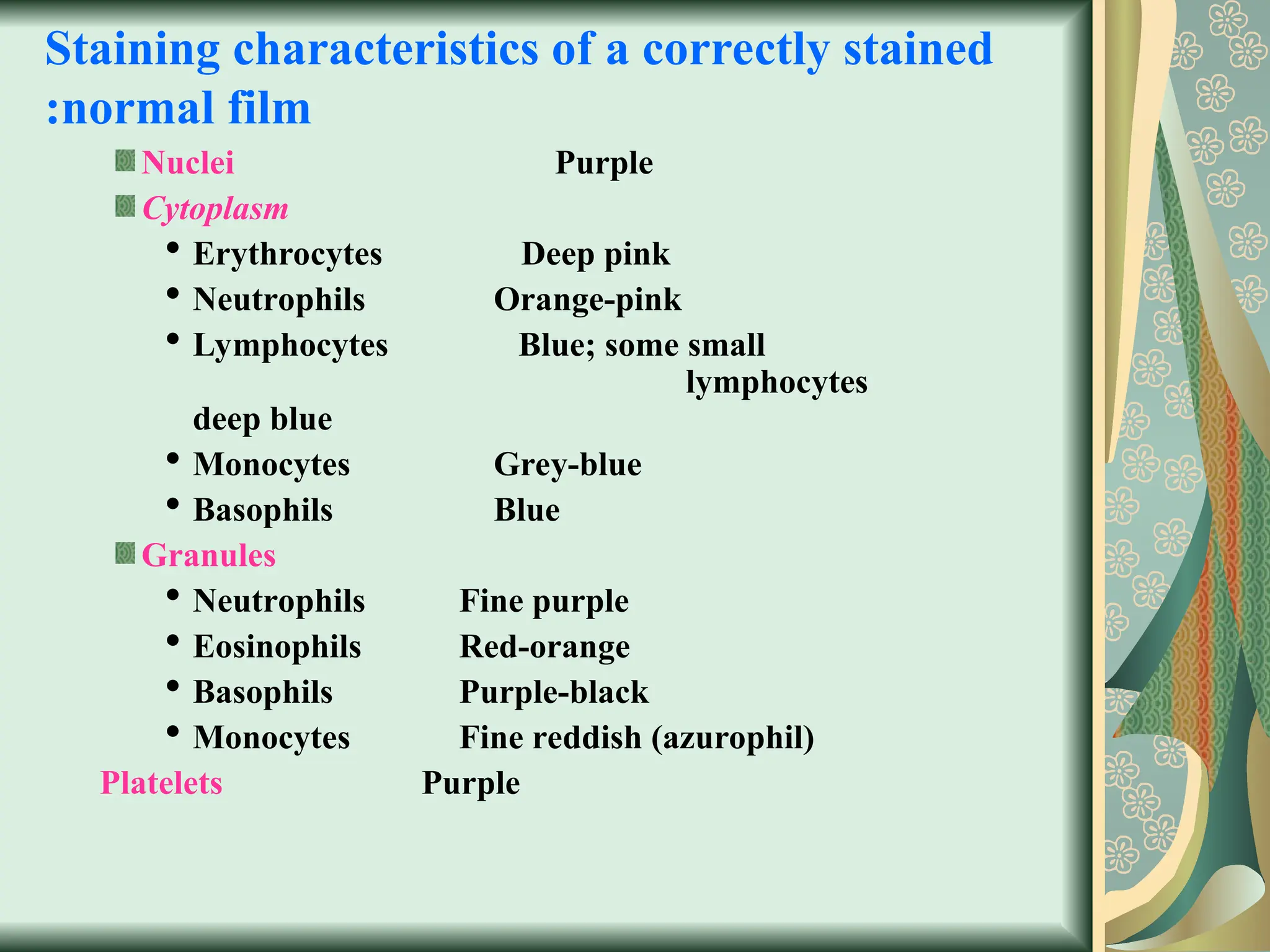
Staining characteristics ofa correctly stained
normal film
:
Nuclei Purple
Cytoplasm
Erythrocytes Deep pink
Neutrophils Orange-pink
Lymphocytes Blue; some small
lymphocytes
deep blue
Monocytes Grey-blue
Basophils Blue
Granules
Neutrophils Fine purple
Eosinophils Red-orange
Basophils Purple-black
Monocytes Fine reddish (azurophil)
Platelets Purple
42.
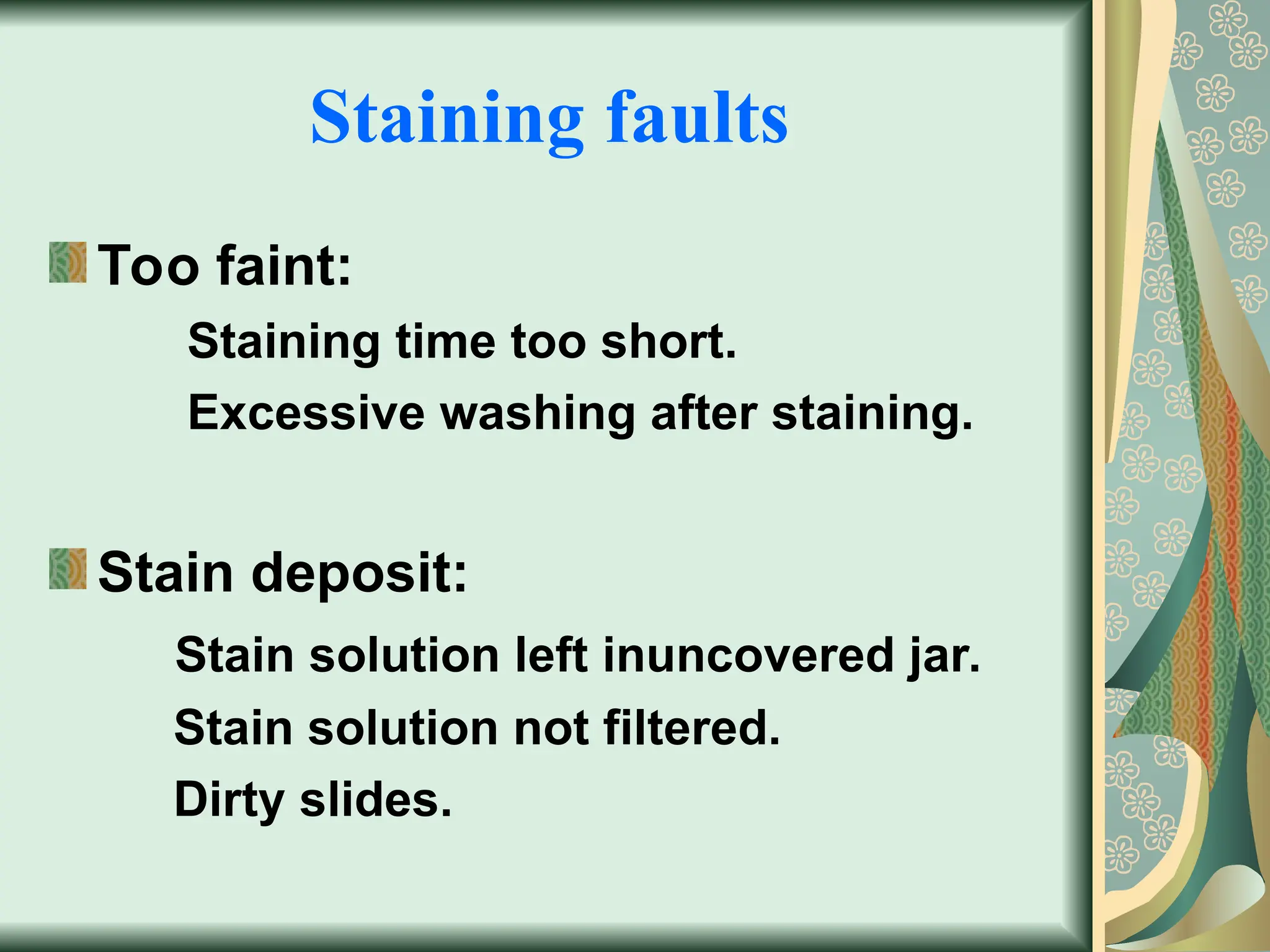
Staining faults
Too faint:
Stainingtime too short.
Excessive washing after staining.
Stain deposit:
Stain solution left inuncovered jar.
Stain solution not filtered.
Dirty slides.
43.
PH of thephosphate buffer
The phosphate buffer controls the PH of
the stain. If the PH is too acid, those cells or
cell parts taking up an acid dye stain will
stain pinker and the acid components that
stain with the basic dye show very pale
staining.
If the stain –buffer mixture is alkaline, the
red blood cells will appear grayish blue and
the white cell nuclei will stain very deeply
purple.
Therefore, to stain all cells and cell parts
well, the PH of the phosphate buffer is
critical.
Continue
……
1. The stainingrack must be exactly
level to guard against uneven staining
of the smear.
2. Insufficient washing of the smears
when removing the stain and buffer
mixture may cause stain precipitate
on the dried smear.
3. Excessive rinsing of the stained smear
will cause the stain to fade.
MANUAL DIFFERENTIAL
Principle
A stainedsmear is examined in order to determine
the percentage of each type of leukocyte present and
assess the erythrocyte and platelet morphology.
Increases in any of the normal leukocyte types or
the presence of immature leukocytes or
erythrocytes in peripheral blood are important
diagnostically in a wide variety of inflammatory
disorders and leukemia.
Erythrocyte abnormalities are clinically important
in various anemia's.
Platelet size irregularities are suggestive of
particular thrombocyte disorders.
49.
MANUAL DIFFERENTIAL
Specimen:
Peripheral bloodsmear made from EDTA-
anticoagulated blood.
Smears should be made within 1 hour of
blood collection from EDTA specimens
stored at room temperature to avoid
distortion of cell morphology.
Unstained smears can be stored for
indefinite periods in a dry environment, but
stained smears gradually fade unless cover
slipped.
Procedure
:
Focus the microscopeon the 10X
objective (low power).
1. Scan the smear to check for cell
distribution, clumping, and abnormal
cells.
2. In scanning the smear it is important
to note anything unusual or
irregular, such as rouleaux or RBC
clumping.
52.
Observing direction
Observing direction
•Observeone field and record the
Observe one field and record the
number of WBC according to the
number of WBC according to the
different type then turn to another field
different type then turn to another field
in the snake-liked direction.
in the snake-liked direction.
•Avoid repeat or miss some cells
Avoid repeat or miss some cells
53.
OBSERVATIONS UNDER× 40X: WBC
ESTIMATES
Using the × 40 high dry with no oil.
Choose a portion of the peripheral
smear where there is only slight
overlapping of the RBCs.
Count 10 fields, take the total number
of white cells and divide by 10.
To do a WBC estimate by taking the
average number of white cells and
multiplying by 2000.
54.
OBSERVATIONS UNDER ×100:
PLATELET ESTIMATES
1.
1. Use the oil immersion lens estimate
Use the oil immersion lens estimate
the number of platelets per field.
the number of platelets per field.
2.
2. Look at 5-6 fields and take an
Look at 5-6 fields and take an
average.
average.
3.
3. Multiply the average by 20,000.
Multiply the average by 20,000.
Platelets per oil immersion field (OIF)
Platelets per oil immersion field (OIF)
1)
1) <8 platelets/OIF = decreased
<8 platelets/OIF = decreased
2)
2) 8 to 20 platelets/OIF = adequate
8 to 20 platelets/OIF = adequate
3)
3) >20 platelets/OIF = increased
>20 platelets/OIF = increased
MANUAL DIFFERENTIAL COUNTS
MANUALDIFFERENTIAL COUNTS
These counts are done in the same area
as WBC and platelet estimates with the
red cells barely touching.
This takes place under × 100 (oil) using
the zigzag method.
Count 100 WBCs
Reporting results
Absolute number of cells/µl = % of cell
type in differential x white cell count.
57.
OBSERVING AND RECORDING
NUCLEATEDRED BLOOD CELLS
(NRBCS)
If 10 or more nucleated RBC's (NRBC)
If 10 or more nucleated RBC's (NRBC)
are seen, correct the
are seen, correct the
White Count using this formula:
White Count using this formula:
Corrected WBC Count =
Corrected WBC Count =
WBC x 100/( NRBC + 100
WBC x 100/( NRBC + 100)
)
White blood cells
Leukocytesare classified into two main groups;
granulocytes and nongranulocytes (also known
as agranulocytes).
1. The granulocytes, ( neutrophils, eosinophils,
and basophiles), have granules in their cell
cytoplasm.
Also have multilobed nucleus. As a result they
are also called polymorphonuclear leukocytes
or "polys“
The nuclei of neutrophils also appear to be
segmented, so they may also be called
segmented neutrophils or “segs“.
2. The nongranulocyte, (lymphocytes and
monocytes), do not have granules and have
nonlobular nuclei. They are sometimes referred
to as mononuclear leukocytes.
60.
Leukocytosis
Leukocytosis, a WBCabove 10,000 is usually
due to an increase in one of the five types of
white blood cells and is given the name of the
cell that shows the primary increase.
1. Neutrophilic leukocytosis = neutrophilia
2. Lymphocytic leukocytosis = lymphocytosis
3. Eosinophilic leukocytosis = eosinophilia
4.Monocytic leukocytosis =monocytosis
5.Basophilic leukocytosis = basophilia
62.
1
.
Neutrophils
Neutrophils are sonamed because they
are not well stained by either eosin, a red
acidic stain, or by methylene blue, a basic
or alkaline stain.
Neutrophils are also known as "segs",
"PMNs" or "polys" (polymorphonuclear).
They are the body's primary defense
against bacterial infection.
63.
Normally, most ofthe neutrophils
circulating in the bloodstream are in a
mature form, with the nucleus of the cell
being divided or segmented. Because of
the segmented appearance of the nucleus,
neutrophils are sometimes referred to as
"segs."
The nucleus of less mature neutrophils is
not segmented, but has a band or rod-like
shape. Less mature neutrophils - those
that have recently been released from the
bone marrow into the bloodstream - are
known as "bands" or "stabs".
Neutrophils
:
Increased neutrophils count(neutrophilia)
1. Acute bacterial infection.
2. Many inflammatory processes.
3. During physical stress.
4. With tissue necrosis.
5. Granulocytic leukemia.
Decreased neutrophil count (neutropenia)
1.Typhoid fever
2. Brucellosis
3. Viral diseases, including hepatitis, influenza,
rubella, and mumps.
4. A great infection can also deplete the bone marrow
of neutrophils.
5.Many drugs used to treat cancer produce bone
marrow depression.
2. Eosinophils
The mostcommon reasons for an
increase in the eosinophil count are
Allergic reactions such as hay fever,
asthma, or drug hypersensitivity.
1.Parasitic infection
2.Eosinophilic leukemia
71.
Eosinophils
Cytoplasm : fullof granules
Cytoplasm : full of granules
Granules: large refractile,
Granules: large refractile,
orange-red
orange-red
Nucleus: blue
Nucleus: blue
dense chromatin
dense chromatin
2
2
lobes like a pair of glass
lobes like a pair of glass
3. Basophils
The purposeof basophils is not completely understood.
Basophils are phagocytes and contain heparin,
histamines, and serotonin.
Tissue basophils are also called" mast cells.
Basophile counts are used to analyze allergic reactions.
An alteration in bone marrow function such as
leukemia or Hodgkin's disease may cause an increase
in basophils.
Corticosteroid drugs may cause the body's small
basophile numbers to decrease.
75.
Cytoplasm : pink
Cytoplasm: pink
Granules: dark blue –
Granules: dark blue –
black obscure nucleus
black obscure nucleus
Nucleus: blue
Nucleus: blue
BASOPHIL
4
.
Lymphocytes
Lymphocytes are theprimary components of
the body's immune system. They are the source
of serum immunoglobulins and of cellular
immune response.
Two types of lymphocytes:
1. B lymphocyte : Humoral immunity
2. T lymphocyte : Cellular immunity
78.
Lymphocytes
:
Lymphocytes increase (lymphocytosis)in:
1.Many viral infections
2.Tuberculosis.
3.Typhoid fever
4.Lymphocytic leukemia.
A decreased lymphocyte (lymphopenia)
count of less than 500 places a patient at
very high risk of infection, particularly
viral infections.
79.
Diameter: small 7-9
Diameter:small 7-9
large 12-16
large 12-16
Cytoplasm: medium blue
Cytoplasm: medium blue
Granules: small agranular
Granules: small agranular
Large a few primary granules
Large a few primary granules
.
.
Nucleus: dark blue round
Nucleus: dark blue round
dense chromatin
dense chromatin
Lymphocytes
:
5
.
Monocytes
Monocytes are thelargest cells in
normal blood. They act as phagocytes
in some inflammatory diseases and are
the body's second line of defense
against infection.
Diseases that cause a monocytosis
include:
•Tuberculosis
•Brucellosis
•Malaria
•Rocky Mountain spotted fever.
•Monocytic leukemia
•Chronic ulcerative colitis
82.
Cytoplasm : greyblue
Cytoplasm : grey blue
Granules: dust-like lilac
Granules: dust-like lilac
color granules
color granules
Nucleus: blue
Nucleus: blue
large irregularly
large irregularly
shaped and folded
shaped and folded
Monocytes
85.
Notes
:
1. A well-madeand well-stained smear is
essential to the accuracy of the differential
count. The knowledge and ability of the cell
morphologist is critical to high-quality results.
2. Before reporting significant abnormalities
such as blasts, malaria or other significant
finding on a patient’s differential, ask a more
experienced tech to review the smear for
confirmation. In clinical settings where a
pathologist or hematologist is present, the
smear is set aside for Pathologist Review.
86.
3
.
If disrupted cellsare present such as smudge
cells or basket cells, not them on the report.
It may be necessary to make an albumin
smear to prevent the disruption of the cells.
RBC morphology and WBC morphology
must always be performed on the non-
albumin smear
.
4
.
When the WBC is very low (below 1,000/µL), it
is difficult to find enough WBCs to perform a
100-cell differential. In this situation, a
differential is usually performed by counting
50 cells. A notation on the report must be
made that only 50 white cells were counted.
Multiply each percentage x 2
.
87.
5. When theWBC is very high (>50,000/µL), a
200-cell diff may be performed to increase
the accuracy of the diff.
6. Never hesitate to ask questions concerning
morphology or the identification of cells.
The differential is one of the most difficult
laboratory tests to learn. In fact, learning
about cells and their morphology is a process
that continues for as long as you perform
differentials.






![Peripheral blood smear [autosaved]](https://cdn.slidesharecdn.com/ss_thumbnails/peripheralbloodsmearautosaved-201029200454-thumbnail.jpg?width=640&height=640&fit=bounds)


