
Presented by
NamYong Kim
nykim@seoultech.ac.kr
1. Introduction
2. Related Works
3. Blockchain-based Multiple AAA System
in Edge Computing for IoT Networks
4. Conclusion
• Recently, cloud service has become an essential environment for mobile
and PC users for convenient life.
• Fog computing and edge computing have excellent location awareness
in fog node, edge related technologies, and are more hierarchical than
traditional cloud.
• The overall market trend is being replaced by edge computing in
existing cloud computing in response to consumer and market changes.
• In the Gartner Top 10 Strategic Technology Trends for 2018, edge and
blockchain in the cloud was selected a key components of the ten key
technologies in the future.
• In current enterprise centralized data center or the cloud from outside
the data of about 10% it is generated and processed. By 2022, Gartner
is expected to see a 50% increase in figures.
1. Introduction
• Large-scale edge computing is essential to security authentication, authorization, and
account management because it is anxious to use if personal information leakage,
various hacking and cyber terrorism occur.
• we have had interesting research themes that apply blockchain of bit coin
technology while considering the ways to have enhanced access control security.
• When applied to a distributed cloud using a blockchain of interest, the distributed
cloud can provide an alternative to the problems that arise from the centralized
cloud architecture.
• Recently, a distributed network can connect each independent node through a
blockchain technique applied to various fields.
• Thus, the distributed cloud shows the Authentication, Authorization, and Accounting
(AAA) system in a distributed manner by connecting each block to an independent
node.
• There are several papers on the security of the authentication system, but there are
few studies on the blockchain and it is necessary to study multiple AAA systems.
1. Introduction
2. Related Works
2.1. Core technology
Edge Computing: Edge computing handles information processing,
content collection and transmission, closer to IoT and machines, and
supports computing on devices located at the edge of the network.
Blockchain: Blockchain is a next-generation transactional application
technology that sets the reliability, transparency, and accountability while
streamlining complex processes.
Authentication, Authorization, Accounting (AAA): Authentication verifies the
user's identity before allowing access to the system. Authorization allows a
level of authority and service to a verified user. Accounting collects usage
information about users' resources and provides billing, auditing, capacity
increase, and reporting.
2. Related Works
MFA is a method of user login authentication through two or more
products or elements. Such authentication requires two or more
authentication methods, including Fast Identity Online (FIDO)
authentication.
The MCA uses different independent channels such as web, mobile and IoT
channels to transmit. The transmission procedure does not include
personal information in the communications section.
2. Related Works
2.2. Required design principles for multiple AAA system
A secure and efficient network environment is need to solve current and future
problems and meet new service requirements. Existing systems rely on evidence
from a single source of information, such as fingerprint, face recognition, and iris
recognition, required for existing authentication. Moreover, we have to solve
various problems such as noise of detected data, similarity in class, and similarity.
• Scalability: When designing an authentication system for future extended IoT
networks, it is necessary to adapt to local conditions first.
• Resilience: Multiple AAA systems using blockchain require various nodes.
Blockchain nodes run continuously, and even if some nodes fail to compute,
autonomous recovery is possible by providing improved resiliency through
operations on subsequent nodes.
• Security: Data between IoT networks and service providers is a design principle
that security integrity and personal information are the most important.
3. PROPOSED MULTIPLE AAA SYSTEM
In an existing cloud environment, various IoT devices are rapidly increasing,
requiring safe and fast data processing. For the safety of numerous data
transmissions, the authentication process includes MFA and MCA, and discusses the
application of various AAA systems on a blockchain basis.
3.1. Blockchain-based Multiple AAA System in Edge Computing for IoT
Networks model
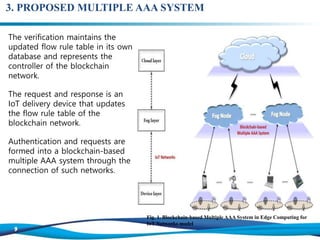
Figure 1 depicts a multiple AAA system model as a whole in Edge computing,
which is classified as a cloud layer, a fog layer, and a device layer.
The cloud includes a variety of service models and can provide all sorts of apps
that are included in the service. The fog layer consists of innumerable fog nodes,
and the fog node is the core of the blockchain-based multiple AAA system. The
blockchain guarantees safety and reliability by connecting the fog nodes together,
and is efficient because there is no need for a trusted authority like the central
cloud. The device layer represents a collection of various IoT devices.
3. PROPOSED MULTIPLE AAA SYSTEM
The verification maintains the
updated flow rule table in its own
database and represents the
controller of the blockchain
network.
The request and response is an
IoT delivery device that updates
the flow rule table of the
blockchain network.
Authentication and requests are
formed into a blockchain-based
multiple AAA system through the
connection of such networks.
Fig. 1. Blockchain-based Multiple AAA System in Edge Computing for
IoT Networks model
3. PROPOSED MULTIPLE AAA SYSTEM
3.2. Service scenario
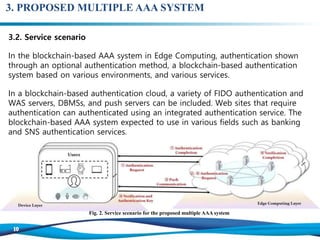
In the blockchain-based AAA system in Edge Computing, authentication shown
through an optional authentication method, a blockchain-based authentication
system based on various environments, and various services.
In a blockchain-based authentication cloud, a variety of FIDO authentication and
WAS servers, DBMSs, and push servers can be included. Web sites that require
authentication can authenticated using an integrated authentication service. The
blockchain-based AAA system expected to use in various fields such as banking
and SNS authentication services.
Fig. 2. Service scenario for the proposed multiple AAA system
3. PROPOSED MULTIPLE AAA SYSTEM
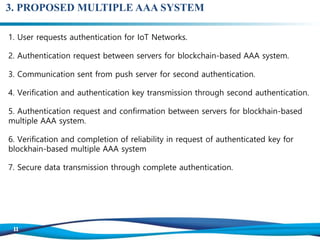
1. User requests authentication for IoT Networks.
2. Authentication request between servers for blockchain-based AAA system.
3. Communication sent from push server for second authentication.
4. Verification and authentication key transmission through second authentication.
5. Authentication request and confirmation between servers for blockhain-based
multiple AAA system.
6. Verification and completion of reliability in request of authenticated key for
blockhain-based multiple AAA system
7. Secure data transmission through complete authentication.
4. CONCLUSIONS
IoT networks require security authentication, authorization and account
management elements because they are unstable to use if hacking and cyber
terrorism occur. Therefore, in the related work, we discussed the importance and
core technology of blockchain and authentication, authorization, and account
management in edge computing. We construct a system that meets the necessary
design principles of multiple AAA system.
We propose a system that improves security through authentication, authorization,
account management and blockchain of IoT network. Proposed paper discuss the
configuration of the proposed system based on the discussion and study
blockchain-based multiple AAA system environment and service scenario in edge
computing.
Q & A
13

Blockchain-based multiple AAA system in edge computing for IoT networks

  • 1.
  • 2.
    1. Introduction 2. RelatedWorks 3. Blockchain-based Multiple AAA System in Edge Computing for IoT Networks 4. Conclusion
  • 3.
    • Recently, cloudservice has become an essential environment for mobile and PC users for convenient life. • Fog computing and edge computing have excellent location awareness in fog node, edge related technologies, and are more hierarchical than traditional cloud. • The overall market trend is being replaced by edge computing in existing cloud computing in response to consumer and market changes. • In the Gartner Top 10 Strategic Technology Trends for 2018, edge and blockchain in the cloud was selected a key components of the ten key technologies in the future. • In current enterprise centralized data center or the cloud from outside the data of about 10% it is generated and processed. By 2022, Gartner is expected to see a 50% increase in figures. 1. Introduction
  • 4.
    • Large-scale edgecomputing is essential to security authentication, authorization, and account management because it is anxious to use if personal information leakage, various hacking and cyber terrorism occur. • we have had interesting research themes that apply blockchain of bit coin technology while considering the ways to have enhanced access control security. • When applied to a distributed cloud using a blockchain of interest, the distributed cloud can provide an alternative to the problems that arise from the centralized cloud architecture. • Recently, a distributed network can connect each independent node through a blockchain technique applied to various fields. • Thus, the distributed cloud shows the Authentication, Authorization, and Accounting (AAA) system in a distributed manner by connecting each block to an independent node. • There are several papers on the security of the authentication system, but there are few studies on the blockchain and it is necessary to study multiple AAA systems. 1. Introduction
  • 5.
    2. Related Works 2.1.Core technology Edge Computing: Edge computing handles information processing, content collection and transmission, closer to IoT and machines, and supports computing on devices located at the edge of the network. Blockchain: Blockchain is a next-generation transactional application technology that sets the reliability, transparency, and accountability while streamlining complex processes. Authentication, Authorization, Accounting (AAA): Authentication verifies the user's identity before allowing access to the system. Authorization allows a level of authority and service to a verified user. Accounting collects usage information about users' resources and provides billing, auditing, capacity increase, and reporting.
  • 6.
    2. Related Works MFAis a method of user login authentication through two or more products or elements. Such authentication requires two or more authentication methods, including Fast Identity Online (FIDO) authentication. The MCA uses different independent channels such as web, mobile and IoT channels to transmit. The transmission procedure does not include personal information in the communications section.
  • 7.
    2. Related Works 2.2.Required design principles for multiple AAA system A secure and efficient network environment is need to solve current and future problems and meet new service requirements. Existing systems rely on evidence from a single source of information, such as fingerprint, face recognition, and iris recognition, required for existing authentication. Moreover, we have to solve various problems such as noise of detected data, similarity in class, and similarity. • Scalability: When designing an authentication system for future extended IoT networks, it is necessary to adapt to local conditions first. • Resilience: Multiple AAA systems using blockchain require various nodes. Blockchain nodes run continuously, and even if some nodes fail to compute, autonomous recovery is possible by providing improved resiliency through operations on subsequent nodes. • Security: Data between IoT networks and service providers is a design principle that security integrity and personal information are the most important.
  • 8.
    3. PROPOSED MULTIPLEAAA SYSTEM In an existing cloud environment, various IoT devices are rapidly increasing, requiring safe and fast data processing. For the safety of numerous data transmissions, the authentication process includes MFA and MCA, and discusses the application of various AAA systems on a blockchain basis. 3.1. Blockchain-based Multiple AAA System in Edge Computing for IoT Networks model Figure 1 depicts a multiple AAA system model as a whole in Edge computing, which is classified as a cloud layer, a fog layer, and a device layer. The cloud includes a variety of service models and can provide all sorts of apps that are included in the service. The fog layer consists of innumerable fog nodes, and the fog node is the core of the blockchain-based multiple AAA system. The blockchain guarantees safety and reliability by connecting the fog nodes together, and is efficient because there is no need for a trusted authority like the central cloud. The device layer represents a collection of various IoT devices.
  • 9.
    3. PROPOSED MULTIPLEAAA SYSTEM The verification maintains the updated flow rule table in its own database and represents the controller of the blockchain network. The request and response is an IoT delivery device that updates the flow rule table of the blockchain network. Authentication and requests are formed into a blockchain-based multiple AAA system through the connection of such networks. Fig. 1. Blockchain-based Multiple AAA System in Edge Computing for IoT Networks model
  • 10.
    3. PROPOSED MULTIPLEAAA SYSTEM 3.2. Service scenario In the blockchain-based AAA system in Edge Computing, authentication shown through an optional authentication method, a blockchain-based authentication system based on various environments, and various services. In a blockchain-based authentication cloud, a variety of FIDO authentication and WAS servers, DBMSs, and push servers can be included. Web sites that require authentication can authenticated using an integrated authentication service. The blockchain-based AAA system expected to use in various fields such as banking and SNS authentication services. Fig. 2. Service scenario for the proposed multiple AAA system
  • 11.
    3. PROPOSED MULTIPLEAAA SYSTEM 1. User requests authentication for IoT Networks. 2. Authentication request between servers for blockchain-based AAA system. 3. Communication sent from push server for second authentication. 4. Verification and authentication key transmission through second authentication. 5. Authentication request and confirmation between servers for blockhain-based multiple AAA system. 6. Verification and completion of reliability in request of authenticated key for blockhain-based multiple AAA system 7. Secure data transmission through complete authentication.
  • 12.
    4. CONCLUSIONS IoT networksrequire security authentication, authorization and account management elements because they are unstable to use if hacking and cyber terrorism occur. Therefore, in the related work, we discussed the importance and core technology of blockchain and authentication, authorization, and account management in edge computing. We construct a system that meets the necessary design principles of multiple AAA system. We propose a system that improves security through authentication, authorization, account management and blockchain of IoT network. Proposed paper discuss the configuration of the proposed system based on the discussion and study blockchain-based multiple AAA system environment and service scenario in edge computing.
  • 13.