www.thecryptoinsight.com
Blockchain
What is Blockchain?
Blockchain is a time-stamped series of blocks containing some data
which acts as a distributed ledger
â—Ź Every block has a memory pool and data is stored in the memory pool
â—Ź Every block is connected linearly with the previous block with block
hashes
â—Ź New blocks are added to the blockchain with new information
â—Ź If a blocks contain transaction data, then the blockchain acts as a
digital ledger
www.thecryptoinsight.com
“Blockchain is not Bitcoin. If
bitcoin is the bulb, then
blockchain is the electricity.”
www.thecryptoinsight.com
History of Blockchain
â—Ź The idea of blockchain was first
conceived by Stuart Haber and W. Scott
Stornetta.
â—Ź They introduced time-stamping of
digital documents with cryptography, so
that the documents cannot be
backdated
â—Ź Later Merkle trees were incorporated to
increase the capacity of data stored in a
block
â—Ź Satoshi Nakamoto combined all these
with RPoW to create bitcoin blockchain
www.thecryptoinsight.com
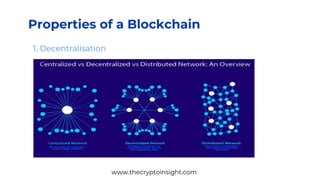
1. Decentralisation
Properties of a Blockchain
www.thecryptoinsight.com
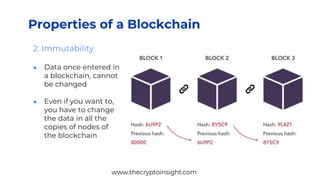
2. Immutability
â—Ź Data once entered in
a blockchain, cannot
be changed
â—Ź Even if you want to,
you have to change
the data in all the
copies of nodes of
the blockchain
Properties of a Blockchain
www.thecryptoinsight.com
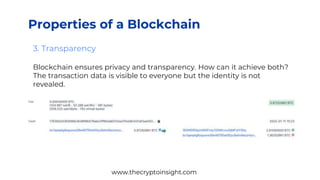
3. Transparency
Blockchain ensures privacy and transparency. How can it achieve both?
The transaction data is visible to everyone but the identity is not
revealed.
Properties of a Blockchain
www.thecryptoinsight.com
Block Explorers
â—Ź Block explorers are the search engines of blockchains
â—Ź Block explorers helps you to explore the data stored in a blockchain
â—Ź The data in a block is not in a searchable format.
â—Ź Block explorers use APIs and fetch the data from the nodes and
present it on a website in a searchable format
â—Ź Some bitcoin block explorers are blockchain.com, btc.com,
blockchair.com etc
www.thecryptoinsight.com
Consensus Algorithm
Consensus algorithm is a set of rules on
which nodes in a blockchain agree on a
single data value. It also ensures that
nodes do not commit any faulty
practices
Proof-of-Work and Proof-of-Stake are
the most popular consensus algorithms
www.thecryptoinsight.com
Proof-of-Work
Proof-of-Work concept was introduced in 1993 and went unused until
Satoshi Nakamoto created Bitcoin in 2009.
â—Ź Miners have to solve complex cryptographic puzzles to add new blocks
and verify transactions
â—Ź Massive amount of computing power is required to create a block and
it consumes a lot of energy
â—Ź A block hash represents a new block and the work done by the miner.
Hence, it is known as Proof-of-Work
www.thecryptoinsight.com
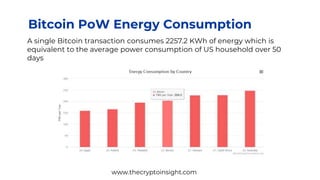
Bitcoin PoW Energy Consumption
A single Bitcoin transaction consumes 2257.2 KWh of energy which is
equivalent to the average power consumption of US household over 50
days
www.thecryptoinsight.com
Proof-of-Stake
â—Ź In Proof-of-Stake, Nodes deposit their cryptocurrency on the network
and stake their tokens
â—Ź Nodes in PoS network are called as Validators
â—Ź Validators verify the transactions and get rewards for verifying the
transactions.
â—Ź No new tokens are created in Proof-of-Stake blockchains
â—Ź Creation of new blocks is called as Forging
www.thecryptoinsight.com
PoS Validator Selection
Validators in PoS are elected based on Staking Age or Wealth of the node
or Randomisation processes
â—Ź In Random block selection, node with lowest block hash and highest
wealth are selected
â—Ź In Coin age selection, staking age is taken into consideration. Once a
node is selected, his age will be reset
â—Ź ALGO, TEZOS are some examples of PoS blockchains
www.thecryptoinsight.com
Delegated Proof-of-Stake
Delegated Proof of Stake is another version of PoS
â—Ź In DPoS, users vote for Delegates or Witnesses to validate the next
block
â—Ź Users add their tokens in the staking pool and get rewarded as APYs
â—Ź DPoS is not as decentralised as PoW
â—Ź EOS, TRON, HIVE, LUNA are some blockchains using DPoS
www.thecryptoinsight.com
51% attack
â—Ź If a single miner controls 50% of the blockchain nodes then there is a
chance of a 51% attack
â—Ź 51% attack can occur in any blockchain whatever the consensus
algorithm may be
â—Ź It is practically impossible for a 51% attack on Bitcoin blockchain
â—Ź Verge, Ethereum Classic are some blockchains which suffered 51%
attacks
www.thecryptoinsight.com
CREDITS: This presentation template was created by
Slidesgo, including icons by Flaticon, and
infographics & images by Freepik
Thank You
www.thecryptoinsight.com

Introduction to Blockchain

  • 1.
  • 2.
    What is Blockchain? Blockchainis a time-stamped series of blocks containing some data which acts as a distributed ledger â—Ź Every block has a memory pool and data is stored in the memory pool â—Ź Every block is connected linearly with the previous block with block hashes â—Ź New blocks are added to the blockchain with new information â—Ź If a blocks contain transaction data, then the blockchain acts as a digital ledger www.thecryptoinsight.com
  • 3.
    “Blockchain is notBitcoin. If bitcoin is the bulb, then blockchain is the electricity.” www.thecryptoinsight.com
  • 4.
    History of Blockchain â—ŹThe idea of blockchain was first conceived by Stuart Haber and W. Scott Stornetta. â—Ź They introduced time-stamping of digital documents with cryptography, so that the documents cannot be backdated â—Ź Later Merkle trees were incorporated to increase the capacity of data stored in a block â—Ź Satoshi Nakamoto combined all these with RPoW to create bitcoin blockchain www.thecryptoinsight.com
  • 5.
    1. Decentralisation Properties ofa Blockchain www.thecryptoinsight.com
  • 6.
    2. Immutability â—Ź Dataonce entered in a blockchain, cannot be changed â—Ź Even if you want to, you have to change the data in all the copies of nodes of the blockchain Properties of a Blockchain www.thecryptoinsight.com
  • 7.
    3. Transparency Blockchain ensuresprivacy and transparency. How can it achieve both? The transaction data is visible to everyone but the identity is not revealed. Properties of a Blockchain www.thecryptoinsight.com
  • 8.
    Block Explorers â—Ź Blockexplorers are the search engines of blockchains â—Ź Block explorers helps you to explore the data stored in a blockchain â—Ź The data in a block is not in a searchable format. â—Ź Block explorers use APIs and fetch the data from the nodes and present it on a website in a searchable format â—Ź Some bitcoin block explorers are blockchain.com, btc.com, blockchair.com etc www.thecryptoinsight.com
  • 9.
    Consensus Algorithm Consensus algorithmis a set of rules on which nodes in a blockchain agree on a single data value. It also ensures that nodes do not commit any faulty practices Proof-of-Work and Proof-of-Stake are the most popular consensus algorithms www.thecryptoinsight.com
  • 10.
    Proof-of-Work Proof-of-Work concept wasintroduced in 1993 and went unused until Satoshi Nakamoto created Bitcoin in 2009. â—Ź Miners have to solve complex cryptographic puzzles to add new blocks and verify transactions â—Ź Massive amount of computing power is required to create a block and it consumes a lot of energy â—Ź A block hash represents a new block and the work done by the miner. Hence, it is known as Proof-of-Work www.thecryptoinsight.com
  • 11.
    Bitcoin PoW EnergyConsumption A single Bitcoin transaction consumes 2257.2 KWh of energy which is equivalent to the average power consumption of US household over 50 days www.thecryptoinsight.com
  • 12.
  • 13.
    Proof-of-Stake â—Ź In Proof-of-Stake,Nodes deposit their cryptocurrency on the network and stake their tokens â—Ź Nodes in PoS network are called as Validators â—Ź Validators verify the transactions and get rewards for verifying the transactions. â—Ź No new tokens are created in Proof-of-Stake blockchains â—Ź Creation of new blocks is called as Forging www.thecryptoinsight.com
  • 14.
    PoS Validator Selection Validatorsin PoS are elected based on Staking Age or Wealth of the node or Randomisation processes â—Ź In Random block selection, node with lowest block hash and highest wealth are selected â—Ź In Coin age selection, staking age is taken into consideration. Once a node is selected, his age will be reset â—Ź ALGO, TEZOS are some examples of PoS blockchains www.thecryptoinsight.com
  • 15.
    Delegated Proof-of-Stake Delegated Proofof Stake is another version of PoS â—Ź In DPoS, users vote for Delegates or Witnesses to validate the next block â—Ź Users add their tokens in the staking pool and get rewarded as APYs â—Ź DPoS is not as decentralised as PoW â—Ź EOS, TRON, HIVE, LUNA are some blockchains using DPoS www.thecryptoinsight.com
  • 16.
    51% attack â—Ź Ifa single miner controls 50% of the blockchain nodes then there is a chance of a 51% attack â—Ź 51% attack can occur in any blockchain whatever the consensus algorithm may be â—Ź It is practically impossible for a 51% attack on Bitcoin blockchain â—Ź Verge, Ethereum Classic are some blockchains which suffered 51% attacks www.thecryptoinsight.com
  • 17.
    CREDITS: This presentationtemplate was created by Slidesgo, including icons by Flaticon, and infographics & images by Freepik Thank You www.thecryptoinsight.com