


Blockchain and Financial Services
Everything could be different
THE IMPACT OF TECHNOLOGY ON SERVICES DELIVERY
Mark Mueller-Eberstein
Rutgers University
The Innovation Economy Institute
CEO of Adgetec Corporation
@MarkMeberstein
WeChat: MarkMEberstein
©Mark Mueller-Eberstein & Adgetec Corporation
“Every inefficiency in a system will be
removed (by technology) sooner or
later.”
2
Mark Mueller-Eberstein
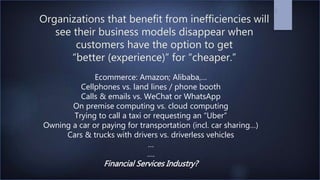
Organizations that benefit from inefficiencies will
see their business models disappear when
customers have the option to get
“better (experience)” for “cheaper.”
3
Ecommerce: Amazon; Alibaba,…
Cellphones vs. land lines / phone booth
Calls & emails vs. WeChat or WhatsApp
On premise computing vs. cloud computing
Trying to call a taxi or requesting an “Uber”
Owning a car or paying for transportation (incl. car sharing…)
Cars & trucks with drivers vs. driverless vehicles
…
….
Financial Services Industry?
Mark Mueller-Eberstein & Adgetec Corporation
What differentiates
Winners from Losers?
Low IT Capability Maturity HIGH IT Capability Maturity
Mark Mueller-Eberstein & Adgetec Corporation
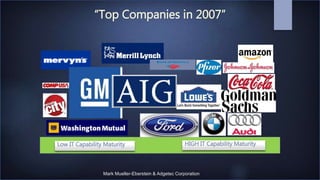
“Top Companies in 2007”
Low IT Capability Maturity HIGH IT Capability Maturity
Mark Mueller-Eberstein & Adgetec Corporation
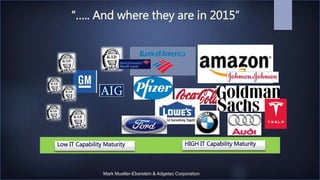
“….. And where they are in 2015”
Low IT Capability Maturity HIGH IT Capability Maturity
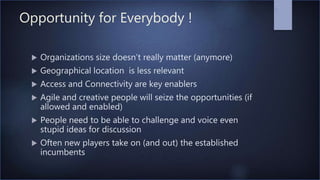
Opportunity for Everybody !
 Organizations size doesn’t really matter (anymore)
 Geographical location is less relevant
 Access and Connectivity are key enablers
 Agile and creative people will seize the opportunities (if
allowed and enabled)
 People need to be able to challenge and voice even
stupid ideas for discussion
 Often new players take on (and out) the established
incumbents
7
©Mark Mueller-Eberstein & Adgetec Corporation
It’s the
F A S T
who eat the
SLOW
©Mark Mueller-Eberstein & Adgetec Corporation
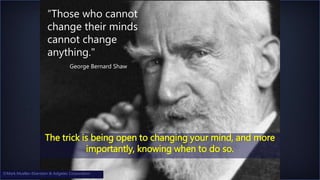
The trick is being open to changing your mind, and more
importantly, knowing when to do so.
George Bernard Shaw
“Those who cannot
change their minds
cannot change
anything."
©Mark Mueller-Eberstein & Adgetec Corporation
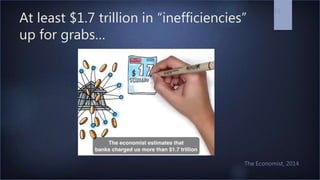
At least $1.7 trillion in “inefficiencies”
up for grabs…
11
The Economist, 2014
©Mark Mueller-Eberstein & Adgetec Corporation
And that is only the banking system…
Think any kind of transaction and
related services…
12
… for example….
 Records of estates
 Records of shares
 Any financial transaction
 Voting
 Domain control (DNS)
 Central Trust (“Escrow”) for any kind of deals
 Messaging (“signed and unchangeable”)
 IP management
 …
13
The more you learn, the more opportunity you will
see.
Nobody knew in early 1990s what the Internet was
or would lead to.
Milton Friedman: “Eventually, there will be a digital
value system beyond the nation state.”
14
Blockchain
 Blockchain is like the Internet
(it changed everything)
 The implications for traditional financial services
are massive
 The end of banks?
 The end of central banks?
 Big implications for regulators.
16
©Mark Mueller-Eberstein & Adgetec Corporation
The “technical stuff”…
17
©Mark Mueller-Eberstein & Adgetec Corporation
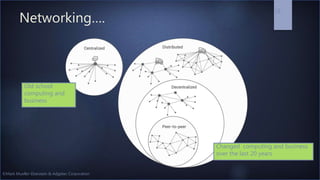
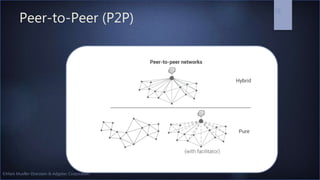
Networking….
18
Old school
computing and
business
Changed computing and business
over the last 20 years
©Mark Mueller-Eberstein & Adgetec Corporation
Peer-to-Peer (P2P)
19
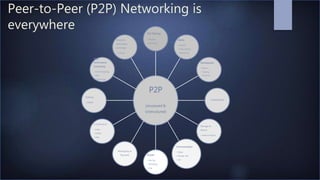
Peer-to-Peer (P2P) Networking is
everywhere
P2P
(structured &
Unstructured)
File Sharing
• Napster
• BitTorrent
Media
• Spotify
• Popcorntime
• PPLive (TV)
Marketplaces
• BitCoin
• “Sharing
Economy”
Cryptography
Storage &
Search
• Minerva Project
Communication
• Skype
• Google Talk
• I M
Mobile
• WeChat
• WhatsApp
• Line
Messaging as
Payment
E-Commerce
• E-Bay
• AirBnB
• Uber
Defense
• DARPA
High
Performance
Computing
• Grid Computing
• HIVE
• SETI@home
Analytics
techniques
exchange
• Chinook
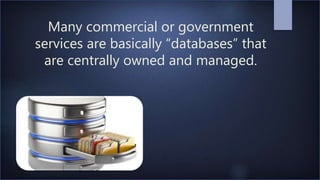
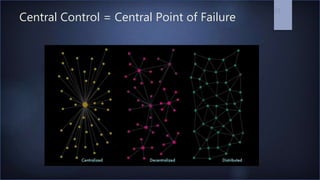
Many commercial or government
services are basically “databases” that
are centrally owned and managed.
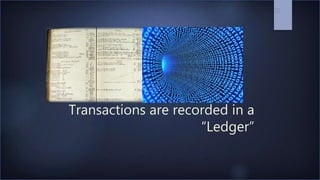
Transactions are recorded in a
“Ledger”
22
Central Control = Central Point of Failure
23
Blockchain technology allows a distributed ledger
vs. a centrally managed ledger.
All transactions within a block are recorded and
visible. And can never be changed.
Blockchain with out a “token” is just a database
24
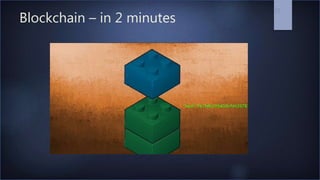
Blockchain – in 2 minutes
25
Benefits of Blockchain secured
distributed leger vs. central ledger
 Information can be put on block chain and can
never be changed
 Worldwide ledger: IP, land titles, art,...
 Full transparency for every transaction
 "Record every information forever"
26
Bitcoin vs. Blockchain
 Bitcoin is (currently the best know) usage of blockchain
technology
 One of many digital currencies using blockchain technology
 Many more uses for blockchain technology other than
“currency”
 Why digital currency is used?
No need to use exchange (e.g. banks) for people who
know/use Bitcoin
Direct exchange between individuals is possible
27
Bitcoin basics
 Insider: "It feels like when we first developed the Internet"
 It is a way to transfer value in the Internet
 Bitcoin can not be copied. First "scarce" digital asset.
 Bitcoin protocol (blockchain) is final piece of Internet puzzle
 Very early and experimental stage
 As longer as Bitcoin exists, the stronger it gets
 60% of all Bitcoin mining done in China (up from 40% 8 months
ago)
 New block created every ten minutes
28
©Mark Mueller-Eberstein & Adgetec Corporation
How “real” is Bitcoin?
29
... Most virtual believe might be "love"
Virtual goods are as real as people believe in them...
There is very little “real money”. Most are “0s””1s” on
some bank’s database
©Mark Mueller-Eberstein & Adgetec Corporation
How “real” is blockchain?
30
 Goldman-Sachs invest $500+ Million
 Microsoft declares “blockchain” as one of the
key “must win” workloads for their Azure
platform and business (and announced
collaboration with many US banks)
 Some governments invest into developing their
own “local” blockchains
©Mark Mueller-Eberstein & Adgetec Corporation
Understanding
change
©Mark Mueller-Eberstein & Adgetec
Corporation
©Mark Mueller-Eberstein & Adgetec Corporation
is scary
Change
©Mark Mueller-Eberstein & Adgetec Corporation
have emotions
People
©Mark Mueller-Eberstein & Adgetec Corporation
Is constant
Uncertainty
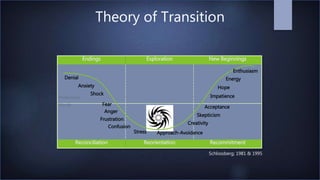
Endings Exploration New Beginnings
Reconciliation Reorientation Recommitment
Denial
Anxiety
Shock
Fear
Anger
Frustration
Confusion
Stress
Creativity
Approach-Avoidance
Skepticism
Acceptance
Impatience
Hope
Energy
Enthusiasm
Productivity
Morale
Theory of Transition
Schlossberg; 1981 & 1995
Regulations and restrictions?
From an economist perspective: Every restriction (and
forced inefficiency) comes with a cost.
Lets be clear who carries the cost and if that is in the
best interest of an economy and society.
37
©Mark Mueller-Eberstein & Adgetec Corporation
Your Opportunity!
1.Change will be fundamental on business,
technology, processes, structures and
people.
2.Technology leaders are positioned to drive
and realize the vision and image of the
future.
©Mark Mueller-Eberstein & Adgetec Corporation
“IT TAKES TEAMWORK DO MAKE THE
DREAM WORK!”
John C. Maxwell; Walt Disney; Martin Luther King Jr.; Captain Kirk;…
©Mark Mueller-Eberstein & Adgetec Corporation
NOW …
“MAKE IT SO!”
THANK YOU!
 MarkME@adgetec.com
 Twitter: MarkMEberstein
 US +1 855.423.4383
Mark Mueller-Eberstein
The Innovation Economy Research Institute
CEO of Adgetec Corporation
Bestselling Author
WeChat: MarkMEberstein

Blockchain and Financial Services: Everything could be different - APEC

  • 1.
    Blockchain and FinancialServices Everything could be different THE IMPACT OF TECHNOLOGY ON SERVICES DELIVERY Mark Mueller-Eberstein Rutgers University The Innovation Economy Institute CEO of Adgetec Corporation @MarkMeberstein WeChat: MarkMEberstein
  • 2.
    ©Mark Mueller-Eberstein &Adgetec Corporation “Every inefficiency in a system will be removed (by technology) sooner or later.” 2 Mark Mueller-Eberstein
  • 3.
    Organizations that benefitfrom inefficiencies will see their business models disappear when customers have the option to get “better (experience)” for “cheaper.” 3 Ecommerce: Amazon; Alibaba,… Cellphones vs. land lines / phone booth Calls & emails vs. WeChat or WhatsApp On premise computing vs. cloud computing Trying to call a taxi or requesting an “Uber” Owning a car or paying for transportation (incl. car sharing…) Cars & trucks with drivers vs. driverless vehicles … …. Financial Services Industry?
  • 4.
    Mark Mueller-Eberstein &Adgetec Corporation What differentiates Winners from Losers? Low IT Capability Maturity HIGH IT Capability Maturity
  • 5.
    Mark Mueller-Eberstein &Adgetec Corporation “Top Companies in 2007” Low IT Capability Maturity HIGH IT Capability Maturity
  • 6.
    Mark Mueller-Eberstein &Adgetec Corporation “….. And where they are in 2015” Low IT Capability Maturity HIGH IT Capability Maturity
  • 7.
    Opportunity for Everybody!  Organizations size doesn’t really matter (anymore)  Geographical location is less relevant  Access and Connectivity are key enablers  Agile and creative people will seize the opportunities (if allowed and enabled)  People need to be able to challenge and voice even stupid ideas for discussion  Often new players take on (and out) the established incumbents 7
  • 8.
    ©Mark Mueller-Eberstein &Adgetec Corporation It’s the F A S T who eat the SLOW
  • 9.
    ©Mark Mueller-Eberstein &Adgetec Corporation The trick is being open to changing your mind, and more importantly, knowing when to do so. George Bernard Shaw “Those who cannot change their minds cannot change anything." ©Mark Mueller-Eberstein & Adgetec Corporation
  • 10.
    At least $1.7trillion in “inefficiencies” up for grabs… 11 The Economist, 2014
  • 11.
    ©Mark Mueller-Eberstein &Adgetec Corporation And that is only the banking system… Think any kind of transaction and related services… 12
  • 12.
    … for example…. Records of estates  Records of shares  Any financial transaction  Voting  Domain control (DNS)  Central Trust (“Escrow”) for any kind of deals  Messaging (“signed and unchangeable”)  IP management  … 13
  • 13.
    The more youlearn, the more opportunity you will see. Nobody knew in early 1990s what the Internet was or would lead to. Milton Friedman: “Eventually, there will be a digital value system beyond the nation state.” 14
  • 14.
    Blockchain  Blockchain islike the Internet (it changed everything)  The implications for traditional financial services are massive  The end of banks?  The end of central banks?  Big implications for regulators. 16
  • 15.
    ©Mark Mueller-Eberstein &Adgetec Corporation The “technical stuff”… 17
  • 16.
    ©Mark Mueller-Eberstein &Adgetec Corporation Networking…. 18 Old school computing and business Changed computing and business over the last 20 years
  • 17.
    ©Mark Mueller-Eberstein &Adgetec Corporation Peer-to-Peer (P2P) 19
  • 18.
    Peer-to-Peer (P2P) Networkingis everywhere P2P (structured & Unstructured) File Sharing • Napster • BitTorrent Media • Spotify • Popcorntime • PPLive (TV) Marketplaces • BitCoin • “Sharing Economy” Cryptography Storage & Search • Minerva Project Communication • Skype • Google Talk • I M Mobile • WeChat • WhatsApp • Line Messaging as Payment E-Commerce • E-Bay • AirBnB • Uber Defense • DARPA High Performance Computing • Grid Computing • HIVE • SETI@home Analytics techniques exchange • Chinook
  • 19.
    Many commercial orgovernment services are basically “databases” that are centrally owned and managed.
  • 20.
    Transactions are recordedin a “Ledger” 22
  • 21.
    Central Control =Central Point of Failure 23
  • 22.
    Blockchain technology allowsa distributed ledger vs. a centrally managed ledger. All transactions within a block are recorded and visible. And can never be changed. Blockchain with out a “token” is just a database 24
  • 23.
    Blockchain – in2 minutes 25
  • 24.
    Benefits of Blockchainsecured distributed leger vs. central ledger  Information can be put on block chain and can never be changed  Worldwide ledger: IP, land titles, art,...  Full transparency for every transaction  "Record every information forever" 26
  • 25.
    Bitcoin vs. Blockchain Bitcoin is (currently the best know) usage of blockchain technology  One of many digital currencies using blockchain technology  Many more uses for blockchain technology other than “currency”  Why digital currency is used? No need to use exchange (e.g. banks) for people who know/use Bitcoin Direct exchange between individuals is possible 27
  • 26.
    Bitcoin basics  Insider:"It feels like when we first developed the Internet"  It is a way to transfer value in the Internet  Bitcoin can not be copied. First "scarce" digital asset.  Bitcoin protocol (blockchain) is final piece of Internet puzzle  Very early and experimental stage  As longer as Bitcoin exists, the stronger it gets  60% of all Bitcoin mining done in China (up from 40% 8 months ago)  New block created every ten minutes 28
  • 27.
    ©Mark Mueller-Eberstein &Adgetec Corporation How “real” is Bitcoin? 29 ... Most virtual believe might be "love" Virtual goods are as real as people believe in them... There is very little “real money”. Most are “0s””1s” on some bank’s database
  • 28.
    ©Mark Mueller-Eberstein &Adgetec Corporation How “real” is blockchain? 30  Goldman-Sachs invest $500+ Million  Microsoft declares “blockchain” as one of the key “must win” workloads for their Azure platform and business (and announced collaboration with many US banks)  Some governments invest into developing their own “local” blockchains
  • 29.
    ©Mark Mueller-Eberstein &Adgetec Corporation Understanding change ©Mark Mueller-Eberstein & Adgetec Corporation
  • 30.
    ©Mark Mueller-Eberstein &Adgetec Corporation is scary Change
  • 31.
    ©Mark Mueller-Eberstein &Adgetec Corporation have emotions People
  • 32.
    ©Mark Mueller-Eberstein &Adgetec Corporation Is constant Uncertainty
  • 33.
    Endings Exploration NewBeginnings Reconciliation Reorientation Recommitment Denial Anxiety Shock Fear Anger Frustration Confusion Stress Creativity Approach-Avoidance Skepticism Acceptance Impatience Hope Energy Enthusiasm Productivity Morale Theory of Transition Schlossberg; 1981 & 1995
  • 34.
    Regulations and restrictions? Froman economist perspective: Every restriction (and forced inefficiency) comes with a cost. Lets be clear who carries the cost and if that is in the best interest of an economy and society. 37
  • 35.
    ©Mark Mueller-Eberstein &Adgetec Corporation Your Opportunity! 1.Change will be fundamental on business, technology, processes, structures and people. 2.Technology leaders are positioned to drive and realize the vision and image of the future.
  • 36.
    ©Mark Mueller-Eberstein &Adgetec Corporation “IT TAKES TEAMWORK DO MAKE THE DREAM WORK!” John C. Maxwell; Walt Disney; Martin Luther King Jr.; Captain Kirk;…
  • 37.
    ©Mark Mueller-Eberstein &Adgetec Corporation NOW … “MAKE IT SO!”
  • 38.
    THANK YOU!  MarkME@adgetec.com Twitter: MarkMEberstein  US +1 855.423.4383 Mark Mueller-Eberstein The Innovation Economy Research Institute CEO of Adgetec Corporation Bestselling Author WeChat: MarkMEberstein

Editor's Notes

  • #2 The Impact of Technology on Services Delivery: Policy Challenges Moderator: TBC Impact of Technology on Services Dr Peter Lovelock (confirmed) Director, TRPC & Coordinator, PECC Task Force on the Internet Economy   The Sharing Economy: Implications for Services Policy Ms Deevya Desai (to be confirmed) Regional Head of Public Affairs Grab   Blockchain and Financial Services Mark Mueller-Eberstein Founder and CEO Adgetec Corporation
  • #10 Found this as reference to a psychology article. http://www.psychologytoday.com/blog/happiness-in-world/201108/changing-your-mind?goback=%2Egde_1550387_member_5798095098101129218#%21
  • #11 Of the 7 billion people in the world, 4 billion use a mobile phone while 3.5 billion own a toothbrush. Sources, HubSpot 2012
  • #29 (404 error: was supposed the value transfer protocol) Bitcoin needs to succeed In order to verify a block chain we play a math game Winner gets the token; verified by all player in the game and visible to all
  • #37 the Transition Theory developed by Nancy K. Schlossberg in 1981 and later revised by Schlossberg, Waters, and Goodman in 1995. This theory was developed to help frame, and to provide understanding and interventions for helping professionals who work with adults in transition. Dr. Nancy Schlossberg’s Theory of Transition is a psychosocial model of development that examines life events which affect various aspects of an individual’s life and their societal roles. The person’s perception of the transition is as important to understanding how a person is affected by his/her changing life events as much as the type, context and impact of the transition itself. Types of transitions include anticipated, unanticipated, event, non-event and chronic or “hassles”.
  • #42 Let me and our colleagues know what you encounter and what works best