InView : Blockchain in insurance – progress review
Blockchain
Commentary & insights
Blockchain has the potential for “modernizing, streamlining and simplifying the
siloed design of the financial industry”.
Ethereum, a crowd funded start-up founded in 2014, runs a decentralized
platform that allows other firms to develop Blockchain based applications,
popularised the use of Blockchain.
The Blockchain is constantly evolving and extending beyond cryptocurrency with
new use cases constantly emerging however questons remain regarding security
and recourse for users.
Background
Blockchain was invented in 2009 as a decentralized infrasturcture that can
enable new currency formats and exchanges between an infinite number of
participants.
Current uses of Blockchain include real estate transactions, government IDs,
financial transactions, insurance, employment contracts, payroll payments,
selling music and organizing elections.
Over $1 billion has been invested in Blockchain companies since 2009, with
recent attention focusing on the insurance industry due to Blockchain’s potential
to improve identiity checks and claims settlement amongst other use cases.
http://www.whitecase.com/publications/insight/beyond-bitcoin-blockchain-revolution-financial-services
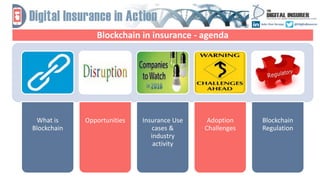
Blockchain in insurance - agenda
What is
Blockchain
Opportunities Insurance Use
cases &
industry
activity
Adoption
Challenges
Blockchain
Regulation
Blockchain technology – the basics
What is Blockchain?
Blockchain is a decentralized ledger, or list,
of all transactions across a network of
participamts with no central authority
Through Blockchain, users can transfer files
(including payments) across the internet
without the need for a central third party to
authorize and track exchanges
Combines distributed computing power
with crypto-token to create fail proof, self
healing applications - Near real time
replication and syncing across network
Helps avoid duplicity - uses cryptography to
authenticate access
Enables maintenance of unalterable
transaction history - Has inbuilt mechanism
to make it hard to change old records
Solves the Trust Problem - Decentralised,
dis-intermediated and transparent
Open source - usually exists over a peer-to-
peer network
How Blockchain Works
Source : https://www.weforum.org/agenda/2015/11/how-will-blockchain-technology-transform-financial-services/
Transparent
Secure
De-centralized
P2P
Self Reparable
No Double Spend
Immutable
Trustless
Blockchain adoption
Blockchain actvity Key development areas
https://www.evry.com/globalassets/insight/bank2020/bank-2020---blockchain-powering-the-internet-of-value---whitepaper.pdfhttp://blog.willis.com/2016/07/for-insurers-blockchain-is-the-new-black/
Although currently the technical and regulatory framework are
not quite mature enough for mass-market adoption, Blockchain
Tech do provide compelling future use-cases and opportunities
1. Build cryptocurrencies for specific
purposes keeping governments and
regulation in mind – Bitcoin
2. Creation of decentralised database
backed by large financial services
consortium. Build public ledger to
register physical assets - Factom
3. Development of value ecosystem -
Ethereum, R3CEV
4. Development of niche applications
by FinTechs and InsurTechs like Smart
Contracts, Smart Payments, Patient
Data Management - SmartContract,
Ripple
Disrupting (& improving) insurance
Areas of Impact & opportunity How Blockchain can benefit Insurance
https://www.willistowerswatson.com/en/insights/2016/06/want-to-get-an-insurers-attention-just-say-blockchain
Reengineering processes
Bundling of services
Rethinking role of intermediaries
Decentralized governance
New flows of value
New legal and regulatory frameworks
7
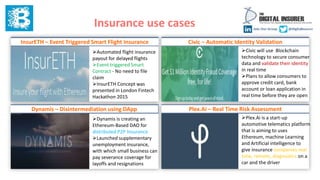
Dynamis – Disintermediation using DApp
Civic – Automatic Identity Validation
Plex.Ai – Real Time Risk Assessment
Insurance use cases
InsurETH – Event Triggered Smart Flight Insurance
Automated flight insurance
payout for delayed flights
Event triggered Smart
Contract - No need to file
claim
InsurETH Concept was
presented in London Fintech
Hackathon 2015
Civic will use Blockchain
technology to secure consumer
data and validate their identity
in real time
Plans to allow consumers to
approve credit card, bank
account or loan application in
real time before they are open
Dynamis is creating an
Ethereum-Based DAO for
distributed P2P Insurance
Launched supplementary
unemployment insurance,
with which small business can
pay severance coverage for
layoffs and resignations
Plex.Ai is a start-up
automotive telematics platform
that is aiming to uses
Ethereum, machine Learning
and Artificial intelligence to
give insurance companies real
time, remote, diagnostics on a
car and the driver
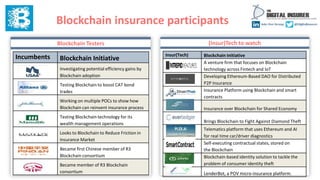
Blockchain insurance participants
Blockchain Testers (Insur)Tech to watch
Incumbents Blockchain Initiative
Investigating potential efficiency gains by
Blockchain adoption
Testing Blockchain to boost CAT bond
trades
Working on multiple POCs to show how
Blockchain can reinvent insurance process
Testing Blockchain technology for its
wealth management operations
Looks to Blockchain to Reduce Friction in
Insurance Market
Became first Chinese member of R3
Blockchain consortium
Became member of R3 Blockchain
consortium
Insur(Tech) Blockchain Initiative
A venture firm that focuses on Blockchain
technology across Fintech and IoT
Developing Ethereum-Based DAO for Distributed
P2P Insurance
Insurance Platform using Blockchain and smart
contracts
Insurance over Blockchain for Shared Economy
Brings Blockchain to Fight Against Diamond Theft
Telematics platform that uses Ethereum and AI
for real time car/driver diagnostics
Self-executing contractual states, stored on
the Blockchain
Blockchain-based identity solution to tackle the
problem of consumer identity theft
LenderBot, a POV micro-insurance platform.
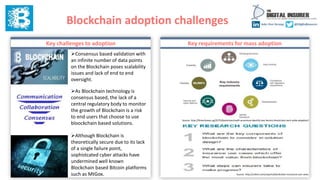
Blockchain adoption challenges
Key challenges to adoption Key requirements for mass adoption
Consensus based validation with
an infinite number of data points
on the Blockchain poses scalability
issues and lack of end to end
oversight.
Although Blockchain is
theoretically secure due to its lack
of a single failure point,
sophistcated cyber attacks have
undermined well known
Blockchain based Bitcoin platforms
such as MtGox.
As Blockchain technology is
consensus based, the lack of a
central regulatory body to monitor
the growth of Blockchain is a risk
to end users that choose to use
bloockchain based solutions.
Source: http://fintechnews.sg/2575/blockchain/swift-accenture-identify-key-factors-blockchain-tech-wide-adoption/
Source: http://celent.com/reports/blockchain-insurance-use-cases
Example of recent teething problems
The Curious Case of DAO – The Hard Fork The Hard Fork Implications
Biggest moment for Ethereum came in April 2016, with a
radical experiment - Distributed Autonomous Organization
(DAO) - an ambitious goal to build a human less venture
capital firm that would allow the investors to make all the
decisions through smart contracts
Launched on April 30th 2016, by May 21, DAO had raised
$150 million from roughly 11,000 investors, in what’s
considered the biggest crowd funding effort in history
Then it got Hacked and $50 million was stolen, with
people watching in real time
To fix the issue, the intervention that’s being weighed was
called a “Hard Fork.” It’s a decentralized network’s version
of a reset button. Hard Fork got implemented in July 2016.
Blockchains not hack proof – they have similar weaknesses to
other technology. Expect new threats as new applications
develop
A supposedly immutable Blockchain history can be altered
A hard fork could be taken as a serious violation of the
principles that underlie the Blockchain protocol leading to
resistance to adoption
Incidents like the DAO hack and the hard fork lend weight to
viewpoints that banks and other regulated institutions need to
build their own private Blockchains rather than agreeing on a
decentralised public network
Blockchain - regulation
Regulatory Enablement of Blockchain - Singapore’s Smart Financial Centre
Source: MAS presentation at IIS Global Summit June 2016
Identity and
authentication
enabled by
Blockchain are part
of the strategic
plans in Singapore
Although Blockchain Tech tackles
inefficiencies, it bypasses regulation
completely in its “purest form”
Government agencies may slow down
the adoption by introducing new laws
to monitor and regulate Blockchain for
compliance
Similar business models may elicit
different reactions from regulators from
different regions and countries
On the upsaide , Governments can
play an enabling role e.g. Singapore
Concerns and Effect
Blockchain in Insurance – next steps
1. Improving governance & security
2. Blockchain configuration options one
or more of
- Public
- Private
- Consortium
- Govt (e.g. indentity)
3. Use cases that go live and deliver the
potential of blockchain
- Identifiy verification
- Smart contracts
Contact The Digital Insurer: hugh.terry@the-digital-insurer.com
Our digital insurance content is free for subscribers and supported by our sponsors.
Join more than 12,000 others @ the-digital-insurer
About The Digital Insurer
The forum for professionals interested in digital insurance
Objective: to help the insurance industry to take full advantage
of digital trends and technologies
The services we offer to ensure our content
remains free
Site sponsorship for content sections
Listing & content development services for technology companies
Consulting services on digital insurance in partnership with KPMG
Conference speaking and workshops
Database & insights on digital innovations
around the world
Snippets, InViews and case studies
Searchable by region and category
Published by: Sponsored by:
What is Digital Insurance in Action?

Blockchain for Insurance

  • 1.
    InView : Blockchainin insurance – progress review
  • 2.
    Blockchain Commentary & insights Blockchainhas the potential for “modernizing, streamlining and simplifying the siloed design of the financial industry”. Ethereum, a crowd funded start-up founded in 2014, runs a decentralized platform that allows other firms to develop Blockchain based applications, popularised the use of Blockchain. The Blockchain is constantly evolving and extending beyond cryptocurrency with new use cases constantly emerging however questons remain regarding security and recourse for users. Background Blockchain was invented in 2009 as a decentralized infrasturcture that can enable new currency formats and exchanges between an infinite number of participants. Current uses of Blockchain include real estate transactions, government IDs, financial transactions, insurance, employment contracts, payroll payments, selling music and organizing elections. Over $1 billion has been invested in Blockchain companies since 2009, with recent attention focusing on the insurance industry due to Blockchain’s potential to improve identiity checks and claims settlement amongst other use cases. http://www.whitecase.com/publications/insight/beyond-bitcoin-blockchain-revolution-financial-services
  • 3.
    Blockchain in insurance- agenda What is Blockchain Opportunities Insurance Use cases & industry activity Adoption Challenges Blockchain Regulation
  • 4.
    Blockchain technology –the basics What is Blockchain? Blockchain is a decentralized ledger, or list, of all transactions across a network of participamts with no central authority Through Blockchain, users can transfer files (including payments) across the internet without the need for a central third party to authorize and track exchanges Combines distributed computing power with crypto-token to create fail proof, self healing applications - Near real time replication and syncing across network Helps avoid duplicity - uses cryptography to authenticate access Enables maintenance of unalterable transaction history - Has inbuilt mechanism to make it hard to change old records Solves the Trust Problem - Decentralised, dis-intermediated and transparent Open source - usually exists over a peer-to- peer network How Blockchain Works Source : https://www.weforum.org/agenda/2015/11/how-will-blockchain-technology-transform-financial-services/ Transparent Secure De-centralized P2P Self Reparable No Double Spend Immutable Trustless
  • 5.
    Blockchain adoption Blockchain actvityKey development areas https://www.evry.com/globalassets/insight/bank2020/bank-2020---blockchain-powering-the-internet-of-value---whitepaper.pdfhttp://blog.willis.com/2016/07/for-insurers-blockchain-is-the-new-black/ Although currently the technical and regulatory framework are not quite mature enough for mass-market adoption, Blockchain Tech do provide compelling future use-cases and opportunities 1. Build cryptocurrencies for specific purposes keeping governments and regulation in mind – Bitcoin 2. Creation of decentralised database backed by large financial services consortium. Build public ledger to register physical assets - Factom 3. Development of value ecosystem - Ethereum, R3CEV 4. Development of niche applications by FinTechs and InsurTechs like Smart Contracts, Smart Payments, Patient Data Management - SmartContract, Ripple
  • 6.
    Disrupting (& improving)insurance Areas of Impact & opportunity How Blockchain can benefit Insurance https://www.willistowerswatson.com/en/insights/2016/06/want-to-get-an-insurers-attention-just-say-blockchain Reengineering processes Bundling of services Rethinking role of intermediaries Decentralized governance New flows of value New legal and regulatory frameworks
  • 7.
    7 Dynamis – Disintermediationusing DApp Civic – Automatic Identity Validation Plex.Ai – Real Time Risk Assessment Insurance use cases InsurETH – Event Triggered Smart Flight Insurance Automated flight insurance payout for delayed flights Event triggered Smart Contract - No need to file claim InsurETH Concept was presented in London Fintech Hackathon 2015 Civic will use Blockchain technology to secure consumer data and validate their identity in real time Plans to allow consumers to approve credit card, bank account or loan application in real time before they are open Dynamis is creating an Ethereum-Based DAO for distributed P2P Insurance Launched supplementary unemployment insurance, with which small business can pay severance coverage for layoffs and resignations Plex.Ai is a start-up automotive telematics platform that is aiming to uses Ethereum, machine Learning and Artificial intelligence to give insurance companies real time, remote, diagnostics on a car and the driver
  • 8.
    Blockchain insurance participants BlockchainTesters (Insur)Tech to watch Incumbents Blockchain Initiative Investigating potential efficiency gains by Blockchain adoption Testing Blockchain to boost CAT bond trades Working on multiple POCs to show how Blockchain can reinvent insurance process Testing Blockchain technology for its wealth management operations Looks to Blockchain to Reduce Friction in Insurance Market Became first Chinese member of R3 Blockchain consortium Became member of R3 Blockchain consortium Insur(Tech) Blockchain Initiative A venture firm that focuses on Blockchain technology across Fintech and IoT Developing Ethereum-Based DAO for Distributed P2P Insurance Insurance Platform using Blockchain and smart contracts Insurance over Blockchain for Shared Economy Brings Blockchain to Fight Against Diamond Theft Telematics platform that uses Ethereum and AI for real time car/driver diagnostics Self-executing contractual states, stored on the Blockchain Blockchain-based identity solution to tackle the problem of consumer identity theft LenderBot, a POV micro-insurance platform.
  • 9.
    Blockchain adoption challenges Keychallenges to adoption Key requirements for mass adoption Consensus based validation with an infinite number of data points on the Blockchain poses scalability issues and lack of end to end oversight. Although Blockchain is theoretically secure due to its lack of a single failure point, sophistcated cyber attacks have undermined well known Blockchain based Bitcoin platforms such as MtGox. As Blockchain technology is consensus based, the lack of a central regulatory body to monitor the growth of Blockchain is a risk to end users that choose to use bloockchain based solutions. Source: http://fintechnews.sg/2575/blockchain/swift-accenture-identify-key-factors-blockchain-tech-wide-adoption/ Source: http://celent.com/reports/blockchain-insurance-use-cases
  • 10.
    Example of recentteething problems The Curious Case of DAO – The Hard Fork The Hard Fork Implications Biggest moment for Ethereum came in April 2016, with a radical experiment - Distributed Autonomous Organization (DAO) - an ambitious goal to build a human less venture capital firm that would allow the investors to make all the decisions through smart contracts Launched on April 30th 2016, by May 21, DAO had raised $150 million from roughly 11,000 investors, in what’s considered the biggest crowd funding effort in history Then it got Hacked and $50 million was stolen, with people watching in real time To fix the issue, the intervention that’s being weighed was called a “Hard Fork.” It’s a decentralized network’s version of a reset button. Hard Fork got implemented in July 2016. Blockchains not hack proof – they have similar weaknesses to other technology. Expect new threats as new applications develop A supposedly immutable Blockchain history can be altered A hard fork could be taken as a serious violation of the principles that underlie the Blockchain protocol leading to resistance to adoption Incidents like the DAO hack and the hard fork lend weight to viewpoints that banks and other regulated institutions need to build their own private Blockchains rather than agreeing on a decentralised public network
  • 11.
    Blockchain - regulation RegulatoryEnablement of Blockchain - Singapore’s Smart Financial Centre Source: MAS presentation at IIS Global Summit June 2016 Identity and authentication enabled by Blockchain are part of the strategic plans in Singapore Although Blockchain Tech tackles inefficiencies, it bypasses regulation completely in its “purest form” Government agencies may slow down the adoption by introducing new laws to monitor and regulate Blockchain for compliance Similar business models may elicit different reactions from regulators from different regions and countries On the upsaide , Governments can play an enabling role e.g. Singapore Concerns and Effect
  • 12.
    Blockchain in Insurance– next steps 1. Improving governance & security 2. Blockchain configuration options one or more of - Public - Private - Consortium - Govt (e.g. indentity) 3. Use cases that go live and deliver the potential of blockchain - Identifiy verification - Smart contracts
  • 13.
    Contact The DigitalInsurer: hugh.terry@the-digital-insurer.com Our digital insurance content is free for subscribers and supported by our sponsors. Join more than 12,000 others @ the-digital-insurer About The Digital Insurer The forum for professionals interested in digital insurance Objective: to help the insurance industry to take full advantage of digital trends and technologies The services we offer to ensure our content remains free Site sponsorship for content sections Listing & content development services for technology companies Consulting services on digital insurance in partnership with KPMG Conference speaking and workshops Database & insights on digital innovations around the world Snippets, InViews and case studies Searchable by region and category Published by: Sponsored by: What is Digital Insurance in Action?

Editor's Notes

  • #2 References for additional reading Links – https://www.google.co.in/url?sa=t&rct=j&q=&esrc=s&source=web&cd=12&cad=rja&uact=8&ved=0ahUKEwj78Jikrv_NAhWHuI8KHXowBz44ChAWCCAwAQ&url=https%3A%2F%2Fwww.willistowerswatson.com%2FDownloadMedia.aspx%3Fmedia%3D%257BF707137A-357E-41B8-9244-3B6363298D6A%257D&usg=AFQjCNFJ21MtbFLKNtC5AgNRQqsGiMwqzg&sig2=UGCBNJjxQuGresfMhu82KQ https://www.google.co.in/url?sa=t&rct=j&q=&esrc=s&source=web&cd=12&cad=rja&uact=8&ved=0ahUKEwigkcz3pf_NAhUBJ8AKHdNxAOY4ChAWCCAwAQ&url=http%3A%2F%2Fwww.mckinsey.com%2F~%2Fmedia%2FMcKinsey%2FIndustries%2FFinancial%2520Services%2FOur%2520Insights%2FBlockchain%2520in%2520insurance%2520opportunity%2520or%2520threat%2FBlockchain-in-insurance-opportunity-or-threat.ashx&usg=AFQjCNFBV7k9N5rzkw5sHnmEclkpBWvwpg&sig2=DxAkDmKsL41OVR5Qwm0gKg&bvm=bv.127178174,d.ZGg http://blog.willis.com/2016/07/for-insurers-blockchain-is-the-new-black/ http://fintechnews.sg/2575/blockchain/swift-accenture-identify-key-factors-blockchain-tech-wide-adoption/ https://cryptortrust.com/2015/12/22/why-asias-bitcoin-blockchain-industry-will-skyrocket-in-2016/