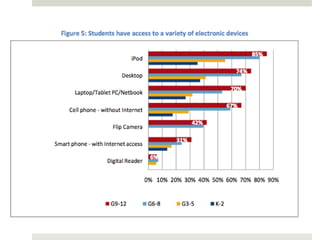
Pockets of Potential:  How schools are using students own phones for enhancing and extending LearningLiz Kolb, Ph.D.University of Michiganelikeren@umich.eduhttp://cellphonesinlearning.comTwitter:  lkolbPresentation Link:  tiny.cc/kolb123Liz’s Mobile Business CardSend a new text:  50500In message: kolb http://contxts.com
AgendaQuick Overview of StatisticsText Messaging Projects (SMS)Multimedia Projects (Picture/Video)Audio Projects (Phone Calls)Policy and SafetyQRcodes and Smartphones
No Cell Phone?  Use iPodiTouchTiny URLhttp://tiny.ccWeb accessNeed WifiCan do a lot off line with AppsFree Texting AppsText for Free
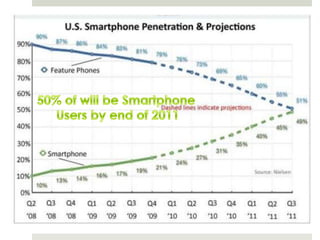
50% of will be Smartphone Users by end of 2011
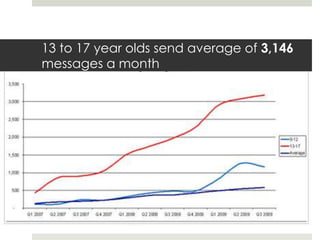
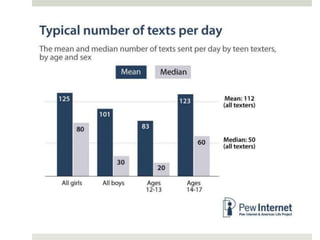
13 to 17 year olds send average of 3,146 messages a month
1:1 Programs have BIG impact on achievement when properly implementedSchools with one-to-one computing programs have fewer discipline problemslower dropout rates (related to social media use)higher rates of college attendance than schools with a higher ratio of students to computersBetter home to school communication85% of 1:1 schools in the study reported that their students’ achievement scores on high-stakes tests were on the rise. All of these schools employed certain strategies for successelectronic formative assessments on a regular basisfrequent collaboration of teachers in professional learning communities.Employ the use of social media and social networkshttp://projectred.org/news/?p=79
Research on cell phones in learning says…"The proportions of textisms that kids used in their sentence translations was positively linked to verbal reasoning; the more textspeak kids used, the higher their test scores”"The younger the age at which the kids had received mobile phones, the better their ability to read words and identify patterns of sound in speech.”http://www.britac.ac.uk/news/news.cfm/newsid/14
Chester NY Middle SchoolKids who used their cell phones to boil down the main points of the stanzas got 80% of the questions about a poem correct on a state test. Kids taught the same poem in the traditional way – reading, reciting and discussing – got only 40% of the questions right.
http://www.abcactionnews.com/dpp/news/region_pasco/wesley_chapel/teacher-welcomes-texting-in-class
Text Messaging (SMS ONLY)
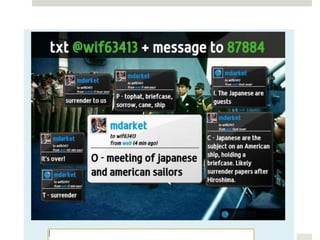
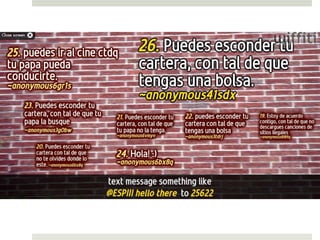
http://wiffiti.com/screens/73806
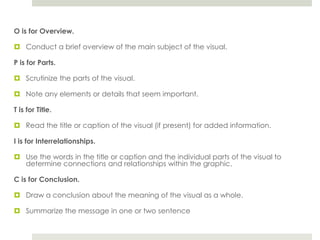
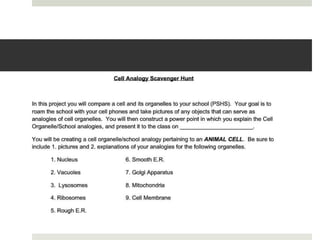
O is for Overview.Conduct a brief overview of the main subject of the visual.P is for Parts.Scrutinize the parts of the visual.Note any elements or details that seem important.T is for Title.Read the title or caption of the visual (if present) for added information.I is for Interrelationships.Use the words in the title or caption and the individual parts of the visual to determine connections and relationships within the graphic.C is for Conclusion.Draw a conclusion about the meaning of the visual as a whole.Summarize the message in one or two sentence
http://wiffiti.com
Describe yourself in 6 wordshttp://www.polleverywhere.com/free_text_polls/MTQ2NjM0MTczNASend text to 22333In text type 48813 then 6 words
6 Word Memoirshttp://www.polleverywhere.com/polls/ODg2ODQwNDYw/results
Text Message Alerts!Sending out mass text messages to large or small groups of people.  http://remind101.com (one way messaging uses phone numbers)ORhttp://cel.ly (2 way messaging uses short codes)
Join our Cel.ly Text on the Fly!Send a message to 23559In message @LizKolbFollow directions in your text
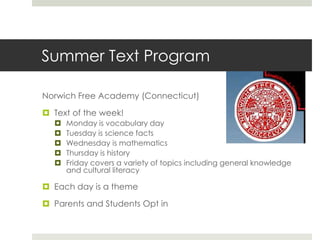
Summer Text ProgramNorwich Free Academy (Connecticut)Text of the week!Monday is vocabulary dayTuesday is science factsWednesday is mathematicsThursday is history Friday covers a variety of topics including general knowledge and cultural literacy Each day is a themeParents and Students Opt in
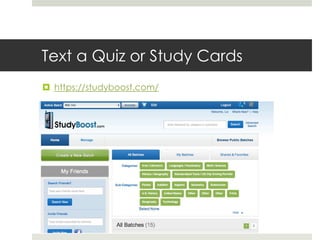
Text a Quiz or Study Cardshttps://studyboost.com/
Scavenger Hunts of Local Historyhttp://scvngr.comhttp://web20history.ning.com/video/scvngr-for-us-history-testhttp://www.scvngr.com/university
Distracted Driving HuntText “driving” to 728647
Follow Experts on Twitter via SMSTo Follow via SMS send:  “follow @twitterid” to 40404 (no twitter account needed)Politicianshttp://tweetcongress.org/Breaking News (CNN, NPR…)Authorshttp://www.squidoo.com/TwitterAuthorsScientistshttp://sciencepond.com/HistoriansSend “follow lkolb” to 40400
Multimedia ProjectsPictures, Videos, Voice and Text
Connecting Math to Everyday Experienceshttp://cellblock.comhttp://bigmacmath.wikispaces.com/cellblock
Posting a picture (using an email address) from a basic phoneAdd a new contact in your phoneName the contactAdd the email address under the email optionSAVEWhen you send…select the contact to send your picture to.
Mobile Pictures and Videoshttp://flickr.comFlickr Mobile
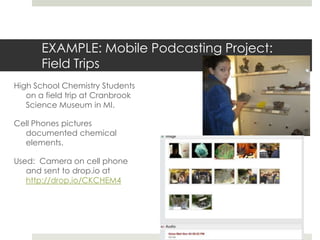
EXAMPLE: Mobile Podcasting Project:  Field TripsHigh School Chemistry Students on a field trip at Cranbrook Science Museum in MI. Cell Phones pictures documented chemical elements.Used:  Camera on cell phone and sent to drop.io at http://drop.io/CKCHEM4
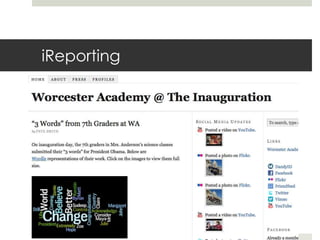
iReporting
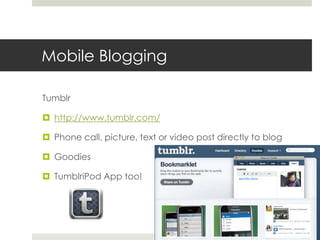
Mobile BloggingTumblrhttp://www.tumblr.com/Phone call, picture, text or video post directly to blogGoodiesTumblriPod App too!
Tumblr in ClassroomGeology Rocks!http://geologyrocks.tumblr.com/
Voice and Phone Calling
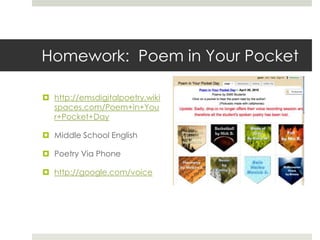
Homework:  Poem in Your Pockethttp://emsdigitalpoetry.wikispaces.com/Poem+in+Your+Pocket+DayMiddle School EnglishPoetry Via Phonehttp://google.com/voice
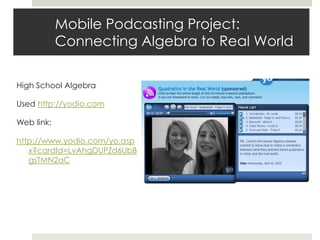
Mobile Podcasting Project:  Connecting Algebra to Real WorldHigh School AlgebraUsed http://yodio.comWeb link:http://www.yodio.com/yo.aspx?cardId=LvAhgDUPZd6UbBgsTMN2aC
Mobile Podcasting Project:  Author StudyMiddle School 6th-7th GradeUsed: http://hipcast.comWeb link:http://541sparkes.blogspot.com/2007/07/author-blog-6.html
Murmur Oral History Projecthttp://murmurtoronto.ca/fortyork
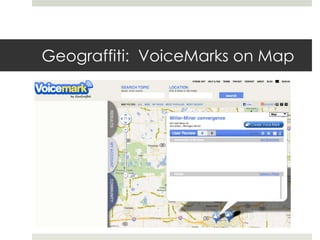
Geograffiti:  VoiceMarks on Map
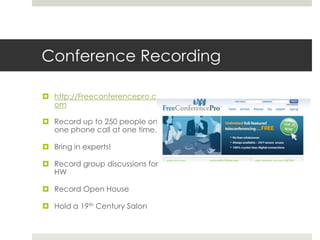
Conference Recordinghttp://Freeconferencepro.comRecord up to 250 people on one phone call at one time.Bring in experts!Record group discussions for HWRecord Open House Hold a 19th Century Salon
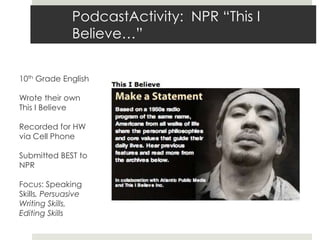
PodcastActivity:  NPR “This I Believe…”10th Grade EnglishWrote their own This I BelieveRecorded for HW via Cell PhoneSubmitted BEST to NPRFocus: Speaking Skills, Persuasive Writing Skills, Editing Skills
iPadio:  Phonecastinghttp://ipadio.comCreate personal podcasts (public or private)Attach to any blogRSS feedsNo time limitFree!
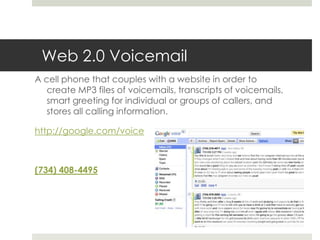
Web 2.0 VoicemailA cell phone that couples with a website in order to create MP3 files of voicemails, transcripts of voicemails, smart greeting for individual or groups of callers, and stores all calling information.http://google.com/voice(734) 408-4495
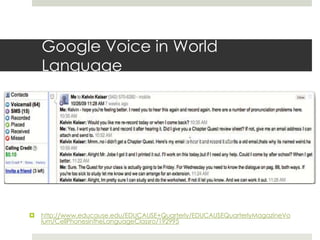
Google Voice in World Languagehttp://www.educause.edu/EDUCAUSE+Quarterly/EDUCAUSEQuarterlyMagazineVolum/CellPhonesintheLanguageClassro/192995
Text Messaging Safely and Appropriately Within Classroom Learning:  Step by Step Integration Guide
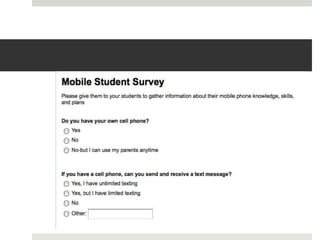
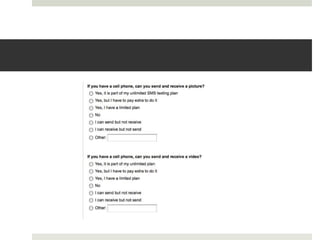
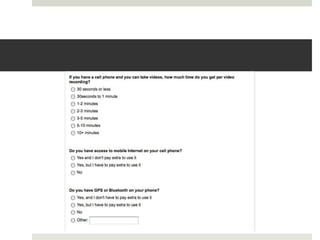
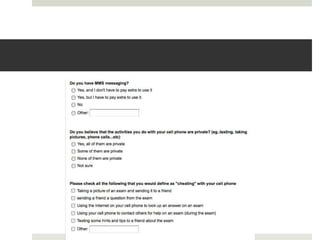
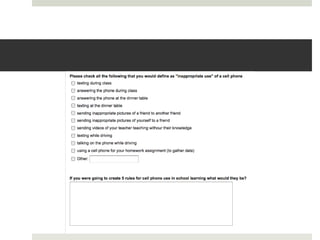
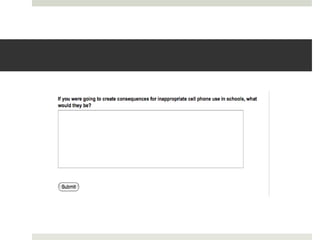
Step 1:  Survey studentsGive Students a Survey
Step 2:  MOBILE Safety
Discuss Mobile Safety & Appropriate UsePart of digital footprintYour digital dossier that includes Internet activity such as social networking, email, chat rooms, YOU can’t erase this!!!  Permanent recordEVERYTHING you send via text message (pictures, videos, text, audio…etc) is PUBLIC!!!Example:  Detroit Mayor Kwame KilpatrickMobile “bullying” and “sexting” is publicMTV Special on Sexting and QuizLG Text Education or That’s Not CoolStudents should know their plansBring in their cell phone plan and a billDiscuss what is charged and how muchGive Students a SurveyLearn more specific safety tips at Connectsafely
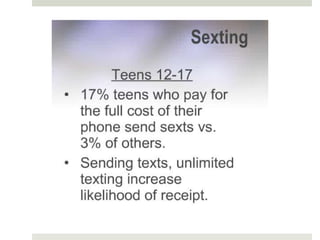
Life ConsequencesStudents are sometimes “sexting” “to friends for their entertainment value, as a joke or for fun."Six teens face child porn (13 to 15) charges after being caught "sexting" each other.  Criminal Charge!IN PA, 3 girls (12, 12, 16) charged with child pornography for sexing.  Picture of  them in bras.15% of teenagers have risque photos of themselves or their friends on their cell phones.1 in 5 sext recipients report that they have passed the images along to someone else http://www.cnn.com/video/#/video/bestoftv/2009/01/15/pn.sexting.teens.cnn
"If you take a picture, you can be accused of producing child pornography; if you send it to somebody, you can be accused of distributing child pornography; and if you keep a picture, you can be accused of possessing child pornography.  Anywhere along this chain of transmission of the images, you can be charged as a registered sex offender." -Parry Aftab, an Internet privacy and security lawyer.
School admissions officers and potential employers often look at online profiles…the repercussions of sending an inappropriate message could be endless
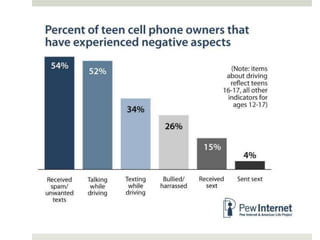
Dangers of Texting and DrivingOne in three (34%) texting teens ages 16-17 say they have texted while driving. That translates into 26% of all American teens ages 16-17;Half (52%) of cell-owning teens ages 16-17 say they have talked on a cell phone while driving. That translates into 43% of all American teens ages 16-17;48% of all teens ages 12-17 say they have been in a car when the driver was texting;40% say they have been in a car when the driver used a cell phone in a way that put themselves or others in danger.
PSA:  Texting While Driving Lesson Activity 1:  Take QuizAre you a distracted driver? http://cartalk.com/ddc/Show Videoshttp://www.oprah.com/oprahshow/Americas-New-Deadly-Obsession-Partial-Episode-Videohttp://www.psych.utah.edu/lab/appliedcognition/Students in GroupsIdentify key risk behaviors in distracted driving (text to interactive Wiffiti.com board)Share with the class
Activity 2:  Create a PSA for distracted drivingWatch Sample PSA’shttp://www.citizenglobal.com/harpoproductions/nophonezone/mediaWeb Resources for ResearchCar Talk (NPR) Distracted Driving Center http://cartalk.com/ddc/National Safety Council http://www.nsc.org/safety_road/Distracted_Driving/Pages/KeyResearch.aspx#cognitivePEW Internet Research http://www.pewinternet.org/Reports/2009/Teens-and-Distracted-Driving.aspx
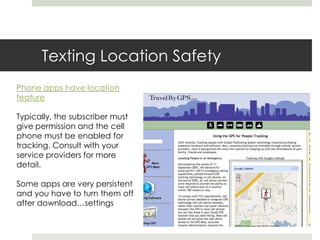
Texting Location SafetyPhone apps have location featureTypically, the subscriber must give permission and the cell phone must be enabled for tracking. Consult with your service providers for more detail.  Some apps are very persistent and you have to turn them off after download…settings
Smartphone Location Trackinghttp://www.youtube.com/watch?v=N2vARzvWxwY
Texting and BullyingWhen kids receive harassing or inappropriate text messages, there are several things they can do:Never, ever respond to the message sender.
Report it as soon as possible to a trusted adult (and if that person doesn’t help, tell others until someone does).
Save or print the message to keep a record, then delete it from the phone.
Only keep contact information of close friends and family in their address book.
Talk to their wireless provider about how they can help (such as blocking the messages or changing their number).Step 3:  Social Contract
Tips for Social ContractThe teacher should explain to the students that there should be some rules concerning how their cell phones will be used in the classroom, and students have an opportunity to be part of the rule making process (the goal is to have no more than 5 simple rules to follow and a consequence for non-compliance).Students should be asked to brainstorm rules.  During the brainstorm,  students should be encouraged to support their rule with reasons why it should be implemented (such as “cell phones should be on vibrate at all times”, the student should then explain why this is important.  If they can’t, ask for other students to help explain it.)Once there is a workable list of rules, students should be encouraged to narrow the list to about five rules.  The teacher may want to do this himself, or to use the analogy of a professional job where one is given a cell phone and a contract.  One could ask the students to imagine that they were given a professional contract, hen they could be asked which“rules” they think should be implemented in their classroom.  Using this analogy may also help to eliminate some redundant or unnecessary rules.Once the rules have been selected.  The students should be asked to brainstorm consequences for not following the rules.   Once again, asking students to decide on the best option.  The teacher should let the students know that she will be adding these rules and consequences to a permission form that will be sent home to have parents and the students sign.
Text Etiquettehttp://www.mastersdegree.com/blog/30-text-etiquette-rules-every-addict-needs-to-know/
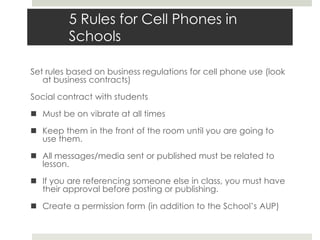
5 Rules for Cell Phones in SchoolsSet rules based on business regulations for cell phone use (look at business contracts)Social contract with studentsMust be on vibrate at all times
Keep them in the front of the room until you are going to use them.
All messages/media sent or published must be related to lesson.
If you are referencing someone else in class, you must have their approval before posting or publishing.
Create a permission form (in addition to the School’s AUP)Step 4:  Permission Form
Sample Permission Form
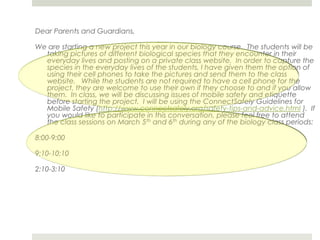
Dear Parents and Guardians,We are starting a new project this year in our biology course.  The students will be taking pictures of different biological species that they encounter in their everyday lives and posting on a private class website.  In order to capture the species in the everyday lives of the students, I have given them the option of using their cell phones to take the pictures and send them to the class website.   While the students are not required to have a cell phone for the project, they are welcome to use their own if they choose to and if you allow them.  In class, we will be discussing issues of mobile safety and etiquette before starting the project.  I will be using the ConnectSafely Guidelines for Mobile Safety (http://www.connectsafely.org/safety-tips-and-advice.html ).  If you would like to participate in this conversation, please feel free to attend the class sessions on March 5th and 6th during any of the biology class periods:8:00-9:009:10-10:102:10-3:10
In addition, I will be holding an information night about mobile safety and the project on March 3rd at 7:00pm.  I will go over the project in detail, show you how it works, and also answer any questions you may have about using cell phones in learning.
There is some research that supports the need for using student cell phones in learning and teaching students how cell phones can be a productive and important tool for their future professional growth.  This will be discussed in detail at the information night as well as during the March 5th and 6th class sessions.
Finally, you are welcome to participate in this project!  We are using a private space in a photo-sharing site called Flickr, where all the photos will be sent and eventually posted to a map at the exact location they were uncovered.  You are welcome to take a picture of a biological species that you encounter, send it to kolb@flickr.com along with a short text message on what you think the species is and the location of where you took the picture!  Feel free to check the website each week to see the learning progress.  Login:  Kolbbiology Password:  Biokid
I hope to see you in class and/or on the March 3rd information night.  In the meantime if you have any questions or concerns do not hesitate to contact me at kolb@gmail.com or by phone 777-222-5777.I give permission for my child to use their cell phone for phone calling for this project:______________________________________________________. (parent signature)**They can only use _____ number of calling minutes for this projectI give permission for my child to use their cell phone for text messaging for this project:______________________________________________________. (parent signature)**They can only use _____ number of text messages for this projectI give permission for my child to use their cell phone for mobile Internet for this project:______________________________________________________. (parent signature)I give permission for my child to use their cell phone for taking and sending pictures and/ or videos (circle one or both) for this project:______________________________________________________. (parent signature)**They can only send _____ number of media messages for this project
Rules agreed upon by students and teacherCell Phones Must Be on Vibrate at All TimesCell phones should be placed in the front of the room at the beginning of class (at the designated table in your numbered slot) and whenever they are not needed for instructionAll mobile messages or media sent from your phone during class MUST be related to the lesson or activityIf you are referencing someone else in class, you must have their (recorded verbal or written) approval before posting or publishing.
ConsequencesThe student will be asked to write a letter home to you and explain why they did not follow the rules in class.  They will also be asked to come up with better class guidelines around cell phones use in schools so this does not occur again. I will adhere to the classroom rules for cell phone use___________________________________________________. (student signature) Thank youLiz Kolb
Step 5:  Alternatives
Alternative IdeasSelect an online resource that couples with cell phones, but also has web-based options for uploading or sharing.  For example if you use Flickr to send pictures to and from mobile phones to a private place online, students who do not have a cell phone, can still upload to Flickr via the web.Grouping students.  Purposely putting students in groups or pairs where the teacher knows that at least one of the group members has a cell phone that can be used for the project is a simple way to keep the students who do not have cell phones anonymous (because the teacher can say, “someone in each group should take out their cell phone to use for this activity.”)Allow students to use your own cell phone.Landlines (many web-based cell phone resources have toll free calling numbers) for phone calling activities.  Center activities for K-8 students where the teacher can use one cell phone with all the students during center time.Allow students to use hardcopy options that they hand in to you, and you upload the work to the online resource.  This is important since a few parents do not want their children using cell phones in any capacity.
Step 6:  parent Information night
Parent Night IdeasAn overview of why you are using the student cell phones.Describe the project(s) that will revolve around cell phone use, and any cost associated with the project and student cell phone use. Alternatives that the students have for completing the project without using cell phones Any change in school cell phone policy as a result of the project(s). Rules of the cell phone use during the project and the consequences for the students who do not follow the rules.Parents should be invited to participate in the activity (within reason). Provide parents with multiple ways for feedback (email address, a text message number, a voicemail (Google Voice would be great for this), and an online anonymous survey (such as Google Form).
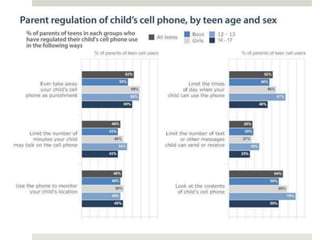
Ideas For Parentshttp://www.safetyweb.com/ (monitor your child’s digital identity).Visit websites that have ideas on how to stay safe via the mobile phone.  One example would be http://connectsafely.comTalk to your kids about text bullying and sexting, especially the short- and long-term consequences.Monitor their cell phone use: Who are they texting? Who is texting them?Suggest that everyone’s cell phone stay on the kitchen counter or another centralized place while they’re home.Set rules about the kind of behavior that is and is not acceptable—on a cell phone, or anywhere else. Remind kids of the rules periodically.
Ideas for ParentsModel Appropriate Use:  Try not to text or talk on the phone while driving, try to not interrupt conversations or dinners with cell phone activities.  Also explain and point out to the children when you are modeling an appropriate use such as, “I am not answering the phone because we are having a family dinner and I want to give my full attention to my family for this hour.” Document Family Activities:  Model how to capture pictures or videos of family vacations or family activities via the cell phone.  Demonstrate how to capture reactions (via audio recording) to family activities.  This is a great way to model data collection in the real world via cell phone. Get involved with the classroom projects.  Since parents often have their mobile phones with them all day, they could capture images or send text messages into class for the school assignment along with their children.  They could join the class text message alert in order to receive information from the teacher about homework or other class activities.
Step 7:  start slowly, remind, Follow through, and Feedback
Improving on Traditional Learning
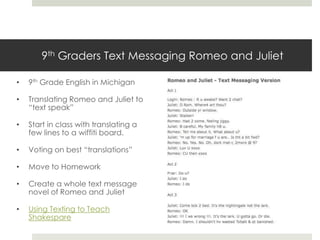
9th Graders Text Messaging Romeo and Juliet9th Grade English in Michigan
Translating Romeo and Juliet to “text speak”
Start in class with translating a few lines to a wiffiti board.
Voting on best “translations”

Blissfield Presentation

  • 1.
    Pockets of Potential: How schools are using students own phones for enhancing and extending LearningLiz Kolb, Ph.D.University of Michiganelikeren@umich.eduhttp://cellphonesinlearning.comTwitter: lkolbPresentation Link: tiny.cc/kolb123Liz’s Mobile Business CardSend a new text: 50500In message: kolb http://contxts.com
  • 2.
    AgendaQuick Overview ofStatisticsText Messaging Projects (SMS)Multimedia Projects (Picture/Video)Audio Projects (Phone Calls)Policy and SafetyQRcodes and Smartphones
  • 3.
    No Cell Phone? Use iPodiTouchTiny URLhttp://tiny.ccWeb accessNeed WifiCan do a lot off line with AppsFree Texting AppsText for Free
  • 5.
    50% of willbe Smartphone Users by end of 2011
  • 6.
    13 to 17year olds send average of 3,146 messages a month
  • 8.
    1:1 Programs haveBIG impact on achievement when properly implementedSchools with one-to-one computing programs have fewer discipline problemslower dropout rates (related to social media use)higher rates of college attendance than schools with a higher ratio of students to computersBetter home to school communication85% of 1:1 schools in the study reported that their students’ achievement scores on high-stakes tests were on the rise. All of these schools employed certain strategies for successelectronic formative assessments on a regular basisfrequent collaboration of teachers in professional learning communities.Employ the use of social media and social networkshttp://projectred.org/news/?p=79
  • 9.
    Research on cellphones in learning says…"The proportions of textisms that kids used in their sentence translations was positively linked to verbal reasoning; the more textspeak kids used, the higher their test scores”"The younger the age at which the kids had received mobile phones, the better their ability to read words and identify patterns of sound in speech.”http://www.britac.ac.uk/news/news.cfm/newsid/14
  • 10.
    Chester NY MiddleSchoolKids who used their cell phones to boil down the main points of the stanzas got 80% of the questions about a poem correct on a state test. Kids taught the same poem in the traditional way – reading, reciting and discussing – got only 40% of the questions right.
  • 11.
  • 12.
  • 13.
  • 14.
    O is forOverview.Conduct a brief overview of the main subject of the visual.P is for Parts.Scrutinize the parts of the visual.Note any elements or details that seem important.T is for Title.Read the title or caption of the visual (if present) for added information.I is for Interrelationships.Use the words in the title or caption and the individual parts of the visual to determine connections and relationships within the graphic.C is for Conclusion.Draw a conclusion about the meaning of the visual as a whole.Summarize the message in one or two sentence
  • 16.
  • 18.
    Describe yourself in6 wordshttp://www.polleverywhere.com/free_text_polls/MTQ2NjM0MTczNASend text to 22333In text type 48813 then 6 words
  • 19.
  • 20.
    Text Message Alerts!Sendingout mass text messages to large or small groups of people. http://remind101.com (one way messaging uses phone numbers)ORhttp://cel.ly (2 way messaging uses short codes)
  • 21.
    Join our Cel.lyText on the Fly!Send a message to 23559In message @LizKolbFollow directions in your text
  • 22.
    Summer Text ProgramNorwichFree Academy (Connecticut)Text of the week!Monday is vocabulary dayTuesday is science factsWednesday is mathematicsThursday is history Friday covers a variety of topics including general knowledge and cultural literacy Each day is a themeParents and Students Opt in
  • 23.
    Text a Quizor Study Cardshttps://studyboost.com/
  • 24.
    Scavenger Hunts ofLocal Historyhttp://scvngr.comhttp://web20history.ning.com/video/scvngr-for-us-history-testhttp://www.scvngr.com/university
  • 25.
    Distracted Driving HuntText“driving” to 728647
  • 26.
    Follow Experts onTwitter via SMSTo Follow via SMS send: “follow @twitterid” to 40404 (no twitter account needed)Politicianshttp://tweetcongress.org/Breaking News (CNN, NPR…)Authorshttp://www.squidoo.com/TwitterAuthorsScientistshttp://sciencepond.com/HistoriansSend “follow lkolb” to 40400
  • 27.
  • 28.
    Connecting Math toEveryday Experienceshttp://cellblock.comhttp://bigmacmath.wikispaces.com/cellblock
  • 29.
    Posting a picture(using an email address) from a basic phoneAdd a new contact in your phoneName the contactAdd the email address under the email optionSAVEWhen you send…select the contact to send your picture to.
  • 30.
    Mobile Pictures andVideoshttp://flickr.comFlickr Mobile
  • 32.
    EXAMPLE: Mobile PodcastingProject: Field TripsHigh School Chemistry Students on a field trip at Cranbrook Science Museum in MI. Cell Phones pictures documented chemical elements.Used: Camera on cell phone and sent to drop.io at http://drop.io/CKCHEM4
  • 33.
  • 34.
    Mobile BloggingTumblrhttp://www.tumblr.com/Phone call,picture, text or video post directly to blogGoodiesTumblriPod App too!
  • 35.
    Tumblr in ClassroomGeologyRocks!http://geologyrocks.tumblr.com/
  • 36.
  • 37.
    Homework: Poemin Your Pockethttp://emsdigitalpoetry.wikispaces.com/Poem+in+Your+Pocket+DayMiddle School EnglishPoetry Via Phonehttp://google.com/voice
  • 38.
    Mobile Podcasting Project: Connecting Algebra to Real WorldHigh School AlgebraUsed http://yodio.comWeb link:http://www.yodio.com/yo.aspx?cardId=LvAhgDUPZd6UbBgsTMN2aC
  • 39.
    Mobile Podcasting Project: Author StudyMiddle School 6th-7th GradeUsed: http://hipcast.comWeb link:http://541sparkes.blogspot.com/2007/07/author-blog-6.html
  • 40.
    Murmur Oral HistoryProjecthttp://murmurtoronto.ca/fortyork
  • 41.
  • 42.
    Conference Recordinghttp://Freeconferencepro.comRecord upto 250 people on one phone call at one time.Bring in experts!Record group discussions for HWRecord Open House Hold a 19th Century Salon
  • 43.
    PodcastActivity: NPR“This I Believe…”10th Grade EnglishWrote their own This I BelieveRecorded for HW via Cell PhoneSubmitted BEST to NPRFocus: Speaking Skills, Persuasive Writing Skills, Editing Skills
  • 44.
    iPadio: Phonecastinghttp://ipadio.comCreatepersonal podcasts (public or private)Attach to any blogRSS feedsNo time limitFree!
  • 45.
    Web 2.0 VoicemailAcell phone that couples with a website in order to create MP3 files of voicemails, transcripts of voicemails, smart greeting for individual or groups of callers, and stores all calling information.http://google.com/voice(734) 408-4495
  • 46.
    Google Voice inWorld Languagehttp://www.educause.edu/EDUCAUSE+Quarterly/EDUCAUSEQuarterlyMagazineVolum/CellPhonesintheLanguageClassro/192995
  • 47.
    Text Messaging Safelyand Appropriately Within Classroom Learning: Step by Step Integration Guide
  • 48.
    Step 1: Survey studentsGive Students a Survey
  • 55.
    Step 2: MOBILE Safety
  • 61.
    Discuss Mobile Safety& Appropriate UsePart of digital footprintYour digital dossier that includes Internet activity such as social networking, email, chat rooms, YOU can’t erase this!!! Permanent recordEVERYTHING you send via text message (pictures, videos, text, audio…etc) is PUBLIC!!!Example: Detroit Mayor Kwame KilpatrickMobile “bullying” and “sexting” is publicMTV Special on Sexting and QuizLG Text Education or That’s Not CoolStudents should know their plansBring in their cell phone plan and a billDiscuss what is charged and how muchGive Students a SurveyLearn more specific safety tips at Connectsafely
  • 62.
    Life ConsequencesStudents aresometimes “sexting” “to friends for their entertainment value, as a joke or for fun."Six teens face child porn (13 to 15) charges after being caught "sexting" each other. Criminal Charge!IN PA, 3 girls (12, 12, 16) charged with child pornography for sexing. Picture of them in bras.15% of teenagers have risque photos of themselves or their friends on their cell phones.1 in 5 sext recipients report that they have passed the images along to someone else http://www.cnn.com/video/#/video/bestoftv/2009/01/15/pn.sexting.teens.cnn
  • 63.
    "If you takea picture, you can be accused of producing child pornography; if you send it to somebody, you can be accused of distributing child pornography; and if you keep a picture, you can be accused of possessing child pornography. Anywhere along this chain of transmission of the images, you can be charged as a registered sex offender." -Parry Aftab, an Internet privacy and security lawyer.
  • 64.
    School admissions officersand potential employers often look at online profiles…the repercussions of sending an inappropriate message could be endless
  • 65.
    Dangers of Textingand DrivingOne in three (34%) texting teens ages 16-17 say they have texted while driving. That translates into 26% of all American teens ages 16-17;Half (52%) of cell-owning teens ages 16-17 say they have talked on a cell phone while driving. That translates into 43% of all American teens ages 16-17;48% of all teens ages 12-17 say they have been in a car when the driver was texting;40% say they have been in a car when the driver used a cell phone in a way that put themselves or others in danger.
  • 66.
    PSA: TextingWhile Driving Lesson Activity 1: Take QuizAre you a distracted driver? http://cartalk.com/ddc/Show Videoshttp://www.oprah.com/oprahshow/Americas-New-Deadly-Obsession-Partial-Episode-Videohttp://www.psych.utah.edu/lab/appliedcognition/Students in GroupsIdentify key risk behaviors in distracted driving (text to interactive Wiffiti.com board)Share with the class
  • 67.
    Activity 2: Create a PSA for distracted drivingWatch Sample PSA’shttp://www.citizenglobal.com/harpoproductions/nophonezone/mediaWeb Resources for ResearchCar Talk (NPR) Distracted Driving Center http://cartalk.com/ddc/National Safety Council http://www.nsc.org/safety_road/Distracted_Driving/Pages/KeyResearch.aspx#cognitivePEW Internet Research http://www.pewinternet.org/Reports/2009/Teens-and-Distracted-Driving.aspx
  • 68.
    Texting Location SafetyPhoneapps have location featureTypically, the subscriber must give permission and the cell phone must be enabled for tracking. Consult with your service providers for more detail. Some apps are very persistent and you have to turn them off after download…settings
  • 69.
  • 70.
    Texting and BullyingWhenkids receive harassing or inappropriate text messages, there are several things they can do:Never, ever respond to the message sender.
  • 71.
    Report it assoon as possible to a trusted adult (and if that person doesn’t help, tell others until someone does).
  • 72.
    Save or printthe message to keep a record, then delete it from the phone.
  • 73.
    Only keep contactinformation of close friends and family in their address book.
  • 74.
    Talk to theirwireless provider about how they can help (such as blocking the messages or changing their number).Step 3: Social Contract
  • 75.
    Tips for SocialContractThe teacher should explain to the students that there should be some rules concerning how their cell phones will be used in the classroom, and students have an opportunity to be part of the rule making process (the goal is to have no more than 5 simple rules to follow and a consequence for non-compliance).Students should be asked to brainstorm rules. During the brainstorm, students should be encouraged to support their rule with reasons why it should be implemented (such as “cell phones should be on vibrate at all times”, the student should then explain why this is important. If they can’t, ask for other students to help explain it.)Once there is a workable list of rules, students should be encouraged to narrow the list to about five rules. The teacher may want to do this himself, or to use the analogy of a professional job where one is given a cell phone and a contract. One could ask the students to imagine that they were given a professional contract, hen they could be asked which“rules” they think should be implemented in their classroom. Using this analogy may also help to eliminate some redundant or unnecessary rules.Once the rules have been selected. The students should be asked to brainstorm consequences for not following the rules. Once again, asking students to decide on the best option. The teacher should let the students know that she will be adding these rules and consequences to a permission form that will be sent home to have parents and the students sign.
  • 76.
  • 77.
    5 Rules forCell Phones in SchoolsSet rules based on business regulations for cell phone use (look at business contracts)Social contract with studentsMust be on vibrate at all times
  • 78.
    Keep them inthe front of the room until you are going to use them.
  • 79.
    All messages/media sentor published must be related to lesson.
  • 80.
    If you arereferencing someone else in class, you must have their approval before posting or publishing.
  • 81.
    Create a permissionform (in addition to the School’s AUP)Step 4: Permission Form
  • 82.
  • 83.
    Dear Parents andGuardians,We are starting a new project this year in our biology course. The students will be taking pictures of different biological species that they encounter in their everyday lives and posting on a private class website. In order to capture the species in the everyday lives of the students, I have given them the option of using their cell phones to take the pictures and send them to the class website. While the students are not required to have a cell phone for the project, they are welcome to use their own if they choose to and if you allow them. In class, we will be discussing issues of mobile safety and etiquette before starting the project. I will be using the ConnectSafely Guidelines for Mobile Safety (http://www.connectsafely.org/safety-tips-and-advice.html ). If you would like to participate in this conversation, please feel free to attend the class sessions on March 5th and 6th during any of the biology class periods:8:00-9:009:10-10:102:10-3:10
  • 84.
    In addition, Iwill be holding an information night about mobile safety and the project on March 3rd at 7:00pm. I will go over the project in detail, show you how it works, and also answer any questions you may have about using cell phones in learning.
  • 85.
    There is someresearch that supports the need for using student cell phones in learning and teaching students how cell phones can be a productive and important tool for their future professional growth. This will be discussed in detail at the information night as well as during the March 5th and 6th class sessions.
  • 86.
    Finally, you arewelcome to participate in this project! We are using a private space in a photo-sharing site called Flickr, where all the photos will be sent and eventually posted to a map at the exact location they were uncovered. You are welcome to take a picture of a biological species that you encounter, send it to kolb@flickr.com along with a short text message on what you think the species is and the location of where you took the picture! Feel free to check the website each week to see the learning progress. Login: Kolbbiology Password: Biokid
  • 87.
    I hope tosee you in class and/or on the March 3rd information night. In the meantime if you have any questions or concerns do not hesitate to contact me at kolb@gmail.com or by phone 777-222-5777.I give permission for my child to use their cell phone for phone calling for this project:______________________________________________________. (parent signature)**They can only use _____ number of calling minutes for this projectI give permission for my child to use their cell phone for text messaging for this project:______________________________________________________. (parent signature)**They can only use _____ number of text messages for this projectI give permission for my child to use their cell phone for mobile Internet for this project:______________________________________________________. (parent signature)I give permission for my child to use their cell phone for taking and sending pictures and/ or videos (circle one or both) for this project:______________________________________________________. (parent signature)**They can only send _____ number of media messages for this project
  • 88.
    Rules agreed uponby students and teacherCell Phones Must Be on Vibrate at All TimesCell phones should be placed in the front of the room at the beginning of class (at the designated table in your numbered slot) and whenever they are not needed for instructionAll mobile messages or media sent from your phone during class MUST be related to the lesson or activityIf you are referencing someone else in class, you must have their (recorded verbal or written) approval before posting or publishing.
  • 89.
    ConsequencesThe student willbe asked to write a letter home to you and explain why they did not follow the rules in class. They will also be asked to come up with better class guidelines around cell phones use in schools so this does not occur again. I will adhere to the classroom rules for cell phone use___________________________________________________. (student signature) Thank youLiz Kolb
  • 90.
    Step 5: Alternatives
  • 91.
    Alternative IdeasSelect anonline resource that couples with cell phones, but also has web-based options for uploading or sharing. For example if you use Flickr to send pictures to and from mobile phones to a private place online, students who do not have a cell phone, can still upload to Flickr via the web.Grouping students. Purposely putting students in groups or pairs where the teacher knows that at least one of the group members has a cell phone that can be used for the project is a simple way to keep the students who do not have cell phones anonymous (because the teacher can say, “someone in each group should take out their cell phone to use for this activity.”)Allow students to use your own cell phone.Landlines (many web-based cell phone resources have toll free calling numbers) for phone calling activities. Center activities for K-8 students where the teacher can use one cell phone with all the students during center time.Allow students to use hardcopy options that they hand in to you, and you upload the work to the online resource. This is important since a few parents do not want their children using cell phones in any capacity.

  • 92.
    Step 6: parent Information night
  • 93.
    Parent Night IdeasAnoverview of why you are using the student cell phones.Describe the project(s) that will revolve around cell phone use, and any cost associated with the project and student cell phone use. Alternatives that the students have for completing the project without using cell phones Any change in school cell phone policy as a result of the project(s). Rules of the cell phone use during the project and the consequences for the students who do not follow the rules.Parents should be invited to participate in the activity (within reason). Provide parents with multiple ways for feedback (email address, a text message number, a voicemail (Google Voice would be great for this), and an online anonymous survey (such as Google Form).
  • 94.
    Ideas For Parentshttp://www.safetyweb.com/(monitor your child’s digital identity).Visit websites that have ideas on how to stay safe via the mobile phone.  One example would be http://connectsafely.comTalk to your kids about text bullying and sexting, especially the short- and long-term consequences.Monitor their cell phone use: Who are they texting? Who is texting them?Suggest that everyone’s cell phone stay on the kitchen counter or another centralized place while they’re home.Set rules about the kind of behavior that is and is not acceptable—on a cell phone, or anywhere else. Remind kids of the rules periodically.
  • 95.
    Ideas for ParentsModelAppropriate Use:  Try not to text or talk on the phone while driving, try to not interrupt conversations or dinners with cell phone activities.  Also explain and point out to the children when you are modeling an appropriate use such as, “I am not answering the phone because we are having a family dinner and I want to give my full attention to my family for this hour.” Document Family Activities:  Model how to capture pictures or videos of family vacations or family activities via the cell phone.  Demonstrate how to capture reactions (via audio recording) to family activities.  This is a great way to model data collection in the real world via cell phone. Get involved with the classroom projects.  Since parents often have their mobile phones with them all day, they could capture images or send text messages into class for the school assignment along with their children.  They could join the class text message alert in order to receive information from the teacher about homework or other class activities.
  • 96.
    Step 7: start slowly, remind, Follow through, and Feedback
  • 97.
  • 98.
    9th Graders TextMessaging Romeo and Juliet9th Grade English in Michigan
  • 99.
    Translating Romeo andJuliet to “text speak”
  • 100.
    Start in classwith translating a few lines to a wiffiti board.
  • 101.
    Voting on best“translations”

Editor's Notes

  • #7 http://blog.nielsen.com/nielsenwire/online_mobile/under-aged-texting-usage-and-actual-cost
  • #8 http://www.pewinternet.org/Presentations/2010/Nov/fosi.aspx
  • #9 http://projectred.org/news/?p=79
  • #10 2005 study follow up 2009 British Academy at Coventry Univ. phonological awareness
  • #11 http://www.recordonline.com/apps/pbcs.dll/article?AID=/20100426/NEWS/100429736
  • #14 http://wiffiti.com/screens/73806
  • #15 http://mrdarket.com/2011/05/18/try-this-out-for-me-wiffiti/
  • #17 Middle School Science “What do you know about elements, compounds, and mixtures?”http://wiffiti.com/screen/?id=eb633c3a-5c10-4f91-805c-7eb986e68934
  • #19 http://www.polleverywhere.com/free_text_polls/MTQ2NjM0MTczNA
  • #22 Motivational phraseBest teaching advice
  • #33 Lynn Sullivan
  • #34 http://wainauguration.org/
  • #45 http://www.livinginthe4thscreen.com/using-student-cell-phones-and-ipadio-to-recor
  • #57 http://www.pewinternet.org/Presentations/2010/Nov/fosi.aspx
  • #63 http://www.cnn.com/video/#/video/bestoftv/2009/01/15/pn.sexting.teens.cnn http://www.philly.com/philly/business/technology/81726862.htmlhttp://www.mtv.com/news/articles/1631891/20100212/index.jhtml
  • #64 http://www.mtv.com/news/articles/1631891/20100212/index.jhtml
  • #65 http://www.cfchildren.org/programs/hot-topics/cyberbullying/dealing-with-text-message-bullying/
  • #66 PEW 2009
  • #93 http://claudia.weblog.com.pt/arquivo/2004/11/romeo_and_julie_1.html
  • #95 King Lear
  • #96 http://www.youtube.com/watch?v=ayW032sKtj8
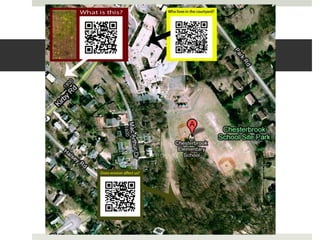
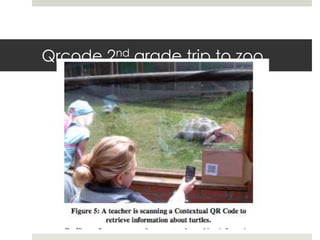
  • #98 4th gradehttp://www.fcps.edu/ChesterbrookES/qrcodes.htmChesterbrook's Living ClassroomsThe Living Classroom across Kirby Road deals with trees particular to Virginia, and is associated with the Fourth grade. Our second Living Classroom is down near a stream