The potential for a productive,
fossil fuel free agriculture based
    on ecosystem services


      Johanna Björklund
 Man –Technology–Environment
     Meal Ecology Forum
       Örebro University
    johanna.bjorklund@oru.se
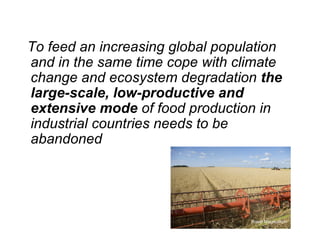
To feed an increasing global population
and in the same time cope with climate
change and ecosystem degradation the
large-scale, low-productive and
extensive mode of food production in
industrial countries needs to be
abandoned


                                  Roine Magnusson
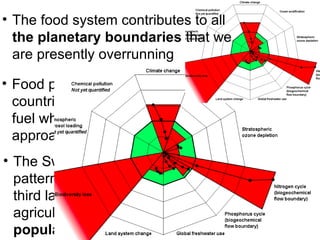
• The food system contributes to all
  the planetary boundaries that we
  are presently overrunning

• Food production in industrial
  countries are addicted to fossil
  fuel when we are rapidly
  approaching ”Peak oil”
• The Swedish consumption
  pattern needs an area one
  third larger than our
  agricultural area - world
  population increases!
Non negotiable demands on
      future food system
• More food with less use of water and without
  fossil fuels
• Agricultural areas needs to sequestrer carbon
• Drastically reduced input of new nitrogen – 25
  % of today? – No more N fertilizers in our
  part of the world
• No more phosphorus to the oceans
• Extinction of species need to be halter to at
  least 1/10 of today
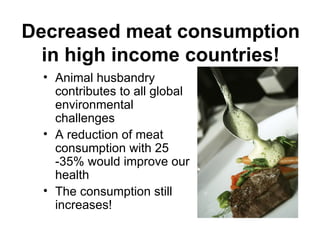
Decreased meat consumption
  in high income countries!
  • Animal husbandry
    contributes to all global
    environmental
    challenges
  • A reduction of meat
    consumption with 25
    -35% would improve our
    health
  • The consumption still
    increases!
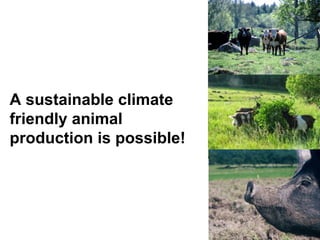
A sustainable climate
friendly animal
production is possible!


                      Arla
                      Foods
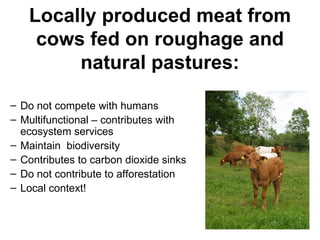
Locally produced meat from
    cows fed on roughage and
        natural pastures:

– Do not compete with humans
– Multifunctional – contributes with
  ecosystem services
– Maintain biodiversity
– Contributes to carbon dioxide sinks
– Do not contribute to afforestation
– Local context!
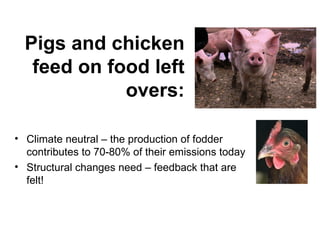
Pigs and chicken
   feed on food left
             overs:

• Climate neutral – the production of fodder
  contributes to 70-80% of their emissions today
• Structural changes need – feedback that are
  felt!
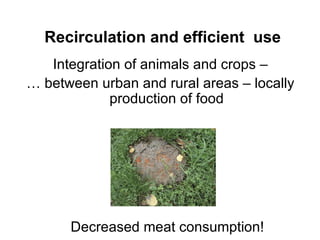
Recirculation and efficient use
   Integration of animals and crops –
… between urban and rural areas – locally
             production of food


      Decreased meat consumption!
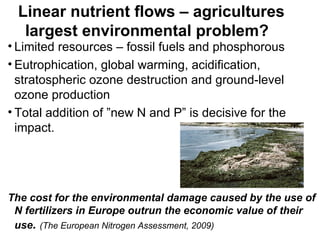
Linear nutrient flows – agricultures
  largest environmental problem?
• Limited resources – fossil fuels and phosphorous
• Eutrophication, global warming, acidification,
  stratospheric ozone destruction and ground-level
  ozone production
• Total addition of ”new N and P” is decisive for the
  impact.


The cost for the environmental damage caused by the use of
 N fertilizers in Europe outrun the economic value of their
 use. (The European Nitrogen Assessment, 2009)
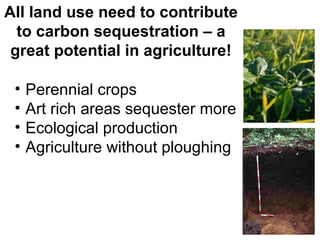
All land use need to contribute
  to carbon sequestration – a
 great potential in agriculture!

 •   Perennial crops
 •   Art rich areas sequester more
 •   Ecological production
 •   Agriculture without ploughing
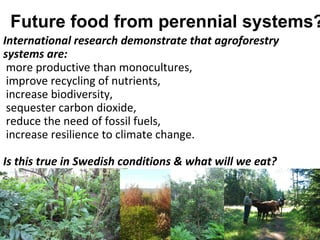
Future food from perennial systems?
International research demonstrate that agroforestry
systems are:
 more productive than monocultures,
 improve recycling of nutrients,
 increase biodiversity,
 sequester carbon dioxide,
 reduce the need of fossil fuels,
 increase resilience to climate change.

Is this true in Swedish conditions & what will we eat?
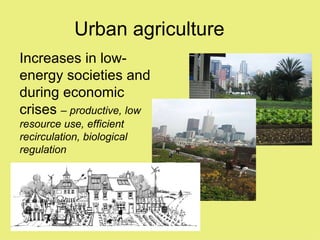
Urban agriculture
Increases in low-
energy societies and
during economic
crises – productive, low
resource use, efficient
recirculation, biological
regulation
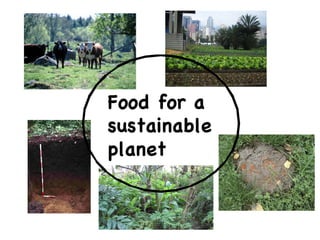
Food for a
sustainable
planet

The potential of a productive, fossil fuel free agriculture based on ecosystem services

  • 1.
    The potential fora productive, fossil fuel free agriculture based on ecosystem services Johanna Björklund Man –Technology–Environment Meal Ecology Forum Örebro University johanna.bjorklund@oru.se
  • 2.
    To feed anincreasing global population and in the same time cope with climate change and ecosystem degradation the large-scale, low-productive and extensive mode of food production in industrial countries needs to be abandoned Roine Magnusson
  • 3.
    • The foodsystem contributes to all the planetary boundaries that we are presently overrunning • Food production in industrial countries are addicted to fossil fuel when we are rapidly approaching ”Peak oil” • The Swedish consumption pattern needs an area one third larger than our agricultural area - world population increases!
  • 4.
    Non negotiable demandson future food system • More food with less use of water and without fossil fuels • Agricultural areas needs to sequestrer carbon • Drastically reduced input of new nitrogen – 25 % of today? – No more N fertilizers in our part of the world • No more phosphorus to the oceans • Extinction of species need to be halter to at least 1/10 of today
  • 5.
    Decreased meat consumption in high income countries! • Animal husbandry contributes to all global environmental challenges • A reduction of meat consumption with 25 -35% would improve our health • The consumption still increases!
  • 6.
    A sustainable climate friendlyanimal production is possible! Arla Foods
  • 7.
    Locally produced meatfrom cows fed on roughage and natural pastures: – Do not compete with humans – Multifunctional – contributes with ecosystem services – Maintain biodiversity – Contributes to carbon dioxide sinks – Do not contribute to afforestation – Local context!
  • 8.
    Pigs and chicken feed on food left overs: • Climate neutral – the production of fodder contributes to 70-80% of their emissions today • Structural changes need – feedback that are felt!
  • 9.
    Recirculation and efficientuse Integration of animals and crops – … between urban and rural areas – locally production of food Decreased meat consumption!
  • 10.
    Linear nutrient flows– agricultures largest environmental problem? • Limited resources – fossil fuels and phosphorous • Eutrophication, global warming, acidification, stratospheric ozone destruction and ground-level ozone production • Total addition of ”new N and P” is decisive for the impact. The cost for the environmental damage caused by the use of N fertilizers in Europe outrun the economic value of their use. (The European Nitrogen Assessment, 2009)
  • 11.
    All land useneed to contribute to carbon sequestration – a great potential in agriculture! • Perennial crops • Art rich areas sequester more • Ecological production • Agriculture without ploughing
  • 12.
    Future food fromperennial systems? International research demonstrate that agroforestry systems are: more productive than monocultures, improve recycling of nutrients, increase biodiversity, sequester carbon dioxide, reduce the need of fossil fuels, increase resilience to climate change. Is this true in Swedish conditions & what will we eat?
  • 13.
    Urban agriculture Increases inlow- energy societies and during economic crises – productive, low resource use, efficient recirculation, biological regulation
  • 14.

Editor's Notes

  • #2 I am a researcher and teacher at Örebro university, focusing on the development of sustainable agriculture with an agroecological approach.
  • #3 We need an agriculture that makes a lot better use of land, labour and local resources and that produces a lot more of benefits to human and other organisms. It is might be rather provocative to say this, but more it is a change in perspective on the word efficiency.
  • #4 We all know this: The food system contributes to all the planetary boundaries that we are presently overrunning, to climate change, to the disruption of the nitrogen recirculation and to the rapid reduction of biodiversity, and to the ones that we are approaching to decreased groundwater levels, afforestration, chemical pollution, phosphorus depleation, acidification, etc.
  • #5 VAR VI LIGGER INTERNATIONELLT
  • #6 A decrease in the meat consumption i the industrialized part of the world is needed as animal hubandry contribute to nearly all global environmental challenges – and that would improve our health
  • #7 A sustainable climate friendly animal production is possible!
  • #8 If ruminants are feed by roughage and grazing on natural pastures, then they dont compete with humans for feed, they contribute with feed to humans, as the largest part of world´s agricultural land is most appropriate for grazing. They also contribute to important ecosystem services such as mainatainance of biodivesity and sequestration of carbon dioxid as pastures and leys are important carbon zinks. They do not contribute to afforestration – when grazing on local pasture in our part of the world.
  • #9 Pigs and hens would be climate friendly if feed on left over because their impact on climate is caused by the production of their food. This by large iligal today, this has to be changed. Structural changes need – feedback that are felt has to be built in – if I put something dangerous in the pigfood I risk getting it in my meat.
  • #10 The awareness of the need of efficient use and recirculation of nutrient is rapidly increasing in the the scientific society combined with decreased meat consumption when the trend is going by large in the other direction – increased consumption and regions and even countries that turn up to be world producers of meat in large scale industries leading to huge animal concentrations and increased demand for fertilizers in parts where cereals are produced.
  • #11 Linear flows of large quantities of nutrient might be agricultures largest environmental problem – beside that they are limited resources or produced with such, phosphorus and especially nitrogen contribute to at least for of the planetary boundaries – and the total addition of new N and P decides the impact. The cost for the environmental damage caused by the use of N fertilizers in Europe outrun the economic value of their use. Recirculation is the only solution here.
  • #12 All land use need to contribute to carbon seqestration if a skenande climate change should be haltered,– agriculture has to be turned from a sources of carbon dioxide to a zink – and ther are great potentials in all agriculture. More perennial crops, increased diversity as Art rich areas sequester more, Ecological production and Agriculture without plowing are only some examples
  • #13 Future food from perennial systems? International research e.g. research done by Andrés in Brazil, demonstrate e agroforestry systems are: more productive than monocultures, improve recycling of nutrients, increase biodiversity, sequester carbon dioxide, reduce the need of fossil fertilizers, increase resilience to climate change. How would such system look like in our climate and what t will we eat to be fed by such agriculture? That is what I am initiating research on presently.
  • #14 15 % of all food is allready produced in cities, 1/3 of what urban citicienze eat comes from cities, most in mega cities in the south. Such production is productive, has a low resource use, enhance efficient recirculation and biological regulation, no fertilizers, pestizid and fossil fuel is needed, fresch and healthy and may contribute to social benefits too.
  • #15 Food for a sustainable planet Less meat from mulitfuctional animals Food production in urban areas All land use also sequester carbon dioxid Short and efficient recirculation