PROS AND CONS OF
MONETIZATION MODELS
2
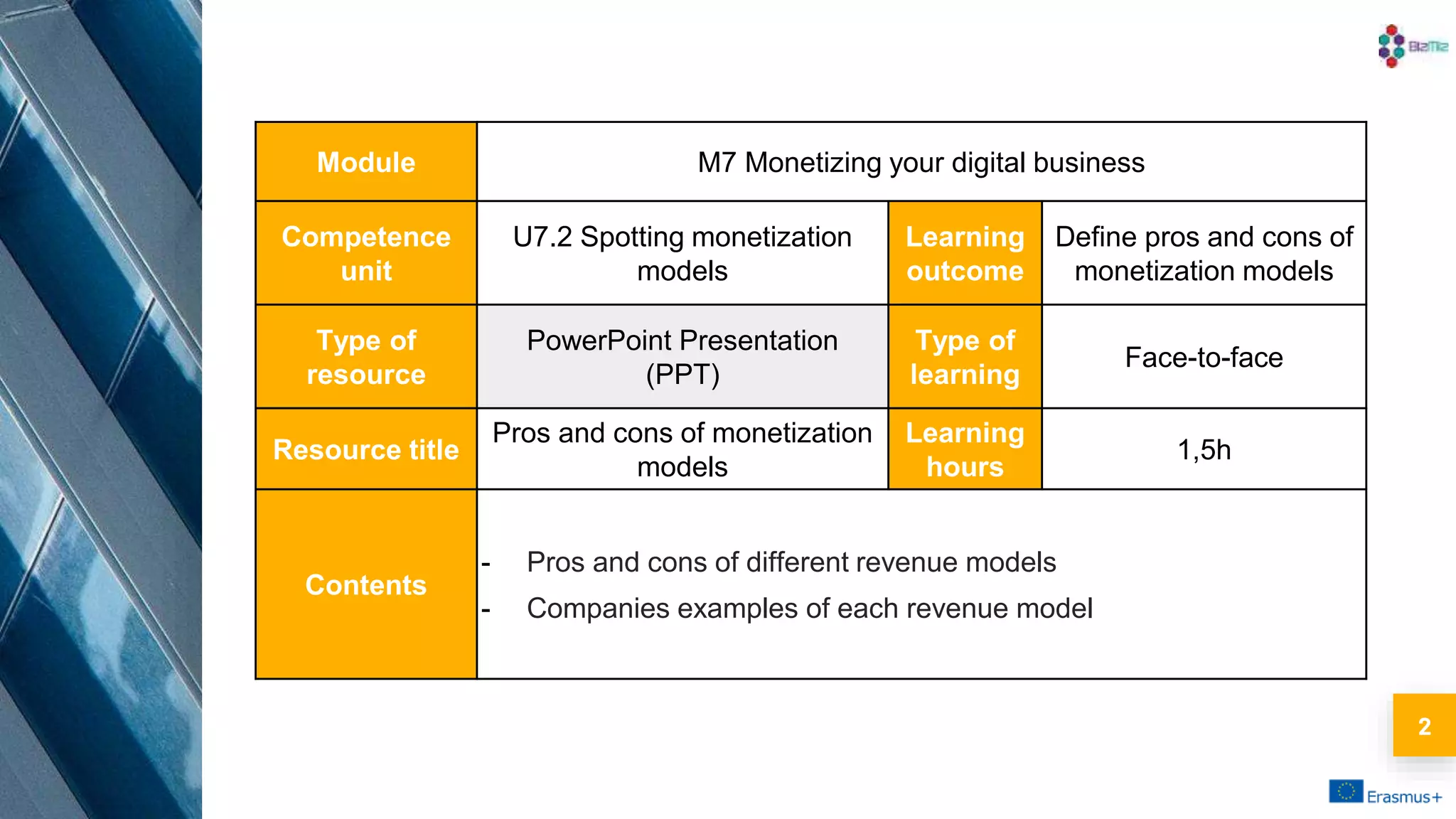
Module M7 Monetizing your digital business
Competence
unit
U7.2 Spotting monetization
models
Learning
outcome
Define pros and cons of
monetization models
Type of
resource
PowerPoint Presentation
(PPT)
Type of
learning
Face-to-face
Resource title
Pros and cons of monetization
models
Learning
hours
1,5h
Contents
- Pros and cons of different revenue models
- Companies examples of each revenue model
“ Content builds
relationships.
Relationships are built
on trust. Trust drives
revenue
Andrew Davis
3
CHOOSING THE BEST REVENUE
MODEL FOR YOUR COMPANY
4
1. Direct Sales
2. Freemium Model
3. Ad-Based Revenue Model
4. Subscription Revenue Model
5. Affiliate Revenue Model
6. Transactional Revenue Model
7. Channel Sales (or Indirect Sales)
8. Web Sales
9. Retail Sales
10. Free Product, EXCEPT Services
START-UP REVENUE MODELS
55
6
PROS AND CONS
Source: www.pixabay.com
6
DIRECT SALES
7
PROS:
 Low financial risk: low to investment and overhead
 Mostly: home-based businesses and are often geared to women
 Relatively low number of customers needed. BUT – more business
builders
CONS:
 Uncomfortable: attempting to sell for your friends, relatives, and
colleagues
 Isn’t optimal for small price items
7
DIRECT SALES:
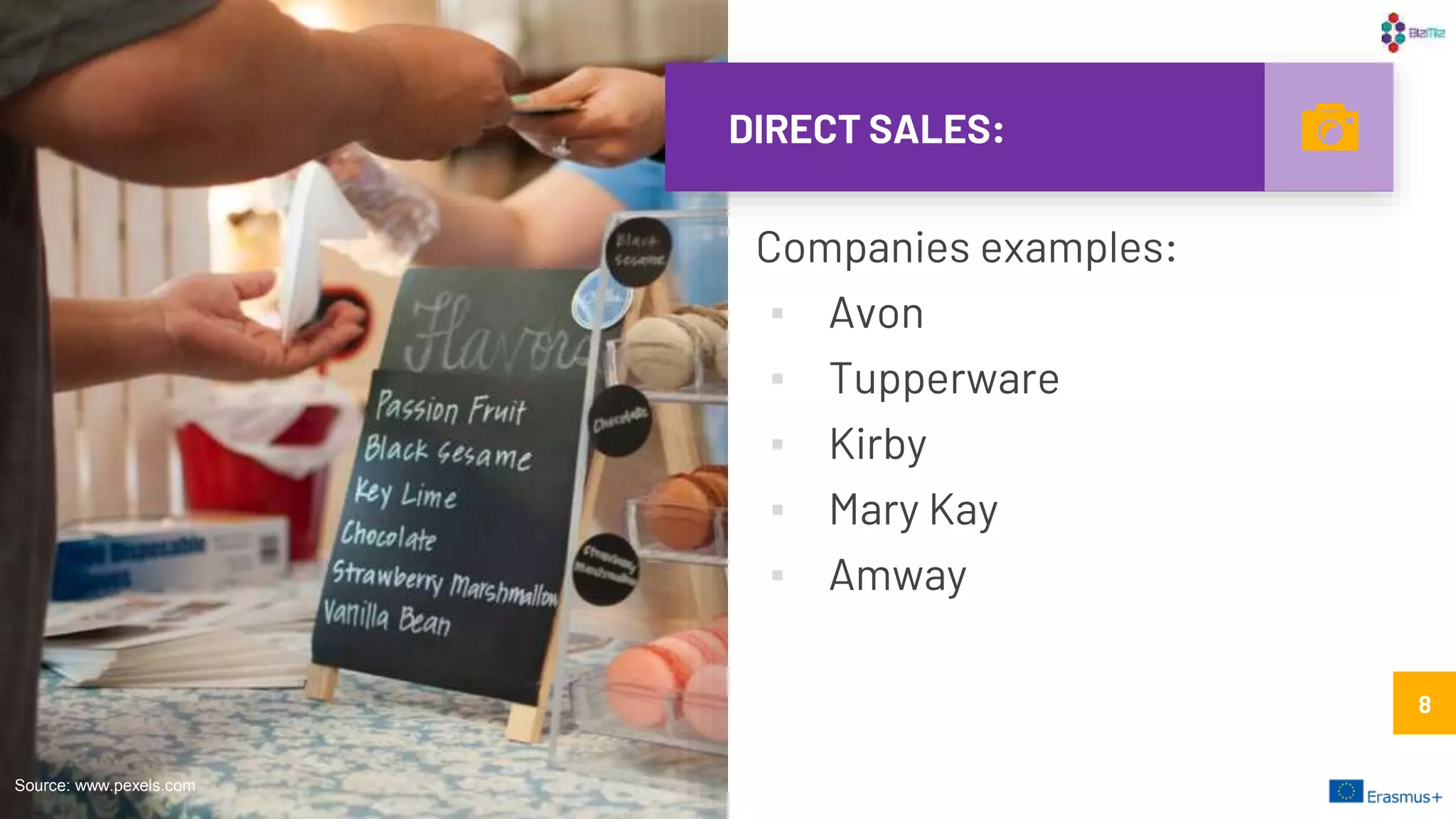
Companies examples:
▪ Avon
▪ Tupperware
▪ Kirby
▪ Mary Kay
▪ Amway
8
Source: www.pexels.com
8
FREEMIUM MODEL
9
PROS:
 Perfect opportunity for free beta testing of new products or features
 People are more likely to become engaged and loyal users later on
 Opportunity to upsell and monetize user base
 Increases audience size with no barriers to entry and no risks
CONS:
 Requires a considerable investment of time and money to reach and
convert free users into paying customers
 Customers must see a great value to invest in upgrade conversion at
some point
9
FREEMIUM MODEL
Companies examples:
▪ Angry Birds
▪ Evernote
▪ MailChimp
▪ Dropbox
10
Source: www. pixabay.com
10
AD-BASED REVENUE MODEL
11
PROS:
 Relatively simple: create a site that has a large and sustainable
traffic
CONS:
 It can be risky: you will need to attract millions of users with any
guarantee that anyone is actually going to click the advertisement
 Your wesite should fit the needs of desired online advertising goals
 Most people find advertisement annoying, which can lead to lower
traffic and decreased revenue
11
AD-BASED REVENUE MODEL
Companies examples:
▪ Buzzfeed
▪ Conde Nast
▪ Disney
▪ Facebook
▪ Forbes
▪ Google
▪ The New York Times 12
Source: www.pixabay.com
12
SUBSCRIPTION REVENUE MODEL
13
PROS:
 Stable and predictable Income
 Subscribers are more likely to be loyal and engaged app users
 Increasing audience motivates to ensure high-quality product
CONS:
 Difficulty keeping the interest and proving the value
 Risk of cancellation: constant pressure to maintain a higher
subscribe rate than an unsubscribe rate
13
SUBSCRIPTION REVENUE
MODEL
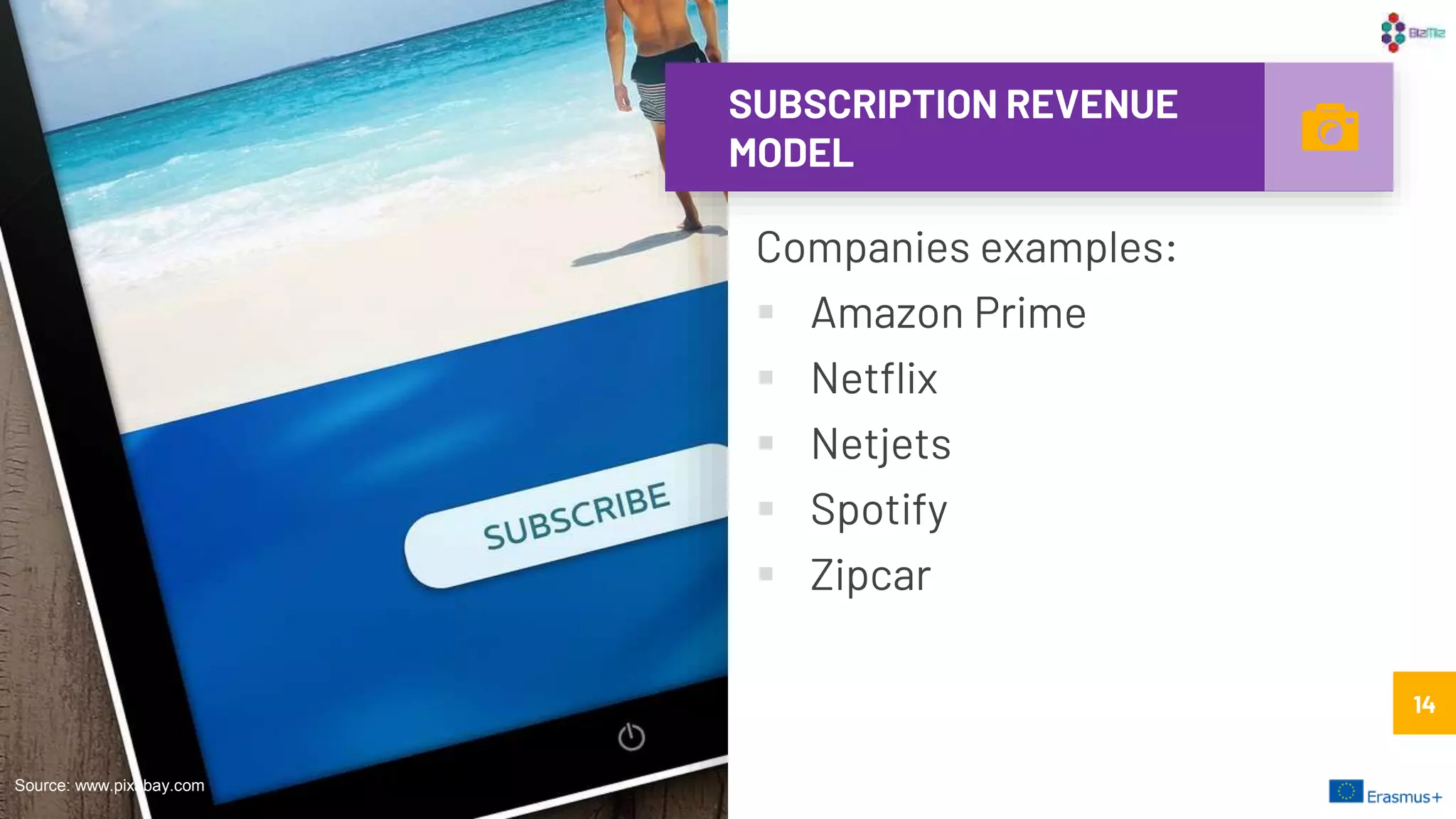
Companies examples:
 Amazon Prime
 Netflix
 Netjets
 Spotify
 Zipcar
14
Source: www.pixabay.com
14
AFFILIATE REVENUE MODEL
15
PROS:
 More money than ad-based revenue models
 Low-cost, low investment
 Loss of control: branding and brand image
 Low responsibility: customer service is not in your interest
 Increasing audience motivates to ensure high-quality product
CONS:
 Revenue is limited to the size of your industry
 Sometimes can be associated with spammy marketing campaigns 15
AFFILIATE REVENUE MODEL: payment methods
16
 Pay Per Click (PPC) - Affiliate gets paid whenever the affiliate link is
clicked.
 Pay Per Impression (PPI) - Affiliate is paid when someone lands on
the merchant’s site.
 Pay Per Lead (PPL) - Affiliate is paid when someone clicks on
affiliate link and takes an action, e.g. completing a form to generate
a new lead.
 Pay Per Sale (PPS) - Affiliate is paid when a sale is made. Affiliate
receives a percentage of the cost of that item.
Source: zuora.com - Affiliate revenue model example: How to increase monetization through the affiliate revenue model?
16
AFFILIATE REVENUE MODEL
Companies examples:
 LifeWire
 ShoutMeLoud
 Dating Advice
17
Source: www.pexels.com
17
TRANSACTION REVENUE MODEL
18
PROS:
 Direct and simple way of generating revenue
 Wide set of options can be offered for customer
CONS:
 High competition and price deterioration
18
TRANSACTION REVENUE
MODEL
Companies examples:
 Doctor On Demand
 Blendle
 Virgin Megastore
19
Source: www.pixabay.com
19
CHANNEL SALES
20
PROS:
 Indirect sales channels have more visitors
 Relatively low maintenance after establishment
 Ideal for companies who have a product that’s an incremental sale
for their channel and can produce incremental profit
CONS:
 This model is not effective if your product requires you to evangelize
your marketplace, or if your product competes with that of your
partner’s, as they will push theirs and not yours
 Bigger competition
Source: The Founder Institute.10 Most Popular Startup Revenue Models
20
CHANNEL SALES
Companies examples:
 Ultra Mobile
 Quick Bridge Funding
 StartApp
 Scopely
21
Source: www.pixabay.com
21
WEB SALES
22
PROS:
 Include a wide variety of offerings, including software, hardware, and
even subscription services
CONS:
 Impersonal Customer Service
 Customer resistance to payment
 Technical issues
 Relationship sales are incompatible with the web sales model, so if
your company is related to consulting or big ticket items (high-value
items such as houses, appliances, and cars), you should consider
employing a model that’s more suited to your offering.
Source: The Founder Institute.10 Most Popular Startup Revenue Models
22
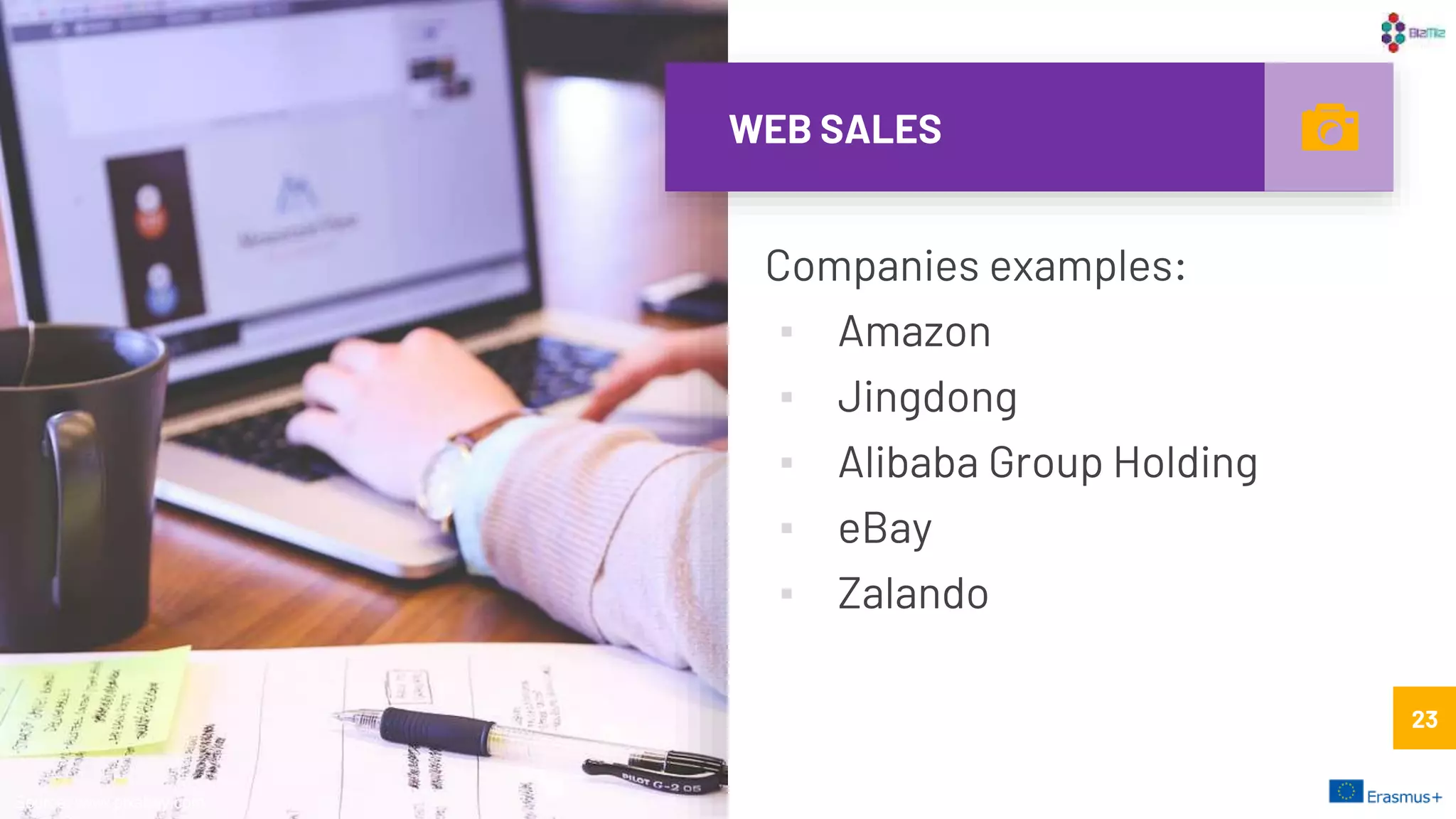
WEB SALES
Companies examples:
▪ Amazon
▪ Jingdong
▪ Alibaba Group Holding
▪ eBay
▪ Zalando
23
Source: www.pixabay.com
23
RETAIL SALES
24
PROS:
 Full control of your vision becoming a reality: products, management
style
 Full responsibility: being the boss
CONS:
 Financial risk
 Long working hours
 Challenges with difficult customers and emploees
24
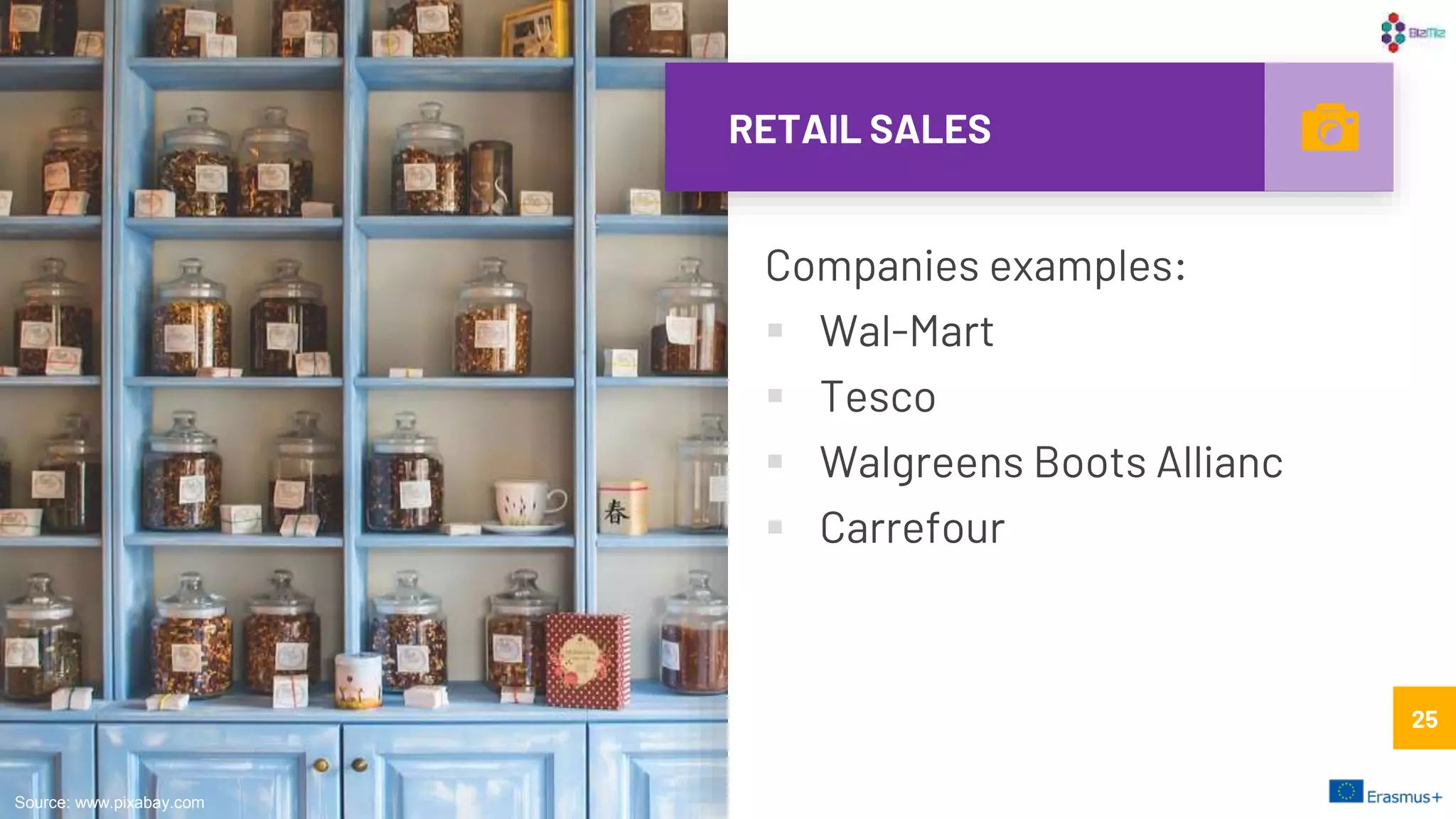
RETAIL SALES
Companies examples:
 Wal-Mart
 Tesco
 Walgreens Boots Allianc
 Carrefour
25
Source: www.pixabay.com
25
FREE PRODUCT, EXCEPT SERVICES
26
PROS:
 Great trust and brand awareness customer
CONS:
 Running a services business with the product as a marketing cost
 Not efficient for scaling a company in the long term.
26
Source: The Founder Institute.10 Most Popular Startup Revenue Models
LET’S REVIEW SOME CONCEPTS
Monetization model Revenue model
Direct Sales Transactional Revenue Model
Freemium Model Free Product, EXCEPT Services
Subscription Revenue Model Channel Sales (or Indirect Sales)
Affiliate Revenue Model Ad-Based Revenue Model
Web Sales Retail Sales 27
This project has been funded with support from the European Commission.
This publication reflec ts the vi ews onl y of the aut hor , and the Commission cannot
be held responsible for any use which may be made of the information contained therein.
Project Number: 2018-1-UK01-KA202-047909
28

Biz miz o1 m7_u7.2.r8_s (ppt-f2f)

  • 1.
    PROS AND CONSOF MONETIZATION MODELS
  • 2.
    2 Module M7 Monetizingyour digital business Competence unit U7.2 Spotting monetization models Learning outcome Define pros and cons of monetization models Type of resource PowerPoint Presentation (PPT) Type of learning Face-to-face Resource title Pros and cons of monetization models Learning hours 1,5h Contents - Pros and cons of different revenue models - Companies examples of each revenue model
  • 3.
    “ Content builds relationships. Relationshipsare built on trust. Trust drives revenue Andrew Davis 3
  • 4.
    CHOOSING THE BESTREVENUE MODEL FOR YOUR COMPANY 4
  • 5.
    1. Direct Sales 2.Freemium Model 3. Ad-Based Revenue Model 4. Subscription Revenue Model 5. Affiliate Revenue Model 6. Transactional Revenue Model 7. Channel Sales (or Indirect Sales) 8. Web Sales 9. Retail Sales 10. Free Product, EXCEPT Services START-UP REVENUE MODELS 55
  • 6.
    6 PROS AND CONS Source:www.pixabay.com 6
  • 7.
    DIRECT SALES 7 PROS:  Lowfinancial risk: low to investment and overhead  Mostly: home-based businesses and are often geared to women  Relatively low number of customers needed. BUT – more business builders CONS:  Uncomfortable: attempting to sell for your friends, relatives, and colleagues  Isn’t optimal for small price items 7
  • 8.
    DIRECT SALES: Companies examples: ▪Avon ▪ Tupperware ▪ Kirby ▪ Mary Kay ▪ Amway 8 Source: www.pexels.com 8
  • 9.
    FREEMIUM MODEL 9 PROS:  Perfectopportunity for free beta testing of new products or features  People are more likely to become engaged and loyal users later on  Opportunity to upsell and monetize user base  Increases audience size with no barriers to entry and no risks CONS:  Requires a considerable investment of time and money to reach and convert free users into paying customers  Customers must see a great value to invest in upgrade conversion at some point 9
  • 10.
    FREEMIUM MODEL Companies examples: ▪Angry Birds ▪ Evernote ▪ MailChimp ▪ Dropbox 10 Source: www. pixabay.com 10
  • 11.
    AD-BASED REVENUE MODEL 11 PROS: Relatively simple: create a site that has a large and sustainable traffic CONS:  It can be risky: you will need to attract millions of users with any guarantee that anyone is actually going to click the advertisement  Your wesite should fit the needs of desired online advertising goals  Most people find advertisement annoying, which can lead to lower traffic and decreased revenue 11
  • 12.
    AD-BASED REVENUE MODEL Companiesexamples: ▪ Buzzfeed ▪ Conde Nast ▪ Disney ▪ Facebook ▪ Forbes ▪ Google ▪ The New York Times 12 Source: www.pixabay.com 12
  • 13.
    SUBSCRIPTION REVENUE MODEL 13 PROS: Stable and predictable Income  Subscribers are more likely to be loyal and engaged app users  Increasing audience motivates to ensure high-quality product CONS:  Difficulty keeping the interest and proving the value  Risk of cancellation: constant pressure to maintain a higher subscribe rate than an unsubscribe rate 13
  • 14.
    SUBSCRIPTION REVENUE MODEL Companies examples: Amazon Prime  Netflix  Netjets  Spotify  Zipcar 14 Source: www.pixabay.com 14
  • 15.
    AFFILIATE REVENUE MODEL 15 PROS: More money than ad-based revenue models  Low-cost, low investment  Loss of control: branding and brand image  Low responsibility: customer service is not in your interest  Increasing audience motivates to ensure high-quality product CONS:  Revenue is limited to the size of your industry  Sometimes can be associated with spammy marketing campaigns 15
  • 16.
    AFFILIATE REVENUE MODEL:payment methods 16  Pay Per Click (PPC) - Affiliate gets paid whenever the affiliate link is clicked.  Pay Per Impression (PPI) - Affiliate is paid when someone lands on the merchant’s site.  Pay Per Lead (PPL) - Affiliate is paid when someone clicks on affiliate link and takes an action, e.g. completing a form to generate a new lead.  Pay Per Sale (PPS) - Affiliate is paid when a sale is made. Affiliate receives a percentage of the cost of that item. Source: zuora.com - Affiliate revenue model example: How to increase monetization through the affiliate revenue model? 16
  • 17.
    AFFILIATE REVENUE MODEL Companiesexamples:  LifeWire  ShoutMeLoud  Dating Advice 17 Source: www.pexels.com 17
  • 18.
    TRANSACTION REVENUE MODEL 18 PROS: Direct and simple way of generating revenue  Wide set of options can be offered for customer CONS:  High competition and price deterioration 18
  • 19.
    TRANSACTION REVENUE MODEL Companies examples: Doctor On Demand  Blendle  Virgin Megastore 19 Source: www.pixabay.com 19
  • 20.
    CHANNEL SALES 20 PROS:  Indirectsales channels have more visitors  Relatively low maintenance after establishment  Ideal for companies who have a product that’s an incremental sale for their channel and can produce incremental profit CONS:  This model is not effective if your product requires you to evangelize your marketplace, or if your product competes with that of your partner’s, as they will push theirs and not yours  Bigger competition Source: The Founder Institute.10 Most Popular Startup Revenue Models 20
  • 21.
    CHANNEL SALES Companies examples: Ultra Mobile  Quick Bridge Funding  StartApp  Scopely 21 Source: www.pixabay.com 21
  • 22.
    WEB SALES 22 PROS:  Includea wide variety of offerings, including software, hardware, and even subscription services CONS:  Impersonal Customer Service  Customer resistance to payment  Technical issues  Relationship sales are incompatible with the web sales model, so if your company is related to consulting or big ticket items (high-value items such as houses, appliances, and cars), you should consider employing a model that’s more suited to your offering. Source: The Founder Institute.10 Most Popular Startup Revenue Models 22
  • 23.
    WEB SALES Companies examples: ▪Amazon ▪ Jingdong ▪ Alibaba Group Holding ▪ eBay ▪ Zalando 23 Source: www.pixabay.com 23
  • 24.
    RETAIL SALES 24 PROS:  Fullcontrol of your vision becoming a reality: products, management style  Full responsibility: being the boss CONS:  Financial risk  Long working hours  Challenges with difficult customers and emploees 24
  • 25.
    RETAIL SALES Companies examples: Wal-Mart  Tesco  Walgreens Boots Allianc  Carrefour 25 Source: www.pixabay.com 25
  • 26.
    FREE PRODUCT, EXCEPTSERVICES 26 PROS:  Great trust and brand awareness customer CONS:  Running a services business with the product as a marketing cost  Not efficient for scaling a company in the long term. 26 Source: The Founder Institute.10 Most Popular Startup Revenue Models
  • 27.
    LET’S REVIEW SOMECONCEPTS Monetization model Revenue model Direct Sales Transactional Revenue Model Freemium Model Free Product, EXCEPT Services Subscription Revenue Model Channel Sales (or Indirect Sales) Affiliate Revenue Model Ad-Based Revenue Model Web Sales Retail Sales 27
  • 28.
    This project hasbeen funded with support from the European Commission. This publication reflec ts the vi ews onl y of the aut hor , and the Commission cannot be held responsible for any use which may be made of the information contained therein. Project Number: 2018-1-UK01-KA202-047909 28

Editor's Notes

  • #8 https://www.zuora.com/billing-topics/affiliate-revenue-model-example
  • #10 https://www.zuora.com/billing-topics/affiliate-revenue-model-example
  • #12 https://www.zuora.com/billing-topics/affiliate-revenue-model-example
  • #14 https://www.zuora.com/billing-topics/affiliate-revenue-model-example
  • #17 https://www.zuora.com/billing-topics/affiliate-revenue-model-example
  • #21 https://fi.co/insight/the-10-most-popular-startup-revenue-models
  • #22 https://blog.hubspot.com/sales/channel-sales
  • #23 https://fi.co/insight/the-10-most-popular-startup-revenue-models
  • #25 https://fi.co/insight/the-10-most-popular-startup-revenue-models
  • #27 https://fi.co/insight/the-10-most-popular-startup-revenue-models