Birmingham Centre for Strategic Elements and Critical Materials 1
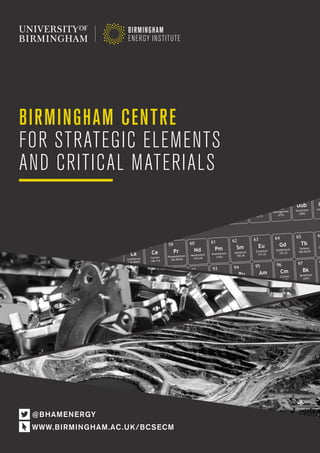
BIRMINGHAM CENTRE
FOR STRATEGIC ELEMENTS
AND CRITICAL MATERIALS
@BHAMENERGY
WWW.BIRMINGHAM.AC.UK/BCSECM
A material is deemed to be critical when it is
economically important but at risk of short supply.
These materials often contain certain elements that
may be regarded as being of strategic importance
to modern and future technologies. The supply
constraints are driven by geological, economic,
technical or political factors, which can only be
addressed by an interdisciplinary team.
The Birmingham Centre for Strategic Elements and Critical Materials
encompasses expertise from across the University of Birmingham and
the Birmingham Energy Institute in biosciences, chemical engineering,
chemistry, earth and environmental sciences, economics, law, materials
science, physics and social science.
The aim of BCSECM is to develop solutions to the problem of criticality
in order to alleviate these supply constraints or to substitute the strategic
materials/elements with less scarce alternatives.
‘STRATEGIC ELEMENTS AND CRITICAL MATERIALS PLAY
A CRUCIAL ROLE IN MANY MODERN DAY TECHNOLOGIES
FROM ELECTRONIC COMPONENTS TO CLEAN ENERGY
APPLICATIONS, SUCH AS WIND TURBINES AND ELECTRIC
VEHICLES. THE SUPPLY OF THESE MATERIALS IS OFTEN
DOMINATED BY ONE OR MORE PRODUCERS, AND SOME
OF THE ELEMENTS ARE SCARCE, WHICH CAN PUT
SIGNIFICANT PRESSURE ON SUPPLY. OUR SCIENTISTS
ARE DEVELOPING SUSTAINABLE AND ECONOMICALLY
SOUND SOLUTIONS TO ALLEVIATE THESE SUPPLY RISKS.’
Dr Allan Walton, Co-Director
BIRMINGHAM CENTRE
FOR STRATEGIC ELEMENTS
AND CRITICAL MATERIALS
‘LOOKING AFTER THE EARTH’S ELEMENTS IS ONE
OF THE DEFINING SCIENTIFIC CHALLENGES OF OUR
TIME, INEXTRICABLY LINKED WITH FEEDING THE ALL
WORLD’S PEOPLE, KEEPING THEM HEALTHY AND
PROVIDING FOR THEIR ENERGY NEEDS. WITHOUT
CAREFUL MANAGEMENT OF THESE RESOURCES IN
THE DECADES TO COME, THE MODERN TECHNOLOGIES
WE ENJOY AND THE QUALITY OF LIFE THEY SUSTAIN
MAY BECOME IMPOSSIBLE TO MAINTAIN.’
Dr Paul Anderson, Co-Director
2 Birmingham Centre for Strategic Elements and Critical Materials
Birmingham Centre for Strategic Elements and Critical Materials 3
ABOUT THE BIRMINGHAM
ENERGY INSTITUTE
The Birmingham Energy Institute is a focal point for the University
and its national and international partners to create change in the
way we deliver, consume and think about energy. The Institute
harnesses expertise from the fundamental sciences and engineering
through to business and economics to deliver co-ordinated research,
education and the development of global partnerships. More than
140 academics from four colleges are engaged in energy and
energy-related research and development, with over £75 million
external research investment. The Birmingham Energy Institute’s
strength comes not only from the concentration of expertise in
specialised centres, but also the breadth of knowledge and
facilities that it can draw upon through interdepartmental and
interdisciplinary working across the University.
WE HAVE OVER
ACADEMICS ENGAGED
THERMAL ENERGY RESEARCH
ACCELERATOR (T-ERA)
The Thermal Energy Research Accelerator (T-ERA) is one of three
work streams that form the Energy Research Accelerator (ERA),
a capital investment of £60 million by government to tackle some
of the biggest challenges facing the global economy. By transforming
research and development in three critical areas: Thermal Energy,
Integrated Systems and Geo-Energy, ERA seeks to build on the
expertise of Birmingham, Aston, Loughborough and Warwick
universities, the British Geological Survey and the regional industrial
base to deliver a step-change in energy research and development,
securing the UK’s leadership position in the sector.
T-ERA is driving the development and integration of a range of thermal
and cryo energy technologies, delivering innovation in the sector as
well as collaborating with industry to convert innovation and emerging
technologies into practical solutions with powerful global benefit. It will
deliver jobs and apprenticeships, wealth creation and the next generation
of scientists and engineers in the energy sector and emerging industries.
The Birmingham Energy Institute Policy Commission ‘Doing Cold
Smarter’ identified the need for a range of more efficient cooling and
refrigeration technologies. Our scientists are working on the next
generation of materials for energy efficient solid-state cooling.
ENERGY RESEARCH ACCELERATOR (ERA)
The government has confirmed a £60 million capital investment
in the Energy Research Accelerator (ERA). Together with private
sector and university support the decision unlocks £180 million total
investment in the Midlands region. The Energy Research Accelerator
(ERA) will tackle some of the biggest challenges facing the global
economy by transforming research and development in three critical
areas of energy: Thermal, Integrated Systems and Geo-Energy.
The core objectives of ERA are to make better use of primary
resources, bring about smarter energy systems, reduce our
dependence on importing energy, enhance energy security and
resilience, and help achieve the UK’s carbon reduction targets.
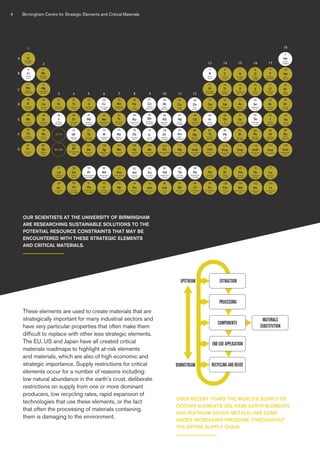
These elements are used to create materials that are
strategically important for many industrial sectors and
have very particular properties that often make them
difficult to replace with other less strategic elements.
The EU, US and Japan have all created critical
materials roadmaps to highlight at-risk elements
and materials, which are also of high economic and
strategic importance. Supply restrictions for critical
elements occur for a number of reasons including:
low natural abundance in the earth’s crust, deliberate
restrictions on supply from one or more dominant
producers, low recycling rates, rapid expansion of
technologies that use these elements, or the fact
that often the processing of materials containing
them is damaging to the environment.
OUR SCIENTISTS AT THE UNIVERSITY OF BIRMINGHAM
ARE RESEARCHING SUSTAINABLE SOLUTIONS TO THE
POTENTIAL RESOURCE CONSTRAINTS THAT MAY BE
ENCOUNTERED WITH THESE STRATEGIC ELEMENTS
AND CRITICAL MATERIALS.
OVER RECENT YEARS THE WORLD’S SUPPLY OF
CERTAIN ELEMENTS (EG, RARE EARTH ELEMENTS
AND PLATINUM GROUP METALS) HAS COME
UNDER INCREASING PRESSURE THROUGHOUT
THE ENTIRE SUPPLY CHAIN.
DOWNSTREAM
UPSTREAM EXTRACTION
PROCESSING
COMPONENTS
END USE APPLICATION
RECYCLING AND REUSE
MATERIALS
SUBSTITUTION
4 Birmingham Centre for Strategic Elements and Critical Materials
Birmingham Centre for Strategic Elements and Critical Materials 5
AS THE FIRST UK CENTRE IN STRATEGIC
ELEMENTS AND CRITICAL MATERIALS,
OUR SCIENTISTS AND RESEARCHERS
AT THE BIRMINGHAM ENERGY INSTITUTE,
ARE LEADING THE WAY IN WORKING ON
THE SOLUTIONS TO THESE CHALLENGES.
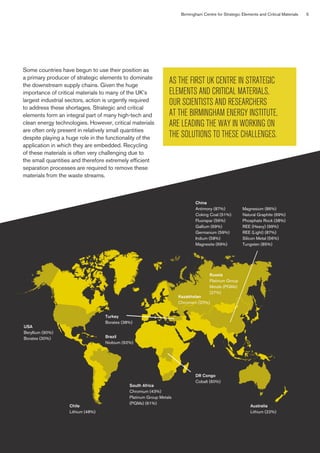
Some countries have begun to use their position as
a primary producer of strategic elements to dominate
the downstream supply chains. Given the huge
importance of critical materials to many of the UK’s
largest industrial sectors, action is urgently required
to address these shortages. Strategic and critical
elements form an integral part of many high-tech and
clean energy technologies. However, critical materials
are often only present in relatively small quantities
despite playing a huge role in the functionality of the
application in which they are embedded. Recycling
of these materials is often very challenging due to
the small quantities and therefore extremely efficient
separation processes are required to remove these
materials from the waste streams.
Chile
Lithium (48%)
South Africa
Chromium (43%)
Platinum Group Metals
(PGMs) (61%)
DR Congo
Cobalt (60%)
Australia
Lithium (22%)
China
Antimony (87%)
Coking Coal (51%)
Fluorspar (56%)
Gallium (69%)
Germanium (59%)
Indium (58%)
Magnesite (69%)
Magnesium (86%)
Natural Graphite (69%)
Phosphate Rock (38%)
REE (Heavy) (99%)
REE (Light) (87%)
Silicon Metal (56%)
Tungsten (85%)
Russia
Platinum Group
Metals (PGMs)
(27%)
Kazakhstan
Chromium (20%)
Turkey
Borates (38%)
Brazil
Niobium (92%)
USA
Beryllium (90%)
Borates (30%)
6 Birmingham Centre for Strategic Elements and Critical Materials
Modern agriculture depends on phosphate fertilisers, whose
supply is predicted to become inadequate to meet demand within
30 years. Modern medicine relies on metal catalysts in drug synthesis
and pharmaceuticals development, not to mention liquid helium
as a coolant for MRI magnets. Modern smartphones and tablets
contain over 50 different metals that are essential to their operation.
Computer hard drives contain rare earth magnetic materials – we
have developed novel methods to recover and recycle this material,
hitherto impossible. We are working on the development of new
recycling processes to enable the recovery of critical materials from
end of life products, mining wastes and even road dust. Simply put,
without efficient use, recycling or replacement of these elements,
the modern technologies we enjoy, the economic benefits they bring
and the quality of life they sustain will be impossible to maintain.
Experts within the centre are developing new science to allow
us to address the global research challenges posed by supply
constraints on strategic elements and critical materials.
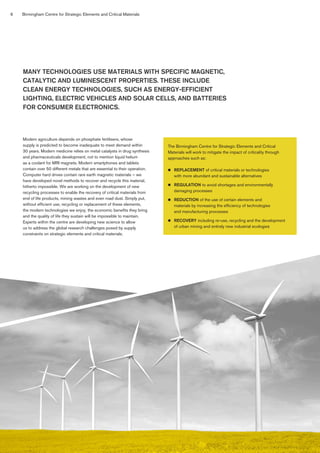
MANY TECHNOLOGIES USE MATERIALS WITH SPECIFIC MAGNETIC,
CATALYTIC AND LUMINESCENT PROPERTIES. THESE INCLUDE
CLEAN ENERGY TECHNOLOGIES, SUCH AS ENERGY-EFFICIENT
LIGHTING, ELECTRIC VEHICLES AND SOLAR CELLS, AND BATTERIES
FOR CONSUMER ELECTRONICS.
The Birmingham Centre for Strategic Elements and Critical
Materials will work to mitigate the impact of criticality through
approaches such as:
n 	 REPLACEMENT of critical materials or technologies
with more abundant and sustainable alternatives
n 	 REGULATION to avoid shortages and environmentally
damaging processes
n 	 REDUCTION of the use of certain elements and
materials by increasing the efficiency of technologies
and manufacturing processes
n 	 RECOVERY including re-use, recycling and the development
of urban mining and entirely new industrial ecologies
Birmingham Centre for Strategic Elements and Critical Materials 7
STRATEGIC ELEMENTS AND CRITICAL MATERIALS ARE CRUCIAL
TO OUR FUTURE ENERGY SYSTEMS. THEY UNDERPIN MANY OF
THE TECHNOLOGIES THAT ARE CRITICAL TO THE FUNCTIONING
OF MODERN ENERGY SYSTEMS. AS WE TRANSITION TO CLEANER
ALTERNATIVES, THE DEMAND FOR CRITICAL MATERIALS IN ENERGY
SYSTEMS WILL ONLY INCREASE.
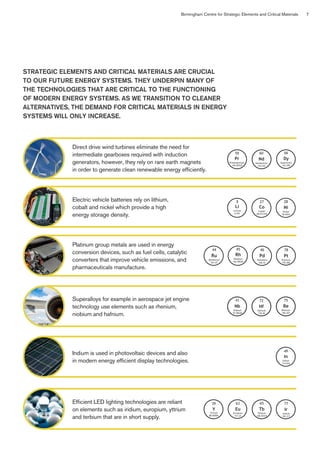
Direct drive wind turbines eliminate the need for
intermediate gearboxes required with induction
generators, however, they rely on rare earth magnets
in order to generate clean renewable energy efficiently.
Electric vehicle batteries rely on lithium,
cobalt and nickel which provide a high
energy storage density.
Platinum group metals are used in energy
conversion devices, such as fuel cells, catalytic
converters that improve vehicle emissions, and
pharmaceuticals manufacture.
Superalloys for example in aerospace jet engine
technology use elements such as rhenium,
niobium and hafnium.
Indium is used in photovoltaic devices and also
in modern energy efficient display technologies.
Efficient LED lighting technologies are reliant
on elements such as iridium, europium, yttrium
and terbium that are in short supply.
15059©UniversityofBirmingham2017.Printedonarecycledgradepapercontaining100%post-consumerwaste.
Birmingham Energy Institute
Edgbaston, Birmingham,
B15 2TT, United Kingdom
www.birmingham.ac.uk
CONTACT US
To learn more about the detail and impact of our research:
Birmingham Centre for Strategic Elements and Critical Materials
Birmingham Energy Institute
School of Metallurgy and Materials
University of Birmingham
Edgbaston B15 2TT
United Kingdom
	 +44 (0)121 414 7031
	 www.birmingham.ac.uk/energy
	 www.birmingham.ac.uk/BCSECM
	 bcsecm@contacts.bham.ac.uk
	 @bhamenergy
Designed and printed by

Birmingham Centre for Strategic Elements & Critical Materials Prospectus (v2)

  • 1.
    Birmingham Centre forStrategic Elements and Critical Materials 1 BIRMINGHAM CENTRE FOR STRATEGIC ELEMENTS AND CRITICAL MATERIALS @BHAMENERGY WWW.BIRMINGHAM.AC.UK/BCSECM
  • 2.
    A material isdeemed to be critical when it is economically important but at risk of short supply. These materials often contain certain elements that may be regarded as being of strategic importance to modern and future technologies. The supply constraints are driven by geological, economic, technical or political factors, which can only be addressed by an interdisciplinary team. The Birmingham Centre for Strategic Elements and Critical Materials encompasses expertise from across the University of Birmingham and the Birmingham Energy Institute in biosciences, chemical engineering, chemistry, earth and environmental sciences, economics, law, materials science, physics and social science. The aim of BCSECM is to develop solutions to the problem of criticality in order to alleviate these supply constraints or to substitute the strategic materials/elements with less scarce alternatives. ‘STRATEGIC ELEMENTS AND CRITICAL MATERIALS PLAY A CRUCIAL ROLE IN MANY MODERN DAY TECHNOLOGIES FROM ELECTRONIC COMPONENTS TO CLEAN ENERGY APPLICATIONS, SUCH AS WIND TURBINES AND ELECTRIC VEHICLES. THE SUPPLY OF THESE MATERIALS IS OFTEN DOMINATED BY ONE OR MORE PRODUCERS, AND SOME OF THE ELEMENTS ARE SCARCE, WHICH CAN PUT SIGNIFICANT PRESSURE ON SUPPLY. OUR SCIENTISTS ARE DEVELOPING SUSTAINABLE AND ECONOMICALLY SOUND SOLUTIONS TO ALLEVIATE THESE SUPPLY RISKS.’ Dr Allan Walton, Co-Director BIRMINGHAM CENTRE FOR STRATEGIC ELEMENTS AND CRITICAL MATERIALS ‘LOOKING AFTER THE EARTH’S ELEMENTS IS ONE OF THE DEFINING SCIENTIFIC CHALLENGES OF OUR TIME, INEXTRICABLY LINKED WITH FEEDING THE ALL WORLD’S PEOPLE, KEEPING THEM HEALTHY AND PROVIDING FOR THEIR ENERGY NEEDS. WITHOUT CAREFUL MANAGEMENT OF THESE RESOURCES IN THE DECADES TO COME, THE MODERN TECHNOLOGIES WE ENJOY AND THE QUALITY OF LIFE THEY SUSTAIN MAY BECOME IMPOSSIBLE TO MAINTAIN.’ Dr Paul Anderson, Co-Director 2 Birmingham Centre for Strategic Elements and Critical Materials
  • 3.
    Birmingham Centre forStrategic Elements and Critical Materials 3 ABOUT THE BIRMINGHAM ENERGY INSTITUTE The Birmingham Energy Institute is a focal point for the University and its national and international partners to create change in the way we deliver, consume and think about energy. The Institute harnesses expertise from the fundamental sciences and engineering through to business and economics to deliver co-ordinated research, education and the development of global partnerships. More than 140 academics from four colleges are engaged in energy and energy-related research and development, with over £75 million external research investment. The Birmingham Energy Institute’s strength comes not only from the concentration of expertise in specialised centres, but also the breadth of knowledge and facilities that it can draw upon through interdepartmental and interdisciplinary working across the University. WE HAVE OVER ACADEMICS ENGAGED THERMAL ENERGY RESEARCH ACCELERATOR (T-ERA) The Thermal Energy Research Accelerator (T-ERA) is one of three work streams that form the Energy Research Accelerator (ERA), a capital investment of £60 million by government to tackle some of the biggest challenges facing the global economy. By transforming research and development in three critical areas: Thermal Energy, Integrated Systems and Geo-Energy, ERA seeks to build on the expertise of Birmingham, Aston, Loughborough and Warwick universities, the British Geological Survey and the regional industrial base to deliver a step-change in energy research and development, securing the UK’s leadership position in the sector. T-ERA is driving the development and integration of a range of thermal and cryo energy technologies, delivering innovation in the sector as well as collaborating with industry to convert innovation and emerging technologies into practical solutions with powerful global benefit. It will deliver jobs and apprenticeships, wealth creation and the next generation of scientists and engineers in the energy sector and emerging industries. The Birmingham Energy Institute Policy Commission ‘Doing Cold Smarter’ identified the need for a range of more efficient cooling and refrigeration technologies. Our scientists are working on the next generation of materials for energy efficient solid-state cooling. ENERGY RESEARCH ACCELERATOR (ERA) The government has confirmed a £60 million capital investment in the Energy Research Accelerator (ERA). Together with private sector and university support the decision unlocks £180 million total investment in the Midlands region. The Energy Research Accelerator (ERA) will tackle some of the biggest challenges facing the global economy by transforming research and development in three critical areas of energy: Thermal, Integrated Systems and Geo-Energy. The core objectives of ERA are to make better use of primary resources, bring about smarter energy systems, reduce our dependence on importing energy, enhance energy security and resilience, and help achieve the UK’s carbon reduction targets.
  • 4.
    These elements areused to create materials that are strategically important for many industrial sectors and have very particular properties that often make them difficult to replace with other less strategic elements. The EU, US and Japan have all created critical materials roadmaps to highlight at-risk elements and materials, which are also of high economic and strategic importance. Supply restrictions for critical elements occur for a number of reasons including: low natural abundance in the earth’s crust, deliberate restrictions on supply from one or more dominant producers, low recycling rates, rapid expansion of technologies that use these elements, or the fact that often the processing of materials containing them is damaging to the environment. OUR SCIENTISTS AT THE UNIVERSITY OF BIRMINGHAM ARE RESEARCHING SUSTAINABLE SOLUTIONS TO THE POTENTIAL RESOURCE CONSTRAINTS THAT MAY BE ENCOUNTERED WITH THESE STRATEGIC ELEMENTS AND CRITICAL MATERIALS. OVER RECENT YEARS THE WORLD’S SUPPLY OF CERTAIN ELEMENTS (EG, RARE EARTH ELEMENTS AND PLATINUM GROUP METALS) HAS COME UNDER INCREASING PRESSURE THROUGHOUT THE ENTIRE SUPPLY CHAIN. DOWNSTREAM UPSTREAM EXTRACTION PROCESSING COMPONENTS END USE APPLICATION RECYCLING AND REUSE MATERIALS SUBSTITUTION 4 Birmingham Centre for Strategic Elements and Critical Materials
  • 5.
    Birmingham Centre forStrategic Elements and Critical Materials 5 AS THE FIRST UK CENTRE IN STRATEGIC ELEMENTS AND CRITICAL MATERIALS, OUR SCIENTISTS AND RESEARCHERS AT THE BIRMINGHAM ENERGY INSTITUTE, ARE LEADING THE WAY IN WORKING ON THE SOLUTIONS TO THESE CHALLENGES. Some countries have begun to use their position as a primary producer of strategic elements to dominate the downstream supply chains. Given the huge importance of critical materials to many of the UK’s largest industrial sectors, action is urgently required to address these shortages. Strategic and critical elements form an integral part of many high-tech and clean energy technologies. However, critical materials are often only present in relatively small quantities despite playing a huge role in the functionality of the application in which they are embedded. Recycling of these materials is often very challenging due to the small quantities and therefore extremely efficient separation processes are required to remove these materials from the waste streams. Chile Lithium (48%) South Africa Chromium (43%) Platinum Group Metals (PGMs) (61%) DR Congo Cobalt (60%) Australia Lithium (22%) China Antimony (87%) Coking Coal (51%) Fluorspar (56%) Gallium (69%) Germanium (59%) Indium (58%) Magnesite (69%) Magnesium (86%) Natural Graphite (69%) Phosphate Rock (38%) REE (Heavy) (99%) REE (Light) (87%) Silicon Metal (56%) Tungsten (85%) Russia Platinum Group Metals (PGMs) (27%) Kazakhstan Chromium (20%) Turkey Borates (38%) Brazil Niobium (92%) USA Beryllium (90%) Borates (30%)
  • 6.
    6 Birmingham Centrefor Strategic Elements and Critical Materials Modern agriculture depends on phosphate fertilisers, whose supply is predicted to become inadequate to meet demand within 30 years. Modern medicine relies on metal catalysts in drug synthesis and pharmaceuticals development, not to mention liquid helium as a coolant for MRI magnets. Modern smartphones and tablets contain over 50 different metals that are essential to their operation. Computer hard drives contain rare earth magnetic materials – we have developed novel methods to recover and recycle this material, hitherto impossible. We are working on the development of new recycling processes to enable the recovery of critical materials from end of life products, mining wastes and even road dust. Simply put, without efficient use, recycling or replacement of these elements, the modern technologies we enjoy, the economic benefits they bring and the quality of life they sustain will be impossible to maintain. Experts within the centre are developing new science to allow us to address the global research challenges posed by supply constraints on strategic elements and critical materials. MANY TECHNOLOGIES USE MATERIALS WITH SPECIFIC MAGNETIC, CATALYTIC AND LUMINESCENT PROPERTIES. THESE INCLUDE CLEAN ENERGY TECHNOLOGIES, SUCH AS ENERGY-EFFICIENT LIGHTING, ELECTRIC VEHICLES AND SOLAR CELLS, AND BATTERIES FOR CONSUMER ELECTRONICS. The Birmingham Centre for Strategic Elements and Critical Materials will work to mitigate the impact of criticality through approaches such as: n REPLACEMENT of critical materials or technologies with more abundant and sustainable alternatives n REGULATION to avoid shortages and environmentally damaging processes n REDUCTION of the use of certain elements and materials by increasing the efficiency of technologies and manufacturing processes n RECOVERY including re-use, recycling and the development of urban mining and entirely new industrial ecologies
  • 7.
    Birmingham Centre forStrategic Elements and Critical Materials 7 STRATEGIC ELEMENTS AND CRITICAL MATERIALS ARE CRUCIAL TO OUR FUTURE ENERGY SYSTEMS. THEY UNDERPIN MANY OF THE TECHNOLOGIES THAT ARE CRITICAL TO THE FUNCTIONING OF MODERN ENERGY SYSTEMS. AS WE TRANSITION TO CLEANER ALTERNATIVES, THE DEMAND FOR CRITICAL MATERIALS IN ENERGY SYSTEMS WILL ONLY INCREASE. Direct drive wind turbines eliminate the need for intermediate gearboxes required with induction generators, however, they rely on rare earth magnets in order to generate clean renewable energy efficiently. Electric vehicle batteries rely on lithium, cobalt and nickel which provide a high energy storage density. Platinum group metals are used in energy conversion devices, such as fuel cells, catalytic converters that improve vehicle emissions, and pharmaceuticals manufacture. Superalloys for example in aerospace jet engine technology use elements such as rhenium, niobium and hafnium. Indium is used in photovoltaic devices and also in modern energy efficient display technologies. Efficient LED lighting technologies are reliant on elements such as iridium, europium, yttrium and terbium that are in short supply.
  • 8.
    15059©UniversityofBirmingham2017.Printedonarecycledgradepapercontaining100%post-consumerwaste. Birmingham Energy Institute Edgbaston,Birmingham, B15 2TT, United Kingdom www.birmingham.ac.uk CONTACT US To learn more about the detail and impact of our research: Birmingham Centre for Strategic Elements and Critical Materials Birmingham Energy Institute School of Metallurgy and Materials University of Birmingham Edgbaston B15 2TT United Kingdom +44 (0)121 414 7031 www.birmingham.ac.uk/energy www.birmingham.ac.uk/BCSECM bcsecm@contacts.bham.ac.uk @bhamenergy Designed and printed by