Birmingham Centre for Strategic Elements and Critical Materials c5 Birmingham Centre for Strategic Elements and Critical Materials
15059©UniversityofBirmingham2017.Printedonarecycledgradepapercontaining100%post-consumerwaste.
Birmingham Energy Institute
Edgbaston, Birmingham,
B15 2TT, United Kingdom
www.birmingham.ac.uk
CONTACT US
To learn more about the detail and impact of our research:
Birmingham Centre for Strategic Elements and Critical Materials
Birmingham Energy Institute
School of Metallurgy and Materials
University of Birmingham
Edgbaston B15 2TT
United Kingdom
	 +44 (0)121 414 7031
	 www.birmingham.ac.uk/energy
	 www.birmingham.ac.uk/BCSECM
	 bcsecm@contacts.bham.ac.uk
	 @bhamenergy
Designed and printed by
BIRMINGHAM CENTRE
FOR STRATEGIC ELEMENTS
AND CRITICAL MATERIALS
@BHAMENERGY
WWW.BIRMINGHAM.AC.UK/BCSECM
RESEARCH HIGHLIGHTS
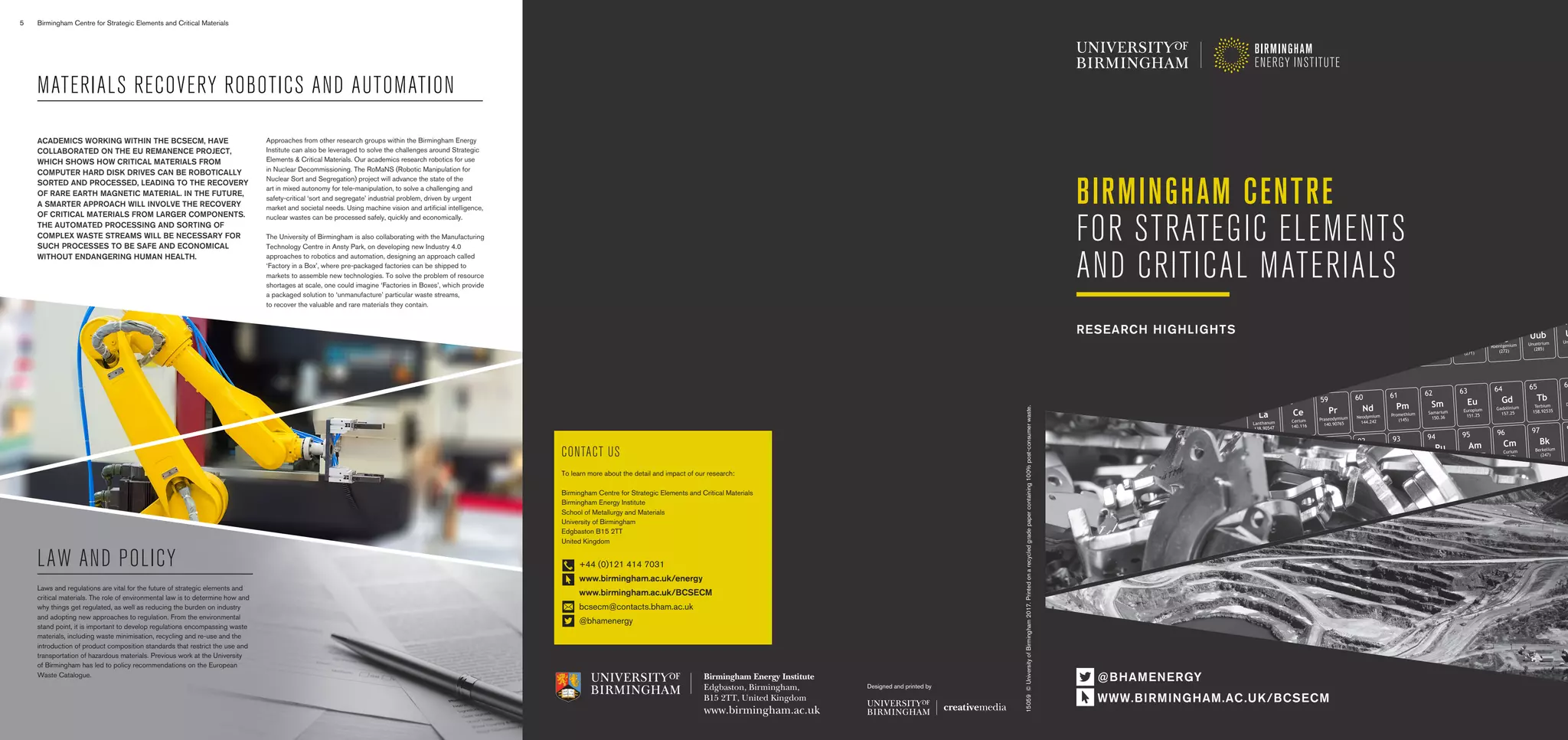
ACADEMICS WORKING WITHIN THE BCSECM, HAVE
COLLABORATED ON THE EU REMANENCE PROJECT,
WHICH SHOWS HOW CRITICAL MATERIALS FROM
COMPUTER HARD DISK DRIVES CAN BE ROBOTICALLY
SORTED AND PROCESSED, LEADING TO THE RECOVERY 	
OF RARE EARTH MAGNETIC MATERIAL. IN THE FUTURE, 	
A SMARTER APPROACH WILL INVOLVE THE RECOVERY 	
OF CRITICAL MATERIALS FROM LARGER COMPONENTS. 	
THE AUTOMATED PROCESSING AND SORTING OF
COMPLEX WASTE STREAMS WILL BE NECESSARY FOR
SUCH PROCESSES TO BE SAFE AND ECONOMICAL
WITHOUT ENDANGERING HUMAN HEALTH.
MATERIALS RECOVERY ROBOTICS AND AUTOMATION
LAW AND POLICY
Laws and regulations are vital for the future of strategic elements and
critical materials. The role of environmental law is to determine how and
why things get regulated, as well as reducing the burden on industry
and adopting new approaches to regulation. From the environmental
stand point, it is important to develop regulations encompassing waste
materials, including waste minimisation, recycling and re-use and the
introduction of product composition standards that restrict the use and
transportation of hazardous materials. Previous work at the University
of Birmingham has led to policy recommendations on the European
Waste Catalogue.
Approaches from other research groups within the Birmingham Energy
Institute can also be leveraged to solve the challenges around Strategic
Elements & Critical Materials. Our academics research robotics for use
in Nuclear Decommissioning. The RoMaNS (Robotic Manipulation for
Nuclear Sort and Segregation) project will advance the state of the
art in mixed autonomy for tele-manipulation, to solve a challenging and
safety-critical ‘sort and segregate’ industrial problem, driven by urgent
market and societal needs. Using machine vision and artificial intelligence,
nuclear wastes can be processed safely, quickly and economically.
The University of Birmingham is also collaborating with the Manufacturing
Technology Centre in Ansty Park, on developing new Industry 4.0
approaches to robotics and automation, designing an approach called
‘Factory in a Box’, where pre-packaged factories can be shipped to
markets to assemble new technologies. To solve the problem of resource
shortages at scale, one could imagine ‘Factories in Boxes’, which provide
a packaged solution to ‘unmanufacture’ particular waste streams,
to recover the valuable and rare materials they contain.
Birmingham Centre for Strategic Elements and Critical Materials 42 Birmingham Centre for Strategic Elements and Critical Materials
PGM REDUCTION:
PLATINUM REDUCTION IN CATALYSIS IS BEING
INVESTIGATED THROUGH MULTIPLE APPROACHES.
NOVEL CORE-SHELL ARCHITECTURES ARE BEING
DEVELOPED TO REDUCE THE OVERALL PLATINUM
CONTENT USING ELECTRODEPOSITION TECHNIQUES.
Careful control of the process conditions enables the platinum
concentration to be optimised for a given application. By using
‘Click Chemistry’ it has been possible to manufacture only the
active form of chiral platinum and palladium catalysts, significantly
reducing the waste produced in conventional processes.
Electrochemically produced nanoparticles can be used to make
more efficient catalysts for use in applications such as fuel cells and
electrolysers by increasing the overall surface area. The development
of nanomaterials will be key for designing next generation polymer
electrolyte fuel cells for automotive applications.
PLATINUM GROUP METALS (PGMS) RARE EARTH ELEMENTS (REES)PERIODIC TABLE OF THE ELEMENTS
PGM REPLACEMENT:
A COMBINATION OF NANO-PATTERNING OF THE 	
EARTH-ABUNDANT MATERIALS AND DOPING WITH 	
FIRST ROW TRANSITION METALS, OR P-BLOCK NON-
METALS TO IMPROVE THE CATALYTIC BEHAVIOUR 	
AND PERFORMANCE.
Platinum can also be replaced by employing carbon structures
doped with non-metallic and/or non-precious metal elements.
We are investigating the development of a new solid oxide fuel cell
concept to allow operation at temperatures between 100–350°C.
This unique solid oxide fuel cell system will eliminate the need
for platinum group metals in the electrode materials.
PGM RECOVERY:
ELECTROCHEMICAL METHODS HAVE BEEN SHOWN 	
TO BE EFFECTIVE FOR RECOVERY AND RECYCLING OF
PRECIOUS METALS FROM PRINTED CIRCUIT BOARDS.
Bio-platinum and bio-palladium has been recovered and recycled
from waste catalytic converters and utilised in the chemical production
of fuels based on sugars that can be mixed with fossil fuels suited
for transportation.
REE REDUCTION:
A NOVEL HYDROGEN DUCTILISATION PROCESS 	
(HYDP) HAS BEEN DEVELOPED (PATENT PENDING)
WHICH ALLOWS FOR ROOM TEMPERATURE
DEFORMATION, SHAPING AND COMPRESSION 	
OF SOLID NEODYMIUM–IRON–BORON ALLOYS.
This process should lead to the production of anisotropic
magnetic material at a low cost without the typical material losses
associated with shaping and machining of sintered compacts.
REE REPLACEMENT:
REPLACEMENT OF RARE EARTHS IN ENERGY
CONVERSION DEVICES SUCH AS FUEL CELLS IS 	
BEING EFFECTED THROUGH SUBSTITUTION OF
ELEMENTS SUCH AS LANTHANUM, GADOLINIUM,
SAMARIUM AND PRASEODYMIUM WITH ALKALINE
EARTHS (CALCIUM, STRONTIUM, BARIUM).
These alkaline earth containing compounds are being stabilised through
the introduction of oxyanions, eliminating the need for rare earths.
HEAVY TRANSITION
ELEMENTS
High temperature superalloys in aerospace
jet engine technology use expensive elements
such as rhenium, niobium and hafnium.
We are utilising advanced modelling techniques
to reduce our reliance on these elements in
nickel-superalloys whilst maintaining their ability
to withstand extreme operating conditions.
LITHIUM (Li)
A novel bioleaching technique has been
developed in order to recover lithium from
kaolin waste. The substitution and replacement
of strategic elements and critical materials in
batteries and fuel cells has been investigated
for both the electrodes and electrolytes. For
batteries the main focus has been on replacing
lithium to reduce the criticality of these
applications by implementing new sodium-ion
and potassium-ion energy storage systems.
As the number of Electric Vehicles on Britain’s
roads increases, the challenges of lithium
supply will place increasing pressure on
automotive supply chains. Our academics are
working on techniques for recycling Electric
Vehicle batteries at the end of life.
IRIDIUM (Ir)
Iridium complexes can be made to emit any
colour, for example they have been used in
OLED smartphone displays as well as in high
accuracy oxygen sensors. We have shown
that iridium can be successfully replaced
with complexes based on the much more
abundant element copper.
REE RECOVERY:
THE MAGNETIC MATERIALS GROUP HAVE BEEN 	
WORKING ON THE RECOVERY AND REPROCESSING 	
OF SINTERED NEODYMIUM–IRON–BORON MAGNETS
FROM END-OF-LIFE PRODUCTS SUCH AS HARD DISK
DRIVES, LOUDSPEAKERS AND DRIVE MOTORS.
By utilising hydrogen as a processing tool it is possible to break the
recovered magnets down to a coarse, friable powder which can be
mechanically liberated from the discarded products. Sieving with
mechanical agitation has been shown to be an efficient route to remove
virtually all of the impurities to make the powder suitable for reprocessing
into new cast alloys, new sintered magnets and also bonded magnets.
Novel processing routes have been adopted to remove selectively
the oxidised components of the recovered powder in an attempt to
enhance the magnetic properties.
Novel processes and systems have been developed where bacteria can
be used to recover and extract heavy metals from waste feeds, nuclear
waste treatment and for hydrogen production from food waste. We have
shown that recovery of rare earth elements from mine tailings can be
performed successfully by placing bacteria on a sponge and feeding
it with a solution of metal tailings and phosphates. The bacteria convert
the mixture into Nd phosphate, which can be extracted for use as a
NdPO4 catalyst or leached to produce Nd-metal for alloy production.
This process has also been adjusted to separate Nd from the radioactive
elements uranium and thorium, which are also found in mine tailings.
GOLD (Au)
There are many applications where molecular
synthesis and catalysis uses precious metals
such as gold. The development of novel and
more efficient methods for synthesis reduces
the steps and processing required to access
targets and leads to a more sustainable and
cost-effective supply chain. This work expands
into the field of metal-sustainability, exploring
catalyst design to enhance the reactivity,
selectivity and recyclability of catalysts and in
replacing precious metals with more abundant,
less critical materials.
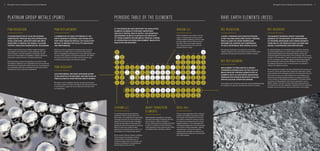
AT THE BCSECM WE HAVE IDENTIFIED THE HIGHLIGHTED
ELEMENTS AS BEING OF STRATEGIC IMPORTANCE 	
AND/OR AT CRITICAL RISK OF SUPPLY. OUR SCIENTISTS
ARE WORKING ON WAYS TO MITIGATE THE CRITICALITY 	
OF THESE ELEMENTS AND MATERIALS THROUGH A RANGE
OF APPROACHES INCLUDING REPLACEMENT, REGULATION,
REDUCTION AND RECOVERY.

Birmingham Centre for Strategic Elements & Critical Materials: Research Highlights

  • 1.
    Birmingham Centre forStrategic Elements and Critical Materials c5 Birmingham Centre for Strategic Elements and Critical Materials 15059©UniversityofBirmingham2017.Printedonarecycledgradepapercontaining100%post-consumerwaste. Birmingham Energy Institute Edgbaston, Birmingham, B15 2TT, United Kingdom www.birmingham.ac.uk CONTACT US To learn more about the detail and impact of our research: Birmingham Centre for Strategic Elements and Critical Materials Birmingham Energy Institute School of Metallurgy and Materials University of Birmingham Edgbaston B15 2TT United Kingdom +44 (0)121 414 7031 www.birmingham.ac.uk/energy www.birmingham.ac.uk/BCSECM bcsecm@contacts.bham.ac.uk @bhamenergy Designed and printed by BIRMINGHAM CENTRE FOR STRATEGIC ELEMENTS AND CRITICAL MATERIALS @BHAMENERGY WWW.BIRMINGHAM.AC.UK/BCSECM RESEARCH HIGHLIGHTS ACADEMICS WORKING WITHIN THE BCSECM, HAVE COLLABORATED ON THE EU REMANENCE PROJECT, WHICH SHOWS HOW CRITICAL MATERIALS FROM COMPUTER HARD DISK DRIVES CAN BE ROBOTICALLY SORTED AND PROCESSED, LEADING TO THE RECOVERY OF RARE EARTH MAGNETIC MATERIAL. IN THE FUTURE, A SMARTER APPROACH WILL INVOLVE THE RECOVERY OF CRITICAL MATERIALS FROM LARGER COMPONENTS. THE AUTOMATED PROCESSING AND SORTING OF COMPLEX WASTE STREAMS WILL BE NECESSARY FOR SUCH PROCESSES TO BE SAFE AND ECONOMICAL WITHOUT ENDANGERING HUMAN HEALTH. MATERIALS RECOVERY ROBOTICS AND AUTOMATION LAW AND POLICY Laws and regulations are vital for the future of strategic elements and critical materials. The role of environmental law is to determine how and why things get regulated, as well as reducing the burden on industry and adopting new approaches to regulation. From the environmental stand point, it is important to develop regulations encompassing waste materials, including waste minimisation, recycling and re-use and the introduction of product composition standards that restrict the use and transportation of hazardous materials. Previous work at the University of Birmingham has led to policy recommendations on the European Waste Catalogue. Approaches from other research groups within the Birmingham Energy Institute can also be leveraged to solve the challenges around Strategic Elements & Critical Materials. Our academics research robotics for use in Nuclear Decommissioning. The RoMaNS (Robotic Manipulation for Nuclear Sort and Segregation) project will advance the state of the art in mixed autonomy for tele-manipulation, to solve a challenging and safety-critical ‘sort and segregate’ industrial problem, driven by urgent market and societal needs. Using machine vision and artificial intelligence, nuclear wastes can be processed safely, quickly and economically. The University of Birmingham is also collaborating with the Manufacturing Technology Centre in Ansty Park, on developing new Industry 4.0 approaches to robotics and automation, designing an approach called ‘Factory in a Box’, where pre-packaged factories can be shipped to markets to assemble new technologies. To solve the problem of resource shortages at scale, one could imagine ‘Factories in Boxes’, which provide a packaged solution to ‘unmanufacture’ particular waste streams, to recover the valuable and rare materials they contain.
  • 2.
    Birmingham Centre forStrategic Elements and Critical Materials 42 Birmingham Centre for Strategic Elements and Critical Materials PGM REDUCTION: PLATINUM REDUCTION IN CATALYSIS IS BEING INVESTIGATED THROUGH MULTIPLE APPROACHES. NOVEL CORE-SHELL ARCHITECTURES ARE BEING DEVELOPED TO REDUCE THE OVERALL PLATINUM CONTENT USING ELECTRODEPOSITION TECHNIQUES. Careful control of the process conditions enables the platinum concentration to be optimised for a given application. By using ‘Click Chemistry’ it has been possible to manufacture only the active form of chiral platinum and palladium catalysts, significantly reducing the waste produced in conventional processes. Electrochemically produced nanoparticles can be used to make more efficient catalysts for use in applications such as fuel cells and electrolysers by increasing the overall surface area. The development of nanomaterials will be key for designing next generation polymer electrolyte fuel cells for automotive applications. PLATINUM GROUP METALS (PGMS) RARE EARTH ELEMENTS (REES)PERIODIC TABLE OF THE ELEMENTS PGM REPLACEMENT: A COMBINATION OF NANO-PATTERNING OF THE EARTH-ABUNDANT MATERIALS AND DOPING WITH FIRST ROW TRANSITION METALS, OR P-BLOCK NON- METALS TO IMPROVE THE CATALYTIC BEHAVIOUR AND PERFORMANCE. Platinum can also be replaced by employing carbon structures doped with non-metallic and/or non-precious metal elements. We are investigating the development of a new solid oxide fuel cell concept to allow operation at temperatures between 100–350°C. This unique solid oxide fuel cell system will eliminate the need for platinum group metals in the electrode materials. PGM RECOVERY: ELECTROCHEMICAL METHODS HAVE BEEN SHOWN TO BE EFFECTIVE FOR RECOVERY AND RECYCLING OF PRECIOUS METALS FROM PRINTED CIRCUIT BOARDS. Bio-platinum and bio-palladium has been recovered and recycled from waste catalytic converters and utilised in the chemical production of fuels based on sugars that can be mixed with fossil fuels suited for transportation. REE REDUCTION: A NOVEL HYDROGEN DUCTILISATION PROCESS (HYDP) HAS BEEN DEVELOPED (PATENT PENDING) WHICH ALLOWS FOR ROOM TEMPERATURE DEFORMATION, SHAPING AND COMPRESSION OF SOLID NEODYMIUM–IRON–BORON ALLOYS. This process should lead to the production of anisotropic magnetic material at a low cost without the typical material losses associated with shaping and machining of sintered compacts. REE REPLACEMENT: REPLACEMENT OF RARE EARTHS IN ENERGY CONVERSION DEVICES SUCH AS FUEL CELLS IS BEING EFFECTED THROUGH SUBSTITUTION OF ELEMENTS SUCH AS LANTHANUM, GADOLINIUM, SAMARIUM AND PRASEODYMIUM WITH ALKALINE EARTHS (CALCIUM, STRONTIUM, BARIUM). These alkaline earth containing compounds are being stabilised through the introduction of oxyanions, eliminating the need for rare earths. HEAVY TRANSITION ELEMENTS High temperature superalloys in aerospace jet engine technology use expensive elements such as rhenium, niobium and hafnium. We are utilising advanced modelling techniques to reduce our reliance on these elements in nickel-superalloys whilst maintaining their ability to withstand extreme operating conditions. LITHIUM (Li) A novel bioleaching technique has been developed in order to recover lithium from kaolin waste. The substitution and replacement of strategic elements and critical materials in batteries and fuel cells has been investigated for both the electrodes and electrolytes. For batteries the main focus has been on replacing lithium to reduce the criticality of these applications by implementing new sodium-ion and potassium-ion energy storage systems. As the number of Electric Vehicles on Britain’s roads increases, the challenges of lithium supply will place increasing pressure on automotive supply chains. Our academics are working on techniques for recycling Electric Vehicle batteries at the end of life. IRIDIUM (Ir) Iridium complexes can be made to emit any colour, for example they have been used in OLED smartphone displays as well as in high accuracy oxygen sensors. We have shown that iridium can be successfully replaced with complexes based on the much more abundant element copper. REE RECOVERY: THE MAGNETIC MATERIALS GROUP HAVE BEEN WORKING ON THE RECOVERY AND REPROCESSING OF SINTERED NEODYMIUM–IRON–BORON MAGNETS FROM END-OF-LIFE PRODUCTS SUCH AS HARD DISK DRIVES, LOUDSPEAKERS AND DRIVE MOTORS. By utilising hydrogen as a processing tool it is possible to break the recovered magnets down to a coarse, friable powder which can be mechanically liberated from the discarded products. Sieving with mechanical agitation has been shown to be an efficient route to remove virtually all of the impurities to make the powder suitable for reprocessing into new cast alloys, new sintered magnets and also bonded magnets. Novel processing routes have been adopted to remove selectively the oxidised components of the recovered powder in an attempt to enhance the magnetic properties. Novel processes and systems have been developed where bacteria can be used to recover and extract heavy metals from waste feeds, nuclear waste treatment and for hydrogen production from food waste. We have shown that recovery of rare earth elements from mine tailings can be performed successfully by placing bacteria on a sponge and feeding it with a solution of metal tailings and phosphates. The bacteria convert the mixture into Nd phosphate, which can be extracted for use as a NdPO4 catalyst or leached to produce Nd-metal for alloy production. This process has also been adjusted to separate Nd from the radioactive elements uranium and thorium, which are also found in mine tailings. GOLD (Au) There are many applications where molecular synthesis and catalysis uses precious metals such as gold. The development of novel and more efficient methods for synthesis reduces the steps and processing required to access targets and leads to a more sustainable and cost-effective supply chain. This work expands into the field of metal-sustainability, exploring catalyst design to enhance the reactivity, selectivity and recyclability of catalysts and in replacing precious metals with more abundant, less critical materials. AT THE BCSECM WE HAVE IDENTIFIED THE HIGHLIGHTED ELEMENTS AS BEING OF STRATEGIC IMPORTANCE AND/OR AT CRITICAL RISK OF SUPPLY. OUR SCIENTISTS ARE WORKING ON WAYS TO MITIGATE THE CRITICALITY OF THESE ELEMENTS AND MATERIALS THROUGH A RANGE OF APPROACHES INCLUDING REPLACEMENT, REGULATION, REDUCTION AND RECOVERY.