“AFTER ALL, THERE IS
NOTHING AS INTERESTING AS
PEOPLE, AND ONE CAN
NEVER STUDY THEM
ENOUGH”
VINCENT VAN GOGH
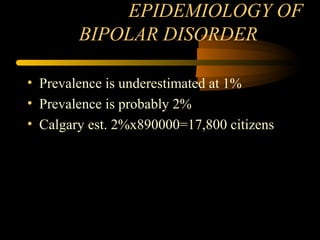
EPIDEMIOLOGY OF
BIPOLAR DISORDER
• Prevalence is underestimated at 1%
• Prevalence is probably 2%
• Calgary est. 2%x890000=17,800 citizens
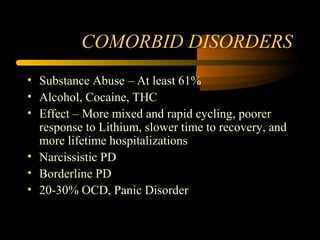
COMORBID DISORDERS
• Substance Abuse – At least 61%
• Alcohol, Cocaine, THC
• Effect – More mixed and rapid cycling, poorer
response to Lithium, slower time to recovery, and
more lifetime hospitalizations
• Narcissistic PD
• Borderline PD
• 20-30% OCD, Panic Disorder
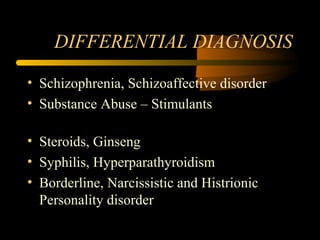
DIFFERENTIAL DIAGNOSIS
• Schizophrenia, Schizoaffective disorder
• Substance Abuse – Stimulants
• Steroids, Ginseng
• Syphilis, Hyperparathyroidism
• Borderline, Narcissistic and Histrionic
Personality disorder
ADOLESCENCE
• Much more likely to be delusional and co
morbid for substance abuse
• More likely to be irritable and
misdiagnosed as conduct disorder
PRECIPITANTS
• 60% of first episodes precipitated by
psychosocial, physical, or drug causes
30% of second episodes
• None of fourth episodes
• Illness starts as exogenous and becomes
more endogenous
• Concept of kindling
SCREENING QUESTIONS
• Have you ever had a period of a week or so
when you felt so happy and energetic that
your friends told you that you were talking
too fast or that you were behaving
differently and strangely?
• Has there been a period when you were so
hyper and irritable that you got into
arguments with people?
SCREENING QUESTIONS
• Has anyone ever called you manic before?
DIGFAST
• Distractibility
• Indiscretion (pleasurable activities)
• Grandiosity
• Flight of ideas
• Activity increase
• Sleep deficit (decreased need)
• Talkativeness (pressured speech)
DISTRACTABILITY
• Were you having trouble thinking or
concentrating?
• Was this because things around you or even
your thoughts were getting you off track?
INDISCRETION
• During the period we were talking about, how
were you spending your time?
• Were you doing things that caused trouble for you
or your family?
• Were you doing things that showed a lack of
judgment, such as driving too fast, running red
lights, or spending too much?
• Were you doing sexual things during this
INDISCRETIONS
this period that was unusual for you?
GRANDIOUSITY
• During this period did you feel so confidant
that you felt you could conquer the world?
• What was your best idea when you felt that
way?
• Did you feel that you had special powers or
abilities?
• Did you feel more religious than normal for
you?
FLIGHT OF IDEAS
• During this period did you have so many
thoughts, or were they so fast, that you
could barely keep up to them?
• Did it feel like your thoughts were racing?
ACTIVITY INCREASE
• During that period, were you more active
than usual?
• Were you constantly starting new projects
and hobbies, working into the night?
SLEEP DEFICIT
• During that period, did you need less sleep?
• Did you ever stay up all night doing all
kinds of things, like working on projects or
phoning people?
• Did your sleep duration become reduced
and still you had lots of energy?
TALKATIVENESS
• During this period, were you talking more
than usual for you?
• Were you talking so much that people had
to interrupt you to speak to you?
• Were you using the phone more than usual
for you?
CORROBORATION
• Denial and lack of insight rule the day
TREATMENT OPTIONS
• Hospitalization for mania, severe
depression
• Mood stabilizers, antipsychotics and
antidepressants
• ECT – most effective treatment
• Supportive psychotherapy and CBT
• Lifestyle change
• Substance abuse treatment
LITHIUM CARBONATE
• 900 – 1500 mg/d .8-1.3 mEq/L
• Most effective medication
• SE’s include teratogenicity, tremor, renal
dysfunction, acne, hypothyroidism, gastric upset,
cardiac conduction problems, cognitive
impairment
• Serum TSH, Cr, EKG, electrolytes pre and TSH,
Cr q6mo.
• Mogen Schou rule, “Always treat SE’s”
CARBAMAZEPINE
• 400 – 1000 mg/d
• Most effective for mixed states, rapid
cycling
• SE’s – sedation, ataxia, aplastic anemia,
agranulocytosis
• Check CBC q3mo ?
VALPROATE
• 500 – 2000 mg/d; Highest blood level for
effect. Highest dose is 60 mg/kg/d
• SE’s – GI upset, weight gain, alopecia,
teratogenicity, liver problems
• Best for mixed states, rapid cycling,
secondary mania. Ineffective for depression
• Selenium for hair loss
• PCOD!
ATYPICAL ANTIPSYCHOTICS
• Olanzepine – 2.5-20 mg/d; very effective;
significant wt gain and lipid problems in
some
• Risperdal - .5-4.0 mg/d; more EPS and
increased prolactin in some
• Clozapine - For truly refractory patient, but
can be remarkably effective. Slow response,
serious SE profile and significant wt gain
Olanzepine Efficacy for Mania:
Two Placebo-Controlled Studies
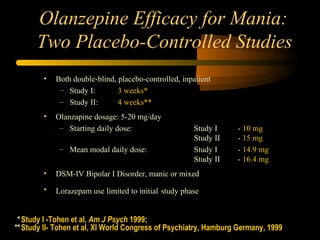
• Both double-blind, placebo-controlled, inpatient
– Study I: 3 weeks*
– Study II: 4 weeks**
• Olanzapine dosage: 5-20 mg/day
– Starting daily dose: Study I - 10 mg
Study II - 15 mg
– Mean modal daily dose: Study I - 14.9 mg
Study II - 16.4 mg
• DSM-IV Bipolar I Disorder, manic or mixed
• Lorazepam use limited to initial study phase
*Study I -Tohen et al, Am J Psych 1999;
**Study II- Tohen et al, XI World Congress of Psychiatry, Hamburg Germany, 1999
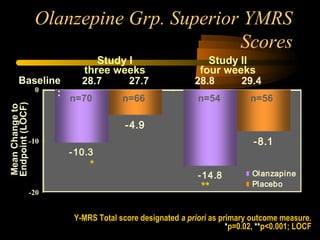
Olanzepine Grp. Superior YMRS
Scores
Y-MRS Total score designated a priori as primary outcome measure.
*p=0.02, **p<0.001; LOCF
-10.3
-14.8
-4.9
-8.1
-20
-10
0
Olanzapine
Placebo
Study I
three weeks
Study II
four weeks
28.7 27.7 28.8 29.4Baseline
:
n=70 n=66 n=54 n=56
*
**
MeanChangeto
Endpoint(LOCF)
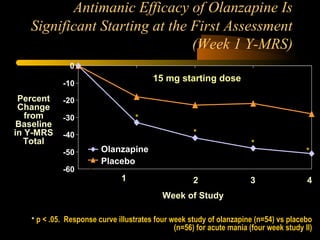
Antimanic Efficacy of Olanzapine Is
Significant Starting at the First Assessment
(Week 1 Y-MRS)
-60
-50
-40
-30
-20
-10
0
Placebo
Olanzapine
1
*
*
*
*
* p < .05. Response curve illustrates four week study of olanzapine (n=54) vs placebo
(n=56) for acute mania (four week study II)
15 mg starting dose
Week of Study
2 3 4
Percent
Change
from
Baseline
in Y-MRS
Total
-20
-15
-10
-5
0
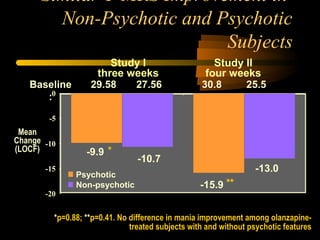
Similar Y-MRS Improvement in
Non-Psychotic and Psychotic
Subjects
*p=0.88; **p=0.41. No difference in mania improvement among olanzapine-
treated subjects with and without psychotic features
Mean
Change
(LOCF)
Study I
three weeks
Study II
four weeks
**
*
Non-psychotic
Psychotic
-9.9
-10.7
-15.9
-13.0
29.58 27.56 30.8 25.5Baseline
:
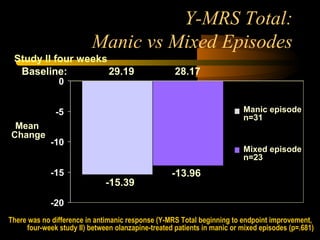
There was no difference in antimanic response (Y-MRS Total beginning to endpoint improvement,
four-week study II) between olanzapine-treated patients in manic or mixed episodes (p=.681)
Y-MRS Total:
Manic vs Mixed Episodes
-20
-15
-10
-5
0
Mean
Change
Manic episode
n=31
Mixed episode
n=23
Baseline: 28.1729.19
-15.39
-13.96
Study II four weeks
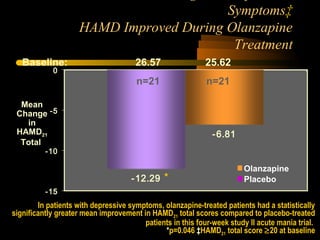
Symptoms‡
HAMD Improved During Olanzapine
Treatment
In patients with depressive symptoms, olanzapine-treated patients had a statistically
significantly greater mean improvement in HAMD21 total scores compared to placebo-treated
patients in this four-week study II acute mania trial.
*p=0.046 ‡HAMD21 total score ≥20 at baseline
-12.29
-6.81
-15
-10
-5
0
26.57 25.62Baseline:
n=21 n=21
*
Olanzapine
Placebo
Mean
Change
in
HAMD21
Total
-18
-15
-12
-9
-6
-3
0
Mean
Change
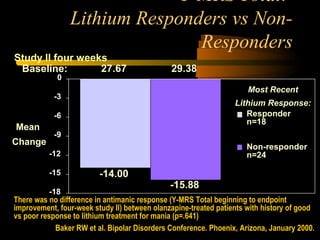
There was no difference in antimanic response (Y-MRS Total beginning to endpoint
improvement, four-week study II) between olanzapine-treated patients with history of good
vs poor response to lithium treatment for mania (p=.641)
Responder
n=18
Non-responder
n=24
Most Recent
Lithium Response:
Y-MRS Total:
Lithium Responders vs Non-
Responders
27.67 29.38
-14.00
-15.88
Baseline:
Study II four weeks
Baker RW et al. Bipolar Disorders Conference. Phoenix, Arizona, January 2000.
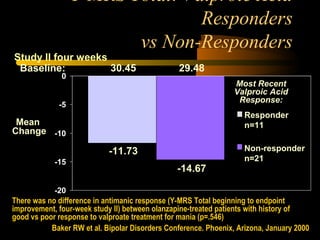
Y-MRS Total: Valproic Acid
Responders
vs Non-Responders
-20
-15
-10
-5
0
-11.73
-14.67
There was no difference in antimanic response (Y-MRS Total beginning to endpoint
improvement, four-week study II) between olanzapine-treated patients with history of
good vs poor response to valproate treatment for mania (p=.546)
30.45 29.48
Mean
Change
Baseline:
Study II four weeks
Responder
n=11
Non-responder
n=21
Baker RW et al. Bipolar Disorders Conference. Phoenix, Arizona, January 2000
Most Recent
Valproic Acid
Response:
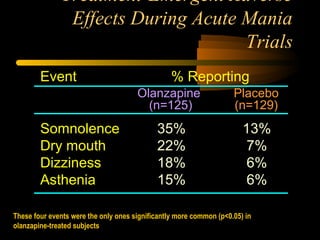
Treatment-Emergent Adverse
Effects During Acute Mania
Trials
These four events were the only ones significantly more common (p<0.05) in
olanzapine-treated subjects
Event % Reporting
Placebo
(n=129)
Somnolence
Dry mouth
Dizziness
Asthenia
35%
22%
18%
15%
13%
7%
6%
6%
Olanzapine
(n=125)
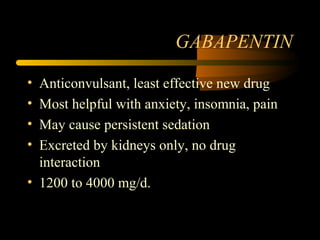
GABAPENTIN
• Anticonvulsant, least effective new drug
• Most helpful with anxiety, insomnia, pain
• May cause persistent sedation
• Excreted by kidneys only, no drug
interaction
• 1200 to 4000 mg/d.
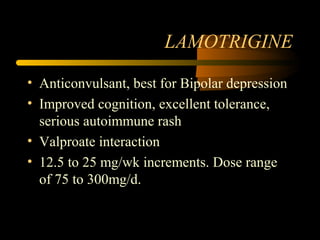
LAMOTRIGINE
• Anticonvulsant, best for Bipolar depression
• Improved cognition, excellent tolerance,
serious autoimmune rash
• Valproate interaction
• 12.5 to 25 mg/wk increments. Dose range
of 75 to 300mg/d.
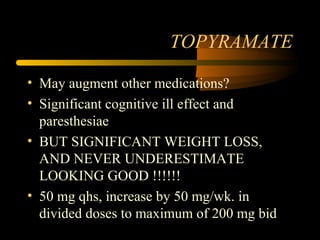
TOPYRAMATE
• May augment other medications?
• Significant cognitive ill effect and
paresthesiae
• BUT SIGNIFICANT WEIGHT LOSS,
AND NEVER UNDERESTIMATE
LOOKING GOOD !!!!!!
• 50 mg qhs, increase by 50 mg/wk. in
divided doses to maximum of 200 mg bid
THYROID AUGMENTATION
• TSH is not reliable indicator of subclinical
hypothyroidism in mood disorder patients
• T3 and T4 in lower range of “normal” cause
cognitive impairment, relapse and lethargy
• Supplemental T4 caused 10/11 Li refractory
to respond
• Large study showed no bone density effect
of high dose T4 treatment
NEVER GIVE UP
It will help patient to be inspired by
us, rather than the other way around

Bipolar_Disorders

  • 6.
    “AFTER ALL, THEREIS NOTHING AS INTERESTING AS PEOPLE, AND ONE CAN NEVER STUDY THEM ENOUGH” VINCENT VAN GOGH
  • 7.
    EPIDEMIOLOGY OF BIPOLAR DISORDER •Prevalence is underestimated at 1% • Prevalence is probably 2% • Calgary est. 2%x890000=17,800 citizens
  • 8.
    COMORBID DISORDERS • SubstanceAbuse – At least 61% • Alcohol, Cocaine, THC • Effect – More mixed and rapid cycling, poorer response to Lithium, slower time to recovery, and more lifetime hospitalizations • Narcissistic PD • Borderline PD • 20-30% OCD, Panic Disorder
  • 9.
    DIFFERENTIAL DIAGNOSIS • Schizophrenia,Schizoaffective disorder • Substance Abuse – Stimulants • Steroids, Ginseng • Syphilis, Hyperparathyroidism • Borderline, Narcissistic and Histrionic Personality disorder
  • 10.
    ADOLESCENCE • Much morelikely to be delusional and co morbid for substance abuse • More likely to be irritable and misdiagnosed as conduct disorder
  • 11.
    PRECIPITANTS • 60% offirst episodes precipitated by psychosocial, physical, or drug causes 30% of second episodes • None of fourth episodes • Illness starts as exogenous and becomes more endogenous • Concept of kindling
  • 12.
    SCREENING QUESTIONS • Haveyou ever had a period of a week or so when you felt so happy and energetic that your friends told you that you were talking too fast or that you were behaving differently and strangely? • Has there been a period when you were so hyper and irritable that you got into arguments with people?
  • 13.
    SCREENING QUESTIONS • Hasanyone ever called you manic before?
  • 14.
    DIGFAST • Distractibility • Indiscretion(pleasurable activities) • Grandiosity • Flight of ideas • Activity increase • Sleep deficit (decreased need) • Talkativeness (pressured speech)
  • 15.
    DISTRACTABILITY • Were youhaving trouble thinking or concentrating? • Was this because things around you or even your thoughts were getting you off track?
  • 16.
    INDISCRETION • During theperiod we were talking about, how were you spending your time? • Were you doing things that caused trouble for you or your family? • Were you doing things that showed a lack of judgment, such as driving too fast, running red lights, or spending too much? • Were you doing sexual things during this
  • 17.
    INDISCRETIONS this period thatwas unusual for you?
  • 18.
    GRANDIOUSITY • During thisperiod did you feel so confidant that you felt you could conquer the world? • What was your best idea when you felt that way? • Did you feel that you had special powers or abilities? • Did you feel more religious than normal for you?
  • 19.
    FLIGHT OF IDEAS •During this period did you have so many thoughts, or were they so fast, that you could barely keep up to them? • Did it feel like your thoughts were racing?
  • 20.
    ACTIVITY INCREASE • Duringthat period, were you more active than usual? • Were you constantly starting new projects and hobbies, working into the night?
  • 21.
    SLEEP DEFICIT • Duringthat period, did you need less sleep? • Did you ever stay up all night doing all kinds of things, like working on projects or phoning people? • Did your sleep duration become reduced and still you had lots of energy?
  • 22.
    TALKATIVENESS • During thisperiod, were you talking more than usual for you? • Were you talking so much that people had to interrupt you to speak to you? • Were you using the phone more than usual for you?
  • 23.
    CORROBORATION • Denial andlack of insight rule the day
  • 24.
    TREATMENT OPTIONS • Hospitalizationfor mania, severe depression • Mood stabilizers, antipsychotics and antidepressants • ECT – most effective treatment • Supportive psychotherapy and CBT • Lifestyle change • Substance abuse treatment
  • 25.
    LITHIUM CARBONATE • 900– 1500 mg/d .8-1.3 mEq/L • Most effective medication • SE’s include teratogenicity, tremor, renal dysfunction, acne, hypothyroidism, gastric upset, cardiac conduction problems, cognitive impairment • Serum TSH, Cr, EKG, electrolytes pre and TSH, Cr q6mo. • Mogen Schou rule, “Always treat SE’s”
  • 26.
    CARBAMAZEPINE • 400 –1000 mg/d • Most effective for mixed states, rapid cycling • SE’s – sedation, ataxia, aplastic anemia, agranulocytosis • Check CBC q3mo ?
  • 27.
    VALPROATE • 500 –2000 mg/d; Highest blood level for effect. Highest dose is 60 mg/kg/d • SE’s – GI upset, weight gain, alopecia, teratogenicity, liver problems • Best for mixed states, rapid cycling, secondary mania. Ineffective for depression • Selenium for hair loss • PCOD!
  • 28.
    ATYPICAL ANTIPSYCHOTICS • Olanzepine– 2.5-20 mg/d; very effective; significant wt gain and lipid problems in some • Risperdal - .5-4.0 mg/d; more EPS and increased prolactin in some • Clozapine - For truly refractory patient, but can be remarkably effective. Slow response, serious SE profile and significant wt gain
  • 29.
    Olanzepine Efficacy forMania: Two Placebo-Controlled Studies • Both double-blind, placebo-controlled, inpatient – Study I: 3 weeks* – Study II: 4 weeks** • Olanzapine dosage: 5-20 mg/day – Starting daily dose: Study I - 10 mg Study II - 15 mg – Mean modal daily dose: Study I - 14.9 mg Study II - 16.4 mg • DSM-IV Bipolar I Disorder, manic or mixed • Lorazepam use limited to initial study phase *Study I -Tohen et al, Am J Psych 1999; **Study II- Tohen et al, XI World Congress of Psychiatry, Hamburg Germany, 1999
  • 30.
    Olanzepine Grp. SuperiorYMRS Scores Y-MRS Total score designated a priori as primary outcome measure. *p=0.02, **p<0.001; LOCF -10.3 -14.8 -4.9 -8.1 -20 -10 0 Olanzapine Placebo Study I three weeks Study II four weeks 28.7 27.7 28.8 29.4Baseline : n=70 n=66 n=54 n=56 * ** MeanChangeto Endpoint(LOCF)
  • 31.
    Antimanic Efficacy ofOlanzapine Is Significant Starting at the First Assessment (Week 1 Y-MRS) -60 -50 -40 -30 -20 -10 0 Placebo Olanzapine 1 * * * * * p < .05. Response curve illustrates four week study of olanzapine (n=54) vs placebo (n=56) for acute mania (four week study II) 15 mg starting dose Week of Study 2 3 4 Percent Change from Baseline in Y-MRS Total
  • 32.
    -20 -15 -10 -5 0 Similar Y-MRS Improvementin Non-Psychotic and Psychotic Subjects *p=0.88; **p=0.41. No difference in mania improvement among olanzapine- treated subjects with and without psychotic features Mean Change (LOCF) Study I three weeks Study II four weeks ** * Non-psychotic Psychotic -9.9 -10.7 -15.9 -13.0 29.58 27.56 30.8 25.5Baseline :
  • 33.
    There was nodifference in antimanic response (Y-MRS Total beginning to endpoint improvement, four-week study II) between olanzapine-treated patients in manic or mixed episodes (p=.681) Y-MRS Total: Manic vs Mixed Episodes -20 -15 -10 -5 0 Mean Change Manic episode n=31 Mixed episode n=23 Baseline: 28.1729.19 -15.39 -13.96 Study II four weeks
  • 34.
    Symptoms‡ HAMD Improved DuringOlanzapine Treatment In patients with depressive symptoms, olanzapine-treated patients had a statistically significantly greater mean improvement in HAMD21 total scores compared to placebo-treated patients in this four-week study II acute mania trial. *p=0.046 ‡HAMD21 total score ≥20 at baseline -12.29 -6.81 -15 -10 -5 0 26.57 25.62Baseline: n=21 n=21 * Olanzapine Placebo Mean Change in HAMD21 Total
  • 35.
    -18 -15 -12 -9 -6 -3 0 Mean Change There was nodifference in antimanic response (Y-MRS Total beginning to endpoint improvement, four-week study II) between olanzapine-treated patients with history of good vs poor response to lithium treatment for mania (p=.641) Responder n=18 Non-responder n=24 Most Recent Lithium Response: Y-MRS Total: Lithium Responders vs Non- Responders 27.67 29.38 -14.00 -15.88 Baseline: Study II four weeks Baker RW et al. Bipolar Disorders Conference. Phoenix, Arizona, January 2000.
  • 36.
    Y-MRS Total: ValproicAcid Responders vs Non-Responders -20 -15 -10 -5 0 -11.73 -14.67 There was no difference in antimanic response (Y-MRS Total beginning to endpoint improvement, four-week study II) between olanzapine-treated patients with history of good vs poor response to valproate treatment for mania (p=.546) 30.45 29.48 Mean Change Baseline: Study II four weeks Responder n=11 Non-responder n=21 Baker RW et al. Bipolar Disorders Conference. Phoenix, Arizona, January 2000 Most Recent Valproic Acid Response:
  • 37.
    Treatment-Emergent Adverse Effects DuringAcute Mania Trials These four events were the only ones significantly more common (p<0.05) in olanzapine-treated subjects Event % Reporting Placebo (n=129) Somnolence Dry mouth Dizziness Asthenia 35% 22% 18% 15% 13% 7% 6% 6% Olanzapine (n=125)
  • 38.
    GABAPENTIN • Anticonvulsant, leasteffective new drug • Most helpful with anxiety, insomnia, pain • May cause persistent sedation • Excreted by kidneys only, no drug interaction • 1200 to 4000 mg/d.
  • 39.
    LAMOTRIGINE • Anticonvulsant, bestfor Bipolar depression • Improved cognition, excellent tolerance, serious autoimmune rash • Valproate interaction • 12.5 to 25 mg/wk increments. Dose range of 75 to 300mg/d.
  • 40.
    TOPYRAMATE • May augmentother medications? • Significant cognitive ill effect and paresthesiae • BUT SIGNIFICANT WEIGHT LOSS, AND NEVER UNDERESTIMATE LOOKING GOOD !!!!!! • 50 mg qhs, increase by 50 mg/wk. in divided doses to maximum of 200 mg bid
  • 41.
    THYROID AUGMENTATION • TSHis not reliable indicator of subclinical hypothyroidism in mood disorder patients • T3 and T4 in lower range of “normal” cause cognitive impairment, relapse and lethargy • Supplemental T4 caused 10/11 Li refractory to respond • Large study showed no bone density effect of high dose T4 treatment
  • 42.
    NEVER GIVE UP Itwill help patient to be inspired by us, rather than the other way around

Editor's Notes

  • #30 Background: 100+ psychiatrists in both inpatient and outpatient settings were interviewed in 1999 on their key goals of therapy in treating bipolar patients in manic or mixed episodes. Key Point: Olanzapine’s efficacy for bipolar mania was demonstrated in two placebo-controlled registration trials. Both trials enrolled initially inpatient subjects in an acute manic or mixed episode, with or without psychotic features. Though the trials had very similar designs, there were two important differences: Study I lasted three weeks but study II lasted four weeks. Starting olanzapine dose was 10 mg in study I, but 15 mg in study II, which appeared to produce more robust results. Background: Both trials were multicenter studies; study I was conducted in 1996-1997 and study II in 1997-1999. These were double-blind, placebo-controlled, parallel group studies of 3 and 4 weeks duration. Subjects were initially inpatient, but responders could be discharged after one week. Medically unstable, organically impaired, or substance-dependent subjects were excluded. Patients in their first episode of mania were excluded from study II. Patients were randomly assigned to therapy. After a two- to four-day screening period, qualified patients were assigned to either olanzapine or placebo. Following the first day of treatment, the daily dose could be adjusted upward or downward, as clinically indicated, by one capsule (olanzapine 5 mg or placebo) within the allowed range of 1 to 4 capsules/day. Limited use of adjunctive lorazepam was allowed; the second study was the more restrictive: Max 2 mg/day for the first four days, max 1 mg/day for the next six days, none after day 10. All randomized patients were included in statistical analyses; ANOVA was used for continuous variables and Fishers exact test for categorical ones; p values are two-tailed with protocol-specified significance level of 0.05. Sources: Study I (HGEH): Tohen M et al. Olanzapine versus placebo in the treatment of acute mania. Am J Psych 156:702-709, 1999 Study II (HGGW): Tohen M et al. Olanzapine in the treatment of mania: a placebo-controlled four-week study poster presentation, XI World Congress ofPsychiatry, Hamburg, Germany, 1999  
  • #31 Key point: In both mania studies, olanzapine was superior to placebo for the reduction of manic symptoms. These studies demonstrated and replicated the finding that olanzapine is effective for treating manic or mixed episodes associated with bipolar disorder. This primary finding allowed application for an indication for the treatment of acute mania in the United States. Background: Efficacy analysis included all subjects with baseline rating and at least one follow-up rating (study I, n=136; study II, n=110). In the three-week study I, olanzapine-treated patients improved by 10.3 points (36%) from baseline to endpoint, versus 4.9 points (18%) in the placebo group. In the four-week study II, olanzapine treated-patients improved by 14.8 points (51%) from baseline to endpoint, versus 8.1 points (28%) in the placebo group. Non-medication treatments (eg, inpatient psychotherapies) were provided to both groups.
  • #32 Key point: Prompt onset of mood-stabilizing effects in mania may be relevant to safety, patient functioning, and length of hospitalization. In the placebo-controlled mania studies, ratings of mania were done at weekly intervals. In study II, with a starting olanzapine dose of 15 mg, efficacy was prompt and superiority over placebo was noted at the first assessment, one week. Olanzapine can have prompt anti-manic effects. Background: In study II, the starting dose was 10 mg. YMRS improvement was noted at each assessment starting at week 1, which was statistically significant within group but separated from placebo only at the third assessment. The more robust effects evident in the study with a 15 mg starting dose suggest that this is the appropriate starting dose for patients similar to those in these trials: Acutely manic inpatients, relatively physically healthy, treated with monotherapy. In placebo-controlled trials, the earliest separation of valproic acid from placebo on the primary efficacy measure (Mania Rating Scale) was at day 10 (Bowden et al. Efficacy of divalproex vs lithium and placebo in the treatment of mania. JAMA 271:918-924, 1994). Some have suggested that high-dose “loading” techniques may produce quicker results with lithium or valproic acid, but time-to-separation from placebo is not available for these techniques.
  • #33 Key point: While olanzapine’s efficacy for psychosis is well known, it is important to note its wider effects for mania. This graph compares improvement in Y-MRS for the 2 studies between subjects with and without baseline psychotic features. Improvement was statistically similar across the 2 groups in both studies, suggesting that olanzapine is not limited in usefulness to psychotic patients, but has broad anti-manic effects. Background: Baseline mean Y-MRS total scores for olanzapine-treated subjects: with psychosis(n)w/o psychosis(n) Study I29.63827.632 Study II30.83325.521  
  • #34 Key point: Olanzapine is useful across a broad range of mania subtypes. A multicenter comparison of lithium and valproic acid revealed that patients with mixed or depressive mania did not respond as well to lithium, and those with more classic mania did not respond as well to valproic acid. This slide from study II illustrates that mania improved similarly between those subjects diagnosed at baseline with manic episode and those in a mixed episode. Therefore, it appears that olanzapine will be useful in both subgroups. Background: Similarly in study I, there was no significant difference in mean Y-MRS change from baseline between patients with pure and mixed mania treated with olanzapine. However, only 17% of subjects in that study were in a mixed state. A secondary analysis of the valproic acid vs lithium vs placebo study in acute mania demonstrated that “depressive symptoms were associated with poor antimanic response to lithium,” and suggested better relative efficacy with valproic acid for depressive mania and lithium for classic mania. By contrast, olanzapine appears to have comparable efficacy in both groups. Reference: Swann AC et al. Depression during mania, treatment response to lithium or divalproex. Arch Gen Psych 54:37-42,1997
  • #35 Key point: Olanzapine does not precipitate depressive symptoms during acute mania treatment, and in fact, average depression ratings declined. What about patients with significant baseline depressive symptoms? In study II, a large number of subjects had depressive mania. Forty-two subjects had baseline Hamilton ratings in the moderately to severely depressed range, ie, HAMD &amp;gt;20. A post-hoc analysis in this group showed that improvement on olanzapine was significantly greater than on placebo. Olanzapine did not induce depression, and the group with significant baseline depressive symptoms improved during olanzapine treatment. Background: Will a drug that improves depressive symptoms in manic patients carry the risks of an antidepressant? In the treatment of bipolar patients, antidepressant drugs are thought to pose a risk for precipitating or exacerbating mania. Mania precipitation has been reported among antipsychotic drugs such as risperidone, and in a number of anecdotal reports for olanzapine. It can be difficult to interpret uncontrolled case reports because of issues of natural history of illness and confounding factors such as withdrawal from other treatments. These placebo-controlled trials offered the opportunity to assess whether olanzapine worsened mania, in a group that presumably would be at high risk if worsening were an issue. Y-MRS worsening occurred more often on placebo than olanzapine, arguing that rather than worsening mania, olanzapine may diminish likelihood of exacerbation.
  • #36 Key point: With the availability of an additional mood stabilizer for mania, it is clinically relevant whether its usefulness will extend to patients with incomplete response to their current primary mood stabilizer. While the placebo-controlled trials of olanzapine do not definitively answer the question, study II did collect information on recent results of mood-stabilizer trials for its subjects. As the slide illustrates, the magnitude of improvement was similar between those with past good response to lithium and those with past poor response. This provides hope that olanzapine will be useful for some patients with incomplete response to lithium. Background: Study I did not record information on past treatment response adequate to address this question. In study II, investigators recorded, when known, the results of the most recent treatment with lithium, which was not necessarily in the present episode. Baker RW et al. Mania impairment during olanzapine treatment is comparable across patient subtypes. Bipolar Disorders Conference. Phoenix, Arizona, January 19-21, 2000
  • #37 Key point: This slide illustrates that the magnitude of improvement was similar between those with past good response to valproic acid and those with past poor response. This provides hope that olanzapine will be useful for some patients with incomplete response to valproic acid. Background: Study I did not record information on past treatment response adequately to address this question. In study II, investigators recorded, when known, the results of the most recent treatment with valproic acid, which was not necessarily in the present episode. Baker RW et al. Mania impairment during olanzapine treatment is comparable across patient subtypes. Bipolar Disorders Conference. Phoenix, Arizona, January 19-21, 2000
  • #38 Key point: Olanzapine was well-tolerated; these are the only 4 treatment-emergent adverse events that were significantly more common on olanzapine than on placebo. Background: Somnolence was the most commonly reported treatment-emergent adverse event. Arguably this “adverse event” was clinically helpful to the symptoms of mania, especially as sleep deprivation may worsen mania. The incidence of somnolence in this study was substantially higher than the 16-26% observed on olanzapine in large-scale schizophrenia trials. Given characteristically increased energy and decreased need for sleep in mania, one is tempted to speculate that the incidence of “somnolence” is increased in part by patients’ misinterpretation of normalizing sleep, energy, and alertness.  
  • #39 Key point: On average depressive symptoms also improved rapidly and then remained stable during open label treatment with olanzapine. Background: Average baseline depression rating was modest, and remained low throughout the study. About one-third of subjects were treated with adjunctive fluoxetine; as a group they had improved from baseline prior to fluoxetine prescription and continued to improve afterward. Compared to subjects not taking fluoxetine, those on olanzapine-fluoxetine combination had some increase in rates of certain side effects such as insomnia and nausea. Tohen MF et al. Long-term olanzapine treatment: Efficacy and safety in manic patients with and without psychotic features. European Neuropsychopharmacol 9(Suppl5):S247, 1999