VIVEKANANDHA ARTS AND SCIENCE COLLEGE
FOR WOMEN
VEERACHIPALAYAM, SANKAGIRI,SALEM,TAMILNADU
DEPARTMENT OF MICROBIOLOG
Topic: Bioremediation process and organisms involved
Subject Incharge :
DR.R. Dinesh Kumar
Assistant professor,
Department of microbiology,
viaas,Sankari.
Submitted By:
S. Abinisha
I-MSC(Microbiology)
Department of Microbiology,
Viaas, Sankari.
Bioremediation:
Nature's Clean-Up Crew
Exploring thefascinatingworldofbioremediationandthemicroscopic
organisms thatmakeitpossible.
What is Bioremediation?
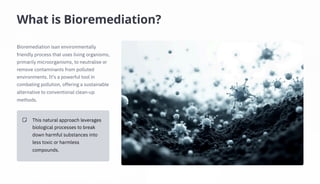
Bioremediation isan environmentally
friendly process that uses living organisms,
primarily microorganisms, to neutralise or
remove contaminants from polluted
environments. It's a powerful tool in
combating pollution, offering a sustainable
alternative to conventional clean-up
methods.
This natural approach leverages
biological processes to break
down harmful substances into
less toxic or harmless
compounds.
The Core Principle
Contaminant Microbes
Harmless
Products
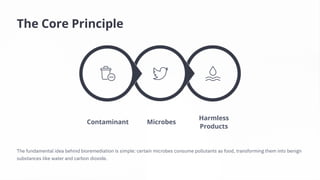
The fundamental idea behind bioremediation is simple: certain microbes consume pollutants as food, transforming them into benign
substances like water and carbon dioxide.
Key Organisms in Bioremediation
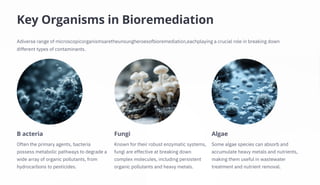
Often the primary agents, bacteria
possess metabolic pathways to degrade a
wide array of organic pollutants, from
hydrocarbons to pesticides.
Known for their robust enzymatic systems,
fungi are effective at breaking down
complex molecules, including persistent
organic pollutants and heavy metals.
Adiverse range of microscopicorganismsaretheunsungheroesofbioremediation,eachplaying a crucial role in breaking down
different types of contaminants.
Some algae species can absorb and
accumulate heavy metals and nutrients,
making them useful in wastewater
treatment and nutrient removal.
B acteria Fungi Algae
Types of Bioremediation
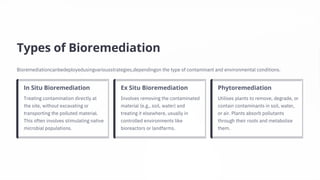
Treating contamination directly at
the site, without excavating or
transporting the polluted material.
This often involves stimulating native
microbial populations.
Involves removing the contaminated
material (e.g., soil, water) and
treating it elsewhere, usually in
controlled environments like
bioreactors or landfarms.
Bioremediationcanbedeployedusingvariousstrategies,dependingon the type of contaminant and environmental conditions.
Utilises plants to remove, degrade, or
contain contaminants in soil, water,
or air. Plants absorb pollutants
through their roots and metabolise
them.
In Situ Bioremediation Ex Situ Bioremediation Phytoremediation
In Situ Techniques: Encouraging Microbes
Biostimulation
Modifying the environment to stimulate
the activity of indigenous microorganisms.
This often involves adding nutrients (e.g.,
nitrogen, phosphorus) or oxygen.
Bio augmentation
Introducing specific, cultured
microorganisms to a contaminated site to
enhance the degradation process,
particularly when native populations are
insufficient.
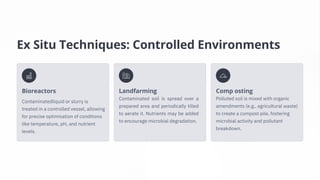
Ex Situ Techniques: Controlled Environments
Bioreactors Landfarming
Contaminated soil is spread over a
prepared area and periodically tilled
to aerate it. Nutrients may be added
to encourage microbial degradation.
Comp osting
Polluted soil is mixed with organic
amendments (e.g., agricultural waste)
to create a compost pile, fostering
microbial activity and pollutant
breakdown.
Contaminatedliquid or slurry is
treated in a controlled vessel, allowing
for precise optimisation of conditions
like temperature, pH, and nutrient
levels.
Advantages of
Bioremediation
Cost-effective:Generally lessexpensivethan traditional physical or
chemical clean-upmethods.
Environmentally friendly: Reduces reliance on harsh chemicals and
minimises ecological disturbance.
Sustainable: Utilises natural processes and can often be conducted on-
site, reducing transport costs and emissions.
Minimises waste: Transforms contaminants rather than simply moving
them to another location.
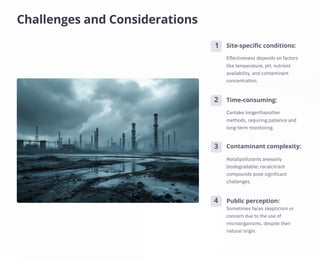
Challenges and Considerations
4
3
2
1
Time-consuming:
Public perception:
Sometimes faces skepticism or
concern due to the use of
microorganisms, despite their
natural origin.
Site-specific conditions:
Contaminant complexity:
Notallpollutants areeasily
biodegradable; recalcitrant
compounds pose significant
challenges.
Cantake longerthanother
methods, requiring patience and
long-term monitoring.
Effectiveness depends on factors
like temperature, pH, nutrient
availability, and contaminant
concentration.
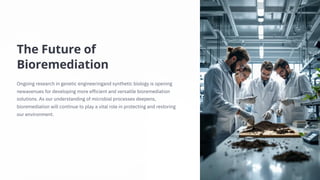
The Future of
Bioremediation
Ongoing research in genetic engineeringand synthetic biology is opening
newavenues for developing more efficient and versatile bioremediation
solutions. As our understanding of microbial processes deepens,
bioremediation will continue to play a vital role in protecting and restoring
our environment.
Thank you

Bioremediation process and organisms involved.pdf

  • 1.
    VIVEKANANDHA ARTS ANDSCIENCE COLLEGE FOR WOMEN VEERACHIPALAYAM, SANKAGIRI,SALEM,TAMILNADU DEPARTMENT OF MICROBIOLOG Topic: Bioremediation process and organisms involved Subject Incharge : DR.R. Dinesh Kumar Assistant professor, Department of microbiology, viaas,Sankari. Submitted By: S. Abinisha I-MSC(Microbiology) Department of Microbiology, Viaas, Sankari.
  • 2.
    Bioremediation: Nature's Clean-Up Crew Exploringthefascinatingworldofbioremediationandthemicroscopic organisms thatmakeitpossible.
  • 3.
    What is Bioremediation? Bioremediationisan environmentally friendly process that uses living organisms, primarily microorganisms, to neutralise or remove contaminants from polluted environments. It's a powerful tool in combating pollution, offering a sustainable alternative to conventional clean-up methods. This natural approach leverages biological processes to break down harmful substances into less toxic or harmless compounds.
  • 4.
    The Core Principle ContaminantMicrobes Harmless Products The fundamental idea behind bioremediation is simple: certain microbes consume pollutants as food, transforming them into benign substances like water and carbon dioxide.
  • 5.
    Key Organisms inBioremediation Often the primary agents, bacteria possess metabolic pathways to degrade a wide array of organic pollutants, from hydrocarbons to pesticides. Known for their robust enzymatic systems, fungi are effective at breaking down complex molecules, including persistent organic pollutants and heavy metals. Adiverse range of microscopicorganismsaretheunsungheroesofbioremediation,eachplaying a crucial role in breaking down different types of contaminants. Some algae species can absorb and accumulate heavy metals and nutrients, making them useful in wastewater treatment and nutrient removal. B acteria Fungi Algae
  • 6.
    Types of Bioremediation Treatingcontamination directly at the site, without excavating or transporting the polluted material. This often involves stimulating native microbial populations. Involves removing the contaminated material (e.g., soil, water) and treating it elsewhere, usually in controlled environments like bioreactors or landfarms. Bioremediationcanbedeployedusingvariousstrategies,dependingon the type of contaminant and environmental conditions. Utilises plants to remove, degrade, or contain contaminants in soil, water, or air. Plants absorb pollutants through their roots and metabolise them. In Situ Bioremediation Ex Situ Bioremediation Phytoremediation
  • 7.
    In Situ Techniques:Encouraging Microbes Biostimulation Modifying the environment to stimulate the activity of indigenous microorganisms. This often involves adding nutrients (e.g., nitrogen, phosphorus) or oxygen. Bio augmentation Introducing specific, cultured microorganisms to a contaminated site to enhance the degradation process, particularly when native populations are insufficient.
  • 8.
    Ex Situ Techniques:Controlled Environments Bioreactors Landfarming Contaminated soil is spread over a prepared area and periodically tilled to aerate it. Nutrients may be added to encourage microbial degradation. Comp osting Polluted soil is mixed with organic amendments (e.g., agricultural waste) to create a compost pile, fostering microbial activity and pollutant breakdown. Contaminatedliquid or slurry is treated in a controlled vessel, allowing for precise optimisation of conditions like temperature, pH, and nutrient levels.
  • 9.
    Advantages of Bioremediation Cost-effective:Generally lessexpensivethantraditional physical or chemical clean-upmethods. Environmentally friendly: Reduces reliance on harsh chemicals and minimises ecological disturbance. Sustainable: Utilises natural processes and can often be conducted on- site, reducing transport costs and emissions. Minimises waste: Transforms contaminants rather than simply moving them to another location.
  • 10.
    Challenges and Considerations 4 3 2 1 Time-consuming: Publicperception: Sometimes faces skepticism or concern due to the use of microorganisms, despite their natural origin. Site-specific conditions: Contaminant complexity: Notallpollutants areeasily biodegradable; recalcitrant compounds pose significant challenges. Cantake longerthanother methods, requiring patience and long-term monitoring. Effectiveness depends on factors like temperature, pH, nutrient availability, and contaminant concentration.
  • 11.
    The Future of Bioremediation Ongoingresearch in genetic engineeringand synthetic biology is opening newavenues for developing more efficient and versatile bioremediation solutions. As our understanding of microbial processes deepens, bioremediation will continue to play a vital role in protecting and restoring our environment.
  • 12.