Bionics
Almost everyone has heard about it, but few really know. So
what is this?
The new discipline of bionics,
which aims to transpose
developed the live nature of
the technical solutions into
practice.
But why is this effective?
The exciting natural selection in nature is the optimal solution of
a problem, in addiction to this it was billion of years to
develop.
What are the methods:
Analog bionics:
-Defining the problem
-Search for analogies in nature
-Analysis of analogies found in nature
-Find a solution to the problem based on
the knowledge acquired
For example: wing tips
Abstractive bionics:
-Research of biological systems
-Identification and description of
the approach
-Principle abstraction
-Analysis of possible technical
applications
-Realization
For example: water repellent materials
Why we need this?
• USA only 185,000 Americans annually lose a limbs each year
Össur, one of the world’s leading prosthetics markers, estimates
that in 2012, the size of the prosthetic market in the U.S., EMEA
and Asia regions was between $850-$950 million.
Other uses
• Energy problems Chemist Daniel Nocera of Harvard
University and his team nset out in
search of a better catalyst, one that
would play well with living
organisms while effectively
splitting water. As the team reports
in Science on June 2, they found it
in an alloy of cobalt and
phosphorus, an amalgam already
in use as an anticorrosion coating
for plastic and metal parts found in
everything from faucets to circuit
boards. With a little charge, this
new catalyst can assemble itself
out of a solution of regular water,
cobalt and phosphate.
Other uses(2)
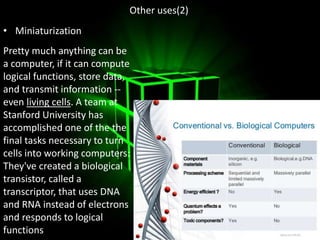
• Miniaturization
Pretty much anything can be
a computer, if it can compute
logical functions, store data,
and transmit information --
even living cells. A team at
Stanford University has
accomplished one of the the
final tasks necessary to turn
cells into working computers:
They've created a biological
transistor, called a
transcriptor, that uses DNA
and RNA instead of electrons
and responds to logical
functions.
People who use bionic technologies
• Stephen Hawking:He is
an English theoretical
physicist, cosmologist,
author and Director of
Research at the Centre
for Theoretical
Cosmology within
the University of
Cambridge. His
scientific works include
a collaboration
with Roger.
Incredibly, Professor Hawking
controls all the functions of his
Windows tablet PC using just a
single switch.
As Hawking’s physical condition
gradually deteriorates, his typing
speed has dropped to just one or
two words per minute.
People who use bionic technologies(2)
• Oscar Pistorius: Oscar Pistorius can
run a quarter mile in 45.07
seconds — fast enough to
compete in the 2012 Olympic
Games. He does it without feet.
The Flex-Foot Cheetah is
a prosthetic human foot
replacement developed
by biomedical engineer Van
Phillips.
The Flex-Foot Cheetah and similar
models are worn by Oscar
Pistorius and other amputee
athletes in the Paralympics and
elsewhere. It is made from carbon
fibre, and unlike all previous foot
prostheses, it stores kinetic
energy from the wearer's steps as
potential energy, like a spring,
allowing the wearer to run and
jump. It is now (as of September
2012) made by Össur.
In history
The term bionics was coined by Jack E. Steele in 1958 while working
at the Aeronautics Division House at Wright-Patterson Air Force Base.
However, nature-inspired inventions, older then the word itself.
Inventions
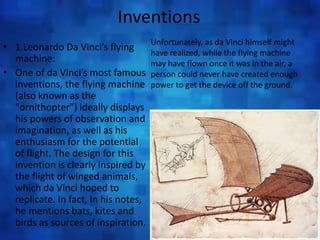
• 1.Leonardo Da Vinci’s flying
machine:
• One of da Vinci’s most famous
inventions, the flying machine
(also known as the
"ornithopter") ideally displays
his powers of observation and
imagination, as well as his
enthusiasm for the potential
of flight. The design for this
invention is clearly inspired by
the flight of winged animals,
which da Vinci hoped to
replicate. In fact, in his notes,
he mentions bats, kites and
birds as sources of inspiration.
Unfortunately, as da Vinci himself might
have realized, while the flying machine
may have flown once it was in the air, a
person could never have created enough
power to get the device off the ground.
2.cat’s eye reflector
• The cat's eye is a retroreflective safety device used in road
marking and was the first of a range of raised pavement markers. It
originated in the UK in 1933 and is today used all over the world. The
original form consisted of two pairs of reflective glass spheres set into
a white rubber dome, mounted in a cast-iron housing. This is the kind
that marks the centre of the road, with one pair of cat's eyes showing
in each direction.
The blackouts of World War
II (1939–1945) and the shuttered
car headlights then in use
demonstrated the value of Shaw's
invention and helped popularise
their mass use in the UK.
3.Computer viruses:
• Computer viruses also show similarities with biological viruses in
their way to curb program-oriented information towards self-
reproduction and dissemination
4.A hand that can feel: • After 10 years of
research, the NEBIAS
project has created
oneof the world’s most
advances bionic hands
– one that can feel
objects. A neutral
interface provides
sensory information
from the artifical hand
to the brain. This links
the patient’s nervous
system with enchanced
sensors embedded in
the prosthesis,
enabling the user to
control complex hand
and finger movements.
5.Total artifical heart:
• A compeletely artifical heart was developed by SynCardia, and
has already awaiting a heart transplant. The device is a
battery powered, self-contained, total replacement system.
6.Retinal implants:
• There are now some 100recipients of the Argus II retinal prosthesis
system, which is approved for use in the US and the EU. This bionic
eye is a tiny camera mounted on a pair of glasses that sends images
to an epiretinal prosthesis that is surgically implanted in the eye-
7.thought-controlled robotic leg:
A pair of sensors
embedded in his muscle
tissue detect electrical
signals from the brain,
connect the neural dots,
and wirelessly transmit
that signal to the robotic
leg. The device is
targeted for commercial
use by 2018.
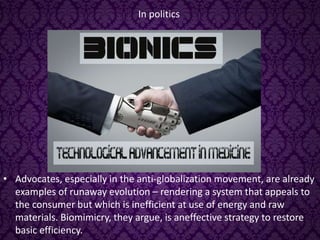
In politics
• Advocates, especially in the anti-globalization movement, are already
examples of runaway evolution – rendering a system that appeals to
the consumer but which is inefficient at use of energy and raw
materials. Biomimicry, they argue, is aneffective strategy to restore
basic efficiency.
Futuristic ambitions
• There are many
opponents of this,
but on my opinion
we stand
confidently in
front of the
future. Think
about it! It has a
lot of potential.
We can develop
physical and
mental abilities of
different
innovations.
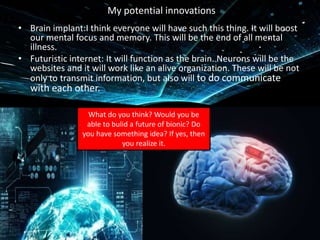
My potential innovations
• Brain implant:I think everyone will have such this thing. It will boost
our mental focus and memory. This will be the end of all mental
illness.
• Futuristic internet: It will function as the brain. Neurons will be the
websites and it will work like an alive organization. These will be not
only to transmit information, but also will to do communicate
with each other.
What do you think? Would you be
able to bulid a future of bionic? Do
you have something idea? If yes, then
you realize it.

Bionics #scichallenge2017

  • 2.
    Bionics Almost everyone hasheard about it, but few really know. So what is this? The new discipline of bionics, which aims to transpose developed the live nature of the technical solutions into practice. But why is this effective?
  • 3.
    The exciting naturalselection in nature is the optimal solution of a problem, in addiction to this it was billion of years to develop. What are the methods: Analog bionics: -Defining the problem -Search for analogies in nature -Analysis of analogies found in nature -Find a solution to the problem based on the knowledge acquired For example: wing tips
  • 4.
    Abstractive bionics: -Research ofbiological systems -Identification and description of the approach -Principle abstraction -Analysis of possible technical applications -Realization For example: water repellent materials
  • 5.
    Why we needthis? • USA only 185,000 Americans annually lose a limbs each year Össur, one of the world’s leading prosthetics markers, estimates that in 2012, the size of the prosthetic market in the U.S., EMEA and Asia regions was between $850-$950 million.
  • 6.
    Other uses • Energyproblems Chemist Daniel Nocera of Harvard University and his team nset out in search of a better catalyst, one that would play well with living organisms while effectively splitting water. As the team reports in Science on June 2, they found it in an alloy of cobalt and phosphorus, an amalgam already in use as an anticorrosion coating for plastic and metal parts found in everything from faucets to circuit boards. With a little charge, this new catalyst can assemble itself out of a solution of regular water, cobalt and phosphate.
  • 7.
    Other uses(2) • Miniaturization Prettymuch anything can be a computer, if it can compute logical functions, store data, and transmit information -- even living cells. A team at Stanford University has accomplished one of the the final tasks necessary to turn cells into working computers: They've created a biological transistor, called a transcriptor, that uses DNA and RNA instead of electrons and responds to logical functions.
  • 8.
    People who usebionic technologies • Stephen Hawking:He is an English theoretical physicist, cosmologist, author and Director of Research at the Centre for Theoretical Cosmology within the University of Cambridge. His scientific works include a collaboration with Roger. Incredibly, Professor Hawking controls all the functions of his Windows tablet PC using just a single switch. As Hawking’s physical condition gradually deteriorates, his typing speed has dropped to just one or two words per minute.
  • 9.
    People who usebionic technologies(2) • Oscar Pistorius: Oscar Pistorius can run a quarter mile in 45.07 seconds — fast enough to compete in the 2012 Olympic Games. He does it without feet. The Flex-Foot Cheetah is a prosthetic human foot replacement developed by biomedical engineer Van Phillips. The Flex-Foot Cheetah and similar models are worn by Oscar Pistorius and other amputee athletes in the Paralympics and elsewhere. It is made from carbon fibre, and unlike all previous foot prostheses, it stores kinetic energy from the wearer's steps as potential energy, like a spring, allowing the wearer to run and jump. It is now (as of September 2012) made by Össur.
  • 10.
    In history The termbionics was coined by Jack E. Steele in 1958 while working at the Aeronautics Division House at Wright-Patterson Air Force Base. However, nature-inspired inventions, older then the word itself.
  • 11.
    Inventions • 1.Leonardo DaVinci’s flying machine: • One of da Vinci’s most famous inventions, the flying machine (also known as the "ornithopter") ideally displays his powers of observation and imagination, as well as his enthusiasm for the potential of flight. The design for this invention is clearly inspired by the flight of winged animals, which da Vinci hoped to replicate. In fact, in his notes, he mentions bats, kites and birds as sources of inspiration. Unfortunately, as da Vinci himself might have realized, while the flying machine may have flown once it was in the air, a person could never have created enough power to get the device off the ground.
  • 12.
    2.cat’s eye reflector •The cat's eye is a retroreflective safety device used in road marking and was the first of a range of raised pavement markers. It originated in the UK in 1933 and is today used all over the world. The original form consisted of two pairs of reflective glass spheres set into a white rubber dome, mounted in a cast-iron housing. This is the kind that marks the centre of the road, with one pair of cat's eyes showing in each direction. The blackouts of World War II (1939–1945) and the shuttered car headlights then in use demonstrated the value of Shaw's invention and helped popularise their mass use in the UK.
  • 13.
    3.Computer viruses: • Computerviruses also show similarities with biological viruses in their way to curb program-oriented information towards self- reproduction and dissemination
  • 14.
    4.A hand thatcan feel: • After 10 years of research, the NEBIAS project has created oneof the world’s most advances bionic hands – one that can feel objects. A neutral interface provides sensory information from the artifical hand to the brain. This links the patient’s nervous system with enchanced sensors embedded in the prosthesis, enabling the user to control complex hand and finger movements.
  • 15.
    5.Total artifical heart: •A compeletely artifical heart was developed by SynCardia, and has already awaiting a heart transplant. The device is a battery powered, self-contained, total replacement system.
  • 16.
    6.Retinal implants: • Thereare now some 100recipients of the Argus II retinal prosthesis system, which is approved for use in the US and the EU. This bionic eye is a tiny camera mounted on a pair of glasses that sends images to an epiretinal prosthesis that is surgically implanted in the eye-
  • 17.
    7.thought-controlled robotic leg: Apair of sensors embedded in his muscle tissue detect electrical signals from the brain, connect the neural dots, and wirelessly transmit that signal to the robotic leg. The device is targeted for commercial use by 2018.
  • 18.
    In politics • Advocates,especially in the anti-globalization movement, are already examples of runaway evolution – rendering a system that appeals to the consumer but which is inefficient at use of energy and raw materials. Biomimicry, they argue, is aneffective strategy to restore basic efficiency.
  • 19.
    Futuristic ambitions • Thereare many opponents of this, but on my opinion we stand confidently in front of the future. Think about it! It has a lot of potential. We can develop physical and mental abilities of different innovations.
  • 20.
    My potential innovations •Brain implant:I think everyone will have such this thing. It will boost our mental focus and memory. This will be the end of all mental illness. • Futuristic internet: It will function as the brain. Neurons will be the websites and it will work like an alive organization. These will be not only to transmit information, but also will to do communicate with each other. What do you think? Would you be able to bulid a future of bionic? Do you have something idea? If yes, then you realize it.