Biogeochemical Cycle
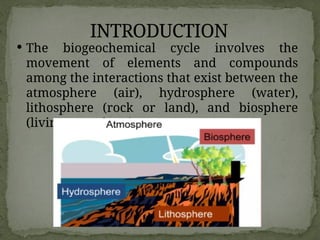
 The biogeochemical cycle involves the
movement of elements and compounds
among the interactions that exist between the
atmosphere (air), hydrosphere (water),
lithosphere (rock or land), and biosphere
(living organisms).
INTRODUCTION
Biogeochemical cycles can be classed as:
 Carbon-Oxygen Cycle
 Water Cycle
 Nitrogen Cycle
 Sedimentary Cycle
Types of Biogeochemical
Cycle
Carbon-Oxygen Cycle
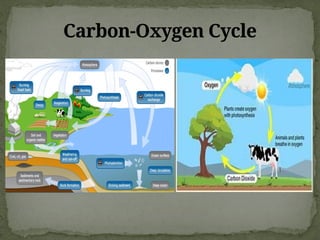
 The carbon cycle describes the
movement of carbon as it is recycled and
reused throughout the biosphere, as well
as long-term processes of carbon
sequestration (storage) to and release
from carbon sinks.
 Comprises a sequence of events that are
key to making Earth capable of
sustaining life.
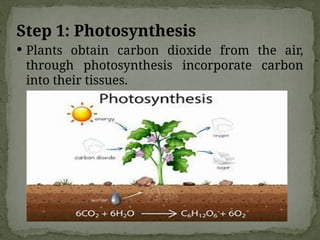
Step 1: Photosynthesis
 Plants obtain carbon dioxide from the air,
through photosynthesis incorporate carbon
into their tissues.
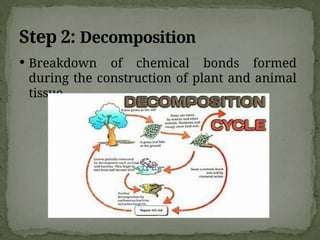
Step 2: Decomposition
 Breakdown of chemical bonds formed
during the construction of plant and animal
tissue.
Step 3: Marine Plankton Remains
 Carbon that is not released back into the
atmosphere eventually become fossil fuels
(coal, oil and natural gas).
Step 4: Combustion (Human &
Natural)
 Process of burning may return the carbon in oil,
coal, natural gas, and wood to the atmosphere.
That organic molecules are rapidly oxidized
(combined with oxygen) and converted carbon
dioxide and water with an accompanying
release of light and heat.
Oxygen Cycle
 Oxygen is found in several parts of the
ecosystem, from the air we breathe
(Atmosphere), the water bodies on the planet
(Hydrosphere), inside all the biological beings
(Biosphere) and inside the earth’s crust
(Lithosphere).
 The sustainable development of the living
components of the ecosystem.
Production of Oxygen
There are two ways in which Oxygen is formed
in nature. They are:
 Photosynthesis
- A complex process used by green plants
where the leaves of the green plants with the
help of sunlight and chlorophyll convert
carbon dioxide and water into Glucose and
Oxygen.
 Photodissociation
- The formation of Oxygen molecules when
sunlight interacts with the water vapor
present in the atmosphere.
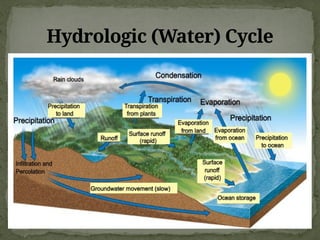
Hydrologic (Water) Cycle
The water cycle consists of five major
processes:
• Evaporation
• Condensation
• Precipitation
• Surface Runoff
• Transpiration
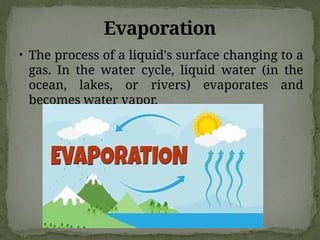
Evaporation
• The process of a liquid's surface changing to a
gas. In the water cycle, liquid water (in the
ocean, lakes, or rivers) evaporates and
becomes water vapor.
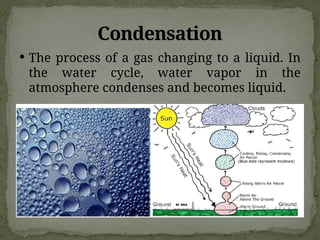
Condensation
 The process of a gas changing to a liquid. In
the water cycle, water vapor in the
atmosphere condenses and becomes liquid.
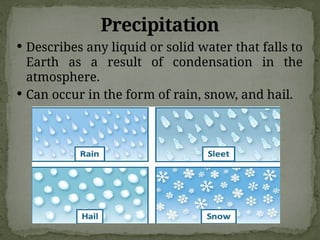
 Describes any liquid or solid water that falls to
Earth as a result of condensation in the
atmosphere.
 Can occur in the form of rain, snow, and hail.
Precipitation
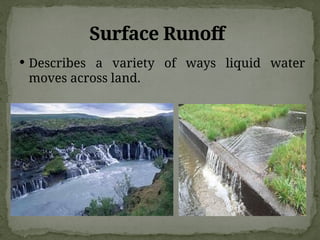
Surface Runoff
 Describes a variety of ways liquid water
moves across land.
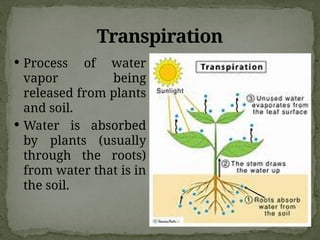
Transpiration
 Process of water
vapor being
released from plants
and soil.
 Water is absorbed
by plants (usually
through the roots)
from water that is in
the soil.
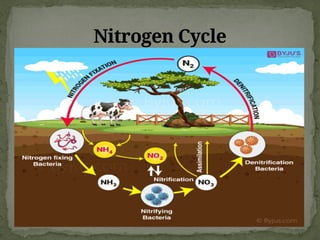
Nitrogen Cycle
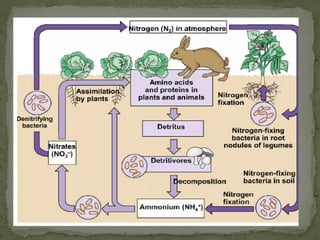
• A biogeochemical process through which
nitrogen is converted into many forms,
consecutively passing from the atmosphere to
the soil to organism and back into the
atmosphere.
• Nitrogen gas exists in both organic and
inorganic forms. Organic nitrogen exists in
living organisms, and they get passed through
the food chain by the consumption of other
living organisms.
• It involves several processes such as Nitrogen
Fixation, Nitrification, Denitrification,
Ammonification/Decay.
Nitrogen Fixation
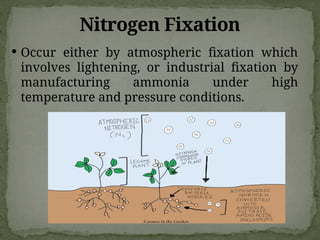
 Occur either by atmospheric fixation which
involves lightening, or industrial fixation by
manufacturing ammonia under high
temperature and pressure conditions.
Types of Nitrogen Fixation
• Atmospheric fixation
- A natural phenomenon where the energy of
lightning breaks the nitrogen into nitrogen
oxides, which are then used by plants.
• Industrial nitrogen fixation
- It is a man-made alternative that aids in nitrogen
fixation by the use of ammonia. Ammonia is
produced by the direct combination of nitrogen and
hydrogen. Later, it is converted into various
fertilizers such as urea.
 Biological nitrogen fixation:
- Bacteria like Rhizobium and blue-green algae
transform the unusable form of nitrogen into other
compounds that are more readily usable. These
nitrogen compounds get fixed in the soil by these
microbes.
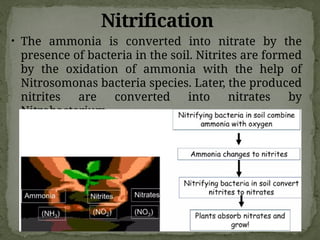
Nitrification
• The ammonia is converted into nitrate by the
presence of bacteria in the soil. Nitrites are formed
by the oxidation of ammonia with the help of
Nitrosomonas bacteria species. Later, the produced
nitrites are converted into nitrates by
Nitrobacterium.
Denitrification
 The process in which the nitrogen compounds
make their way back into the atmosphere by
converting nitrate into gaseous nitrogen.
 Denitrification is carried out by the
denitrifying bacterial species Clostridium and
Pseudomonas, which will process nitrate to
gain oxygen and gives out free nitrogen gas as
a by product.
Ammonification/Decay
• The decomposers, namely bacteria or fungi
present in the soil, convert the organic matter
back into ammonium. This process of
decomposition produces ammonia, which is
further used for other biological processes.
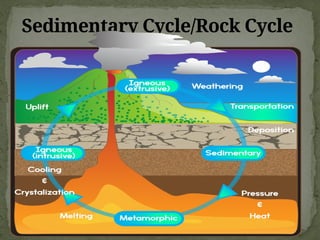
Sedimentary Cycle/Rock Cycle
• Include the leaching of minerals and salts
from the Earth’s crust, which the settle as
sediment or rock before the cycle repeats.
• There are three main types of rocks:
sedimentary, igneous, and metamorphic.
Each of these rocks are formed by physical
changes such as melting, cooling, eroding,
compacting, or deforming
Sedimentary Rocks
• Formed from pieces of other existing rock
or organic material.
• There are three different types of
sedimentary rocks: clastic, organic
(biological), and chemical. Clastic
sedimentary rocks, like sandstone, form
from clasts, or pieces of other rock.
• Organic sedimentary rocks, like coal, form
from hard, biological materials like plants,
shells, and bones that are compressed into
rock.
• Chemical sedimentary rocks, like limestone,
and flint, form from chemical precipitation. A
chemical precipitate is a chemical compound
for instance, calcium carbonate, salt, and
silica that forms when the solution it is
dissolved in, usually water, evaporates and
leaves the compound behind.
Metamorphic Rocks
• Rocks that have been changed from their
original form by immense heat or pressure.
• Metamorphic rocks have two classes:
- Foliated
- Nonfoliated
• Foliation is the aligning of elongated or
platy minerals, like hornblende or mica,
perpendicular to the direction of pressure
that is applied. An example of this

transformation can be seen with granite, an
igneous rock.
• Nonfoliated rocks are formed the same way,
but they do not contain the minerals that
tend to line up under pressure and thus do
not have the layered appearance of foliated
rocks. Sedimentary rocks like limestone, and
sandstone when given enough heat and
pressure.
• Nonfoliated rocks can also form by
metamorphism, which happens when
magma comes in contact with the
surrounding rock.
Igneous Rocks
• Are formed when molten hot material cools
and solidifies. When they are formed inside of
the earth, they are called intrusive, or plutonic,
igneous rocks. If they are formed outside or on
top of Earth’s crust, they are called extrusive,
or volcanic, igneous rocks.
• Granite and diorite are examples of common
intrusive rocks. They have a coarse texture
with large mineral grains, indicating that they
spent thousands or millions of years cooling
down inside the earth, a time course that
allowed large mineral crystals to grow.
• The most important geological processes
that lead to the creation of sedimentary
rocks are erosion, weathering, dissolution,
precipitation, and lithification.
• Erosion and weathering include the effects
of wind and rain, which slowly break down
large rocks into smaller ones. Erosion and
weathering transform boulders and even
mountains into sediments, such as sand or
mud.
• Dissolution is a form of chemical weathering.
With this process, water that is slightly acidic
slowly wears away stone.
• Precipitation and lithification are processes
that build new rocks or minerals. Precipitation
is the formation of rocks and minerals from
chemicals that precipitate from water.
• Finally, lithification is the process by which
clay, sand, and other sediments on the bottom
of the ocean or other bodies of water are
slowly compacted into rocks from the weight
of overlying sediments.
 Sedimentary rocks can be organized into
two categories.
• The first is detrital rock, which comes from
the erosion and accumulation of rock
fragments, sediment, or other materials
categorized in total as detritus, or debris.
• The other is chemical rock, produced from
the dissolution and precipitation of
minerals.
BIOGEOCHEMICAL-CYCLE - ENVIRNMENTAL SCIENCE

BIOGEOCHEMICAL-CYCLE - ENVIRNMENTAL SCIENCE

  • 1.
  • 2.
     The biogeochemicalcycle involves the movement of elements and compounds among the interactions that exist between the atmosphere (air), hydrosphere (water), lithosphere (rock or land), and biosphere (living organisms). INTRODUCTION
  • 3.
    Biogeochemical cycles canbe classed as:  Carbon-Oxygen Cycle  Water Cycle  Nitrogen Cycle  Sedimentary Cycle Types of Biogeochemical Cycle
  • 4.
  • 5.
     The carboncycle describes the movement of carbon as it is recycled and reused throughout the biosphere, as well as long-term processes of carbon sequestration (storage) to and release from carbon sinks.  Comprises a sequence of events that are key to making Earth capable of sustaining life.
  • 6.
    Step 1: Photosynthesis Plants obtain carbon dioxide from the air, through photosynthesis incorporate carbon into their tissues.
  • 7.
    Step 2: Decomposition Breakdown of chemical bonds formed during the construction of plant and animal tissue.
  • 8.
    Step 3: MarinePlankton Remains  Carbon that is not released back into the atmosphere eventually become fossil fuels (coal, oil and natural gas). Step 4: Combustion (Human & Natural)  Process of burning may return the carbon in oil, coal, natural gas, and wood to the atmosphere. That organic molecules are rapidly oxidized (combined with oxygen) and converted carbon dioxide and water with an accompanying release of light and heat.
  • 9.
    Oxygen Cycle  Oxygenis found in several parts of the ecosystem, from the air we breathe (Atmosphere), the water bodies on the planet (Hydrosphere), inside all the biological beings (Biosphere) and inside the earth’s crust (Lithosphere).  The sustainable development of the living components of the ecosystem.
  • 10.
    Production of Oxygen Thereare two ways in which Oxygen is formed in nature. They are:  Photosynthesis - A complex process used by green plants where the leaves of the green plants with the help of sunlight and chlorophyll convert carbon dioxide and water into Glucose and Oxygen.
  • 11.
     Photodissociation - Theformation of Oxygen molecules when sunlight interacts with the water vapor present in the atmosphere.
  • 12.
  • 13.
    The water cycleconsists of five major processes: • Evaporation • Condensation • Precipitation • Surface Runoff • Transpiration
  • 14.
    Evaporation • The processof a liquid's surface changing to a gas. In the water cycle, liquid water (in the ocean, lakes, or rivers) evaporates and becomes water vapor.
  • 15.
    Condensation  The processof a gas changing to a liquid. In the water cycle, water vapor in the atmosphere condenses and becomes liquid.
  • 16.
     Describes anyliquid or solid water that falls to Earth as a result of condensation in the atmosphere.  Can occur in the form of rain, snow, and hail. Precipitation
  • 17.
    Surface Runoff  Describesa variety of ways liquid water moves across land.
  • 18.
    Transpiration  Process ofwater vapor being released from plants and soil.  Water is absorbed by plants (usually through the roots) from water that is in the soil.
  • 19.
  • 20.
    • A biogeochemicalprocess through which nitrogen is converted into many forms, consecutively passing from the atmosphere to the soil to organism and back into the atmosphere. • Nitrogen gas exists in both organic and inorganic forms. Organic nitrogen exists in living organisms, and they get passed through the food chain by the consumption of other living organisms. • It involves several processes such as Nitrogen Fixation, Nitrification, Denitrification, Ammonification/Decay.
  • 22.
    Nitrogen Fixation  Occureither by atmospheric fixation which involves lightening, or industrial fixation by manufacturing ammonia under high temperature and pressure conditions.
  • 23.
    Types of NitrogenFixation • Atmospheric fixation - A natural phenomenon where the energy of lightning breaks the nitrogen into nitrogen oxides, which are then used by plants.
  • 24.
    • Industrial nitrogenfixation - It is a man-made alternative that aids in nitrogen fixation by the use of ammonia. Ammonia is produced by the direct combination of nitrogen and hydrogen. Later, it is converted into various fertilizers such as urea.  Biological nitrogen fixation: - Bacteria like Rhizobium and blue-green algae transform the unusable form of nitrogen into other compounds that are more readily usable. These nitrogen compounds get fixed in the soil by these microbes.
  • 25.
    Nitrification • The ammoniais converted into nitrate by the presence of bacteria in the soil. Nitrites are formed by the oxidation of ammonia with the help of Nitrosomonas bacteria species. Later, the produced nitrites are converted into nitrates by Nitrobacterium.
  • 26.
    Denitrification  The processin which the nitrogen compounds make their way back into the atmosphere by converting nitrate into gaseous nitrogen.  Denitrification is carried out by the denitrifying bacterial species Clostridium and Pseudomonas, which will process nitrate to gain oxygen and gives out free nitrogen gas as a by product.
  • 27.
    Ammonification/Decay • The decomposers,namely bacteria or fungi present in the soil, convert the organic matter back into ammonium. This process of decomposition produces ammonia, which is further used for other biological processes.
  • 28.
  • 29.
    • Include theleaching of minerals and salts from the Earth’s crust, which the settle as sediment or rock before the cycle repeats. • There are three main types of rocks: sedimentary, igneous, and metamorphic. Each of these rocks are formed by physical changes such as melting, cooling, eroding, compacting, or deforming
  • 30.
    Sedimentary Rocks • Formedfrom pieces of other existing rock or organic material. • There are three different types of sedimentary rocks: clastic, organic (biological), and chemical. Clastic sedimentary rocks, like sandstone, form from clasts, or pieces of other rock.
  • 31.
    • Organic sedimentaryrocks, like coal, form from hard, biological materials like plants, shells, and bones that are compressed into rock. • Chemical sedimentary rocks, like limestone, and flint, form from chemical precipitation. A chemical precipitate is a chemical compound for instance, calcium carbonate, salt, and silica that forms when the solution it is dissolved in, usually water, evaporates and leaves the compound behind.
  • 32.
    Metamorphic Rocks • Rocksthat have been changed from their original form by immense heat or pressure. • Metamorphic rocks have two classes: - Foliated - Nonfoliated • Foliation is the aligning of elongated or platy minerals, like hornblende or mica, perpendicular to the direction of pressure that is applied. An example of this transformation can be seen with granite, an igneous rock.
  • 33.
    • Nonfoliated rocksare formed the same way, but they do not contain the minerals that tend to line up under pressure and thus do not have the layered appearance of foliated rocks. Sedimentary rocks like limestone, and sandstone when given enough heat and pressure. • Nonfoliated rocks can also form by metamorphism, which happens when magma comes in contact with the surrounding rock.
  • 34.
    Igneous Rocks • Areformed when molten hot material cools and solidifies. When they are formed inside of the earth, they are called intrusive, or plutonic, igneous rocks. If they are formed outside or on top of Earth’s crust, they are called extrusive, or volcanic, igneous rocks. • Granite and diorite are examples of common intrusive rocks. They have a coarse texture with large mineral grains, indicating that they spent thousands or millions of years cooling down inside the earth, a time course that allowed large mineral crystals to grow.
  • 35.
    • The mostimportant geological processes that lead to the creation of sedimentary rocks are erosion, weathering, dissolution, precipitation, and lithification. • Erosion and weathering include the effects of wind and rain, which slowly break down large rocks into smaller ones. Erosion and weathering transform boulders and even mountains into sediments, such as sand or mud.
  • 36.
    • Dissolution isa form of chemical weathering. With this process, water that is slightly acidic slowly wears away stone. • Precipitation and lithification are processes that build new rocks or minerals. Precipitation is the formation of rocks and minerals from chemicals that precipitate from water. • Finally, lithification is the process by which clay, sand, and other sediments on the bottom of the ocean or other bodies of water are slowly compacted into rocks from the weight of overlying sediments.
  • 37.
     Sedimentary rockscan be organized into two categories. • The first is detrital rock, which comes from the erosion and accumulation of rock fragments, sediment, or other materials categorized in total as detritus, or debris. • The other is chemical rock, produced from the dissolution and precipitation of minerals.