SUBMITTED BY
Name: Parmar Sneha Jayantilal
Reg.no.:2010122045
Genetics and plant breeding
B.A. College of agriculture
Anand
SUBMITTED TO
Dr Kalyanrao Patil
Deparment of Seed Science and
Technology
AAU, Anand
CONTENTS
Introduction
Need for genetic purity testing
Various tests for genetic purity-Phenol test for Wheat and Rice
KOH bleach test for Sorghum
Sodium hydroxide test for Wheat
Peroxidase activity test for soyabean
Modified Phenol test for Wheat
INTRODUCTION
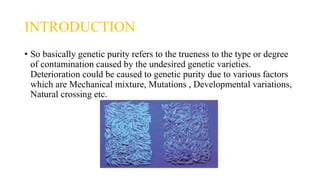
• So basically genetic purity refers to the trueness to the type or degree
of contamination caused by the undesired genetic varieties.
Deterioration could be caused to genetic purity due to various factors
which are Mechanical mixture, Mutations , Developmental variations,
Natural crossing etc.
NEED FOR GENETIC PURITY TESTING
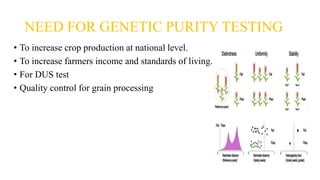
• To increase crop production at national level.
• To increase farmers income and standards of living.
• For DUS test
• Quality control for grain processing
PHENOL COLOUR TEST
Varieties of cereals particularly wheat ,rice and sorghum are verified
Through involvement of the enzyme tyrosinase using phenol as a
substance.
Seed treated with fungicide are rinsed with methanol prior to soaking.
Seeds are placed in a beaker and immersed in distilled water.
Two sheets of filter paper are arranged in petriplate, seeds are
arranged on filter paper.
1% solution of carbolic acid applied in each petriplate with help of
pipette till ¾ th part of seed is covered.
and it’s intensity to distinguish the genetic impure
seed.
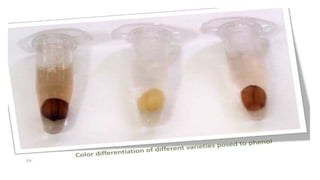
Intensity of the colour developed on the seed is
observed as no reaction (-)deep olive(+), lights
brown (++), brown (+++)and black (++++).
Seed pure at genetic level express similar
intensity of colour in response to the test.Similarly
any seed showing variation in expression indicates
genetic impurity.
KOH BLEACH TEST
• This test is mainly performed for estimating genetic purity for
sorghum crop.
• The presence or absence of a darkly pigmented testa can be used to
differentiate sorghum cultivars. The dark pigment is tannic acid.
• Steps-Prepare 1:5(w/v) solution of KOH and fresh bleach
(5.25%NaOCl)
• Put seeds in glass container and completely cover with KOH
bleach solution.
• Soak the seeds with brown seed coats for 10min and seeds with
white coat for 5 min.
• Gently rinse with tap water then air dried it.
• Record number of dark and light seeds and they are examined for
presence of dark pigmented tannic acid.
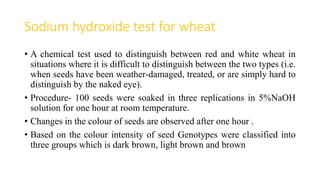
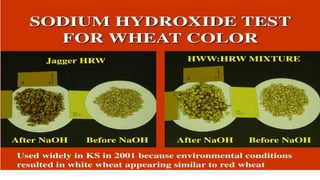
Sodium hydroxide test for wheat
• A chemical test used to distinguish between red and white wheat in
situations where it is difficult to distinguish between the two types (i.e.
when seeds have been weather-damaged, treated, or are simply hard to
distinguish by the naked eye).
• Procedure- 100 seeds were soaked in three replications in 5%NaOH
solution for one hour at room temperature.
• Changes in the colour of seeds are observed after one hour .
• Based on the colour intensity of seed Genotypes were classified into
three groups which is dark brown, light brown and brown
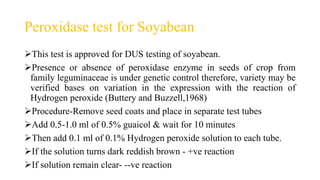
Peroxidase test for Soyabean
This test is approved for DUS testing of soyabean.
Presence or absence of peroxidase enzyme in seeds of crop from
family leguminaceae is under genetic control therefore, variety may be
verified bases on variation in the expression with the reaction of
Hydrogen peroxide (Buttery and Buzzell,1968)
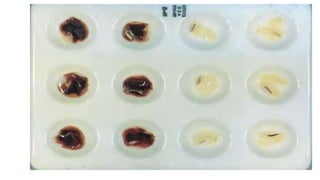
Procedure-Remove seed coats and place in separate test tubes
Add 0.5-1.0 ml of 0.5% guaicol & wait for 10 minutes
Then add 0.1 ml of 0.1% Hydrogen peroxide solution to each tube.
If the solution turns dark reddish brown - +ve reaction
If solution remain clear- --ve reaction
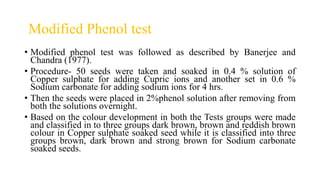
Modified Phenol test
• Modified phenol test was followed as described by Banerjee and
Chandra (1977).
• Procedure- 50 seeds were taken and soaked in 0.4 % solution of
Copper sulphate for adding Cupric ions and another set in 0.6 %
Sodium carbonate for adding sodium ions for 4 hrs.
• Then the seeds were placed in 2%phenol solution after removing from
both the solutions overnight.
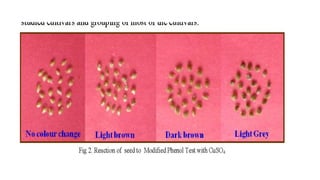
• Based on the colour development in both the Tests groups were made
and classified in to three groups dark brown, brown and reddish brown
colour in Copper sulphate soaked seed while it is classified into three
groups brown, dark brown and strong brown for Sodium carbonate
soaked seeds.
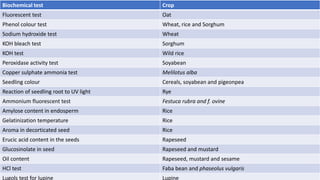
Biochemical test Crop
Fluorescent test Oat
Phenol colour test Wheat, rice and Sorghum
Sodium hydroxide test Wheat
KOH bleach test Sorghum
KOH test Wild rice
Peroxidase activity test Soyabean
Copper sulphate ammonia test Melilotus alba
Seedling colour Cereals, soyabean and pigeonpea
Reaction of seedling root to UV light Rye
Ammonium fluorescent test Festuca rubra and f. ovine
Amylose content in endosperm Rice
Gelatinization temperature Rice
Aroma in decorticated seed Rice
Erucic acid content in the seeds Rapeseed
Glucosinolate in seed Rapeseed and mustard
Oil content Rapeseed, mustard and sesame
HCl test Faba bean and phaseolus vulgaris
Lugols test for lupine Lupine
Biochemical-test-for-genetic-purity.pptx

Biochemical-test-for-genetic-purity.pptx

  • 1.
    SUBMITTED BY Name: ParmarSneha Jayantilal Reg.no.:2010122045 Genetics and plant breeding B.A. College of agriculture Anand SUBMITTED TO Dr Kalyanrao Patil Deparment of Seed Science and Technology AAU, Anand
  • 2.
    CONTENTS Introduction Need for geneticpurity testing Various tests for genetic purity-Phenol test for Wheat and Rice KOH bleach test for Sorghum Sodium hydroxide test for Wheat Peroxidase activity test for soyabean Modified Phenol test for Wheat
  • 3.
    INTRODUCTION • So basicallygenetic purity refers to the trueness to the type or degree of contamination caused by the undesired genetic varieties. Deterioration could be caused to genetic purity due to various factors which are Mechanical mixture, Mutations , Developmental variations, Natural crossing etc.
  • 4.
    NEED FOR GENETICPURITY TESTING • To increase crop production at national level. • To increase farmers income and standards of living. • For DUS test • Quality control for grain processing
  • 5.
    PHENOL COLOUR TEST Varietiesof cereals particularly wheat ,rice and sorghum are verified Through involvement of the enzyme tyrosinase using phenol as a substance. Seed treated with fungicide are rinsed with methanol prior to soaking. Seeds are placed in a beaker and immersed in distilled water. Two sheets of filter paper are arranged in petriplate, seeds are arranged on filter paper. 1% solution of carbolic acid applied in each petriplate with help of pipette till ¾ th part of seed is covered.
  • 6.
    and it’s intensityto distinguish the genetic impure seed. Intensity of the colour developed on the seed is observed as no reaction (-)deep olive(+), lights brown (++), brown (+++)and black (++++). Seed pure at genetic level express similar intensity of colour in response to the test.Similarly any seed showing variation in expression indicates genetic impurity.
  • 8.
    KOH BLEACH TEST •This test is mainly performed for estimating genetic purity for sorghum crop. • The presence or absence of a darkly pigmented testa can be used to differentiate sorghum cultivars. The dark pigment is tannic acid. • Steps-Prepare 1:5(w/v) solution of KOH and fresh bleach (5.25%NaOCl) • Put seeds in glass container and completely cover with KOH bleach solution. • Soak the seeds with brown seed coats for 10min and seeds with white coat for 5 min. • Gently rinse with tap water then air dried it. • Record number of dark and light seeds and they are examined for presence of dark pigmented tannic acid.
  • 9.
    Sodium hydroxide testfor wheat • A chemical test used to distinguish between red and white wheat in situations where it is difficult to distinguish between the two types (i.e. when seeds have been weather-damaged, treated, or are simply hard to distinguish by the naked eye). • Procedure- 100 seeds were soaked in three replications in 5%NaOH solution for one hour at room temperature. • Changes in the colour of seeds are observed after one hour . • Based on the colour intensity of seed Genotypes were classified into three groups which is dark brown, light brown and brown
  • 11.
    Peroxidase test forSoyabean This test is approved for DUS testing of soyabean. Presence or absence of peroxidase enzyme in seeds of crop from family leguminaceae is under genetic control therefore, variety may be verified bases on variation in the expression with the reaction of Hydrogen peroxide (Buttery and Buzzell,1968) Procedure-Remove seed coats and place in separate test tubes Add 0.5-1.0 ml of 0.5% guaicol & wait for 10 minutes Then add 0.1 ml of 0.1% Hydrogen peroxide solution to each tube. If the solution turns dark reddish brown - +ve reaction If solution remain clear- --ve reaction
  • 13.
    Modified Phenol test •Modified phenol test was followed as described by Banerjee and Chandra (1977). • Procedure- 50 seeds were taken and soaked in 0.4 % solution of Copper sulphate for adding Cupric ions and another set in 0.6 % Sodium carbonate for adding sodium ions for 4 hrs. • Then the seeds were placed in 2%phenol solution after removing from both the solutions overnight. • Based on the colour development in both the Tests groups were made and classified in to three groups dark brown, brown and reddish brown colour in Copper sulphate soaked seed while it is classified into three groups brown, dark brown and strong brown for Sodium carbonate soaked seeds.
  • 15.
    Biochemical test Crop Fluorescenttest Oat Phenol colour test Wheat, rice and Sorghum Sodium hydroxide test Wheat KOH bleach test Sorghum KOH test Wild rice Peroxidase activity test Soyabean Copper sulphate ammonia test Melilotus alba Seedling colour Cereals, soyabean and pigeonpea Reaction of seedling root to UV light Rye Ammonium fluorescent test Festuca rubra and f. ovine Amylose content in endosperm Rice Gelatinization temperature Rice Aroma in decorticated seed Rice Erucic acid content in the seeds Rapeseed Glucosinolate in seed Rapeseed and mustard Oil content Rapeseed, mustard and sesame HCl test Faba bean and phaseolus vulgaris Lugols test for lupine Lupine