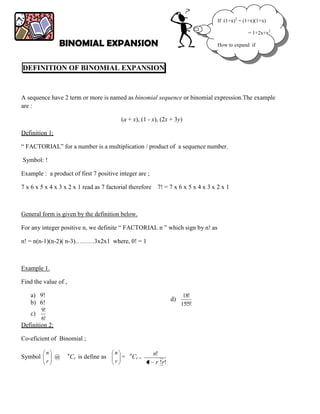
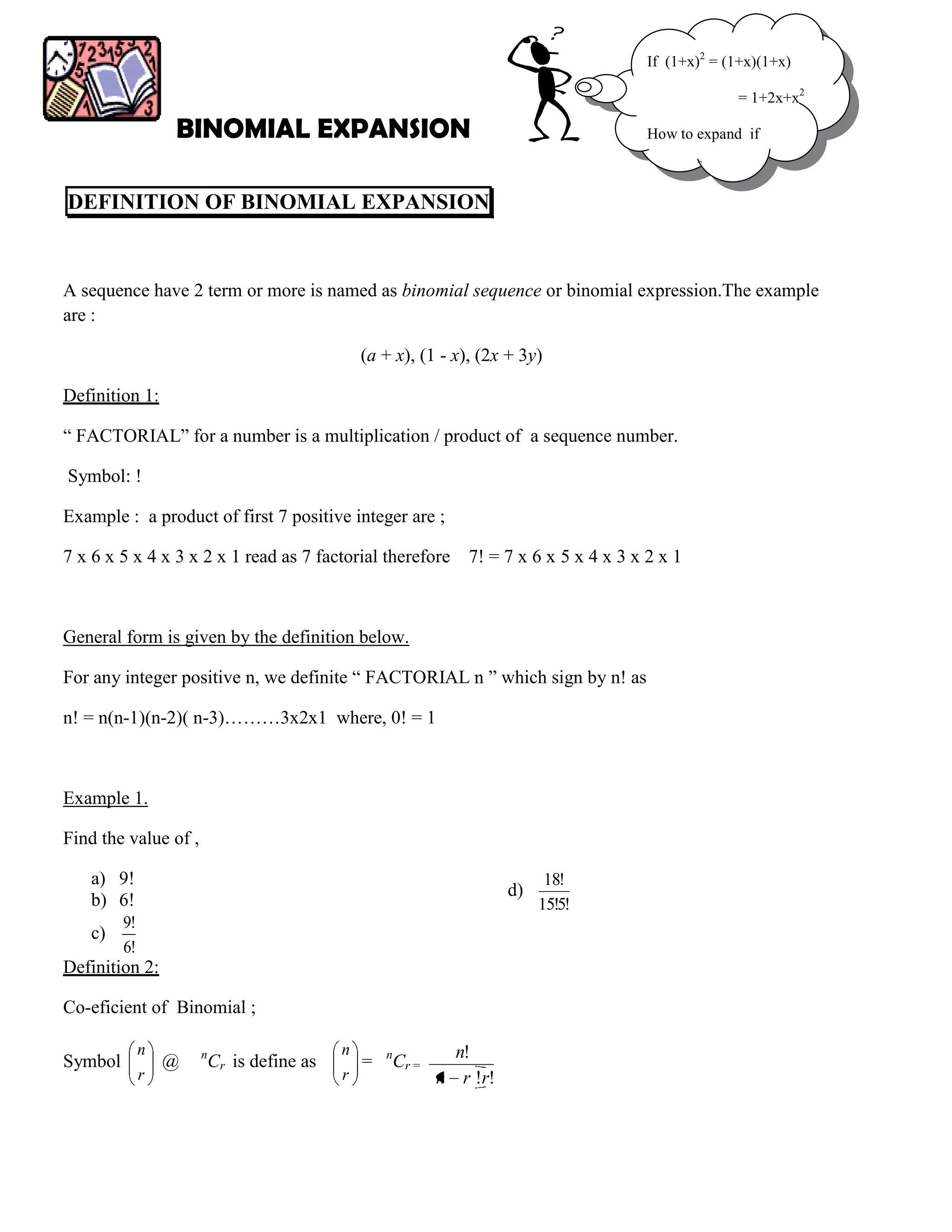
If (1+x)2 = (1+x)(1+x)

                                                                                                  = 1+2x+x2

                BINOMIAL EXPANSION                                                  How to expand if

                                                                                    (2 + 3x)9 = ?????

DEFINITION OF BINOMIAL EXPANSION


A sequence have 2 term or more is named as binomial sequence or binomial expression.The example
are :

                                             (a + x), (1 - x), (2x + 3y)

Definition 1:

“ FACTORIAL” for a number is a multiplication / product of a sequence number.

Symbol: !

Example : a product of first 7 positive integer are ;

7 x 6 x 5 x 4 x 3 x 2 x 1 read as 7 factorial therefore 7! = 7 x 6 x 5 x 4 x 3 x 2 x 1


General form is given by the definition below.

For any integer positive n, we definite “ FACTORIAL n ” which sign by n! as

n! = n(n-1)(n-2)( n-3)………3x2x1 where, 0! = 1


Example 1.

Find the value of ,

   a) 9!                                                                     18!
                                                                       d)
   b) 6!                                                                    15!5!
         9!
   c)
         6!
Definition 2:

Co-eficient of Binomial ;

              n       n                     n     n            n!
Symbol          @         Cr is define as     =       Cr =
              r                             r                n r !r!
We can use the        button on our calculator to find these values

Example 2:

Find the value of ,

         5                                                       20
   a)                                                      c)
         3                                                       17
         n                                                       6 5
   b)                                                      d)
         0                                                       4 3


EXERCISE 1                         EXERCISE 2                         ANSWER :

Find the value of ;                Without using the
                                   calculator, find:
    a) 8!                                                             EX. 1:
    b) 4!7!                                 5
         7!                            a)                             a) 40320
    c)                                      2
         0!                                                           b) 120960
                                            18                        c) 5040
    d) 6! – 3!                         b)
       8!                                    3                        d) 714
    e)                                                                e) 56
       6!
        14!                                                           f) 1001
    f)                                                                g) 1344
       10!4!
                                                                      h) 30240
       4!8!
    g)                                                                EX. 2:
        6!
                                                                      a) 10
    h) 8! – ( 2!7!)
                                                                      b) 816
BINOMIAL THEOREM


Expansion in general form (a + b ) n where a, b is any number and n is integer positive is given as


                 n n 0 n n 1 1 n n 2 2        n n r r     n 0 n
(a + b ) n =       a b +   a b +   a b +……….+   a  b +……+   a b
                 0       1       2            r           m


            or

                                                                                                                   n!
                                                                                                                        a 0b n
                    n!               n!                 n!                      n!                             n!(n n)!
(a + b ) n =             a nb0 +          a n 1b1 +          a n 2 b 2 +….+           a n r b r +..........+
                0!(n 0)!         1!(n 1)!           2!(n 2)!                r!(n r )!


Or

(a + b)n = an + nC1an – 1b + nC2an – 2b2 + nC3an – 3b3 + ... + nCran – rbr + ... + xn


Or we simplify generally as :          (a + b ) n =      n
                                                             Cran – rbr …………[ general form]


Note:

     a) Remember !! power of a is desending,power of b is ascending
     b) First term , T1= an
     c) Final term T(n)= bn
                                         n n r r
     d) Term of ( r+1) , T( r+1) =         a  b
                                         r
Example 3 :

By using the binomial theorem,expand all the following;

               a) ( 3+ x) 5                                                          x
                                                                                         5
               b) ( 4-x) 6                                                  d)   2
                                                                                     2
               c) ( 1- 3x) 5
PASCAL'S TRIANGLE

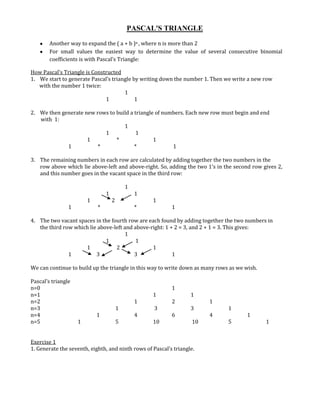
        Another way to expand the ( a + b )n , where n is more than 2
        For small values the easiest way to determine the value of several consecutive binomial
        coefficients is with Pascal's Triangle:

How Pascal's Triangle is Constructed
1. We start to generate Pascal’s triangle by writing down the number 1. Then we write a new row
   with the number 1 twice:
                                      1
                              1            1

2. We then generate new rows to build a triangle of numbers. Each new row must begin and end
   with 1:
                                   1
                           1             1
                     1          *               1
             1           *              *              1

3. The remaining numbers in each row are calculated by adding together the two numbers in the
   row above which lie above-left and above-right. So, adding the two 1’s in the second row gives 2,
   and this number goes in the vacant space in the third row:

                                            1
                                1               1
                        1           2               1
                1           *                   *          1

4. The two vacant spaces in the fourth row are each found by adding together the two numbers in
   the third row which lie above-left and above-right: 1 + 2 = 3, and 2 + 1 = 3. This gives:
                                      1
                              1            1
                     1            2              1
               1          3               3               1

We can continue to build up the triangle in this way to write down as many rows as we wish.

Pascal’s triangle
n=0                                                        1
n=1                                                 1              1
n=2                                             1          2             1
n=3                                     1           3              3           1
n=4                         1                   4          6             4             1
n=5                 1                   5           10              10         5              1


Exercise 1
1. Generate the seventh, eighth, and ninth rows of Pascal’s triangle.
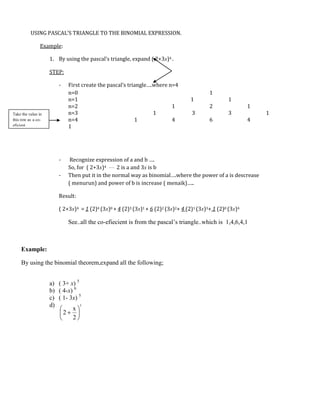
USING PASCAL’S TRIANGLE TO THE BINOMIAL EXPRESSION.

                Example:

                    1. By using the pascal’s triangle, expand ( 2+3x)4 .

                    STEP:

                        -   First create the pascal’s triangle….where n=4
                            n=0                                                            1
                            n=1                                                    1                1
                            n=2                                        1                   2                1
Take the value in           n=3                                 1                  3                3           1
this row as a co-           n=4                          1             4                   6                4
eficient                    1


                        -    Recognize expression of a and b ….
                            So, for ( 2+3x)4 …… 2 is a and 3x is b
                        -   Then put it in the normal way as binomial….where the power of a is descrease
                            ( menurun) and power of b is increase ( menaik)…..

                        Result:

                        ( 2+3x)4 = 1 (2)4 (3x)0 + 4 (2)3 (3x)1 + 6 (2)2 (3x)2+ 4 (2)1 (3x)3+ 1 (2)0 (3x)4

                            See..all the co-efiecient is from the pascal’s triangle..which is 1,4,6,4,1


    Example:

    By using the binomial theorem,expand all the following;


                    a) ( 3+ x) 5
                    b) ( 4-x) 6
                    c) ( 1- 3x) 5
                    d)           5
                             x
                         2
                             2
Binomial expansion+teorem pascal+mapping

Binomial expansion+teorem pascal+mapping

  • 1.
    If (1+x)2 =(1+x)(1+x) = 1+2x+x2 BINOMIAL EXPANSION How to expand if (2 + 3x)9 = ????? DEFINITION OF BINOMIAL EXPANSION A sequence have 2 term or more is named as binomial sequence or binomial expression.The example are : (a + x), (1 - x), (2x + 3y) Definition 1: “ FACTORIAL” for a number is a multiplication / product of a sequence number. Symbol: ! Example : a product of first 7 positive integer are ; 7 x 6 x 5 x 4 x 3 x 2 x 1 read as 7 factorial therefore 7! = 7 x 6 x 5 x 4 x 3 x 2 x 1 General form is given by the definition below. For any integer positive n, we definite “ FACTORIAL n ” which sign by n! as n! = n(n-1)(n-2)( n-3)………3x2x1 where, 0! = 1 Example 1. Find the value of , a) 9! 18! d) b) 6! 15!5! 9! c) 6! Definition 2: Co-eficient of Binomial ; n n n n n! Symbol @ Cr is define as = Cr = r r n r !r!
  • 2.
    We can usethe button on our calculator to find these values Example 2: Find the value of , 5 20 a) c) 3 17 n 6 5 b) d) 0 4 3 EXERCISE 1 EXERCISE 2 ANSWER : Find the value of ; Without using the calculator, find: a) 8! EX. 1: b) 4!7! 5 7! a) a) 40320 c) 2 0! b) 120960 18 c) 5040 d) 6! – 3! b) 8! 3 d) 714 e) e) 56 6! 14! f) 1001 f) g) 1344 10!4! h) 30240 4!8! g) EX. 2: 6! a) 10 h) 8! – ( 2!7!) b) 816
  • 3.
    BINOMIAL THEOREM Expansion ingeneral form (a + b ) n where a, b is any number and n is integer positive is given as n n 0 n n 1 1 n n 2 2 n n r r n 0 n (a + b ) n = a b + a b + a b +……….+ a b +……+ a b 0 1 2 r m or n! a 0b n n! n! n! n! n!(n n)! (a + b ) n = a nb0 + a n 1b1 + a n 2 b 2 +….+ a n r b r +..........+ 0!(n 0)! 1!(n 1)! 2!(n 2)! r!(n r )! Or (a + b)n = an + nC1an – 1b + nC2an – 2b2 + nC3an – 3b3 + ... + nCran – rbr + ... + xn Or we simplify generally as : (a + b ) n = n Cran – rbr …………[ general form] Note: a) Remember !! power of a is desending,power of b is ascending b) First term , T1= an c) Final term T(n)= bn n n r r d) Term of ( r+1) , T( r+1) = a b r Example 3 : By using the binomial theorem,expand all the following; a) ( 3+ x) 5 x 5 b) ( 4-x) 6 d) 2 2 c) ( 1- 3x) 5
  • 4.
    PASCAL'S TRIANGLE Another way to expand the ( a + b )n , where n is more than 2 For small values the easiest way to determine the value of several consecutive binomial coefficients is with Pascal's Triangle: How Pascal's Triangle is Constructed 1. We start to generate Pascal’s triangle by writing down the number 1. Then we write a new row with the number 1 twice: 1 1 1 2. We then generate new rows to build a triangle of numbers. Each new row must begin and end with 1: 1 1 1 1 * 1 1 * * 1 3. The remaining numbers in each row are calculated by adding together the two numbers in the row above which lie above-left and above-right. So, adding the two 1’s in the second row gives 2, and this number goes in the vacant space in the third row: 1 1 1 1 2 1 1 * * 1 4. The two vacant spaces in the fourth row are each found by adding together the two numbers in the third row which lie above-left and above-right: 1 + 2 = 3, and 2 + 1 = 3. This gives: 1 1 1 1 2 1 1 3 3 1 We can continue to build up the triangle in this way to write down as many rows as we wish. Pascal’s triangle n=0 1 n=1 1 1 n=2 1 2 1 n=3 1 3 3 1 n=4 1 4 6 4 1 n=5 1 5 10 10 5 1 Exercise 1 1. Generate the seventh, eighth, and ninth rows of Pascal’s triangle.
  • 5.
    USING PASCAL’S TRIANGLETO THE BINOMIAL EXPRESSION. Example: 1. By using the pascal’s triangle, expand ( 2+3x)4 . STEP: - First create the pascal’s triangle….where n=4 n=0 1 n=1 1 1 n=2 1 2 1 Take the value in n=3 1 3 3 1 this row as a co- n=4 1 4 6 4 eficient 1 - Recognize expression of a and b …. So, for ( 2+3x)4 …… 2 is a and 3x is b - Then put it in the normal way as binomial….where the power of a is descrease ( menurun) and power of b is increase ( menaik)….. Result: ( 2+3x)4 = 1 (2)4 (3x)0 + 4 (2)3 (3x)1 + 6 (2)2 (3x)2+ 4 (2)1 (3x)3+ 1 (2)0 (3x)4 See..all the co-efiecient is from the pascal’s triangle..which is 1,4,6,4,1 Example: By using the binomial theorem,expand all the following; a) ( 3+ x) 5 b) ( 4-x) 6 c) ( 1- 3x) 5 d) 5 x 2 2