
LeSar Development Consultants
SESSION MODERATOR
Jennifer LeSar, President and CEO
2410 First Avenue
San Diego, CA 92101
619-236-0612
jennifer@lesardevelopment.com
Outlook on
Pay for Success/
Social Impact Bonds (SIBs)
Session Overview
 Welcome and Introduction
 Overview of SIBs
 A SIB Program for Social Enterprise
 How SIBs Fit in a Workforce Context
 SIBs: The Source for Housing Solutions
 Moderated Q&A with the Audience
SIB Basics
 A contract to deliver verifiable social outcomes in
exchange for payment.
 If outcomes are not achieved, no payment is
made.
 Also known as “Pay for Success” or Pay for
Performance”
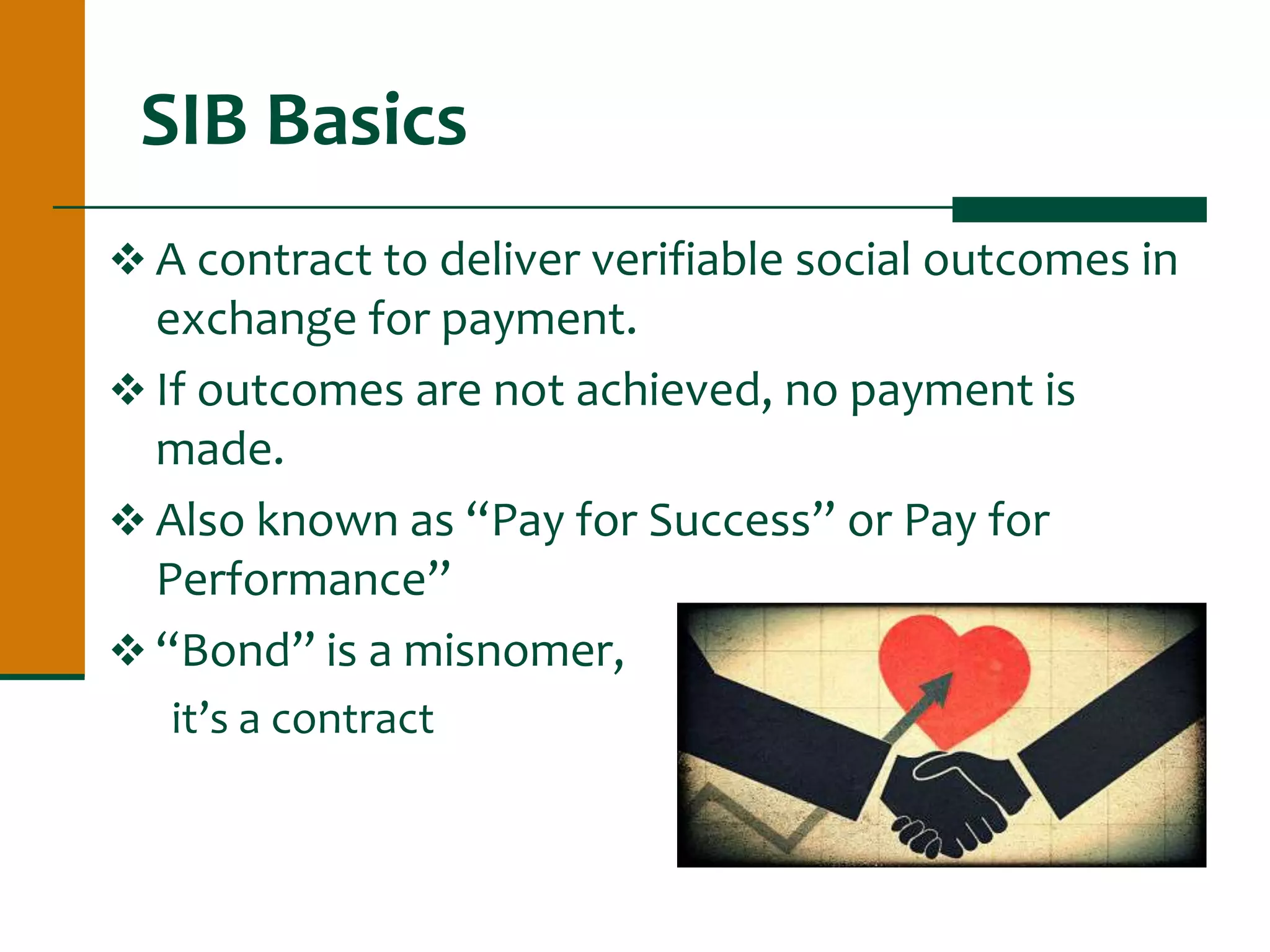
 “Bond” is a misnomer,
it’s a contract
The Potential
 Increase effectiveness of social interventions in
challenging program areas (e.g.
homelessness, workforce
development, recidivism, affordable housing)
 Reduce public costs for downstream program
expenses – or increase revenues
 Reduce taxpayer dollars spent on in
in-effective programs
 Bring new ideas, funding, strengthening,
and management talent to
social sector services
Critiques and Challenges
 Significant Transaction Costs
 Credible Outcome Measurement
 Limited Government Capacity
 Limited Provider Capacity
 Difficulty in “Accessing” Government Cost
Savings
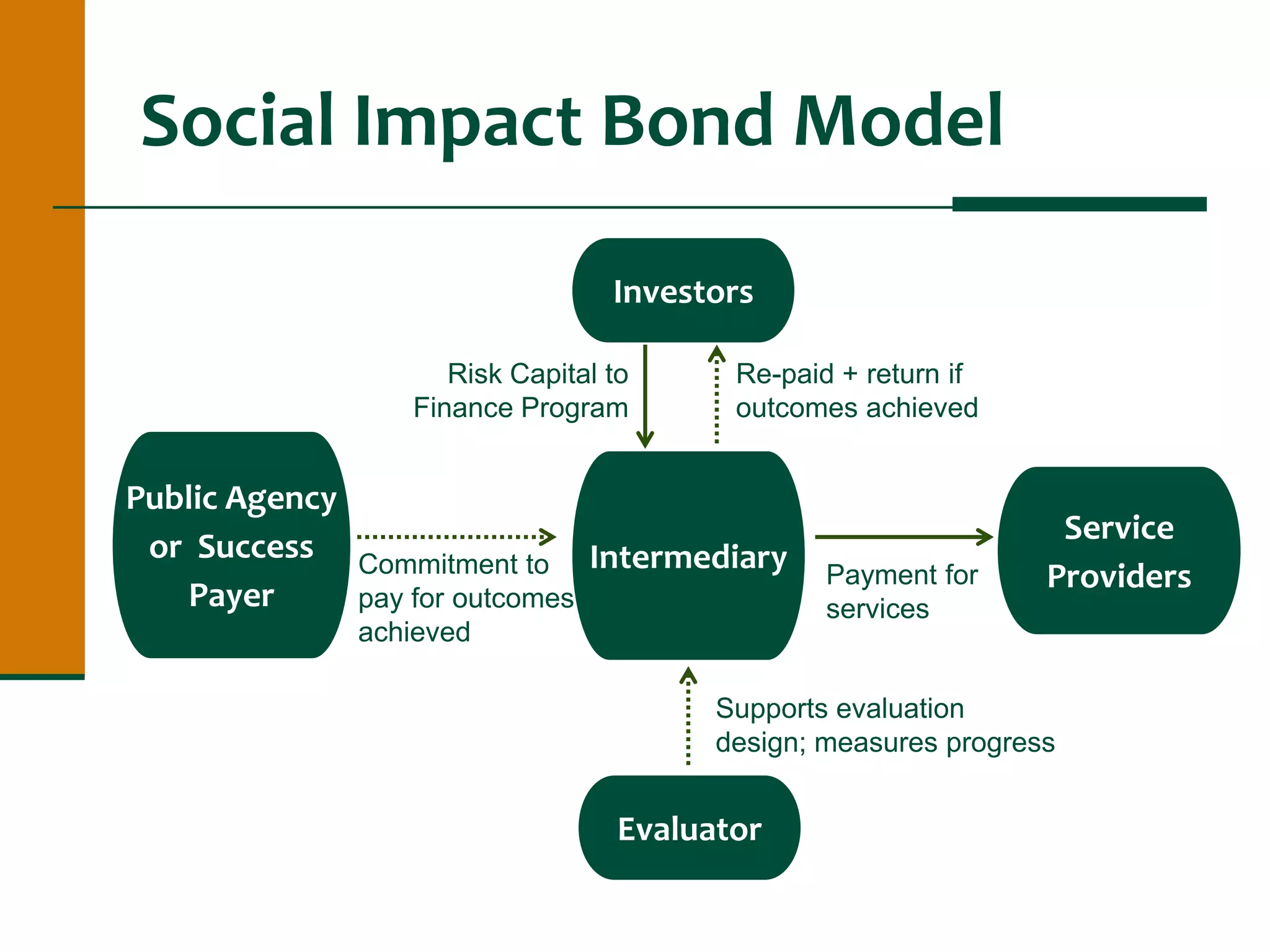
Social Impact Bond Model
Intermediary
Service
Providers
Investors
Public Agency
or Success
Payer
Commitment to
pay for outcomes
achieved
Payment for
services
Risk Capital to
Finance Program
Re-paid + return if
outcomes achieved
Evaluator
Supports evaluation
design; measures progress
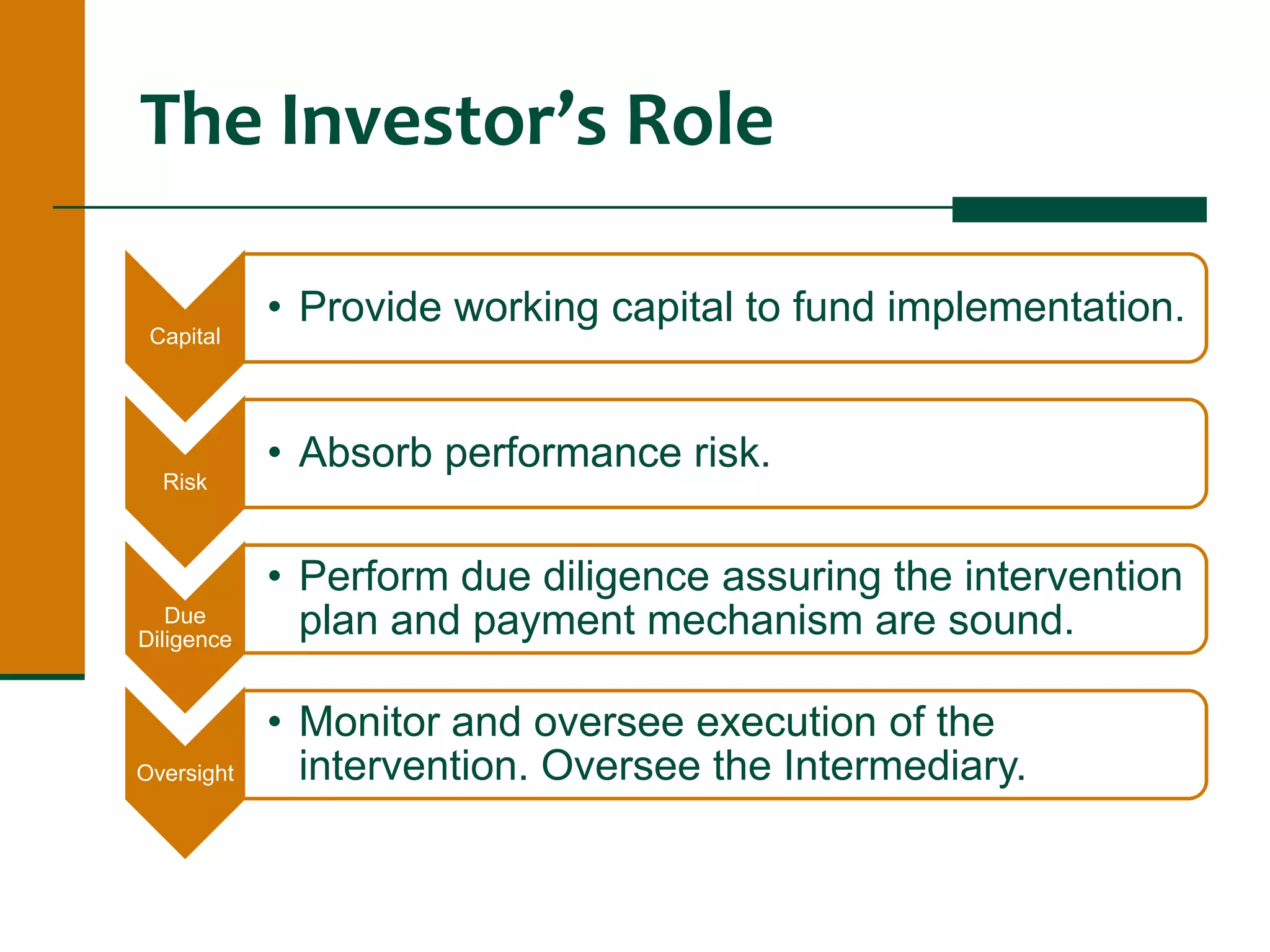
The Investor’s Role
Capital
• Provide working capital to fund implementation.
Risk
• Absorb performance risk.
Due
Diligence
• Perform due diligence assuring the intervention
plan and payment mechanism are sound.
Oversight
• Monitor and oversee execution of the
intervention. Oversee the Intermediary.
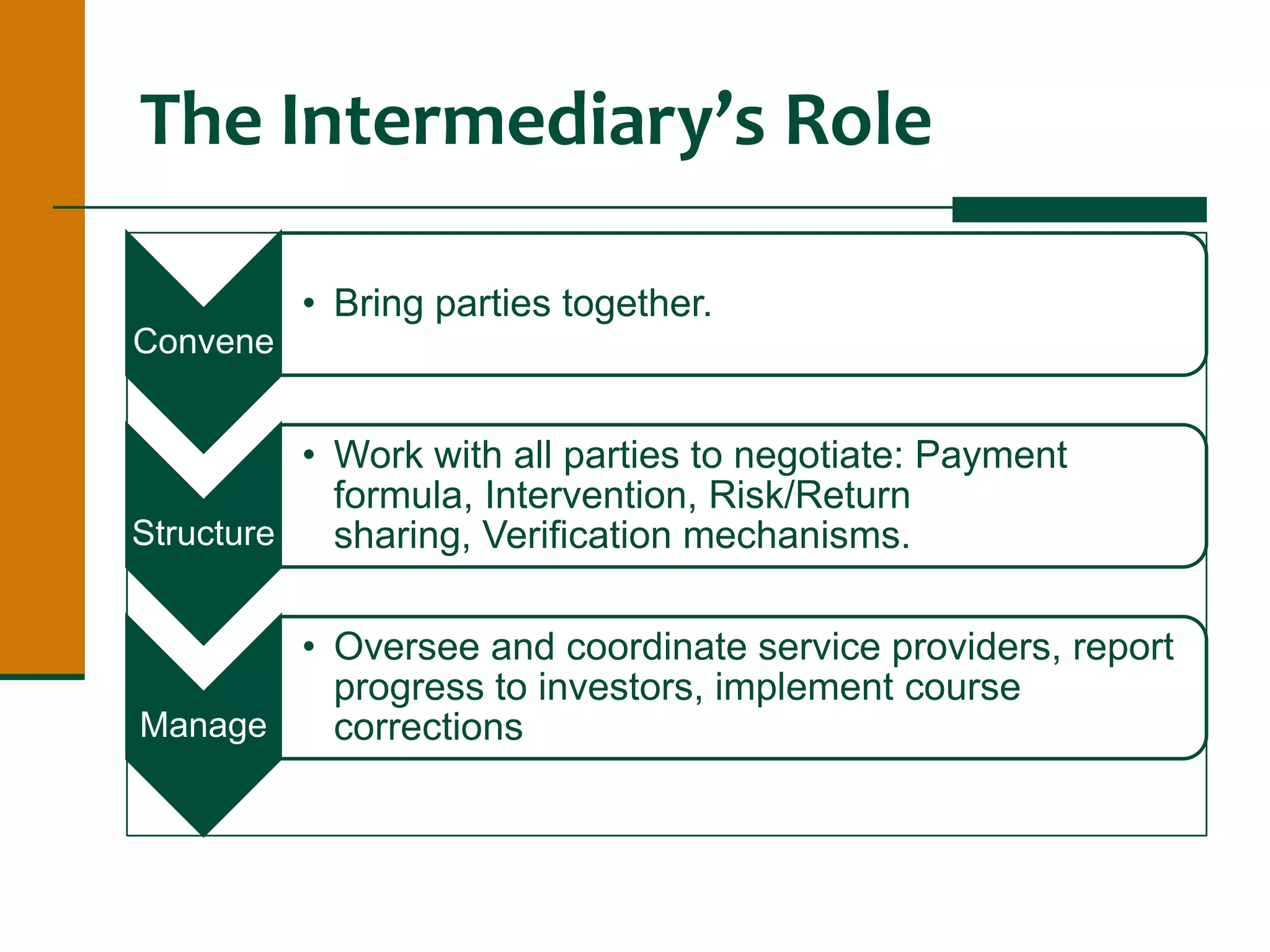
The Intermediary’s Role
Convene
• Bring parties together.
Structure
• Work with all parties to negotiate: Payment
formula, Intervention, Risk/Return
sharing, Verification mechanisms.
Manage
• Oversee and coordinate service providers, report
progress to investors, implement course
corrections
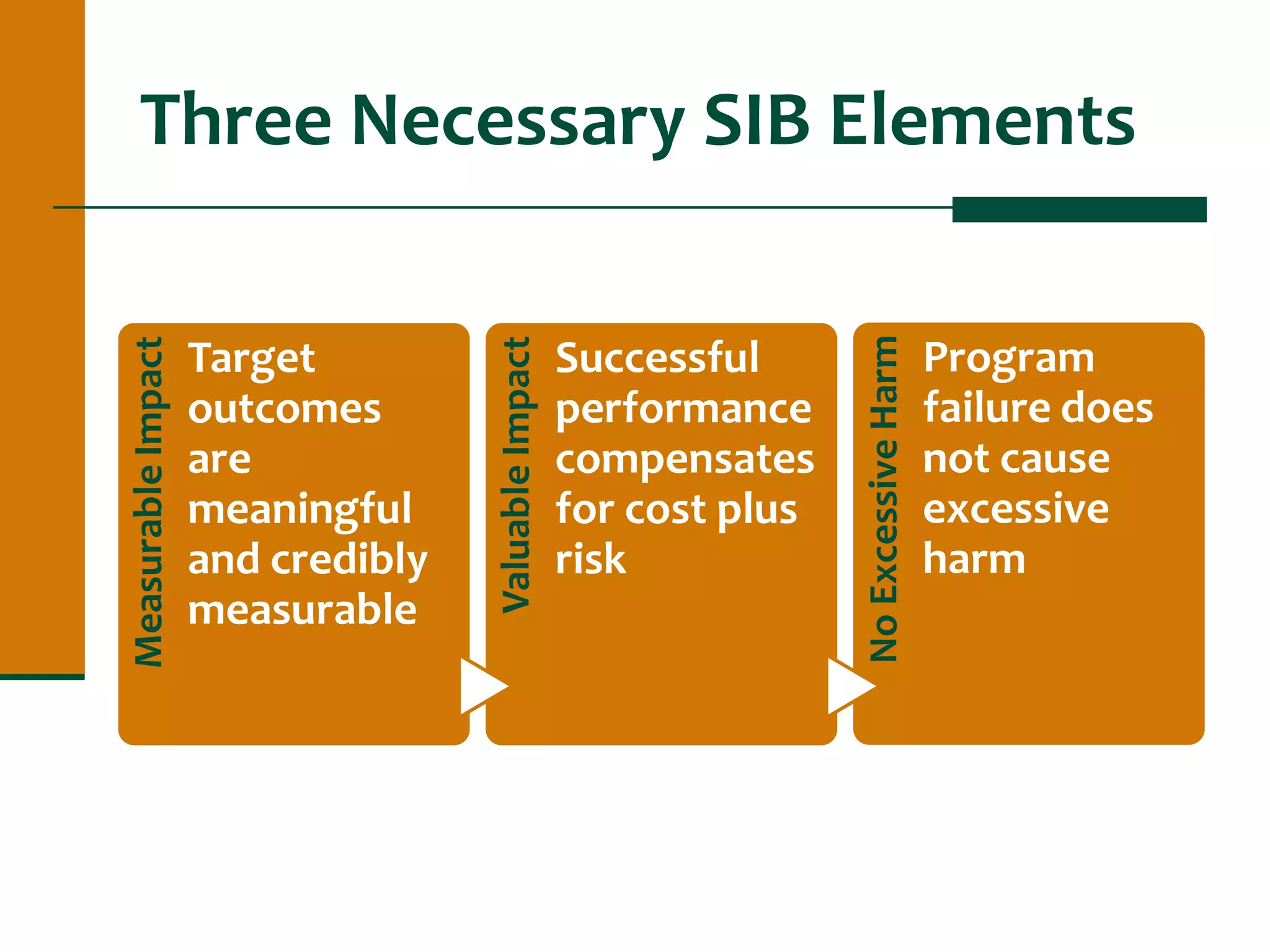
Three Necessary SIB ElementsMeasurableImpact
Target
outcomes
are
meaningful
and credibly
measurable
ValuableImpact
Successful
performance
compensates
for cost plus
risk
NoExcessiveHarm
Program
failure does
not cause
excessive
harm
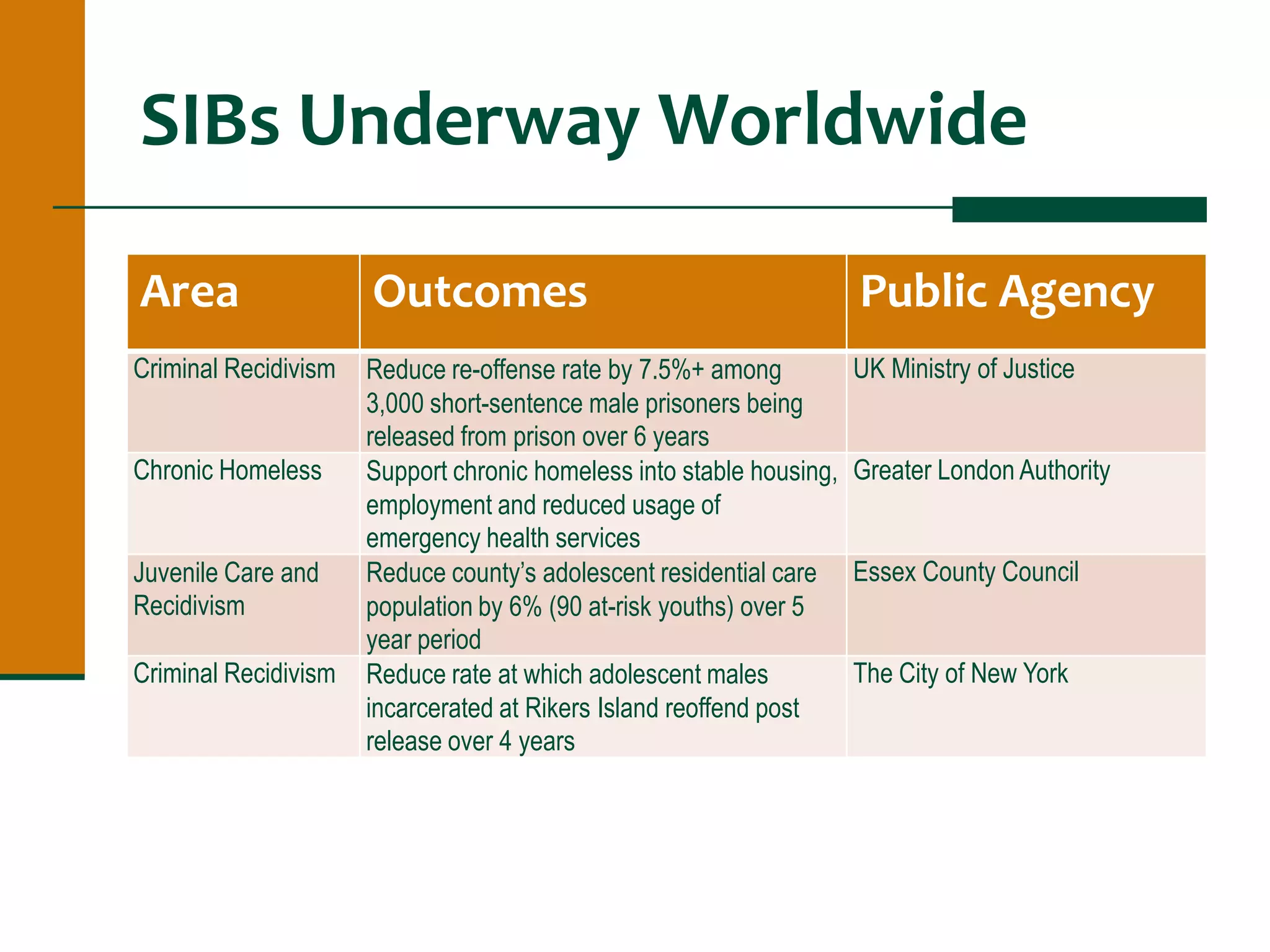
SIBs Underway Worldwide
Area Outcomes Public Agency
Criminal Recidivism Reduce re-offense rate by 7.5%+ among
3,000 short-sentence male prisoners being
released from prison over 6 years
UK Ministry of Justice
Chronic Homeless Support chronic homeless into stable housing,
employment and reduced usage of
emergency health services
Greater London Authority
Juvenile Care and
Recidivism
Reduce county’s adolescent residential care
population by 6% (90 at-risk youths) over 5
year period
Essex County Council
Criminal Recidivism Reduce rate at which adolescent males
incarcerated at Rikers Island reoffend post
release over 4 years
The City of New York
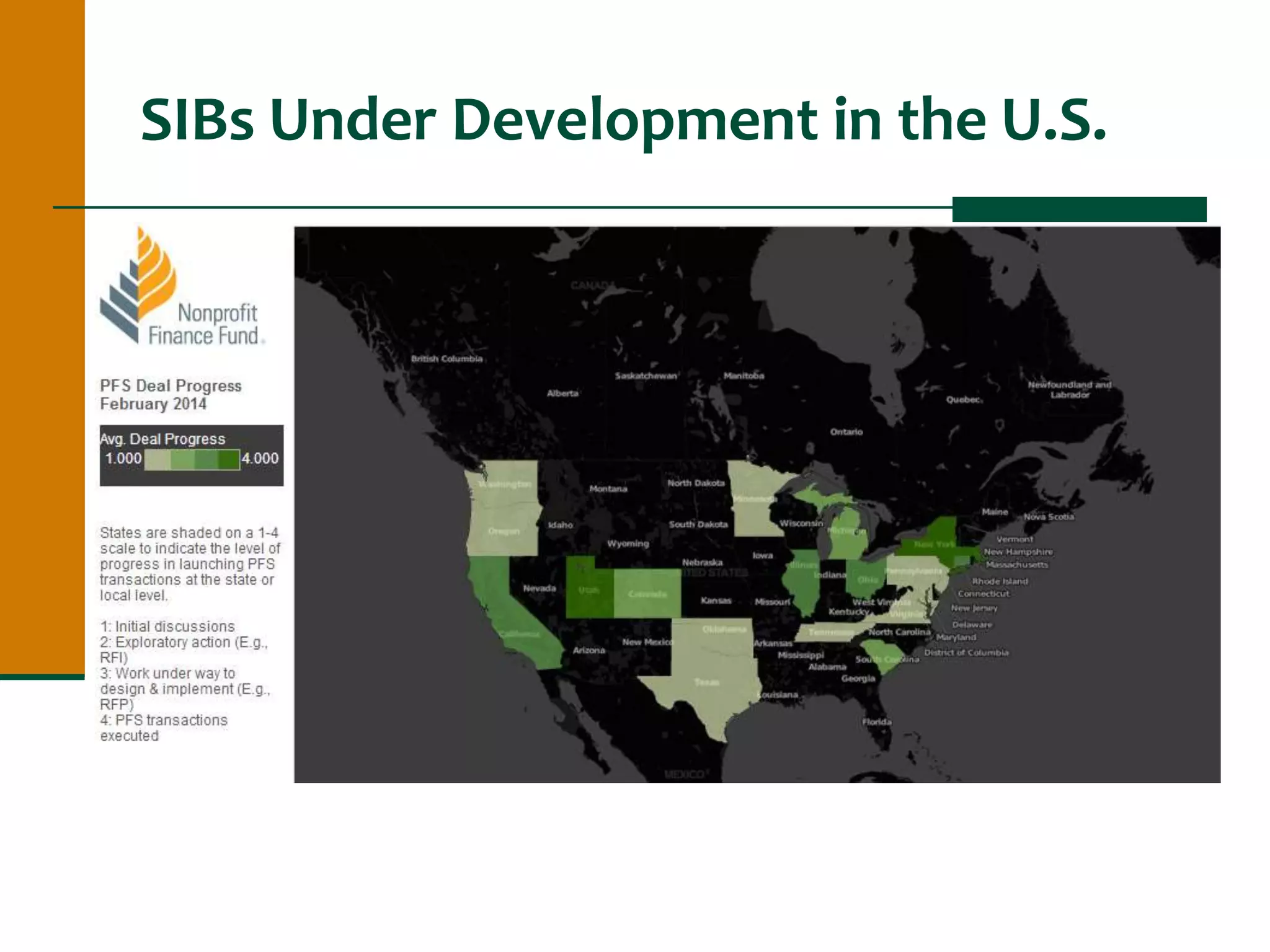
SIBs Under Development in the U.S.
Jennifer LeSar
LeSar Development Consultants
2410 First Avenue
San Diego, CA 92101
619-236-0612 x 101
jennifer@lesardevelopment.com
The Source for
Housing Solutions
Pay for Success /
Social Impact Bonds
CSH: Our Mission
CSH advances solutions that use housing as a
platform for services to improve the lives of the
most vulnerable people, maximize public
resources, and build healthy relationships.
15
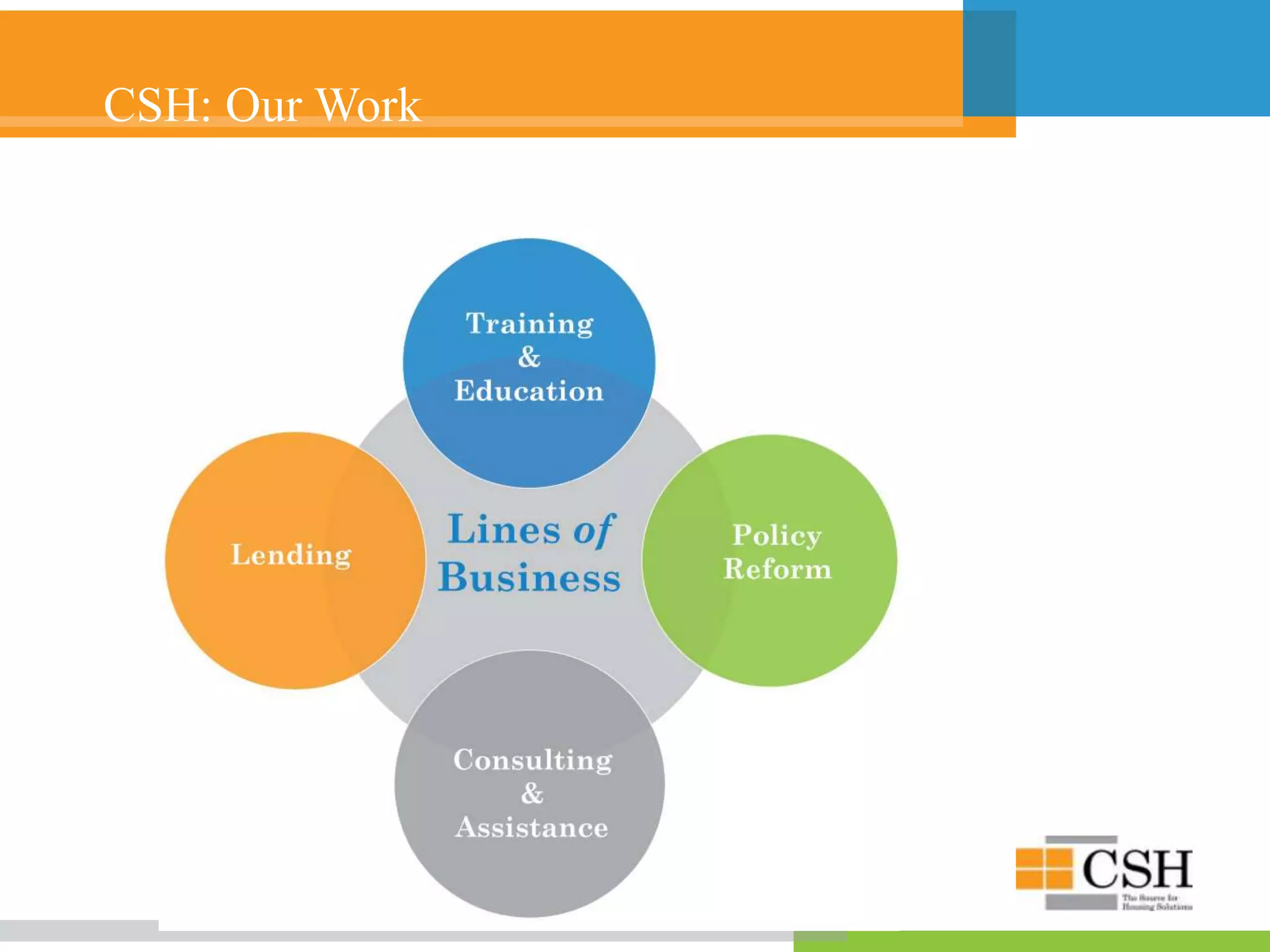
CSH: Our Work
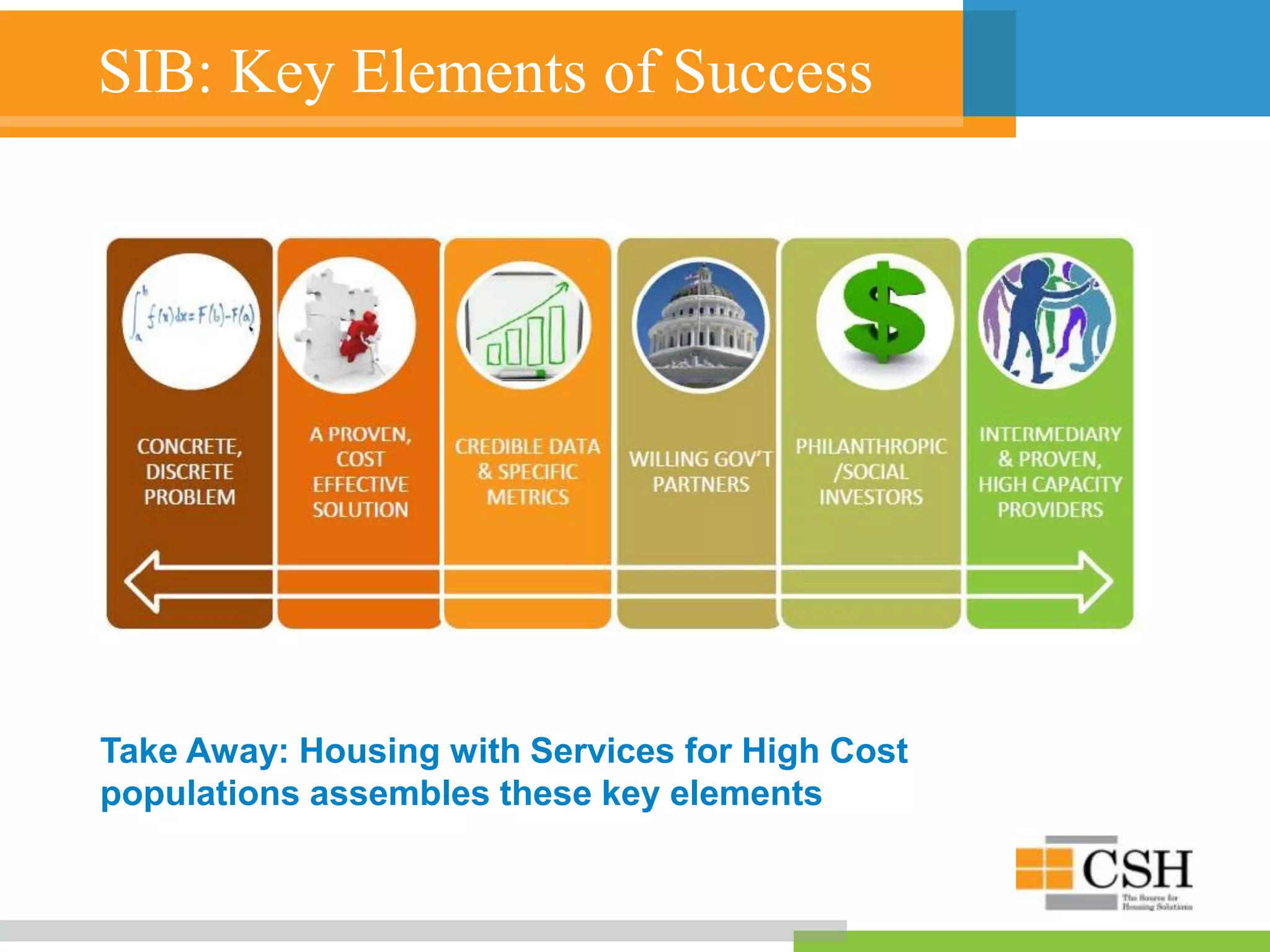
SIB: Key Elements of Success
Take Away: Housing with Services for High Cost
populations assembles these key elements
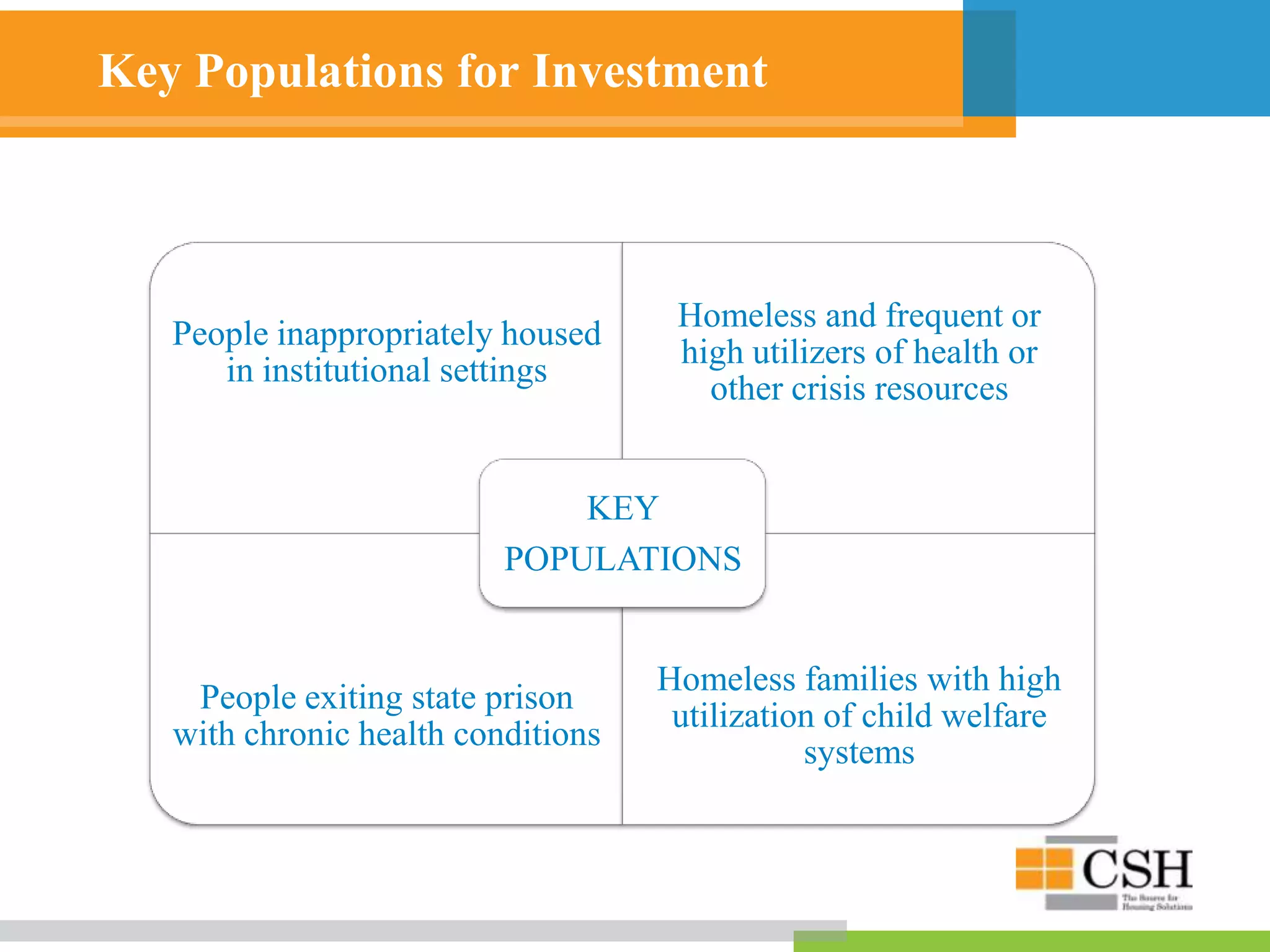
Key Populations for Investment
People inappropriately housed
in institutional settings
Homeless and frequent or
high utilizers of health or
other crisis resources
People exiting state prison
with chronic health conditions
Homeless families with high
utilization of child welfare
systems
KEY
POPULATIONS
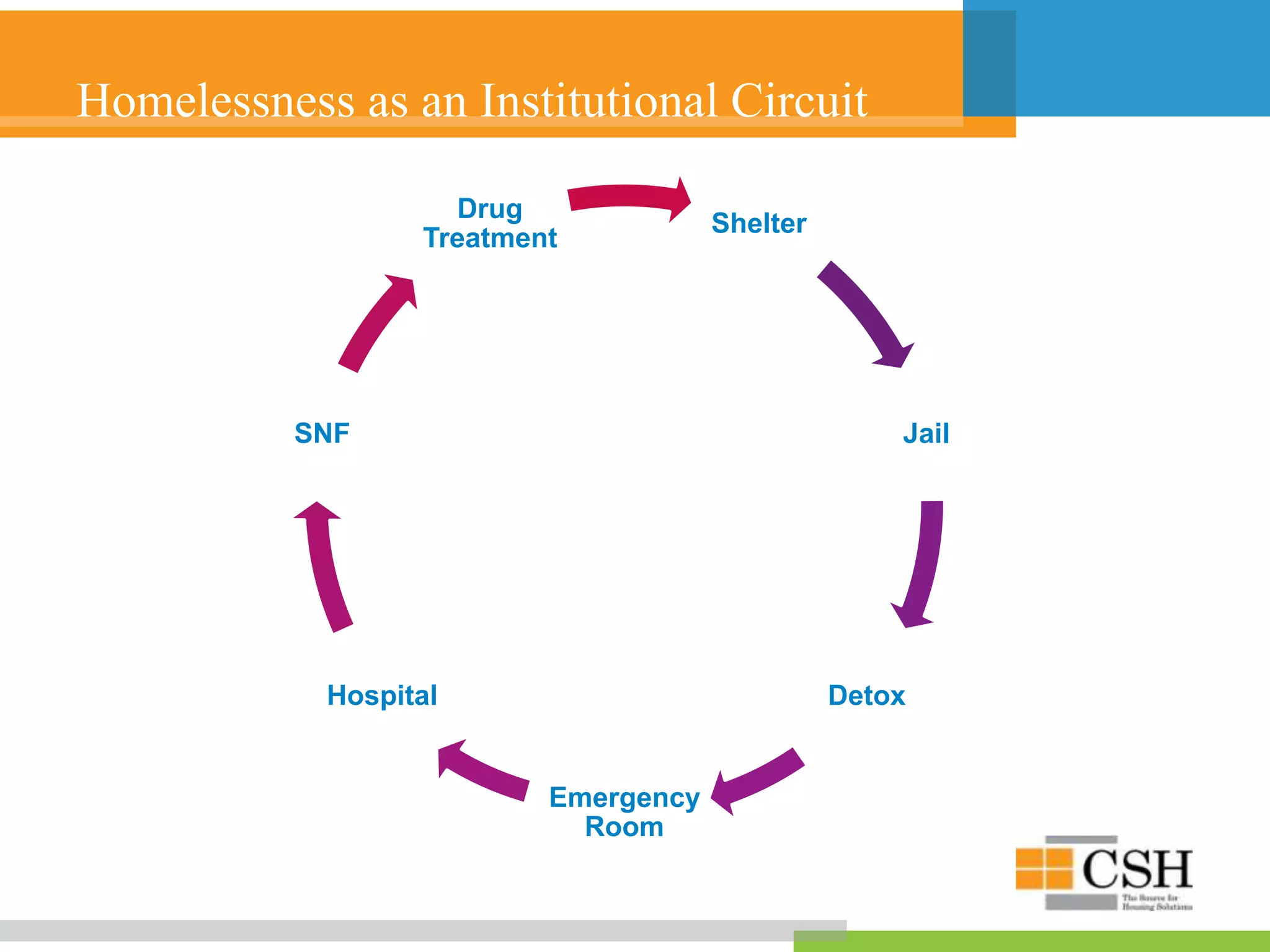
Shelter
Jail
Detox
Emergency
Room
Hospital
SNF
Drug
Treatment
Homelessness as an Institutional Circuit
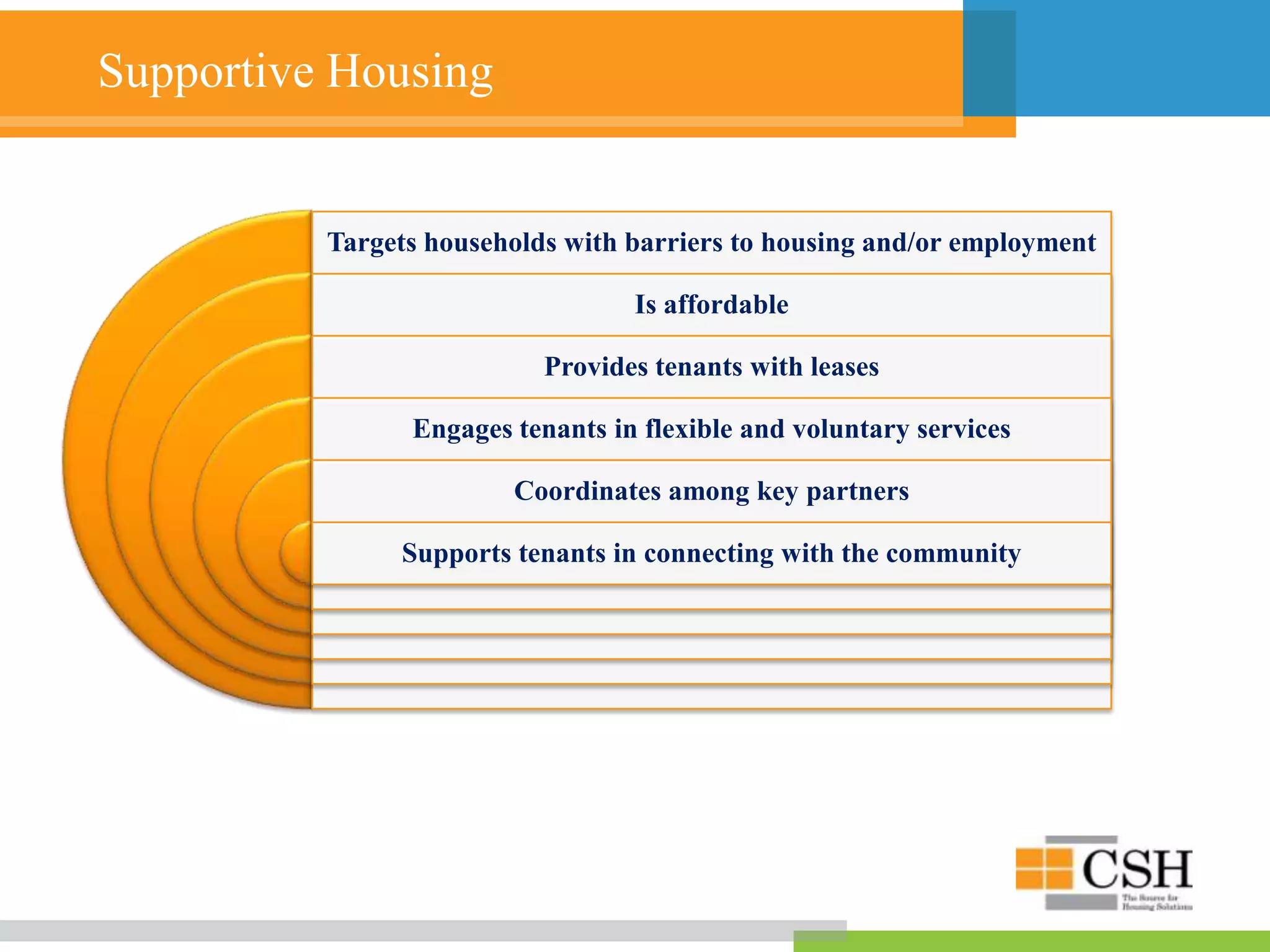
Supportive Housing
Targets households with barriers to housing and/or employment
Is affordable
Provides tenants with leases
Engages tenants in flexible and voluntary services
Coordinates among key partners
Supports tenants in connecting with the community
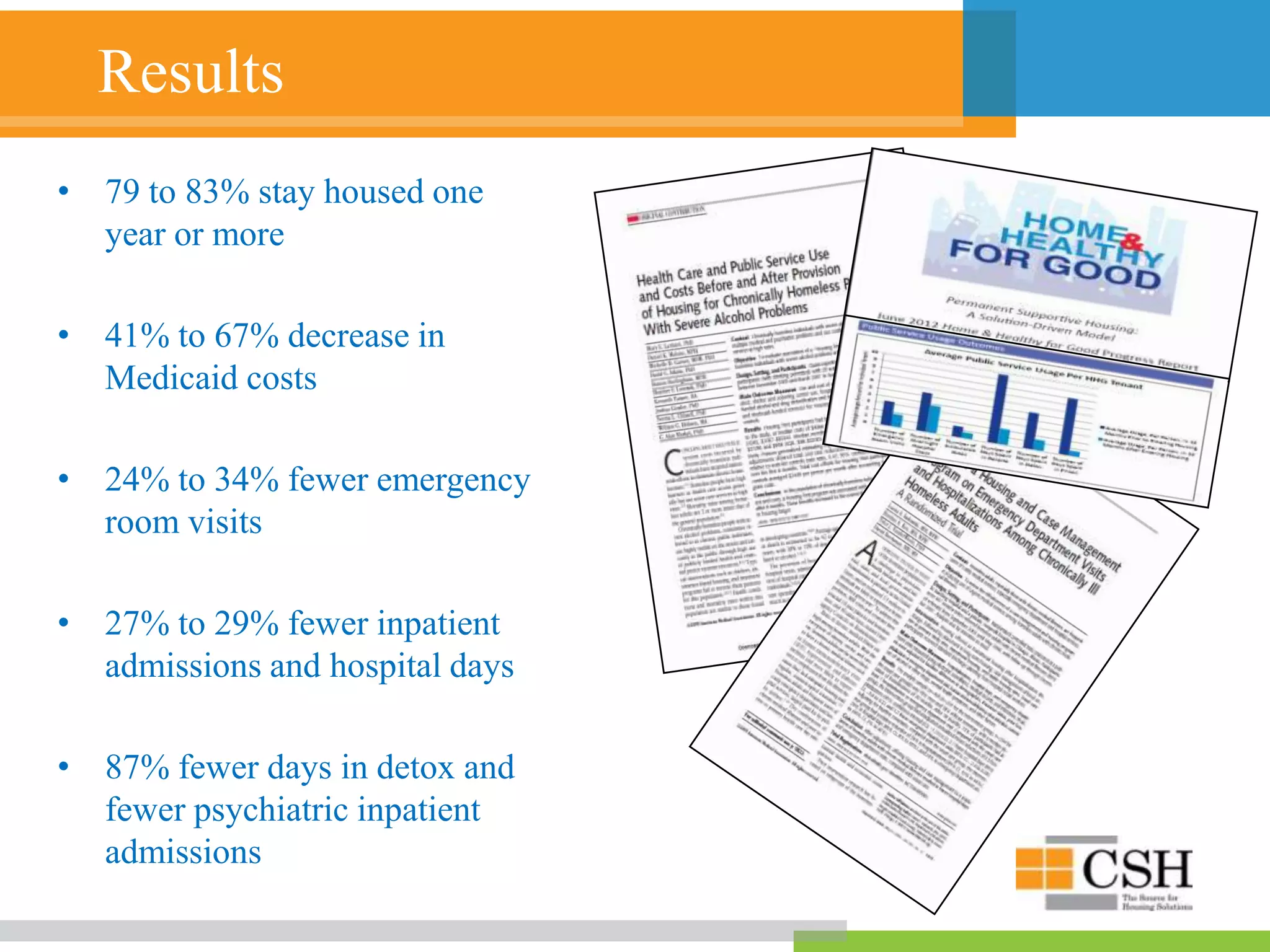
Results
• 79 to 83% stay housed one
year or more
• 41% to 67% decrease in
Medicaid costs
• 24% to 34% fewer emergency
room visits
• 27% to 29% fewer inpatient
admissions and hospital days
• 87% fewer days in detox and
fewer psychiatric inpatient
admissions
Housing Stability
 83% of formerly chronically homeless persons in housing
programs remained housed after 1 year and 77% were still
housed after 2 years
 Closer to Home Initiative (Barrow, Rodriguez, Cordova)
 81% of formerly chronically homeless tenants in San Francisco
remained in permanent supportive housing for at least 1 year
 Analysis of tenant outcomes of two supportive housing projects
in San Francisco (Martinez, Burt)
Pay for Performance in Minnesota
 $10 million authorization
 2 pilot projects
 Supportive Housing
 Workforce Development
Supportive Housing Example:
Massachusetts
 Competitive Procurement
 Evidence Based
 Partners:
 Third Sector Capital
 Corporation for Supportive Housing
 United Way of Massachusetts Bay and Merrimack Valley
 Massachusetts Housing and Shelter Alliance (MHSA):
 Home & Healthy for Good
 Low-threshold housing
 600 units
Building the Evidence in CA:
Just In Reach
 Pilot project
 Documenting cost impacts:
 Supportive Housing
 Homeless
 Frequent Users of LA County jail
 Chronic mental health/substance use
 Re-entering the community
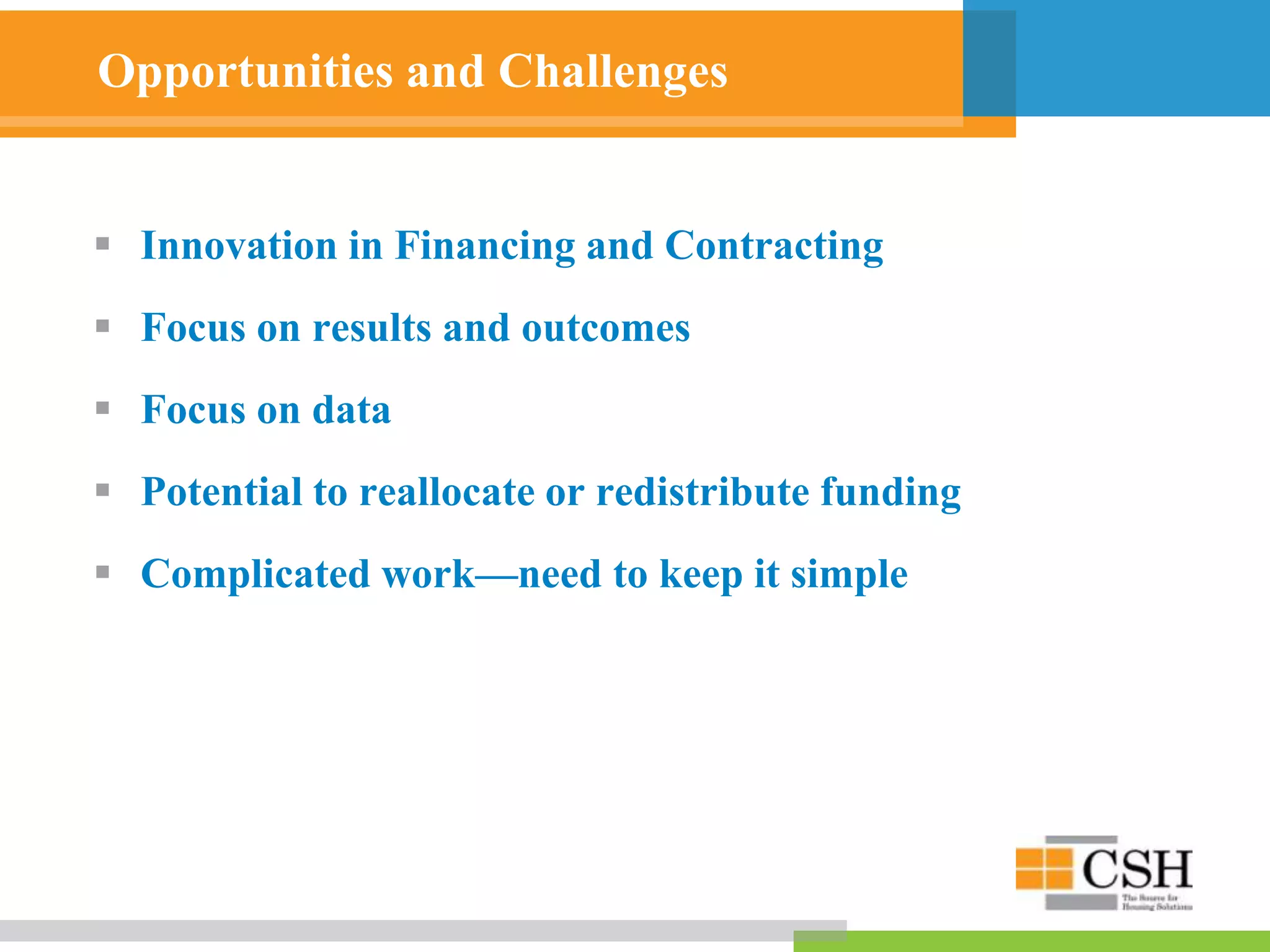
Opportunities and Challenges
 Innovation in Financing and Contracting
 Focus on results and outcomes
 Focus on data
 Potential to reallocate or redistribute funding
 Complicated work—need to keep it simple
Contact Information
Simonne Ruff
Director
619.234.4102
simonne.ruff@csh.org
Third Sector Capital Partners, Inc.
Boston & San Francisco | (617) 912-8957 | info@thirdsectorcap.org | www.thirdsectorcap.org
This document is the property of Third Sector Capital Partners, Inc. (“Third Sector”). It contains
confidential, proprietary, trade secret information of Third Sector that must not be reproduced, disclosed to anyone or used
for the benefit of anyone other than Third Sector unless expressly authorized in writing by an executive officer of Third
Sector.
Nuts & Bolts of
Social Impact Bond Deal Making
April 17, 2014
Caroline Whistler
Co-Founder & Partner
caroline@thirdsectorcap.org
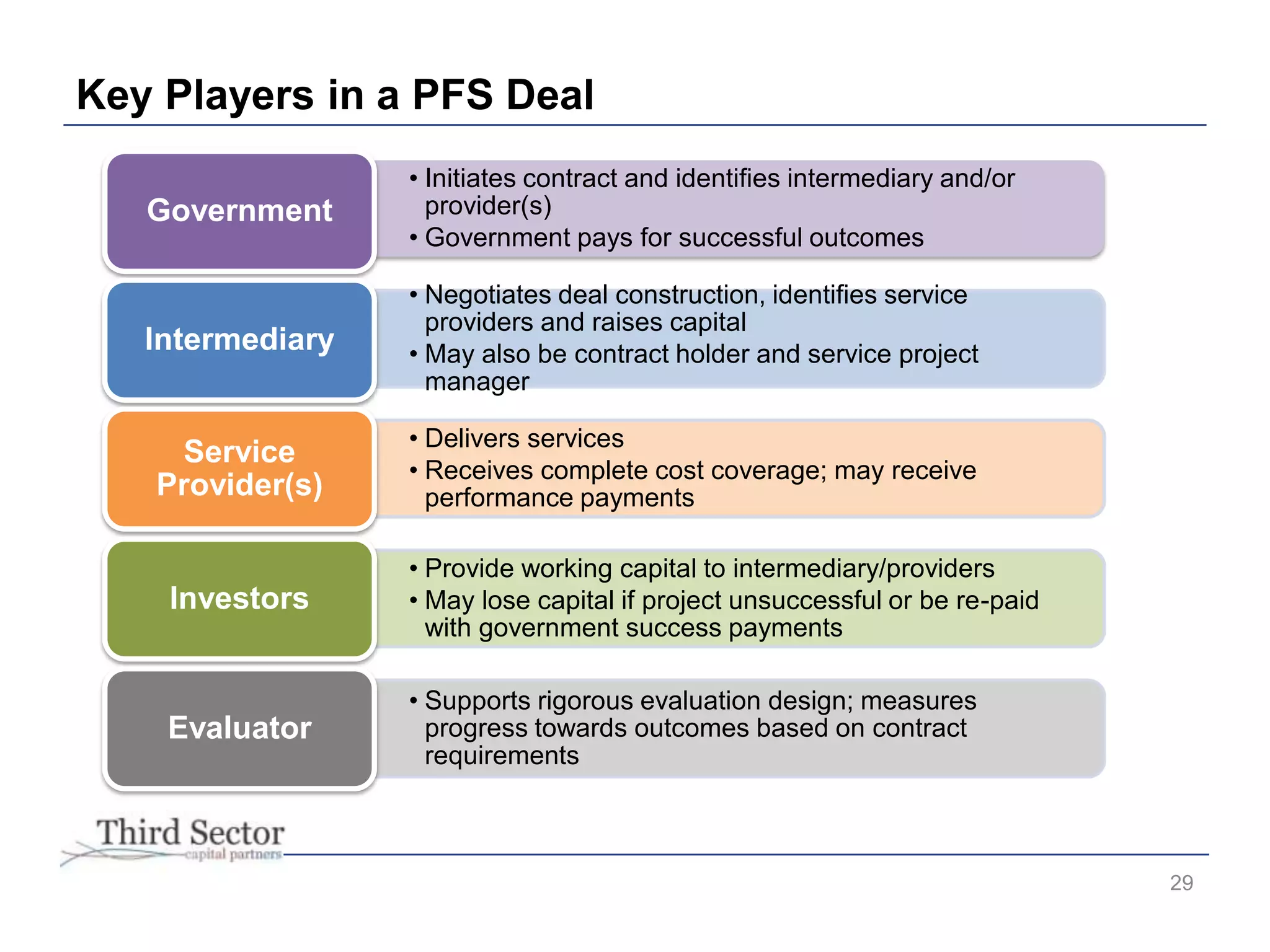
Key Players in a PFS Deal
29
• Initiates contract and identifies intermediary and/or
provider(s)
• Government pays for successful outcomes
Government
• Negotiates deal construction, identifies service
providers and raises capital
• May also be contract holder and service project
manager
Intermediary
• Delivers services
• Receives complete cost coverage; may receive
performance payments
Service
Provider(s)
• Provide working capital to intermediary/providers
• May lose capital if project unsuccessful or be re-paid
with government success payments
Investors
• Supports rigorous evaluation design; measures
progress towards outcomes based on contract
requirements
Evaluator
30
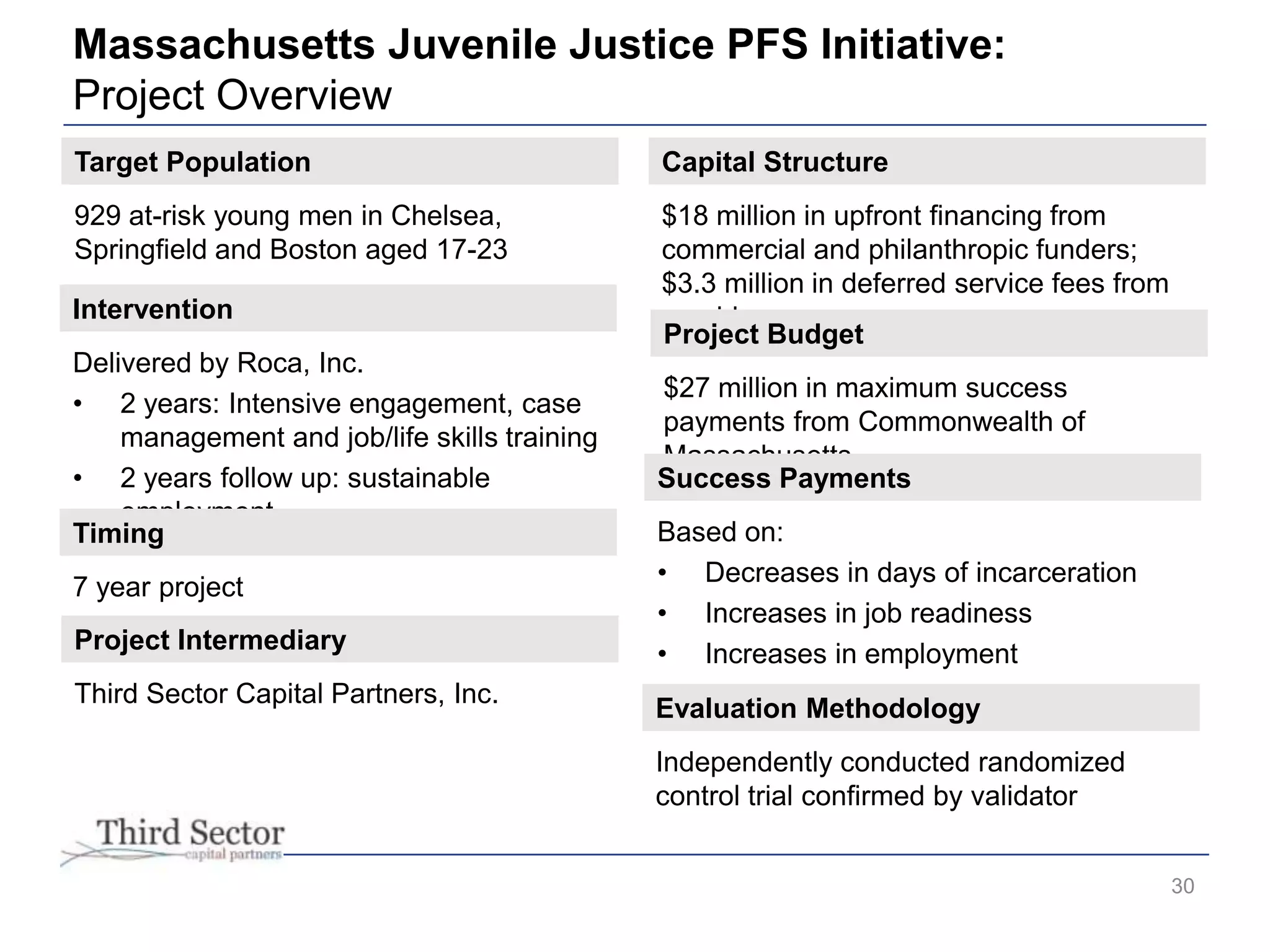
Massachusetts Juvenile Justice PFS Initiative:
Project Overview
Target Population
929 at-risk young men in Chelsea,
Springfield and Boston aged 17-23
Intervention
Delivered by Roca, Inc.
• 2 years: Intensive engagement, case
management and job/life skills training
• 2 years follow up: sustainable
employment
Timing
7 year project
Project Intermediary
Third Sector Capital Partners, Inc.
Capital Structure
$18 million in upfront financing from
commercial and philanthropic funders;
$3.3 million in deferred service fees from
provider
Project Budget
$27 million in maximum success
payments from Commonwealth of
Massachusetts
Success Payments
Based on:
• Decreases in days of incarceration
• Increases in job readiness
• Increases in employment
Evaluation Methodology
Independently conducted randomized
control trial confirmed by validator
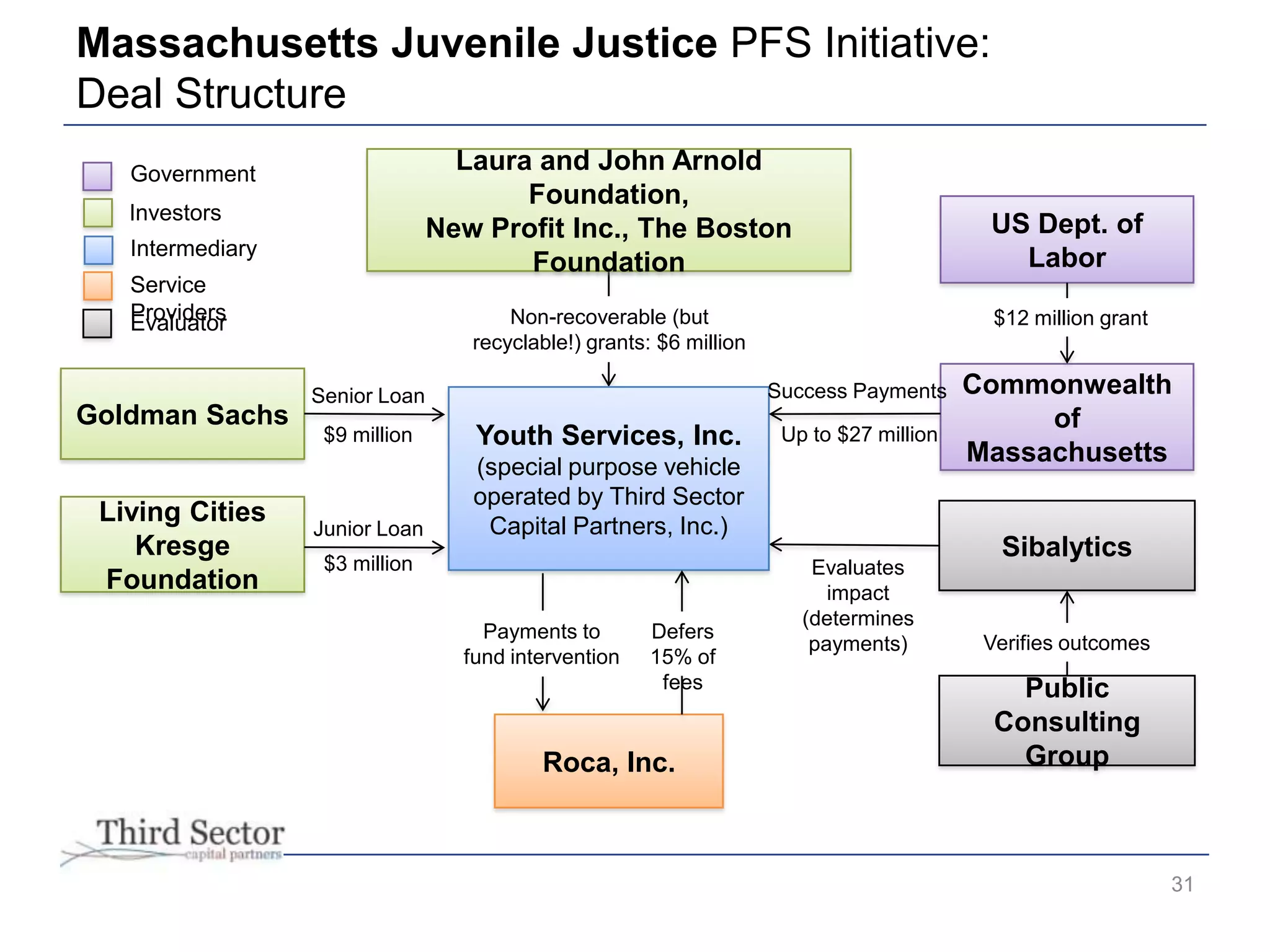
$9 million
Senior Loan
Evaluates
impact
(determines
payments)
$3 million
Up to $27 million
31
Massachusetts Juvenile Justice PFS Initiative:
Deal Structure
Youth Services, Inc.
(special purpose vehicle
operated by Third Sector
Capital Partners, Inc.)
Laura and John Arnold
Foundation,
New Profit Inc., The Boston
Foundation
Goldman Sachs
Commonwealth
of
Massachusetts
Sibalytics
Roca, Inc.
Success Payments
Payments to
fund intervention
US Dept. of
Labor
$12 million grant
Living Cities
Kresge
Foundation
Non-recoverable (but
recyclable!) grants: $6 million
Junior Loan
Defers
15% of
fees Public
Consulting
Group
Verifies outcomes
Investors
Government
Intermediary
Service
ProvidersEvaluator
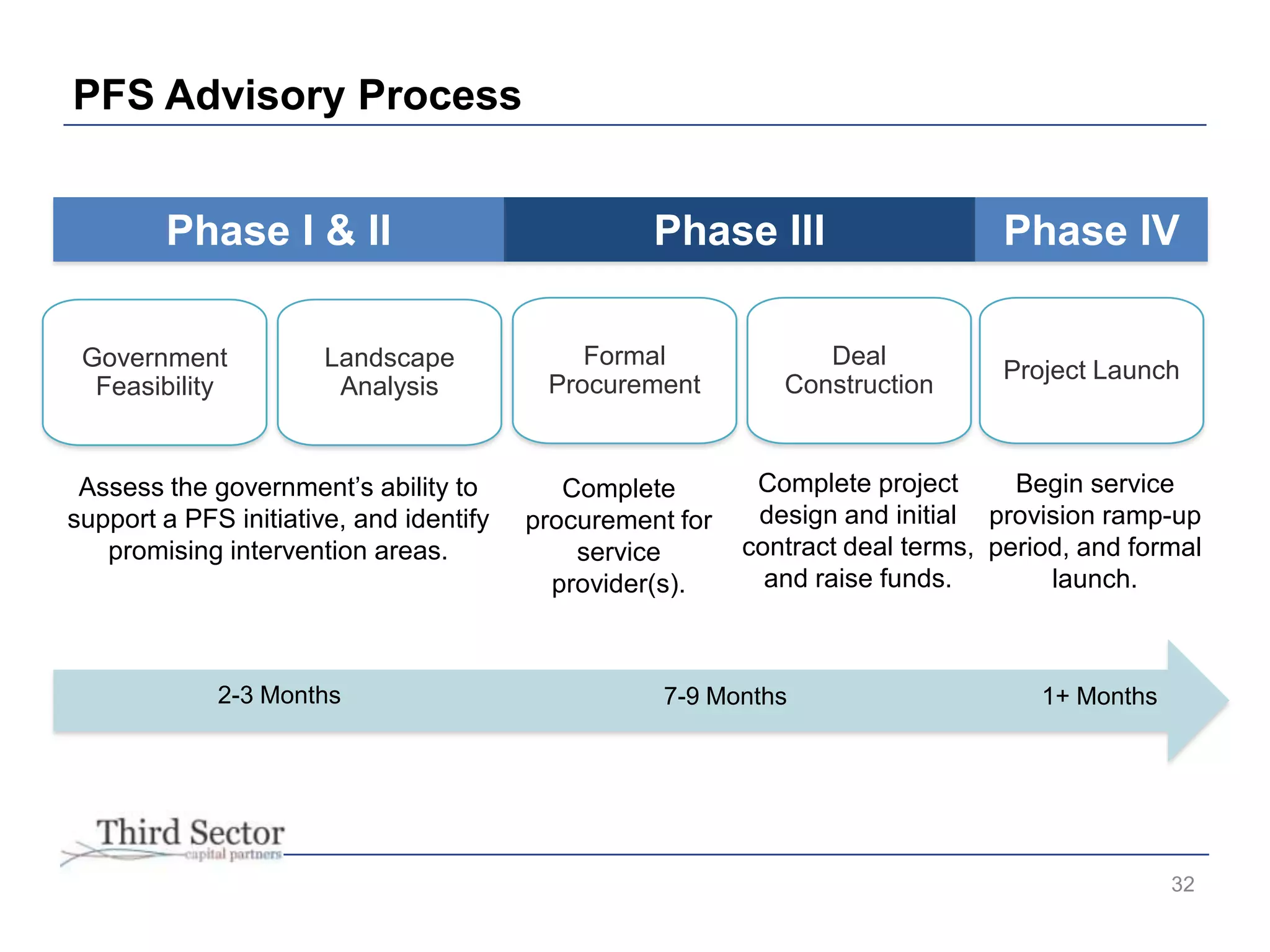
PFS Advisory Process
Government
Feasibility
Landscape
Analysis
Formal
Procurement
2-3 Months 7-9 Months 1+ Months
Phase III
32
Phase IVPhase I & II
Deal
Construction
Project Launch
Assess the government’s ability to
support a PFS initiative, and identify
promising intervention areas.
Complete
procurement for
service
provider(s).
Complete project
design and initial
contract deal terms,
and raise funds.
Begin service
provision ramp-up
period, and formal
launch.
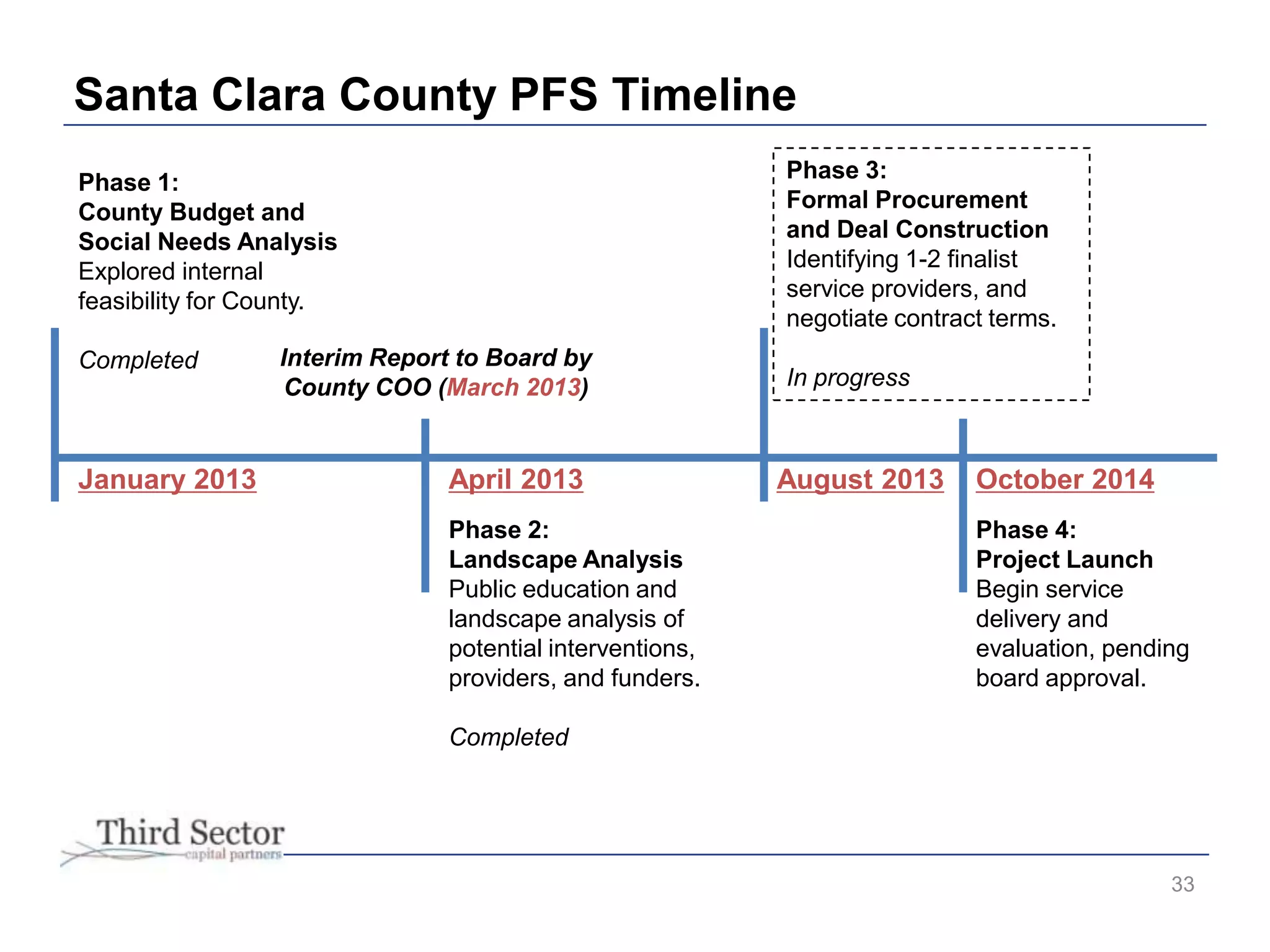
Santa Clara County PFS Timeline
Interim Report to Board by
County COO (March 2013)
Phase 1:
County Budget and
Social Needs Analysis
Explored internal
feasibility for County.
Completed
Phase 2:
Landscape Analysis
Public education and
landscape analysis of
potential interventions,
providers, and funders.
Completed
Phase 3:
Formal Procurement
and Deal Construction
Identifying 1-2 finalist
service providers, and
negotiate contract terms.
In progress
Phase 4:
Project Launch
Begin service
delivery and
evaluation, pending
board approval.
January 2013 April 2013 August 2013 October 2014
33
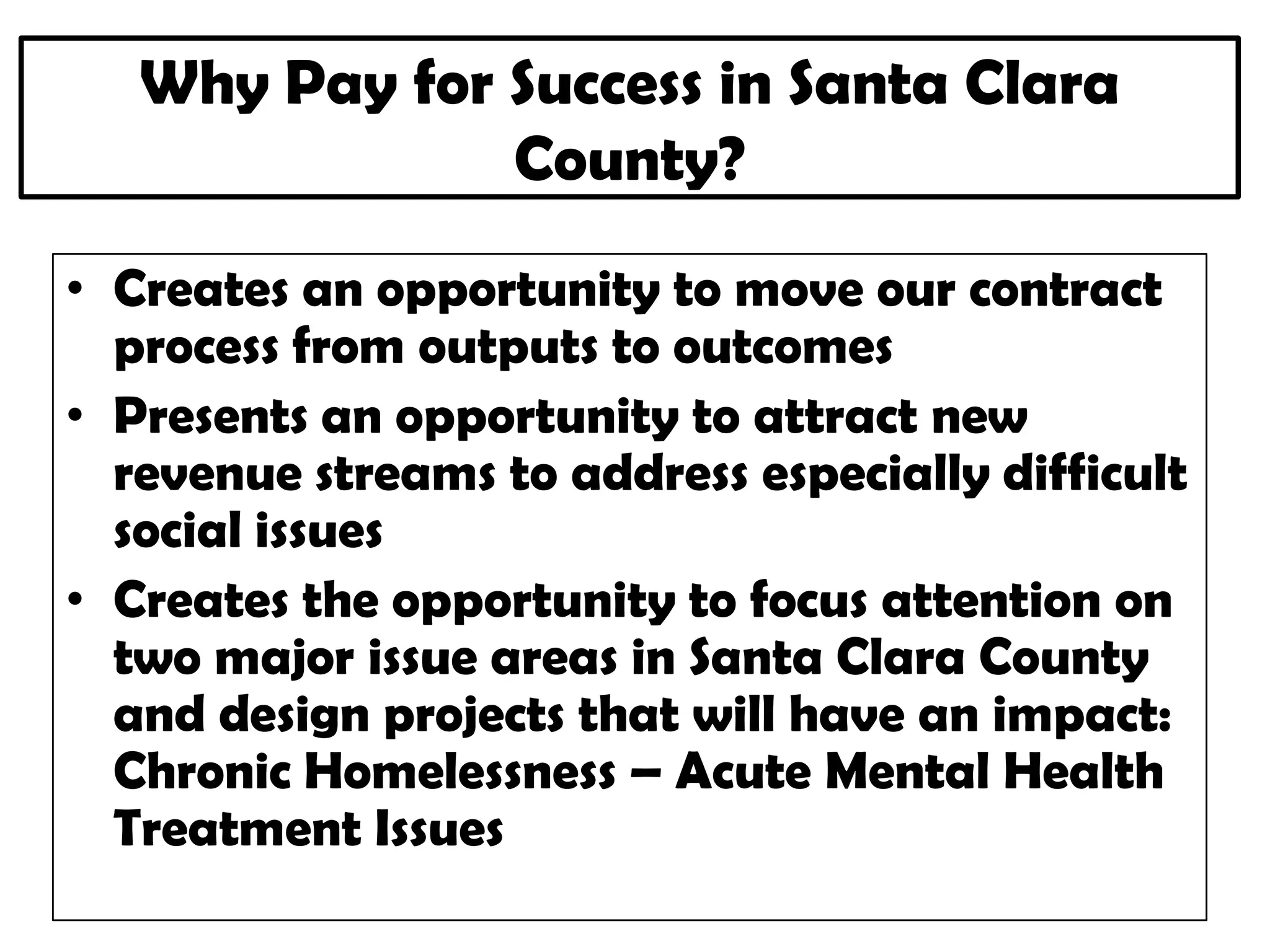
Why Pay for Success in Santa Clara
County?
• Creates an opportunity to move our contract
process from outputs to outcomes
• Presents an opportunity to attract new
revenue streams to address especially difficult
social issues
• Creates the opportunity to focus attention on
two major issue areas in Santa Clara County
and design projects that will have an impact:
Chronic Homelessness – Acute Mental Health
Treatment Issues
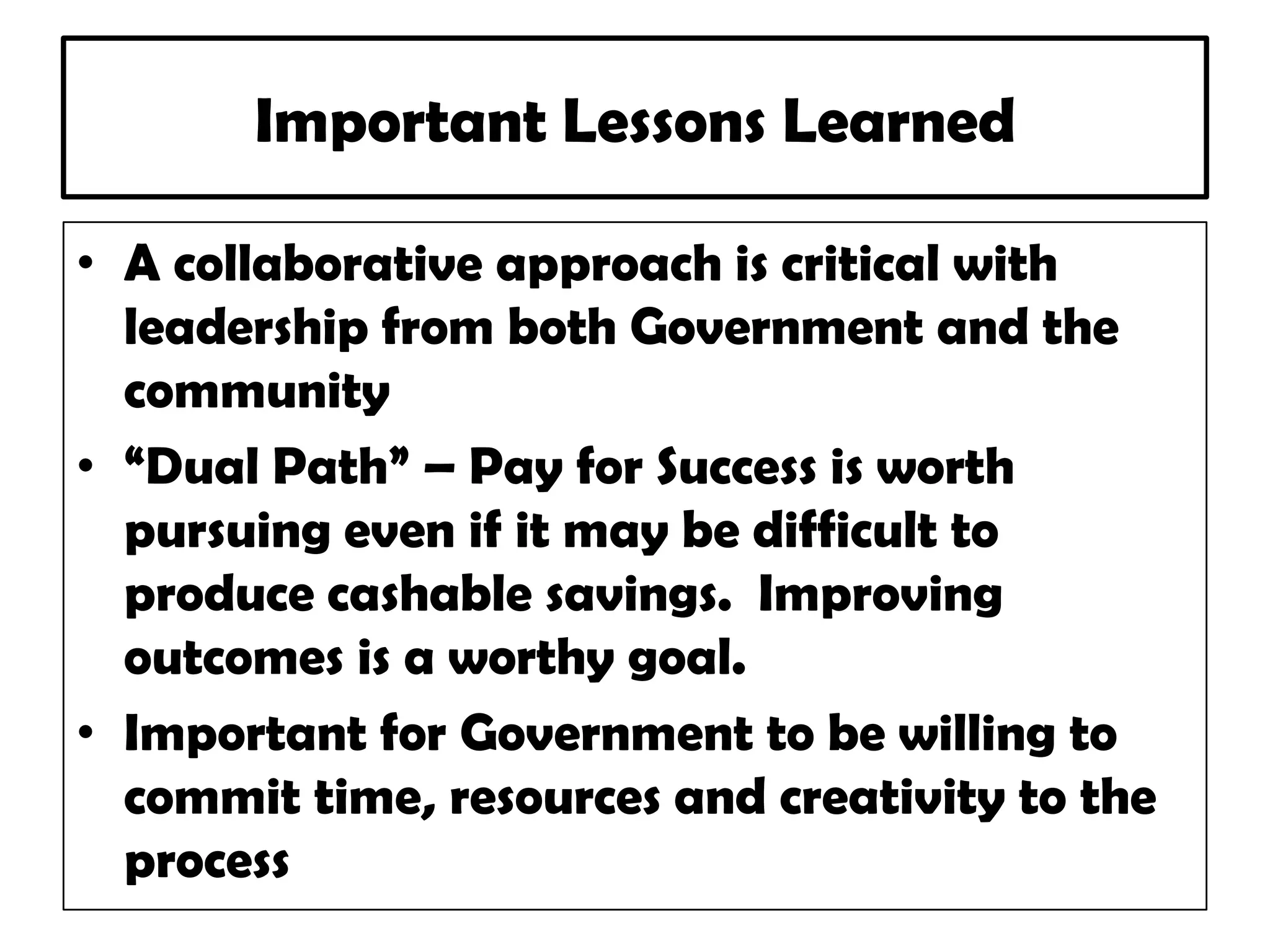
Important Lessons Learned
• A collaborative approach is critical with
leadership from both Government and the
community
• “Dual Path” – Pay for Success is worth
pursuing even if it may be difficult to
produce cashable savings. Improving
outcomes is a worthy goal.
• Important for Government to be willing to
commit time, resources and creativity to the
process
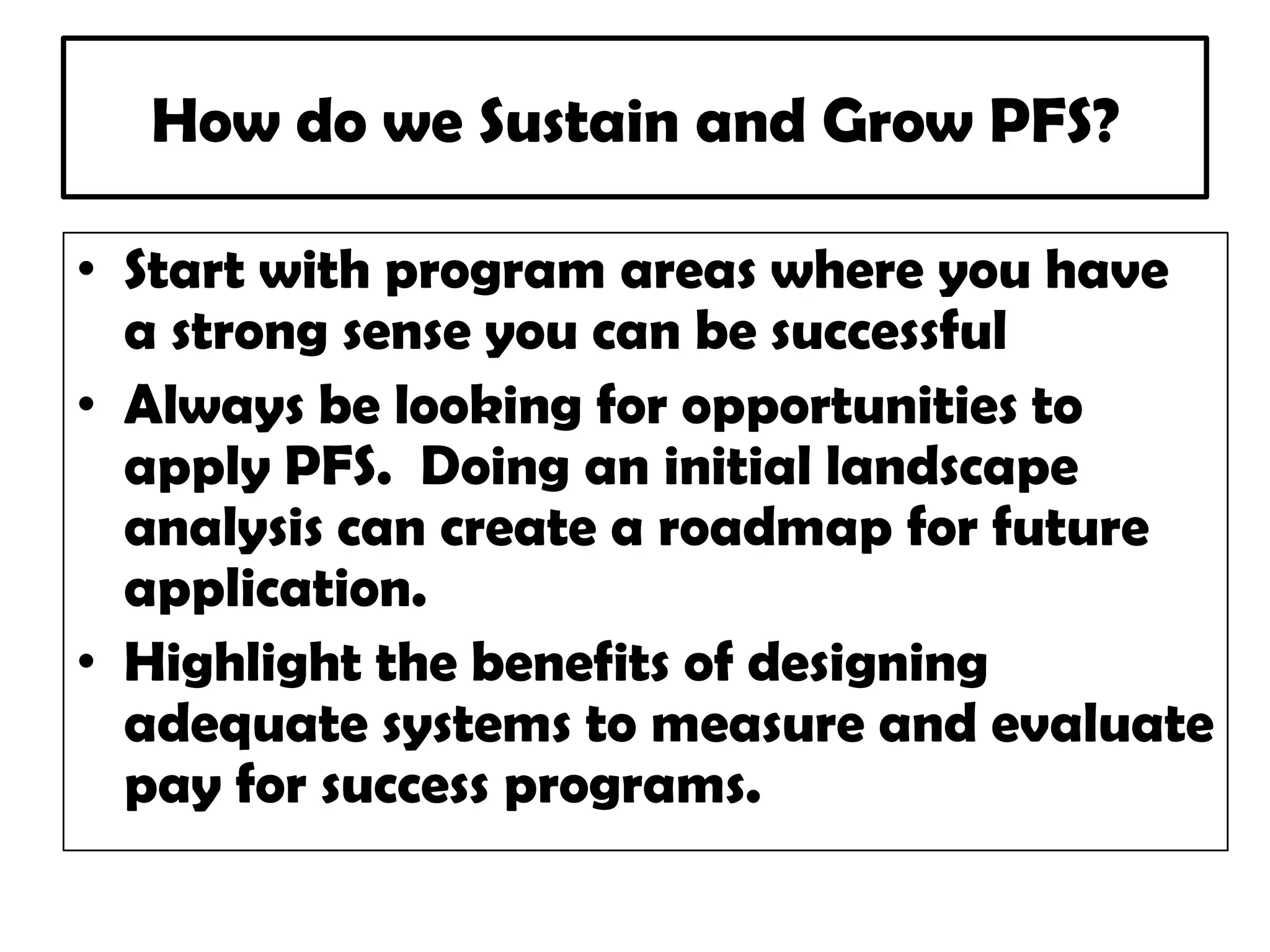
How do we Sustain and Grow PFS?
• Start with program areas where you have
a strong sense you can be successful
• Always be looking for opportunities to
apply PFS. Doing an initial landscape
analysis can create a roadmap for future
application.
• Highlight the benefits of designing
adequate systems to measure and evaluate
pay for success programs.
Outlook on Social Impact
Bonds
Zack Olmstead
Office of Speaker-Elect Toni Atkins
Housing California Conference
April 17th, 2014
An Intriguing Tool for Legislators
• Strain on public resources persists despite improvement
in economic climate
• Many competing interests for scarce public dollars
• Need for a menu of new tools and resources in the new
post redevelopment era
• Public-Private partnerships always a “buzzworthy”
concept
• Desire to be in best position to keep investment at home
and take advantage of new funds as they become
available
Pending Legislation
• Many bills indicate legislative interest in the topic:
• AB 1837 (Atkins)-Establishes Governor’s Office of
Business and Economic Development as lead entity to
explore “social innovation financing”.
• SB 593 (Lieu)-Requires the Office of Planning and
Research to create and manage a Social Impact
Partnership Pilot Program.
Pending Legislation
• AB 495 (Campos)-Establishes the California Community
Investment Program within the Governor’s Office of
Business and Economic Development to coordinate
public sector financial investment and public programs to
assist low-income communities to utilize “triple bottom-
line” investment.
• AB 1456 (Jones Sawyer)-Creates the “Pay it
Forward, Pay it Back Pilot Program”, using similar
concept where a student’s tuition would be paid if they
agree to pay a percentage of their future earnings upon
graduation.
What’s Next?
• Fate of legislation
• Possible resources within state Budget?
o Pilot programs
o Anti-Recidivism efforts
o Inclusion as an eligible model for existing funds?
• How state can best support local government efforts?

Outlook on Pay for Success / Social Impact Bonds (SIBs)

  • 1.
    LeSar Development Consultants SESSIONMODERATOR Jennifer LeSar, President and CEO 2410 First Avenue San Diego, CA 92101 619-236-0612 jennifer@lesardevelopment.com Outlook on Pay for Success/ Social Impact Bonds (SIBs)
  • 2.
    Session Overview  Welcomeand Introduction  Overview of SIBs  A SIB Program for Social Enterprise  How SIBs Fit in a Workforce Context  SIBs: The Source for Housing Solutions  Moderated Q&A with the Audience
  • 3.
    SIB Basics  Acontract to deliver verifiable social outcomes in exchange for payment.  If outcomes are not achieved, no payment is made.  Also known as “Pay for Success” or Pay for Performance”  “Bond” is a misnomer, it’s a contract
  • 4.
    The Potential  Increaseeffectiveness of social interventions in challenging program areas (e.g. homelessness, workforce development, recidivism, affordable housing)  Reduce public costs for downstream program expenses – or increase revenues  Reduce taxpayer dollars spent on in in-effective programs  Bring new ideas, funding, strengthening, and management talent to social sector services
  • 5.
    Critiques and Challenges Significant Transaction Costs  Credible Outcome Measurement  Limited Government Capacity  Limited Provider Capacity  Difficulty in “Accessing” Government Cost Savings
  • 6.
    Social Impact BondModel Intermediary Service Providers Investors Public Agency or Success Payer Commitment to pay for outcomes achieved Payment for services Risk Capital to Finance Program Re-paid + return if outcomes achieved Evaluator Supports evaluation design; measures progress
  • 7.
    The Investor’s Role Capital •Provide working capital to fund implementation. Risk • Absorb performance risk. Due Diligence • Perform due diligence assuring the intervention plan and payment mechanism are sound. Oversight • Monitor and oversee execution of the intervention. Oversee the Intermediary.
  • 8.
    The Intermediary’s Role Convene •Bring parties together. Structure • Work with all parties to negotiate: Payment formula, Intervention, Risk/Return sharing, Verification mechanisms. Manage • Oversee and coordinate service providers, report progress to investors, implement course corrections
  • 9.
    Three Necessary SIBElementsMeasurableImpact Target outcomes are meaningful and credibly measurable ValuableImpact Successful performance compensates for cost plus risk NoExcessiveHarm Program failure does not cause excessive harm
  • 10.
    SIBs Underway Worldwide AreaOutcomes Public Agency Criminal Recidivism Reduce re-offense rate by 7.5%+ among 3,000 short-sentence male prisoners being released from prison over 6 years UK Ministry of Justice Chronic Homeless Support chronic homeless into stable housing, employment and reduced usage of emergency health services Greater London Authority Juvenile Care and Recidivism Reduce county’s adolescent residential care population by 6% (90 at-risk youths) over 5 year period Essex County Council Criminal Recidivism Reduce rate at which adolescent males incarcerated at Rikers Island reoffend post release over 4 years The City of New York
  • 11.
  • 12.
    Jennifer LeSar LeSar DevelopmentConsultants 2410 First Avenue San Diego, CA 92101 619-236-0612 x 101 jennifer@lesardevelopment.com
  • 13.
    The Source for HousingSolutions Pay for Success / Social Impact Bonds
  • 14.
    CSH: Our Mission CSHadvances solutions that use housing as a platform for services to improve the lives of the most vulnerable people, maximize public resources, and build healthy relationships.
  • 15.
  • 16.
    SIB: Key Elementsof Success Take Away: Housing with Services for High Cost populations assembles these key elements
  • 17.
    Key Populations forInvestment People inappropriately housed in institutional settings Homeless and frequent or high utilizers of health or other crisis resources People exiting state prison with chronic health conditions Homeless families with high utilization of child welfare systems KEY POPULATIONS
  • 19.
  • 20.
    Supportive Housing Targets householdswith barriers to housing and/or employment Is affordable Provides tenants with leases Engages tenants in flexible and voluntary services Coordinates among key partners Supports tenants in connecting with the community
  • 21.
    Results • 79 to83% stay housed one year or more • 41% to 67% decrease in Medicaid costs • 24% to 34% fewer emergency room visits • 27% to 29% fewer inpatient admissions and hospital days • 87% fewer days in detox and fewer psychiatric inpatient admissions
  • 22.
    Housing Stability  83%of formerly chronically homeless persons in housing programs remained housed after 1 year and 77% were still housed after 2 years  Closer to Home Initiative (Barrow, Rodriguez, Cordova)  81% of formerly chronically homeless tenants in San Francisco remained in permanent supportive housing for at least 1 year  Analysis of tenant outcomes of two supportive housing projects in San Francisco (Martinez, Burt)
  • 23.
    Pay for Performancein Minnesota  $10 million authorization  2 pilot projects  Supportive Housing  Workforce Development
  • 24.
    Supportive Housing Example: Massachusetts Competitive Procurement  Evidence Based  Partners:  Third Sector Capital  Corporation for Supportive Housing  United Way of Massachusetts Bay and Merrimack Valley  Massachusetts Housing and Shelter Alliance (MHSA):  Home & Healthy for Good  Low-threshold housing  600 units
  • 25.
    Building the Evidencein CA: Just In Reach  Pilot project  Documenting cost impacts:  Supportive Housing  Homeless  Frequent Users of LA County jail  Chronic mental health/substance use  Re-entering the community
  • 26.
    Opportunities and Challenges Innovation in Financing and Contracting  Focus on results and outcomes  Focus on data  Potential to reallocate or redistribute funding  Complicated work—need to keep it simple
  • 27.
  • 28.
    Third Sector CapitalPartners, Inc. Boston & San Francisco | (617) 912-8957 | info@thirdsectorcap.org | www.thirdsectorcap.org This document is the property of Third Sector Capital Partners, Inc. (“Third Sector”). It contains confidential, proprietary, trade secret information of Third Sector that must not be reproduced, disclosed to anyone or used for the benefit of anyone other than Third Sector unless expressly authorized in writing by an executive officer of Third Sector. Nuts & Bolts of Social Impact Bond Deal Making April 17, 2014 Caroline Whistler Co-Founder & Partner caroline@thirdsectorcap.org
  • 29.
    Key Players ina PFS Deal 29 • Initiates contract and identifies intermediary and/or provider(s) • Government pays for successful outcomes Government • Negotiates deal construction, identifies service providers and raises capital • May also be contract holder and service project manager Intermediary • Delivers services • Receives complete cost coverage; may receive performance payments Service Provider(s) • Provide working capital to intermediary/providers • May lose capital if project unsuccessful or be re-paid with government success payments Investors • Supports rigorous evaluation design; measures progress towards outcomes based on contract requirements Evaluator
  • 30.
    30 Massachusetts Juvenile JusticePFS Initiative: Project Overview Target Population 929 at-risk young men in Chelsea, Springfield and Boston aged 17-23 Intervention Delivered by Roca, Inc. • 2 years: Intensive engagement, case management and job/life skills training • 2 years follow up: sustainable employment Timing 7 year project Project Intermediary Third Sector Capital Partners, Inc. Capital Structure $18 million in upfront financing from commercial and philanthropic funders; $3.3 million in deferred service fees from provider Project Budget $27 million in maximum success payments from Commonwealth of Massachusetts Success Payments Based on: • Decreases in days of incarceration • Increases in job readiness • Increases in employment Evaluation Methodology Independently conducted randomized control trial confirmed by validator
  • 31.
    $9 million Senior Loan Evaluates impact (determines payments) $3million Up to $27 million 31 Massachusetts Juvenile Justice PFS Initiative: Deal Structure Youth Services, Inc. (special purpose vehicle operated by Third Sector Capital Partners, Inc.) Laura and John Arnold Foundation, New Profit Inc., The Boston Foundation Goldman Sachs Commonwealth of Massachusetts Sibalytics Roca, Inc. Success Payments Payments to fund intervention US Dept. of Labor $12 million grant Living Cities Kresge Foundation Non-recoverable (but recyclable!) grants: $6 million Junior Loan Defers 15% of fees Public Consulting Group Verifies outcomes Investors Government Intermediary Service ProvidersEvaluator
  • 32.
    PFS Advisory Process Government Feasibility Landscape Analysis Formal Procurement 2-3Months 7-9 Months 1+ Months Phase III 32 Phase IVPhase I & II Deal Construction Project Launch Assess the government’s ability to support a PFS initiative, and identify promising intervention areas. Complete procurement for service provider(s). Complete project design and initial contract deal terms, and raise funds. Begin service provision ramp-up period, and formal launch.
  • 33.
    Santa Clara CountyPFS Timeline Interim Report to Board by County COO (March 2013) Phase 1: County Budget and Social Needs Analysis Explored internal feasibility for County. Completed Phase 2: Landscape Analysis Public education and landscape analysis of potential interventions, providers, and funders. Completed Phase 3: Formal Procurement and Deal Construction Identifying 1-2 finalist service providers, and negotiate contract terms. In progress Phase 4: Project Launch Begin service delivery and evaluation, pending board approval. January 2013 April 2013 August 2013 October 2014 33
  • 34.
    Why Pay forSuccess in Santa Clara County? • Creates an opportunity to move our contract process from outputs to outcomes • Presents an opportunity to attract new revenue streams to address especially difficult social issues • Creates the opportunity to focus attention on two major issue areas in Santa Clara County and design projects that will have an impact: Chronic Homelessness – Acute Mental Health Treatment Issues
  • 35.
    Important Lessons Learned •A collaborative approach is critical with leadership from both Government and the community • “Dual Path” – Pay for Success is worth pursuing even if it may be difficult to produce cashable savings. Improving outcomes is a worthy goal. • Important for Government to be willing to commit time, resources and creativity to the process
  • 36.
    How do weSustain and Grow PFS? • Start with program areas where you have a strong sense you can be successful • Always be looking for opportunities to apply PFS. Doing an initial landscape analysis can create a roadmap for future application. • Highlight the benefits of designing adequate systems to measure and evaluate pay for success programs.
  • 37.
    Outlook on SocialImpact Bonds Zack Olmstead Office of Speaker-Elect Toni Atkins Housing California Conference April 17th, 2014
  • 38.
    An Intriguing Toolfor Legislators • Strain on public resources persists despite improvement in economic climate • Many competing interests for scarce public dollars • Need for a menu of new tools and resources in the new post redevelopment era • Public-Private partnerships always a “buzzworthy” concept • Desire to be in best position to keep investment at home and take advantage of new funds as they become available
  • 39.
    Pending Legislation • Manybills indicate legislative interest in the topic: • AB 1837 (Atkins)-Establishes Governor’s Office of Business and Economic Development as lead entity to explore “social innovation financing”. • SB 593 (Lieu)-Requires the Office of Planning and Research to create and manage a Social Impact Partnership Pilot Program.
  • 40.
    Pending Legislation • AB495 (Campos)-Establishes the California Community Investment Program within the Governor’s Office of Business and Economic Development to coordinate public sector financial investment and public programs to assist low-income communities to utilize “triple bottom- line” investment. • AB 1456 (Jones Sawyer)-Creates the “Pay it Forward, Pay it Back Pilot Program”, using similar concept where a student’s tuition would be paid if they agree to pay a percentage of their future earnings upon graduation.
  • 41.
    What’s Next? • Fateof legislation • Possible resources within state Budget? o Pilot programs o Anti-Recidivism efforts o Inclusion as an eligible model for existing funds? • How state can best support local government efforts?

Editor's Notes

  • #5 What’s everyone so excited about?
  • #6 Systems Needed to initiate and/or participate with SIBs knowledge and capability to collect data and measure success + data integrity levels demanded
  • #7 Public Agency or Success Payor commits to pay if specific social outcomes realizedIntermediary arranges transaction, identifying a promising service model to achieve specified outcomes, a qualifies service provider team, and convinces investors to put their money at risk in exchange for repayment plus a return.Investors float the cash to fund the program.If outcomes are realized, PA pays
  • #10 Three Necessary Conditions for Social Impact BondsTarget outcomes are meaningful and credibly measurable – The treatment population must be definite and readily observable. The targeted outcomes must be clearly and meaningfully defined and measurable. Performance assessment must be based on credible evaluation techniques.  Successful performance compensates for cost plus risk – Structuring a SIB transaction is costlier thanother contracting mechanisms and the interventions employed are risky. The social value of achieving successful outcomes must be high enough such that it is worth the program and transaction costs plus adequate reward for the parties absorbing the risk. Program failure does not cause excessive harm– If a program begins to fail, investors have an incentive to withdraw resources rapidly. The parties must be able to plan for this contingency and avoid leaving the participating program population, or society at-large, worse-off than they were initially. Therefore SIBs are usually not applicable to core government services. (If social service provider participates financially, must be able to withstand economic loss if outcomes not achieved – i.e. can’t gamble the stability of the organization.)
  • #12 Average Deal Progress SCALE1.0 – 4.0 (not 1,000 to 4,000)Fresno Asthma,LA,San Diego San MateoSanta ClaraContra CostaState Level
  • #19 “revolving door”
  • #20 They experience a revolving door of not one, but multiple crisis service settings, so much so that their homelessness can be described as an “institutional circuit.” The irony, of course, is that despite their high use of services, they experience worsening outcomes: continuing homelessness, worsening health status, the trauma of incarceration, and exposure to high-risk and traumatic circumstances.Our initiative is trying to both catch people who are caught on this cycle, stop the revolving doors, and give people a chance to live more stable, healthy, and hopeful lives.
  • #21 Although there are many models of supportive housing in a wide range of geographic locations, all quality supportive housing Targets persons who are homeless, at-risk of homelessness, or exiting institutions with challenges such as serious mental illness, substance abuse and/or chronic health conditionsIs affordable to persons meaning that they ideally pay no more than 30% of their incomeTreats SH tenants just like any other tenant with standard lease or sublease agreementsHave service providers who use a variety of techniques to engage tenants in servicesBrings together the key project partners such as the service provider and property manager to work together to help tenants achieve their goalsSupports tenants in being an integral and connected part of their community
  • #25 Big Impact (homelessness; recividism)Mayor/Governor’s Big 6Fundamental question: who benefits? Who pays?Why does it work?- doing things we know work: new financing mechanism (e.g. question of risk)measuring/monitoring plus incentives = improved performance- multi-year sustained partnership: must see results