LETTERS TO THE EDITOR
A greener mode of transportation?
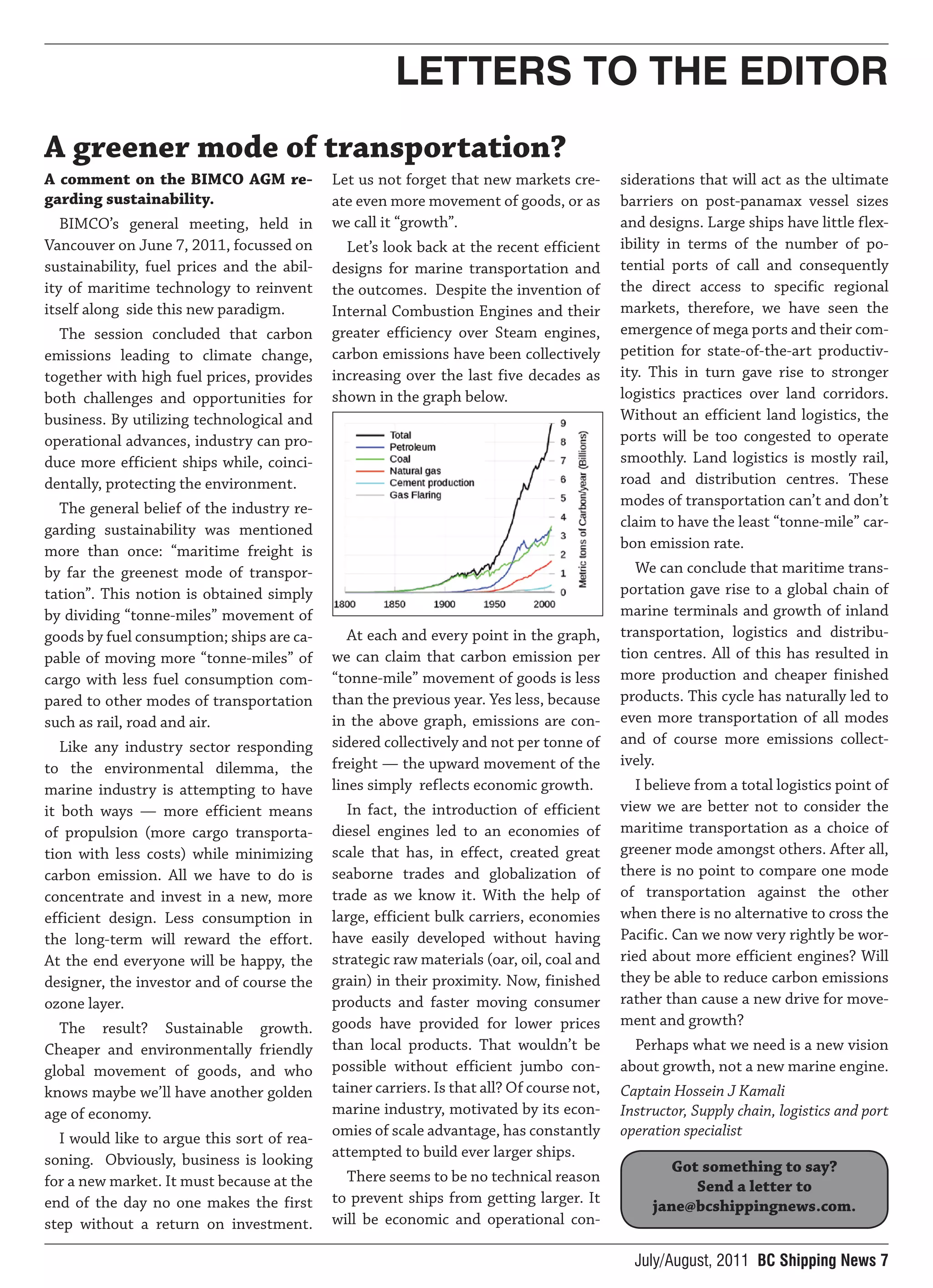
A comment on the BIMCO AGM re-               Let us not forget that new markets cre-        siderations that will act as the ultimate
garding sustainability.                      ate even more movement of goods, or as         barriers on post-panamax vessel sizes
   BIMCO’s general meeting, held in          we call it “growth”.                           and designs. Large ships have little flex-
Vancouver on June 7, 2011, focussed on         Let’s look back at the recent efficient      ibility in terms of the number of po-
sustainability, fuel prices and the abil-    designs for marine transportation and          tential ports of call and consequently
ity of maritime technology to reinvent       the outcomes. Despite the invention of         the direct access to specific regional
itself along side this new paradigm.         Internal Combustion Engines and their          markets, therefore, we have seen the
   The session concluded that carbon         greater efficiency over Steam engines,         emergence of mega ports and their com-
emissions leading to climate change,         carbon emissions have been collectively        petition for state-of-the-art productiv-
together with high fuel prices, provides     increasing over the last five decades as       ity. This in turn gave rise to stronger
both challenges and opportunities for        shown in the graph below.                      logistics practices over land corridors.
business. By utilizing technological and                                                    Without an efficient land logistics, the
operational advances, industry can pro-                                                     ports will be too congested to operate
duce more efficient ships while, coinci-                                                    smoothly. Land logistics is mostly rail,
dentally, protecting the environment.                                                       road and distribution centres. These
   The general belief of the industry re-                                                   modes of transportation can’t and don’t
garding sustainability was mentioned                                                        claim to have the least “tonne-mile” car-
more than once: “maritime freight is                                                        bon emission rate.
by far the greenest mode of transpor-                                                          We can conclude that maritime trans-
tation”. This notion is obtained simply                                                     portation gave rise to a global chain of
by dividing “tonne-miles” movement of                                                       marine terminals and growth of inland
goods by fuel consumption; ships are ca-        At each and every point in the graph,       transportation, logistics and distribu-
pable of moving more “tonne-miles” of        we can claim that carbon emission per          tion centres. All of this has resulted in
cargo with less fuel consumption com-        “tonne-mile” movement of goods is less         more production and cheaper finished
pared to other modes of transportation       than the previous year. Yes less, because      products. This cycle has naturally led to
such as rail, road and air.                  in the above graph, emissions are con-         even more transportation of all modes
   Like any industry sector responding       sidered collectively and not per tonne of      and of course more emissions collect-
to the environmental dilemma, the            freight — the upward movement of the           ively.
marine industry is attempting to have        lines simply reflects economic growth.            I believe from a total logistics point of
it both ways — more efficient means             In fact, the introduction of efficient      view we are better not to consider the
of propulsion (more cargo transporta-        diesel engines led to an economies of          maritime transportation as a choice of
tion with less costs) while minimizing       scale that has, in effect, created great       greener mode amongst others. After all,
carbon emission. All we have to do is        seaborne trades and globalization of           there is no point to compare one mode
concentrate and invest in a new, more        trade as we know it. With the help of          of transportation against the other
efficient design. Less consumption in        large, efficient bulk carriers, economies      when there is no alternative to cross the
the long-term will reward the effort.        have easily developed without having           Pacific. Can we now very rightly be wor-
At the end everyone will be happy, the       strategic raw materials (oar, oil, coal and    ried about more efficient engines? Will
designer, the investor and of course the     grain) in their proximity. Now, finished       they be able to reduce carbon emissions
ozone layer.                                 products and faster moving consumer            rather than cause a new drive for move-
   The result? Sustainable growth.           goods have provided for lower prices           ment and growth?
Cheaper and environmentally friendly         than local products. That wouldn’t be             Perhaps what we need is a new vision
global movement of goods, and who            possible without efficient jumbo con-          about growth, not a new marine engine.
knows maybe we’ll have another golden        tainer carriers. Is that all? Of course not,   Captain Hossein J Kamali
age of economy.                              marine industry, motivated by its econ-        Instructor, Supply chain, logistics and port
   I would like to argue this sort of rea-   omies of scale advantage, has constantly       operation specialist
soning. Obviously, business is looking       attempted to build ever larger ships.
                                                                                                    Got something to say?
for a new market. It must because at the        There seems to be no technical reason
                                                                                                       Send a letter to
end of the day no one makes the first        to prevent ships from getting larger. It
                                                                                                 jane@bcshippingnews.com.
step without a return on investment.         will be economic and operational con-

                                                                                              July/August, 2011 BC Shipping News 7

Greener mode of transportation?

  • 1.
    LETTERS TO THEEDITOR A greener mode of transportation? A comment on the BIMCO AGM re- Let us not forget that new markets cre- siderations that will act as the ultimate garding sustainability. ate even more movement of goods, or as barriers on post-panamax vessel sizes BIMCO’s general meeting, held in we call it “growth”. and designs. Large ships have little flex- Vancouver on June 7, 2011, focussed on Let’s look back at the recent efficient ibility in terms of the number of po- sustainability, fuel prices and the abil- designs for marine transportation and tential ports of call and consequently ity of maritime technology to reinvent the outcomes. Despite the invention of the direct access to specific regional itself along side this new paradigm. Internal Combustion Engines and their markets, therefore, we have seen the The session concluded that carbon greater efficiency over Steam engines, emergence of mega ports and their com- emissions leading to climate change, carbon emissions have been collectively petition for state-of-the-art productiv- together with high fuel prices, provides increasing over the last five decades as ity. This in turn gave rise to stronger both challenges and opportunities for shown in the graph below. logistics practices over land corridors. business. By utilizing technological and Without an efficient land logistics, the operational advances, industry can pro- ports will be too congested to operate duce more efficient ships while, coinci- smoothly. Land logistics is mostly rail, dentally, protecting the environment. road and distribution centres. These The general belief of the industry re- modes of transportation can’t and don’t garding sustainability was mentioned claim to have the least “tonne-mile” car- more than once: “maritime freight is bon emission rate. by far the greenest mode of transpor- We can conclude that maritime trans- tation”. This notion is obtained simply portation gave rise to a global chain of by dividing “tonne-miles” movement of marine terminals and growth of inland goods by fuel consumption; ships are ca- At each and every point in the graph, transportation, logistics and distribu- pable of moving more “tonne-miles” of we can claim that carbon emission per tion centres. All of this has resulted in cargo with less fuel consumption com- “tonne-mile” movement of goods is less more production and cheaper finished pared to other modes of transportation than the previous year. Yes less, because products. This cycle has naturally led to such as rail, road and air. in the above graph, emissions are con- even more transportation of all modes Like any industry sector responding sidered collectively and not per tonne of and of course more emissions collect- to the environmental dilemma, the freight — the upward movement of the ively. marine industry is attempting to have lines simply reflects economic growth. I believe from a total logistics point of it both ways — more efficient means In fact, the introduction of efficient view we are better not to consider the of propulsion (more cargo transporta- diesel engines led to an economies of maritime transportation as a choice of tion with less costs) while minimizing scale that has, in effect, created great greener mode amongst others. After all, carbon emission. All we have to do is seaborne trades and globalization of there is no point to compare one mode concentrate and invest in a new, more trade as we know it. With the help of of transportation against the other efficient design. Less consumption in large, efficient bulk carriers, economies when there is no alternative to cross the the long-term will reward the effort. have easily developed without having Pacific. Can we now very rightly be wor- At the end everyone will be happy, the strategic raw materials (oar, oil, coal and ried about more efficient engines? Will designer, the investor and of course the grain) in their proximity. Now, finished they be able to reduce carbon emissions ozone layer. products and faster moving consumer rather than cause a new drive for move- The result? Sustainable growth. goods have provided for lower prices ment and growth? Cheaper and environmentally friendly than local products. That wouldn’t be Perhaps what we need is a new vision global movement of goods, and who possible without efficient jumbo con- about growth, not a new marine engine. knows maybe we’ll have another golden tainer carriers. Is that all? Of course not, Captain Hossein J Kamali age of economy. marine industry, motivated by its econ- Instructor, Supply chain, logistics and port I would like to argue this sort of rea- omies of scale advantage, has constantly operation specialist soning. Obviously, business is looking attempted to build ever larger ships. Got something to say? for a new market. It must because at the There seems to be no technical reason Send a letter to end of the day no one makes the first to prevent ships from getting larger. It jane@bcshippingnews.com. step without a return on investment. will be economic and operational con- July/August, 2011 BC Shipping News 7