Carbon Pricing and Fiscal Reform:
State Cap and Trade vs Federal 
Carbon Pricing
Billy Pizer
North American Climate Policy Forum
June 23, 2016
Main Points
• Over the last decade, cap and trade programs 
increasingly use auctions and allowance value 
for “policy purposes” not just distributing cost.
• Unless a carbon tax is part of large package of 
tax reforms, may be hard to distinguish fiscal 
reform from fiscal policy.
• While cost‐effective, federal carbon pricing 
threatens state‐level revenues from cap‐and‐
trade.
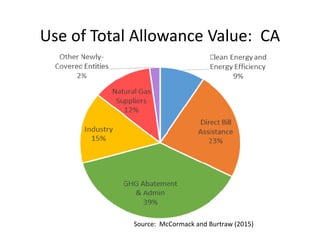
2015 Cap‐and‐trade Revenue
• California
– $2B in “auction revenue” (not including consignment)
– 50% of total allowance value
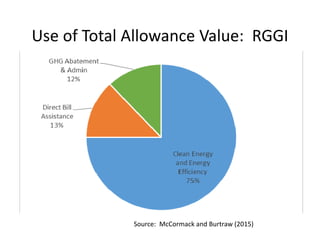
• Regional Greenhouse Gas Initiative
– $0.4B in auction revenue
– 100% of total allowance value
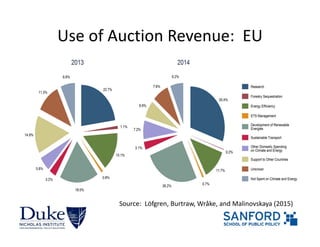
• European Union  
– $5B in auction revenue
– 40% of total allowance value
• Both auction revenue and non‐auction 
allowance value is used in a variety of ways
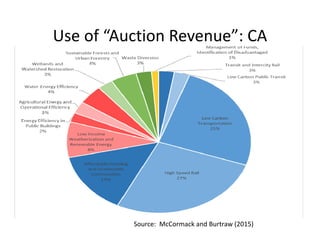
Use of “Auction Revenue”: CA
Source:  McCormack and Burtraw (2015) 
Use of Total Allowance Value:  CA
Source:  McCormack and Burtraw (2015) 
Use of Total Allowance Value:  RGGI
Source:  McCormack and Burtraw (2015) 
Use of Auction Revenue:  EU
Source:  Löfgren, Burtraw, Wråke, and Malinovskaya (2015)
Fiscal reform versus fiscal policy?
FISCAL REFORM
Introduce carbon tax
Cut labor and other taxes
BUT THEN…
Raise labor and other taxes
Increase spending on necessary policies
versus: CAP AND TRADE PROGRAM
Introduce cap and trade
Use revenue for necessary policies
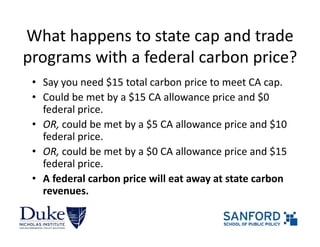
What happens to state cap and trade 
programs with a federal carbon price?
• Say you need $15 total carbon price to meet CA cap.
• Could be met by a $15 CA allowance price and $0 
federal price.
• OR, could be met by a $5 CA allowance price and $10 
federal price.
• OR, could be met by a $0 CA allowance price and $15 
federal price.
• A federal carbon price will eat away at state carbon 
revenues.
Concluding thoughts
• Unless one key piece of major tax reform, “fiscal 
reform” may not be a strong argument for carbon tax 
versus auctioned cap and trade program (though 
many other distinctions b/w tax and trading)
– Carbon pricing with a carbon tax or cap and trade can raise 
revenue.  Any use of those revenues can be changed in the 
future.
• Federal carbon pricing is more cost‐effective than a 
patchwork of state programs.
• Existing state programs are using cap and trade 
revenues.  These could be diminished by federal 
carbon pricing.

Billy Pizer, Sanford School of Public Policy and Nicholas Institute for Environmental Policy Solutions, Duke University