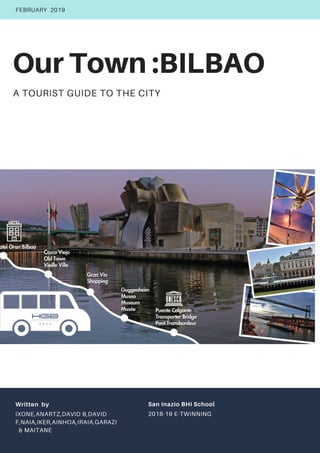
Our Town :BILBAO
A TOURIST GUIDE TO THE CITY
FEBRUARY 2019
Written by
IXONE,ANARTZ,DAVID B,DAVID
F,NAIA,IKER,AINHOA,IRAIA,GARAZI
& MAITANE
San Inazio BHI School
2018-19 E-TWINNING
1.Description of the
city
2.History and
Economy
3.Important
landmarks
4.Shopping and
eating
5.Culture:Cuisine,
Sport, Music...
6.Traditions and
Festivals
INDEX
1.DESCRIPTION OF BILBAO
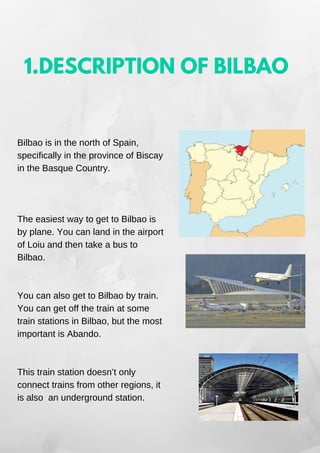
Bilbao is in the north of Spain,
specifically in the province of Biscay
in the Basque Country.
The easiest way to get to Bilbao is
by plane. You can land in the airport
of Loiu and then take a bus to
Bilbao.
You can also get to Bilbao by train.
You can get off the train at some
train stations in Bilbao, but the most
important is Abando.
This train station doesn’t only
connect trains from other regions, it
is also an underground station.
IN BILBAO YOU CAN USE DIFFERENT MEANS OF
TRANSPORT TO MOVE:BUS, UNDERGROUND,
TRAIN, TAXI AND BICYCLE LANES.
The buses of Bilbao allow you to
move around all the
neighbourhoods. To use this
transport you can pay with money or
use a Barik card. The Barik Card is a
contactless card which costs 5
euros, and can be used for buses,
the underground and some other
public transport in the Basque
Country, like the tram.
The underground has three different
lines which allow you to move
around Biscay. To use the
underground you can pay or use the
Barik card.
Bilbao has a great fleet of taxis to to
be able to transport as many people
as possible. At present the Basque
Government has informed that they
will buy new electrical taxis because
they are safer and they pollute less
than other types of cars.
In Bilbao we have a bicycle lane (the
“bidegorri”). “Bide” is path and “gorri”
is red in Basque. There you can use
your bike or the bicycles of the Town
Hall.
Last year the Town Hall put public
bicycles in many places of the city.
To use these bicycles there was only
one requirement : to pay 25€ each
year. At present this project has
been renewed and now the bikes are
electrical.
In Bilbao there are 345 821 inhabitants. The spoken languages
are Spanish and Basque . In Bilbao 96.774 can speak Basque,
but 175.501  know it.
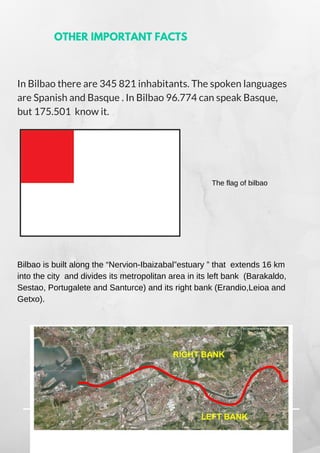
The flag of bilbao
Bilbao is built along the “Nervion-Ibaizabal”estuary ” that extends 16 km
into the city and divides its metropolitan area in its left bank (Barakaldo,
Sestao, Portugalete and Santurce) and its right bank (Erandio,Leioa and
Getxo).
OTHER IMPORTANT FACTS
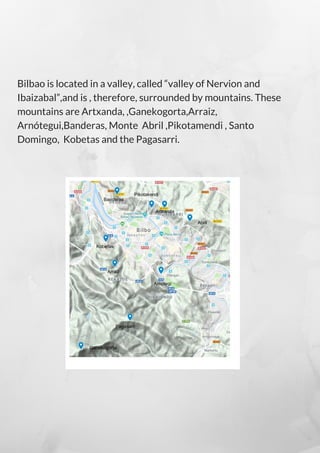
Bilbao is located in a valley, called “valley of Nervion and
Ibaizabal”,and is , therefore, surrounded by mountains. These
mountains are Artxanda, ,Ganekogorta,Arraiz,
Arnótegui,Banderas, Monte  Abril ,Pikotamendi , Santo
Domingo, Kobetas and the Pagasarri.
2. HISTORY AND
ECONOMY OF THE
TOWN
The foundation of Bilbao was in 13th century. In the 19th and 20th centuries, the
big evolution of the city started . Although years ago Bilbao was an industrial city ,
recently it has became a service city.
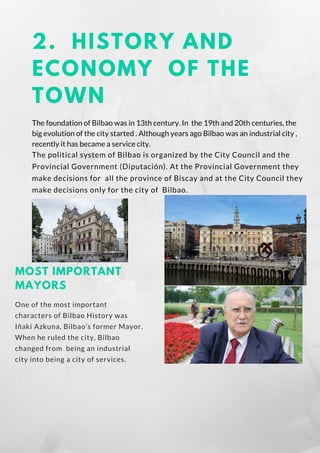
The political system of Bilbao is organized by the City Council and the
Provincial Government (Diputación). At the Provincial Government they
make decisions for  all the province of Biscay and at the City Council they
make decisions only for the city of Bilbao.
MOST IMPORTANT
MAYORS
One of the most important
characters of Bilbao History was
Iñaki Azkuna, Bilbao’s former Mayor.
When he ruled the city, Bilbao
changed from  being an industrial
city into being a city of services.
ECONOMICAL FEATURES
Bilbao has always been a very important commercial and  financial centre. Lots of
financial headquarters are in Bilbao: Bilbao Stock Exchange, SPRI (entrepreneurs’
association), the most important Banks in Spain , some of the most relevant
Lawyers’ firms and  Business Associations, and all kinds of, building, real estate,
engineering and service companies.
Years ago, there was a  lot of industry around Bilbao, but with the transformation of
Bilbao into a service city they disappeared.
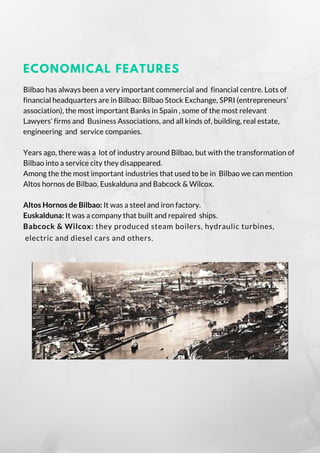
Among the the most important industries that used to be in  Bilbao we can mention
Altos hornos de Bilbao, Euskalduna and Babcock & Wilcox.
Altos Hornos de Bilbao: It was a steel and iron factory.
Euskalduna: It was a company that built and repaired  ships.
Babcock & Wilcox: they produced steam boilers, hydraulic turbines,
 electric and diesel cars and others.
TOURISM
Apart from being a financial center, Bilbao is also  a very commercial city where  a
lot of people from Spain and The Basque Country come to buy  things, particularly
to shopping centres.
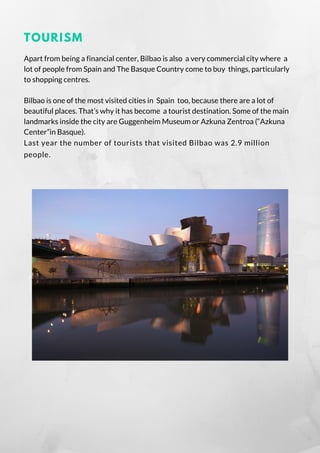
Bilbao is one of the most visited cities in  Spain  too, because there are a lot of
beautiful places. That’s why it has become  a tourist destination. Some of the main
landmarks inside the city are Guggenheim Museum or Azkuna Zentroa (“Azkuna
Center”in Basque).
Last year the number of tourists that visited Bilbao was 2.9 million
people.
FISHING
As Bilbao is a metropolitan area , fishing is not practiced in the city itself,
but around Bilbao it is. All that is fished around the Basque Country
comes to the Rivera Market (the most important market in Bilbao), where
we can find some of the most appreciated kinds of fish such as hake, cod
or all kinds of shellfish.
AGRICULTURE
Although in Bilbao we haven’t got
agriculture, there is a lot around
Bilbao , in Basque houses called
"Baserriak". It is common to grow
wheat, barley, grapes, oats, peppers,
apples, potatoes and tomatoes.
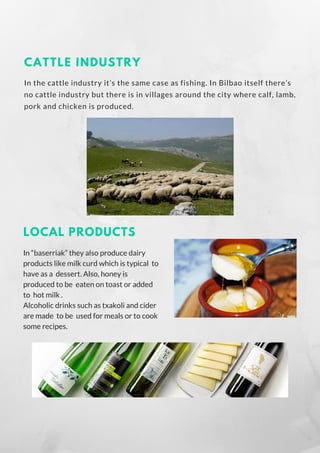
CATTLE INDUSTRY
In the cattle industry it’s the same case as fishing. In Bilbao itself there’s
no cattle industry but there is in villages around the city where calf, lamb,
pork and chicken is produced.
LOCAL PRODUCTS
In “baserriak” they also produce dairy
products like milk curd which is typical  to
have as a dessert. Also, honey is
produced to be eaten on toast or added
to hot milk .
Alcoholic drinks such as txakoli and cider
are made  to be used for meals or to cook
some recipes.
3.IMPORTANT
LANDMARKS
Biscay has some important areas, most of them are in Bilbao but some
are scattered throughout Biscay too. The main important landmarks are
the following ones.
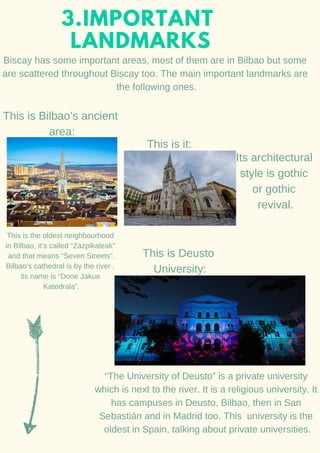
This is Bilbao’s ancient
area:
This is the oldest neighbourhood
in Bilbao, it’s called “Zazpikaleak”
and that means “Seven Streets”.
Bilbao’s cathedral is by the river ,
its name is “Done Jakue
Katedrala”.
This is it:
Its architectural
style is gothic
or gothic
revival.
This is Deusto
University:
“The University of Deusto” is a private university
which is next to the river. It is a religious university. It
has campuses in Deusto, Bilbao, then in San
Sebastián and in Madrid too. This university is the
oldest in Spain, talking about private universities.
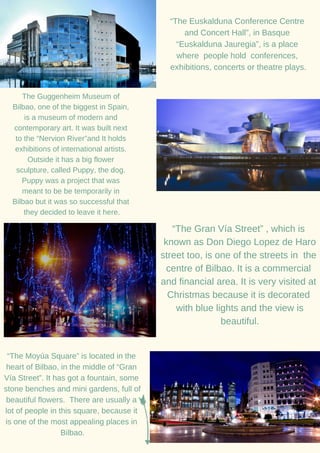
“The Euskalduna Conference Centre
and Concert Hall”, in Basque
“Euskalduna Jauregia”, is a place
where people hold conferences,
exhibitions, concerts or theatre plays.
The Guggenheim Museum of
Bilbao, one of the biggest in Spain,
is a museum of modern and
contemporary art. It was built next
to the “Nervion River”and It holds
exhibitions of international artists.
Outside it has a big flower
sculpture, called Puppy, the dog.
Puppy was a project that was
meant to be be temporarily in
Bilbao but it was so successful that
they decided to leave it here.
“The Gran Vía Street” , which is
known as Don Diego Lopez de Haro
street too, is one of the streets in the
centre of Bilbao. It is a commercial
and financial area. It is very visited at
Christmas because it is decorated
with blue lights and the view is
beautiful.
“The Moyúa Square” is located in the
heart of Bilbao, in the middle of “Gran
Vía Street”. It has got a fountain, some
stone benches and mini gardens, full of
beautiful flowers. There are usually a
lot of people in this square, because it
is one of the most appealing places in
Bilbao.
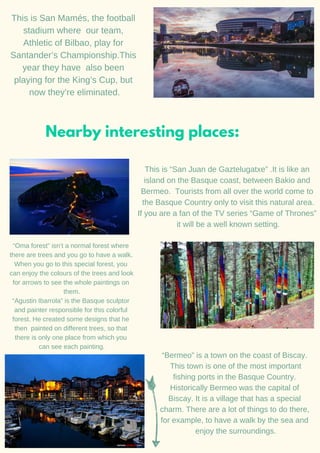
This is San Mamés, the football
stadium where our team,
Athletic of Bilbao, play for
Santander’s Championship.This
year they have also been
playing for the King’s Cup, but
now they’re eliminated.
Nearby interesting places:
This is “San Juan de Gaztelugatxe” .It is like an
island on the Basque coast, between Bakio and
Bermeo. Tourists from all over the world come to
the Basque Country only to visit this natural area.
If you are a fan of the TV series “Game of Thrones”
it will be a well known setting.
“Oma forest” isn’t a normal forest where
there are trees and you go to have a walk.
When you go to this special forest, you
can enjoy the colours of the trees and look
for arrows to see the whole paintings on
them.
“Agustin Ibarrola” is the Basque sculptor
and painter responsible for this colorful
forest. He created some designs that he
then painted on different trees, so that
there is only one place from which you
can see each painting.
“Bermeo” is a town on the coast of Biscay.
This town is one of the most important
fishing ports in the Basque Country.
Historically Bermeo was the capital of
Biscay. It is a village that has a special
charm. There are a lot of things to do there,
for example, to have a walk by the sea and
enjoy the surroundings.
This bridge is a “Suspension Bridge”
which means that the deck is hung
below the suspension cables. This
bridge joins “Getxo” and
“Portugalete”. It can carry cars and
people too. It crosses the “Nervion
River”.
On the 26th of April of 1937, during the Spanish Civil War, Gernika was
bombed by the Francoist. Inspired by these facts, Pablo Picasso painted
his Gernika masterpiece.
In Gernika you can find The House of Assembly “Casa De Juntas”, a
building that is used to celebrate the plenary sessions of the Biscayne
government. The inside part is decorated with portraits of all the noblemen
of Biscay. In The Assembly House you can find two different trees, one is
the Gernika’s tree, that is more than 200 years old, planted in 1742 and
died in 1892, and a second tree which is the “new” Gernika’s tree,
representing the freedom of the traditions of Biscay.
4. EATING AND
SHOPPING IN BILBAO
Bilbao is famous because of its gastronomy. Lots of people come to Bilbao
to have a good meal. There are lots of restaurants , some of which
awarded with Michelin stars.
Nerua: It is a Michelin star restaurant that is located inside the
Guggenheim Museum.
Zortziko: The cheapest menu costs around 100€. A year ago it  was
awarded with a Michelin star.
Mina: It  is located in  Bilbao’s most famous  market (La Ribera Market). It
has got a star too.
Etxanobe Atelier: It  is located in the “Euskalduna Palace” ,which is like a
theatre.
Apart from being a gastronomical spot, Bilbao is also  a very commercial
city where  a lot of people from Spain and The Basque Country come to
buy  things, particularly in shopping centres, some of which are in the city
itself (Zubiarte,Bidarte,El Corte Inglés…) and others  in the nearby cities
of Barakaldo (Megapark,Max Center,Park Avenue) Portugalete (Ballonti)
Leiao (Artea) or Basauri (Bilbondo).
We must also point out that some of the most prestigious firms of clothes,
jewellery ,accessories and delicatessen can be found in the centre of the
town in traditionally commercial areas such as the old part of Bilbao
(Casco Viejo) , Gran Via street ,Colon de Larreategui street, Moyua
Square or Indautxu neighbourhood and the nearby areas.
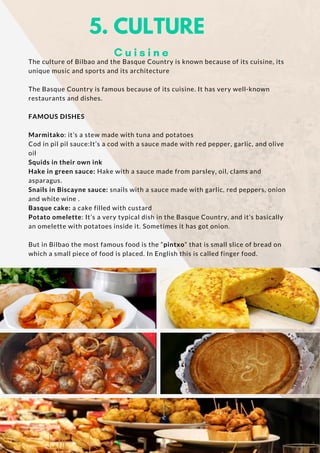
The culture of Bilbao and the Basque Country is known because of its cuisine, its
unique music and sports and its architecture
The Basque Country is famous because of its cuisine. It has very well-known
restaurants and dishes.
FAMOUS DISHES
Marmitako: it’s a stew made with tuna and potatoes
Cod in pil pil sauce:It’s a cod with a sauce made with red pepper, garlic, and olive
oil     
Squids in their own ink
Hake in green sauce: Hake with a sauce made from parsley, oil, clams and
asparagus.
Snails in Biscayne sauce: snails with a sauce made with garlic, red peppers, onion
and white wine .
Basque cake: a cake filled with custard
Potato omelette: It’s a very typical dish in the Basque Country, and it’s basically
an omelette with potatoes inside it. Sometimes it has got onion.
But in Bilbao the most famous food is the “pintxo” that is small slice of bread on
which a small piece of food is placed. In English this is called finger food.
C u i s i n e
5. CULTURE
S P O R T S
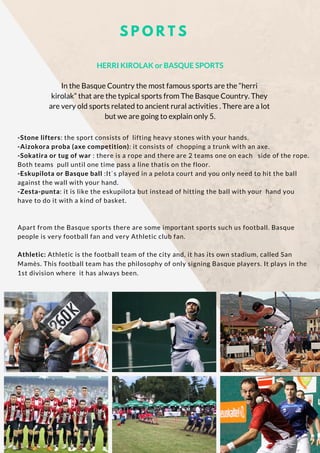
-Stone lifters: the sport consists of  lifting heavy stones with your hands.
-Aizokora proba (axe competition): it consists of  chopping a trunk with an axe.
-Sokatira or tug of war : there is a rope and there are 2 teams one on each   side of the rope.
Both teams  pull until one time pass a line thatis on the floor.
-Eskupilota or Basque ball :It`s played in a pelota court and you only need to hit the ball
against the wall with your hand.
-Zesta-punta: it is like the eskupilota but instead of hitting the ball with your  hand you
have to do it with a kind of basket.
Apart from the Basque sports there are some important sports such us football. Basque
people is very football fan and very Athletic club fan.
Athletic: Athletic is the football team of the city and, it has its own stadium, called San
Mamès. This football team has the philosophy of only signing Basque players. It plays in the
1st division where  it has always been.
HERRI KIROLAK or BASQUE SPORTS
In the Basque Country the most famous sports are the “herri
kirolak” that are the typical sports from The Basque Country. They
are very old sports related to ancient rural activities . There are a lot
but we are going to explain only 5.
D A N C E
Basque Dance is the typical dance style of The Basque Country. The
dance style has different variations depending on the village or town
where it´s danced. Some dances are performed by one only  person and
others by many.
Aurresku: this dance is used to show respect and welcome to other
people. Sometimes it is danced in weddings and homages.
Kaxarranka: it is a dance that is performed on a box held on the
shoulders of 8 fishermen.
Ezpata dantza (Sword dance): this dance is performed with swords
and sticks.
M U S I C
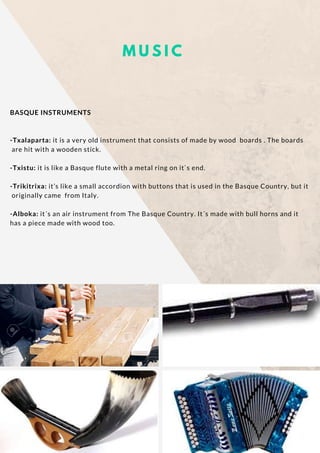
BASQUE INSTRUMENTS
-Txalaparta: it is a very old instrument that consists of made by wood  boards . The boards
 are hit with a wooden stick.
-Txistu: it is like a Basque flute with a metal ring on it`s end.
-Trikitrixa: it’s like a small accordion with buttons that is used in the Basque Country, but it
 originally came  from Italy.
-Alboka: it´s an air instrument from The Basque Country. It´s made with bull horns and it
has a piece made with wood too.
A R C H I T E C T U R E
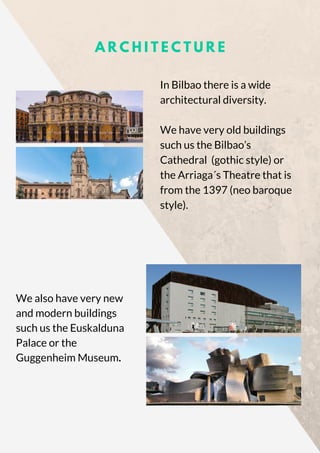
In Bilbao there is a wide
architectural diversity.
We have very old buildings
such us the Bilbao’s
Cathedral  (gothic style) or
the Arriaga´s Theatre that is
from the 1397 (neo baroque
style).
We also have very new
and modern buildings
such us the Euskalduna
Palace or the
Guggenheim Museum.
F A M O U S
C E L E B R I T I E S
In Bilbao there have been many
cultural celebrities such as
Diego Lopez de Haro that was
the founder of Bilbao or Miguel
de Unamuno that was a famous
writer  and philosopher from
here.
6.TRADITIONS AND
FESTIVALS
SANTO TOMAS
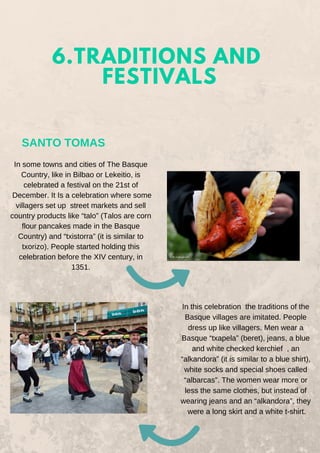
In some towns and cities of The Basque
Country, like in Bilbao or Lekeitio, is
celebrated a festival on the 21st of
December. It Is a celebration where some
villagers set up street markets and sell
country products like “talo” (Talos are corn
flour pancakes made in the Basque
Country) and “txistorra” (it is similar to
txorizo). People started holding this
celebration before the XIV century, in
1351.
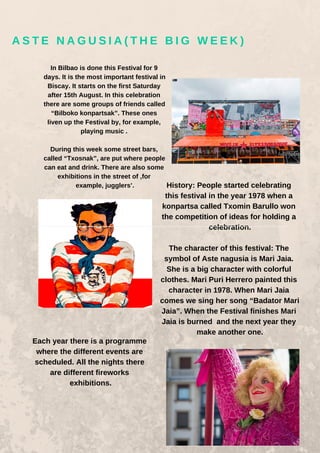
In this celebration the traditions of the
Basque villages are imitated. People
dress up like villagers. Men wear a
Basque “txapela” (beret), jeans, a blue
and white checked kerchief , an
“alkandora” (it is similar to a blue shirt),
white socks and special shoes called
“albarcas”. The women wear more or
less the same clothes, but instead of
wearing jeans and an “alkandora”, they
were a long skirt and a white t-shirt.
In Bilbao is done this Festival for 9
days. It is the most important festival in
Biscay. It starts on the first Saturday
after 15th August. In this celebration
there are some groups of friends called
“Bilboko konpartsak”. These ones
liven up the Festival by, for example,
playing music .
During this week some street bars,
called “Txosnak”, are put where people
can eat and drink. There are also some
exhibitions in the street of ,for
example, jugglers’. History: People started celebrating
this festival in the year 1978 when a
konpartsa called Txomin Barullo won
the competition of ideas for holding a
celebration.
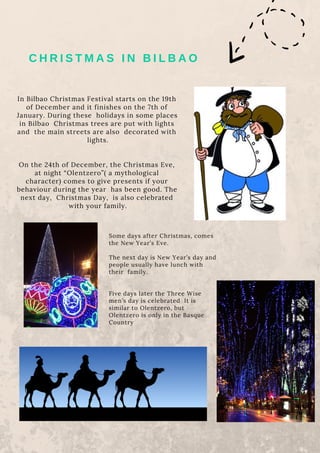
The character of this festival: The
symbol of Aste nagusia is Mari Jaia.
She is a big character with colorful
clothes. Mari Puri Herrero painted this
character in 1978. When Mari Jaia
comes we sing her song “Badator Mari
Jaia”. When the Festival finishes Mari
Jaia is burned and the next year they
make another one.
Each year there is a programme
where the different events are
scheduled. All the nights there
are different fireworks
exhibitions.
A S T E N A G U S I A ( T H E B I G W E E K )
T H E C I T Y A N N I V E R S A R Y
This festival is celebrated on the 15th
and 16th of June. In the night of the
15th the Bilbao’s City Hall decorates
the street with lights. That night is
called the “Gau zuria”, in English “the
white night”. The lights are on from 21:
30 to 1:30 a.m. Last year it was the
718th anniversary of Bilbao.
Apart from the lights,there are some
plays on the streets and they also play
some music.
S A N T A A G U E D A
Santa Agueda is a religious
celebration because of the martyr
Agueda de Catania or Saint Agueda.
A martyr is a person that is
persecuted because of defending
something, normally about religion.
We celebrate this on the 5th  of
February because this martyr died
on that day. On this day people
 dress up like “villagers”.
On this festival’s eve some choirs go
singing in Basque throughout the
city. The people in these choirs
stand in circles while singing and
there is always a person with a
lantern in the centre. The rest of the
group takes a wooden stick to mark
the rhythm. They sing a typical song
in Basque about Santa Agueda.
C H R I S T M A S I N B I L B A O
In Bilbao Christmas Festival starts on the 19th
of December and it finishes on the 7th of
January. During these  holidays in some places
in Bilbao  Christmas trees are put with lights
and  the main streets are also decorated with
 lights.
On the 24th of December, the Christmas Eve,
at night “Olentzero”( a mythological
character) comes to give presents if your
behaviour during the year  has been good. The
next day, Christmas Day, is also celebrated
with your family.
Some days after Christmas, comes
the New Year’s Eve.
The next day is New Year’s day and
people usually have lunch with
their  family.
Five days later the Three Wise
men’s day is celebrated  It is
similar to Olentzero, but
Olentzero is only in the Basque
Country
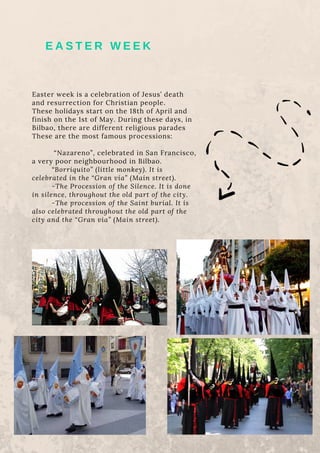
Easter week is a celebration of Jesus’ death
and resurrection for Christian people.
These holidays start on the 18th of April and
finish on the 1st of May. During these days, in
Bilbao, there are different religious parades
These are the most famous processions:
“Nazareno”, celebrated in San Francisco,
a very poor neighbourhood in Bilbao.
“Borriquito” (little monkey). It is
celebrated in the “Gran vía” (Main street).
-The Procession of the Silence. It is done
in silence, throughout the old part of the city.
-The procession of the Saint burial. It is
also celebrated throughout the old part of the
city and the “Gran via” (Main street).
E A S T E R W E E K
Don't take longer!
Come and visit us!

Bilbao,my town

  • 1.
    Our Town :BILBAO ATOURIST GUIDE TO THE CITY FEBRUARY 2019 Written by IXONE,ANARTZ,DAVID B,DAVID F,NAIA,IKER,AINHOA,IRAIA,GARAZI & MAITANE San Inazio BHI School 2018-19 E-TWINNING
  • 2.
    1.Description of the city 2.Historyand Economy 3.Important landmarks 4.Shopping and eating 5.Culture:Cuisine, Sport, Music... 6.Traditions and Festivals INDEX
  • 3.
    1.DESCRIPTION OF BILBAO Bilbaois in the north of Spain, specifically in the province of Biscay in the Basque Country. The easiest way to get to Bilbao is by plane. You can land in the airport of Loiu and then take a bus to Bilbao. You can also get to Bilbao by train. You can get off the train at some train stations in Bilbao, but the most important is Abando. This train station doesn’t only connect trains from other regions, it is also an underground station.
  • 4.
    IN BILBAO YOUCAN USE DIFFERENT MEANS OF TRANSPORT TO MOVE:BUS, UNDERGROUND, TRAIN, TAXI AND BICYCLE LANES. The buses of Bilbao allow you to move around all the neighbourhoods. To use this transport you can pay with money or use a Barik card. The Barik Card is a contactless card which costs 5 euros, and can be used for buses, the underground and some other public transport in the Basque Country, like the tram. The underground has three different lines which allow you to move around Biscay. To use the underground you can pay or use the Barik card.
  • 5.
    Bilbao has agreat fleet of taxis to to be able to transport as many people as possible. At present the Basque Government has informed that they will buy new electrical taxis because they are safer and they pollute less than other types of cars. In Bilbao we have a bicycle lane (the “bidegorri”). “Bide” is path and “gorri” is red in Basque. There you can use your bike or the bicycles of the Town Hall. Last year the Town Hall put public bicycles in many places of the city. To use these bicycles there was only one requirement : to pay 25€ each year. At present this project has been renewed and now the bikes are electrical.
  • 6.
    In Bilbao thereare 345 821 inhabitants. The spoken languages are Spanish and Basque . In Bilbao 96.774 can speak Basque, but 175.501  know it. The flag of bilbao Bilbao is built along the “Nervion-Ibaizabal”estuary ” that extends 16 km into the city and divides its metropolitan area in its left bank (Barakaldo, Sestao, Portugalete and Santurce) and its right bank (Erandio,Leioa and Getxo). OTHER IMPORTANT FACTS
  • 7.
    Bilbao is locatedin a valley, called “valley of Nervion and Ibaizabal”,and is , therefore, surrounded by mountains. These mountains are Artxanda, ,Ganekogorta,Arraiz, Arnótegui,Banderas, Monte  Abril ,Pikotamendi , Santo Domingo, Kobetas and the Pagasarri.
  • 8.
    2. HISTORY AND ECONOMYOF THE TOWN The foundation of Bilbao was in 13th century. In the 19th and 20th centuries, the big evolution of the city started . Although years ago Bilbao was an industrial city , recently it has became a service city. The political system of Bilbao is organized by the City Council and the Provincial Government (Diputación). At the Provincial Government they make decisions for  all the province of Biscay and at the City Council they make decisions only for the city of Bilbao. MOST IMPORTANT MAYORS One of the most important characters of Bilbao History was Iñaki Azkuna, Bilbao’s former Mayor. When he ruled the city, Bilbao changed from  being an industrial city into being a city of services.
  • 9.
    ECONOMICAL FEATURES Bilbao hasalways been a very important commercial and  financial centre. Lots of financial headquarters are in Bilbao: Bilbao Stock Exchange, SPRI (entrepreneurs’ association), the most important Banks in Spain , some of the most relevant Lawyers’ firms and  Business Associations, and all kinds of, building, real estate, engineering and service companies. Years ago, there was a  lot of industry around Bilbao, but with the transformation of Bilbao into a service city they disappeared. Among the the most important industries that used to be in  Bilbao we can mention Altos hornos de Bilbao, Euskalduna and Babcock & Wilcox. Altos Hornos de Bilbao: It was a steel and iron factory. Euskalduna: It was a company that built and repaired  ships. Babcock & Wilcox: they produced steam boilers, hydraulic turbines,  electric and diesel cars and others.
  • 10.
    TOURISM Apart from beinga financial center, Bilbao is also  a very commercial city where  a lot of people from Spain and The Basque Country come to buy  things, particularly to shopping centres. Bilbao is one of the most visited cities in  Spain  too, because there are a lot of beautiful places. That’s why it has become  a tourist destination. Some of the main landmarks inside the city are Guggenheim Museum or Azkuna Zentroa (“Azkuna Center”in Basque). Last year the number of tourists that visited Bilbao was 2.9 million people.
  • 11.
    FISHING As Bilbao isa metropolitan area , fishing is not practiced in the city itself, but around Bilbao it is. All that is fished around the Basque Country comes to the Rivera Market (the most important market in Bilbao), where we can find some of the most appreciated kinds of fish such as hake, cod or all kinds of shellfish. AGRICULTURE Although in Bilbao we haven’t got agriculture, there is a lot around Bilbao , in Basque houses called "Baserriak". It is common to grow wheat, barley, grapes, oats, peppers, apples, potatoes and tomatoes.
  • 12.
    CATTLE INDUSTRY In thecattle industry it’s the same case as fishing. In Bilbao itself there’s no cattle industry but there is in villages around the city where calf, lamb, pork and chicken is produced. LOCAL PRODUCTS In “baserriak” they also produce dairy products like milk curd which is typical  to have as a dessert. Also, honey is produced to be eaten on toast or added to hot milk . Alcoholic drinks such as txakoli and cider are made  to be used for meals or to cook some recipes.
  • 13.
    3.IMPORTANT LANDMARKS Biscay has someimportant areas, most of them are in Bilbao but some are scattered throughout Biscay too. The main important landmarks are the following ones. This is Bilbao’s ancient area: This is the oldest neighbourhood in Bilbao, it’s called “Zazpikaleak” and that means “Seven Streets”. Bilbao’s cathedral is by the river , its name is “Done Jakue Katedrala”. This is it: Its architectural style is gothic or gothic revival. This is Deusto University: “The University of Deusto” is a private university which is next to the river. It is a religious university. It has campuses in Deusto, Bilbao, then in San Sebastián and in Madrid too. This university is the oldest in Spain, talking about private universities.
  • 14.
    “The Euskalduna ConferenceCentre and Concert Hall”, in Basque “Euskalduna Jauregia”, is a place where people hold conferences, exhibitions, concerts or theatre plays. The Guggenheim Museum of Bilbao, one of the biggest in Spain, is a museum of modern and contemporary art. It was built next to the “Nervion River”and It holds exhibitions of international artists. Outside it has a big flower sculpture, called Puppy, the dog. Puppy was a project that was meant to be be temporarily in Bilbao but it was so successful that they decided to leave it here. “The Gran Vía Street” , which is known as Don Diego Lopez de Haro street too, is one of the streets in the centre of Bilbao. It is a commercial and financial area. It is very visited at Christmas because it is decorated with blue lights and the view is beautiful. “The Moyúa Square” is located in the heart of Bilbao, in the middle of “Gran Vía Street”. It has got a fountain, some stone benches and mini gardens, full of beautiful flowers. There are usually a lot of people in this square, because it is one of the most appealing places in Bilbao.
  • 15.
    This is SanMamés, the football stadium where our team, Athletic of Bilbao, play for Santander’s Championship.This year they have also been playing for the King’s Cup, but now they’re eliminated. Nearby interesting places: This is “San Juan de Gaztelugatxe” .It is like an island on the Basque coast, between Bakio and Bermeo. Tourists from all over the world come to the Basque Country only to visit this natural area. If you are a fan of the TV series “Game of Thrones” it will be a well known setting. “Oma forest” isn’t a normal forest where there are trees and you go to have a walk. When you go to this special forest, you can enjoy the colours of the trees and look for arrows to see the whole paintings on them. “Agustin Ibarrola” is the Basque sculptor and painter responsible for this colorful forest. He created some designs that he then painted on different trees, so that there is only one place from which you can see each painting. “Bermeo” is a town on the coast of Biscay. This town is one of the most important fishing ports in the Basque Country. Historically Bermeo was the capital of Biscay. It is a village that has a special charm. There are a lot of things to do there, for example, to have a walk by the sea and enjoy the surroundings.
  • 16.
    This bridge isa “Suspension Bridge” which means that the deck is hung below the suspension cables. This bridge joins “Getxo” and “Portugalete”. It can carry cars and people too. It crosses the “Nervion River”. On the 26th of April of 1937, during the Spanish Civil War, Gernika was bombed by the Francoist. Inspired by these facts, Pablo Picasso painted his Gernika masterpiece. In Gernika you can find The House of Assembly “Casa De Juntas”, a building that is used to celebrate the plenary sessions of the Biscayne government. The inside part is decorated with portraits of all the noblemen of Biscay. In The Assembly House you can find two different trees, one is the Gernika’s tree, that is more than 200 years old, planted in 1742 and died in 1892, and a second tree which is the “new” Gernika’s tree, representing the freedom of the traditions of Biscay.
  • 17.
    4. EATING AND SHOPPINGIN BILBAO Bilbao is famous because of its gastronomy. Lots of people come to Bilbao to have a good meal. There are lots of restaurants , some of which awarded with Michelin stars. Nerua: It is a Michelin star restaurant that is located inside the Guggenheim Museum. Zortziko: The cheapest menu costs around 100€. A year ago it  was awarded with a Michelin star. Mina: It  is located in  Bilbao’s most famous  market (La Ribera Market). It has got a star too. Etxanobe Atelier: It  is located in the “Euskalduna Palace” ,which is like a theatre. Apart from being a gastronomical spot, Bilbao is also  a very commercial city where  a lot of people from Spain and The Basque Country come to buy  things, particularly in shopping centres, some of which are in the city itself (Zubiarte,Bidarte,El Corte Inglés…) and others  in the nearby cities of Barakaldo (Megapark,Max Center,Park Avenue) Portugalete (Ballonti) Leiao (Artea) or Basauri (Bilbondo). We must also point out that some of the most prestigious firms of clothes, jewellery ,accessories and delicatessen can be found in the centre of the town in traditionally commercial areas such as the old part of Bilbao (Casco Viejo) , Gran Via street ,Colon de Larreategui street, Moyua Square or Indautxu neighbourhood and the nearby areas.
  • 18.
    The culture ofBilbao and the Basque Country is known because of its cuisine, its unique music and sports and its architecture The Basque Country is famous because of its cuisine. It has very well-known restaurants and dishes. FAMOUS DISHES Marmitako: it’s a stew made with tuna and potatoes Cod in pil pil sauce:It’s a cod with a sauce made with red pepper, garlic, and olive oil      Squids in their own ink Hake in green sauce: Hake with a sauce made from parsley, oil, clams and asparagus. Snails in Biscayne sauce: snails with a sauce made with garlic, red peppers, onion and white wine . Basque cake: a cake filled with custard Potato omelette: It’s a very typical dish in the Basque Country, and it’s basically an omelette with potatoes inside it. Sometimes it has got onion. But in Bilbao the most famous food is the “pintxo” that is small slice of bread on which a small piece of food is placed. In English this is called finger food. C u i s i n e 5. CULTURE
  • 19.
    S P OR T S -Stone lifters: the sport consists of  lifting heavy stones with your hands. -Aizokora proba (axe competition): it consists of  chopping a trunk with an axe. -Sokatira or tug of war : there is a rope and there are 2 teams one on each   side of the rope. Both teams  pull until one time pass a line thatis on the floor. -Eskupilota or Basque ball :It`s played in a pelota court and you only need to hit the ball against the wall with your hand. -Zesta-punta: it is like the eskupilota but instead of hitting the ball with your  hand you have to do it with a kind of basket. Apart from the Basque sports there are some important sports such us football. Basque people is very football fan and very Athletic club fan. Athletic: Athletic is the football team of the city and, it has its own stadium, called San Mamès. This football team has the philosophy of only signing Basque players. It plays in the 1st division where  it has always been. HERRI KIROLAK or BASQUE SPORTS In the Basque Country the most famous sports are the “herri kirolak” that are the typical sports from The Basque Country. They are very old sports related to ancient rural activities . There are a lot but we are going to explain only 5.
  • 20.
    D A NC E Basque Dance is the typical dance style of The Basque Country. The dance style has different variations depending on the village or town where it´s danced. Some dances are performed by one only  person and others by many. Aurresku: this dance is used to show respect and welcome to other people. Sometimes it is danced in weddings and homages. Kaxarranka: it is a dance that is performed on a box held on the shoulders of 8 fishermen. Ezpata dantza (Sword dance): this dance is performed with swords and sticks.
  • 21.
    M U SI C BASQUE INSTRUMENTS -Txalaparta: it is a very old instrument that consists of made by wood  boards . The boards  are hit with a wooden stick. -Txistu: it is like a Basque flute with a metal ring on it`s end. -Trikitrixa: it’s like a small accordion with buttons that is used in the Basque Country, but it  originally came  from Italy. -Alboka: it´s an air instrument from The Basque Country. It´s made with bull horns and it has a piece made with wood too.
  • 22.
    A R CH I T E C T U R E In Bilbao there is a wide architectural diversity. We have very old buildings such us the Bilbao’s Cathedral  (gothic style) or the Arriaga´s Theatre that is from the 1397 (neo baroque style). We also have very new and modern buildings such us the Euskalduna Palace or the Guggenheim Museum.
  • 23.
    F A MO U S C E L E B R I T I E S In Bilbao there have been many cultural celebrities such as Diego Lopez de Haro that was the founder of Bilbao or Miguel de Unamuno that was a famous writer  and philosopher from here.
  • 24.
    6.TRADITIONS AND FESTIVALS SANTO TOMAS Insome towns and cities of The Basque Country, like in Bilbao or Lekeitio, is celebrated a festival on the 21st of December. It Is a celebration where some villagers set up street markets and sell country products like “talo” (Talos are corn flour pancakes made in the Basque Country) and “txistorra” (it is similar to txorizo). People started holding this celebration before the XIV century, in 1351. In this celebration the traditions of the Basque villages are imitated. People dress up like villagers. Men wear a Basque “txapela” (beret), jeans, a blue and white checked kerchief , an “alkandora” (it is similar to a blue shirt), white socks and special shoes called “albarcas”. The women wear more or less the same clothes, but instead of wearing jeans and an “alkandora”, they were a long skirt and a white t-shirt.
  • 25.
    In Bilbao isdone this Festival for 9 days. It is the most important festival in Biscay. It starts on the first Saturday after 15th August. In this celebration there are some groups of friends called “Bilboko konpartsak”. These ones liven up the Festival by, for example, playing music . During this week some street bars, called “Txosnak”, are put where people can eat and drink. There are also some exhibitions in the street of ,for example, jugglers’. History: People started celebrating this festival in the year 1978 when a konpartsa called Txomin Barullo won the competition of ideas for holding a celebration. The character of this festival: The symbol of Aste nagusia is Mari Jaia. She is a big character with colorful clothes. Mari Puri Herrero painted this character in 1978. When Mari Jaia comes we sing her song “Badator Mari Jaia”. When the Festival finishes Mari Jaia is burned and the next year they make another one. Each year there is a programme where the different events are scheduled. All the nights there are different fireworks exhibitions. A S T E N A G U S I A ( T H E B I G W E E K )
  • 26.
    T H EC I T Y A N N I V E R S A R Y This festival is celebrated on the 15th and 16th of June. In the night of the 15th the Bilbao’s City Hall decorates the street with lights. That night is called the “Gau zuria”, in English “the white night”. The lights are on from 21: 30 to 1:30 a.m. Last year it was the 718th anniversary of Bilbao. Apart from the lights,there are some plays on the streets and they also play some music.
  • 27.
    S A NT A A G U E D A Santa Agueda is a religious celebration because of the martyr Agueda de Catania or Saint Agueda. A martyr is a person that is persecuted because of defending something, normally about religion. We celebrate this on the 5th  of February because this martyr died on that day. On this day people  dress up like “villagers”. On this festival’s eve some choirs go singing in Basque throughout the city. The people in these choirs stand in circles while singing and there is always a person with a lantern in the centre. The rest of the group takes a wooden stick to mark the rhythm. They sing a typical song in Basque about Santa Agueda.
  • 28.
    C H RI S T M A S I N B I L B A O In Bilbao Christmas Festival starts on the 19th of December and it finishes on the 7th of January. During these  holidays in some places in Bilbao  Christmas trees are put with lights and  the main streets are also decorated with  lights. On the 24th of December, the Christmas Eve, at night “Olentzero”( a mythological character) comes to give presents if your behaviour during the year  has been good. The next day, Christmas Day, is also celebrated with your family. Some days after Christmas, comes the New Year’s Eve. The next day is New Year’s day and people usually have lunch with their  family. Five days later the Three Wise men’s day is celebrated  It is similar to Olentzero, but Olentzero is only in the Basque Country
  • 29.
    Easter week isa celebration of Jesus’ death and resurrection for Christian people. These holidays start on the 18th of April and finish on the 1st of May. During these days, in Bilbao, there are different religious parades These are the most famous processions: “Nazareno”, celebrated in San Francisco, a very poor neighbourhood in Bilbao. “Borriquito” (little monkey). It is celebrated in the “Gran vía” (Main street). -The Procession of the Silence. It is done in silence, throughout the old part of the city. -The procession of the Saint burial. It is also celebrated throughout the old part of the city and the “Gran via” (Main street). E A S T E R W E E K
  • 30.