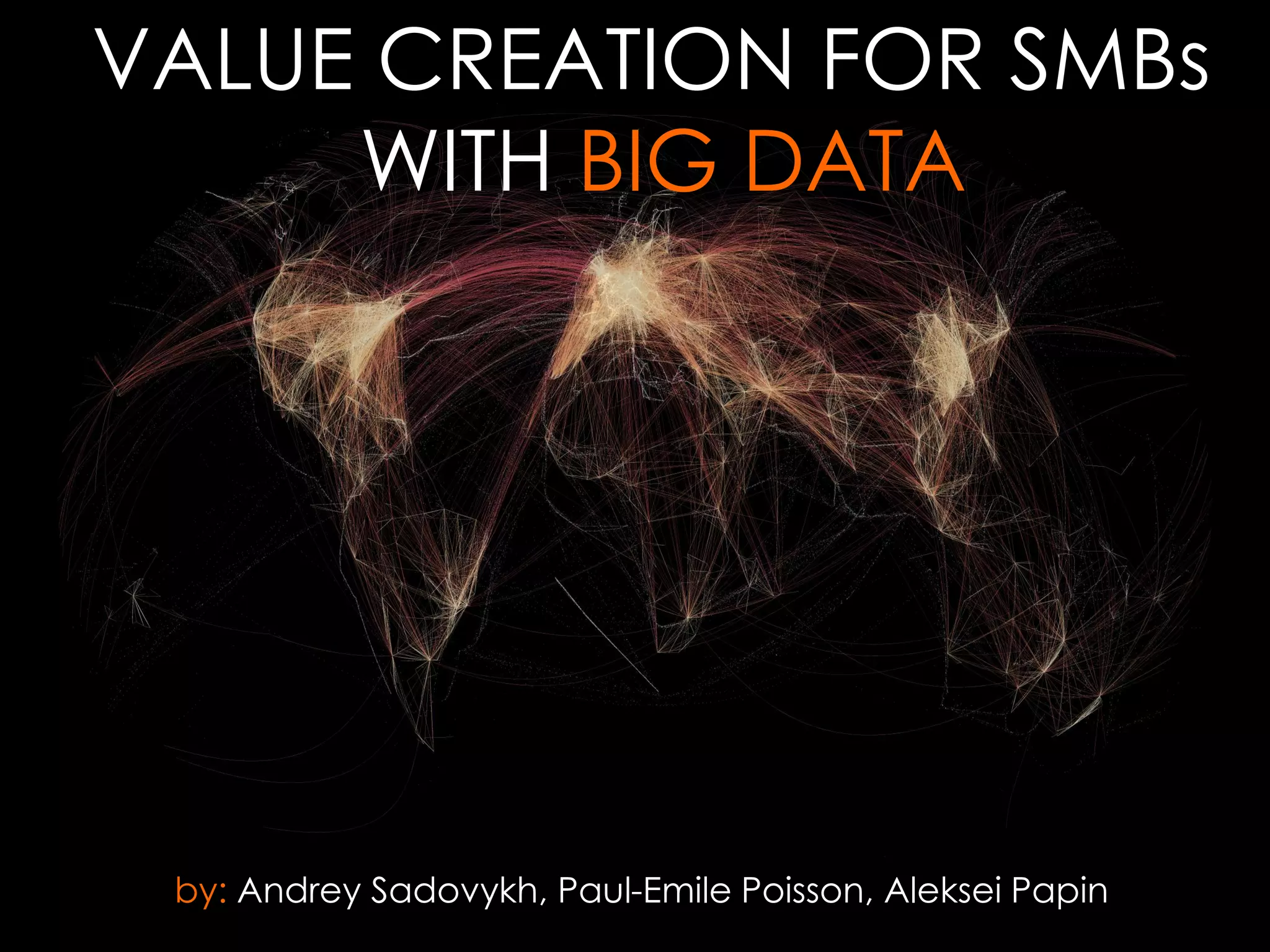

VALUE CREATION FOR SMBs
WITH BIG DATA

by: Andrey Sadovykh, Paul-Emile Poisson, Aleksei Papin
Summary
1. Big Data Phenomenon

• Understanding sources and trends of the phenomenon
• Overview of the Big Data market and SMB sector
2. Big Data Service Providers
• Current services in the market for SMB (bird’s eye view)
3. SMBs Survey
• SMB Segments
• Understanding Big Data
• Value Creation and Go-To-Market
• SMB Pain Points for Big Data
• SMB Trends
4. Recommendations and Lessons Learnt

© Sadovykh, Poisson, Papin, 2014

2
PART #1: BIG DATA
PHENOMENON
3
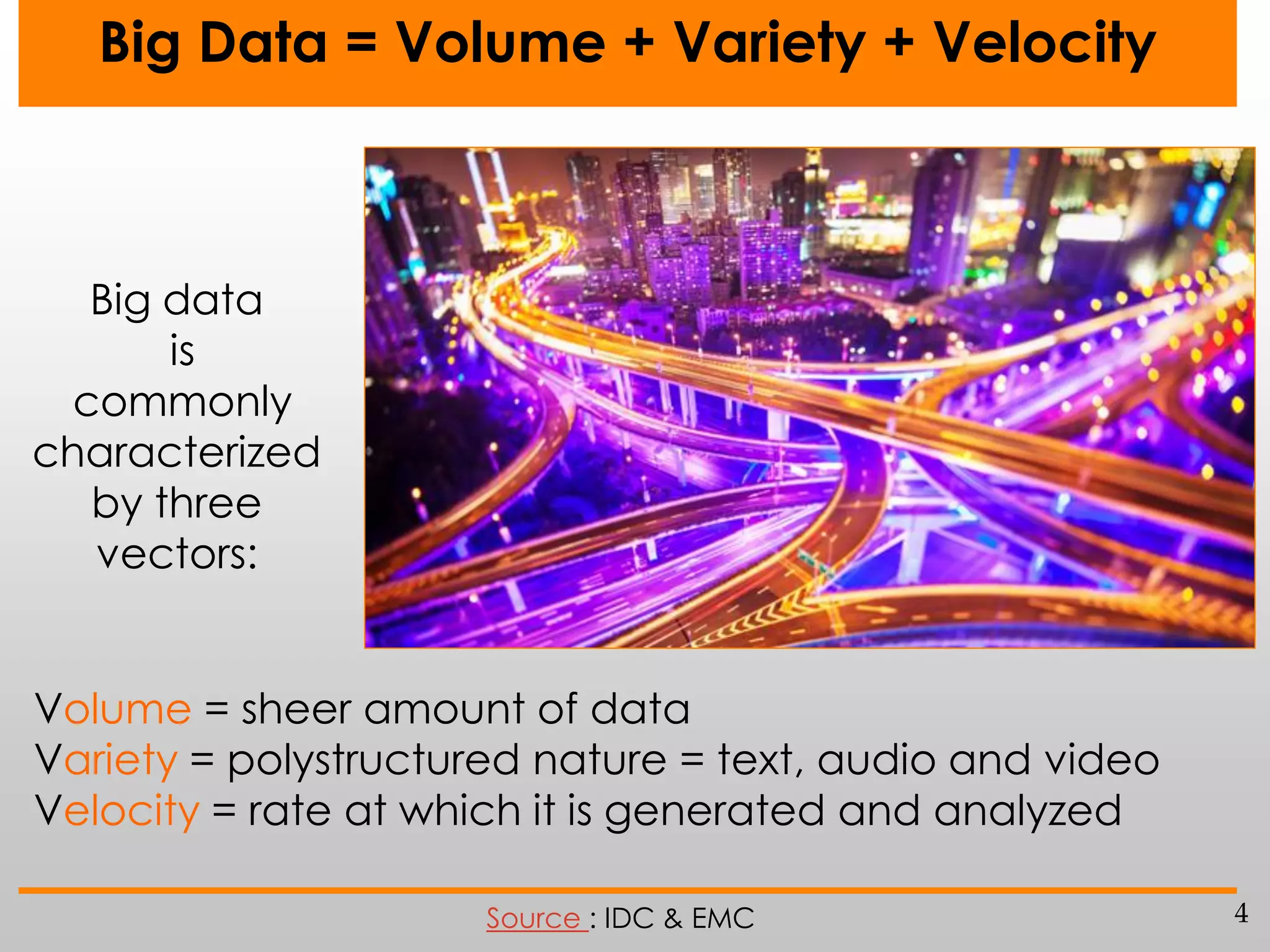
Big Data = Volume + Variety + Velocity

Big data
is
commonly
characterized
by three
vectors:
Volume = sheer amount of data
Variety = polystructured nature = text, audio and video
Velocity = rate at which it is generated and analyzed
Source : IDC & EMC

4
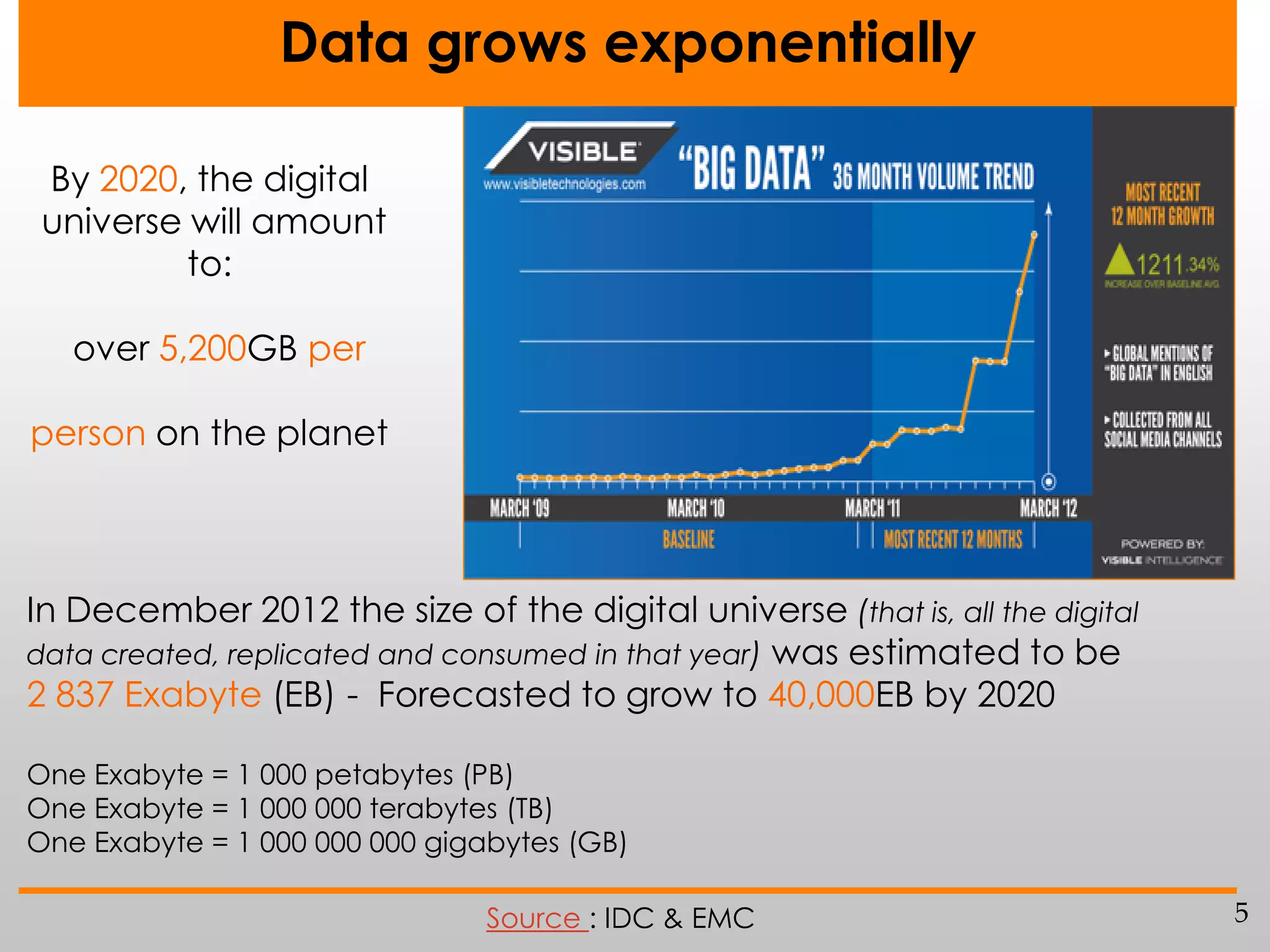
Data grows exponentially
By 2020, the digital
universe will amount
to:
over 5,200GB per
person on the planet

In December 2012 the size of the digital universe (that is, all the digital
data created, replicated and consumed in that year) was estimated to be
2 837 Exabyte (EB) - Forecasted to grow to 40,000EB by 2020
One Exabyte = 1 000 petabytes (PB)
One Exabyte = 1 000 000 terabytes (TB)
One Exabyte = 1 000 000 000 gigabytes (GB)
Source : IDC & EMC

5
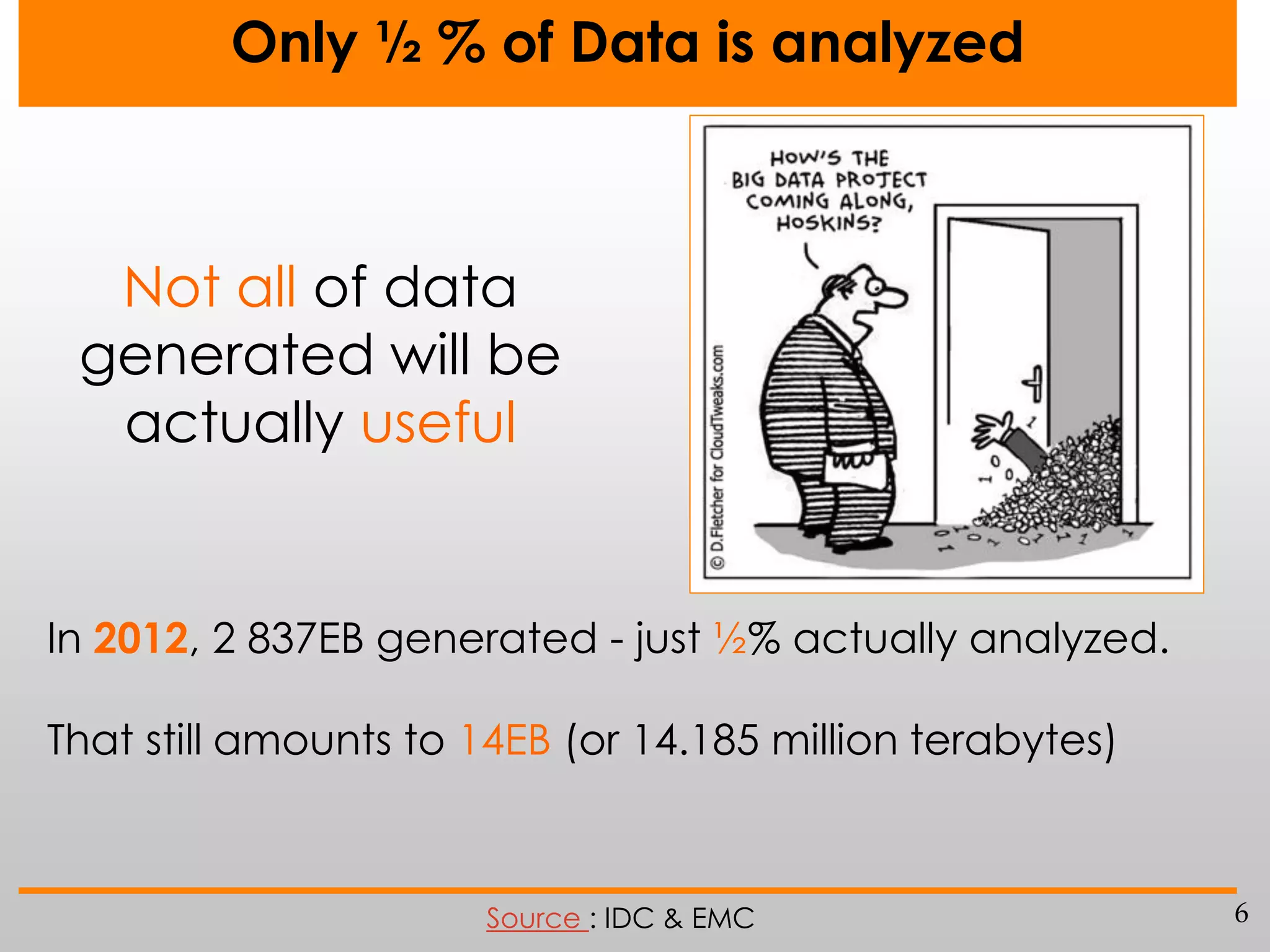
Only ½ % of Data is analyzed

Not all of data
generated will be
actually useful

In 2012, 2 837EB generated - just ½% actually analyzed.
That still amounts to 14EB (or 14.185 million terabytes)

Source : IDC & EMC

6
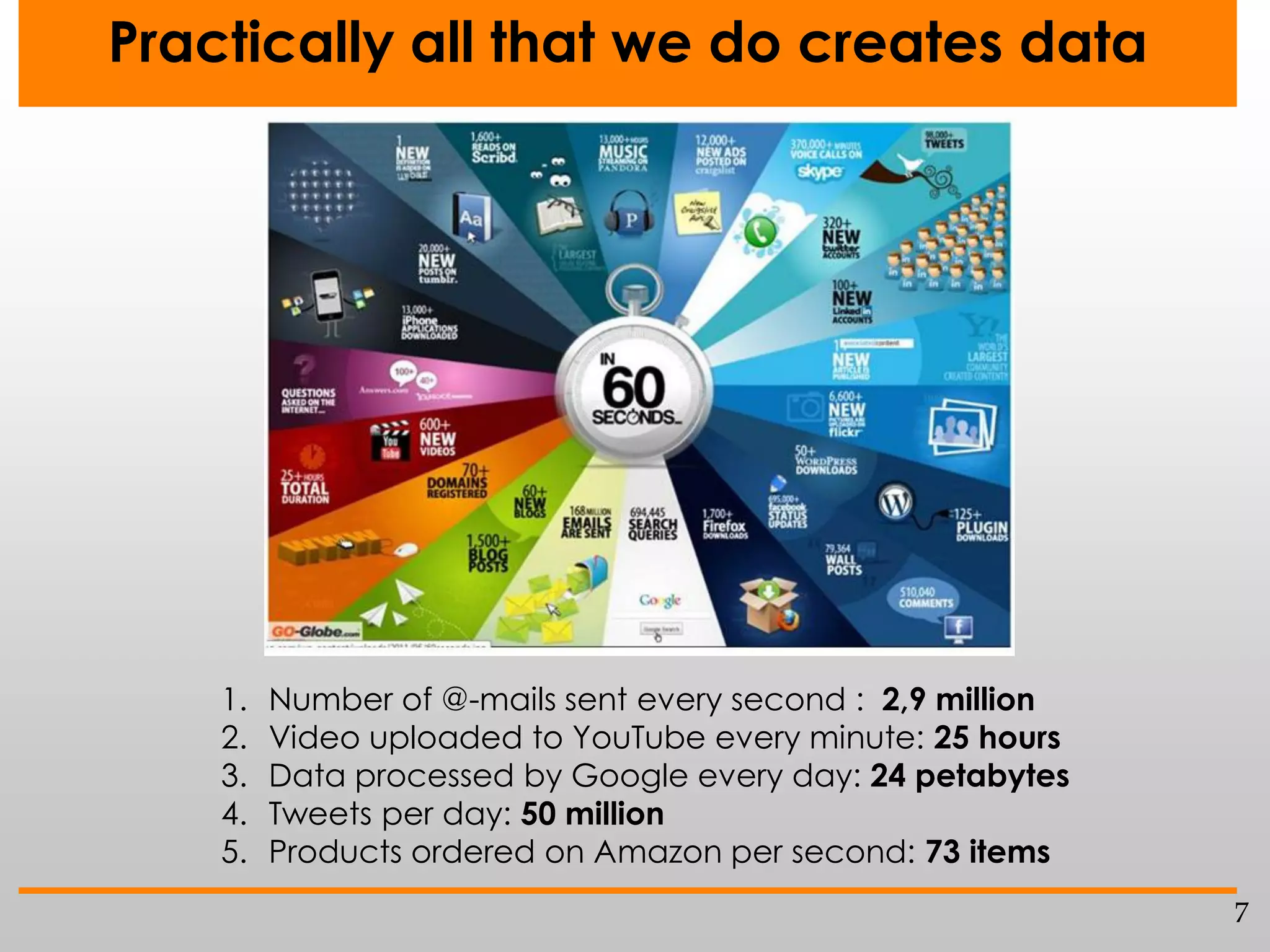
Practically all that we do creates data

1.
2.
3.
4.
5.

Number of @-mails sent every second : 2,9 million
Video uploaded to YouTube every minute: 25 hours
Data processed by Google every day: 24 petabytes
Tweets per day: 50 million
Products ordered on Amazon per second: 73 items
7
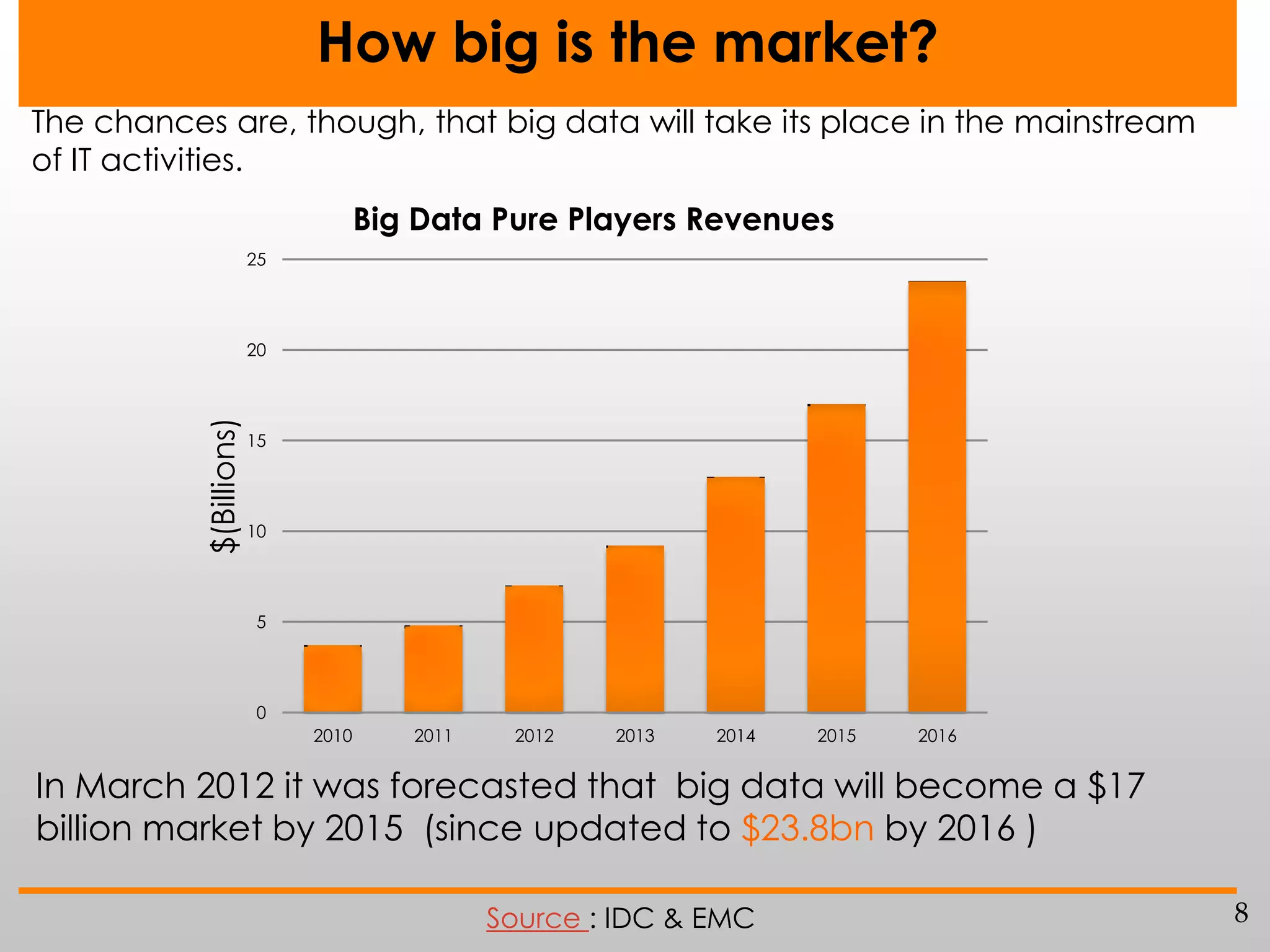
How big is the market?
The chances are, though, that big data will take its place in the mainstream
of IT activities.
Big Data Pure Players Revenues
25

$(Billions)

20

15

10

5

0
2010

2011

2012

2013

2014

2015

2016

In March 2012 it was forecasted that big data will become a $17
billion market by 2015 (since updated to $23.8bn by 2016 )
Source : IDC & EMC

8
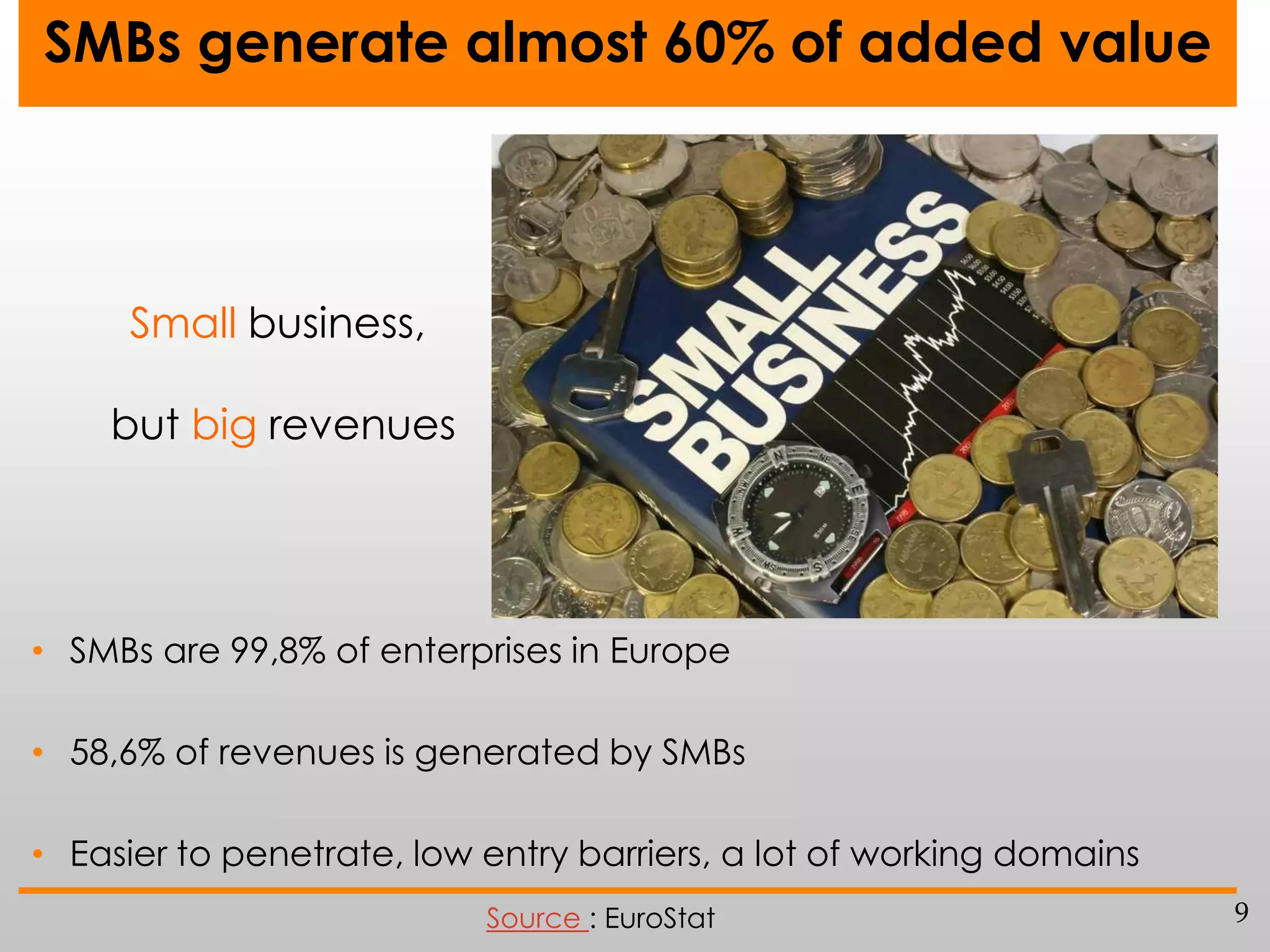
SMBs generate almost 60% of added value

Small business,
but big revenues

• SMBs are 99,8% of enterprises in Europe

• 58,6% of revenues is generated by SMBs
• Easier to penetrate, low entry barriers, a lot of working domains
Source : EuroStat

9
SMBs can leverage Big Data
1.

Big Data phenomenon is driven by
accelerated growth of the unstructured
data.

2.

Traditional analytics means cannot cope
with such volumes, variety and velocity of
data.

3.

Proliferation of Cloud computing and
Software-as-a-Service made it possible for
appearance of affordable data analytics
tools for SMBs.
© Sadovykh, Poisson, Papin, 2014

10
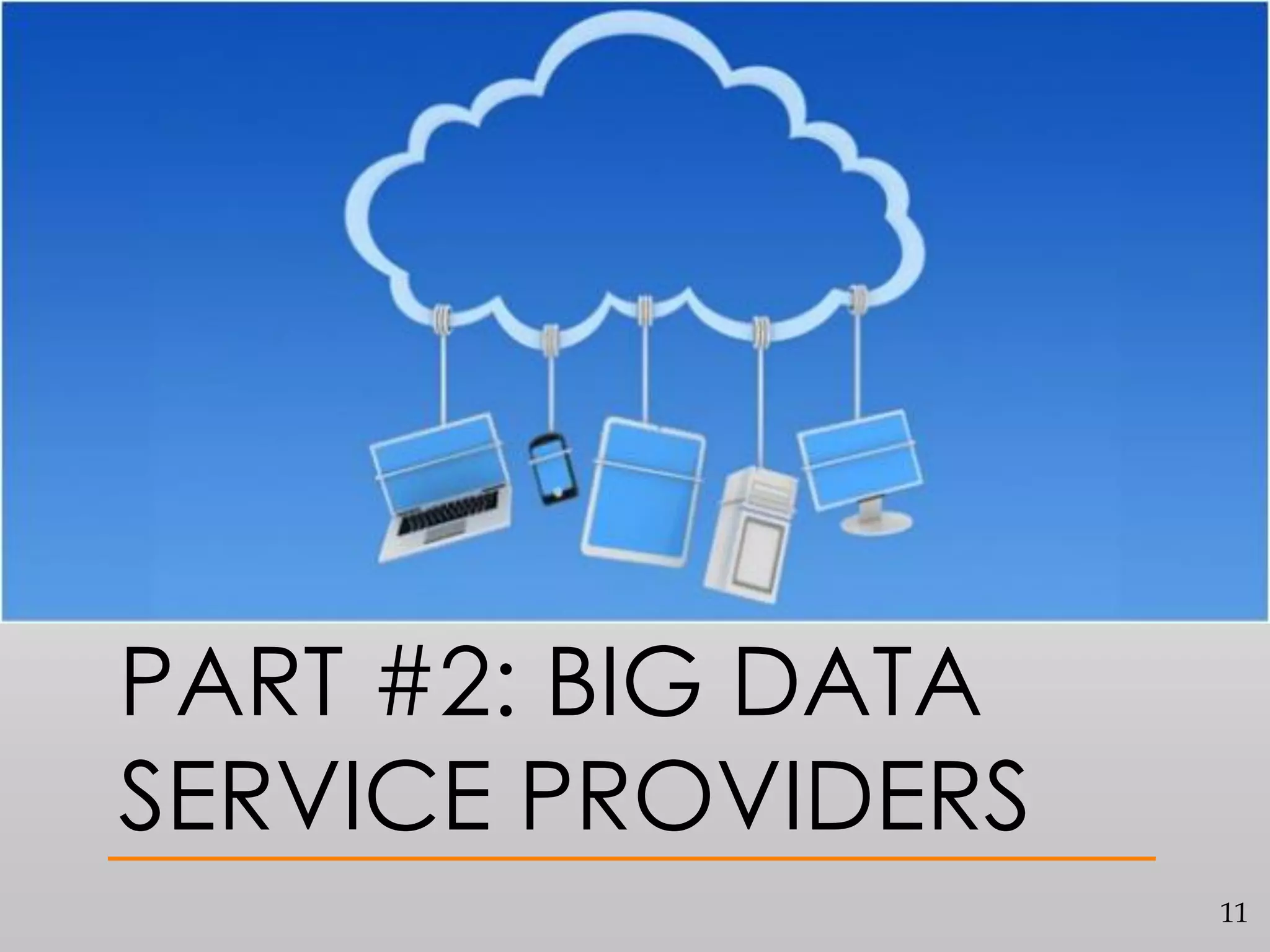
PART #2: BIG DATA
SERVICE PROVIDERS
11
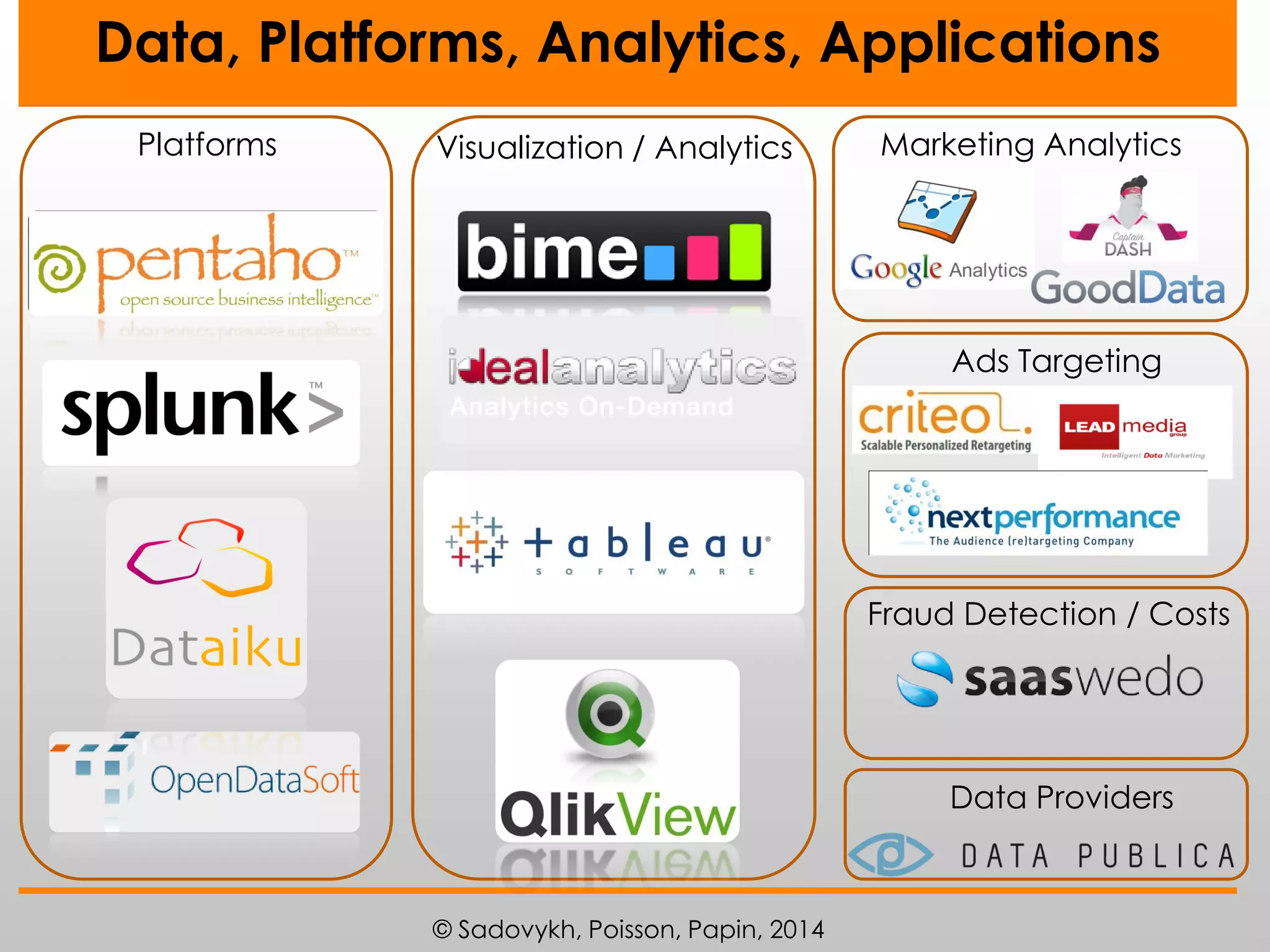
Data, Platforms, Analytics, Applications
Platforms

Visualization / Analytics

Marketing Analytics

Ads Targeting

Fraud Detection / Costs

Data Providers

© Sadovykh, Poisson, Papin, 2014
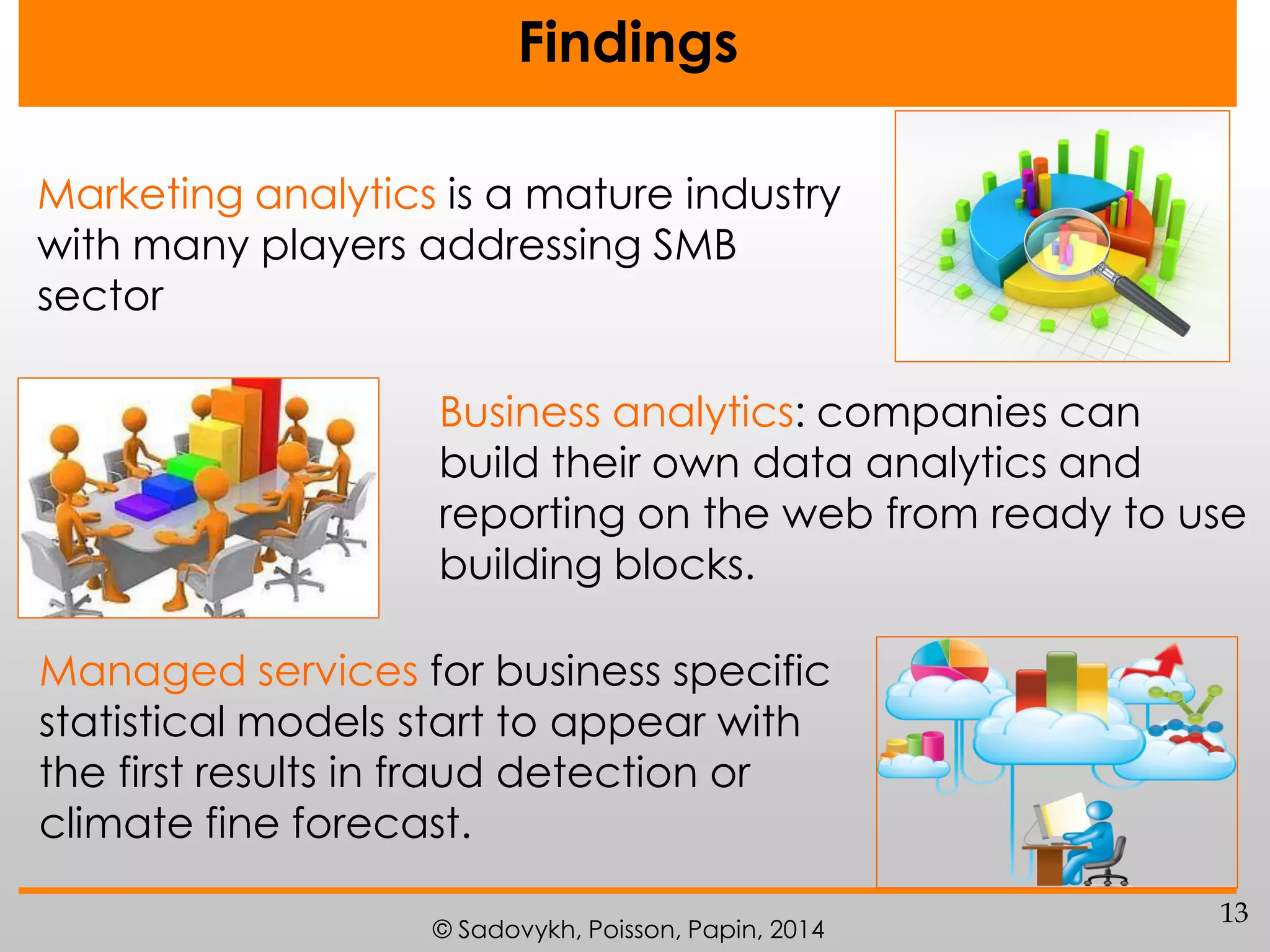
Findings
Marketing analytics is a mature industry
with many players addressing SMB
sector
Business analytics: companies can
build their own data analytics and
reporting on the web from ready to use
building blocks.

Managed services for business specific
statistical models start to appear with
the first results in fraud detection or
climate fine forecast.
© Sadovykh, Poisson, Papin, 2014

13
PART #3: SMB SURVEY
14
Big Data phenomenon
understanding

32 SMBs
participated in our
survey about:

Value creation and
Go-To-Market
SMBs’ pain points
Trends

15
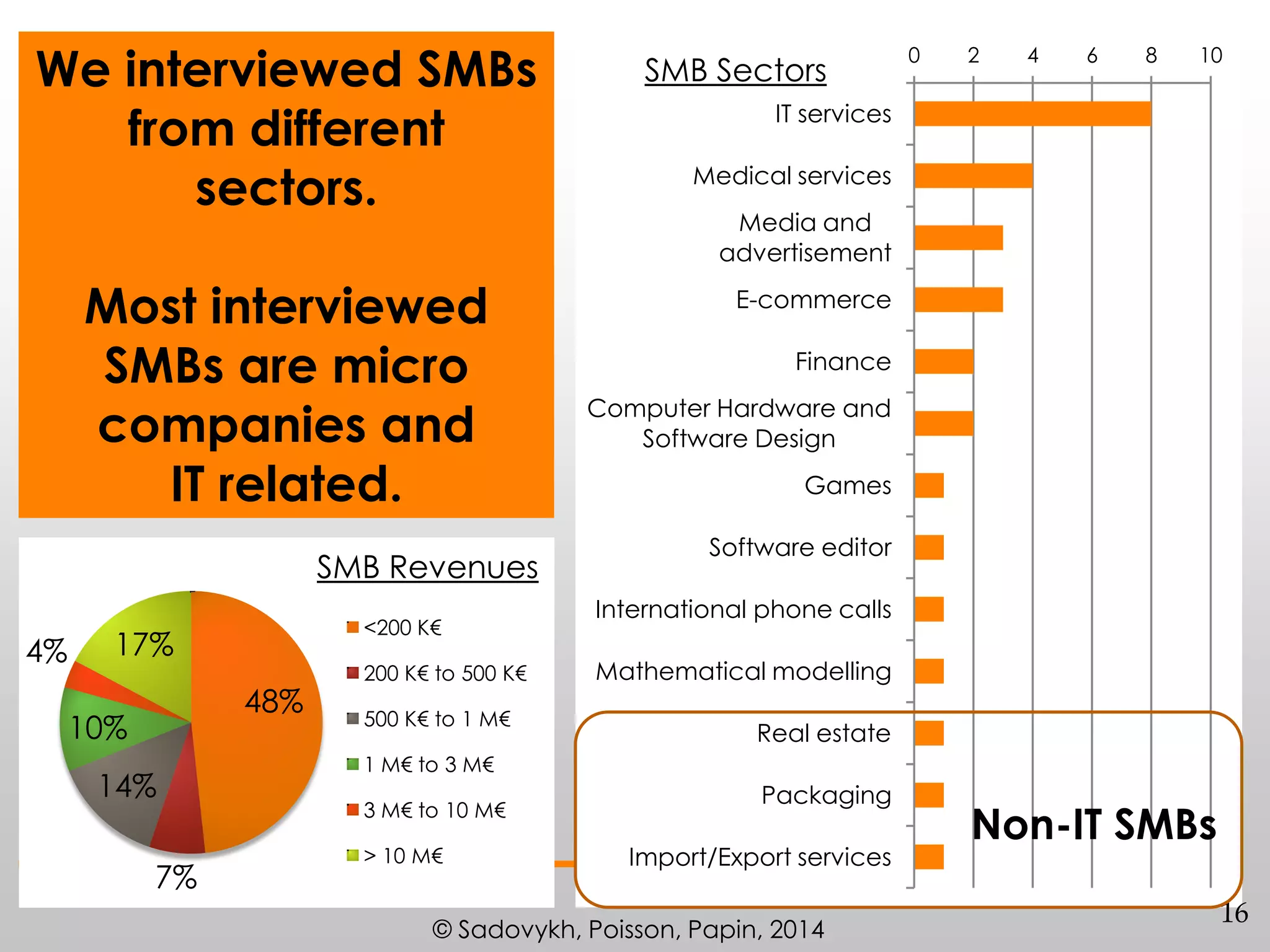
We interviewed SMBs
from different
sectors.
Most interviewed
SMBs are micro
companies and
IT related.
SMB Revenues
4%

<200 K€

17%
48%

10%

14%
7%

200 K€ to 500 K€
500 K€ to 1 M€

SMB Sectors

0

2

4

6

8

10

IT services
Medical services
Media and
advertisement
E-commerce
Finance
Computer Hardware and
Software Design
Games
Software editor
International phone calls

Mathematical modelling
Real estate

1 M€ to 3 M€
3 M€ to 10 M€
> 10 M€

Packaging
Import/Export services

© Sadovykh, Poisson, Papin, 2014

Non-IT SMBs
16
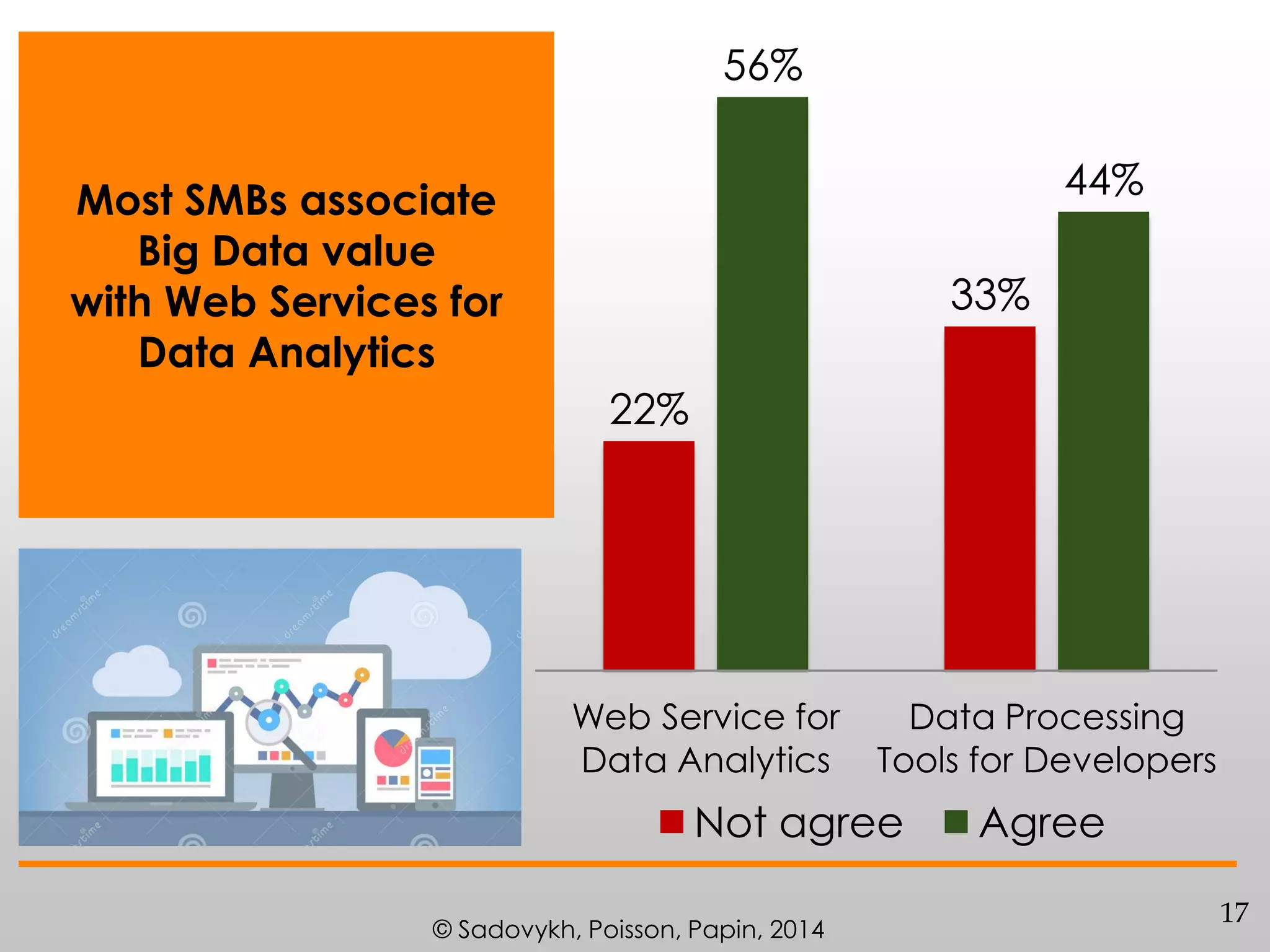
56%

44%

Most SMBs associate
Big Data value
with Web Services for
Data Analytics

33%
22%

Web Service for
Data Analytics

Data Processing
Tools for Developers

Not agree
© Sadovykh, Poisson, Papin, 2014

Agree
17
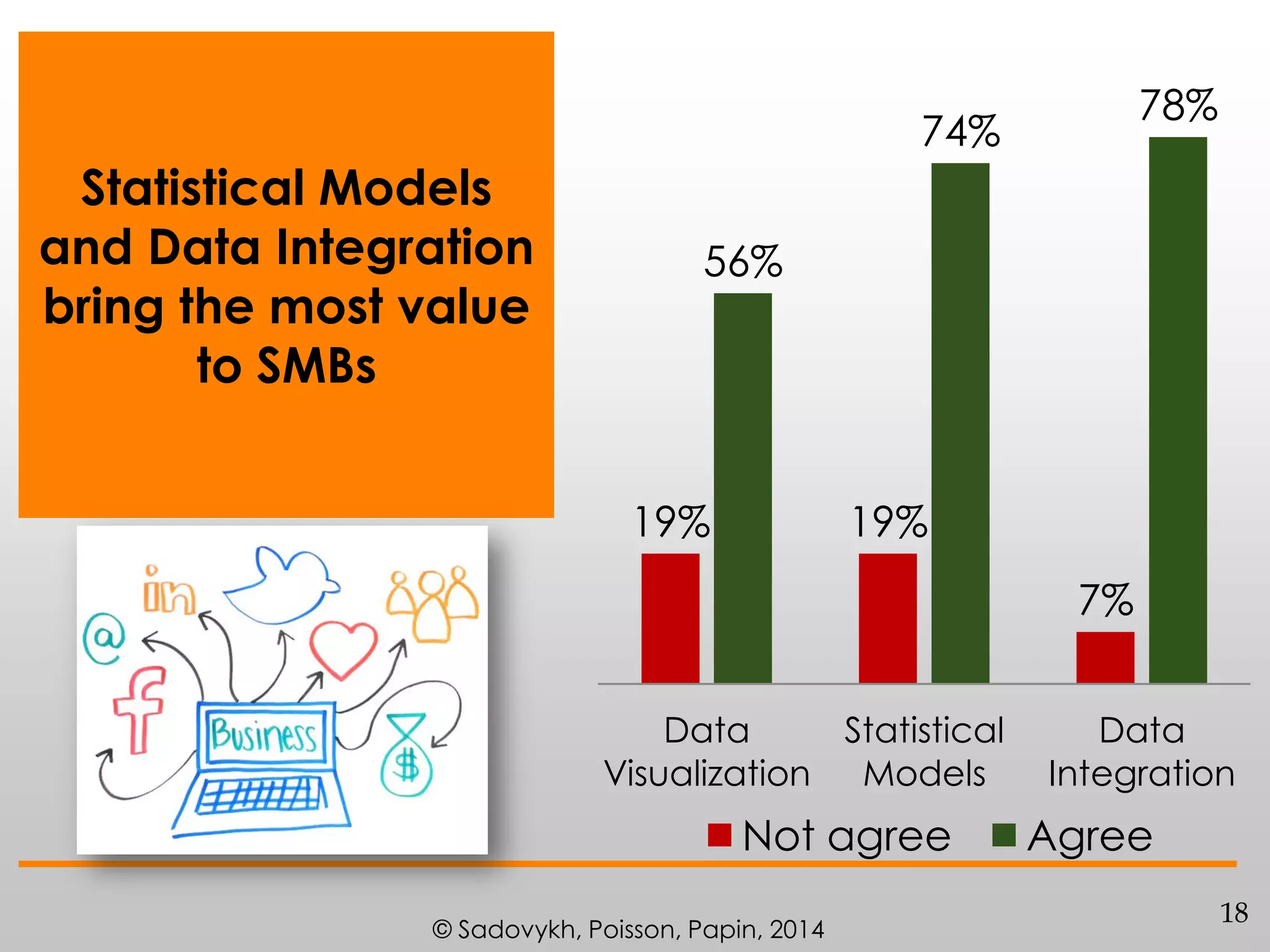
78%

74%

Statistical Models
and Data Integration
bring the most value
to SMBs

56%

19%

19%

7%
Data
Statistical
Visualization Models

Not agree
© Sadovykh, Poisson, Papin, 2014

Data
Integration

Agree
18
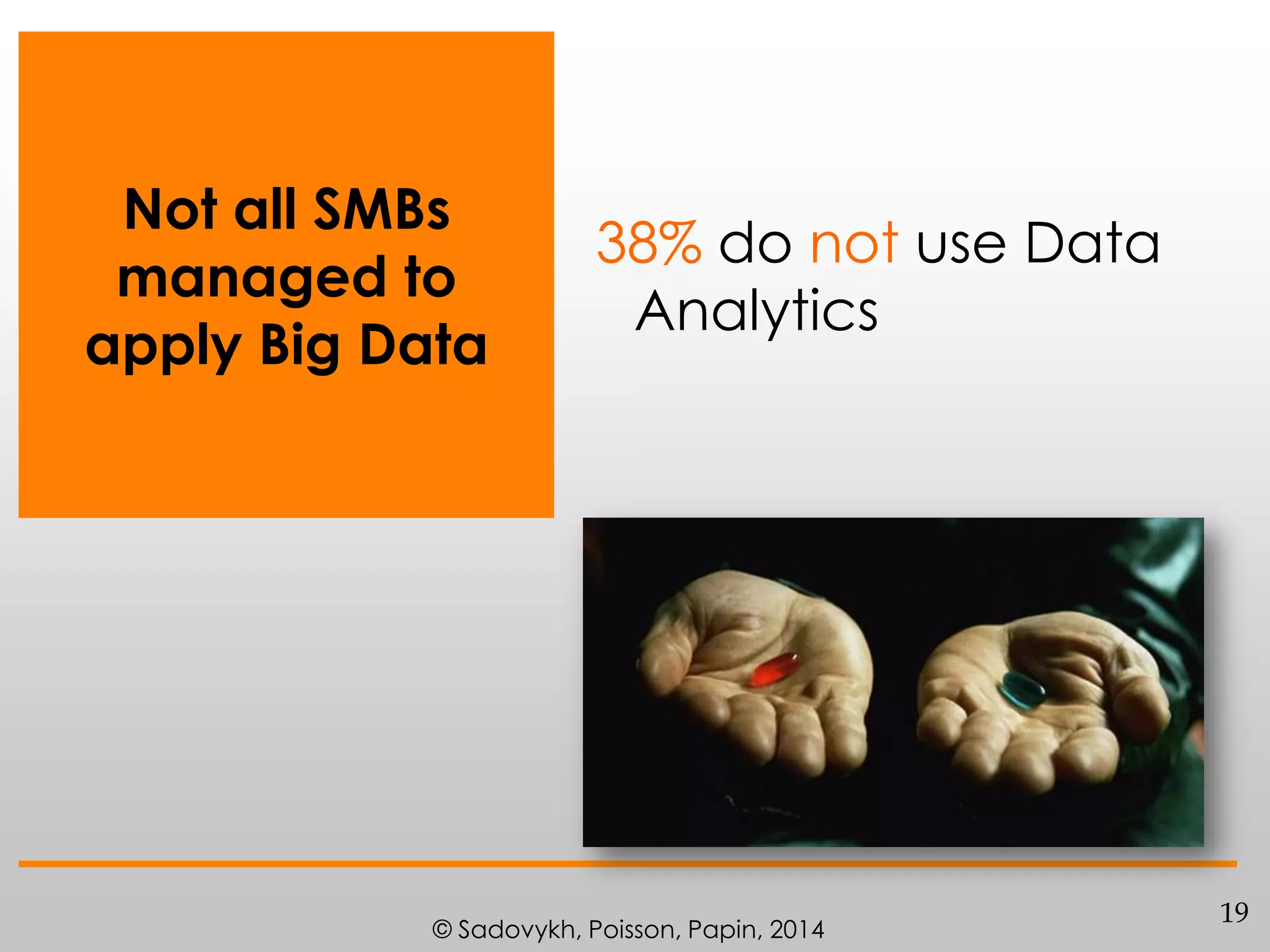
Not all SMBs
managed to
apply Big Data

38% do not use Data
Analytics

© Sadovykh, Poisson, Papin, 2014

19
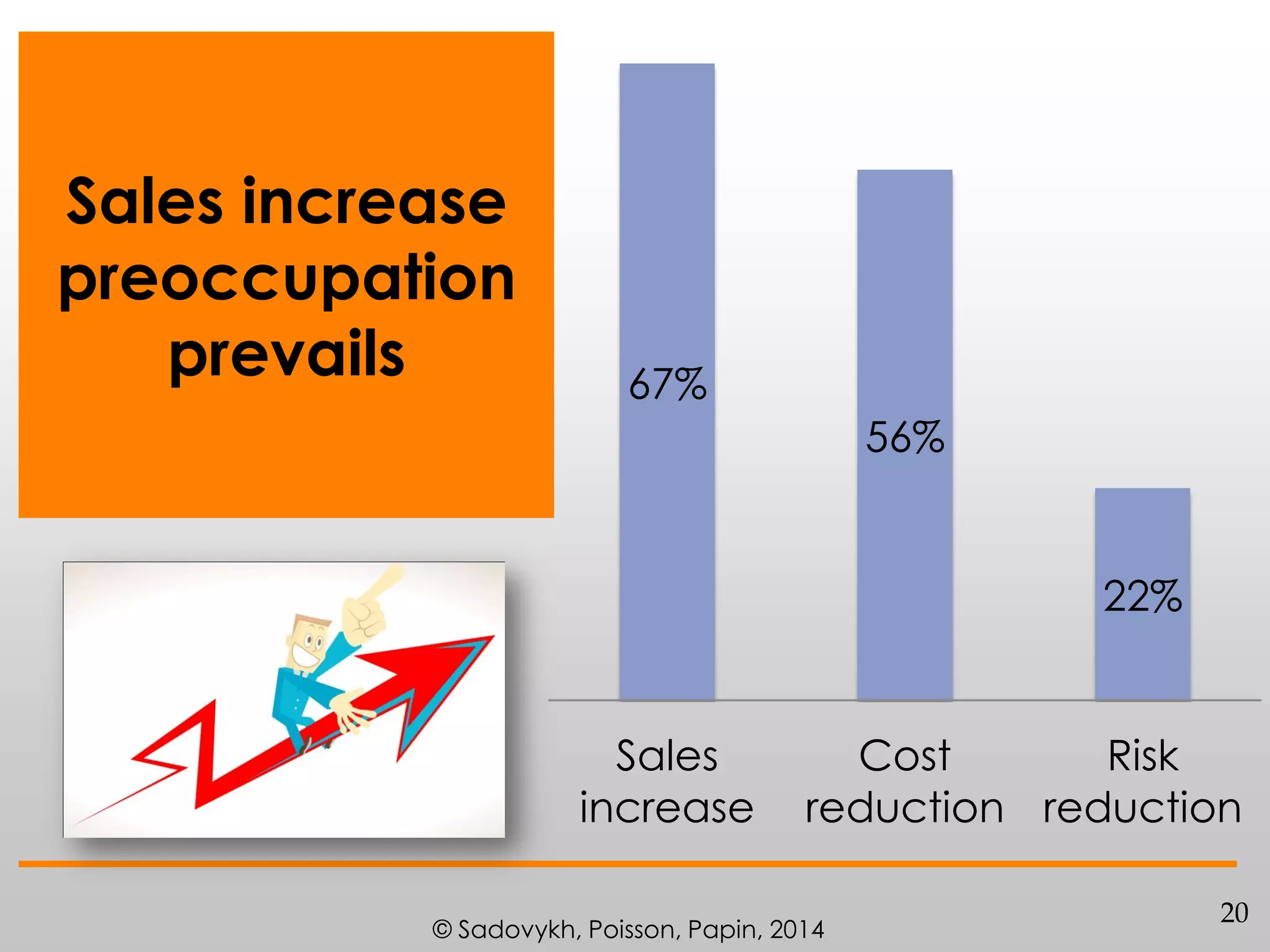
Sales increase
preoccupation
prevails

67%
56%

22%

Sales
increase

Cost
Risk
reduction reduction

© Sadovykh, Poisson, Papin, 2014

20
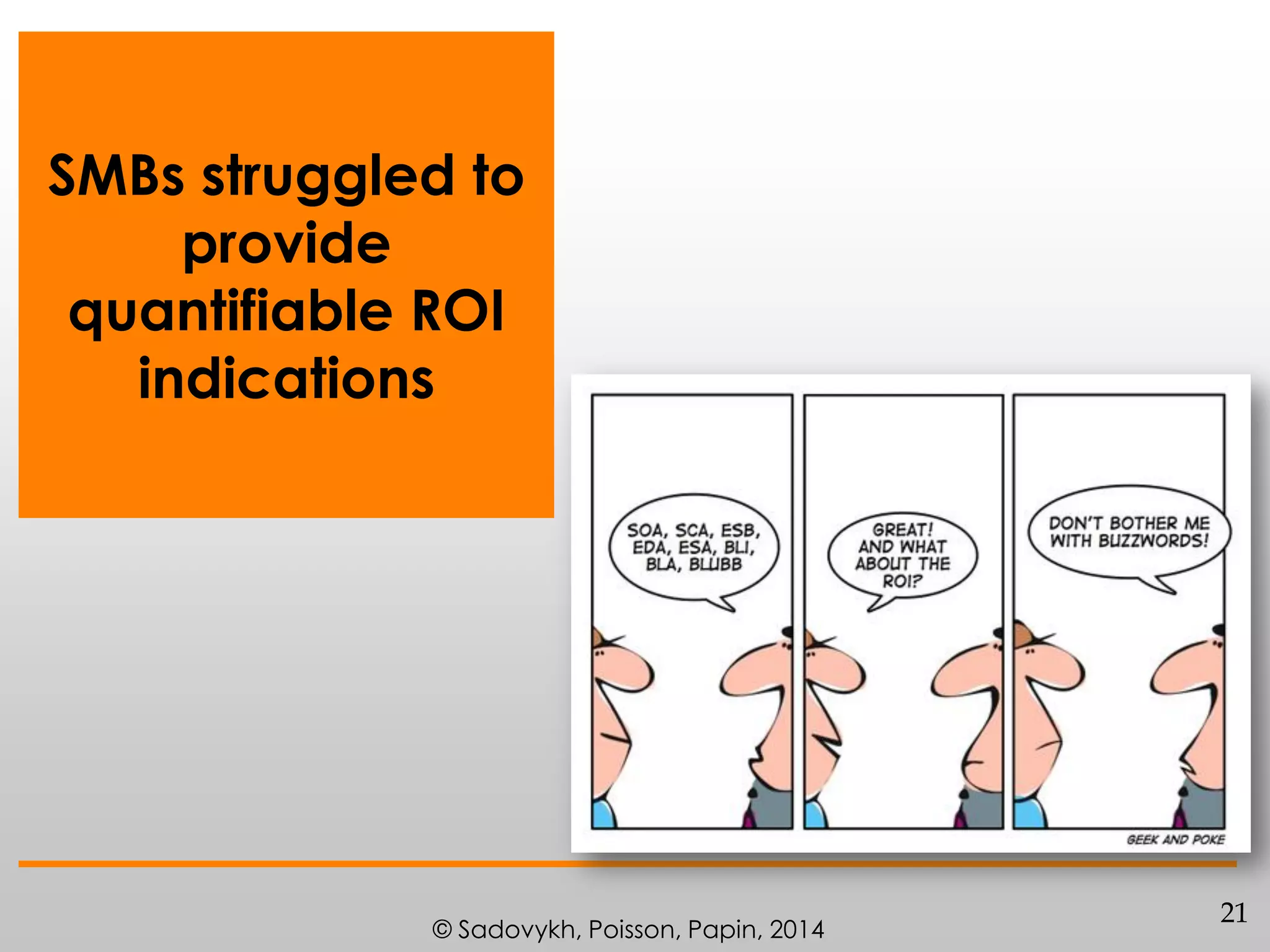
SMBs struggled to
provide
quantifiable ROI
indications

© Sadovykh, Poisson, Papin, 2014

21
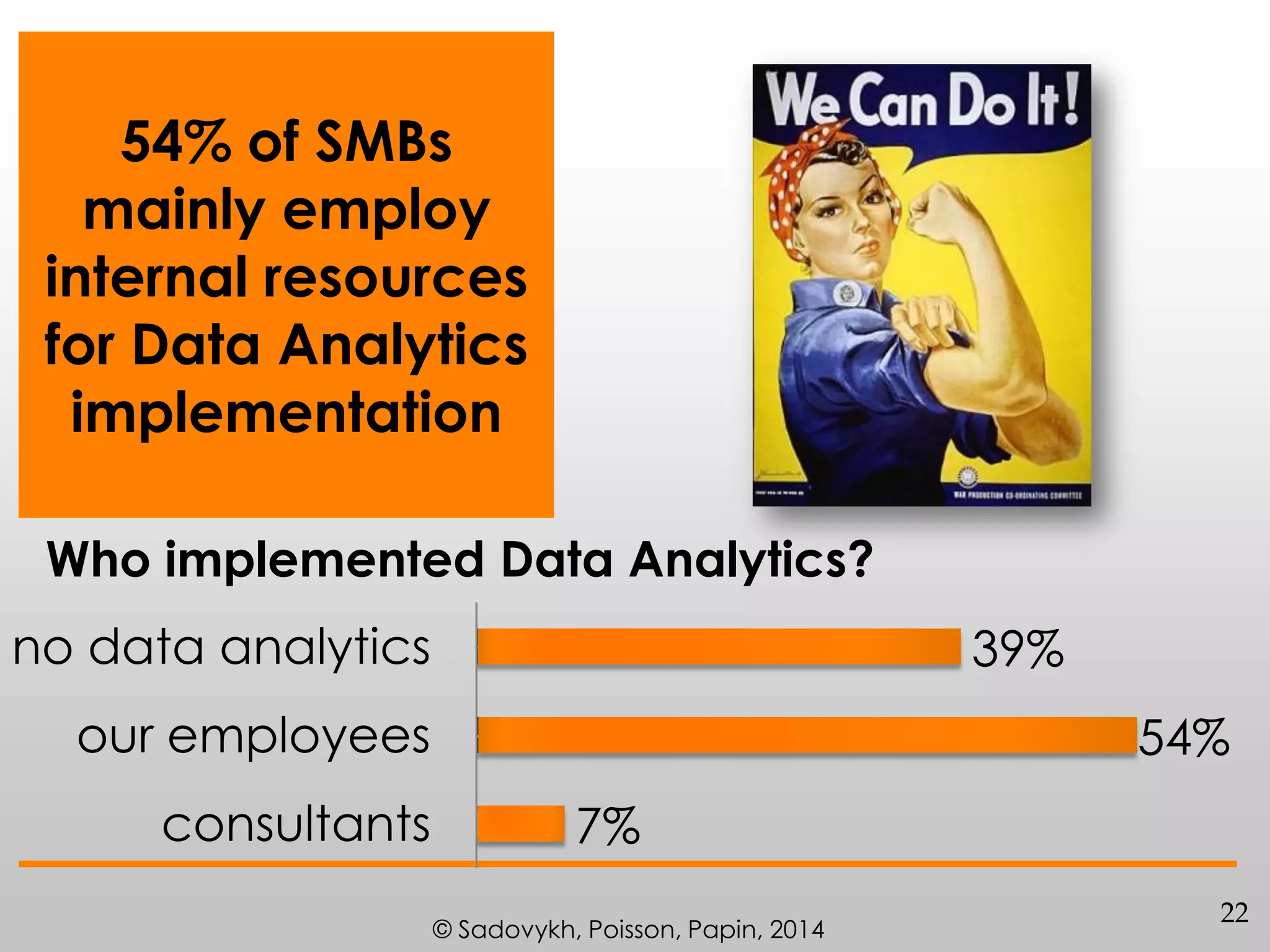
54% of SMBs
mainly employ
internal resources
for Data Analytics
implementation
Who implemented Data Analytics?
no data analytics

39%

our employees
consultants

54%
7%
© Sadovykh, Poisson, Papin, 2014

22
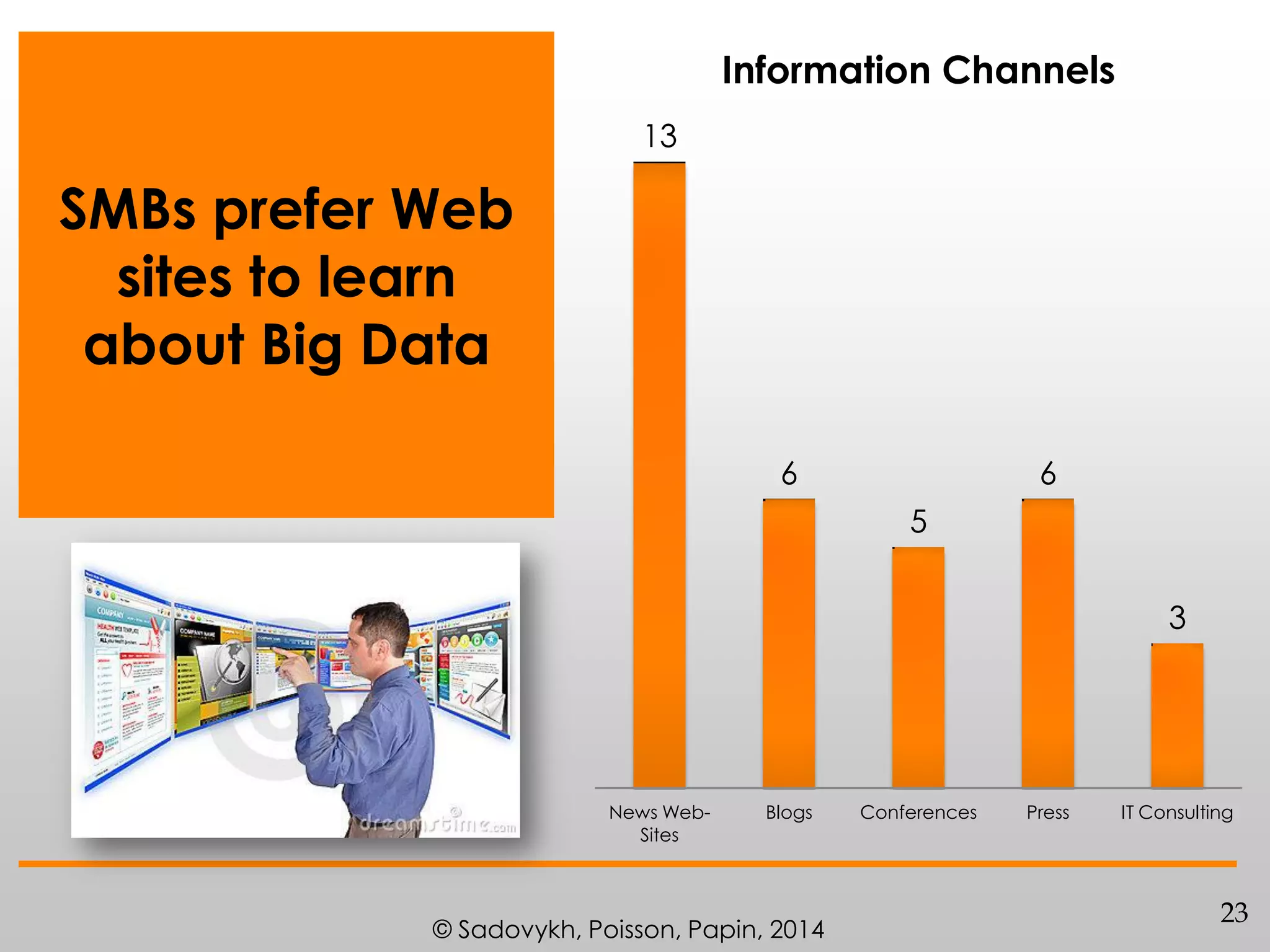
Information Channels
13

SMBs prefer Web
sites to learn
about Big Data
6

6
5

3

News WebSites

Blogs

© Sadovykh, Poisson, Papin, 2014

Conferences

Press

IT Consulting

23
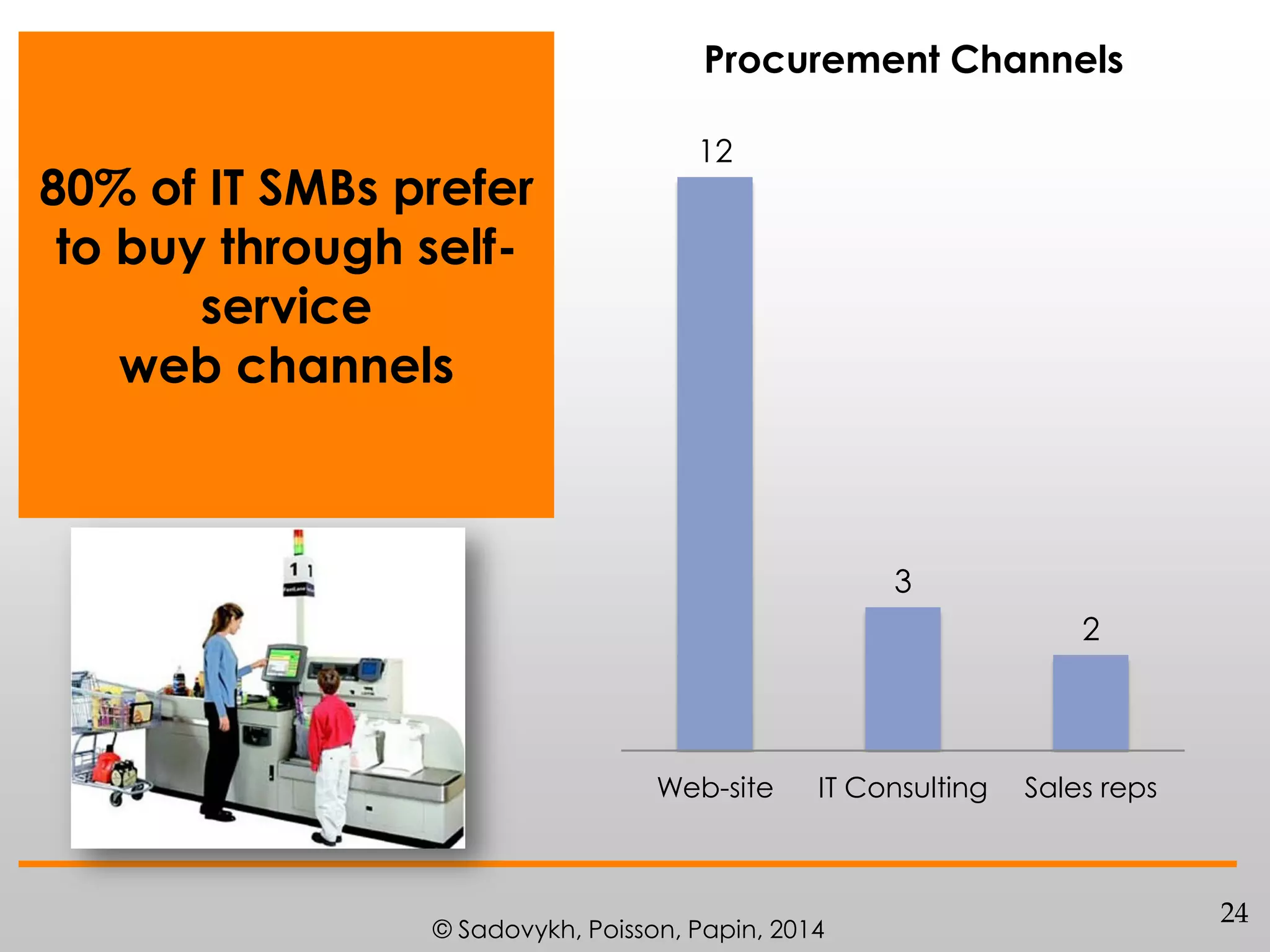
Procurement Channels

80% of IT SMBs prefer
to buy through selfservice
web channels

12

3
2

Web-site

IT Consulting

© Sadovykh, Poisson, Papin, 2014

Sales reps

24
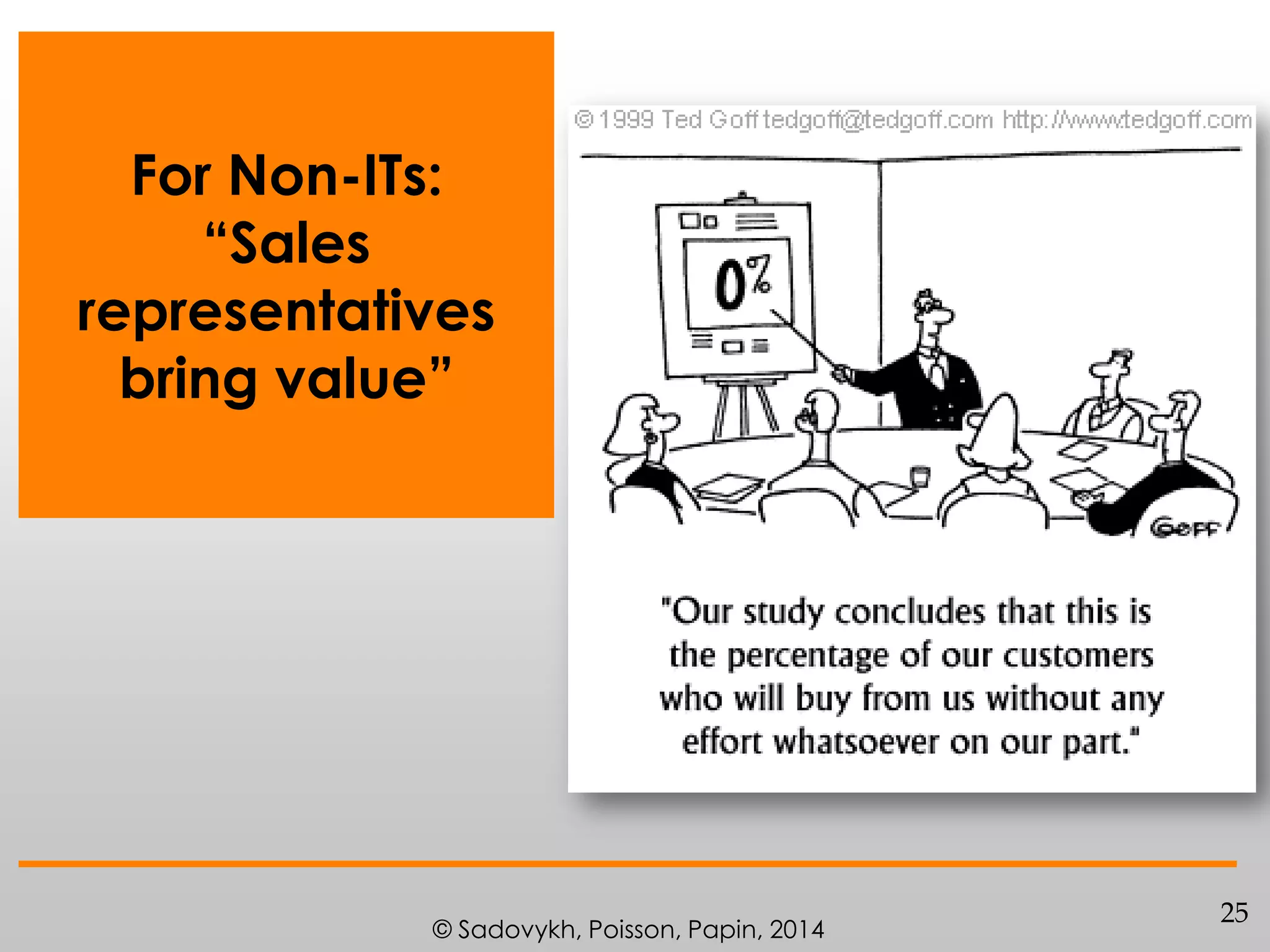
For Non-ITs:
“Sales
representatives
bring value”

© Sadovykh, Poisson, Papin, 2014

25
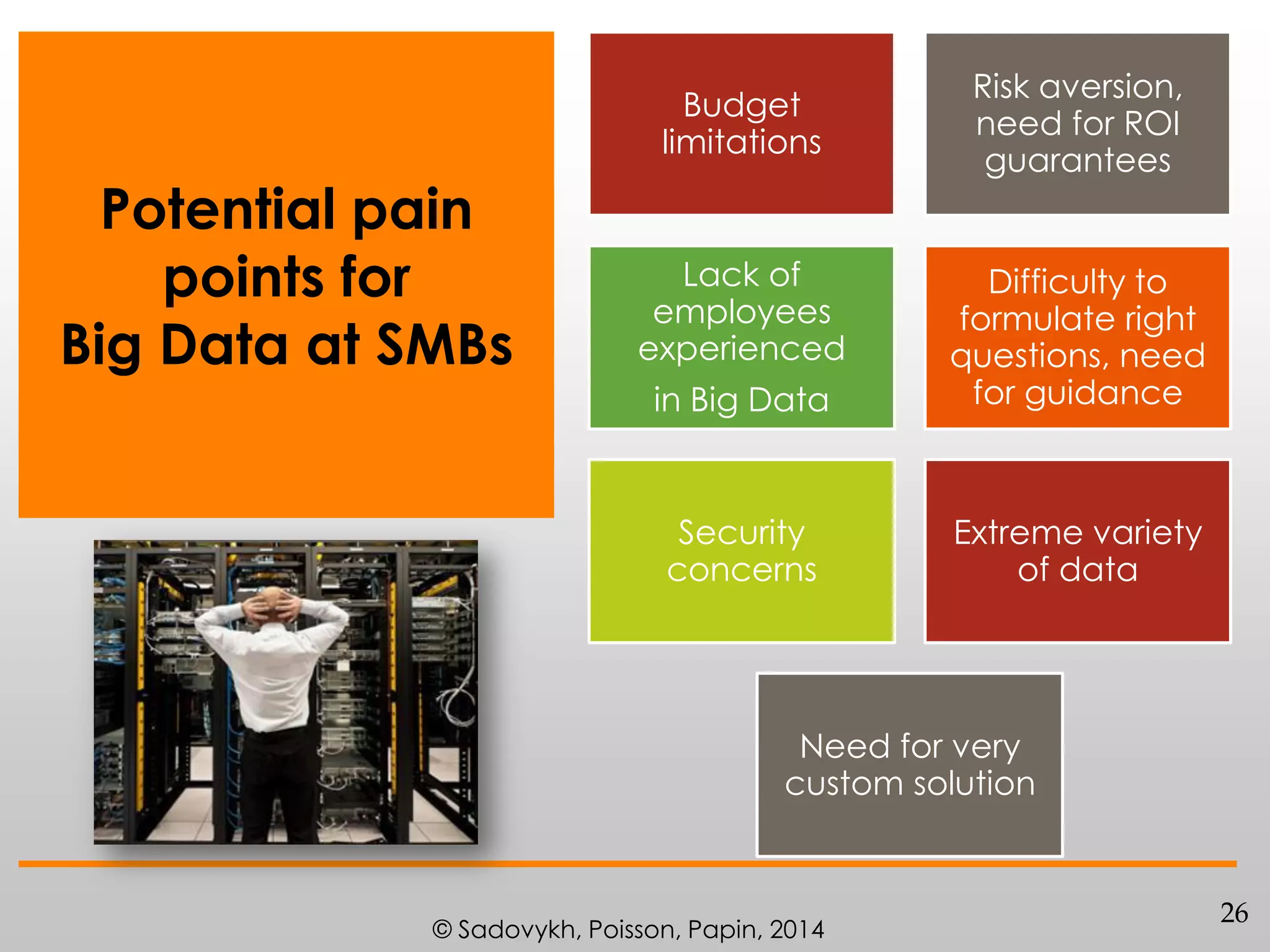
Budget
limitations

Potential pain
points for
Big Data at SMBs

Lack of
employees
experienced

Risk aversion,
need for ROI
guarantees

in Big Data

Difficulty to
formulate right
questions, need
for guidance

Security
concerns

Extreme variety
of data

Need for very
custom solution

© Sadovykh, Poisson, Papin, 2014

26
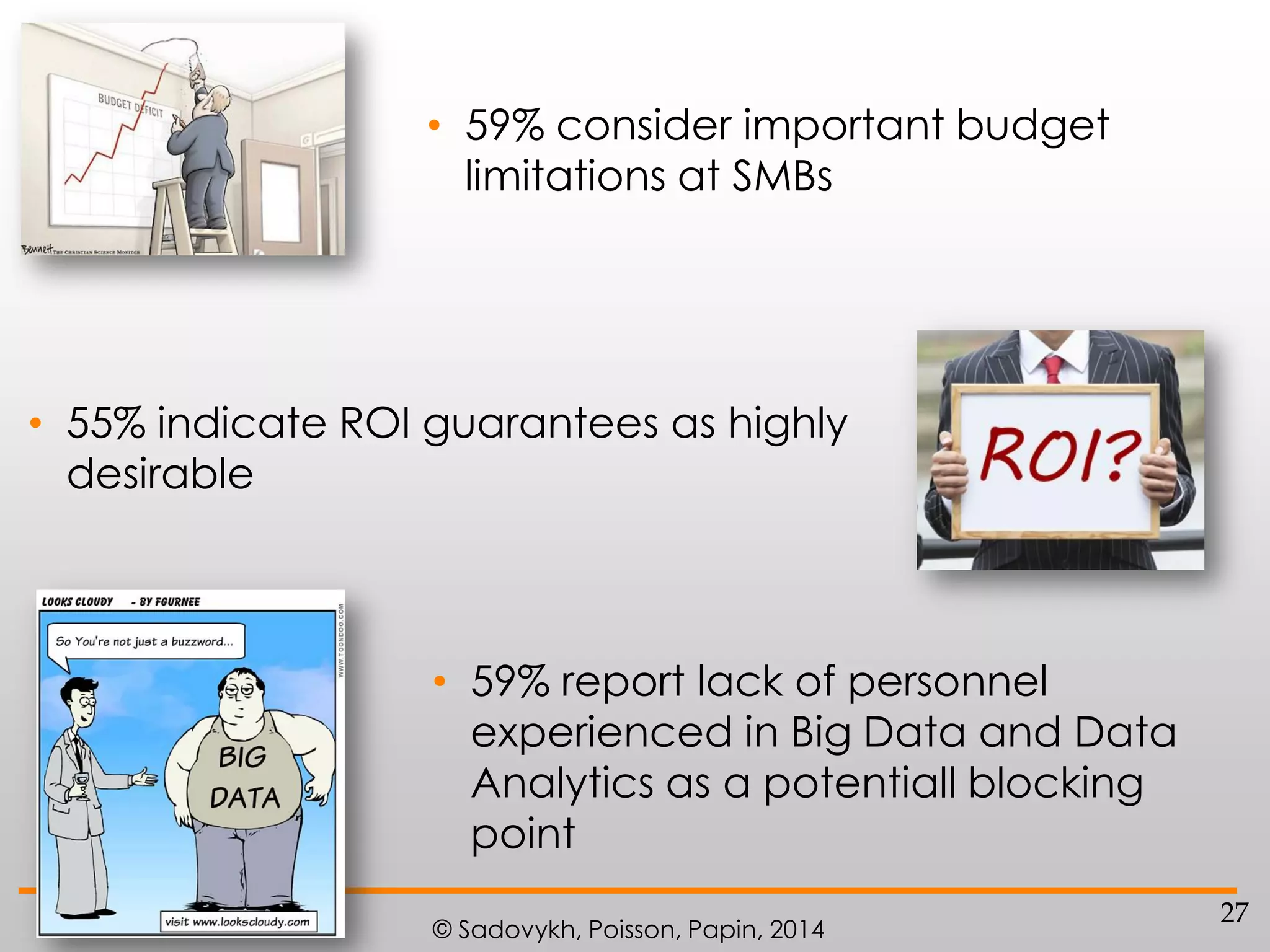
• 59% consider important budget
limitations at SMBs

• 55% indicate ROI guarantees as highly
desirable

• 59% report lack of personnel
experienced in Big Data and Data
Analytics as a potentiall blocking
point
© Sadovykh, Poisson, Papin, 2014

27
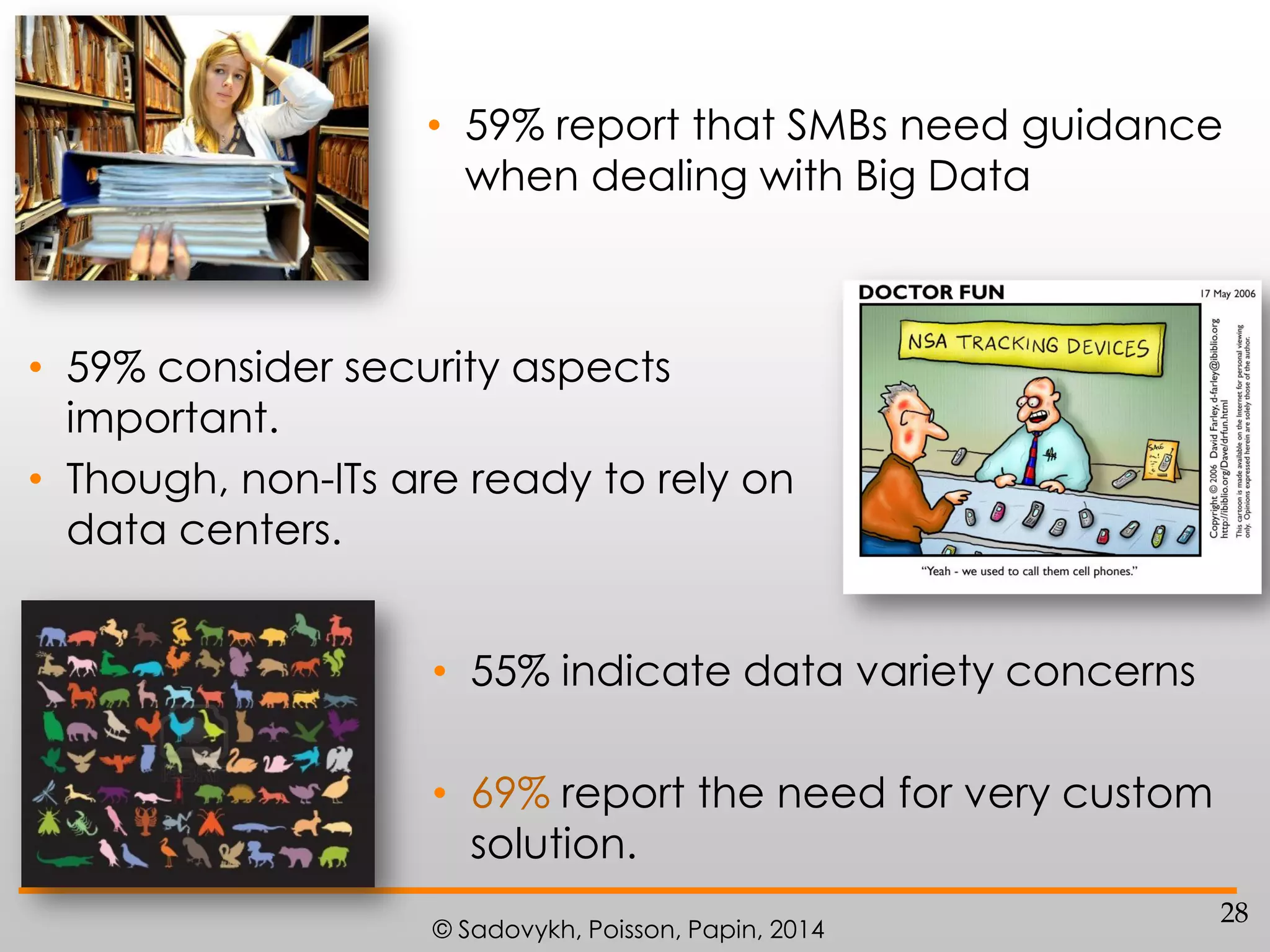
• 59% report that SMBs need guidance
when dealing with Big Data

• 59% consider security aspects
important.
• Though, non-ITs are ready to rely on
data centers.
• 55% indicate data variety concerns
• 69% report the need for very custom
solution.
© Sadovykh, Poisson, Papin, 2014

28
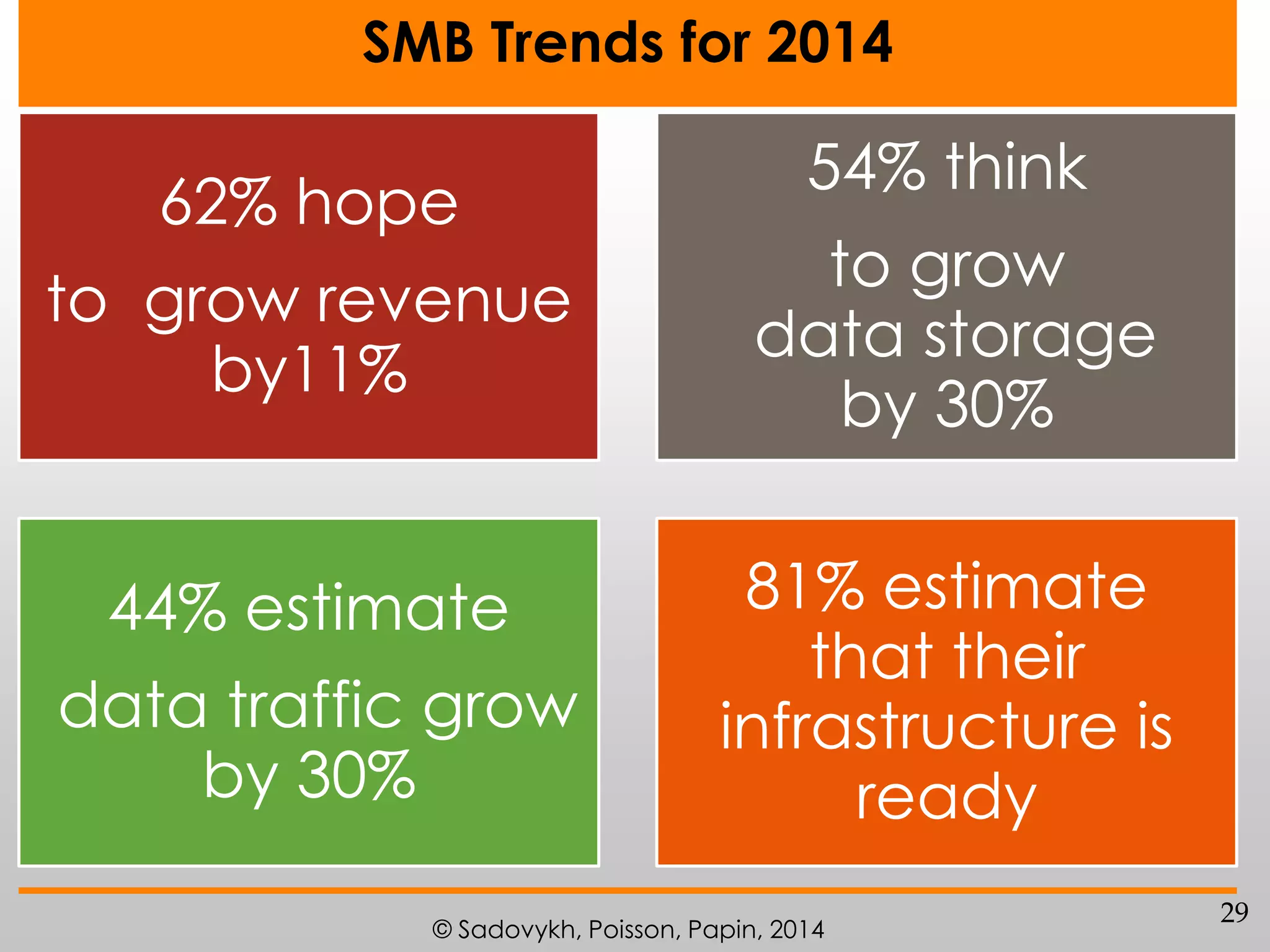
SMB Trends for 2014

62% hope
to grow revenue
by11%

44% estimate
data traffic grow
by 30%

54% think
to grow
data storage
by 30%
81% estimate
that their
infrastructure is
ready

© Sadovykh, Poisson, Papin, 2014

29
PART #4:
RECOMMENDATIONS
30
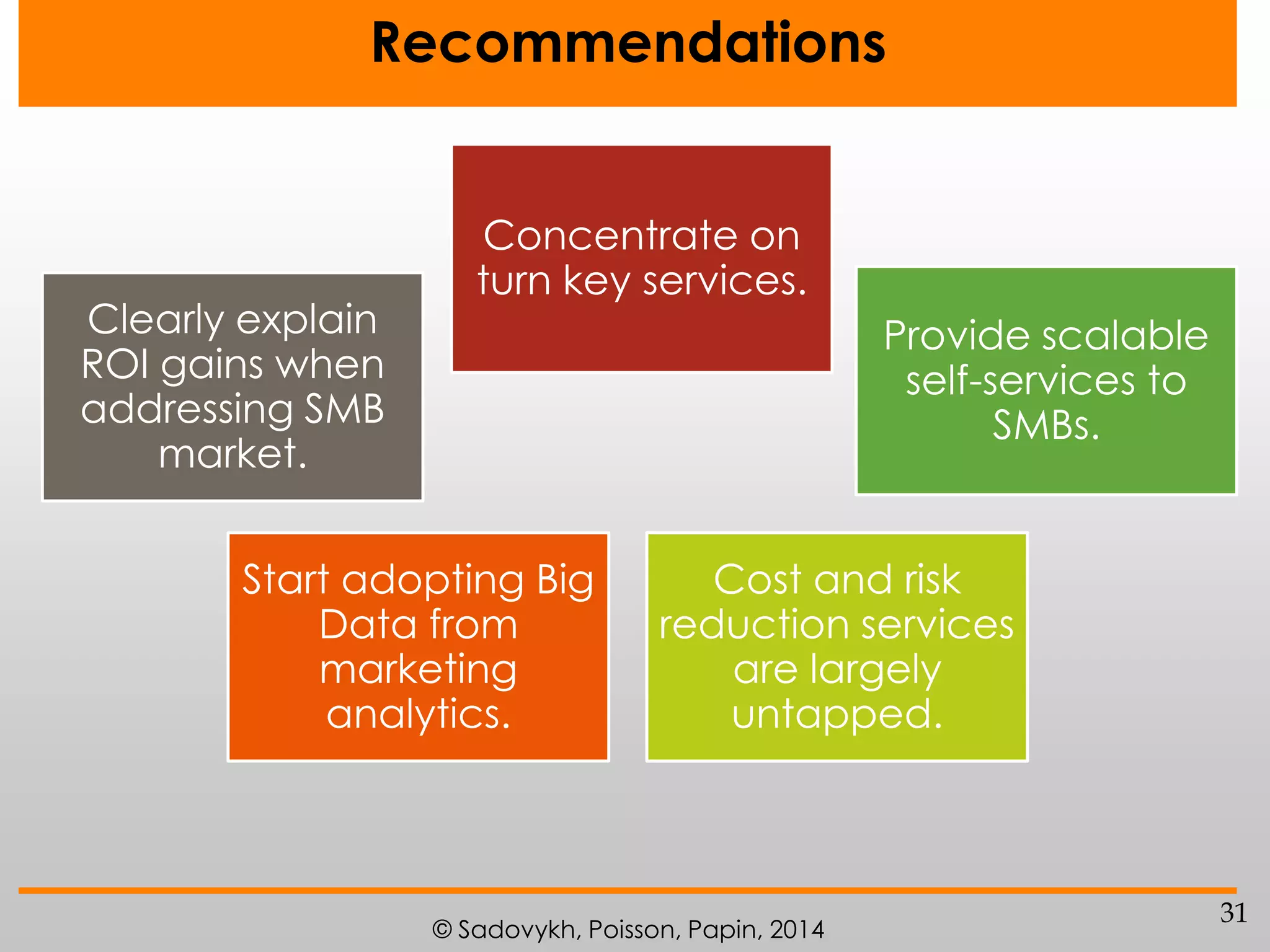
Recommendations

Clearly explain
ROI gains when
addressing SMB
market.

Concentrate on
turn key services.
Provide scalable
self-services to
SMBs.

Start adopting Big
Data from
marketing
analytics.

Cost and risk
reduction services
are largely
untapped.

© Sadovykh, Poisson, Papin, 2014

31
BIG DATA COULD BE THE SOLUTION
FOR YOUR BUSINESS TOMORROW…
32
Contacts

• For further information and
full report please contact:
• Andrey.Sadovykh@hec.edu
• Paul-Emile.Poisson@hec.edu
• Aleksei.Papin@hec.edu

This presentation is prepared in the context of the consulting
project conducted by HEC Paris Business School

© Sadovykh, Poisson, Papin, 2014

33

Value Creation for SMBs with Big Data

  • 1.
    VALUE CREATION FORSMBs WITH BIG DATA by: Andrey Sadovykh, Paul-Emile Poisson, Aleksei Papin
  • 2.
    Summary 1. Big DataPhenomenon • Understanding sources and trends of the phenomenon • Overview of the Big Data market and SMB sector 2. Big Data Service Providers • Current services in the market for SMB (bird’s eye view) 3. SMBs Survey • SMB Segments • Understanding Big Data • Value Creation and Go-To-Market • SMB Pain Points for Big Data • SMB Trends 4. Recommendations and Lessons Learnt © Sadovykh, Poisson, Papin, 2014 2
  • 3.
    PART #1: BIGDATA PHENOMENON 3
  • 4.
    Big Data =Volume + Variety + Velocity Big data is commonly characterized by three vectors: Volume = sheer amount of data Variety = polystructured nature = text, audio and video Velocity = rate at which it is generated and analyzed Source : IDC & EMC 4
  • 5.
    Data grows exponentially By2020, the digital universe will amount to: over 5,200GB per person on the planet In December 2012 the size of the digital universe (that is, all the digital data created, replicated and consumed in that year) was estimated to be 2 837 Exabyte (EB) - Forecasted to grow to 40,000EB by 2020 One Exabyte = 1 000 petabytes (PB) One Exabyte = 1 000 000 terabytes (TB) One Exabyte = 1 000 000 000 gigabytes (GB) Source : IDC & EMC 5
  • 6.
    Only ½ %of Data is analyzed Not all of data generated will be actually useful In 2012, 2 837EB generated - just ½% actually analyzed. That still amounts to 14EB (or 14.185 million terabytes) Source : IDC & EMC 6
  • 7.
    Practically all thatwe do creates data 1. 2. 3. 4. 5. Number of @-mails sent every second : 2,9 million Video uploaded to YouTube every minute: 25 hours Data processed by Google every day: 24 petabytes Tweets per day: 50 million Products ordered on Amazon per second: 73 items 7
  • 8.
    How big isthe market? The chances are, though, that big data will take its place in the mainstream of IT activities. Big Data Pure Players Revenues 25 $(Billions) 20 15 10 5 0 2010 2011 2012 2013 2014 2015 2016 In March 2012 it was forecasted that big data will become a $17 billion market by 2015 (since updated to $23.8bn by 2016 ) Source : IDC & EMC 8
  • 9.
    SMBs generate almost60% of added value Small business, but big revenues • SMBs are 99,8% of enterprises in Europe • 58,6% of revenues is generated by SMBs • Easier to penetrate, low entry barriers, a lot of working domains Source : EuroStat 9
  • 10.
    SMBs can leverageBig Data 1. Big Data phenomenon is driven by accelerated growth of the unstructured data. 2. Traditional analytics means cannot cope with such volumes, variety and velocity of data. 3. Proliferation of Cloud computing and Software-as-a-Service made it possible for appearance of affordable data analytics tools for SMBs. © Sadovykh, Poisson, Papin, 2014 10
  • 11.
    PART #2: BIGDATA SERVICE PROVIDERS 11
  • 12.
    Data, Platforms, Analytics,Applications Platforms Visualization / Analytics Marketing Analytics Ads Targeting Fraud Detection / Costs Data Providers © Sadovykh, Poisson, Papin, 2014
  • 13.
    Findings Marketing analytics isa mature industry with many players addressing SMB sector Business analytics: companies can build their own data analytics and reporting on the web from ready to use building blocks. Managed services for business specific statistical models start to appear with the first results in fraud detection or climate fine forecast. © Sadovykh, Poisson, Papin, 2014 13
  • 14.
    PART #3: SMBSURVEY 14
  • 15.
    Big Data phenomenon understanding 32SMBs participated in our survey about: Value creation and Go-To-Market SMBs’ pain points Trends 15
  • 16.
    We interviewed SMBs fromdifferent sectors. Most interviewed SMBs are micro companies and IT related. SMB Revenues 4% <200 K€ 17% 48% 10% 14% 7% 200 K€ to 500 K€ 500 K€ to 1 M€ SMB Sectors 0 2 4 6 8 10 IT services Medical services Media and advertisement E-commerce Finance Computer Hardware and Software Design Games Software editor International phone calls Mathematical modelling Real estate 1 M€ to 3 M€ 3 M€ to 10 M€ > 10 M€ Packaging Import/Export services © Sadovykh, Poisson, Papin, 2014 Non-IT SMBs 16
  • 17.
    56% 44% Most SMBs associate BigData value with Web Services for Data Analytics 33% 22% Web Service for Data Analytics Data Processing Tools for Developers Not agree © Sadovykh, Poisson, Papin, 2014 Agree 17
  • 18.
    78% 74% Statistical Models and DataIntegration bring the most value to SMBs 56% 19% 19% 7% Data Statistical Visualization Models Not agree © Sadovykh, Poisson, Papin, 2014 Data Integration Agree 18
  • 19.
    Not all SMBs managedto apply Big Data 38% do not use Data Analytics © Sadovykh, Poisson, Papin, 2014 19
  • 20.
  • 21.
    SMBs struggled to provide quantifiableROI indications © Sadovykh, Poisson, Papin, 2014 21
  • 22.
    54% of SMBs mainlyemploy internal resources for Data Analytics implementation Who implemented Data Analytics? no data analytics 39% our employees consultants 54% 7% © Sadovykh, Poisson, Papin, 2014 22
  • 23.
    Information Channels 13 SMBs preferWeb sites to learn about Big Data 6 6 5 3 News WebSites Blogs © Sadovykh, Poisson, Papin, 2014 Conferences Press IT Consulting 23
  • 24.
    Procurement Channels 80% ofIT SMBs prefer to buy through selfservice web channels 12 3 2 Web-site IT Consulting © Sadovykh, Poisson, Papin, 2014 Sales reps 24
  • 25.
  • 26.
    Budget limitations Potential pain points for BigData at SMBs Lack of employees experienced Risk aversion, need for ROI guarantees in Big Data Difficulty to formulate right questions, need for guidance Security concerns Extreme variety of data Need for very custom solution © Sadovykh, Poisson, Papin, 2014 26
  • 27.
    • 59% considerimportant budget limitations at SMBs • 55% indicate ROI guarantees as highly desirable • 59% report lack of personnel experienced in Big Data and Data Analytics as a potentiall blocking point © Sadovykh, Poisson, Papin, 2014 27
  • 28.
    • 59% reportthat SMBs need guidance when dealing with Big Data • 59% consider security aspects important. • Though, non-ITs are ready to rely on data centers. • 55% indicate data variety concerns • 69% report the need for very custom solution. © Sadovykh, Poisson, Papin, 2014 28
  • 29.
    SMB Trends for2014 62% hope to grow revenue by11% 44% estimate data traffic grow by 30% 54% think to grow data storage by 30% 81% estimate that their infrastructure is ready © Sadovykh, Poisson, Papin, 2014 29
  • 30.
  • 31.
    Recommendations Clearly explain ROI gainswhen addressing SMB market. Concentrate on turn key services. Provide scalable self-services to SMBs. Start adopting Big Data from marketing analytics. Cost and risk reduction services are largely untapped. © Sadovykh, Poisson, Papin, 2014 31
  • 32.
    BIG DATA COULDBE THE SOLUTION FOR YOUR BUSINESS TOMORROW… 32
  • 33.
    Contacts • For furtherinformation and full report please contact: • Andrey.Sadovykh@hec.edu • Paul-Emile.Poisson@hec.edu • Aleksei.Papin@hec.edu This presentation is prepared in the context of the consulting project conducted by HEC Paris Business School © Sadovykh, Poisson, Papin, 2014 33