Bicycle for India
By Vijaya Narayanpeddy and Nancy Sampson


                Himanshu Singh (1012)
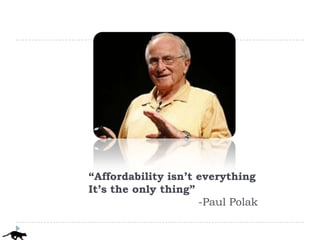
“Affordability isn’t everything
It’s the only thing”
                     -Paul Polak
   International Development Enterprise
   Founded in 1981
   International not-for-profit corporation devoted to the
    manufacture, marketing, and, scalable micro-irrigation
    and other low-cost water recovery systems throughout
    the developing world
   Facilitates local manufacture and distribution of these
    products through local supply chains that sell to farmers
    at an affordable price
   This strategy allows farmers to grow higher value and
    surplus crops, and in turn links them to high-value crop
    markets where they can realize profits from their higher
    yields.
   Mainly work in Africa (Burkina Faso, Ghana,
    Ethiopia, Zambia, Zimbabwe, Mozambique), Asia
    (India, Nepal, Bangladesh, Myanmar, Cambodia
    and Vietnam) and Latin America (Honduras and
    Nicaragua)
   Decentralized organizational structure
   Head office in India - New Delhi
   Field office in in India - Orissa, West Bengal,
    Aurangabad, Bangalore, Indore, Himachal Pradesh
    and Udaipur
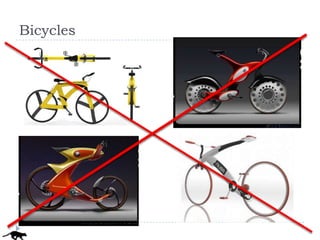
Bicycles
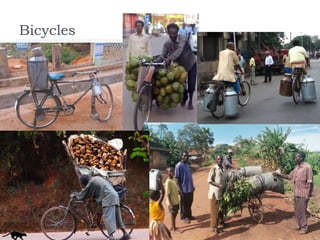
Bicycles
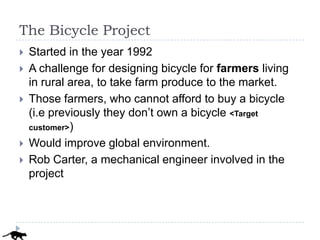
The Bicycle Project
   Started in the year 1992
   A challenge for designing bicycle for farmers living
    in rural area, to take farm produce to the market.
   Those farmers, who cannot afford to buy a bicycle
    (i.e previously they don’t own a bicycle <Target
    customer>)

   Would improve global environment.
   Rob Carter, a mechanical engineer involved in the
    project
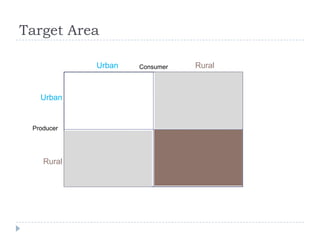
Target Area

            Urban   Consumer   Rural


   Urban


 Producer


    Rural
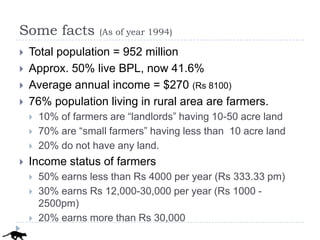
Some facts           (As of year 1994)

   Total population = 952 million
   Approx. 50% live BPL, now 41.6%
   Average annual income = $270 (Rs 8100)
   76% population living in rural area are farmers.
       10% of farmers are “landlords” having 10-50 acre land
       70% are “small farmers” having less than 10 acre land
       20% do not have any land.
   Income status of farmers
       50% earns less than Rs 4000 per year (Rs 333.33 pm)
       30% earns Rs 12,000-30,000 per year (Rs 1000 -
        2500pm)
       20% earns more than Rs 30,000
Some facts       (As of year 1994)

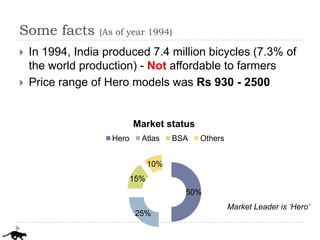
   In 1994, India produced 7.4 million bicycles (7.3% of
    the world production) - Not affordable to farmers
   Price range of Hero models was Rs 930 - 2500


                           Market status
                    Hero     Atlas     BSA   Others


                                 10%
                           15%
                                         50%
                                                      Market Leader is ‘Hero’
                            25%
The bicycle project
   IDE bicycles must have;
       Simple design – could be manufactured and served in rural
        setting
       Durable, with ease of maintenance
       Minimum speed capability of 6 miles an hour (twice the speed
        of walking)
       Withstand gravel-paved or dirt roads
       Transport of minimum 50Kg of cargo
       Retail including profit margin at not more than $ 15 (approx Rs
        450)
   %15 is a target lesser than the minimum price in India for
    a bicycle.
   IDE also emphasized on the price, that it should not be
    higher than the second hand bicycle.
Technological development
   Main aim to reduce the cost
       Stripped bells and whistles
       Chins and sprockets were removed and the drive was
        placed directly on the first wheel
       Sheet metal was to be used to make the frame
   The key success of the project rested on a wheel
    (How??)
       Cheapest wheel available was of $5 each. i.e. $10 for
        both wheel
       Frame and front fork will cost $ 10
       Over all cost would reach $20 (Higher than the ceiling
        retail price)
       Plastic Wheel can be the solution (given by Joe Montgomery)
IDE concern
   Their bike would be the cheapest
   With the increase in income gradually, target
    consumer may shift towards the conventional
    bicycle.
Field Testing
   Prototype suitable to Indian farmers were made, and
    tested
   Subcontracted to local village NGOs
   Mixed response
       Stable/unstable
       Easy/difficult ride
   Farmers found it uncomfortable
   Limited carrying capacity
The challenge
   To find solution for wheel and bearings

                                       Samples were
•Plastic wheel made                 collected and were
up of nylon reinforced               sent for physical
with fiberglass (used
                                  testing in University of
in wheelchair) – It
would be costly                          Colorado
•Polypropylene –
found in twine used               Later Canadian firm also
for bailing hay, will be          shown unwillingness to
reinforced with jute.             make more samples
The challenge
   Cannondale - An American bicycle manufacturer
    was very impressed with what Paul has done
   Paul realized that Best fit is in Hero, but his ceiling
    price is too low to agree Hero upon
   Or Paul should look for other industrial giants like
    Tatas and Birlas as partners
4 A analysis
   Awareness - Positive
   Availability - Positive
   Affordability - Positive
   Acceptability - Positive
What he should do??


         SCRAP        CONTINUE
Bicycle for india himanshu

Bicycle for india himanshu

  • 1.
    Bicycle for India ByVijaya Narayanpeddy and Nancy Sampson Himanshu Singh (1012)
  • 2.
    “Affordability isn’t everything It’sthe only thing” -Paul Polak
  • 3.
    International Development Enterprise  Founded in 1981  International not-for-profit corporation devoted to the manufacture, marketing, and, scalable micro-irrigation and other low-cost water recovery systems throughout the developing world  Facilitates local manufacture and distribution of these products through local supply chains that sell to farmers at an affordable price  This strategy allows farmers to grow higher value and surplus crops, and in turn links them to high-value crop markets where they can realize profits from their higher yields.
  • 4.
    Mainly work in Africa (Burkina Faso, Ghana, Ethiopia, Zambia, Zimbabwe, Mozambique), Asia (India, Nepal, Bangladesh, Myanmar, Cambodia and Vietnam) and Latin America (Honduras and Nicaragua)  Decentralized organizational structure  Head office in India - New Delhi  Field office in in India - Orissa, West Bengal, Aurangabad, Bangalore, Indore, Himachal Pradesh and Udaipur
  • 5.
  • 6.
  • 7.
    The Bicycle Project  Started in the year 1992  A challenge for designing bicycle for farmers living in rural area, to take farm produce to the market.  Those farmers, who cannot afford to buy a bicycle (i.e previously they don’t own a bicycle <Target customer>)  Would improve global environment.  Rob Carter, a mechanical engineer involved in the project
  • 8.
    Target Area Urban Consumer Rural Urban Producer Rural
  • 9.
    Some facts (As of year 1994)  Total population = 952 million  Approx. 50% live BPL, now 41.6%  Average annual income = $270 (Rs 8100)  76% population living in rural area are farmers.  10% of farmers are “landlords” having 10-50 acre land  70% are “small farmers” having less than 10 acre land  20% do not have any land.  Income status of farmers  50% earns less than Rs 4000 per year (Rs 333.33 pm)  30% earns Rs 12,000-30,000 per year (Rs 1000 - 2500pm)  20% earns more than Rs 30,000
  • 10.
    Some facts (As of year 1994)  In 1994, India produced 7.4 million bicycles (7.3% of the world production) - Not affordable to farmers  Price range of Hero models was Rs 930 - 2500 Market status Hero Atlas BSA Others 10% 15% 50% Market Leader is ‘Hero’ 25%
  • 11.
    The bicycle project  IDE bicycles must have;  Simple design – could be manufactured and served in rural setting  Durable, with ease of maintenance  Minimum speed capability of 6 miles an hour (twice the speed of walking)  Withstand gravel-paved or dirt roads  Transport of minimum 50Kg of cargo  Retail including profit margin at not more than $ 15 (approx Rs 450)  %15 is a target lesser than the minimum price in India for a bicycle.  IDE also emphasized on the price, that it should not be higher than the second hand bicycle.
  • 12.
    Technological development  Main aim to reduce the cost  Stripped bells and whistles  Chins and sprockets were removed and the drive was placed directly on the first wheel  Sheet metal was to be used to make the frame  The key success of the project rested on a wheel (How??)  Cheapest wheel available was of $5 each. i.e. $10 for both wheel  Frame and front fork will cost $ 10  Over all cost would reach $20 (Higher than the ceiling retail price)  Plastic Wheel can be the solution (given by Joe Montgomery)
  • 14.
    IDE concern  Their bike would be the cheapest  With the increase in income gradually, target consumer may shift towards the conventional bicycle.
  • 15.
    Field Testing  Prototype suitable to Indian farmers were made, and tested  Subcontracted to local village NGOs  Mixed response  Stable/unstable  Easy/difficult ride  Farmers found it uncomfortable  Limited carrying capacity
  • 16.
    The challenge  To find solution for wheel and bearings Samples were •Plastic wheel made collected and were up of nylon reinforced sent for physical with fiberglass (used testing in University of in wheelchair) – It would be costly Colorado •Polypropylene – found in twine used Later Canadian firm also for bailing hay, will be shown unwillingness to reinforced with jute. make more samples
  • 17.
    The challenge  Cannondale - An American bicycle manufacturer was very impressed with what Paul has done  Paul realized that Best fit is in Hero, but his ceiling price is too low to agree Hero upon  Or Paul should look for other industrial giants like Tatas and Birlas as partners
  • 18.
    4 A analysis  Awareness - Positive  Availability - Positive  Affordability - Positive  Acceptability - Positive
  • 19.
    What he shoulddo?? SCRAP CONTINUE