Examining
Biased and
Unbiased
Statements
● Bias is a tendency to lean in a certain direction,
either in favor of or against a particular thing. To
be truly biased means to lack a neutral viewpoint
on a particular topic.
● It is also defined as:
- a prejudice against something an author
is writing about;
- a favoritism for something an author is writing
about;
- an author letting feelings or emotions cloud
his/her objectivity with regard to something he/she
is writing about
Recognizing Bias
1. Look for loaded words – words that are charged with
emotion (whether positive or negative) can reveal an author’s
opinion about his/her topic.
2. Watch out for stereotypes – if the author labels an entire
group, the writing is probably biased.
3. Notice vague language or generalizations – if the author
isn’t using specific language, this could be an indicator of bias.
4. Be on the lookout for one-sided arguments – if the author
only presents one side of an argument, his/her writing is
probably biased.
5. Does the author present facts or opinions? Facts are what
they are – the truth. But opinions can be based on feelings,
emotions, or prejudices, which aren’t objective.
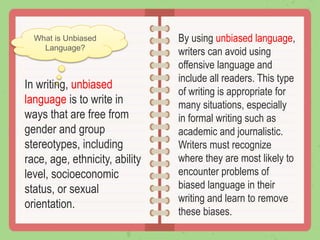
In writing, unbiased
language is to write in
ways that are free from
gender and group
stereotypes, including
race, age, ethnicity, ability
level, socioeconomic
status, or sexual
orientation.
What is Unbiased
Language?
By using unbiased language,
writers can avoid using
offensive language and
include all readers. This type
of writing is appropriate for
many situations, especially
in formal writing such as
academic and journalistic.
Writers must recognize
where they are most likely to
encounter problems of
biased language in their
writing and learn to remove
these biases.
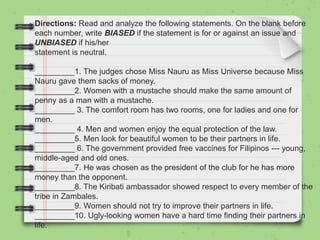
Directions: Read and analyze the following statements. On the blank before
each number, write BIASED if the statement is for or against an issue and
UNBIASED if his/her
statement is neutral.
_________1. The judges chose Miss Nauru as Miss Universe because Miss
Nauru gave them sacks of money.
_________2. Women with a mustache should make the same amount of
penny as a man with a mustache.
_________ 3. The comfort room has two rooms, one for ladies and one for
men.
_________ 4. Men and women enjoy the equal protection of the law.
_________5. Men look for beautiful women to be their partners in life.
_________ 6. The government provided free vaccines for Filipinos --- young,
middle-aged and old ones.
_________7. He was chosen as the president of the club for he has more
money than the opponent.
_________8. The Kiribati ambassador showed respect to every member of the
tribe in Zambales.
_________9. Women should not try to improve their partners in life.
_________10. Ugly-looking women have a hard time finding their partners in
life.

bias unbiased.pptx

  • 1.
  • 2.
    ● Bias isa tendency to lean in a certain direction, either in favor of or against a particular thing. To be truly biased means to lack a neutral viewpoint on a particular topic. ● It is also defined as: - a prejudice against something an author is writing about; - a favoritism for something an author is writing about; - an author letting feelings or emotions cloud his/her objectivity with regard to something he/she is writing about
  • 3.
    Recognizing Bias 1. Lookfor loaded words – words that are charged with emotion (whether positive or negative) can reveal an author’s opinion about his/her topic. 2. Watch out for stereotypes – if the author labels an entire group, the writing is probably biased. 3. Notice vague language or generalizations – if the author isn’t using specific language, this could be an indicator of bias. 4. Be on the lookout for one-sided arguments – if the author only presents one side of an argument, his/her writing is probably biased. 5. Does the author present facts or opinions? Facts are what they are – the truth. But opinions can be based on feelings, emotions, or prejudices, which aren’t objective.
  • 8.
    In writing, unbiased languageis to write in ways that are free from gender and group stereotypes, including race, age, ethnicity, ability level, socioeconomic status, or sexual orientation. What is Unbiased Language? By using unbiased language, writers can avoid using offensive language and include all readers. This type of writing is appropriate for many situations, especially in formal writing such as academic and journalistic. Writers must recognize where they are most likely to encounter problems of biased language in their writing and learn to remove these biases.
  • 12.
    Directions: Read andanalyze the following statements. On the blank before each number, write BIASED if the statement is for or against an issue and UNBIASED if his/her statement is neutral. _________1. The judges chose Miss Nauru as Miss Universe because Miss Nauru gave them sacks of money. _________2. Women with a mustache should make the same amount of penny as a man with a mustache. _________ 3. The comfort room has two rooms, one for ladies and one for men. _________ 4. Men and women enjoy the equal protection of the law. _________5. Men look for beautiful women to be their partners in life. _________ 6. The government provided free vaccines for Filipinos --- young, middle-aged and old ones. _________7. He was chosen as the president of the club for he has more money than the opponent. _________8. The Kiribati ambassador showed respect to every member of the tribe in Zambales. _________9. Women should not try to improve their partners in life. _________10. Ugly-looking women have a hard time finding their partners in life.