CONTENTS
• Introduction to python
• History of python
• Basics of programming python
• Object oriented programming (oop)
• Applications
INTRODUCTION TO PYTHON
• Python is a general purpose programming language that is often to applied in
scripting roles.
• So, python is programming language as well as scripting language.
• Python is also called interpreted language.
HISTORY OF PYTHON
• Invented in Netherlands, early 90’s by Guido van Rossum
• Python was conceived in the alte 1980’s and its implementation was started in
December 1989
HOW TO PRINT OUTPUT
• It is very easy to print output.
• Print(“HELLO WORLD”)
• Here print is predefined function in python for printing the output.
BASICS OF PYTHON PROGRAMMING
• Keywords in python
• Python variables
• Data types
• Python operators
• Conditional and Looping statements
• Python functions
KEYWORDS IN PYTHON
• Keywords are predefined, reserved words used in Python programming that have
special meanings to the compiler.
• We cannot use a keyword as a variable name, function name, or any other
identifier. They are used to define the syntax and structure of the Python
language.
• Ex: True, False, else, def, if, import, for, pass, return.
PYTHON VARIABLES
• In programming, a variable is a container (storage area) to hold data. For
example
• number=10
• Here, number is the variable storing the value 10
DATA TYPES
• In computer programming, data types specify the type of data that can be stored
inside a variable.
• num=6.
• Here 6 is an integer is assigned to num variable. So that num is the integer data
type.
PYTHON DATA TYPES
NAME TYPE DESCRIPTION
Integer int To store sny integer value such as: 3,400,34
Floating point float Numbers with decimal values:3.45,12.7
Strings Str Collection of characters:” Bhaskar”
Lists List A=[10,”rohit”,20.9]
Dictionaries Dict B={1:”dhoni”,2:2003,3:6}
Sets Sets C={1,2,3,”virat”}
Tuples Tuple D=(“Bhaskar”,6,9,2003)
Boolean bool Logical value indicating True or false
PYTHON OPERATORS
• Here's a list of different types of Python operators that we will learn in this tutorial.
• Arithmetic operators : +, - , * , /, % etc.
• Assignment operators : =, +=, -=, *= etc.
• Logical operators : and, or, not
• Bitwise operators : &, |, ^, >>, <<
• Conditional operators : ==, < , >, >=, <=, !=
CONDITIONAL STATEMENTS
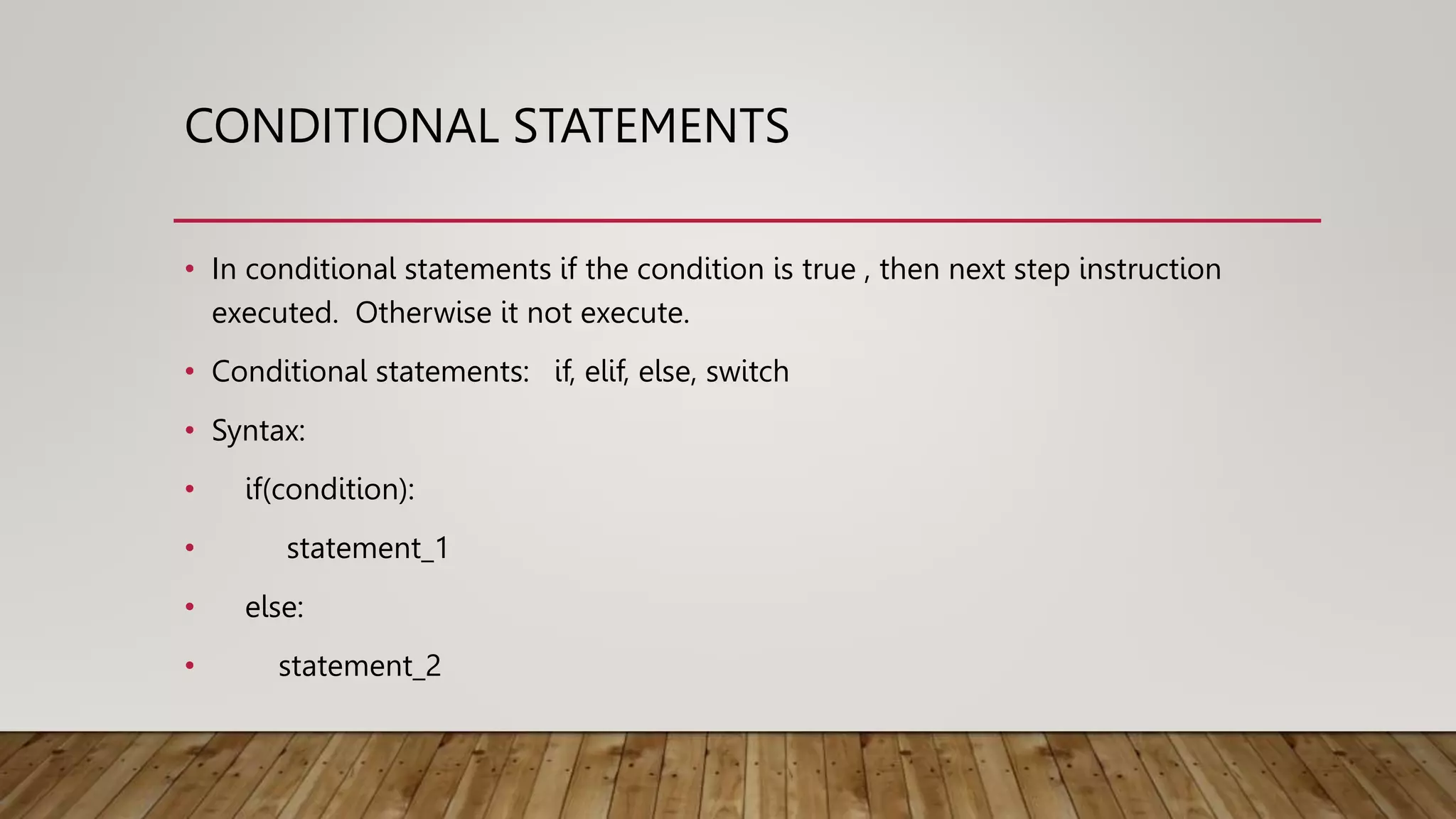
• In conditional statements if the condition is true , then next step instruction
executed. Otherwise it not execute.
• Conditional statements: if, elif, else, switch
• Syntax:
• if(condition):
• statement_1
• else:
• statement_2
LOOP STATEMENTS
• Generally looping statements are used for repeatition.
• Loop statements: for, while, do while.
• Syntax:
• for( range):
• statement_1
• statement_2
PYTHON FUNCTIONS
• A function is a block of code that performs a specific task.
There are two types of function in Python programming:
•Standard library functions - These are built-in functions in Python that
are available to use.
•User-defined functions - We can create our own functions based on
our requirements.
PYTHON FUNCTIONS
• Syntax:
• def greet():
• print(“hello world”)
• Here def is the keyword to create a user defined function and greet is the
function name. That is our choice to give any name to the function.
OBJECT ORIENTED PROGRAMMING
• Python is a versatile programming language that supports various programming
styles, including object-oriented programming (OOP) through the use
of objects and classes.
• An object is any entity that has attributes and behaviors
• A class is a blueprint for that object.
OBJECT ORIENTED PROGRAMMING
• INHERITANCE : Inheritance is a way of creating a new class for using details of an existing class
without modifying it. The newly formed class is a derived class (or child class). Similarly, the existing
class is a base class (or parent class).
• ENCAPSULATION : Encapsulation is one of the key features of object-oriented programming.
Encapsulation refers to the bundling of attributes and methods inside a single class.It prevents
outer classes from accessing and changing attributes and methods of a class. This also helps to
achieve data hiding.
• POLYMORPHISM: Polymorphism is another important concept of object-oriented programming. It
simply means more than one form.
•
APPLICATIONS
• Database programming
• GUI programming
• Games and 3d garphics
• Web development
• Scientific applications
THANK YOU

bhaskars.pptx

  • 1.
    CONTENTS • Introduction topython • History of python • Basics of programming python • Object oriented programming (oop) • Applications
  • 2.
    INTRODUCTION TO PYTHON •Python is a general purpose programming language that is often to applied in scripting roles. • So, python is programming language as well as scripting language. • Python is also called interpreted language.
  • 3.
    HISTORY OF PYTHON •Invented in Netherlands, early 90’s by Guido van Rossum • Python was conceived in the alte 1980’s and its implementation was started in December 1989
  • 4.
    HOW TO PRINTOUTPUT • It is very easy to print output. • Print(“HELLO WORLD”) • Here print is predefined function in python for printing the output.
  • 5.
    BASICS OF PYTHONPROGRAMMING • Keywords in python • Python variables • Data types • Python operators • Conditional and Looping statements • Python functions
  • 6.
    KEYWORDS IN PYTHON •Keywords are predefined, reserved words used in Python programming that have special meanings to the compiler. • We cannot use a keyword as a variable name, function name, or any other identifier. They are used to define the syntax and structure of the Python language. • Ex: True, False, else, def, if, import, for, pass, return.
  • 7.
    PYTHON VARIABLES • Inprogramming, a variable is a container (storage area) to hold data. For example • number=10 • Here, number is the variable storing the value 10
  • 8.
    DATA TYPES • Incomputer programming, data types specify the type of data that can be stored inside a variable. • num=6. • Here 6 is an integer is assigned to num variable. So that num is the integer data type.
  • 9.
    PYTHON DATA TYPES NAMETYPE DESCRIPTION Integer int To store sny integer value such as: 3,400,34 Floating point float Numbers with decimal values:3.45,12.7 Strings Str Collection of characters:” Bhaskar” Lists List A=[10,”rohit”,20.9] Dictionaries Dict B={1:”dhoni”,2:2003,3:6} Sets Sets C={1,2,3,”virat”} Tuples Tuple D=(“Bhaskar”,6,9,2003) Boolean bool Logical value indicating True or false
  • 10.
    PYTHON OPERATORS • Here'sa list of different types of Python operators that we will learn in this tutorial. • Arithmetic operators : +, - , * , /, % etc. • Assignment operators : =, +=, -=, *= etc. • Logical operators : and, or, not • Bitwise operators : &, |, ^, >>, << • Conditional operators : ==, < , >, >=, <=, !=
  • 11.
    CONDITIONAL STATEMENTS • Inconditional statements if the condition is true , then next step instruction executed. Otherwise it not execute. • Conditional statements: if, elif, else, switch • Syntax: • if(condition): • statement_1 • else: • statement_2
  • 12.
    LOOP STATEMENTS • Generallylooping statements are used for repeatition. • Loop statements: for, while, do while. • Syntax: • for( range): • statement_1 • statement_2
  • 13.
    PYTHON FUNCTIONS • Afunction is a block of code that performs a specific task. There are two types of function in Python programming: •Standard library functions - These are built-in functions in Python that are available to use. •User-defined functions - We can create our own functions based on our requirements.
  • 14.
    PYTHON FUNCTIONS • Syntax: •def greet(): • print(“hello world”) • Here def is the keyword to create a user defined function and greet is the function name. That is our choice to give any name to the function.
  • 15.
    OBJECT ORIENTED PROGRAMMING •Python is a versatile programming language that supports various programming styles, including object-oriented programming (OOP) through the use of objects and classes. • An object is any entity that has attributes and behaviors • A class is a blueprint for that object.
  • 16.
    OBJECT ORIENTED PROGRAMMING •INHERITANCE : Inheritance is a way of creating a new class for using details of an existing class without modifying it. The newly formed class is a derived class (or child class). Similarly, the existing class is a base class (or parent class). • ENCAPSULATION : Encapsulation is one of the key features of object-oriented programming. Encapsulation refers to the bundling of attributes and methods inside a single class.It prevents outer classes from accessing and changing attributes and methods of a class. This also helps to achieve data hiding. • POLYMORPHISM: Polymorphism is another important concept of object-oriented programming. It simply means more than one form. •
  • 17.
    APPLICATIONS • Database programming •GUI programming • Games and 3d garphics • Web development • Scientific applications
  • 18.