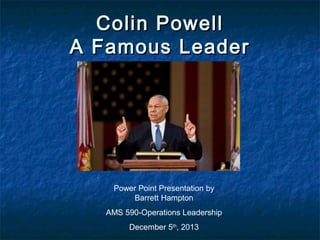
Colin Powell
A Famous Leader

Power Point Presentation by
Barrett Hampton
AMS 590-Operations Leadership
December 5th, 2013
Colin Powell
A little background


Born in Harlem, NY in April of 1937.



Raised by immigrant parents in Bronx.



Education:
 BS in Geology 1958 from City College of NY
 MBA in 1971 from George Washington Uni.
(Powell, 1995)
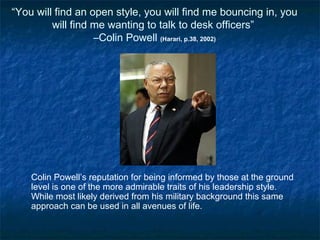
“You will find an open style, you will find me bouncing in, you
will find me wanting to talk to desk officers”
–Colin Powell (Harari, p.38, 2002)

Colin Powell’s reputation for being informed by those at the ground
level is one of the more admirable traits of his leadership style.
While most likely derived from his military background this same
approach can be used in all avenues of life.
Rising through the Ranks










ROTC during undergrad years (1954-58)
2nd Lieutenant 1958
1962 Military Advisor in Vietnam
Promoted to Major (1966)
Promoted to Lieutenant Colonel (1969)
Full Colonel (1973)
Brigade General (1978)
Lieutenant General (1986)
4 Star General (1989)

(Powell, 1995)
Increased
Responsibilities






1st ARVN Division Headquarters - Advisor
Fort Benning – Infantry Trainer
South Korea – Commander 1st Battalion
101st Airborne – Lead Division Officer
Fort Carson - Asst. Division Commander

(Powell, 1995)
Powell’s Five Principles on
Communications







Maintain a real, no b.s. open-door policy.
Foster a noisy system.
Use every means to encourage communication, never
let hierarchy get in the way.
Use technology to improve communication
Treat turf wars as the enemy of communication.

(Harari, 2002)
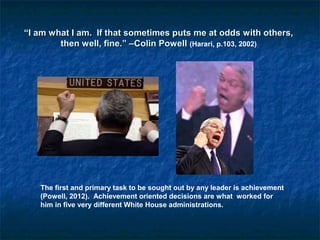
“I am what I am. If that sometimes puts me at odds with others,
then well, fine.” –Colin Powell (Harari, p.103, 2002)

The first and primary task to be sought out by any leader is achievement
(Powell, 2012). Achievement oriented decisions are what worked for
him in five very different White House administrations.
Leading through Changes

Consistent Achievement creates
Consistent Reliability
Working with Presidential
Administrations
Nixon: White House Fellow in
the Office of Management and Budget
 Carter: Senior Assistant to deputy
secretary of defense.
 Reagan: Senior Military Assistant
 G.H.W. Bush: Chairman of Joint Chiefs
 Clinton: Chairman of Joint Chiefs
 G.W. Bush: Secretary of State


(Powell, 2012)
Powell’s Four Principles on
Challenge






Challenge the pros to get better solutions.
Emphasize dignity, respect, and honor while
disagreeing.
Be Patient.
Build a setting in which all feel free to speak out.

(Harari, 2002)
“Leadership will always require people who are able to organize
the effort of (others) to accomplish the objectives that flow from
the vision” –Colin Powell (Harari, p.126, 2002)

These words are a reflection of the style approach in which Colin Powell
leads. His intent is that a leader should understand that it takes all
people involved to achieve goals and that the ability to focus them is the
core of leadership.
Powell’s Principles on
People






Count on people more than plans or structures.
Assume that people are competent, and that
every job counts, until proven otherwise.
Spend at least 50% of your time on people.
View people as partners, regardless of their
place in hierarchy.
Become a servant leader. Work for your
people.
(Harari, 2002)
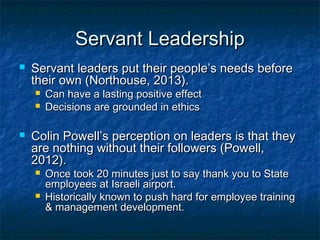
Servant Leadership


Servant leaders put their people’s needs before
their own (Northouse, 2013).





Can have a lasting positive effect
Decisions are grounded in ethics

Colin Powell’s perception on leaders is that they
are nothing without their followers (Powell,
2012).



Once took 20 minutes just to say thank you to State
employees at Israeli airport.
Historically known to push hard for employee training
& management development.
Powell Points on Picking People









Intelligence
Judgment
Capacity to anticipate
Loyalty
Integrity
High energy
Balanced ego
Drive to get things done

(Harari, 2002)
Powell’s Leadership Belief
“The leader sets an example. Whether in the
Army or in civilian life, the other people in
the organization that their cue from the
leader—not from what the leader says but
from what the leader does”
–Colin Powel (Harari, p.249, 2002).
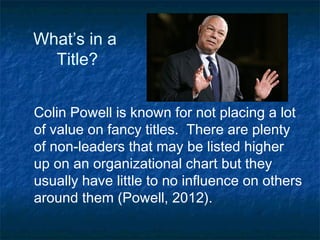
What’s in a
Title?
Colin Powell is known for not placing a lot
of value on fancy titles. There are plenty
of non-leaders that may be listed higher
up on an organizational chart but they
usually have little to no influence on others
around them (Powell, 2012).
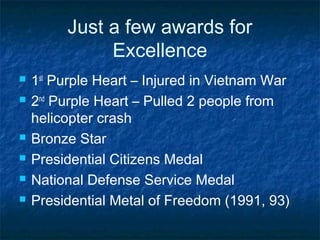
Just a few awards for
Excellence








1st Purple Heart – Injured in Vietnam War
2nd Purple Heart – Pulled 2 people from
helicopter crash
Bronze Star
Presidential Citizens Medal
National Defense Service Medal
Presidential Metal of Freedom (1991, 93)
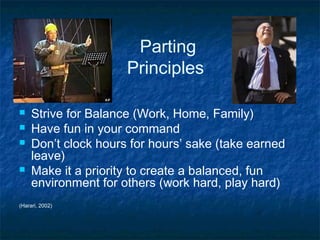
Parting
Principles





Strive for Balance (Work, Home, Family)
Have fun in your command
Don’t clock hours for hours’ sake (take earned
leave)
Make it a priority to create a balanced, fun
environment for others (work hard, play hard)

(Harari, 2002)
Why Colin Powell?
Colin Powell rose up from a modest living to
become one of the world’s most recognized
American leader. His consistent actions were
always in line with his words. This type of
approach not only earned him many awards and
recognitions but it has lasted through many
Whitehouse administrations. He is arguably the
best living example of leadership in America.
“Being responsible sometimes means pissing people off”
–Colin Powell (Harari, p.30, 2002)

References

Harai, O. (2002). The Leadership Secrets of Colin Powell. New York, NY: McGraw-Hil
Northouse, P. G. (2013). Leadership: Theory and practice (6th ed.). Thousand Oaks, CA:
SAGE Publications, Inc
Powell, C., Persico, J. (1995). My American Journey. New York, NY: Random House
Powell, C., Kotzen, T. (2012). It worked for me: In life and leadership. NY: Harper.

Bhampton colin powell

  • 1.
    Colin Powell A FamousLeader Power Point Presentation by Barrett Hampton AMS 590-Operations Leadership December 5th, 2013
  • 2.
    Colin Powell A littlebackground  Born in Harlem, NY in April of 1937.  Raised by immigrant parents in Bronx.  Education:  BS in Geology 1958 from City College of NY  MBA in 1971 from George Washington Uni. (Powell, 1995)
  • 3.
    “You will findan open style, you will find me bouncing in, you will find me wanting to talk to desk officers” –Colin Powell (Harari, p.38, 2002) Colin Powell’s reputation for being informed by those at the ground level is one of the more admirable traits of his leadership style. While most likely derived from his military background this same approach can be used in all avenues of life.
  • 4.
    Rising through theRanks          ROTC during undergrad years (1954-58) 2nd Lieutenant 1958 1962 Military Advisor in Vietnam Promoted to Major (1966) Promoted to Lieutenant Colonel (1969) Full Colonel (1973) Brigade General (1978) Lieutenant General (1986) 4 Star General (1989) (Powell, 1995)
  • 5.
    Increased Responsibilities      1st ARVN DivisionHeadquarters - Advisor Fort Benning – Infantry Trainer South Korea – Commander 1st Battalion 101st Airborne – Lead Division Officer Fort Carson - Asst. Division Commander (Powell, 1995)
  • 6.
    Powell’s Five Principleson Communications      Maintain a real, no b.s. open-door policy. Foster a noisy system. Use every means to encourage communication, never let hierarchy get in the way. Use technology to improve communication Treat turf wars as the enemy of communication. (Harari, 2002)
  • 7.
    “I am whatI am. If that sometimes puts me at odds with others, then well, fine.” –Colin Powell (Harari, p.103, 2002) The first and primary task to be sought out by any leader is achievement (Powell, 2012). Achievement oriented decisions are what worked for him in five very different White House administrations.
  • 8.
    Leading through Changes ConsistentAchievement creates Consistent Reliability
  • 9.
    Working with Presidential Administrations Nixon:White House Fellow in the Office of Management and Budget  Carter: Senior Assistant to deputy secretary of defense.  Reagan: Senior Military Assistant  G.H.W. Bush: Chairman of Joint Chiefs  Clinton: Chairman of Joint Chiefs  G.W. Bush: Secretary of State  (Powell, 2012)
  • 10.
    Powell’s Four Principleson Challenge     Challenge the pros to get better solutions. Emphasize dignity, respect, and honor while disagreeing. Be Patient. Build a setting in which all feel free to speak out. (Harari, 2002)
  • 11.
    “Leadership will alwaysrequire people who are able to organize the effort of (others) to accomplish the objectives that flow from the vision” –Colin Powell (Harari, p.126, 2002) These words are a reflection of the style approach in which Colin Powell leads. His intent is that a leader should understand that it takes all people involved to achieve goals and that the ability to focus them is the core of leadership.
  • 12.
    Powell’s Principles on People      Counton people more than plans or structures. Assume that people are competent, and that every job counts, until proven otherwise. Spend at least 50% of your time on people. View people as partners, regardless of their place in hierarchy. Become a servant leader. Work for your people. (Harari, 2002)
  • 13.
    Servant Leadership  Servant leadersput their people’s needs before their own (Northouse, 2013).    Can have a lasting positive effect Decisions are grounded in ethics Colin Powell’s perception on leaders is that they are nothing without their followers (Powell, 2012).   Once took 20 minutes just to say thank you to State employees at Israeli airport. Historically known to push hard for employee training & management development.
  • 14.
    Powell Points onPicking People         Intelligence Judgment Capacity to anticipate Loyalty Integrity High energy Balanced ego Drive to get things done (Harari, 2002)
  • 15.
    Powell’s Leadership Belief “Theleader sets an example. Whether in the Army or in civilian life, the other people in the organization that their cue from the leader—not from what the leader says but from what the leader does” –Colin Powel (Harari, p.249, 2002).
  • 16.
    What’s in a Title? ColinPowell is known for not placing a lot of value on fancy titles. There are plenty of non-leaders that may be listed higher up on an organizational chart but they usually have little to no influence on others around them (Powell, 2012).
  • 17.
    Just a fewawards for Excellence       1st Purple Heart – Injured in Vietnam War 2nd Purple Heart – Pulled 2 people from helicopter crash Bronze Star Presidential Citizens Medal National Defense Service Medal Presidential Metal of Freedom (1991, 93)
  • 18.
    Parting Principles     Strive for Balance(Work, Home, Family) Have fun in your command Don’t clock hours for hours’ sake (take earned leave) Make it a priority to create a balanced, fun environment for others (work hard, play hard) (Harari, 2002)
  • 19.
    Why Colin Powell? ColinPowell rose up from a modest living to become one of the world’s most recognized American leader. His consistent actions were always in line with his words. This type of approach not only earned him many awards and recognitions but it has lasted through many Whitehouse administrations. He is arguably the best living example of leadership in America.
  • 20.
    “Being responsible sometimesmeans pissing people off” –Colin Powell (Harari, p.30, 2002) References Harai, O. (2002). The Leadership Secrets of Colin Powell. New York, NY: McGraw-Hil Northouse, P. G. (2013). Leadership: Theory and practice (6th ed.). Thousand Oaks, CA: SAGE Publications, Inc Powell, C., Persico, J. (1995). My American Journey. New York, NY: Random House Powell, C., Kotzen, T. (2012). It worked for me: In life and leadership. NY: Harper.