Download to read offline


![• Are people who are
from Albion there?
Insulae Albion et Hibernia cum minoribus adjacentibus, 1600-1699,
Bibliothèque nationale de France, département Cartes et plans,
CPL GE DD-2987 (9732), [Europeana.eu].](https://image.slidesharecdn.com/lauzikashpnamersfoort2016-2-160405125846/75/Beyond-the-space-the-LoCloud-Historical-Place-Names-microservice-4-2048.jpg)

![• Have you ever been to
Aquinicum?
Plattegrond van Buda, 1686, Harmanus van Loon, Lodewijk XIV (koning van
Frankrijk), 1693 - 1696, Rijksmuseum, RP-P-1892-A-16766,
[Europeana.eu].](https://image.slidesharecdn.com/lauzikashpnamersfoort2016-2-160405125846/75/Beyond-the-space-the-LoCloud-Historical-Place-Names-microservice-6-2048.jpg)
![• Do you know where
Atlantis is located?
Carte de l'Atlantide : d'après Platon et Diodore, 1775, Bibliothèque nationale
de France, département Cartes et plans, GE D-17772, [Europeana.eu].](https://image.slidesharecdn.com/lauzikashpnamersfoort2016-2-160405125846/75/Beyond-the-space-the-LoCloud-Historical-Place-Names-microservice-8-2048.jpg)
![• The set of place names in historical sources.
Three points of view: geographical (earth sciences), historical (humanities), IT
(technical).
Two understandings: geo-name as tool [for information management], geo-name as
intangible heritage.
Technically [in mean of CIDOC-CRM] an HPN is a place appellation, which may
refer to several places, because its use may change over time.
On the other hand, the place as an object is determined in GIS as a defined
immovable geographic object: point, polygon or a line on a map
A place name can be understood as an historical identifier for several places and (or)
as a kind of intangible heritage (“non-material products of our minds”).
What are Historical Place Names?](https://image.slidesharecdn.com/lauzikashpnamersfoort2016-2-160405125846/75/Beyond-the-space-the-LoCloud-Historical-Place-Names-microservice-9-2048.jpg)
![1. Interoperability.
[Europeana.eu, 09-02-2015: Lietuva: 39697;
Lithuania: 28948; Litauen: 11308;
Lituanie: 8770; Litwa: 20647; ...].
2. Conservation of intangible heritage.
[HPN as a link between past and present
(“enduring voices”), losing HPN is
losing our cultural signs].
3. Creation of European “multi-
narrative”/”political narrative”.
[“the mind and body of Europe”].
What are the problems?
Sebastian Munster. Europa Regina, Cosmographia, Basel, 1570,
[Wikipedia.org].](https://image.slidesharecdn.com/lauzikashpnamersfoort2016-2-160405125846/75/Beyond-the-space-the-LoCloud-Historical-Place-Names-microservice-10-2048.jpg)

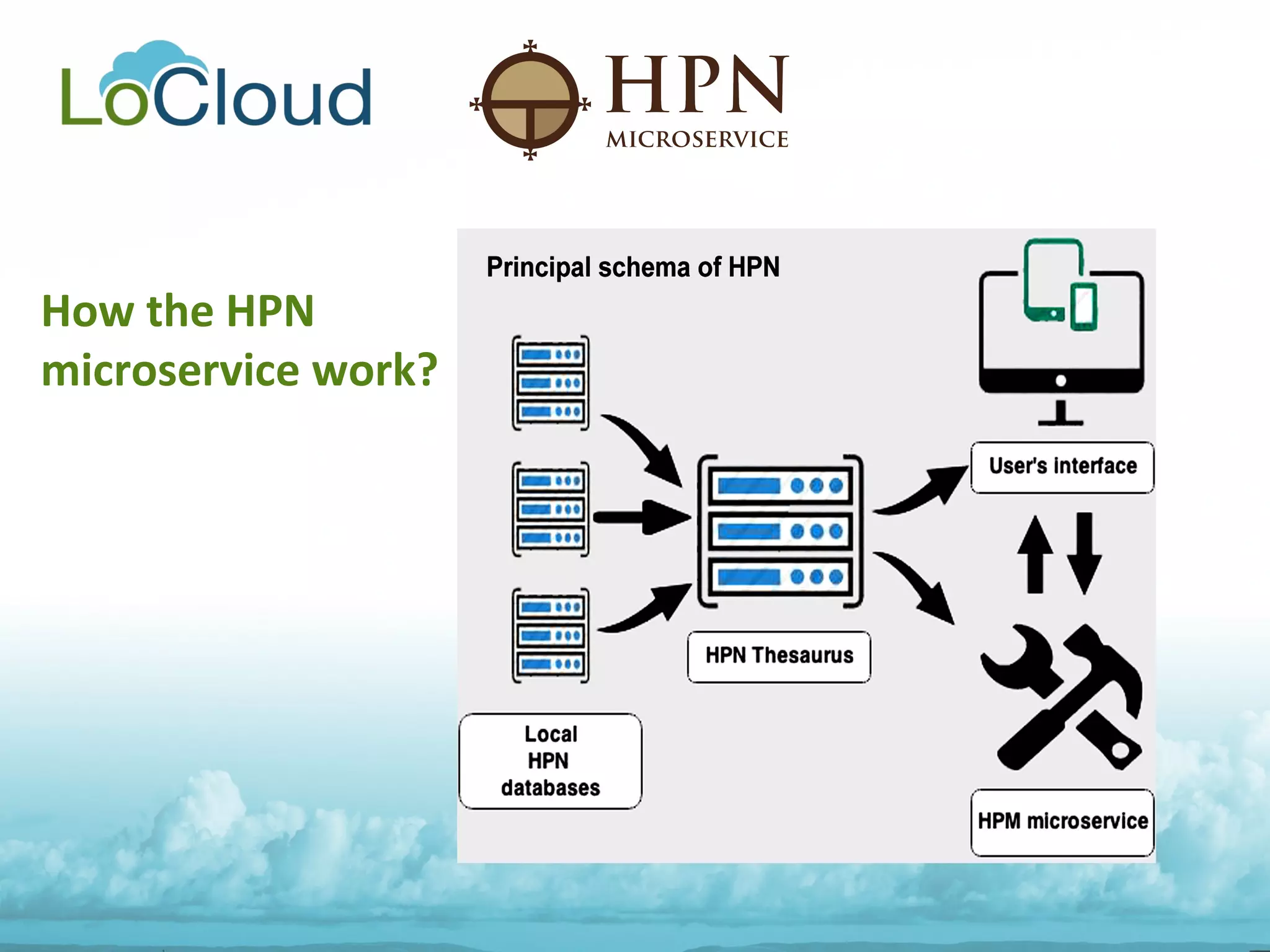
![User Case I:
Local history researcher
[unregistered user]
• To verify the availability of a
historical place name in the
LoCloud HPN Thesaurus
• To get information about the
interconnection of HPN with
contemporary place names, its
linguistic variations and
geographical coordinates
• To propose [crowdsource] a new
historic place name for the
LoCloud HPN Thesaurus](https://image.slidesharecdn.com/lauzikashpnamersfoort2016-2-160405125846/75/Beyond-the-space-the-LoCloud-Historical-Place-Names-microservice-14-2048.jpg)
![User Case II:
Local history database administrator
[registered user]
• To export selected LoCloud HPN
Thesaurus data sets.
• To interconnect contemporary
place names, different historical
and linguistic place name forms
and geographical coordinates.
• To enrich a local system with
exported HPN geo-data.
• To collaborate in developing the
LoCloud HPN Thesaurus by
sending local data and contacting
us.](https://image.slidesharecdn.com/lauzikashpnamersfoort2016-2-160405125846/75/Beyond-the-space-the-LoCloud-Historical-Place-Names-microservice-15-2048.jpg)


The Locloud historical place names microservice, funded by the European Commission, aims to enhance historical geo-information management by connecting historical place names to contemporary ones and preserving intangible heritage. It provides tools for local cultural institutions to collaborate on a thesaurus of historical place names, enabling users to access and contribute data. Future development plans include improving multilingual capabilities, enhancing data content, and ensuring interoperability with other similar services.


