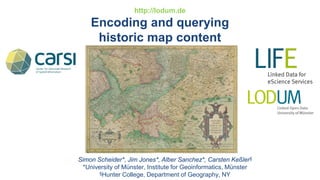
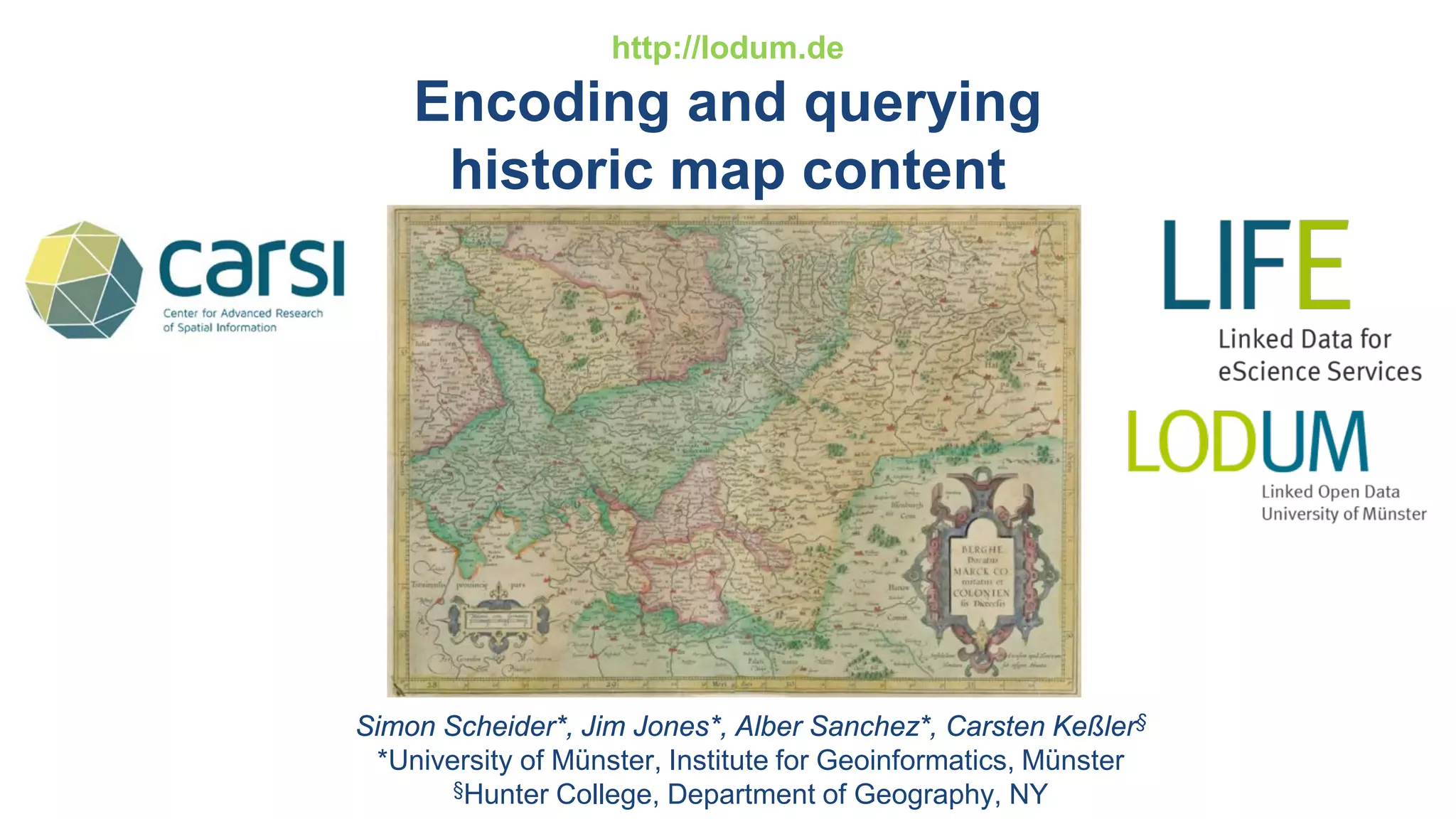
http://lodum.de
Encoding and querying
historic map content
Simon Scheider*, Jim Jones*, Alber Sanchez*, Carsten Keßler§
*University of Münster, Institute for Geoinformatics, Münster
§Hunter College, Department of Geography, NY
How can (we support) historians (in) find(ing)
(answers in) maps?
Question:
“What was the type of
landcover around Hildesheim
in the 19th century?”
1) Manual search
(through 20.000 maps?)
2) Text field search:
- title:
(“Gaußsche Landesaufnahme”
“Berghe Ducatus”,...)
- author:
(Gerhard Mercator, ...)
- year of production
(1680, 1839, ...)
-key words: (“topographic map”,
“Flurkarte”)
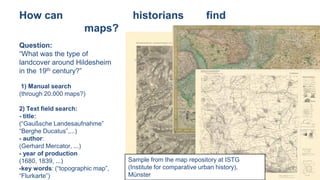
Sample from the map repository at ISTG
(Institute for comparative urban history),
Münster
How can (we support) historians (in) find(ing)
(answers in) maps?
Technical challenges:
1) Manual search
(through 20.000 maps?)
2) Text field search:
- title:
(“Gaußsche Landesaufnahme”
“Berghe Ducatius”,...)
- author:
(Gerhard Mercator, ...)
- year of production
(1680, 1839, ...)
-key words: (“topographic map”,
“Flurkarte”)
Not scalable!
Language?
How to pick the „right“
terms? (which correspond
to the answer?)
How to pick the „right“
place/space? („the area
around Hildesheim“)
How to pick the right time?
(„19th century“)
There are many
languages in maps (Latin, ...)!
Placenames are changing!
Historic maps are distorted and
lack CRS!
Terms are ambiguous!
There is too much content!
There is nameless content
(e.g. „landcover around Hildesheim“)!
How can (we support) historians (in) find(ing)
(answers in) maps?
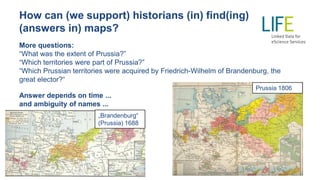
More questions:
“What was the extent of Prussia?”
“Which territories were part of Prussia?”
“Which Prussian territories were acquired by Friedrich-Wilhelm of Brandenburg, the
great elector?“
Answer depends on time ...
and ambiguity of names ...
Prussia 1806
„Brandenburg“
(Prussia) 1688
How can (we support) historians (in) find(ing)
(answers in) maps?
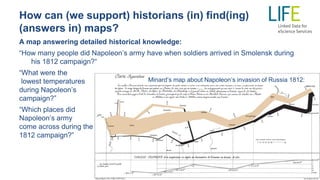
A map answering detailed historical knowledge:
“How many people did Napoleon’s army have when soldiers arrived in Smolensk during
his 1812 campaign?“
“What were the
lowest temperatures
during Napoleon’s
campaign?”
“Which places did
Napoleon’s army
come across during the
1812 campaign?”
Minard’s map about Napoleon’s invasion of Russia 1812:
How can (we support) historians (in) find(ing)
(answers in) maps?
Research topics we addressed in the paper:
1) How to precisely
encode and query
- semantic,
- spatial and
- temporal
map contents?
2) How to deal with
- wealth of content
- language/naming
ambiguity?
Linked spatio-temporal data for historic maps
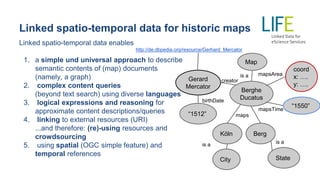
Linked spatio-temporal data enables
1. a simple und universal approach to describe
semantic contents of (map) documents
(namely, a graph)
2. complex content queries
(beyond text search) using diverse languages
3. logical expressions and reasoning for
approximate content descriptions/queries
4. linking to external resources (URI)
...and therefore: (re)-using resources and
crowdsourcing
5. using spatial (OGC simple feature) and
temporal references
Map
Berghe
Ducatus
Gerard
Mercator
is a
creator
coord
x: ….
y: ….
mapsArea
“1550”mapsTime
Berg
State
is a
Köln
maps
City
“1512”
birthDate
is a
Formally encoding map contents
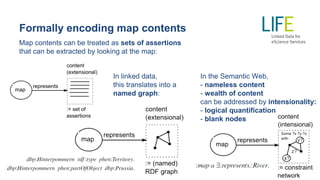
Map contents can be treated as sets of assertions
that can be extracted by looking at the map:
In the Semantic Web,
- nameless content
- wealth of content
can be addressed by intensionality:
- logical quantification
- blank nodes
In linked data,
this translates into a
named graph:
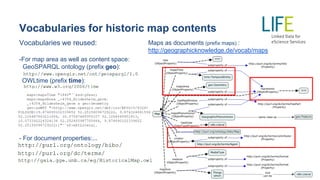
Vocabularies we reused:
-For map area as well as content space:
GeoSPARQL ontology (prefix geo):
OWLtime (prefix time):
- For document properties:...
Vocabularies for historic map contents
Maps as documents (prefix maps) :
http://geographicknowledge.de/vocab/maps
Vocabularies for historic map contents
Content phenomena (prefix phen):
http://geographicknowledge.de/vocab/historicmapsphen [.rdf/.jpg]:
(reuse of
any
geographic/
historical
ontology,
such as: )
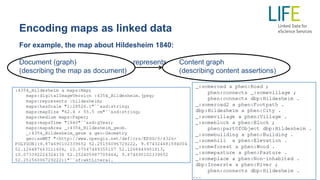
Encoding maps as linked data
For example, the map about Hildesheim 1840:
Document (graph) represents Content graph
(describing the map as document) (describing content assertions)
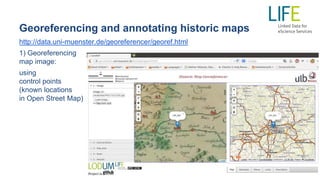
Georeferencing and annotating historic maps
http://data.uni-muenster.de/georeferencer/georef.html
1) Georeferencing
map image:
using
control points
(known locations
in Open Street Map)
Georeferencing and annotating historic maps
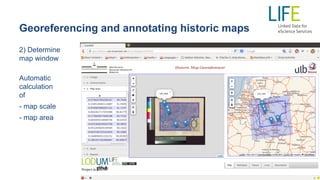
2) Determine
map window
Automatic
calculation
of
- map scale
- map area
Georeferencing and annotating historic maps
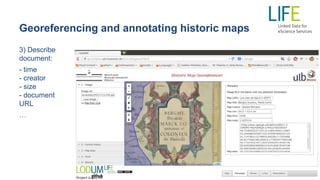
3) Describe
document:
- time
- creator
- size
- document
URL
…
Georeferencing and annotating historic maps
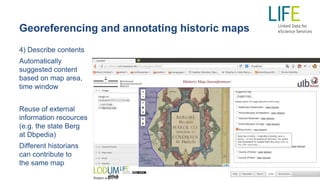
4) Describe contents
Automatically
suggested content
based on map area,
time window
Reuse of external
information recources
(e.g. the state Berg
at Dbpedia)
Different historians
can contribute to
the same map
Publishing maps and their contents
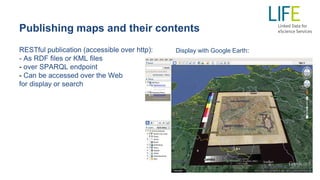
RESTful publication (accessible over http):
- As RDF files or KML files
- over SPARQL endpoint
- Can be accessed over the Web
for display or search
Display with Google Earth:
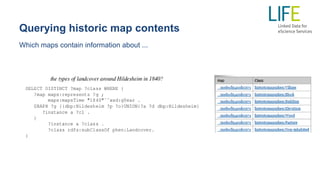
Querying historic map contents
Which maps contain information about ...
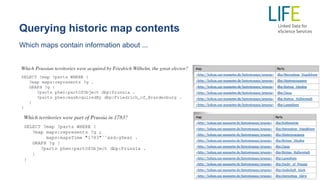
Querying historic map contents
Which maps contain information about ...
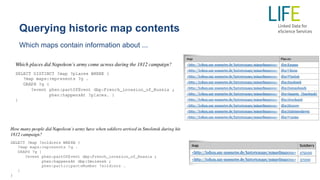
Querying historic map contents
Which maps contain information about ...
Conclusion
• Historic map contents =: named RDF graphs!
• ... allows the expression of map contents in a precise way as a set of
(triple) assertions
•... and the linking of maps as documents with their contents, reusing
published vocabularies and external links (Dbpedia)
• ... enables crowdsourcing of content descriptions
• ... makes possible intensional descriptions (using blank nodes) in
order to cope with the wealth of content, nameless content and content
approximation
• ... enables retrieval of maps that can answer historians‘ questions!
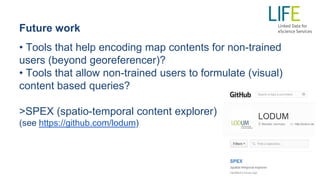
Future work
• Tools that help encoding map contents for non-trained
users (beyond georeferencer)?
• Tools that allow non-trained users to formulate (visual)
content based queries?
>SPEX (spatio-temporal content explorer)
(see https://github.com/lodum)
Dr. Simon Scheider
Institut für Geoinformatik der
Westfälischen Wilhelms-Universität
Heisenbergstraße 2, 48149 Münster
simon.scheider@uni-muenster.de
Tel.: 0251 I 83-30088
Thanks for your
attention!

Encoding and querying historic map content

  • 1.
    http://lodum.de Encoding and querying historicmap content Simon Scheider*, Jim Jones*, Alber Sanchez*, Carsten Keßler§ *University of Münster, Institute for Geoinformatics, Münster §Hunter College, Department of Geography, NY
  • 2.
    How can (wesupport) historians (in) find(ing) (answers in) maps? Question: “What was the type of landcover around Hildesheim in the 19th century?” 1) Manual search (through 20.000 maps?) 2) Text field search: - title: (“Gaußsche Landesaufnahme” “Berghe Ducatus”,...) - author: (Gerhard Mercator, ...) - year of production (1680, 1839, ...) -key words: (“topographic map”, “Flurkarte”) Sample from the map repository at ISTG (Institute for comparative urban history), Münster
  • 3.
    How can (wesupport) historians (in) find(ing) (answers in) maps? Technical challenges: 1) Manual search (through 20.000 maps?) 2) Text field search: - title: (“Gaußsche Landesaufnahme” “Berghe Ducatius”,...) - author: (Gerhard Mercator, ...) - year of production (1680, 1839, ...) -key words: (“topographic map”, “Flurkarte”) Not scalable! Language? How to pick the „right“ terms? (which correspond to the answer?) How to pick the „right“ place/space? („the area around Hildesheim“) How to pick the right time? („19th century“) There are many languages in maps (Latin, ...)! Placenames are changing! Historic maps are distorted and lack CRS! Terms are ambiguous! There is too much content! There is nameless content (e.g. „landcover around Hildesheim“)!
  • 4.
    How can (wesupport) historians (in) find(ing) (answers in) maps? More questions: “What was the extent of Prussia?” “Which territories were part of Prussia?” “Which Prussian territories were acquired by Friedrich-Wilhelm of Brandenburg, the great elector?“ Answer depends on time ... and ambiguity of names ... Prussia 1806 „Brandenburg“ (Prussia) 1688
  • 5.
    How can (wesupport) historians (in) find(ing) (answers in) maps? A map answering detailed historical knowledge: “How many people did Napoleon’s army have when soldiers arrived in Smolensk during his 1812 campaign?“ “What were the lowest temperatures during Napoleon’s campaign?” “Which places did Napoleon’s army come across during the 1812 campaign?” Minard’s map about Napoleon’s invasion of Russia 1812:
  • 6.
    How can (wesupport) historians (in) find(ing) (answers in) maps? Research topics we addressed in the paper: 1) How to precisely encode and query - semantic, - spatial and - temporal map contents? 2) How to deal with - wealth of content - language/naming ambiguity?
  • 7.
    Linked spatio-temporal datafor historic maps Linked spatio-temporal data enables 1. a simple und universal approach to describe semantic contents of (map) documents (namely, a graph) 2. complex content queries (beyond text search) using diverse languages 3. logical expressions and reasoning for approximate content descriptions/queries 4. linking to external resources (URI) ...and therefore: (re)-using resources and crowdsourcing 5. using spatial (OGC simple feature) and temporal references Map Berghe Ducatus Gerard Mercator is a creator coord x: …. y: …. mapsArea “1550”mapsTime Berg State is a Köln maps City “1512” birthDate is a
  • 8.
    Formally encoding mapcontents Map contents can be treated as sets of assertions that can be extracted by looking at the map: In the Semantic Web, - nameless content - wealth of content can be addressed by intensionality: - logical quantification - blank nodes In linked data, this translates into a named graph:
  • 9.
    Vocabularies we reused: -Formap area as well as content space: GeoSPARQL ontology (prefix geo): OWLtime (prefix time): - For document properties:... Vocabularies for historic map contents Maps as documents (prefix maps) : http://geographicknowledge.de/vocab/maps
  • 10.
    Vocabularies for historicmap contents Content phenomena (prefix phen): http://geographicknowledge.de/vocab/historicmapsphen [.rdf/.jpg]: (reuse of any geographic/ historical ontology, such as: )
  • 11.
    Encoding maps aslinked data For example, the map about Hildesheim 1840: Document (graph) represents Content graph (describing the map as document) (describing content assertions)
  • 12.
    Georeferencing and annotatinghistoric maps http://data.uni-muenster.de/georeferencer/georef.html 1) Georeferencing map image: using control points (known locations in Open Street Map)
  • 13.
    Georeferencing and annotatinghistoric maps 2) Determine map window Automatic calculation of - map scale - map area
  • 14.
    Georeferencing and annotatinghistoric maps 3) Describe document: - time - creator - size - document URL …
  • 15.
    Georeferencing and annotatinghistoric maps 4) Describe contents Automatically suggested content based on map area, time window Reuse of external information recources (e.g. the state Berg at Dbpedia) Different historians can contribute to the same map
  • 16.
    Publishing maps andtheir contents RESTful publication (accessible over http): - As RDF files or KML files - over SPARQL endpoint - Can be accessed over the Web for display or search Display with Google Earth:
  • 17.
    Querying historic mapcontents Which maps contain information about ...
  • 18.
    Querying historic mapcontents Which maps contain information about ...
  • 19.
    Querying historic mapcontents Which maps contain information about ...
  • 20.
    Conclusion • Historic mapcontents =: named RDF graphs! • ... allows the expression of map contents in a precise way as a set of (triple) assertions •... and the linking of maps as documents with their contents, reusing published vocabularies and external links (Dbpedia) • ... enables crowdsourcing of content descriptions • ... makes possible intensional descriptions (using blank nodes) in order to cope with the wealth of content, nameless content and content approximation • ... enables retrieval of maps that can answer historians‘ questions!
  • 21.
    Future work • Toolsthat help encoding map contents for non-trained users (beyond georeferencer)? • Tools that allow non-trained users to formulate (visual) content based queries? >SPEX (spatio-temporal content explorer) (see https://github.com/lodum)
  • 22.
    Dr. Simon Scheider Institutfür Geoinformatik der Westfälischen Wilhelms-Universität Heisenbergstraße 2, 48149 Münster simon.scheider@uni-muenster.de Tel.: 0251 I 83-30088 Thanks for your attention!