BEST PRACTICES IN TOURISM
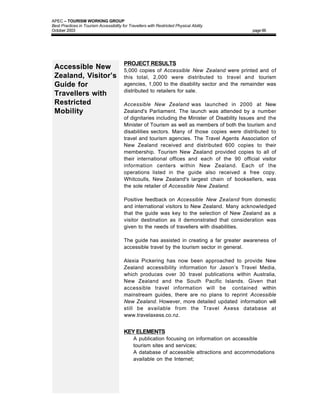
     ACCESSIBILITY FOR TRAVELLERS
    WITH RESTRICTED PHYSICAL ABILITY


                       FINAL REPORT
                APEC TOURISM WORKING GROUP


                       October 2003


Conducted by:               With the collaboration of:
APEC – TOURISM WORKING GROUP
Best Practices in Tourism Accessibility for Travellers with Restricted Physical Ability
October 2003                                                                              page I


STUDY DIRECTED BY:

André Leclerc, General Manager
Kéroul

Normand Dulude, President
Le Groupe DBSF

CONDUCTED BY:

Geneviève Bédard, Project Director
Le Groupe DBSF

Michèle Brisebois, Research Assistant
Lisa-Marie Hein, Research Assistant
Le Groupe DBSF

COORDINATION

Lyne Ménard, Administrative Director
Kéroul

GRAPHIC DESIGN

Nancy Robert
Caroline Quinton
Le Groupe DBSF


SPECIAL ACKNOWLEDGEMENT

Kéroul wishes to thank the project overseer,
Mrs. Irenka Farmilo, from the Canadian Tourism Commission.
We gratefully acknowledge her kind support and assistance.

2003
Publication number: APEC 3203-TO-01.2
ISBN: 2-922058-13-1

APEC Secretariat
35 Heng Mui Keng Terrace
Singapore 119616

Telephone: +65 6775 6012
Facsimile: +65 6775 6013

Copyright „ 2003 APEC Secretariat
APEC – TOURISM WORKING GROUP
Best Practices in Tourism Accessibility for Travellers with Restricted Physical Ability
October 2003                                                                                                        page II


TABLE OF CONTENTS

1.      INTRODUCTION...................................................................................................1
        1.1     Study Context ...........................................................................................1
        1.2     Aims and Objectives.................................................................................1
        1.3     Methodology..............................................................................................2
2.      INFORMATION ON PERSONS WITH RESTRICTED PHYSICAL ABILITY...............4
        2.1     Who are Persons with Restricted Physical Ability?..................................4
        2.2     Travellers and Accessibility......................................................................5
                2.2.1 Transportation...............................................................................5
                2.2.2 Accommodations ..........................................................................6
                2.2.3 Tourism Sites ................................................................................7
                2.2.4 Travel Planning..............................................................................7
                2.2.5 Customer services........................................................................7
3.      WHAT IS A BEST PRACTICE IN TOURISM ACCESSIBILITY? ..............................8
        3.1     Categories of Best Practices....................................................................9
        3.2     Evaluation Criteria of a Best Practice......................................................10
4.      BEST PRACTICES BY CATEGORIES ................................................................11
        4.1 Transportation.........................................................................................11
        4.2 Physical Planning and Accessibility........................................................31
        4.3 Research and Development....................................................................47
        4.4 Information and Promotion.......................................................................58
        4.5 Training ...................................................................................................67
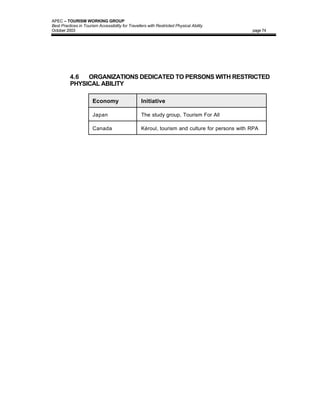
        4.6 Organizations Dedicated to Persons with Restricted Physical Ability....74
5.      CONDITIONS TO PROMOTE TOURISM ACCESSIBILITY AND
        TARGET AREAS OF INTERVENTION................................................................81
        5.1     Opportunities for future research and analysis .....................................81
                5.1.1 Global Approach.........................................................................81
                5.1.2 Partnership and Collaboration.....................................................82
                5.1.3 Gradual Implementation and Flexibility.........................................82
                5.1.4 Research and Development........................................................82
                5.1.5 Information and Promotion...........................................................82
                5.1.6 Training .......................................................................................83
                5.1.7 Participation of Organizations for Persons with
                       Restricted Physical Ability...........................................................83
        5.2     Target Areas of Intervention...................................................................84
                5.2.1 Transportation.............................................................................84
                5.2.2 Physical planning and Accessibility............................................84
BIBLIOGRAPHY .........................................................................................................85
APEC – TOURISM WORKING GROUP
Best Practices in Tourism Accessibility for Travellers with Restricted Physical Ability
October 2003                                                                                page 1


1.        INTRODUCTION

          1.1        STUDY CONTEXT

                     At the inaugural APEC Tourism Ministerial Meeting in Seoul in July 2000,
                     the tourism ministers adopted the Tourism Charter, which referred to four
                     specific policy goals, the second of which was “increasing mobility of
                     visitors and stimulating demand for tourism goods and services in the
                     APEC region.”

                     The project discussed here identifies best practices for tourism
                     accessibility for travellers with restricted physical ability (RPA) and falls
                     under policy goal #2 of the Tourism Charter. This project may also serve
                     as a base for member economies to establish a credible and
                     internationally comparable set of standards describing the stage reached
                     in providing tourism accessibility to travellers with RPA.

                     Wishing to make tourism more accessible to its members, APEC
                     commissioned this study on best practices in accessibility. Touching
                     various aspects of accessibility, the examples are drawn from the
                     initiatives of governmental as well as non-governmental agencies.


          1.2        AIMS AND OBJECTIVES

                     As stated in the Tourism Working Group Request For Proposals, the
                     objectives of the survey of best practices on tourism accessibility for
                     travellers with RPA are to:

                          •     Promote greater accessibility to tourism for travellers with RPA by
                                consolidating all standards for tourism accessibility into a
                                comprehensive manual;

                          •     Raise the level of awareness on the importance and significance
                                of making travel accessible to everyone;

                          •     Harmonize the standards in providing tourism accessibility to
                                travellers with RPA and allow APEC members to identify areas to
                                be modified and/or improved in order to support full accessibility to
                                travellers with RPA; and

                          •     Facilitate the exchange of information among members.
APEC – TOURISM WORKING GROUP
Best Practices in Tourism Accessibility for Travellers with Restricted Physical Ability
October 2003                                                                               page 2


                     As we have seen, the study is part of a considerable process of thought
                     and discussion to encourage the mobility of travellers within APEC
                     member economies and to stimulate tourism demand in the Asia-Pacific
                     region.


                     Scope and Limitations of the Study

                     In order to accomplish its objectives, the study examined examples of
                     best practices supplied by APEC member economies to evaluate their
                     transferability.

                     Nevertheless, the reader should view the practices presented here as a
                     simple exploration of the possibilities that were offered.

                     In this context, this report is therefore intended to offer:

                          •     A discussion of the principles that should guide the actions of
                                APEC member economies with regard to the accessibility of
                                tourism for travellers with RPA;

                          •     Documentation of the thought processes of APEC member
                                economies regarding desirable standards of accessibility; and

                          •     Concrete examples to enrich the toolboxes of the member
                                economies.


          1.3        METHODOLOGY

                     The identification of examples on accessible tourism for travellers with
                     RPA relied first and foremost on the collaboration of the APEC Tourism
                     Working Group member economies.

                     The method chosen for the survey was a questionnaire, self-completed
                     by either the APEC representative, a member of a government agency, or
                     a member of an organization representing persons with RPA. This w a s
                     considered the most efficient means to reach all the APEC community.

                     Each submitter was invited to provide additional support material such as
                     published articles, photographs or other graphic material, brochures or
                     promotional material.

                     Twenty-two completed questionnaires were returned from 11 member
                     economies. Participation in the study, namely, gathering and structuring
APEC – TOURISM WORKING GROUP
Best Practices in Tourism Accessibility for Travellers with Restricted Physical Ability
October 2003                                                                              page 3


                     the information, was undoubtedly a considerable task for some of the
                     organizations and may have limited some participation.

                     Each of the proposed initiatives was examined according to the analytical
                     framework developed for the study. The goal of this analysis was not to
                     rank the initiatives from best to worst, but rather to evaluate their
                     “transferability” to other countries. Based on the analysis, it was then
                     possible to select examples likely to advance the cause of accessible
                     tourism.

                     A review of literature and a search on the Internet was then undertaken
                     for secondary data.

                     Participating member economies were:
                        • Australia
                        • Canada
                        • Chinese Taipei
                        • Hong Kong, China
                        • Japan
                        • Macau, China
                        • Mexico
                        • New Zealand
                        • Republic of the Philippines
                        • Thailand
                        • United States
APEC – TOURISM WORKING GROUP
Best Practices in Tourism Accessibility for Travellers with Restricted Physical Ability
October 2003                                                                                                       page 4


2.        INFORMATION ON PERSONS WITH RESTRICTED
          PHYSICAL ABILITY

          2.1        WHO ARE PERSONS WITH RESTRICTED PHYSICAL ABILITY?

                     For the purpose of this document, a person with RPA is any person who
                     has a disability or whose activity is limited, whether the cause is
                     physiological or mental. The World Health Organization (WHO) has
                     adopted the following definition to describe this condition:

                           …disability is any restriction or lack (resulting from an
                            impairment) of ability to perform an activity in the manner
                            or within the range considered normal for a human being.1

                     According to the Society for Accessible Tourism Hospitality (SATH), there
                     are an estimated 859 million persons worldwide with disabilities. For
                     example, Australia’s 1993 survey indicated that persons with a disability
                     comprise 18 percent of its population. New Zealand’s national household
                     survey (1996) yielded a disability rate of 19.1 percent. Within the United
                     States alone, as of 1994-1995, 20.6 percent of the population – 54 million
                     persons – had a disability. In Canada, the percentage of persons with
                     disabilities was 15.5 percent as of 1991 (Kéroul, 1995). In Europe, Deloitte
                     Touche estimated in 1991 that there were 50 million persons with
                     disabilities at any given time, roughly 14 percent of the population.

                     Notably, the estimated disability rates reported by different regions vary
                     widely. The variation depends, to a large extent, on the research
                     methodology used. For example, a 1987 survey in China indicated 4.9
                     percent of the population living with a disability. In the Philippines, in the
                     1995 census, conducted by the National Statistics Office, there were
                     919,332 persons with RPA (1.2 percent of the total population).

                     The proportion of older persons in the population of developed countries
                     is already rising dramatically. The same phenomenon is starting to occur
                     in developing countries. According to United Nations projections, by the
                     year 2025 about 14 percent of the Asia-Pacific region’s total population
                     will be 60 years or older, and the region will be home to 56 percent of the
                     world’s older persons. Among older persons, a significant percentage
                     presents some type of disability. For example, in Western Australia over
                     50 percent of persons over 60 years of age have a disability. In Canada,
                     46 percent of persons aged 65 and over have a disability.


                     1
                         World Health Organization, International Classification of Impairments, Disabilities and Handicaps,
                         1980.
APEC – TOURISM WORKING GROUP
Best Practices in Tourism Accessibility for Travellers with Restricted Physical Ability
October 2003                                                                                page 5


          2.2        TRAVELLERS AND ACCESSIBILITY

                     Persons with RPA are travellers with habits, preferences and goals
                     similar to those of the general population. While these individuals do have
                     specific needs in some respects, only a small portion of these travellers
                     requires sophisticated equipment.

                     Access varies depending on disability. According to Simon Darcy (1998),
                     access has three main dimensions:

                               (a) Physical access, which involves persons with
                                   physical disabilities requiring the use of wheelchairs
                                   or walking aids and, consequently, the provision of,
                                   for example, handrails, ramps, lifts and lowered
                                   counters.

                               (b) Sensory access, which involves persons with
                                   hearing or sight impairments, necessitating the
                                   provision of, for example, tactile markings, signs,
                                   labels, hearing augmentation-listening systems and
                                   audio cues for lifts and lights.

                               (c) Communication access, which involves those
                                   persons who have difficulty with the written word,
                                   vision, speech, and hearing impairments of persons
                                   from other cultures.

                     Persons with RPA have a right to, and do want to, enjoy travel and leisure
                     experiences. Like everyone else, tourists with RPA want to visit places
                     with which they identify, places consistent with their lifestyle, where they
                     can find pleasure, safety and comfort. They also seek friendly, inhabited
                     places.

                     However, their travel experiences are still characterized by numerous
                     constraints.


                     2.2.1 Transportation

                     Transportation is a crucial issue, representing a major portion of a
                     tourism-related trip. While air travel in general has become easier and
                     airlines increasingly provide user-friendly services to these travellers,
                     some problems still arise from time to time that can seriously
                     inconvenience a traveller with RPA. For example, an issue among some
                     travellers with RPA is the damage to and loss of wheelchairs on
                     airplanes. Other constraints facing wheelchair travellers include the
APEC – TOURISM WORKING GROUP
Best Practices in Tourism Accessibility for Travellers with Restricted Physical Ability
October 2003                                                                              page 6


                     difficulty of boarding and disembarking the aircraft, changing flights, and
                     the inaccessibility of airplane restrooms. For persons with visual
                     impairments, identifying and retrieving luggage becomes another obstacle
                     in the course of their already difficult journey.

                     For local or regional trips, persons with RPA use various modes of
                     transportation trips – such as car, bus or train. Private automobiles
                     equipped with customized features have the advantage of providing
                     schedule flexibility if used for pleasure travel. However, only a small
                     group of affluent persons with RPA can afford such cars. Modern
                     technology greatly facilitates bus travel, as those with RPA can now
                     journey in buses equipped with hydraulic lifts, which help them to board
                     easily. “Low-floor” buses are gradually becoming the standard for intra-
                     urban public transportation in a growing number of countries. These
                     buses have the floor some 50 cm above street level. They feature a
                     hydraulic “kneeling” function, which reduces the step to some 25 cm.
                     However, in most countries the availability of such specially designed
                     buses remains limited. While trains could better accommodate the travel
                     needs of persons with RPA, the gap between car door and platform is
                     often too wide; access to toilets and compartments also remains a
                     constraint, especially for persons with physical disabilities and
                     wheelchair users.


                     2.2.2 Accommodations

                     Accommodations and restaurants are frequently ill equipped to meet the
                     needs of tourists with RPA. The lack of suitable accommodations will
                     often limit persons to up-scale hotels, which are most often the only
                     establishments that are accessible. For example, very few hotels offer
                     accessible rooms with wide entrances or low switches, hand dryers,
                     towel racks and beds. Of the rooms available, few are on the ground
                     floor.

                     Access throughout hotels is also problematic. Few hotels have elevators
                     to all floors, access to reception, pool or bar areas, clear signage, visual
                     alarms, and complete access through the entire building. While the
                     majority of hotels provide special parking areas, these are often
                     uncovered and quite distant from the main hotel entrances, often requiring
                     that steps be negotiated in order to enter or exit buildings.

                     Many travellers with RPA have difficulty accessing restaurant
                     establishments within tourist destination areas. Others encounter
                     problems after making hotel reservations. In some instances, rooms that
                     were promoted as accessible were actually inaccessible to persons with
                     RPA. For example, showers with handrails may well accommodate some
                     people, but, for many wheelchair users, bathtubs present a major barrier.
APEC – TOURISM WORKING GROUP
Best Practices in Tourism Accessibility for Travellers with Restricted Physical Ability
October 2003                                                                               page 7


                     2.2.3 Tourism Sites

                     Major barriers for travellers with RPA involve physical obstacles that limit
                     access to tourism sites and attractions, the very elements that underlie, or
                     enhance, a journey.

                     Attractions may include leisure-based activities, such as visiting theme
                     parks or participating in sport events; nature- or historical-based
                     activities, such as visiting museums or a patrimonial site; and socio-
                     cultural activities, such as festivals or exhibitions. In these activities, most
                     of the constraints encountered by tourists with RPA involve site
                     inaccessibility. For example, beaches are often not equipped to
                     accommodate wheelchair users. Similarly, poor access to museums,
                     historical monuments or shopping areas restricts persons with RPA from
                     participation in these activities.


                     2.2.4 Travel Planning

                     For travellers with RPA, planning a vacation can be somewhat daunting.
                     Their constraints lead such travellers to ensure that proper attention will
                     be given to their special needs. Arrangements cannot be made without
                     the assistance of travel agencies that cater to those special needs.

                     For several years, accessible tourism has shown promising signs of
                     expansion. Yet tour operators have only recently started to appreciate
                     the potential of this market. Many opportunities exist for the distribution
                     network to market products and services that are underused.


                     2.2.5 Customer Services

                     Very often services providers are uncomfortable in direct contact
                     situation with persons with RPA because they don’t know what is
                     required from them.

                     There is a range of disabilities which may have different implications.
                     Usually, these customers require no additional assistance, although many
                     of them will appreciate it.

                     Staff training is important at al level of the tourism organization not only for
                     those employees in direct contact with clients but also housekeeping and
                     support staff who might encounter clients in the performance of their
                     duties. Often, simply increased awareness, good communication will be
                     even more important than the assistance techniques.
APEC – TOURISM WORKING GROUP
Best Practices in Tourism Accessibility for Travellers with Restricted Physical Ability
October 2003                                                                              page 8


3.        WHAT IS A BEST PRACTICE IN TOURISM
          ACCESSIBILITY ?

                     Tourism is a rapidly growing industry in the Asia-Pacific region. According
                     to the World Tourism Organization (WTO), the Asia-Pacific region
                     registered an annual growth rate of 5.5 percent in 2001. Further, this
                     trend is expected to continue at the same rate for the years to come.

                     The Asia-Pacific region is becoming more and more aware of the
                     opportunity offered by the potential market of travellers with RPA. The
                     tourism industry wants to understand the needs involved and learn how
                     to respond to these challenges for the benefit of all.

                     Although much remains to be done before proclaiming a barrier-free
                     environment, many economies have already made great strides in
                     improving access to tourism for persons with RPA.

                     A best practice in tourism accessibility is a one that is replicable,
                     transferable or adaptable: an initiative conducted successfully and with a
                     tangible impact on improving people’s tourism experiences.

                     Identifying best practices is useful as a means to:

                          •     Improve public policies based on what works;

                          •     Raise awareness of decision makers; and

                          •     Share and transfer knowledge, expertise and experience through
                                networking and peer-to-peer learning.

                     The categories of best practices developed for the study were chosen in
                     order to identify initiatives from different aspects of tourism accessibility.
APEC – TOURISM WORKING GROUP
Best Practices in Tourism Accessibility for Travellers with Restricted Physical Ability
October 2003                                                                                                    page 9


          3.1        CATEGORIES OF BEST PRACTICES

                     The practices addressed are categorized as follows:

                       Themes                                   Best practices case studies

                        Transportation                            •   Policies and procedures
                                                                  •   Evaluation methods and tools
                                                                  •   Regulatory methods and tools

                        Physical planning and                     •   Evaluation methods and tools
                        accessibility                             •   Regulatory methods and tools
                                                                  •   Certification methods and tools, and
                                                                      labelling
                                                                  •   Support mechanisms and development
                                                                      tools

                        Research and development                  •   Knowledge of market (expectations and
                                                                      needs of clientele)
                                                                  •   Techniques for gathering and using
                                                                      information
                                                                  •   Financial aid granted to individuals and
                                                                      businesses

                        Information and promotion                 •   Mechanisms for communicating
                                                                      accessibility standards
                                                                  •   Facilities specific to tourism industry
                                                                  •   Infrastructures common to public
                                                                      establishments
                                                                  •   Method of disseminating information
                                                                      concerning services, establishments
                                                                      and attractions

                        Training                                  •   Type of training
                                                                      - Customer service
                                                                      - Hospitality
                                                                      - Physical planning
                                                                  •   Type of clientele
                                                                      - Tourism industry
                                                                      - Professionals working for common
                                                                         public establishments
                        Travel                                    •   Travel industry organizations
                                                                  •   Specialized travel agencies
                                                                  •   Specialized individual or group tour
                                                                      packages
                        Innovation                                •   Innovative projects sponsored by:
                                                                      - Regions
                                                                      - Municipalities
                                                                      - Businesses
                        Organizations dedicated to                •   Representation and promotion of rights
                        tourism for disabled                      •   Networking and partnership
                        persons
                                                                  •   Member services
APEC – TOURISM WORKING GROUP
Best Practices in Tourism Accessibility for Travellers with Restricted Physical Ability
October 2003                                                                                  page 10


          3.2        EVALUATION CRITERIA OF A BEST PRACTICE

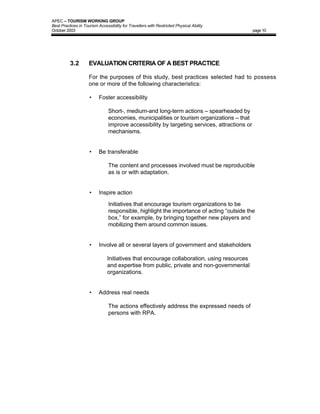
                     For the purposes of this study, best practices selected had to possess
                     one or more of the following characteristics:

                     •     Foster accessibility

                                Short-, medium-and long-term actions – spearheaded by
                                economies, municipalities or tourism organizations – that
                                improve accessibility by targeting services, attractions or
                                mechanisms.


                     •     Be transferable

                                The content and processes involved must be reproducible
                                as is or with adaptation.


                     •     Inspire action

                                Initiatives that encourage tourism organizations to be
                                responsible, highlight the importance of acting “outside the
                                box,” for example, by bringing together new players and
                                mobilizing them around common issues.


                     •     Involve all or several layers of government and stakeholders

                               Initiatives that encourage collaboration, using resources
                               and expertise from public, private and non-governmental
                               organizations.


                     •     Address real needs

                                The actions effectively address the expressed needs of
                                persons with RPA.
APEC – TOURISM WORKING GROUP
Best Practices in Tourism Accessibility for Travellers with Restricted Physical Ability
October 2003                                                                                      page 11


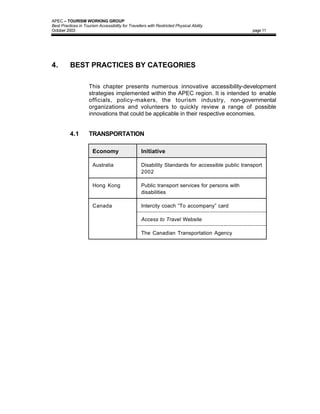
4.        BEST PRACTICES BY CATEGORIES

                     This chapter presents numerous innovative accessibility-development
                     strategies implemented within the APEC region. It is intended to enable
                     officials, policy-makers, the tourism industry, non-governmental
                     organizations and volunteers to quickly review a range of possible
                     innovations that could be applicable in their respective economies.


          4.1        TRANSPORTATION

                       Economy                     Initiative

                       Australia                   Disability Standards for accessible public transport
                                                   2002

                       Hong Kong                   Public transport services for persons with
                                                   disabilities

                       Canada                      Intercity coach “To accompany” card

                                                   Access to Travel Website

                                                   The Canadian Transportation Agency
APEC – TOURISM WORKING GROUP
Best Practices in Tourism Accessibility for Travellers with Restricted Physical Ability
October 2003                                                                                     page 12


                                                PROJECT
 Disability Standards                           The Disability Standards for Accessible Public Transport
 for Accessible                                 provide practical measures to be taken by transport
                                                operators and providers to make public transport more
 Public Transport                               accessible, both for persons with disabilities, as well as
 2002                                           the elderly and those travelling with young children.


                                                PROJECT OBJECTIVES
                                                • To ensure public transport operators and providers
                                                  remove discrimination from public transport services;
                                                • To remove discrimination on the basis of disability
 Member Economy:
                                                  from public transport services over a 30-year period;
 Australia
                                                • To ensure that persons with disabilities, their families
                                                  and caregivers can participate fully in, and enjoy,
                                                  community life;
                                                • To promote recognition and acceptance within the
 Category:
                                                  community of the principle that persons with
 Transportation                                   disabilities have the same fundamental rights as the
                                                  rest of the community.


                                                DESCRIPTION OF THE PROJECT
                                                The Disability Discrimination Act 1992 seeks to eliminate
 Contact:                                       discrimination, “as far as possible,” against persons with
                                                disabilities. Public transport is a service covered by this
 Tourism Division
                                                Act.
 Level 1, 33 Allara street
 GPO Box 9839                                   Transport standards ensure that public transport is more
 Canberra City, ACT                             accessible for persons with disabilities, the elderly and
 2600                                           parents with infants in strollers.
 Australia
                                                For the first time, the Transport Standards set out formal
 Mrs. Trudi Ridge                               requirements for accessibility to public transport in
 Regional and Niche Tourism                     Australia. The standards take into account the range of
 Business Development                           disabilities covered by the Act and apply to a range of
 Group                                          public transport conveyances, premises and
                                                infrastructure, with some limited exceptions. They provide
 Phone:                                         greater certainty about rights and obligations under the
 +612-6213-7084                                 Disability Discrimination Act.
 Fax:
 +612-6213-7093                                 The standards prescribe detailed requirements in relation
                                                to accessibility issues such as access paths,
 E-mail:                                        manoeuvring areas, ramps and boarding devices,
 trudi.ridge@industry.gov.au                    allocated spaces, handrails, doorways, controls, symbols
                                                and signs, the payment of fares, the provision of
 Website:                                       information, belongings, etc.
 www.industry.gov.au
APEC – TOURISM WORKING GROUP
Best Practices in Tourism Accessibility for Travellers with Restricted Physical Ability
October 2003                                                                                   page 13


                                         In prescribing how public transport is to be made accessible,
 Disability                              the Standards acknowledge certain rights of passengers,
 Standards for                           operators and providers, as well as impose some
                                         responsibilities.
 Accessible
 Public Transport                        Providers and operators of public transport, infrastructure and
                                         premises must meet the requirements for all new items coming
 2002
                                         into service and will have a staggered compliance timeframe
                                         for upgrading equipment. All new items will have to comply
                                         with the standards from the time they come into effect so that
                                         non-conforming items are gradually retired or upgraded in
                                         accordance with an incremental compliance timetable.

                                         In appropriate cases, the Human Rights and Equal
                                         Opportunity Commission is also able to grant temporary
                                         exemptions from the requirements of the standards, taking
                                         into account advice from the National Transport Secretariat, to
                                         ensure that the system operates in a fair and balanced way.

                                         The Disability Standards apply to the operation or provision of
                                         public transportation services and facilities to persons with
                                         disabilities by public and private sector operators of public
                                         transportation.


                                         MAIN RESOURCES NEEDED FOR THE PROJECT
                                         The Commonwealth Government estimates the cost of
                                         Australia-wide compliance with the disability standards over 20
                                         years was $3.7 billion (Australian), in 1999.


                                         PRINCIPAL PARTNERS
                                         The standards were developed following extensive
                                         consultation with the transport industry, people with restricted
                                         physical ability and government representatives.

                                         The Attorney General funds a Disability Discrimination Act
                                         Standards Project established by disability community peak
                                         organizations to co-ordinate input by persons with disabilities
                                         to standards development processes.


                                         PROJECT DEVELOPMENT
                                         Section 31 of the Disability Discrimination Act 1992 provides
                                         for the making of standards. The Act gives the Attorney
                                         General the power to formulate these standards, while
                                         reserving the power to review the standards to Parliament,
                                         according to typical arrangements made for delegated
                                         legislation.
APEC – TOURISM WORKING GROUP
Best Practices in Tourism Accessibility for Travellers with Restricted Physical Ability
October 2003                                                                                     page 14


 Disability                               The Attorney General may make Disability Standards to
 Standards for                            specify rights and responsibilities about equal access and
                                          opportunity for persons with disabilities, in more detail and with
 Accessible
                                          more certainty than the Act itself provides. The Human Rights
 Public Transport                         and Equal Opportunity Commission has a function of advising
 2002                                     the Attorney General on making such standards.

                                          The Disability Standards for Accessible Public Transport and
                                          accompanying Guidelines under the Disability Discrimination
                                          Act 1992 came into effect on 23 October 2002 – 10 years
                                          after the Act passed through Parliament. They will be
                                          reviewed at five-year intervals.

                                          The Disability Standards detail mandatory performance
                                          outcomes covering a range of accessibility issues. Due to the
                                          very specific requirements in the Disability Standards, they are
                                          the national authority for compliance with anti-discrimination
                                          legislation in the areas specified in the Disability Standards.

                                          The compliance timetable ensures that increased accessibility
                                          is provided in a way that does not create an undue burden for
                                          operators and providers by allowing for incremental
                                          compliance with the relevant requirements over 30 years, with
                                          milestones at the fifth, tenth, fifteenth, twentieth and thirtieth
                                          years.

                                          For example, 10 years after the standards commence,
                                          operators and providers must ensure full compliance with the
                                          relevant requirements in relation to surfaces; handrails and
                                          grab rails; gateways; and vending machines, as applicable to
                                          conveyances, premises and infrastructure. After 20 years, all
                                          buses must be fully compliant with the standards.


                                          PROJECT RESULTS
                                          Public transport is becoming more accessible by the
                                          replacement or upgrading of conveyances, premises and
                                          infrastructure at the end of their service lives.
APEC – TOURISM WORKING GROUP
Best Practices in Tourism Accessibility for Travellers with Restricted Physical Ability
October 2003                                                                                    page 15


                                         KEY ELEMENTS
 Disability                              • Example of persons with disabilities, government and
 Standards for                                 industry groups working together to find practical ways to
 Accessible                                    eliminate discrimination;
                                         •     Information provided to transport operators to assist them
 Public Transport                              in eliminating, to the extent possible, discrimination from
 2002                                          public transport services for persons with disabilities;
                                         •     Provision of certainty about particular requirements, which
                                               need to be complied with in accordance with a specific
                                               timetable;
                                         •     Temporary exemptions granted by the Human Rights and
                                               Equal Opportunity Commission from the requirements of
                                               the standards, in appropriate cases, to ensure that the
                                               system operates in a fair and balanced way;
                                         •     A copy of the Transport Standards and accompanying
                                               Guidelines are available at
                                               http://www.law.gov.au/DSFAPT/Welcome.html.
APEC – TOURISM WORKING GROUP
Best Practices in Tourism Accessibility for Travellers with Restricted Physical Ability
October 2003                                                                                    page 16


                                          PROJECT
 Public Transport                         Provision of convenient transport services for persons with
 Services for                             disabilities.
 Persons with
 Disabilities                             PROJECT OBJECTIVES
                                          • To provide a barrier-free public transport service to
                                            persons with disabilities;
                                          • To enhance their mobility and their integration with the
                                            community.


                                          DESCRIPTION OF THE PROJECT
                                          Hong Kong covers a small area of less than 1,100 square
                                          kilometres. It has one of the world's best public transport
                                          systems comprising railways, regular and light buses, taxis and
 Member Economy:                          ferries. The region serves more than 11 million commuters
 Hong Kong, China                         daily, with no direct government subsidies.

                                          During the last decade, the government of the Hong Kong
                                          Special Administrative Region promoted accessibility by
                                          improving the transport system and by encouraging transport
 Category:
                                          operators to provide facilities for citizens with disabilities.
 Transportation
                                          The Transport Department promotes access to transportation
                                          through the provision of accessible public transport services
                                          and on-street facilities.

                                          Public transport and railway operators are encouraged to
                                          make their vehicles and services accessible as far as is
                                          practicable.
 Contact:
 Transport Department                     MAIN RESOURCES NEEDED FOR THE PROJECT
 40/F, Immigration                        The Transport Department is in charge of monitoring the
 Tower, 7 Gloucester                      improvements to public transport services. It is also
 Road, Wanchai,                           responsible for the design and consultation process:
 Hong Kong                                • The Highway Department is responsible for construction
                                              projects;
 Mrs. Cecilia LAI                         • The Electrical and Mechanical Service Departments are
                                              responsible for the installation of audible tactile signals.
 Phone:
 +852-2829-5309                           The government of the Hong Kong Special Administrative
 Fax:                                     Region provides incentives to the private sector, in the form of
 +852-2824-2176                           a profitable operating environment, guidelines and design
                                          standards.
 E-mail:
                                          Major transport companies are responsible for procurement of
 cecilia_lai@td.gov.hk
                                          wheelchair accessible buses and for installation and
 Website:
 www.info.gov.hk/td
APEC – TOURISM WORKING GROUP
Best Practices in Tourism Accessibility for Travellers with Restricted Physical Ability
October 2003                                                                                        page 17


                                         retrofitting of disabled facilities in railway stations, train and bus
 Public Transport                        compartments.
 Services for
 Persons with                            PRINCIPAL PARTNERS
 Disabilities                            The Transport Department of the Hong Kong SAR government
                                         is the agency that oversees and implements accessible
                                         transportation.

                                         Organizations representing persons with disabilities are part of
                                         the consultation process and provide input regarding facilities
                                         requirements.
                                         PROJECT DEVELOPMENT
                                         Access and transportation are priority issues for persons with a
                                         disability. Both are necessary for the overall objective of equal
                                         opportunity and full social integration. With this in mind, The
                                         Hong Kong SAR government's policy objectives are to ensure:

                                         •     The development of a barrier-free physical environment
                                               that permits access to all buildings and facilities for all
                                               persons with disabilities;
                                         •     The development of a transport system that includes
                                               provisions to meet the needs of persons with disabilities,
                                               so as to enhance their mobility within society and facilitate
                                               their full participation and integration into the community.

                                         The Transport Department set up a Working Group on Access
                                         to Public Transport for persons with disabilities. The working
                                         group was created to facilitate communication among
                                         representatives of persons with disabilities, public transport
                                         operators, and relevant government departments. The working
                                         group has provided a useful forum for the exchange of views
                                         and the discussion of issues of common concern. It also takes
                                         the lead in tackling problems common to all public transport
                                         operators, such as establishing common standards and
                                         guidelines on the provision and modification of facilities.

                                         The working group continues to identify new initiatives on a
                                         regular basis and monitors implementation of approved
                                         programs. The Transport Department has developed and
                                         formulated a Transport Planning and Design Manual, in
                                         consultation with representatives of persons with disabilities, to
                                         provide general guidelines on the design and provision of
                                         facilities and to promote awareness of such factors. The
                                         manual has been widely adopted by various planners and
                                         providers of services for persons with disabilities.
APEC – TOURISM WORKING GROUP
Best Practices in Tourism Accessibility for Travellers with Restricted Physical Ability
October 2003                                                                                      page 18


                                         PROJECT RESULTS
 Public Transport                        As a consequence of the implemented measures, Hong Kong
 Services for                            is better able to meet the transport needs of persons with
                                         disabilities.
 Persons with
 Disabilities                            The government provides accessible traffic facilities, such as
                                         over 10,000 audible traffic signals, tactile warning strips and
                                         dropped kerbs at pedestrian crossings.

                                         The government also funds Rehabus services for those who
                                         are unable to use public transport. It is a territory-wide
                                         transport network comprising a fleet of about 90 wheelchair -
                                         accessible buses. The network offers scheduled and feeder
                                         services on fixed routes, plus a dial-a-ride service to enable
                                         some 490,000 passengers a year to travel to work, school,
                                         etc.

                                         The bus operators in Hong Kong have introduced about 2,000
                                         wheelchair-accessible buses in Hong Kong, or about 30
                                         percent of all buses. These buses are equipped with a fixed
                                         ramp and wheelchair parking space inside the compartment.
                                         This number should increase to about 3,200 by 2006.

                                         Taxis have been adapted for persons with visual impairment.
                                         At present, over 17,200, or 95 percent of all taxis, have a
                                         Braille and tactile vehicle registration-number plate inside the
                                         vehicle compartment. By 2004, all 18,000 taxis in Hong Kong
                                         will be equipped with this plate.

                                         Also, about 7,500 newly registered taxis in Hong Kong have
                                         been installed with talking meters that announce taxi service
                                         and taxi fare messages in Cantonese, Putonghua and
                                         English.


                                         KEY ELEMENTS
                                         •     Policy, legislation and institutional arrangements to support
                                               implementation of accessible public transportation;
                                         •     Effective coordination between government departments,
                                               major transport operators, and organizations for persons
                                               with disabilities.
APEC – TOURISM WORKING GROUP
Best Practices in Tourism Accessibility for Travellers with Restricted Physical Ability
October 2003                                                                                      page 19


                                          PROJECT
 Intercity Coach                          Introduction by the Quebec Bus Owners Association
 “To Accompany”                           (l'Association des propriétaires d'autobus du Québec) of a
 Card                                     free travel card for those who accompany persons with
                                          restricted physical ability. This “To Accompany” card is valid on
                                          all intercity bus services in the province of Quebec.


                                          PROJECT OBJECTIVES
                                          • To make travel more affordable for persons with restricted
                                            physical ability and their attendants;
                                          • To develop a travel attendant policy for all bus companies
 Member Economy:                            in Quebec;
 Canada                                   • The long-term objective is to have the card recognized by
                                            all carriers across Canada.


                                          DESCRIPTION OF THE PROJECT
 Category:                                The Quebec Bus Owners Association (QBOA) is a not-for-
 Transportation                           profit organization that has represented private businesses
                                          operating in the bus transportation sector in Quebec since
                                          1926.

                                          In June 1995, the intercity bus transportation industry offered
                                          uneven travel privileges for persons accompanying travellers
                                          with restricted physical ability. In fact, some customers
                                          preferred other modes of transportation because having to
 Contact:                                 buy a ticket for the person accompanying them made the cost
 Association des                          prohibitive.
 propriétaires d’autobus
 du Québec                                In 1997, the QBOA announced the commissioning of 15 fully
 225, boulevard Charest                   accessible coaches for travellers with restricted physical ability.
 Est, bureau 107,                         The Quebec intercity bus system was finally opening up to
 Québec, Quebec                           passengers with all levels of disability, finally allowing them to
 Canada                                   use public transportation like all Quebecers. The "To
 G1K 3G9                                  Accompany" travel card further enhances the network's
                                          accessibility by eliminating the fare for the person
 Mr. Romain Girard                        accompanying a person with restricted physical ability who is
                                          unable to travel alone. The ”To Accompany” card is meant for
 Phone:                                   all persons with restricted physical ability over eight years of
 +1-418-522-7131                          age who need to be accompanied on their intercity journeys.
 Fax:
 + 1-418-522-6455                         The card is important because, although intercity coach
                                          transport is increasingly accessible to persons with restricted
 E-mail:                                  physical ability, there are still some limitations and some
 romaingirard@apaq.qc.ca                  personal needs that carriers cannot meet. For these reasons,
                                          an accompanying person is essential for some travellers.
 Website:
 www.apaq.qc.ca
APEC – TOURISM WORKING GROUP
Best Practices in Tourism Accessibility for Travellers with Restricted Physical Ability
October 2003                                                                                       page 20


                                          To qualify for the card, the accompanying person must be at
 Intercity Coach                          least 14 years old and capable of providing the required care
 "To Accompany"                           that is not normally provided by carrier staff.
 Card
                                          Participants must submit the completed form, with their
                                          photograph, to the Quebec Bus Owners Association QBOA,
                                          which will evaluate their eligibility and issue the card within four
                                          weeks.
                                          There are no charges for issuing the Quebec “To Accompany”
                                          card which is valid for five years. Before the expiration date, a
                                          renewal form is sent to the participants.


                                          MAIN RESOURCES NEEDED FOR THE PROJECT
                                          The annual cost of the program is US $6,900. The QBOA
                                          supervises the program and has assigned one half-time
                                          secretary to the program. The only equipments needed are
                                          the cards and a plastic laminator.


                                          PRINCIPAL PARTNERS
                                          The program is funded by the Quebec Bus Owners
                                          Association, l'Office des personnes handicapées du Québec
                                          (Quebec Board for Disabled Persons), the Ministère des
                                          Transports (Quebec transport ministry), and by individual
                                          intercity carrier members (27).

                                          Ten associations representing persons with restricted physical
                                          ability have contributed to the introduction of the card,
                                          supplying their members with information on the program.


                                          PROJECT DEVELOPMENT
                                          In 1995, the QBOA formed a committee to define what might
                                          be a fair, accessible and useful program based on need.
                                          Subsequently, it obtained from the Office des personnes
                                          handicapées du Québec (the Quebec Board for Disabled
                                          Persons) the authority to query applicants about their
                                          disabilities and their needs. In August 1997, the program was
                                          in place.
                                          The associations for the disabled were widely consulted and
                                          their recommendations make up the core of the agreement.

                                          The QBOA has launched a wide-scale effort to maintain the
                                          support of participating carriers. In addition, the carriers and
                                          their association are committed to ensuring that the Quebec
                                          "To Accompany" card will be recognized by other Canadian
                                          associations of intercity coach carriers.
APEC – TOURISM WORKING GROUP
Best Practices in Tourism Accessibility for Travellers with Restricted Physical Ability
October 2003                                                                                    page 21


                                          PROJECT RESULTS
 Intercity Coach                          The “To Accompany” card is now part of the service offering of
 "To Accompany"                           intercity bus carriers. As the QBOA is a key player, the card is
                                          recognized by all 27 member-companies.
 Card
                                          The card has become a standard service that travellers with
                                          restricted physical ability and their attendants have come to
                                          expect and the card. In Quebec, 2,699 cards have been
                                          issued.


                                          KEY ELEMENTS
                                          •    Partnership between the private and public sectors and
                                               organizations for persons with restricted physical ability;
                                          •    Modest resources requirement;
APEC – TOURISM WORKING GROUP
Best Practices in Tourism Accessibility for Travellers with Restricted Physical Ability
October 2003                                                                                   page 22


                                        PROJECT
Access to Travel                        The Access to Travel (ATT) Website contains information on
Website                                 accessible bus, train, plane and ferry transportation, on
                                        government policies and programs and on public and private
                                        local transportation, as well as links to other accessible-
                                        transportation sites. It is an initiative of the federal
                                        government, managed by Transport Canada, the federal
                                        transport ministry.

Member Economy:                         PROJECT OBJECTIVES
Canada                                  • The goal of the Access to Travel Website is to provide
                                          persons with disabilities, their caregivers, and seniors,
                                          information on accessible-transportation services across
                                          Canada, in order to make their travelling experiences easier
Category:                                 and more enjoyable;
Transportation                          • The ATT Website project enables Transport Canada to help
                                          the Canadian government fulfill its commitment to create a
                                          more inclusive society in Canada, while encouraging
                                          interdepartmental collaboration and private/public sector
                                          partnerships;
                                        • The Access to Travel Website provides information in both
                                          of Canada’s official languages, English and French.

Contact:
Transport Canada                        DESCRIPTION OF THE PROJECT
Intergovernmental                       A study conducted by Transport Canada in the summer of
Affairs and Accessibility               2000 found that Canadians and international travellers with
(ACCF)                                  disabilities face numerous challenges and difficulties when
330 Sparks Street                       travelling in Canada. Differences were found in accessible
Place de Ville, Tower C                 transportation services among communities and a lack of
Ottawa, Ontario                         readily available information. This made trip planning onerous
Canada                                  and time consuming. In response, the Access to Travel Website
K1A 0N5                                 was developed to address these difficulties by the federal
                                        government in partnership with several provincial governments,
Mrs. Barbara Nelson                     as well as the private and not-for-profit sectors.

Phone:                                  Although the ATT Website is directed primarily to persons with
+1-613-990-2269                         disabilities, it also provides information for their families and
Fax:                                    caregivers. The information on the site is also useful for
+1-613-991-6422                         seniors.

E-mail:                                 The Website was built on the principles of simplicity, relevancy,
nelsonb@tc.gc.ca                        currency, comprehensiveness, and consistency in order to be
                                        useful to as many persons as possible. Users have an
Website:                                opportunity to provide feedback and suggestions on the
www.accesstotravel.gc.ca                Website or file a complaint against a service provider. If a
APEC – TOURISM WORKING GROUP
Best Practices in Tourism Accessibility for Travellers with Restricted Physical Ability
October 2003                                                                                   page 23


                                         service provider wishes to be listed on sthe Website there is a
 Access to Travel                        mechanism in place for it to do so.
 Website
                                         MAIN RESOURCES NEEDED FOR THE PROJECT
                                         Transport Canada manages the ATT Website project. Two
                                         Transport Canada employees are directly responsible for
                                         developing and maintaining the Website, with support from
                                         another four working in information management and
                                         technology.

                                         Provincial and territorial representatives provide contact
                                         information and local accessible-transportation information that
                                         is used to populate the Access to Travel database.

                                         Kéroul, a not-for-profit organization, and the Ontario
                                         Community Transportation Association (OCTA), both gathered
                                         data on accessible transportation in the provinces of Quebec
                                         and Ontario.

                                         Private sector consultants, Once Corporation and
                                         subcontractor IntoInfo Inc. initially designed the ATT Website.
                                         The technologies used for the project are an Oracle database,
                                         a Microsoft Web and NT server, Dreamweaver, Coast
                                         Webmaster 5.0, and Lynx software, as well as accessibility
                                         software (JAWS, Zoomtext, Bobby).


                                         PRINCIPAL PARTNERS
                                         The Access to Travel Website was developed by Transport
                                         Canada in collaboration with the Canadian Transportation
                                         Agency, the Canadian Tourism Commission, Human
                                         Resources Development, Canada’s Office of Disability Issues,
                                         and the Canadian Government On-Line office. Kéroul, OCTA,
                                         and the Canadian provinces and territories are all instrumental
                                         towards furthering the Website.


                                         PROJECT DEVELOPMENT
                                         The first phase included two project stages:
                                         Step 1:Conceptual design
                                         Step 2:Design and development, Website and database
                                         testing, communications and marketing, manuals, translation,
                                         travel and promotion

                                         Phase 1 was completed on March 31, 2002, and the Website
                                         was officially launched on April 4, 2002.
APEC – TOURISM WORKING GROUP
Best Practices in Tourism Accessibility for Travellers with Restricted Physical Ability
October 2003                                                                                    page 24


                                         Phase 2 took place during 2002-2003, which involved the
 Access to Travel                        signing of co-operative agreements with the Canadian
 Website                                 provinces and territories, promoting the Website, and
                                         conducting usability testing and accessibility testing.
                                         Phase 3, 2003-2005, involved continued development of the
                                         site by building public-private partnerships, collaborating with
                                         provincial and territorial governments, and not-for-profit
                                         organizations.

                                         The future challenges of the project are:
                                         • Usability testing, user feedback, and monitoring help to
                                            determine how the Access to Travel Website can better
                                            serve persons with disabilities, seniors, all Canadians, and
                                            our international friends travelling in Canada. The Access
                                            to Travel team aim to improve both the content of the
                                            Website and ease of understanding and finding
                                            information on the Website;
                                         • To continue to collect more data from local communities
                                            and to market the Website;
                                         • To explore Website improvements such as connecting
                                            accessible transport to accessible travel through gathering
                                            information on local tourist attractions, hotel
                                            accommodations, restaurants, and other sites and
                                            facilities;
                                         • To integrate the Access to Travel project with the projects
                                            of other government departments.


                                         PROJECT RESULTS
                                         During the Access to Travel Website’s first year, there were
                                         330,000 successful hits, with a typical user staying on the site
                                         an average of 24 minutes. The number of hits rose from
                                         roughly 20,000 per month during the spring/summer of 2002
                                         to about 40,000 per month during the winter of 2003.

                                         More travellers are becoming aware of the availability of
                                         accessible transportation in Canada.


                                         KEY ELEMENTS
                                         •     A Web-based database of shared information;
                                         •     A public, private and not-for-profit sector partnership;
                                         •     A clear plan of action, with milestones;
                                         •     A clear commitment to communicate government policy
                                               and information on accessible transportation.
APEC – TOURISM WORKING GROUP
Best Practices in Tourism Accessibility for Travellers with Restricted Physical Ability
October 2003                                                                                       page 25


                                          PROJECT
 The Canadian                             The Canadian Transportation Agency's mission is to
 Transportation                           administer transportation legislation and Government of
                                          Canada policies to help achieve an efficient and accessible
 Agency
                                          transportation system by education, consultation and
                                          essential regulation.


                                          PROJECT OBJECTIVES
                                          • To ensure that persons with disabilities obtain access to
                                            Canada's transportation system b y             eliminating
                                            unnecessary or unjustified barriers.
 Member Economy:
 Canada
                                          DESCRIPTION OF THE PROJECT
                                          The Agency is an independent, quasi-judicial tribunal that
                                          makes decisions on a wide range of economic matters
                                          involving federally regulated modes of transportation (air, rail
 Category:
                                          and marine), and has the powers, rights and privileges of a
 Transportation                           superior court to exercise its authority. Along with its roles as
                                          an economic regulator and an aeronautical authority, the
                                          Agency works to facilitate accessible transportation, and
                                          serves as a dispute resolution authority over certain
                                          transportation rate and service complaints.

                                          The Canada Transportation A c t is the Agency's enabling
                                          statute to implement the federal government's transportation
                                          policy. The National Transportation Policy, as set out in
                                          paragraph 5 of the Canada Transportation Act, requires that
                                          carriers or modes of transportation carry traffic under fares,
 Contact:                                 rates and conditions that do not constitute an undue obstacle
 Canadian Transportation                  to the mobility of persons, including persons with disabilities.
 Agency                                   To that end, the Act gives the Canadian Transportation
 Ottawa, Ontario                          Agency responsibility for setting, administering and enforcing
 Canada                                   accessibility standards for all modes of transportation under
 K1A 0N9                                  federal jurisdiction (air, rail, marine and extra-provincial bus
                                          transportation).

 Phone:                                    With the approval of the Governor in Council, the Agency
 +1-888-222-2592                          may make regulations to eliminate all undue obstacles in the
 +1-800-669-5575 (TTY)                    transportation network governed by the Act. More specifically,
 Fax:                                     the Agency may regulate:
 +1-(819) 953-6019
                                               •     The design, construction or modification of means of
 E-mail:                                             transportation and related facilities and premises, and
 cta.comment@cta-otc.gc.ca                           their equipment;
                                               •     Training of personnel interacting with persons with
 Website:                                            disabilities;
 www.cta-otc.gc.ca
APEC – TOURISM WORKING GROUP
Best Practices in Tourism Accessibility for Travellers with Restricted Physical Ability
October 2003                                                                                        page 26


                                               •     The tariffs, rates, fares, charges, and terms and
 The Canadian                                        conditions of carriage of persons with disabilities; and
 Transportation                                •     Communication of information to persons with
                                                     disabilities.
 Agency
                                          The Agency may also conduct investigations to determine
                                          whether unnecessary obstacles to the mobility of persons with
                                          disabilities exist.


                                          MAIN RESOURCES NEEDED FOR THE PROJECT
                                          The Agency currently has seven permanent members. A staff
                                          of about 270 employees assists the members in their
                                          decision-making process and provides administrative support.


                                          PRINCIPAL PARTNERS
                                          The Agency has its own Accessibility Advisory Committee. The
                                          Committee’s objective is to work with the Agency in
                                          developing regulations and standards which will enhance the
                                          accessibility of transportation by removing undue obstacles to
                                          the mobility of persons with disabilities. The Committee is
                                          composed of representatives of organizations of and for
                                          persons with disabilities, industry representatives and, other
                                          government departments. The Agency meets with the
                                          members of its committee yearly.


                                          PROJECT DEVELOPMENT
                                          The Agency's program of accessible transportation includes
                                          four main activities:

                                               •     Complaint Resolution;
                                               •     Development of Regulatory Instruments;
                                               •     Public consultation and Liaison;
                                               •     Monitoring.

                                          Complaint Resolution
                                          If a person with a disability encounters an obstacle while
                                          travelling, that person may choose to file a complaint with the
                                          Agency. The Agency must then consult those involved and
                                          make a decision within 120 days unless the parties agree to
                                          an extension. If the Agency determines the problem is an
                                          "undue obstacle," it may order corrective action. For example,
                                          the Agency may order the removal of the obstacle, the
                                          payment of compensation or both.
APEC – TOURISM WORKING GROUP
Best Practices in Tourism Accessibility for Travellers with Restricted Physical Ability
October 2003                                                                                        page 27


                                          In many instances, a traveller with a disability may resolve a
 The Canadian                             problem by talking with the transportation service provider.
 Transportation                           The Agency also uses mediation to help parties come to an
                                          agreement. However, if the problem is not resolved to the
 Agency                                   satisfaction of all parties, the Agency can settle the dispute
                                          through a formal complaint process.

                                          Development of Regulatory Instruments
                                          In accordance with the government policy of setting standards
                                          using alternatives to regulations, the Agency also adopts
                                          regulatory instruments having a voluntary application:
                                          guidelines, codes of practice, reports and recommendations.

                                          Two sets of regulations were adopted by the Agency:

                                               •     Terms and Conditions of Carriage. Under Part VII of
                                                     the Air Transportation Regulations, certain air carriers
                                                     are required to provide various services and
                                                     information to travellers with disabilities. The
                                                     regulations cover Canadian air carriers operating
                                                     services within Canada with aircraft of 30 or more
                                                     seats; and
                                               •     The Personnel Training Regulations, applying to
                                                     carriers and terminal operators in the air, rail and
                                                     marine modes.

                                          The Agency also adopted the following instruments, which the
                                          transportation industry has committed to implement on a
                                          voluntary basis:

                                               •     The Air Code of Practice (1997) to improve
                                                     accessibility of aircraft of 30 or more passenger seats);
                                               •     The Rail Code of Practice (1998) to improve
                                                     passenger rail car accessibility and terms and
                                                     conditions of carriage and;
                                               •     The Ferry Code of Practice (1999) to improve
                                                     accessibility of ferries of 1000 gross tonnes or more.

                                          In 1997, the Agency also released the Communication
                                          Barriers Report to address barriers to communication facing
                                          persons with disabilities who travel by air. Following the
                                          issuance of this report, the Agency is currently developing a
                                          new Code of Practice: Removing Communication Barriers to
                                          Travellers with Disabilities to improve access to transportation-
                                          related information for persons with disabilities for air, rail and
                                          ferry terminals and carriers.          A User's Guide, which
                                          accompanies the new Code, is also currently being developed
APEC – TOURISM WORKING GROUP
Best Practices in Tourism Accessibility for Travellers with Restricted Physical Ability
October 2003                                                                                    page 28


                                          to help industry implement the provisions of the
 The Canadian
                                          Communications Code. The Guide will be made available at
 Transportation                           the same time as the Code.
 Agency
                                          Public consultation and Liaison
                                          Communicating with Canadians is a priority for the Agency in
                                          achieving an efficient and accessible transportation system.
                                          Sharing information and obtaining the views of a wide variety
                                          of people are important activities to raise awareness of the
                                          problems experienced by travellers with disabilities. The
                                          Agency also recognizes the vital role of accessible
                                          transportation to the tourism sector and promotes tourism to
                                          persons with disabilities in Canada and abroad.

                                          The Agency consults regularly with groups and associations
                                          representing persons w i t h        disabilities, government
                                          departments and representatives from the transportation
                                          industry. It also studies issues and conducts surveys relating
                                          to accessibility in the transportation industry and promotes
                                          awareness of transportation accessibility regulations and, their
                                          products and program through liaison and presentations at
                                          conferences and trade shows and international events.

                                          Agency programs are directed at informing and consulting
                                          transportation service providers and users. Through printed
                                          material, the Agency's Web site and participation in public
                                          events, the Canadian Transportation Agency provides
                                          information about its services, and also the rights and
                                          obligations of transportation operators and their customers.

                                          The Agency publishes a newsletter and a number of
                                          consumer publications to better inform and educate travellers.
                                          These are also available electronically on the Agency’s
                                          Website as follows:
                                             • Air Travel Guide (http://www.cta-
                                                 otc.gc.ca/access/guide/index_e.html).
                                             • Air Travel Accessibility Survey Report (http://www.cta-
                                                 otc.gc.ca/access/surv-rpts/atd_survey/cover_e.html);
                                             • Reservation Checklist (http://www.cta-
                                                 otc.gc.ca/access/reservation/checklist_e.pdf);
                                             •    "Moving Ahead" Newsletters (http://www.cta-
                                                 otc.gc.ca/access/newsletter/index_e.html);
                                             • This newsletter is distributed to over 4,000 individuals
                                                 included on the Agency’s database. In 1998, the
                                                 Agency released a special issue on tourism and
                                                 transportation. The Agency also provides information
                                                 in multiple formats.
APEC – TOURISM WORKING GROUP
Best Practices in Tourism Accessibility for Travellers with Restricted Physical Ability
October 2003                                                                                     page 29


The Canadian                             Monitoring
                                         The Agency monitors the implementation of all of its codes of
Transportation                           practice on transportation accessibility and Personnel Training
Agency                                   Regulations. Monitoring questionnaires are used to collect
                                         data on the implementation of all criteria in the codes. The
                                         results are included in monitoring reports available to the
                                         public and presented to the Agency's Accessibility Advisory
                                         Committee. This information is also verified by site visits by the
                                         Agency's field enforcement agents.


                                         The implementation of the Personnel Training Regulations is
                                         evaluated on an on-going basis.         Transportation Service
                                         Providers under federal jurisdiction submit their training plans
                                         for all staff who interact with the travelling public and these
                                         plans are reviewed and monitored by Agency staff.


                                         In the year 2000, the Agency conducted a survey of persons
                                         with disabilities who travelled by air. The survey was designed
                                         in part to measure the effectiveness of the Agency's
                                         regulations and codes of practice in improving air travel
                                         accessibility and also to establish where gaps remain in the
                                         accessibility of the air travel network, and which groups of
                                         persons with disabilities were particularly affected (additional
                                         information and results of the survey are available at the
                                         Agency's Website at http://www.cta-otc.gc.ca/access/surv-
                                         rpts/atd_survey/cover_e.html).

                                         The Agency also evaluates the effectiveness of its public
                                         information tools, such as the Air Travel Guide, by conducting
                                         surveys and consultations with travellers with disabilities.


                                         PROJECT RESULTS

                                         In 2002, the Canadian Transportation Agency completed its
                                         sixth full year as an independent quasi-judicial administrative
                                         tribunal and regulator of transportation under federal
                                         jurisdiction.

                                         The results of the industry surveys are encouraging. Most of
                                         the criteria are at a level of full or high compliance in all three
                                         modes and only a few are at a level of low or non-compliance.
                                         This shows the positive impact of the Agency's codes of
                                         practice and monitoring on the transportation industry. It also
                                         shows that carriers want to improve the levels of accessibility of
                                         their fleets.
APEC – TOURISM WORKING GROUP
Best Practices in Tourism Accessibility for Travellers with Restricted Physical Ability
October 2003                                                                                   page 30


 The Canadian                             Generally, the criteria with a low rate of compliance included
                                          colour contrasting and tactile identification of equipment and
 Transportation                           accessories, such as signs and markers for call buttons. On
 Agency                                   average, rail carriers showed improvement in the identification
                                          of accessible washrooms, tactile markers on accessories in
                                          accessible washrooms, and emergency window exits.

                                          In 2003, the Agency will present the survey results of the
                                          three codes of practice to its Accessibility Advisory Committee
                                          and send copies of the reports to all carriers that participated
                                          in the surveys.

                                          Transportation service providers are encouraged to continue
                                          their commitment to overall fleet accessibility. They should
                                          regularly assess themselves against the requirements of the
                                          codes, remembering that all new equipment should meet or
                                          exceed the codes' accessibility criteria.

                                          The Agency will continue to conduct periodic surveys to
                                          measure and report on improvements in accessibility.

                                          KEY ELEMENTS
                                          • Global approach to accessibility issues for persons with
                                             disabilities;
                                          •    Implementation of regulations and standards;
                                          •    Partnership with public and private sectors and with
                                               organizations for persons with disabilities;
                                          •    Information, guidance and publications available on the
                                               agency’s Website;
                                          •    Resolution of complaints.
APEC – TOURISM WORKING GROUP
Best Practices in Tourism Accessibility for Travellers with Restricted Physical Ability
October 2003                                                                                      page 31


          4.2        PHYSICAL PLANNING AND ACCESSIBILITY

                       Economy                     Initiative

                       New Zealand                 The Building Act (1991)

                       United States               The Access Board, a federal agency committed to
                                                   accessible design

                       Mexico                      Promotion of the technical aspects of accessibility
                                                   for tourism establishments

                       Canada                      Evaluation and accreditation program of accessible
                                                   tourism sites and facilities
APEC – TOURISM WORKING GROUP
Best Practices in Tourism Accessibility for Travellers with Restricted Physical Ability
October 2003                                                                                    page 32


                                         PROJECT
 The Building Act                        The way New Zealand has integrated access for persons with
 (1991)                                  disabilities within its building legislation serves as a useful
                                         example for countries undertaking similar building control
                                         changes.

                                         PROJECT OBJECTIVES
                                         • To draft a building legislation that is performance based;
 Member Economy:                         • To include accessibility for persons with disabilities in the
 New Zealand                               only legislation with building requirements;
                                         • To apply the legislation nationally.


 Category:                               DESCRIPTION OF THE PROJECT
 Physical Planning and                   The Building Act 1991 sets down the law for building work in
 Accessibility                           New Zealand. Building requirements in other legislation were to
                                         be revoked and replaced by or included in the new building
                                         legislation. In developing the accessibility requirements within
                                         the Building Act, it was expected that when properly
                                         implemented, good design for access would enable
                                         independent use of the built environment by all individuals
                                         regardless of age and mobility, enhance the usability of
                                         buildings and reduce the possibility for injury by accident. This
                                         meant that access for persons with disabilities in buildings would
                                         inevitably become a part of the new building legislation, rather
                                         than be contained in specific disability legislation.
 Contact:
                                         The provision of accessibility in public buildings/spaces within
 Ministry of Tourism                     the Act (Section 47(a)) arose out of recognition of the needs of
 Level 7, 33 Bowen                       and the difficulties faced by persons with disabilities in New
 Street                                  Zealand when accessing and moving within public buildings.
 PO Box 5640                             New Zealand has become known internationally for its
 Wellington                              advancement in implementing access requirements. In New
 New Zealand                             Zealand the 2001 statistics showed that nearly one in five
                                         individuals, or 19 percent of the population, lives with the long-
 Mrs. Meryl Jupp                         term effects of a disability. In addition, it is estimated that 15
                                         percent of the world’s population has a disabling condition so it
 Phone:
 +644-498-7449                           is not unreasonable to assume that a significant proportion of
 Fax:                                    visitors to New Zealand have restricted mobility.
 +644-498-7445
                                         MAIN RESOURCES NEEDED FOR THE PROJECT
 E-mail:                                 The New Zealand government developed the Act as part of its
 Meryl.jupp@tourism.govt.nz
                                         ongoing program of policy development and implementation.

 Website:
 www.tourism.govt.nz
APEC – TOURISM WORKING GROUP
Best Practices in Tourism Accessibility for Travellers with Restricted Physical Ability
October 2003                                                                                    page 33


                                         PRINCIPAL PARTNERS
 The Building Act                        It was essential that the development of the new legislation
 (1991)                                  include a consultation process with organizations for persons
                                         with disabilities to match the objectives held for the new
                                         legislation with the accessibility provisions contained in the
                                         existing legislation.

                                         PROJECT DEVELOPMENT
                                         The purpose of the Building Act is to provide for necessary
                                         controls for building work and to ensure that buildings are
                                         safe and sanitary, have means of escape from fire, and to
                                         co-ordinate these controls with other controls relating to
                                         building use and the management of natural and physical
                                         resources. The act aims to achieve this by controlling the
                                         construction, alteration, demolition or removal of a building
                                         through the building consent process, and a performance
                                         based national building code. It prohibits certain changes
                                         of use of a building unless appropriate upgrading is carried
                                         out and enforces annual inspections to ensure a safe and
                                         healthy environment for all occupants.

                                         The Building Regulations 1992 were established under the
                                         Building Act and generally cover various administrative
                                         procedures as well as setting out the Building Code.

                                         Local government bodies have administrative and
                                         enforcement powers under the Building A c t . A local
                                         government body can only grant a building consent for a new
                                         building if it fully complies with access provisions of the
                                         Building Code. The local government body reserves the right
                                         to close down or condemn a building. It may also carry out
                                         work on the building at the owner’s expense, or issue a notice
                                         requiring work to be rectified and other work to be stopped in
                                         the meantime.

                                         A local government body will, on the satisfactory completion of
                                         building work, issue a code compliance certificate indicating
                                         that all necessary provisions of the New Zealand Code have
                                         been satisfied. A “warrant of fitness” is provided to confirm that
                                         the inspection, reporting and maintenance requirements
                                         contained in the compliance schedule have been fully met
                                         with during the previous 12 months. A copy of the building
                                         warrant of fitness must be publicly displayed where it can be
                                         seen by users of the building.
APEC – TOURISM WORKING GROUP
Best Practices in Tourism Accessibility for Travellers with Restricted Physical Ability
October 2003                                                                                    page 34


                                         Accessibility within the Building Act
 The Building Act
 (1991)                                  The Act requires access for persons with disabilities in all new
                                         constructions and alterations. Under Section 47(a), titled
                                         “Access and facilities for persons with disabilities to and within
                                         buildings”, particular regard is given to the need to provide
                                         access and facilities so that persons with disabilities can enter
                                         and carry out normal activities and processes in buildings.

                                         Subsection 1 of this Section notes that “in any case where
                                         provision is being made for the construction or alteration of
                                         any building to which the public are to be admitted, whether
                                         on payment or otherwise, reasonable and adequate provision
                                         by way of access, parking provisions, and sanitary
                                         conveniences, shall be made for persons with disabilities who
                                         may be expected to visit or work in that building and carry out
                                         normal activities and processes.” The provisions of the section
                                         apply to, but are not be limited to, buildings, and parts of
                                         buildings (including driveways, access ways, and passages
                                         within and between complexes and developments, and
                                         associated landscaping, if any) that are intended to be used
                                         for a number of purposes. Purposes include commercial
                                         buildings, land, sea and air passenger terminals and facilities,
                                         hotels and motels, museums, art galleries, restaurants and
                                         numerous others.

                                         The mandatory requirements for access are implemented, in
                                         practice, on the basis of the “accessible route.” This is defined,
                                         in the Building Code, as an access route usable by persons
                                         with disability. It is a continuous route that can be negotiated
                                         unaided by a wheelchair user. The route must extend from
                                         the street boundary or parking area to those spaces within the
                                         building required to be accessible to enable persons with
                                         disabilities to carry out normal activities and processes within
                                         the building.” With the exception of such places as plant
                                         rooms, the accessible route applies to all parts of a building
                                         and its environs. The two most important elements of the
                                         “accessible route” are that it is continuous and that it enables
                                         unaided, or independent, access. In other words, every
                                         person, including a person with disability, can approach, enter
                                         and use a building without requiring assistance. The Act’s
                                         mandatory requirements include specifications regarding toilet
                                         doors, which must slide or open out. Bath controls should be
                                         reachable from a seated position, and ramps must have easy
                                         gradients for independent use.
APEC – TOURISM WORKING GROUP
Best Practices in Tourism Accessibility for Travellers with Restricted Physical Ability
October 2003                                                                                     page 35


                                          PROJECT RESULTS
 The Building Act                         Implementation has encouraged a number of accommodation
 (1991)                                   providers to recognize the value of travellers with disabilities.
                                          There are now accessible bed and breakfasts, home stays,
                                          holiday parks with tourist flats/cabins and hotels and motels.
                                          However, the degree of access to and ease of movement
                                          around the buildings varies among different providers.

                                          These benefits in terms of increasing ease of access have
                                          been noted by a number of visitors to New Zealand. Travellers
                                          comments include the high level of accessibility in all sizes of
                                          towns, and that accessible accommodation could be found at
                                          reasonable rates. The Building Act helps ensure that all kinds
                                          of accommodation in terms of price range are accessible to
                                          persons with disabilities. It applies to the building of and
                                          alterations to all kinds of establishments, not just those that
                                          are regarded as “luxury” accommodation providers.

                                          The Lofts Apartments, Queenstown, on New Zealand’s South
                                          Island, are an example of a tourism provider that has
                                          extended accessibility beyond the requirements of the Act.
                                          The tourist accommodation provides flat access to a fully
                                          accessible apartment with excellent security. It has a
                                          wheelchair-accessible kitchen with a low bench, knee space
                                          and a wheel-in pantry. It also has a large suite with a toilet,
                                          wet area shower and laundry.

                                          KEY ELEMENTS
                                          •    Performance based legislation;
                                          •    Objectives to be achieved rather than prescribing
                                               construction methods. The emphasis is on how a building
                                               and its components must perform as opposed to how the
                                               building must be designed and constructed;
                                          •    Access requirements for persons with disabilities in all new
                                               constructions and alterations included in the Building Act;
                                          •    Nationally applied legislation: The Building Act is the only
                                               legislation with buildings requirements;
                                          •    Administrative and enforcement powers of local
                                               government bodies under the Building Act.
APEC – TOURISM WORKING GROUP
Best Practices in Tourism Accessibility for Travellers with Restricted Physical Ability
October 2003                                                                                     page 36


                                          PROJECT
 The Access                               The Access Board is an independent federal agency devoted
 Board: A Federal                         to accessibility for persons with disabilities. Created in 1973 to
                                          ensure access to federally funded facilities, the Board is a
 Agency
                                          leading source of information on accessible design.
 Committed to
 Accessible                               PROJECT OBJECTIVES
 Design                                   • To develop and maintain accessibility requirements for the
                                            built environment, transportation vehicles;
                                            telecommunications equipment, and for electronic and
 Member Economy:                            information technology, in the federal sector;
 United States                            • To provide technical assistance and training on these
                                            guidelines and standards;
                                          • To enforce accessibility standards for federally funded
                                            facilities.
 Category:
 Physical Planning and                    DESCRIPTION OF THE PROJECT
 Accessibility                            The Board is structured to function as a coordinating body
                                          among federal agencies and to directly represent the public,
                                          particularly persons with disabilities.

                                          The Board develops accessibility requirements under several
                                          laws and follows a process common to most federal
                                          regulations, which provides an opportunity for public comment.
                                          These laws include:
                                          • Architectural Barriers Act, a law requiring access to
                                              facilities designed, built, altered, or leased with federal
 Contact:                                     funds;
 Access Board                             • Americans with Disabilities Act, a major civil rights law
 1331 F Street NW                             prohibiting discrimination on the basis of disability in the
 Suite 1000                                   private and public sectors;
 Washington, DC                           • Telecommunications Act (Section 255), which requires
 20004-1111                                   access to new telecommunications and customer premises
 United States                                equipment where "readily achievable";
                                          • Rehabilitation Act, and amendments to section 508 to
 Phone:                                       ensure access to electronic and information technology in
 +1-202-272-0080                              the federal sector.
 +1-202-272-0082 (TTY)
 Fax:                                     In developing accessibility requirements, it has become
 +1-202-272-0081                          standard practice for the Board to establish advisory or
                                          regulatory negotiation committees.
 E-mail:
 info@access-board.gov                    MAIN RESOURCES NEEDED FOR THE PROJECT
                                          The Access Board operates with about 30 staff and a
 Website:                                 governing board.
 www.access-board.gov
APEC – TOURISM WORKING GROUP
Best Practices in Tourism Accessibility for Travellers with Restricted Physical Ability
October 2003                                                                                    page 37


                                          About half of the governing board is made up of
 The Access                               representatives from most of the federal departments.
 Board: A Federal                         The other half consists of members of the public appointed by
                                          the President to four-year terms. Every year the Board elects
 Agency
                                          officers, including a Chair and Vice-chair. These posts
 Committed to                             alternate between a public and a federal member.
 Accessible
                                          PRINCIPAL PARTNERS
 Design                                   Advisory committees and regulatory negotiation committees
                                          allow interested groups, including those representing
                                          designers, industry, and persons with disabilities, to play a
                                          substantive role in the Board’s development of guidelines,
                                          which are then proposed for public comment.

                                          The Board routinely coordinates with private-sector standards
                                          organizations. Such coordination has a twofold purpose: it
                                          allows the Board to encourage or enhance the coverage of
                                          accessibility by industry standards and also advances the
                                          harmonization of Board guidelines and industry standards.


                                          PROJECT DEVELOPMENT
                                          An increasing awareness of the problems many Americans
                                          were encountering with barriers to accessibility led Congress
                                          to take a careful and extensive look at the problem in 1965.
                                          Congress created the National Commission on Architectural
                                          Barriers to Rehabilitation of the Handicapped. The
                                          Commission's charge was to determine the extent to which
                                          architectural barriers prevented access to public facilities,
                                          report on what was being done to eliminate barriers, and
                                          propose measures to eliminate and prevent barriers. The
                                          Commission's report, issued in June 1968, laid the
                                          groundwork for succeeding legislation.

                                          Congress began implementing the Commission's
                                          recommendations by enacting the Architectural Barriers Act
                                          (ABA) on August 12, 1968. In passing this law, Congress
                                          aimed to make federal facilities fully accessible to persons with
                                          disabilities. Congress also expected the federal government's
                                          activity in eliminating barriers to set an example for state and
                                          local governments and private industry.

                                          Several years after the Architectural Barriers Act had become
                                          law, Congress observed that compliance had been uneven
                                          and that no initiatives to create federal design standards for
                                          accessibility were underway. Clearly, one central agency
                                          needed to take charge of enforcing the Architectural Barriers
APEC – TOURISM WORKING GROUP
Best Practices in Tourism Accessibility for Travellers with Restricted Physical Ability
October 2003                                                                                      page 38


                                          A c t and ensuring development of design standards. The
 The Access                               concept of such an agency began to take shape as Congress
 Board: A Federal                         considered the Rehabilitation Act of 1973. Section 502 of this
                                          law created the Access Board, originally named the
 Agency                                   Architectural and Transportation Barriers Compliance Board.
 Committed to                             The Board was charged with ensuring federal agency
 Accessible                               compliance with the Architectural Barriers Act and proposing
                                          solutions to the environmental barriers problems addressed in
 Design                                   the act.

                                          Compliance was the primary essence of the Board's function.
                                          As originally constituted, the Board had Cabinet-level officials
                                          of eight federal agencies responsible for nearly all federal
                                          programs that affected the design, development, and
                                          construction of buildings and facilities. The eight were the
                                          departments of Health, Education and Welfare; Housing and
                                          Urban Development, Interior, Labor; Transportation; the
                                          General Services Administration; the Veterans Administration;
                                          and the U.S. Postal Service.

                                          The Rehabilitation Act Amendments of 1978 added to the
                                          Board’s mandate and changed its structure and composition.
                                          The new law authorized the Board to establish minimum
                                          accessibility guidelines under the ABA and to ensure
                                          compliance with the requirements. The Board's technical
                                          assistance role was expanded to include providing help on
                                          the removal of barriers including for the first time,
                                          communication barriers in federally funded buildings and
                                          facilities. In addition, the Board was directed to provide
                                          technical assistance to private entities to the extent
                                          practicable.

                                          During the 1980s, the Board continued its work in enforcing
                                          and providing technical assistance on the ABA as it applied to
                                          federal buildings and facilities. Increasingly, however, the
                                          Board was asked to take part in research and testimony
                                          before Congress on a range of accessible design issues
                                          which would come together as part of the civil rights legislation
                                          known as the Americans with Disabilities Act (ADA) enacted in
                                          1990.

                                          The Americans with Disabilities Act extends to persons with
                                          disabilities civil rights and prohibits discrimination on the basis
                                          of disability in the private sector and in state and local
                                          governments, public accommodations and services, including
                                          transportation, provided by public and private entities. The act
APEC – TOURISM WORKING GROUP
Best Practices in Tourism Accessibility for Travellers with Restricted Physical Ability
October 2003                                                                                   page 39


                                         also provides for telecommunication relay services for persons
The Access                               with hearing or speech impairments.
Board: A Federal
Agency                                   The Americans with Disabilities Act expanded the Board's
                                         mandate to include:
Committed to                             • Developing the accessibility guidelines for facilities and
Accessible                                  transit vehicles covered by the law;
                                         • Providing technical assistance and training on these
Design                                      guidelines; and
                                         • Conducting research to support and maintain the
                                            guidelines.

                                         PROJECT RESULTS
                                         The Board provides technical assistance on all of its guidelines
                                         and standards. It maintains a toll-free telephone line to
                                         answer questions but also receives inquiries by mail, e-mail
                                         and fax. In 2002, The Board responded to more than 13,280
                                         inquiries, most of which came from designers, architects, code
                                         officials, manufacturers and persons with disabilities. The
                                         majority of questions concerned the ADA Accessibility
                                         Guidelines, the most widely used document issued by the
                                         Board.

                                         The Board provides training on its design requirements and
                                         routinely participates in programs and conferences throughout
                                         the country sponsored by other organizations.

                                         The Board also uses its Website at www.access-board.gov to
                                         provide guidance and interpretative materials on its design
                                         criteria, including answers to frequently asked questions and
                                         on-line training modules. The site had more than 1.2 million
                                         user sessions and 10.3 million hits over the course of 2002.

                                         The Board was established to develop and enforce design
                                         requirements for facilities covered by the Architectural Barriers
                                         A c t (ABA). The Board enforces the ABA through the
                                         investigation of complaints it receives concerning particular
                                         facilities. The first step of an investigation is to determine
                                         whether the facility is covered by the law. The next step is to
                                         verify whether the facility meets the applicable accessibility
                                         standards. If it does not, then the Board will work with the
                                         entities responsible to develop a plan to bring the facility into
                                         compliance. Cases are closed only after the necessary
                                         corrective action is completed.

                                         The Board supplies various printed materials to the public free
                                         upon request. These include copies of all of its guidelines and
APEC – TOURISM WORKING GROUP
Best Practices in Tourism Accessibility for Travellers with Restricted Physical Ability
October 2003                                                                              page 40


                     standards and related guidance materials, such as technical bulletins, design
                     guides, and manuals. More than 30 such publications are available in print
                     and on the Board’s Website.

                     The Board also funds research on various aspects of accessibility relating to
                     architecture, communications, and transportation.
APEC – TOURISM WORKING GROUP
Best Practices in Tourism Accessibility for Travellers with Restricted Physical Ability
October 2003                                                                                   page 41


                                          KEY ELEMENTS
 The Access                               •    Global approach to accessibility issues for persons with
 Board: A Federal                              disabilities;
                                               Development of accessibility requirements under several
 Agency                                   •
                                               laws;
 Committed to                             •    Partnership with public and private sectors and with
 Accessible                                    organizations for persons with disabilities.

 Design
APEC – TOURISM WORKING GROUP
Best Practices in Tourism Accessibility for Travellers with Restricted Physical Ability
October 2003                                                                                    page 42


                                         PROJECT
 Promotion of the                        Publication of a technical manual on accessibility in a built-up
 Technical                               environment, and organization of seminars for tourism service
                                         providers.
 Aspects of
 Accessibility for
                                         PROJECT OBJECTIVES
 Tourism                                 • To promote the construction of adequate spaces for
 Establishments                            persons with disabilities;
                                         • To foster a culture of accessibility;
                                         • To increase the integration of persons with restricted
 Member Economy:                           physical ability into the community.
 Mexico
                                         DESCRIPTION OF THE PROJECT
                                         The project started in January 2001 in Mexico.

 Category:                               An Accessibility Recommendations manual was designed by
 Physical Planning and                   the Office for the Representation and Integration of Persons
 Accessibility                           with Disabilities (a federal agency). Its specifications are based
                                         on a universal design of products and environments to be
                                         usable by all persons. The manual contains technical
                                         requirements for accessibility of public open spaces, and
                                         access to public buildings and facilities by persons with
                                         disabilities. These technical requirements are to be applied in
                                         the design, construction, and renovation of buildings and
                                         facilities.

 Contact:                                Technical seminars were designed to encourage appropriate
 Secretaria de Turismo                   construction.
 Avenida Presidente                      Under the supervision of the Tourism Ministry, municipal
 Masaryk 172, 2o piso                    authorities convene meetings of various associations and
 Col. Chapultepec                        interested members of the public to encourage participation in
 Morales. CP 11587                       the seminars.
 Mexico, Distrito federal

                                         MAIN RESOURCES NEEDED FOR THE PROJECT
                                         Publication of the document and organization of the seminars
 Mr. Victor Chale
                                         were funded by the federal government. The Tourism Ministry
 Phone:                                  coordinates the information seminars project for the tourism
 +52-55-3002-6372                        sector.
 Fax:
 +52-55-3002-6980
                                         PRINCIPAL PARTNERS
                                         The Tourism Ministry works with the support of other federal
 E-mail:
                                         entities and the collaboration of the various states and
 vchale@sectur.gob.mx
                                         municipalities.
 Website:
 www.sectur.gob.mx
APEC – TOURISM WORKING GROUP
Best Practices in Tourism Accessibility for Travellers with Restricted Physical Ability
October 2003                                                                                    page 43


                                          PROJECT DEVELOPMENT
 Promotion of the                         The project for promoting the technical aspects of accessibility
 Technical                                was established as a consequence of actions taken by the
 Aspects of                               Office for the Representation and Integration of Persons with
                                          Disabilities, which reports to the Office of the President.
 Accessibility for                        The tourism sector was involved in the project to foster
 Tourism                                  accessibility of new constructions and the restoration of
                                          establishments in the major tourism destinations of Mexico.
 Establishments

                                          PROJECT RESULTS
                                          The publication of 5,000 printed copies of the Accessibility
                                          Recommendations manual were distributed throughout Mexico
                                          and the manual is also available on the Internet at
                                          http://discapacidad.presidencia.gob.mx/?P=6

                                          The seminars are attended by diverse              groups        and
                                          associations.


                                          KEY ELEMENTS
                                          • Collaboration among different levels of government;
                                          • Accessibility Recommendations are based on universal
                                               design.
APEC – TOURISM WORKING GROUP
Best Practices in Tourism Accessibility for Travellers with Restricted Physical Ability
October 2003                                                                                    page 44


                                          PROJECT
 Evaluation and                           For over 25 years, Kéroul has been developing an
 Accreditation                            accreditation program designating hotels, restaurants,
 Program for                              museums and historical sites as adapted, partially accessible,
                                          or inaccessible to persons with restricted physical ability.
 Accessible
 Tourism Sites                            PROJECT OBJECTIVES
 and Facilities                            • To ensure the accuracy of information on accessibility;
                                           • To evaluate the accessibility of tourism infrastructures;
                                           • To disseminate information on accessibility;
                                           • To provide tools to tourism and cultural stakeholders who
                                              wish to improve the accessibility of their sites and
                                              facilities.
 Member Economy:
 Canada
                                          DESCRIPTION OF THE PROJECT
                                          The project started in 1979 in the province of Quebec.

 Category:                                Tourism products present a number of shortcomings that
 Physical Planning and                    challenge persons with restricted physical ability. Kéroul
 Accessibility                            provides an important service by identifying accessible tourism
                                          facilities– including cultural sites– so clients have fair and
                                          accurate knowledge of the degree of accessibility. This
                                          information is then published in Accessible Quebec guides
 Contact:                                 and directories on the tourism industry.
 Kéroul
                                          Kéroul evaluates the accessibility of all tourism establishments
 4545, avenue Pierre-De
                                          in the province of Quebec in co-operation with tourism industry
 Coubertin, C.P. 1000,
                                          partners, namely: the Corporation de l’industrie touristique du
 succursale M.
                                          Québec (lodging), Camping Quebec (camping), the ministère
 Montréal, Quebec
                                          de l'Agriculture, des Pêcheries et de l'Alimentation du Québec
 Canada
                                          (restaurants and food services) and other networks.
 H1V 3R2

                                          The completed questionnaires are compiled and analyzed by
                                          Kéroul’s research department. By the end of 2002, over 6,200
 Mrs. Lyne Ménard
                                          questionnaires had been completed.


 Phone:                                   MAIN RESOURCES NEEDED FOR THE PROJECT
 +1-514-252-3104
                                          A research and development consultant supervises the work
 Fax:
                                          of the evaluators and compiles and computerizes the data.
 +1-514-254-0766
                                          Qualified persons with disabilities are also hired to do
                                          evaluation work.
 E-mail:
 Imenard@keroul.qc.ca

 Website:
 www.keroul.qc.ca
APEC – TOURISM WORKING GROUP
Best Practices in Tourism Accessibility for Travellers with Restricted Physical Ability
October 2003                                                                                    page 45


                                          PRINCIPAL PARTNERS
 Evaluation and                           Many organizations are involved in the evaluation process:
 Accreditation                            • Corporation de l’industrie touristique du Québec (Quebec
                                             tourism industry corporation): this association’s evaluators
 Program for
                                             are trained by Kéroul and complete the accommodation
 Accessible                                  questionnaire;
 Tourism Sites                            • Camping Quebec: the sites are evaluated by an
                                             employee of the association;
 and Facilities                           • Regional tourism associations: yearly publish the list of
                                             accessible sites annually in their directories;
                                          • Tourism Quebec: recognizes Kéroul’s role in
                                             disseminating information on accessibility and allows
                                             Kéroul to present a Special Mention award at the Grands
                                             prix du tourisme québécois;
                                          • Tourism industry quality program: Kéroul’s criteria are the
                                             only ones recognized for assignment of ratings (adapted,
                                             partially accessible, and inaccessible).


                                          PROJECT DEVELOPMENT
                                          Kéroul has developed a survey process for evaluating and
                                          accrediting tourism sites:
                                           • Identify needs of clientele (evaluation priorities);
                                           • Analyze supply and demand per industry sector (pre-
                                               survey);
                                           • Design questionnaires in terms of sectors to be evaluated;
                                           • Train evaluators;
                                           • Evaluate establishments;
                                           • Analyze and compile data;
                                           • Data processing;
                                           • Disseminate information to clientele (print and Internet-
                                               based guides published by Kéroul or the tourism industry);
                                           • Disseminate information to tourism industry (provide
                                               examples and advice to help establishments become
                                               accessible);
                                           • Present a special mention award at the Grand prix du
                                               tourisme québécois to a stakeholder that has made efforts
                                               to improve the accessibility of its site or establishment.
                                          A complaint system has been set up for dissatisfied clients
                                          to submit their comments.

                                          PROJECT RESULTS
                                          Only seven percent of establishments are considered adapted
                                          and 27 percent partially accessible. Accreditation is slowly but
                                          gradually increasing the number of accessible tourism and
                                          cultural establishments in Quebec.
APEC – TOURISM WORKING GROUP
Best Practices in Tourism Accessibility for Travellers with Restricted Physical Ability
October 2003                                                                                    page 46


                                          Fair and accurate information for travellers with restricted
  Evaluation and
                                          physical ability has been disseminated. Various documents
  Accreditation                           have been produced to encourage owners and managers to
  Program for                             improve the accessibility of their establishments. A guide,
                                          Building Design and Hospitality… to Better Serve Your
  Accessible                              Clients, contains many design and renovation suggestions to
  Tourism Sites                           improve the accessibility of buildings and establishments.
  and Facilities                          Also, the pamphlet “Accès sans obstacles” provides resources
                                          and services for owners and managers of tourism and cultural
                                          establishments.

                                          KEY ELEMENTS
                                          •    Creation of a survey process for evaluating and
                                               accrediting tourism sites and establishments;
                                          •    Evaluation process done by persons with restricted
                                               physical ability;
                                          •    A single set of criteria for assignment of accessibility
                                               rating;
                                          •    Incorporation of the criteria into the Quebec tourism
                                               industry’s quality program;
                                          •    Publication of a guide, Building Design and Hospitality…
                                               to Better Serve Your Clients, which is available in French
                                               and English, and is being translated into Thai.
APEC – TOURISM WORKING GROUP
Best Practices in Tourism Accessibility for Travellers with Restricted Physical Ability
October 2003                                                                                     page 47


          4.3        RESEARCH AND DEVELOPMENT

                       Economy                     Initiative

                       Japan                       Study on public information symbols

                       Canada                      Market study on the behaviours of tourists with
                                                   restricted physical ability in Canada

                                                   Universal accessibility standards
APEC – TOURISM WORKING GROUP
Best Practices in Tourism Accessibility for Travellers with Restricted Physical Ability
October 2003                                                                                   page 48


                                          PROJECT
 Study on Public                          Development and application of universally public information
 Information                              symbols to be used in signage at airports, stadiums, and
                                          other public facilities in Japan.
 Symbols
                                          PROJECT OBJECTIVES
                                          • To enable international travellers, including persons with
                                            disabilities, to recognize the graphic symbols at a glance
                                            at public facilities;
                                          • To standardize pictograms that can be easily understood
 Member Economy:
                                            by international tourists who might not understand the
 Japan
                                            language;
                                          • To apply universal design principles.


 Category:                                DESCRIPTION OF THE PROJECT
 Research and                             The resulting pictograms are action-oriented images featuring
 Development                              designs of simple forms that attract attention and ensure easy
                                          interpretation. Based on principles of universal design, the
                                          pictograms are easy to understand, regardless of the user’s
                                          experience, knowledge, language skills, or current
 Contact:                                 concentration level.
 Foundation for
                                          •    A substantial inventory of approximately 1,200 pictograms
 Promoting Personal
                                               was collected from 63 institutions, from which candidates
 Mobility and Ecological
                                               for standardization were selected. The symbols of the
 Transportation
                                               International Organization for Standardization (ISO) and
 (Eco-Mo Foundation)
                                               the pictograms developed by the American Institute of
 Syuwa Kioi-cho
                                               Graphic Arts (AIGA) were also examined;
 TBR Building,
                                          •    The Japan Sign Design Association and Kenzo
  Suite 808 5- 7
                                               Nakagawa of NDC Graphics designed the first symbols,
 Kojimachi,
                                               using the graphic elements by a study committee and
 Chiyoda-ku, Tokyo
                                               under its editorship;
 102-0083
                                          •    The graphic symbols were evaluated for their
 Japan
                                               appropriateness by means of comprehension and visibility
                                               tests specified by the ISO and Japan Industrial Standards
 Mr. Hidehiko Sugai
                                               Association (JIS).
 Phone:
 +81-3-3221-6673                          MAIN RESOURCES NEEDED FOR THE PROJECT
 Fax:                                     The Ministry of Land, Infrastructure and Transport and the
 +81-3-3221-6674                          Nippon Foundation co-sponsored the project.

 E-mail:
 h-sugai@ecomo.or.jp                      PRINCIPAL PARTNERS
                                          The project was made possible with the support and co-
 Website:                                 operation of a wide range of fields, including government
 www.ecomo.or.jp                          organizations such as, the Ministry of Land, Infrastructure and
APEC – TOURISM WORKING GROUP
Best Practices in Tourism Accessibility for Travellers with Restricted Physical Ability
October 2003                                                                                      page 49


                                          Transport; the Ministry of Economy, Trade and Industry; the
 Study on Public                          Ministry of Education, Culture, Sports, Science and
 Information                              Technology; the National Police Agency; and the Fire and
                                          Disaster Management Agency; travel and distribution
 Symbols
                                          associations; consumer groups; groups for persons with
                                          restricted physical ability; welfare groups; academic experts;
                                          and designers.

                                          PROJECT DEVELOPMENT
                                          Graphic symbols used at high-traffic public facilities such as
                                          public transportation, tourist attractions, sports venues and
                                          commercial facilities can be effective means of providing
                                          important information. In Japan, these symbols were used
                                          inconsistently from facility to facility, not being standardized by
                                          the Japanese Industrial Standards association (JIS).

                                          In 1999, the Eco-Mo Foundation, a public service organization
                                          affiliated with the Ministry of Land, Infrastructure and
                                          Transport, established the Study Committee of Public
                                          Information Symbols.

                                          The task of the committee was to standardize and improve the
                                          public information symbols, with growing attention from the
                                          perspective of normalization and establishing a barrier-free
                                          society.

                                          The study committee spent the first year collecting existing
                                          public information symbols internationally, classifying
                                          categories, selecting referents variants and studying
                                          descriptions.

                                          During the second year, the designed symbols were tested for
                                          visual recognition and understanding, which were followed by
                                          further study and modifications. The committee included
                                          graphic designers as well as groups for persons with
                                          disabilities, who all took part in the tests. The symbols were
                                          also posted on the Internet, and opinions from the general
                                          public were collected.


                                          PROJECT RESULTS
                                          The Study Committee settled on a total of 125 public
                                          information symbols. In 2002, the Japanese Standards
                                          Association adopted 104 of the symbols as the Japanese
                                          Industrial Standards.
APEC – TOURISM WORKING GROUP
Best Practices in Tourism Accessibility for Travellers with Restricted Physical Ability
October 2003                                                                                    page 50


                                          Pilot projects were initiated in Tokyo, Shinjuku, and other large
 Study on Public                          train terminals have already started to employ some of the
 Information                              new pictograms. They also are being used throughout the
                                          new World Cup stadium and also at the East Asian Games
 Symbols
                                          held in Osaka.

                                          The pictograms are available on the Eco-Mo Foundation
                                          Website (http//www.ecomo.or.jp) together with usage
                                          guidelines. The standardized pictograms, though copyrighted,
                                          that can be freely used by anyone.


                                          KEY ELEMENTS
                                          • Commitment of public-private partnership to work together
                                             to develop standardized pictograms as public signage.
APEC – TOURISM WORKING GROUP
Best Practices in Tourism Accessibility for Travellers with Restricted Physical Ability
October 2003                                                                                    page 51


                                          PROJECT
 Market Study on                          A Canada-wide market study that draws a detailed picture of
 the Behaviours                           the tourism and culture behaviours and needs of Canadians
 of Tourists with                         with restricted physical ability.
 Restricted
                                          PROJECT OBJECTIVES
 Physical Ability                         • To improve knowledge of the travel culture, behaviours
 in Canada                                  and needs of Canadians with restricted physical ability;
                                          • To help supply-side stakeholders gain a better
                                            understanding of the expectations of this market;
                                          • To sensitize the tourism industry and general public to the
                                            importance of the persons with restricted physical ability.


 Member Economy:                          DESCRIPTION OF THE PROJECT
 Canada                                   Persons with restricted physical ability represent approximately
                                          15 percent of the overall Canadian population, and nearly
                                          80 percent of this population segment is prepared to travel
 Category:                                fairly frequently in Canada and abroad. These are the main
 Research and                             conclusions of an initial survey commissioned by Kéroul in
 Development                              1995. Kéroul decided to take this research further and
                                          commissioned a new study to gather objective data on the
                                          tourism behaviours of persons with restricted physical ability.

                                          For the purpose of the survey, persons with restricted physical
                                          ability defined as having:

 Contact:                                      •     Physical disabilities;
 Kéroul                                        •     Mobility problems;
 4545, avenue Pierre-De-                       •     Agility problems;
 Coubertin,                                    •     Obesity;
 C.P. 1000, succursale                         •     Small stature;
 M, Montréal, Quebec                           •     Vision problems;
 Canada                                        •     Hearing problems.
 H1V 3R2
                                          MAIN RESOURCES NEEDED FOR THE PROJECT
 Mr. Jean-François                        The study was carried out by the Université du Québec à
 Lavoie                                   Montréal (UQAM), Department of Urban and Tourism Studies,
                                          and by the polling firm of Léger Marketing.
 Phone:
 +1-514-252-3104
 Fax:                                     PRINCIPAL PARTNERS:
                                          The study was fund by Canada Economic Development, a
 +1-514-254-0766
                                          federal agency mandated to promote regional economic
                                          development in Canada, and by Tourisme Québec, a
 E-mail:
                                          destination marketing organization for the province of
 jflavoie@keroul.qc.ca
                                          Quebec.
 Website:
 www.keroul.qc.ca
APEC – TOURISM WORKING GROUP
Best Practices in Tourism Accessibility for Travellers with Restricted Physical Ability
October 2003                                                                                      page 52


                                          PROJECT DEVELOPMENT
 Market Study on                          The survey included five overall dimensions:
 the Behaviours
 of Tourists with                         •    The socio-economic characteristics of the population
                                               being studied;
 Restricted                               •    Departures and travel behaviours in the previous year;
 Physical Ability                         •    The accessibility of tourist sites and attractions during
 in Canada                                     these trips;
                                          •    The factors (elements) and activities that encourage
                                               travel;
                                          •    Trips planned in the upcoming year.

                                          The target population was Canadian adults with restricted
                                          physical ability who could be reached by telephone and who
                                          were able to express themselves in either French or English.

                                          The sample was drawn using the Canada Survey Sampler
                                          software. It was stratified, by province, and non-proportional to
                                          the weight of the provinces, with a random sample in each
                                          province. The data were weighted on the basis of the most
                                          recent national census (1996) to reflect the actual
                                          demographic make-up of each province.

                                          The polling firm Léger Marketing collected the data during
                                          spring and summer of 2000. The firm conducted 1003
                                          interviews, with a response rate of 65 percent and a maximum
                                          statistical margin of error of plus or minus 3.1 percent, 19
                                          times out of 20. Each interview lasted an average of 15.6
                                          minutes.

                                          PROJECT RESULTS
                                          The study proves the considerable potential of the market of
                                          travellers with restricted physical ability, given the large
                                          proportion of these individuals who travel, and the fact that
                                          their stays are longer than those observed in the general
                                          population. Each year, more than 2.2 million people with
                                          restricted physical ability take trips of at least one night, more
                                          than 80 kilometers away from home. The average duration of
                                          the last trip taken by these travellers was eight days.

                                          According to the survey, the economic repercussions related
                                          to tourism and travel for this segment market is estimated to
                                          US $1 billion per year.

                                          Persons with restricted physical ability take an average of four
                                          trips annually and rarely travel alone. In 82 percent of cases,
                                          they are accompanied by one or more individuals.
APEC – TOURISM WORKING GROUP
Best Practices in Tourism Accessibility for Travellers with Restricted Physical Ability
October 2003                                                                                       page 53


                                         The essential criterion in these travellers’ choice of a tourist
 Market Study on                         destination is accessibility of its facilities, services and
 the Behaviours                          attractions. Their main information sources are travel agents,
 of Tourists with                        acquaintances and the Internet.
 Restricted
                                         Obstacles that hinder access to tourist sites and facilities
 Physical Ability                        affect one-third of this clientele either directly or indirectly. The
 in Canada                               impact of the obstacles increases with the degree of mobility
                                         impairment.


                                         KEY ELEMENTS
                                         •     A study conducted under supervision of knowledgeable
                                               researchers;
                                         •     Representative study sample with reliable useful results;
                                         •     Published report in both English and French.
APEC – TOURISM WORKING GROUP
Best Practices in Tourism Accessibility for Travellers with Restricted Physical Ability
October 2003                                                                                   page 54


                                         PROJECT
Universal                                A formal system of universal accessibility standards for tourism
Accessibility                            establishments and infrastructure.
Standard
                                         PROJECT OBJECTIVES
                                         • To reduce or eliminate the obstacles to international
                                           tourism faced by persons with restricted physical ability;
                                         • To ensure that all of the standards developed for those
                                           with mobility, sight and hearing impairments are recognized
                                           nationally and internationally.
Member Economy:
Canada
                                         DESCRIPTION OF THE PROJECT
                                         The project consisted of researching and designing a coherent
                                         system of accessibility standards that takes into account the
                                         many realities of people with restricted physical ability and
Category:                                closely approaches the recognized standards of other
Research and                             countries.
Development
                                         The standards feature five levels of accessibility:
                                         • Level 1: Total accessibility - Facilities meet all of the
                                            accessibility standards for persons with impaired mobility,
                                            including those in motorized wheelchairs and/or those with
                                            limited use of their upper limbs;
                                         • Level 2: Partial accessibility - The establishment is
Contact:                                    accessible to independent persons in wheelchairs, with
                                            some restrictions. In general, these requirements meet the
Kéroul
                                            needs of users of manual wheel chairs, which are easier to
4545, avenue Pierre-De
                                            manoeuvre;
Coubertin, C.P. 1000,
                                         • Level 3: Reduced accessibility - The establishment is
succursale M.
                                            accessible to persons with impaired mobility who are able
Montréal, Quebec
                                            to walk. Facilities do not meet the requirements of level 1
Canada
                                            or level 2;
H1V 3R2
                                         • Sensory: Visual impairment - The establishment is
                                            accessible to persons who are visually impaired. Hearing
                                            impairment - The establishment is accessible to persons
Mrs. Lyne Ménard
                                            with impaired hearing;
                                         • Small stature: The establishment is accessible to persons
Phone:
                                            of small stature.
+1-514-252-3104
Fax:
+1-514-254-0766                          MAIN RESOURCES NEEDED FOR THE PROJECT
                                         The Office des personnes handicapées du Québec (Quebec
                                         Board for Disabled Persons) assumed the US $6,900 cost of
E-mail:
                                         the project
lmenard@keroul.qc.ca

Website:
www.keroul.qc.ca
APEC – TOURISM WORKING GROUP
Best Practices in Tourism Accessibility for Travellers with Restricted Physical Ability
October 2003                                                                                    page 55


 Universal                               PRINCIPAL PARTNERS
                                         Several organizations supported the project, notably: La
 Accessibility                           société logique, a resource center for architectural
 Standard                                accessibility; the Quebec Paraplegic Association; L'association
                                         québécoise des personnes de petite taille (The Quebec
                                         Association for Persons of Small Stature); the Quebec Centre
                                         for the Hearing Impaired; the Quebec Federation of Senior
                                         Citizens; le Regroupement des aveugles et amblyopes du
                                         Québec (Quebec Organization of the Blind and Visually
                                         Impaired).


                                         PROJECT DEVELOPMENT
                                         In November 1998, Kéroul, a Quebec organization that
                                         promotes tourism and culture for persons with restricted
                                         physical ability, saw a need for universal standards of
                                         accessibility that could provide simple, reliable information for
                                         tourists with restricted physical ability. The consulting firm of
                                         Groupe DBSF was commissioned to conduct this study.

                                         Initially, the following standards were analyzed: the Quebec
                                         Building Code; the Alberta Access Program; the U.S.
                                         Americans with Disabilities Act; France’s Ministry of Housing;
                                         and Great Britain’s Tourism for All accessibility standards. Also,
                                         the recommendations of the following organizations were
                                         analyzed: the European Union’s “Access to tourism
                                         establishments by persons with disabilities”; l’Association
                                         québécoise de loisirs pour personnes handicapées (Quebec
                                         Recreational Association for Persons with Disabilities); and
                                         Kéroul’s own recommendations.

                                         The analysis compared the requirements of each standard,
                                         assessed its relevance, identified similarities and differences,
                                         and enabled the assessment of various levels of accessibility,
                                         in accordance with the requirements of the standard.

                                         The analysis of comparable standards produced the following
                                         findings:
                                         • Standards were found to be directed at two main types of
                                             infrastructure and establishments, specifically:
                                             - Infrastructure common to public establishments
                                                  (tourism and non-tourism) such as public telephones,
                                                  restrooms and parking facilities; and
                                             - Establishments and facilities specific to the tourism
                                                  industry, such as campgrounds, movie theatres, and
                                                  airports.
APEC – TOURISM WORKING GROUP
Best Practices in Tourism Accessibility for Travellers with Restricted Physical Ability
October 2003                                                                                     page 56


                                         •     Simplicity was a vital characteristic in facilitating the
 Universal                                     universal understanding and application of a standard;
 Accessibility                           •     A universal standard had to have the potential to reduce
 Standard                                      the major differences between accessibility levels;
                                         •     Cultural and functional differences in perception were
                                               allowable, but the standard had to be specific enough to
                                               enable assessment of its application;
                                         •     The identifying, directional, regulatory and informational
                                               values of signs posted in public places had to be
                                               respected. Also, the presence of auditory, visual and
                                               tactile signals was essential.

                                         Universal accessibility standards were developed from these
                                         results, following extensive consultation with organizations
                                         representing persons with restricted physical ability.

                                         Following are the main reasons behind the choices made in
                                         developing the proposed standards:
                                             - The standards must, above all, promote the
                                                 independence of persons with restricted physical
                                                 ability;
                                             - The implementation of new standards must allow a
                                                 smooth transition from one system to another for
                                                 tourism establishments that already meet accessibility
                                                 criteria. The standards are purposely not overly
                                                 restrictive in order to ensure compliance by a greater
                                                 number of establishments. The focus is on the
                                                 essential rather than the desirable;
                                             - The requirements called for by the standards must
                                                 command the respect of persons with physical
                                                 disabilities; however, such persons must be willing to
                                                 accept that they will not necessarily be guaranteed the
                                                 same comforts they have at home;
                                             - Because of the limitations specific to the various types
                                                 of disabilities, a distinction was made between persons
                                                 with sensory disabilities (visual or hearing impairment),
                                                 persons of small stature, and persons with impaired
                                                 mobility;
                                             - The width requirements for wheelchair accessibility are
                                                 based on the minimum and maximum measurements
                                                 of a wheelchair, as well as its turning radius.


                                         PROJECT RESULTS
                                         The standards were adopted by the Quebec organizations
                                         representing persons with restricted physical ability, specifically
                                         individuals with motor, visual or hearing impairment.
APEC – TOURISM WORKING GROUP
Best Practices in Tourism Accessibility for Travellers with Restricted Physical Ability
October 2003                                                                                      page 57


                                          The accessibility criteria are now being incorporated into the
 Universal                                Quebec tourism industry’s Quality Program. This program aims
 Accessibility                            at supporting the tourism companies to raise the level of
 Standard                                 service offered to the customers, to guarantee uniformity and
                                          consistency.
                                          The study has resulted in the development of the only known
                                          set of standards, officially recognized by the Quebec tourism
                                          ministry, for categorizing the accessibility of tourism sites and
                                          establishments for travellers with physical, visual or hearing
                                          impairment.


                                          KEY ELEMENTS
                                          •    Accessibility criteria based on a study of comparable
                                               elements in Canada, the United States, England, France
                                               and the European Union;
                                          •    Partnership with organization for persons with disabilities;
                                          •    Flexible standards system for gradual implementation.
APEC – TOURISM WORKING GROUP
Best Practices in Tourism Accessibility for Travellers with Restricted Physical Ability
October 2003                                                                                           page 58


          4.4        INFORMATION AND PROMOTION

                       Economy                     Initiative

                       Australia                   Tourism Challenge — Access for All

                       New Zealand                 Accessible New Zealand,
                                                   visitor’s guide for travellers with restricted mobility
APEC – TOURISM WORKING GROUP
Best Practices in Tourism Accessibility for Travellers with Restricted Physical Ability
October 2003                                                                                     page 59


                                          PROJECT
 The Tourism                              An information kit on tourists with disabilities, covering topics
 Challenge –                              such as accommodation, legislation and marketing from a
                                          tourism perspective.
 Access for All
                                          PROJECT OBJECTIVES
                                          • To increase the participation of persons with disabilities in
                                            tourism by improving access and services and by
                                            promoting these tourism opportunities within the
 Member Economy:
                                            community of persons with disabilities;
 Australia
                                          • To provide information and guidance to tourism service
                                            operators/providers about how to better cater for tourists
                                            with disabilities and offered guidance on how to build on
                                            existing minimum levels of accessibility.
 Category:
 Information and
 Promotion                                DESCRIPTION OF THE PROJECT
                                          In the lead up to the Sydney 2000 Olympic and Paralympic
                                          Games there was a need to increase awareness among
                                          tourism service providers of the persons with disabilities and
                                          the opportunities this market presents.

                                          In 1997, the former Office of National Tourism (now the
 Contact:                                 Department of Industry, Tourism and Resources) produced
                                          The Tourism Challenge – Access for All information kit
 Tourism Division
                                          designed as a guide for tourism service providers.
 Level 1, 33 Allara street
 GPO Box 9839
                                          The material for the project include:
 Canberra, ACT 2600
                                          • An information kit – loose pages covering issues relevant
 Australia
                                             to service providers, supplemented with material from
                                             other agencies, including case studies or showcase
 Mrs. Trudi Ridge
                                             profiles of commendable businesses and services;
 Regional and Niche
                                          • A contact kit – summary of contact details for tourists with
 Tourism
                                             disabilities;
 Business Development
                                          • An Internet page – publishing material from information
 Group
                                             and contact kit, with links to relevant tourism and disability
                                             support sites. The Internet page also includes feedback
 Phone:
 +612-6213-7084                              mechanisms such as access counter and response
 Fax:                                        option;
 +612-6213-7093                           • A database - list of disability or tourism organizations,
                                             publications sorted for ready reference; for international
 E-mail:                                     inquiries, summary of guidelines on important issues such
 trudi.ridge@industry.gov.au                 as airline policies, guide dogs, medical benefits reciprocity
                                             are also available.
 Website:
 www.industry.gov.au
APEC – TOURISM WORKING GROUP
Best Practices in Tourism Accessibility for Travellers with Restricted Physical Ability
October 2003                                                                                   page 60


                                         MAIN RESOURCES NEEDED FOR THE PROJECT
 The Tourism                             The project was fund by the former Office of National
 Challenge–                              Tourism.
 Access for All
                                         PRINCIPAL PARTNERS
                                         The Office of national Tourism undertook the project in
                                         consultation with the Office of Disability, Department of Health
                                         and Family Services.


                                         PROJECT DEVELOPMENT
                                         Preliminary research and anecdotal evidence indicated that
                                         there was (and still is) a scarcity of tourism information
                                         available to persons with disabilities or to industry service
                                         providers. In 1997, it was crucial that the industry be prepared
                                         to meet the needs of tourists with disabilities. Therefore, this
                                         kit was developed in consultation with a Steering Committee
                                         representative of government, industry and community groups.

                                         It was decided that the main targets for this project were
                                         tourism services providers and persons with disabilities. The
                                         primary focus was the domestic market; a small amount of
                                         material relevant to international tourists would be compiled.

                                         The information kit consisted of eight information sheets
                                         designed to be used either individually or as a complete
                                         package and presented in a folder for ready reference.

                                         The Information kit covers the following topics:

                                         Accommodation: Accessible accommodation does not
                                         necessarily mean incurring major expense. Often modifications
                                         can be simple and inexpensive, yet effective.

                                         Service Training: Service techniques can make or break a
                                         reputation. Extra awareness of the needs of persons with
                                         disabilities is no great burden. Staff can be encouraged to
                                         develop relevant skills to assist these clients. Often simply
                                         raising staff awareness, good communication and flexibility
                                         may be all that is needed.

                                         Marketing: A good business operator knows the importance of
                                         advertising. The challenge is to make certain that the target
                                         market is aware of what the business offers them. There are
                                         some suggestions for promoting businesses to persons with
                                         restricted physical ability, their families and friends.
APEC – TOURISM WORKING GROUP
Best Practices in Tourism Accessibility for Travellers with Restricted Physical Ability
October 2003                                                                                      page 61


                                          Legislation: Legislation exists in Australia to protect the rights
  The Tourism                             of persons with disabilities. Therefore it is necessary to
  Challenge–                              consider whether premises used by the public and the goods
                                          and services offered are accessible to everyone.
  Access for All
                                          Tourism Stories: It is important to realize that persons with
                                          disabilities are no different from other members of the
                                          community. They are consumers of goods and services and
                                          as potential customers, they and their friends and families, will
                                          be attracted to a business that makes its services and
                                          facilities accessible.

                                          Contact Details: There are a number of relevant organizations
                                          and agencies that can provide further information on issues
                                          raised in the Kit. These are listed on the relevant information
                                          sheet.


                                          PROJECT RESULTS
                                          The International Day of Persons with a Disability on
                                          December 3, 1997, provided an opportunity for the launch of
                                          the kit. The following four-pronged distribution strategy was
                                          adopted:
                                          • An introduction letter from the federal minister and bulk
                                              copies of the kit were distributed to regional offices. For
                                              example, state and territory Tourism Authorities,
                                              Commonwealth Department state offices, commonwealth
                                              and state health departments and the Australian Council
                                              for the Rehabilitation of the Disabled (ACROD);
                                          • An introduction letter from the federal minister and one kit
                                              was sent to local governments, regional tourism centers
                                              and tourism hospitality facilities, including contact details
                                              to obtain further copies;
                                          • An advertising flyer was sent to universities, institutes of
                                              technology and training colleges;
                                          • Advertising flyers were inserted in certain newsletters and
                                              publications.

                                          A number of tourism service providers have made positive
                                          steps towards providing a high standard of service to persons
                                          with disabilities and are seeing the benefits. They provide
                                          examples of best practice for the tourism industry.
APEC – TOURISM WORKING GROUP
Best Practices in Tourism Accessibility for Travellers with Restricted Physical Ability
October 2003                                                                                    page 62


                                         KEY ELEMENTS
 The Tourism                             •     Information sheets designed to be used either individually
 Challenge–                                    or as a complete package and presented in a folder for
                                               ready reference;
 Access for All                          •     Provision of useful introduction for operators looking to
                                               improve service to the special needs market;
                                         •     Partnership between representatives of government,
                                               industry and community groups;
                                         •     Effective distribution strategy.
APEC – TOURISM WORKING GROUP
Best Practices in Tourism Accessibility for Travellers with Restricted Physical Ability
October 2003                                                                                    page 63


                                                 PROJECT
 Accessible New                                  A publication providing information on the accessibility of
 Zealand, Visitor’s                              New Zealand’s accommodations and attractions.
 Guide for Travellers
 with Restricted                                 PROJECT OBJECTIVES
 Mobility                                        • To inform travellers, tourism decision makers, visitor
                                                   information providers and inbound tour operators on
                                                   the accessibility of accommodations and attractions;
                                                 • To create an awareness of the value of persons with
                                                   disabilities as a consumer market to the tourism
 Member Economy:                                   sector.
 New Zealand

                                                 DESCRIPTION OF THE PROJECT
 Category:                                       Accessible New Zealand is a 300+-page visitor guide for
                                                 travellers with disabilities. The publication provides
 Information and                                 information on the accessibility of New Zealand's best
 Promotion                                       known attractions and includes a list of accessible
                                                 accommodation options.


                                                 MAIN RESOURCES NEEDED FOR THE PROJECT
                                                 The author and one contractor worked for a year on the
                                                 design and development of the database, which can be
                                                 accessed via the Internet.

                                                 For the visits of all sites assistance with transport and
 Contact:                                        accompanying on trips were needed.
 Mrs. Alexia Pickering -
 Accessible Options                              Employees at the publishing company gave their time to
 P.O. Box 7227,                                  design the cover and format and checked all data for
 Wellington,                                     inaccuracies. This work took at least three months and
 New Zealand                                     was done in consultation with the author.

 Mrs. Alexia Pickering                           PRINCIPAL PARTNERS
                                                 Volunteer assistance from friends and family.
 Phone:                                          McLaren Brown Publishing provided in-kind support for
 +644-976-9944
                                                 graphic design and publishing services.
 Fax:
                                                 The project was financed with the help of several
 +644-976-9940
                                                 partners:
                                                 • 20 percent sponsored by Waikato Business and
 E-mail:
                                                     Development Board (grant for feasibility study),
 alexiapickering@clear.net.nz
                                                     Monkton Trust (charitable trust) – research grant and
                                                     McLaren Brown Publishing;
 Website:
                                                 • 30 percent financed by Tourism New Zealand and Air
 www.travelaxess.co.nz
                                                     New Zealand;
                                                 • 50 percent financed by the author, Alexia Pickering.
APEC – TOURISM WORKING GROUP
Best Practices in Tourism Accessibility for Travellers with Restricted Physical Ability
October 2003                                                                                   page 64


                                         PROJECT DEVELOPMENT
 Accessible New                          The project started in 1995, coordinated from Hamilton, in New
 Zealand, Visitor’s                      Zealand.
 Guide for                               There was a demand from travellers with restricted mobility for
                                         accurate and comprehensive information on the accessibility
 Travellers with                         of accommodation and attractions within New Zealand.
 Restricted
 Mobility                                Accessible travel guidebooks were available in several other
                                         global destinations. There was an opportunity to provide
                                         similar information for travellers to New Zealand with restricted
                                         mobility.

                                         Alexia Pickering first identified the need for accessible New
                                         Zealand travel information following travels to countries where
                                         accessible travel visitor guides were available. She received
                                         funding from the local Business and Development Board (now
                                         Industry New Zealand, a central government agency), to
                                         conduct a business feasibility study on the publication of
                                         accessible travel information. The study resulted in the design
                                         and development of a database of accessible accommodation
                                         (www.travelaxess.co.nz) and a free telephone information
                                         service. This information proved popular and it became clear
                                         that there was not only a demand for a visitor guide that could
                                         be used during travels around New Zealand, but that the
                                         guide should also comprise an independent assessment of
                                         sites by a person with disabilities.

                                         The author spent three years gathering information, carrying
                                         out several tours throughout both the North and South
                                         Islands. She received funding from a charitable trust
                                         (Monckton Trust) to undertake this research and relied heavily
                                         on volunteer support from family and friends who assisted with
                                         the logistics of travelling around the country and visiting each
                                         of the sites within the guide. One of the most common
                                         comments from the feasibility study was that the term “access”
                                         as used by accommodation operators was often limited to
                                         entranceways. The author personally inspected each site to
                                         assess the accessibility of other amenities including shower,
                                         toilet and kitchen facilities.

                                         Alexia Pickering spent six months full time compiling and
                                         writing up the results of her research. After seeking quotes
                                         from publishers and recognizing that she would be unable to
                                         fund the publication of the guide independently, she
                                         approached prominent tourism organizations for sponsorship.
                                         Air New Zealand agreed to purchase a full-page colour
                                         advertisement worth US $2,400. Tourism New Zealand, the
APEC – TOURISM WORKING GROUP
Best Practices in Tourism Accessibility for Travellers with Restricted Physical Ability
October 2003                                                                              page 65


                                        government agency responsible for the offshore marketing of
Accessible New                          New Zealand as a destination, purchased 1,000 copies in
Zealand, Visitor’s                      advance and this provided seed funding that allowed the
Guide for                               publication of the guide to proceed. Publishing company
                                        McLaren Brown contributed graphic design, formatting and
Travellers with                         staff time.
Restricted
Mobility
APEC – TOURISM WORKING GROUP
Best Practices in Tourism Accessibility for Travellers with Restricted Physical Ability
October 2003                                                                                    page 66


                                         PROJECT RESULTS
 Accessible New                          5,000 copies of Accessible New Zealand were printed and of
 Zealand, Visitor’s                      this total, 2,000 were distributed to travel and tourism
 Guide for                               agencies, 1,000 to the disability sector and the remainder was
                                         distributed to retailers for sale.
 Travellers with
 Restricted                              Accessible New Zealand was launched in 2000 at New
 Mobility                                Zealand's Parliament. The launch was attended by a number
                                         of dignitaries including the Minister of Disability Issues and the
                                         Minister of Tourism as well as members of both the tourism and
                                         disabilities sectors. Many of those copies were distributed to
                                         travel and tourism agencies. The Travel Agents Association of
                                         New Zealand received and distributed 600 copies to their
                                         membership. Tourism New Zealand provided copies to all of
                                         their international offices and each of the 90 official visitor
                                         information centers within New Zealand. Each of the
                                         operations listed in the guide also received a free copy.
                                         Whitcoulls, New Zealand's largest chain of booksellers, was
                                         the sole retailer of Accessible New Zealand.

                                         Positive feedback on Accessible New Zealand from domestic
                                         and international visitors to New Zealand. Many acknowledged
                                         that the guide was key to the selection of New Zealand as a
                                         visitor destination as it demonstrated that consideration was
                                         given to the needs of travellers with disabilities.

                                         The guide has assisted in creating a far greater awareness of
                                         accessible travel by the tourism sector in general.

                                         Alexia Pickering has now been approached to provide New
                                         Zealand accessibility information for Jason’s Travel Media,
                                         which produces over 30 travel publications within Australia,
                                         New Zealand and the South Pacific Islands. Given that
                                         accessible travel information will be contained within
                                         mainstream guides, there are no plans to reprint Accessible
                                         New Zealand. However, more detailed updated information will
                                         still be available from the Travel Axess database at
                                         www.travelaxess.co.nz.


                                         KEY ELEMENTS
                                         •     A publication focusing on information on accessible
                                               tourism sites and services;
                                         •     A database of accessible attractions and accommodations
                                               available on the Internet;
APEC – TOURISM WORKING GROUP
Best Practices in Tourism Accessibility for Travellers with Restricted Physical Ability
October 2003                                                                                         page 67


•     A guide of sites independently assessed by a person with disabilities; Distribution
     network of a guide to travel and tourism agencies throughout New Zealand.


          4.5        TRAINING

                       Economy                     Initiative

                       Philippines                 Training sessions for the transportation sector

                       Canada                      Training sessions on customer services offered to
                                                   travellers with disabilities and seniors persons
APEC – TOURISM WORKING GROUP
Best Practices in Tourism Accessibility for Travellers with Restricted Physical Ability
October 2003                                                                                       page 68


                                          PROJECT
  Training                                Training on Assisting the Disabled and Elderly Persons Who
  Sessions for the                        Travel (ADEPT).
  Transportation
  Sector                                  PROJECT OBJECTIVES
                                          •     To generate awareness among participants on the
                                                Accessibility Law, particularly provisions relating to
                                                transport facilities;
                                          •     To acquaint participants with policies of implementing
                                                agencies on the prevention, rehabilitation and
  Member Economy:                               equalization of opportunities for persons with disabilities;
  Philippines                             •     To enhance the mobility of persons with disabilities and
                                                the elderly to make their travelling smooth, safe and
                                                trouble-free;
                                          •     To develop appropriate attitude, knowledge and skills of
  Category:                                     the participants on the proper handling and care of
  Training                                      persons with disabilities before boarding, while on board
                                                and when disembarking from transport facilities.


                                          DESCRIPTION OF THE PROJECT
                                          The project ‘’Training on Assisting the Disabled and Elderly
  Contact:                                Persons Who Travel (ADEPT)’’ was initiated in 1994 by the
  National Council for the                National Council for the Welfare of Disabled Persons
  Welfare of Disabled                     (NCWDP), the national government agency mandated to
  Persons                                 formulate policies and coordinate activities of all agencies,
  R/F SRA Main Building,                  whether public or private, concerning disability issues.
  North Avenue, Diliman
  1100 Quezon City                        The training project came about with the enactment in 1983
  Philippines                             of the Accessibility Law, which is “An Act to enhance the
                                          mobility of disabled persons by requiring certain buildings,
  Mrs. Catalina L. Fermin                 institutions, establishments and public utilities to install
  Executive Director                      facilities and other devices.” The law sought to promote the
                                          realization of the rights of persons with disabilities to
                                          participate fully in social life.
  Phone:
  +632-920-1503                           A manual entitled “Guidebook on Assisting Disabled and
  Fax:                                    Elderly Persons Who Travel” was developed to help train
  +632-929-8879                           personnel and crew of land, sea and air transportation firms.
                                          This aims to make them confident and at ease in assisting the
  E-mail:                                 elderly and persons with disabilities who travel. Participants
  council@ncwdp.gov.ph                    develop appropriate attitudes, knowledge and skills on the
                                          proper handling and care of such clients.
  Web site:
  www.ncwdp.gov.ph                        The National Council for the Welfare of Disabled Persons
                                          coordinates schedule, venue and resource persons.
APEC – TOURISM WORKING GROUP
Best Practices in Tourism Accessibility for Travellers with Restricted Physical Ability
October 2003                                                                                      page 69


                                         The training utilizes lectures, hands-on/practicum, role playing
 Training                                and simulation exercises. An open forum follows at the end of
 Sessions for the                        each module on the following areas of concern:
 Transportation
                                         •     Guiding visually impaired passengers;
 Sector                                  •     Assisting passengers with restricted physical
                                               ability/physically impaired passengers;
                                         •     Communicating with hearing impaired passengers;
                                         •     Handling passengers with learning disability.


                                         MAIN RESOURCES NEEDED FOR THE PROJECT
                                         •     Experts are invited to serve as resource persons during
                                               the training, for which they are paid an honorarium.
                                         •     The manuals are provided by the NCWDP, but the cost of
                                               the venue and the resource persons honoraria are borne
                                               by the requesting agency.


                                         PRINCIPAL PARTNERS
                                         Many organizations contributed to the training project:

                                         •     De La Salle University - Health Sciences Campus;
                                         •     University of the Philippines, College of Allied Medical
                                               Professions;
                                         •     Resources for the Blind;
                                         •     Philippine School for the Deaf;
                                         •     Cupertino Center (Foundation for Retarded Children);
                                         •     Autism Society Philippines, Inc.


                                         PROJECT DEVELOPMENT
                                         The course and its manual were developed by the Task Force
                                         on Transportation of the NCWDP Inter-Agency Committee on
                                         Accessibility now referred to as the Sub-Committee on
                                         Accessibility and Telecommunications. Trainings has already
                                         been conducted in the sea, land and air transport sectors and
                                         will continue upon request and as the need arises.


                                         PROJECT RESULTS
                                         The training provides safe, trouble-free travel and enhanced
                                         mobility for travellers with disabilities as well as the elderly
                                         persons.

                                         The training contributed to the fulfillment of Council’s mission
                                         and the implementation of the Philippine Accessibility Law.
APEC – TOURISM WORKING GROUP
Best Practices in Tourism Accessibility for Travellers with Restricted Physical Ability
October 2003                                                                                    page 70


                                         KEY ELEMENTS
 Training                                •     Air, land and sea personnel trained for assisting persons
 Sessions for the                              with disabilities as well as the elderly;
                                               Project initiated by organizations dedicated to persons
 Transportation                          •
                                               with disabilities.
 Sector
APEC – TOURISM WORKING GROUP
Best Practices in Tourism Accessibility for Travellers with Restricted Physical Ability
October 2003                                                                                    page 71


                                          PROJECT
 Training                                 Development and delivery of courses in hospitality and
 Sessions on                              customer service for those working with persons with
 Customer                                 disabilities and seniors, and given by persons with restricted
                                          physical ability.
 Services for
 Travellers with
                                          PROJECT OBJECTIVES
 Disabilities and                         • To develop the hospitality and customer service skills of
 Seniors Persons                            culture and tourism industry personnel who work with
                                            persons with disabilities and seniors;
                                          • To improve the quality of services offered to persons with
                                            disabilities and to seniors.


                                          DESCRIPTION OF THE PROJECT
 Member Economy:
                                          “Welcoming Ways” is a course on service delivery to persons
 Canada
                                          with disabilities and seniors in Quebec. The client's needs and
                                          the responsibilities of the employees being trained are
                                          analyzed. There are several modules available. The basic
                                          training is a three-hour course for 12 to 18 individuals. If the
 Category:
                                          participants' duties require them to provide physical assistance
 Training                                 or, for instance, transfer a person with disabilities, an
                                          additional module on transfer and assistance techniques is
                                          added. Similarly, if the training is for airline personnel, a
                                          module on handling wheelchairs is added.

                                          For students of tourism, the training takes place in classrooms.
 Contact:                                 For personnel already working in the tourism field, the training
 Kéroul                                   is conducted at the place of business or in a hotel meeting
 4545, avenue Pierre-De                   room. At the end of each session, the participants fill out a
 Coubertin, C.P. 1000,                    course evaluation form, which helps to improve the course
 Succursale M.                            content. The training has also been adapted to the demands
 Montréal, Quebec                         of the business world, and the health and transportation
 Canada                                   sectors. The course is tax deductible for companies and
 H1V 3R2                                  organizations.

 Mr. Jean-François                        Course content:
 Lavoie                                       - The clientele and the market;
                                              - Description of client groups;
 Phone:                                       - Perceptions and attitudes;
 1-514-252-3104                               - Hospitality and assistance techniques;
 Fax:                                         - Practical exercises.
 1-514-254-0766                           A special feature of the course is that the trainers are persons
                                          with restricted physical ability. Simply being in contact with a
 E-mail:                                  person with disabilities during the training helps the
 jflavoie@keroul.qc.ca                    participants feel more at ease with these clients, as well as
                                          understand their needs.
 Website:
 www.keroul.qc.ca
APEC – TOURISM WORKING GROUP
Best Practices in Tourism Accessibility for Travellers with Restricted Physical Ability
October 2003                                                                                    page 72


                                          MAIN RESOURCES NEEDED FOR THE PROJECT
 Training                                 The course is available for sale at US $45 per individual
 sessions on                              attending. Two types of training are available: private (for pre-
 customer                                 established groups) and public (which allows individual
                                          registrations). A fact book and certificate are distributed to
 services for                             participants. A provincial grant covers two-thirds of the course
 travellers with                          expenses, when it is sold to Quebec learning institutions.
 disabilities and
                                          The trainers have university-level training in human resources
 for seniors
                                          management or relevant experience in group facilitation.
 persons
                                          PRINCIPAL PARTNERS
                                          The training is certified by Emploi Québec (the provincial
                                          agency responsible for sustainable employment measures
                                          and offering services for job placement and labour market
                                          information) and by the Conseil québécois de ressources
                                          humaines en tourisme (a provincial forum responsible for
                                          human resources development strategies in tourism.
                                          The course is recognized by Tourisme Québec (the provincial
                                          destination marketing organization) as part of its tourism
                                          industry quality program.

                                          PROJECT DEVELOPMENT
                                          The course has been available since 1983. Kéroul has one
                                          staff member dedicated to refining and improving the course
                                          and another who markets the course to members of the
                                          tourism and cultural industry in Quebec and Canada. The
                                          course is available in both English and French. A group of six
                                          trainers in three cities complete the team.

                                          In response to training requests from outside Canada, Kéroul
                                          has developed a “training the trainers” program, which
                                          consists of a weeklong workshop intensive.

                                          PROJECT RESULTS
                                          Since 1983, over 20,000 persons have been trained. The
                                          training, initially offered to tourism industry employees and
                                          tourism and hotel students, has been adapted to the
                                          demands of the business world, the culture industry, and the
                                          health and transportation sectors.

                                          Air, motor coach and public urban transit carriers and a
                                          number of employees of museums and tourist attractions,
                                          hotels, and now financial institutions and government have
                                          also taken the training.
APEC – TOURISM WORKING GROUP
Best Practices in Tourism Accessibility for Travellers with Restricted Physical Ability
October 2003                                                                                       page 73


                                         KEY ELEMENTS
 Training                                •     Training offered by persons with restricted physical ability;
 sessions on                             •     Flexible training adapted to the needs of businesses;
 customer                                •     Training recognized by government human resource
                                               agencies;
 services for
                                         •     Eligible training expense under provincial tax law;
 travellers with                         •     Constantly updated training and improved based on
 disabilities and                              participant evaluations.
 for seniors
 persons
APEC – TOURISM WORKING GROUP
Best Practices in Tourism Accessibility for Travellers with Restricted Physical Ability
October 2003                                                                                    page 74


          4.6  ORGANIZATIONS DEDICATED TO PERSONS WITH RESTRICTED
          PHYSICAL ABILITY

                       Economy                     Initiative

                       Japan                       The study group, Tourism For All

                       Canada                      Kéroul, tourism and culture for persons with RPA
APEC – TOURISM WORKING GROUP
Best Practices in Tourism Accessibility for Travellers with Restricted Physical Ability
October 2003                                                                                    page 75


 Tourism for All                         PROJECT
                                         Tourism for All is an organization dedicated to making travel
                                         possible for persons with restricted physical ability.


                                         PROJECT OBJECTIVES
                                         • To create a social environment in which everyone,
 Member Economy:                           including those with restricted physical ability, can travel
 Japan                                     comfortably without worry about inaccessibility.


                                         DESCRIPTION OF THE PROJECT
                                         Since its creation in 1991, the organization has taken up the
                                         issues of "barrier-free" and "universal” design. These are
 Category:                               among the principles that guide the actions and initiatives of
                                         organization. Tourism for All has two sub-groups, named
 Organizations                           "Manabi-tai" (Learning Group) and "Asobi-tai" (Playing Group).
 Dedicated to Tourism                    The activities of Manabi-tai are diversified and involve:
 for Travellers with                         • Organizing gatherings on specific themes, such as
 Restricted Physical                             attendant care during travel or legislation for traffic
 Ability                                         access;
                                             • Developing various research projects, relating mainly
                                                 to a barrier-free travel environment;
                                             • Evaluating the accessibility of tourism sites and
                                                 establishments. For example, before the opening of
                                                 the Nagano Paralympic Games in 1998, the group
                                                 was consulted to evaluate the accessibility of the sites
                                                 and facilities;
 Contact:                                    • Making representations to various levels of
                                                 government and tourism authorities to promote
 Tourism for All, Japan                          accessibility;
 C/O Office Kinuta, 29-4                     • Participating in travel and tourism industry conferences
 Kinuta 1-chome                                  and trade shows.
 Setagaya-ku, Tokyo
 157-0073                                The members take what they learn at the study meetings into
 Japan                                   the workplace, among which are travel agencies, airlines, and
                                         hotels.

                                         MAIN RESOURCES NEEDED FOR THE PROJECT
 Mr. Iichiro Kusanagi
                                         The organization employs one administrative clerk (for
                                         correspondence and accounting) and a number of volunteers
                                         handle the activities of the board of directors and the
 Phone:                                  publication of the newsletter.
 +813-3416-0428
 Fax:                                    Tourism for All operates with limited resources. The budget for
 +813-3416-0428                          2001 was US $5,300. The organization funds its operations
                                         mostly through annual membership dues and contribution from
 E-mail:                                 participants in activities, such as lectures.
 kusanagi@tourism.jp

 Website:
 www.yasashiitabi.net
APEC – TOURISM WORKING GROUP
Best Practices in Tourism Accessibility for Travellers with Restricted Physical Ability
October 2003                                                                                     page 76


 Tourism for All                         PRINCIPAL PARTNERS
                                         There is a co-operative relationship with the Association for
                                         Travel-Free in Yokohama, and with Accessible Morioka.

                                         The Japanese Association of Travel Agents (JATA) provides
                                         the site for the monthly meetings financially supports the
                                         promotional activities of Tourism for All.


                                         PROJECT DEVELOPMENT
                                         Tourism for All was founded in 1991 by a group of 10
                                         individuals. Originally it was a study group to research ways to
                                         promote an environment in which every individual could travel
                                         freely, without physical restrictions or barriers.

                                         Over the years, the group has consolidated its activities,
                                         although its financial resources remain limited. While it
                                         continues to meet monthly, the group has broadened its
                                         action to include research, education and the dissemination of
                                         information on accessibility, as well as representations to
                                         stakeholders in the tourism industry.

                                         After 12 years of existence, Tourism for All has over a 100
                                         members, all of whom play an active role in the organization.


                                         PROJECT RESULTS
                                         In 1995, Tourism for All produced a book entitled A Travel
                                         Handbook for The Disabled, published by Gakuensha
                                         Publications.

                                         Tourism for All has held two symposiums on travel for the
                                         elderly and for persons with restricted physical ability (1994
                                         and 1997).


                                         KEY ELEMENTS
                                               •    Partnership with an Association of Travel Agents;
                                               •    Modest resources and volunteers participation.
APEC – TOURISM WORKING GROUP
Best Practices in Tourism Accessibility for Travellers with Restricted Physical Ability
October 2003                                                                                    page 77


                                         PROJECT
 Kéroul, Tourism                         Kéroul, a not-for-profit organization founded in 1979, has as
 and Culture for                         its objective to make tourism and culture accessible to persons
 Persons with                            with restricted physical ability, as well as to their families and
                                         travelling companions. Kéroul has worked closely with the
 Restricted                              industry for many years to adapt and develop better tourism
 Physical Ability                        products. To aid in achieving this objective, Kéroul created an
                                         advisory “VIP Committee” to bring together stakeholders from
                                         the tourism, business and government sectors.


                                         PROJECT OBJECTIVES
                                         • To promote and foster the development of tourism and
                                           culture among persons with restricted physical ability;
 Member Economy:                         • To increase the accessibility of tourist sites and cultural
 Canada                                    events for persons with restricted physical ability;
                                         • To sensitize business and organizations operating in the
                                           area of tourism and culture to the needs of persons with
                                           restricted physical ability.
 Category:
 Organizations
                                         DESCRIPTION OF THE PROJECT
 Dedicated to Tourism
                                         Kéroul, houses a range of complementary tourism services
 for Travellers with
                                         under one roof. Its research department identifies accessible
 Restricted Physical
                                         places, its travel information department and Accessible
 Ability
                                         Quebec Guide provide information on accessibility, and its
                                         training department educates personnel on providing
                                         hospitality and service to seniors and persons with disabilities.
 Contact:
                                         To ensure that it has the necessary tools to achieve its
 Kéroul                                  objectives, Kéroul prepares a new development plan every
 4545 avenue Pierre-De                   three year. Some of the priorities are:          Increase the
 Coubertin,                              accessibility of Montreal’s underground city; develop and offer
 C.P. 1000, succursale                   an “Accessible Canadian Route”; promote awareness of
 M. Montréal, Quebec                     Kéroul’s training products among enterprises involved in
 Canada                                  Quebec’s quality certification process; create business
 H1V 3R2                                 relationships with cultural enterprises; identify accessible
                                         cultural and farm tourism sites in Quebec; identify accessible
 Mrs. Lyne Ménard                        accommodations across Canada; offer adapted packages
                                         Canada-wide; create strategic alliances with disability
 Phone:
                                         organizations on a Canada-wide and international scale; have
 +-514-252-3104
                                         the system of standards developed by Kéroul recognized by
 Fax:
                                         international organization.
 +1-514-254-0766
                                         Kéroul also participates each year in the World Congress for
 E-mail:
                                         Travellers with Disabilities, organized by the American Society
 lmenard@keroul.qc.ca
                                         for Accessible Travel and Hospitality.
 Website:
 www.keroul.qc.ca
APEC – TOURISM WORKING GROUP
Best Practices in Tourism Accessibility for Travellers with Restricted Physical Ability
October 2003                                                                                   page 78


 Kéroul, Tourism                         MAIN RESOURCES NEEDED FOR THE PROJECT
                                         Kéroul is staffed by nine employees and a number of contract
 and Culture for                         workers. The organization also hires evaluators during the
 Persons with                            summer and has eight regional trainers. A good number of its
                                         employees, evaluators and trainers are persons with restricted
 Restricted
                                         physical ability.
 Physical Ability
                                         Kéroul has had a VIP Committee since 1993. This is an
                                         advisory committee composed of 30 persons from the
                                         business and tourism milieus, who provide Kéroul with sound
                                         advice on a variety of subjects.

                                         The organization funds its activities through the sale of
                                         courses and publications, an annual benefit evening, and
                                         contributions by members. In addition, almost 60 percent of its
                                         budget comes from grants from various Quebec government
                                         departments and agencies, including the tourism, sports and
                                         recreation, culture and communications, and transport
                                         ministries.

                                         PRINCIPAL PARTNERS
                                         Over the years, Kéroul has created a network of contacts with
                                         30 or so federal and provincial government departments and
                                         agencies. Kéroul’s principal partners in the tourism industry are
                                         the regional tourism associations, hotel associations, and
                                         restaurant and food services associations. Kéroul is also a
                                         member of Regroupement Loisir Québec, a private
                                         organization representing 105 sports and recreation
                                         associations, the Quebec council on leisure, the International
                                         Bureau of Social Tourism, the Board of Trade of Metropolitan
                                         Montréal, the confederation of provincial organizations for
                                         disabled persons, Tourism Montréal, and Culture Montréal.

                                         Private partners also support Kéroul, such as Van-Action, a
                                         company dedicated to manufacturing accessible taxis and
                                         accessible shuttles, which has put an adapted van at the
                                         organization’s disposal.
                                         PROJECT DEVELOPMENT
                                         While hitchhiking in his wheelchair, in the 1970s, the founder
                                         André Leclerc realized the extent of the obstacles preventing
                                         Quebec from being a tourist destination accessible to persons
                                         with restricted physical ability. From that time on, he began
                                         approaching tourism establishments to convince them to make
                                         themselves accessible and founded Kéroul in 1979. The
                                         name Kéroul is derived from «Québec roule» or literally
                                         “Quebec rolls.”
APEC – TOURISM WORKING GROUP
Best Practices in Tourism Accessibility for Travellers with Restricted Physical Ability
October 2003                                                                                       page 79


                                         Initially, Kéroul received subsidies from the federal
 Kéroul, Tourism                         government. Later, in 1987, Kéroul was recognized by Tourism
 and Culture for                         Quebec, as its official representative on tourism accessibility
                                         issues.
 Persons with
 Restricted
                                         PROJECT RESULTS
 Physical Ability                        • Today, Kéroul represents 240,000 persons through its
                                           40 member organizations;
                                         •    Kéroul has succeeded in incorporating the issue of
                                              accessibility into many programs, standards and
                                              recommendations of advisory committees;
                                         •    It works in partnership with over 30 federal and provincial
                                              departments;
                                         •    It is the Quebec Ministry of Tourism’s official representative
                                              for the evaluation and accreditation of all tourism
                                              establishments in Quebec, based on accessibility criteria
                                              Kéroul has developed;
                                         •    Kéroul also participated in the revision of the Quebec
                                              Building Code. The 1995 Code now provides that 10
                                              percent of rooms in accommodation establishments must
                                              be accessible to persons with restricted physical ability. A
                                              more effective Building Code provides for improved
                                              accessibility in new buildings;
                                         •    In order to promote accessibility, the provincial and federal
                                              governments have improved their tax deduction policies.
                                              Certain expenses are now tax-deductible if they relate to
                                              making alterations to a building to adapt it to the needs of
                                              disabled persons;
                                         •    Kéroul has trained 20,000 persons in the tourism industry
                                              and responded to 17,000 requests for tourist information
                                              over the past 23 years;
                                         •    Each year, Kéroul selects, for a special mention award at
                                              the Grands prix du tourisme gala, a tourism establishment
                                              or site that has demonstrated its commitment to excellence
                                              in accessibility;
                                         •    Increasingly, Kéroul’s services are being solicited on an
                                              international level. It receives regular invitations to lecture
                                              on the results of its studies and to sensitize tourism
                                              stakeholders to the accessibility of establishments and
                                              tourist and cultural attractions. Some countries, like Peru
                                              and Costa Rica, have developed partnership projects with
                                              Kéroul.
APEC – TOURISM WORKING GROUP
Best Practices in Tourism Accessibility for Travellers with Restricted Physical Ability
October 2003                                                                                    page 80


                                         KEY ELEMENTS
 Kéroul, Tourism                         •     Organization totally dedicated to tourism for persons with
 and Culture for                               restricted physical ability;
                                               Partnership with organizations with similar goals;
 Persons with                            •
                                         •     Staff composed with many persons with restricted physical
 Restricted                                    ability;
 Physical Ability                        •     Encourages ongoing commitment to the needs of persons
                                               with restricted physical ability by sponsoring an annual
                                               award.
APEC – TOURISM WORKING GROUP
Best Practices in Tourism Accessibility for Travellers with Restricted Physical Ability
October 2003                                                                              page 81


5.        CONDITIONS TO PROMOTE TOURISM ACCESSIBILITY
          AND TARGET AREAS OF INTERVENTION

          5.1        OPPORTUNITIES FOR FUTURE RESEARCH AND ANALYSIS

                     A number of observations can be made from this report to guide further
                     research and analysis on accessibility issues.


                     5.1.1 Global Approach

                     An important aspect of best practices is a global approach to accessibility
                     issues. Rather than focusing on one particular element in isolation from
                     others, the global approach addresses the problem within a larger
                     context. For example, a successful accessibility project would focus not
                     only on providing accessibility to one attraction, but would also provide
                     links to other attractions by means of an accessible transportation
                     system.

                     Suggested Opportunities:

                          •     Develop accessible tourism in a context of national and regional
                                strategies that would help organizations deliver accessible
                                services;

                          •     Develop tourist areas to meet the full range of consumer needs:
                                transportation, accommodation, access to tourism sites and
                                services;


                     5.1.2 Partnership and Collaboration

                     Multi-sector collaboration can generate creative responses to a problem,
                     using resources and talents from the private, public and not-for-profit
                     sectors.

                     Partnerships between organizations can also improve coordination of
                     services and resource utilization.

                     Partnership offers an opportunity to include all stakeholders in the
                     planning and implementation of projects.

                     Suggested Opportunities:

                           •    Identify organizations for persons with RPA and foster their
                                participation in accessibility issues.
APEC – TOURISM WORKING GROUP
Best Practices in Tourism Accessibility for Travellers with Restricted Physical Ability
October 2003                                                                              page 82


                           •    Study, and if necessary, improve existing organizational networks
                                for barrier-free tourism.


                     5.1.3 Gradual Implementation and Flexibility

                     The promotion of a barrier-free tourism requires gradual implementation,
                     as human and materials resources must be mobilized for a new project. It
                     takes time to implement change, create consensus and engage all
                     stakeholders.

                     Suggested Opportunities:

                           •    Develop master plans, with compliance timetables, to undertake
                                the systemic change required to eliminate constraints to
                                accessible tourism.


                     5.1.4 Research and Development

                     Research is the only way to define the size and features of the market of
                     travellers with RPA and of tracking changes and progress.

                     Suggested Opportunities:

                           •    Develop and adopt consistent terminology and criteria for national
                                surveys, in co-operation with organizations representing persons
                                with disabilities;

                           •    Initiate, support and share research on social, economic and
                                accessibility issues that affect the experience of travellers with
                                RPA. Include studies on the population size, its economic value to
                                tourism and the behaviours of such travellers.


                     5.1.5 Information and Promotion

                     General access is a cause of great concern for persons with RPA and
                     relates to all tourism sectors.

                     Suggested Opportunities:

                           •   Develop and disseminate accurate and readily available
                               information on accessible tourism products;

                           •    Provide information and guidance to tourism operators and service
                                providers about how to better cater to tourists with RPA;
APEC – TOURISM WORKING GROUP
Best Practices in Tourism Accessibility for Travellers with Restricted Physical Ability
October 2003                                                                              page 83


                           •    Develop a recognition program, such as annual awards for best
                                accessibility practices;


                     5.1.6 Training

                     Education and training, with a focus on awareness and sensitivity, is
                     another target area for future work to promote accessible tourism.

                     Suggested Opportunities:

                           •    Develop educational programs aimed at tourism service providers
                                on disabled persons’ right to access and customer services for
                                persons with disabilities;

                           •    Invite the collaboration of organizations dedicated to disability
                                concerns, the tourism industry and the education sector; facilitate
                                the development of the required training programs.


                     5.1.7 Participation of organizations for Persons with Restricted
                           Physical Ability

                     The participation of various disability organizations is integral to the
                     successful planning and development of projects.

                     Suggested Opportunities:

                           •    Increase participation of organizations for persons with RPA as
                                advisors to training institutions and policy-making bodies
                                concerned with accessible tourism services.

                           •    Foster partnerships on such activities.
APEC – TOURISM WORKING GROUP
Best Practices in Tourism Accessibility for Travellers with Restricted Physical Ability
October 2003                                                                               page 84


          5.2        TARGET AREAS OF INTERVENTION


                     5.2.1 Transportation

                     The transportation sector has improved over the last decade in providing
                     services to persons with RPA. Additional effort, nonetheless, is required
                     to remove the remaining obstacles. This will become increasingly
                     important, as the world population will be aging rapidly in the years to
                     come.

                     Suggested Opportunities:

                           •    Establish accessibility regulations and standards on accessible
                                transportation, working in collaboration with the industry and
                                organizations representing persons with disabilities.


                     5.2.2 Physical Planning and Accessibility

                     Universal plant design will help travellers with RPA.

                     Suggested Opportunities:

                          •     Initiate regulatory measures to remove obstacles to participation in
                                indoor and outdoor physical environments.

                          •     Offer the community of tourism operators and travellers with RPA
                                information on disability policy and measures to achieve
                                accessibility;

                          •     Develop certification systems based on realistic minimum
                                requirements.
APEC – TOURISM WORKING GROUP
Best Practices in Tourism Accessibility for Travellers with Restricted Physical Ability
October 2003                                                                              page 85


BIBLIOGRAPHY

        Arai, Kikuo. “Sign Language,” Pacific Friend, Window on Japan, Vol. 29, no. 04,
        August 2001.

        Association des propriétaires d’autobus du Québec (APAQ), La carte québécoise
        à l’accompagnement en transport interurbain par autocar, 2000.

        Association des propriétaires d’autobus du Québec (APAQ), Rapport annuel
        2001, Révision du cadre organisationnel et financier dans le transport adapté,
        2001.

        Coventry Nigel, “ ‘Disabled’ treated like cargo!” Inside Tourism, Paraparaumu
        Beach, Issue 328, October 2000.

        Darcy, Simon, From Anxiety to Access: The Tourism Patterns and Experiences of
        New South Wales Persons with a Physical Disability, Tourism New South Wales,
        Sydney, 1998.

        Economic and Social Commission for Asia and the Pacific, Asian and Pacific
        Decade of Disabled Persons: mid-point ~ country perspectives, United Nations,
        New York, 1999.

        Flying Wheels Travel, The Wheelies News, Owatonna, Spring 2001.

        Foundation for Promoting Personal Mobility and Ecological Transportation, Public
        Information Symbols Guideline, Study Committee of Public Information Symbols,
        2001.

        “Giving Power to the People,” The Evening Post, Tuesday, October 16, 2001.

        Hong Kong Transport Department, A guide to public transport for persons with
        disabilities, Hong Kong, 2002.

        Kéroul, Tourism for persons with restricted physical ability: A little known but
        rapidly growing market, Québec, 1995.

        Kéroul, A Growth Market: Behaviours of tourists with restricted physical abilities
        in Canada, Montréal, 2001.

        Kéroul, Sortir pour voyager sans limites, un plaisir essentiel, Tourisme Québec,
        Montréal. *

        Kéroul, Service Complice, Formation sur l’accueil et le service offerts aux
        personnes handicapées et aux personnes âgées, Tourisme Québec, Montréal. *
APEC – TOURISM WORKING GROUP
Best Practices in Tourism Accessibility for Travellers with Restricted Physical Ability
October 2003                                                                              page 86


        Kéroul, Towards universal accessibility standards – Vers des normes
        universelles d’accessibilité, Montréal, 1999.

        Kéroul, Québec accessible, Tourisme Québec, Montréal, 2002.

        Kéroul, Building Design and Hospitality…To better serve your clients!, Quebec,
        1987.

        Kéroul, Accès sans obstacles, la qualité c’est rentable !, Montréal, 2003.

        Ministerio de Transportes (MTC), Reglamento nacional de construcciones, Mexico
        2001.

        Pickering, Alexia, Accessible New Zealand, a complete visitor guide for the
        traveller with restricted mobility, Auckland, 2000.

        Pickering, Alexia, “Have wheelchair…”, New Zealand Woman’s Weekly,
        15 October 2001.

        Smart, Cathy and Co., Niche Marketing, 2002 Series of Workshops, Toronto,
        2002.

        Society for Accessible Travel & Hospitality (SATH), Open world for disability and
        mature travel, New York, # 4, Issue 4, 2002.

        Touche, Ross and Co., Tourism for all in Europe: profiting from opportunities - A
        new market for tourism, Tourism 2000 Tourism for all in Europe, Touche Ross
        and Co., London, 1993.

        Tourism Toronto, Toronto with Ease, The Guide to Accessibility, 6th edition, St.
        Ann’s, 2002.

        United Nations, ESCASP, Promotion of user-friendly public transport systems for
        persons with disabilities, 1997-98.

        World Health Organization, International Classification of Impairments, Disability
        and Handicaps, ICIDH, Geneva, 1980.

        World Tourism Organization (WTO), Tourism Highlights, 2002.

        * Documents are brochures published by organizations and are undated.
APEC – TOURISM WORKING GROUP
Best Practices in Tourism Accessibility for Travellers with Restricted Physical Ability
October 2003                                                                              page 87


        Websites

        Note: The Websites were up to date at the moment of publication.

        http://www.keroul.qc.ca
        Official Website of Kéroul, Canada

        http://www.industry.gov.au
        Department of Industry, Tourism and Resources, Australia

        http://www.cta-otc.gc.ca
        Canadian Transportation Agency

        http://www.sectur.gob.mx
        Secretaria de Turismo SECTUR, Mexico
        http://www.discapacidad.presidencia.gob.mx
        Recomendaciones de accesibilidad, Mexico

        http://www.travelaxess.co.nz
        Accessible Options; Accessible New Zealand

        http://www.torontotourism.com
        Tourism Website of the City of Toronto, Canada

        http://www.rvsd.ac.th/
        Redemptorist Vocational School for Disabled

        http://www.yasashiitabi.net
        Tourism For All in Japan

        http://www.ecomo.or.jp/symbols_english/page01.html
        Guidelines for Public Information Symbols, Japan

        http://www.nippon-foundation.or.jp/eng/
        The Nippon Foundation, Japan

        http://www.ncwdp.gov.ph
        National Council for the Welfare of Disabled Persons, Philippines

        http://apaq.qc.ca
        Association des propriétaires d’autobus du Québec, Canada

        http://www.accesstotravel.gc.ca
        Access to travel / Voyage Accessible, Canada

        http://www.flyingwheelstravel.com
APEC – TOURISM WORKING GROUP
Best Practices in Tourism Accessibility for Travellers with Restricted Physical Ability
October 2003                                                                              page 88


        Flying Wheels Travel, a full Service Travel Agency, United States

        http://www.access-board.gov/
        Access Board, United States

        http://www.access-board.gov/indexes/aboutindex.htm
        Access Board, United States (include links to the differents accessibility laws and
        acts )

        http://www.usdoj.gov/crt/ada/adahom1.htm
        Americans with Disabilities Act, United States

        http://www.info.gov.hk/td/eng/services/disable.html
        A Guide to Public Transport for Persons with Disabilities, Hong Kong
        http://www.unescap.org/decade
        UN-ESCAP Asian and Pacific Decade for Disabled persons, 1993-2002, United
        Nations

        http://www.access-able.com/ft-05-toronto.html
        Accessible Toronto, Canada

        http://www.adaptenv.org/accessdesign/profiles/9_garza.php
        Taide Buenfil Garza, Mexico

        http://www.apta.com/intnatl/intfocus/bestpac201.htm
        American Public Transportation Association (APTA), United States

        http://www.get2testing.com/Pics_ECOMO_E.htm
        Examples of pictograms of the Eco-Mo Foundation, Japan

        http://bigdip.net/lxs/dot/howto.htm
        Wow Philippines!, accredited DPT establishment, Philippines

        http://www.independentliving.or/standardrules/UN_Answers/NewZealand.html
        Government Action on Disability Policy, New Zealand

        http://www.law.gov.au/DSFAPT/Welcome.html
        Disability Standards for Accessible Public Transport and Guidelines, Australia

Best Practices

  • 1.
    BEST PRACTICES INTOURISM ACCESSIBILITY FOR TRAVELLERS WITH RESTRICTED PHYSICAL ABILITY FINAL REPORT APEC TOURISM WORKING GROUP October 2003 Conducted by: With the collaboration of:
  • 2.
    APEC – TOURISMWORKING GROUP Best Practices in Tourism Accessibility for Travellers with Restricted Physical Ability October 2003 page I STUDY DIRECTED BY: André Leclerc, General Manager Kéroul Normand Dulude, President Le Groupe DBSF CONDUCTED BY: Geneviève Bédard, Project Director Le Groupe DBSF Michèle Brisebois, Research Assistant Lisa-Marie Hein, Research Assistant Le Groupe DBSF COORDINATION Lyne Ménard, Administrative Director Kéroul GRAPHIC DESIGN Nancy Robert Caroline Quinton Le Groupe DBSF SPECIAL ACKNOWLEDGEMENT Kéroul wishes to thank the project overseer, Mrs. Irenka Farmilo, from the Canadian Tourism Commission. We gratefully acknowledge her kind support and assistance. 2003 Publication number: APEC 3203-TO-01.2 ISBN: 2-922058-13-1 APEC Secretariat 35 Heng Mui Keng Terrace Singapore 119616 Telephone: +65 6775 6012 Facsimile: +65 6775 6013 Copyright „ 2003 APEC Secretariat
  • 3.
    APEC – TOURISMWORKING GROUP Best Practices in Tourism Accessibility for Travellers with Restricted Physical Ability October 2003 page II TABLE OF CONTENTS 1. INTRODUCTION...................................................................................................1 1.1 Study Context ...........................................................................................1 1.2 Aims and Objectives.................................................................................1 1.3 Methodology..............................................................................................2 2. INFORMATION ON PERSONS WITH RESTRICTED PHYSICAL ABILITY...............4 2.1 Who are Persons with Restricted Physical Ability?..................................4 2.2 Travellers and Accessibility......................................................................5 2.2.1 Transportation...............................................................................5 2.2.2 Accommodations ..........................................................................6 2.2.3 Tourism Sites ................................................................................7 2.2.4 Travel Planning..............................................................................7 2.2.5 Customer services........................................................................7 3. WHAT IS A BEST PRACTICE IN TOURISM ACCESSIBILITY? ..............................8 3.1 Categories of Best Practices....................................................................9 3.2 Evaluation Criteria of a Best Practice......................................................10 4. BEST PRACTICES BY CATEGORIES ................................................................11 4.1 Transportation.........................................................................................11 4.2 Physical Planning and Accessibility........................................................31 4.3 Research and Development....................................................................47 4.4 Information and Promotion.......................................................................58 4.5 Training ...................................................................................................67 4.6 Organizations Dedicated to Persons with Restricted Physical Ability....74 5. CONDITIONS TO PROMOTE TOURISM ACCESSIBILITY AND TARGET AREAS OF INTERVENTION................................................................81 5.1 Opportunities for future research and analysis .....................................81 5.1.1 Global Approach.........................................................................81 5.1.2 Partnership and Collaboration.....................................................82 5.1.3 Gradual Implementation and Flexibility.........................................82 5.1.4 Research and Development........................................................82 5.1.5 Information and Promotion...........................................................82 5.1.6 Training .......................................................................................83 5.1.7 Participation of Organizations for Persons with Restricted Physical Ability...........................................................83 5.2 Target Areas of Intervention...................................................................84 5.2.1 Transportation.............................................................................84 5.2.2 Physical planning and Accessibility............................................84 BIBLIOGRAPHY .........................................................................................................85
  • 4.
    APEC – TOURISMWORKING GROUP Best Practices in Tourism Accessibility for Travellers with Restricted Physical Ability October 2003 page 1 1. INTRODUCTION 1.1 STUDY CONTEXT At the inaugural APEC Tourism Ministerial Meeting in Seoul in July 2000, the tourism ministers adopted the Tourism Charter, which referred to four specific policy goals, the second of which was “increasing mobility of visitors and stimulating demand for tourism goods and services in the APEC region.” The project discussed here identifies best practices for tourism accessibility for travellers with restricted physical ability (RPA) and falls under policy goal #2 of the Tourism Charter. This project may also serve as a base for member economies to establish a credible and internationally comparable set of standards describing the stage reached in providing tourism accessibility to travellers with RPA. Wishing to make tourism more accessible to its members, APEC commissioned this study on best practices in accessibility. Touching various aspects of accessibility, the examples are drawn from the initiatives of governmental as well as non-governmental agencies. 1.2 AIMS AND OBJECTIVES As stated in the Tourism Working Group Request For Proposals, the objectives of the survey of best practices on tourism accessibility for travellers with RPA are to: • Promote greater accessibility to tourism for travellers with RPA by consolidating all standards for tourism accessibility into a comprehensive manual; • Raise the level of awareness on the importance and significance of making travel accessible to everyone; • Harmonize the standards in providing tourism accessibility to travellers with RPA and allow APEC members to identify areas to be modified and/or improved in order to support full accessibility to travellers with RPA; and • Facilitate the exchange of information among members.
  • 5.
    APEC – TOURISMWORKING GROUP Best Practices in Tourism Accessibility for Travellers with Restricted Physical Ability October 2003 page 2 As we have seen, the study is part of a considerable process of thought and discussion to encourage the mobility of travellers within APEC member economies and to stimulate tourism demand in the Asia-Pacific region. Scope and Limitations of the Study In order to accomplish its objectives, the study examined examples of best practices supplied by APEC member economies to evaluate their transferability. Nevertheless, the reader should view the practices presented here as a simple exploration of the possibilities that were offered. In this context, this report is therefore intended to offer: • A discussion of the principles that should guide the actions of APEC member economies with regard to the accessibility of tourism for travellers with RPA; • Documentation of the thought processes of APEC member economies regarding desirable standards of accessibility; and • Concrete examples to enrich the toolboxes of the member economies. 1.3 METHODOLOGY The identification of examples on accessible tourism for travellers with RPA relied first and foremost on the collaboration of the APEC Tourism Working Group member economies. The method chosen for the survey was a questionnaire, self-completed by either the APEC representative, a member of a government agency, or a member of an organization representing persons with RPA. This w a s considered the most efficient means to reach all the APEC community. Each submitter was invited to provide additional support material such as published articles, photographs or other graphic material, brochures or promotional material. Twenty-two completed questionnaires were returned from 11 member economies. Participation in the study, namely, gathering and structuring
  • 6.
    APEC – TOURISMWORKING GROUP Best Practices in Tourism Accessibility for Travellers with Restricted Physical Ability October 2003 page 3 the information, was undoubtedly a considerable task for some of the organizations and may have limited some participation. Each of the proposed initiatives was examined according to the analytical framework developed for the study. The goal of this analysis was not to rank the initiatives from best to worst, but rather to evaluate their “transferability” to other countries. Based on the analysis, it was then possible to select examples likely to advance the cause of accessible tourism. A review of literature and a search on the Internet was then undertaken for secondary data. Participating member economies were: • Australia • Canada • Chinese Taipei • Hong Kong, China • Japan • Macau, China • Mexico • New Zealand • Republic of the Philippines • Thailand • United States
  • 7.
    APEC – TOURISMWORKING GROUP Best Practices in Tourism Accessibility for Travellers with Restricted Physical Ability October 2003 page 4 2. INFORMATION ON PERSONS WITH RESTRICTED PHYSICAL ABILITY 2.1 WHO ARE PERSONS WITH RESTRICTED PHYSICAL ABILITY? For the purpose of this document, a person with RPA is any person who has a disability or whose activity is limited, whether the cause is physiological or mental. The World Health Organization (WHO) has adopted the following definition to describe this condition: …disability is any restriction or lack (resulting from an impairment) of ability to perform an activity in the manner or within the range considered normal for a human being.1 According to the Society for Accessible Tourism Hospitality (SATH), there are an estimated 859 million persons worldwide with disabilities. For example, Australia’s 1993 survey indicated that persons with a disability comprise 18 percent of its population. New Zealand’s national household survey (1996) yielded a disability rate of 19.1 percent. Within the United States alone, as of 1994-1995, 20.6 percent of the population – 54 million persons – had a disability. In Canada, the percentage of persons with disabilities was 15.5 percent as of 1991 (Kéroul, 1995). In Europe, Deloitte Touche estimated in 1991 that there were 50 million persons with disabilities at any given time, roughly 14 percent of the population. Notably, the estimated disability rates reported by different regions vary widely. The variation depends, to a large extent, on the research methodology used. For example, a 1987 survey in China indicated 4.9 percent of the population living with a disability. In the Philippines, in the 1995 census, conducted by the National Statistics Office, there were 919,332 persons with RPA (1.2 percent of the total population). The proportion of older persons in the population of developed countries is already rising dramatically. The same phenomenon is starting to occur in developing countries. According to United Nations projections, by the year 2025 about 14 percent of the Asia-Pacific region’s total population will be 60 years or older, and the region will be home to 56 percent of the world’s older persons. Among older persons, a significant percentage presents some type of disability. For example, in Western Australia over 50 percent of persons over 60 years of age have a disability. In Canada, 46 percent of persons aged 65 and over have a disability. 1 World Health Organization, International Classification of Impairments, Disabilities and Handicaps, 1980.
  • 8.
    APEC – TOURISMWORKING GROUP Best Practices in Tourism Accessibility for Travellers with Restricted Physical Ability October 2003 page 5 2.2 TRAVELLERS AND ACCESSIBILITY Persons with RPA are travellers with habits, preferences and goals similar to those of the general population. While these individuals do have specific needs in some respects, only a small portion of these travellers requires sophisticated equipment. Access varies depending on disability. According to Simon Darcy (1998), access has three main dimensions: (a) Physical access, which involves persons with physical disabilities requiring the use of wheelchairs or walking aids and, consequently, the provision of, for example, handrails, ramps, lifts and lowered counters. (b) Sensory access, which involves persons with hearing or sight impairments, necessitating the provision of, for example, tactile markings, signs, labels, hearing augmentation-listening systems and audio cues for lifts and lights. (c) Communication access, which involves those persons who have difficulty with the written word, vision, speech, and hearing impairments of persons from other cultures. Persons with RPA have a right to, and do want to, enjoy travel and leisure experiences. Like everyone else, tourists with RPA want to visit places with which they identify, places consistent with their lifestyle, where they can find pleasure, safety and comfort. They also seek friendly, inhabited places. However, their travel experiences are still characterized by numerous constraints. 2.2.1 Transportation Transportation is a crucial issue, representing a major portion of a tourism-related trip. While air travel in general has become easier and airlines increasingly provide user-friendly services to these travellers, some problems still arise from time to time that can seriously inconvenience a traveller with RPA. For example, an issue among some travellers with RPA is the damage to and loss of wheelchairs on airplanes. Other constraints facing wheelchair travellers include the
  • 9.
    APEC – TOURISMWORKING GROUP Best Practices in Tourism Accessibility for Travellers with Restricted Physical Ability October 2003 page 6 difficulty of boarding and disembarking the aircraft, changing flights, and the inaccessibility of airplane restrooms. For persons with visual impairments, identifying and retrieving luggage becomes another obstacle in the course of their already difficult journey. For local or regional trips, persons with RPA use various modes of transportation trips – such as car, bus or train. Private automobiles equipped with customized features have the advantage of providing schedule flexibility if used for pleasure travel. However, only a small group of affluent persons with RPA can afford such cars. Modern technology greatly facilitates bus travel, as those with RPA can now journey in buses equipped with hydraulic lifts, which help them to board easily. “Low-floor” buses are gradually becoming the standard for intra- urban public transportation in a growing number of countries. These buses have the floor some 50 cm above street level. They feature a hydraulic “kneeling” function, which reduces the step to some 25 cm. However, in most countries the availability of such specially designed buses remains limited. While trains could better accommodate the travel needs of persons with RPA, the gap between car door and platform is often too wide; access to toilets and compartments also remains a constraint, especially for persons with physical disabilities and wheelchair users. 2.2.2 Accommodations Accommodations and restaurants are frequently ill equipped to meet the needs of tourists with RPA. The lack of suitable accommodations will often limit persons to up-scale hotels, which are most often the only establishments that are accessible. For example, very few hotels offer accessible rooms with wide entrances or low switches, hand dryers, towel racks and beds. Of the rooms available, few are on the ground floor. Access throughout hotels is also problematic. Few hotels have elevators to all floors, access to reception, pool or bar areas, clear signage, visual alarms, and complete access through the entire building. While the majority of hotels provide special parking areas, these are often uncovered and quite distant from the main hotel entrances, often requiring that steps be negotiated in order to enter or exit buildings. Many travellers with RPA have difficulty accessing restaurant establishments within tourist destination areas. Others encounter problems after making hotel reservations. In some instances, rooms that were promoted as accessible were actually inaccessible to persons with RPA. For example, showers with handrails may well accommodate some people, but, for many wheelchair users, bathtubs present a major barrier.
  • 10.
    APEC – TOURISMWORKING GROUP Best Practices in Tourism Accessibility for Travellers with Restricted Physical Ability October 2003 page 7 2.2.3 Tourism Sites Major barriers for travellers with RPA involve physical obstacles that limit access to tourism sites and attractions, the very elements that underlie, or enhance, a journey. Attractions may include leisure-based activities, such as visiting theme parks or participating in sport events; nature- or historical-based activities, such as visiting museums or a patrimonial site; and socio- cultural activities, such as festivals or exhibitions. In these activities, most of the constraints encountered by tourists with RPA involve site inaccessibility. For example, beaches are often not equipped to accommodate wheelchair users. Similarly, poor access to museums, historical monuments or shopping areas restricts persons with RPA from participation in these activities. 2.2.4 Travel Planning For travellers with RPA, planning a vacation can be somewhat daunting. Their constraints lead such travellers to ensure that proper attention will be given to their special needs. Arrangements cannot be made without the assistance of travel agencies that cater to those special needs. For several years, accessible tourism has shown promising signs of expansion. Yet tour operators have only recently started to appreciate the potential of this market. Many opportunities exist for the distribution network to market products and services that are underused. 2.2.5 Customer Services Very often services providers are uncomfortable in direct contact situation with persons with RPA because they don’t know what is required from them. There is a range of disabilities which may have different implications. Usually, these customers require no additional assistance, although many of them will appreciate it. Staff training is important at al level of the tourism organization not only for those employees in direct contact with clients but also housekeeping and support staff who might encounter clients in the performance of their duties. Often, simply increased awareness, good communication will be even more important than the assistance techniques.
  • 11.
    APEC – TOURISMWORKING GROUP Best Practices in Tourism Accessibility for Travellers with Restricted Physical Ability October 2003 page 8 3. WHAT IS A BEST PRACTICE IN TOURISM ACCESSIBILITY ? Tourism is a rapidly growing industry in the Asia-Pacific region. According to the World Tourism Organization (WTO), the Asia-Pacific region registered an annual growth rate of 5.5 percent in 2001. Further, this trend is expected to continue at the same rate for the years to come. The Asia-Pacific region is becoming more and more aware of the opportunity offered by the potential market of travellers with RPA. The tourism industry wants to understand the needs involved and learn how to respond to these challenges for the benefit of all. Although much remains to be done before proclaiming a barrier-free environment, many economies have already made great strides in improving access to tourism for persons with RPA. A best practice in tourism accessibility is a one that is replicable, transferable or adaptable: an initiative conducted successfully and with a tangible impact on improving people’s tourism experiences. Identifying best practices is useful as a means to: • Improve public policies based on what works; • Raise awareness of decision makers; and • Share and transfer knowledge, expertise and experience through networking and peer-to-peer learning. The categories of best practices developed for the study were chosen in order to identify initiatives from different aspects of tourism accessibility.
  • 12.
    APEC – TOURISMWORKING GROUP Best Practices in Tourism Accessibility for Travellers with Restricted Physical Ability October 2003 page 9 3.1 CATEGORIES OF BEST PRACTICES The practices addressed are categorized as follows: Themes Best practices case studies Transportation • Policies and procedures • Evaluation methods and tools • Regulatory methods and tools Physical planning and • Evaluation methods and tools accessibility • Regulatory methods and tools • Certification methods and tools, and labelling • Support mechanisms and development tools Research and development • Knowledge of market (expectations and needs of clientele) • Techniques for gathering and using information • Financial aid granted to individuals and businesses Information and promotion • Mechanisms for communicating accessibility standards • Facilities specific to tourism industry • Infrastructures common to public establishments • Method of disseminating information concerning services, establishments and attractions Training • Type of training - Customer service - Hospitality - Physical planning • Type of clientele - Tourism industry - Professionals working for common public establishments Travel • Travel industry organizations • Specialized travel agencies • Specialized individual or group tour packages Innovation • Innovative projects sponsored by: - Regions - Municipalities - Businesses Organizations dedicated to • Representation and promotion of rights tourism for disabled • Networking and partnership persons • Member services
  • 13.
    APEC – TOURISMWORKING GROUP Best Practices in Tourism Accessibility for Travellers with Restricted Physical Ability October 2003 page 10 3.2 EVALUATION CRITERIA OF A BEST PRACTICE For the purposes of this study, best practices selected had to possess one or more of the following characteristics: • Foster accessibility Short-, medium-and long-term actions – spearheaded by economies, municipalities or tourism organizations – that improve accessibility by targeting services, attractions or mechanisms. • Be transferable The content and processes involved must be reproducible as is or with adaptation. • Inspire action Initiatives that encourage tourism organizations to be responsible, highlight the importance of acting “outside the box,” for example, by bringing together new players and mobilizing them around common issues. • Involve all or several layers of government and stakeholders Initiatives that encourage collaboration, using resources and expertise from public, private and non-governmental organizations. • Address real needs The actions effectively address the expressed needs of persons with RPA.
  • 14.
    APEC – TOURISMWORKING GROUP Best Practices in Tourism Accessibility for Travellers with Restricted Physical Ability October 2003 page 11 4. BEST PRACTICES BY CATEGORIES This chapter presents numerous innovative accessibility-development strategies implemented within the APEC region. It is intended to enable officials, policy-makers, the tourism industry, non-governmental organizations and volunteers to quickly review a range of possible innovations that could be applicable in their respective economies. 4.1 TRANSPORTATION Economy Initiative Australia Disability Standards for accessible public transport 2002 Hong Kong Public transport services for persons with disabilities Canada Intercity coach “To accompany” card Access to Travel Website The Canadian Transportation Agency
  • 15.
    APEC – TOURISMWORKING GROUP Best Practices in Tourism Accessibility for Travellers with Restricted Physical Ability October 2003 page 12 PROJECT Disability Standards The Disability Standards for Accessible Public Transport for Accessible provide practical measures to be taken by transport operators and providers to make public transport more Public Transport accessible, both for persons with disabilities, as well as 2002 the elderly and those travelling with young children. PROJECT OBJECTIVES • To ensure public transport operators and providers remove discrimination from public transport services; • To remove discrimination on the basis of disability Member Economy: from public transport services over a 30-year period; Australia • To ensure that persons with disabilities, their families and caregivers can participate fully in, and enjoy, community life; • To promote recognition and acceptance within the Category: community of the principle that persons with Transportation disabilities have the same fundamental rights as the rest of the community. DESCRIPTION OF THE PROJECT The Disability Discrimination Act 1992 seeks to eliminate Contact: discrimination, “as far as possible,” against persons with disabilities. Public transport is a service covered by this Tourism Division Act. Level 1, 33 Allara street GPO Box 9839 Transport standards ensure that public transport is more Canberra City, ACT accessible for persons with disabilities, the elderly and 2600 parents with infants in strollers. Australia For the first time, the Transport Standards set out formal Mrs. Trudi Ridge requirements for accessibility to public transport in Regional and Niche Tourism Australia. The standards take into account the range of Business Development disabilities covered by the Act and apply to a range of Group public transport conveyances, premises and infrastructure, with some limited exceptions. They provide Phone: greater certainty about rights and obligations under the +612-6213-7084 Disability Discrimination Act. Fax: +612-6213-7093 The standards prescribe detailed requirements in relation to accessibility issues such as access paths, E-mail: manoeuvring areas, ramps and boarding devices, trudi.ridge@industry.gov.au allocated spaces, handrails, doorways, controls, symbols and signs, the payment of fares, the provision of Website: information, belongings, etc. www.industry.gov.au
  • 16.
    APEC – TOURISMWORKING GROUP Best Practices in Tourism Accessibility for Travellers with Restricted Physical Ability October 2003 page 13 In prescribing how public transport is to be made accessible, Disability the Standards acknowledge certain rights of passengers, Standards for operators and providers, as well as impose some responsibilities. Accessible Public Transport Providers and operators of public transport, infrastructure and premises must meet the requirements for all new items coming 2002 into service and will have a staggered compliance timeframe for upgrading equipment. All new items will have to comply with the standards from the time they come into effect so that non-conforming items are gradually retired or upgraded in accordance with an incremental compliance timetable. In appropriate cases, the Human Rights and Equal Opportunity Commission is also able to grant temporary exemptions from the requirements of the standards, taking into account advice from the National Transport Secretariat, to ensure that the system operates in a fair and balanced way. The Disability Standards apply to the operation or provision of public transportation services and facilities to persons with disabilities by public and private sector operators of public transportation. MAIN RESOURCES NEEDED FOR THE PROJECT The Commonwealth Government estimates the cost of Australia-wide compliance with the disability standards over 20 years was $3.7 billion (Australian), in 1999. PRINCIPAL PARTNERS The standards were developed following extensive consultation with the transport industry, people with restricted physical ability and government representatives. The Attorney General funds a Disability Discrimination Act Standards Project established by disability community peak organizations to co-ordinate input by persons with disabilities to standards development processes. PROJECT DEVELOPMENT Section 31 of the Disability Discrimination Act 1992 provides for the making of standards. The Act gives the Attorney General the power to formulate these standards, while reserving the power to review the standards to Parliament, according to typical arrangements made for delegated legislation.
  • 17.
    APEC – TOURISMWORKING GROUP Best Practices in Tourism Accessibility for Travellers with Restricted Physical Ability October 2003 page 14 Disability The Attorney General may make Disability Standards to Standards for specify rights and responsibilities about equal access and opportunity for persons with disabilities, in more detail and with Accessible more certainty than the Act itself provides. The Human Rights Public Transport and Equal Opportunity Commission has a function of advising 2002 the Attorney General on making such standards. The Disability Standards for Accessible Public Transport and accompanying Guidelines under the Disability Discrimination Act 1992 came into effect on 23 October 2002 – 10 years after the Act passed through Parliament. They will be reviewed at five-year intervals. The Disability Standards detail mandatory performance outcomes covering a range of accessibility issues. Due to the very specific requirements in the Disability Standards, they are the national authority for compliance with anti-discrimination legislation in the areas specified in the Disability Standards. The compliance timetable ensures that increased accessibility is provided in a way that does not create an undue burden for operators and providers by allowing for incremental compliance with the relevant requirements over 30 years, with milestones at the fifth, tenth, fifteenth, twentieth and thirtieth years. For example, 10 years after the standards commence, operators and providers must ensure full compliance with the relevant requirements in relation to surfaces; handrails and grab rails; gateways; and vending machines, as applicable to conveyances, premises and infrastructure. After 20 years, all buses must be fully compliant with the standards. PROJECT RESULTS Public transport is becoming more accessible by the replacement or upgrading of conveyances, premises and infrastructure at the end of their service lives.
  • 18.
    APEC – TOURISMWORKING GROUP Best Practices in Tourism Accessibility for Travellers with Restricted Physical Ability October 2003 page 15 KEY ELEMENTS Disability • Example of persons with disabilities, government and Standards for industry groups working together to find practical ways to Accessible eliminate discrimination; • Information provided to transport operators to assist them Public Transport in eliminating, to the extent possible, discrimination from 2002 public transport services for persons with disabilities; • Provision of certainty about particular requirements, which need to be complied with in accordance with a specific timetable; • Temporary exemptions granted by the Human Rights and Equal Opportunity Commission from the requirements of the standards, in appropriate cases, to ensure that the system operates in a fair and balanced way; • A copy of the Transport Standards and accompanying Guidelines are available at http://www.law.gov.au/DSFAPT/Welcome.html.
  • 19.
    APEC – TOURISMWORKING GROUP Best Practices in Tourism Accessibility for Travellers with Restricted Physical Ability October 2003 page 16 PROJECT Public Transport Provision of convenient transport services for persons with Services for disabilities. Persons with Disabilities PROJECT OBJECTIVES • To provide a barrier-free public transport service to persons with disabilities; • To enhance their mobility and their integration with the community. DESCRIPTION OF THE PROJECT Hong Kong covers a small area of less than 1,100 square kilometres. It has one of the world's best public transport systems comprising railways, regular and light buses, taxis and Member Economy: ferries. The region serves more than 11 million commuters Hong Kong, China daily, with no direct government subsidies. During the last decade, the government of the Hong Kong Special Administrative Region promoted accessibility by improving the transport system and by encouraging transport Category: operators to provide facilities for citizens with disabilities. Transportation The Transport Department promotes access to transportation through the provision of accessible public transport services and on-street facilities. Public transport and railway operators are encouraged to make their vehicles and services accessible as far as is practicable. Contact: Transport Department MAIN RESOURCES NEEDED FOR THE PROJECT 40/F, Immigration The Transport Department is in charge of monitoring the Tower, 7 Gloucester improvements to public transport services. It is also Road, Wanchai, responsible for the design and consultation process: Hong Kong • The Highway Department is responsible for construction projects; Mrs. Cecilia LAI • The Electrical and Mechanical Service Departments are responsible for the installation of audible tactile signals. Phone: +852-2829-5309 The government of the Hong Kong Special Administrative Fax: Region provides incentives to the private sector, in the form of +852-2824-2176 a profitable operating environment, guidelines and design standards. E-mail: Major transport companies are responsible for procurement of cecilia_lai@td.gov.hk wheelchair accessible buses and for installation and Website: www.info.gov.hk/td
  • 20.
    APEC – TOURISMWORKING GROUP Best Practices in Tourism Accessibility for Travellers with Restricted Physical Ability October 2003 page 17 retrofitting of disabled facilities in railway stations, train and bus Public Transport compartments. Services for Persons with PRINCIPAL PARTNERS Disabilities The Transport Department of the Hong Kong SAR government is the agency that oversees and implements accessible transportation. Organizations representing persons with disabilities are part of the consultation process and provide input regarding facilities requirements. PROJECT DEVELOPMENT Access and transportation are priority issues for persons with a disability. Both are necessary for the overall objective of equal opportunity and full social integration. With this in mind, The Hong Kong SAR government's policy objectives are to ensure: • The development of a barrier-free physical environment that permits access to all buildings and facilities for all persons with disabilities; • The development of a transport system that includes provisions to meet the needs of persons with disabilities, so as to enhance their mobility within society and facilitate their full participation and integration into the community. The Transport Department set up a Working Group on Access to Public Transport for persons with disabilities. The working group was created to facilitate communication among representatives of persons with disabilities, public transport operators, and relevant government departments. The working group has provided a useful forum for the exchange of views and the discussion of issues of common concern. It also takes the lead in tackling problems common to all public transport operators, such as establishing common standards and guidelines on the provision and modification of facilities. The working group continues to identify new initiatives on a regular basis and monitors implementation of approved programs. The Transport Department has developed and formulated a Transport Planning and Design Manual, in consultation with representatives of persons with disabilities, to provide general guidelines on the design and provision of facilities and to promote awareness of such factors. The manual has been widely adopted by various planners and providers of services for persons with disabilities.
  • 21.
    APEC – TOURISMWORKING GROUP Best Practices in Tourism Accessibility for Travellers with Restricted Physical Ability October 2003 page 18 PROJECT RESULTS Public Transport As a consequence of the implemented measures, Hong Kong Services for is better able to meet the transport needs of persons with disabilities. Persons with Disabilities The government provides accessible traffic facilities, such as over 10,000 audible traffic signals, tactile warning strips and dropped kerbs at pedestrian crossings. The government also funds Rehabus services for those who are unable to use public transport. It is a territory-wide transport network comprising a fleet of about 90 wheelchair - accessible buses. The network offers scheduled and feeder services on fixed routes, plus a dial-a-ride service to enable some 490,000 passengers a year to travel to work, school, etc. The bus operators in Hong Kong have introduced about 2,000 wheelchair-accessible buses in Hong Kong, or about 30 percent of all buses. These buses are equipped with a fixed ramp and wheelchair parking space inside the compartment. This number should increase to about 3,200 by 2006. Taxis have been adapted for persons with visual impairment. At present, over 17,200, or 95 percent of all taxis, have a Braille and tactile vehicle registration-number plate inside the vehicle compartment. By 2004, all 18,000 taxis in Hong Kong will be equipped with this plate. Also, about 7,500 newly registered taxis in Hong Kong have been installed with talking meters that announce taxi service and taxi fare messages in Cantonese, Putonghua and English. KEY ELEMENTS • Policy, legislation and institutional arrangements to support implementation of accessible public transportation; • Effective coordination between government departments, major transport operators, and organizations for persons with disabilities.
  • 22.
    APEC – TOURISMWORKING GROUP Best Practices in Tourism Accessibility for Travellers with Restricted Physical Ability October 2003 page 19 PROJECT Intercity Coach Introduction by the Quebec Bus Owners Association “To Accompany” (l'Association des propriétaires d'autobus du Québec) of a Card free travel card for those who accompany persons with restricted physical ability. This “To Accompany” card is valid on all intercity bus services in the province of Quebec. PROJECT OBJECTIVES • To make travel more affordable for persons with restricted physical ability and their attendants; • To develop a travel attendant policy for all bus companies Member Economy: in Quebec; Canada • The long-term objective is to have the card recognized by all carriers across Canada. DESCRIPTION OF THE PROJECT Category: The Quebec Bus Owners Association (QBOA) is a not-for- Transportation profit organization that has represented private businesses operating in the bus transportation sector in Quebec since 1926. In June 1995, the intercity bus transportation industry offered uneven travel privileges for persons accompanying travellers with restricted physical ability. In fact, some customers preferred other modes of transportation because having to Contact: buy a ticket for the person accompanying them made the cost Association des prohibitive. propriétaires d’autobus du Québec In 1997, the QBOA announced the commissioning of 15 fully 225, boulevard Charest accessible coaches for travellers with restricted physical ability. Est, bureau 107, The Quebec intercity bus system was finally opening up to Québec, Quebec passengers with all levels of disability, finally allowing them to Canada use public transportation like all Quebecers. The "To G1K 3G9 Accompany" travel card further enhances the network's accessibility by eliminating the fare for the person Mr. Romain Girard accompanying a person with restricted physical ability who is unable to travel alone. The ”To Accompany” card is meant for Phone: all persons with restricted physical ability over eight years of +1-418-522-7131 age who need to be accompanied on their intercity journeys. Fax: + 1-418-522-6455 The card is important because, although intercity coach transport is increasingly accessible to persons with restricted E-mail: physical ability, there are still some limitations and some romaingirard@apaq.qc.ca personal needs that carriers cannot meet. For these reasons, an accompanying person is essential for some travellers. Website: www.apaq.qc.ca
  • 23.
    APEC – TOURISMWORKING GROUP Best Practices in Tourism Accessibility for Travellers with Restricted Physical Ability October 2003 page 20 To qualify for the card, the accompanying person must be at Intercity Coach least 14 years old and capable of providing the required care "To Accompany" that is not normally provided by carrier staff. Card Participants must submit the completed form, with their photograph, to the Quebec Bus Owners Association QBOA, which will evaluate their eligibility and issue the card within four weeks. There are no charges for issuing the Quebec “To Accompany” card which is valid for five years. Before the expiration date, a renewal form is sent to the participants. MAIN RESOURCES NEEDED FOR THE PROJECT The annual cost of the program is US $6,900. The QBOA supervises the program and has assigned one half-time secretary to the program. The only equipments needed are the cards and a plastic laminator. PRINCIPAL PARTNERS The program is funded by the Quebec Bus Owners Association, l'Office des personnes handicapées du Québec (Quebec Board for Disabled Persons), the Ministère des Transports (Quebec transport ministry), and by individual intercity carrier members (27). Ten associations representing persons with restricted physical ability have contributed to the introduction of the card, supplying their members with information on the program. PROJECT DEVELOPMENT In 1995, the QBOA formed a committee to define what might be a fair, accessible and useful program based on need. Subsequently, it obtained from the Office des personnes handicapées du Québec (the Quebec Board for Disabled Persons) the authority to query applicants about their disabilities and their needs. In August 1997, the program was in place. The associations for the disabled were widely consulted and their recommendations make up the core of the agreement. The QBOA has launched a wide-scale effort to maintain the support of participating carriers. In addition, the carriers and their association are committed to ensuring that the Quebec "To Accompany" card will be recognized by other Canadian associations of intercity coach carriers.
  • 24.
    APEC – TOURISMWORKING GROUP Best Practices in Tourism Accessibility for Travellers with Restricted Physical Ability October 2003 page 21 PROJECT RESULTS Intercity Coach The “To Accompany” card is now part of the service offering of "To Accompany" intercity bus carriers. As the QBOA is a key player, the card is recognized by all 27 member-companies. Card The card has become a standard service that travellers with restricted physical ability and their attendants have come to expect and the card. In Quebec, 2,699 cards have been issued. KEY ELEMENTS • Partnership between the private and public sectors and organizations for persons with restricted physical ability; • Modest resources requirement;
  • 25.
    APEC – TOURISMWORKING GROUP Best Practices in Tourism Accessibility for Travellers with Restricted Physical Ability October 2003 page 22 PROJECT Access to Travel The Access to Travel (ATT) Website contains information on Website accessible bus, train, plane and ferry transportation, on government policies and programs and on public and private local transportation, as well as links to other accessible- transportation sites. It is an initiative of the federal government, managed by Transport Canada, the federal transport ministry. Member Economy: PROJECT OBJECTIVES Canada • The goal of the Access to Travel Website is to provide persons with disabilities, their caregivers, and seniors, information on accessible-transportation services across Canada, in order to make their travelling experiences easier Category: and more enjoyable; Transportation • The ATT Website project enables Transport Canada to help the Canadian government fulfill its commitment to create a more inclusive society in Canada, while encouraging interdepartmental collaboration and private/public sector partnerships; • The Access to Travel Website provides information in both of Canada’s official languages, English and French. Contact: Transport Canada DESCRIPTION OF THE PROJECT Intergovernmental A study conducted by Transport Canada in the summer of Affairs and Accessibility 2000 found that Canadians and international travellers with (ACCF) disabilities face numerous challenges and difficulties when 330 Sparks Street travelling in Canada. Differences were found in accessible Place de Ville, Tower C transportation services among communities and a lack of Ottawa, Ontario readily available information. This made trip planning onerous Canada and time consuming. In response, the Access to Travel Website K1A 0N5 was developed to address these difficulties by the federal government in partnership with several provincial governments, Mrs. Barbara Nelson as well as the private and not-for-profit sectors. Phone: Although the ATT Website is directed primarily to persons with +1-613-990-2269 disabilities, it also provides information for their families and Fax: caregivers. The information on the site is also useful for +1-613-991-6422 seniors. E-mail: The Website was built on the principles of simplicity, relevancy, nelsonb@tc.gc.ca currency, comprehensiveness, and consistency in order to be useful to as many persons as possible. Users have an Website: opportunity to provide feedback and suggestions on the www.accesstotravel.gc.ca Website or file a complaint against a service provider. If a
  • 26.
    APEC – TOURISMWORKING GROUP Best Practices in Tourism Accessibility for Travellers with Restricted Physical Ability October 2003 page 23 service provider wishes to be listed on sthe Website there is a Access to Travel mechanism in place for it to do so. Website MAIN RESOURCES NEEDED FOR THE PROJECT Transport Canada manages the ATT Website project. Two Transport Canada employees are directly responsible for developing and maintaining the Website, with support from another four working in information management and technology. Provincial and territorial representatives provide contact information and local accessible-transportation information that is used to populate the Access to Travel database. Kéroul, a not-for-profit organization, and the Ontario Community Transportation Association (OCTA), both gathered data on accessible transportation in the provinces of Quebec and Ontario. Private sector consultants, Once Corporation and subcontractor IntoInfo Inc. initially designed the ATT Website. The technologies used for the project are an Oracle database, a Microsoft Web and NT server, Dreamweaver, Coast Webmaster 5.0, and Lynx software, as well as accessibility software (JAWS, Zoomtext, Bobby). PRINCIPAL PARTNERS The Access to Travel Website was developed by Transport Canada in collaboration with the Canadian Transportation Agency, the Canadian Tourism Commission, Human Resources Development, Canada’s Office of Disability Issues, and the Canadian Government On-Line office. Kéroul, OCTA, and the Canadian provinces and territories are all instrumental towards furthering the Website. PROJECT DEVELOPMENT The first phase included two project stages: Step 1:Conceptual design Step 2:Design and development, Website and database testing, communications and marketing, manuals, translation, travel and promotion Phase 1 was completed on March 31, 2002, and the Website was officially launched on April 4, 2002.
  • 27.
    APEC – TOURISMWORKING GROUP Best Practices in Tourism Accessibility for Travellers with Restricted Physical Ability October 2003 page 24 Phase 2 took place during 2002-2003, which involved the Access to Travel signing of co-operative agreements with the Canadian Website provinces and territories, promoting the Website, and conducting usability testing and accessibility testing. Phase 3, 2003-2005, involved continued development of the site by building public-private partnerships, collaborating with provincial and territorial governments, and not-for-profit organizations. The future challenges of the project are: • Usability testing, user feedback, and monitoring help to determine how the Access to Travel Website can better serve persons with disabilities, seniors, all Canadians, and our international friends travelling in Canada. The Access to Travel team aim to improve both the content of the Website and ease of understanding and finding information on the Website; • To continue to collect more data from local communities and to market the Website; • To explore Website improvements such as connecting accessible transport to accessible travel through gathering information on local tourist attractions, hotel accommodations, restaurants, and other sites and facilities; • To integrate the Access to Travel project with the projects of other government departments. PROJECT RESULTS During the Access to Travel Website’s first year, there were 330,000 successful hits, with a typical user staying on the site an average of 24 minutes. The number of hits rose from roughly 20,000 per month during the spring/summer of 2002 to about 40,000 per month during the winter of 2003. More travellers are becoming aware of the availability of accessible transportation in Canada. KEY ELEMENTS • A Web-based database of shared information; • A public, private and not-for-profit sector partnership; • A clear plan of action, with milestones; • A clear commitment to communicate government policy and information on accessible transportation.
  • 28.
    APEC – TOURISMWORKING GROUP Best Practices in Tourism Accessibility for Travellers with Restricted Physical Ability October 2003 page 25 PROJECT The Canadian The Canadian Transportation Agency's mission is to Transportation administer transportation legislation and Government of Canada policies to help achieve an efficient and accessible Agency transportation system by education, consultation and essential regulation. PROJECT OBJECTIVES • To ensure that persons with disabilities obtain access to Canada's transportation system b y eliminating unnecessary or unjustified barriers. Member Economy: Canada DESCRIPTION OF THE PROJECT The Agency is an independent, quasi-judicial tribunal that makes decisions on a wide range of economic matters involving federally regulated modes of transportation (air, rail Category: and marine), and has the powers, rights and privileges of a Transportation superior court to exercise its authority. Along with its roles as an economic regulator and an aeronautical authority, the Agency works to facilitate accessible transportation, and serves as a dispute resolution authority over certain transportation rate and service complaints. The Canada Transportation A c t is the Agency's enabling statute to implement the federal government's transportation policy. The National Transportation Policy, as set out in paragraph 5 of the Canada Transportation Act, requires that carriers or modes of transportation carry traffic under fares, Contact: rates and conditions that do not constitute an undue obstacle Canadian Transportation to the mobility of persons, including persons with disabilities. Agency To that end, the Act gives the Canadian Transportation Ottawa, Ontario Agency responsibility for setting, administering and enforcing Canada accessibility standards for all modes of transportation under K1A 0N9 federal jurisdiction (air, rail, marine and extra-provincial bus transportation). Phone: With the approval of the Governor in Council, the Agency +1-888-222-2592 may make regulations to eliminate all undue obstacles in the +1-800-669-5575 (TTY) transportation network governed by the Act. More specifically, Fax: the Agency may regulate: +1-(819) 953-6019 • The design, construction or modification of means of E-mail: transportation and related facilities and premises, and cta.comment@cta-otc.gc.ca their equipment; • Training of personnel interacting with persons with Website: disabilities; www.cta-otc.gc.ca
  • 29.
    APEC – TOURISMWORKING GROUP Best Practices in Tourism Accessibility for Travellers with Restricted Physical Ability October 2003 page 26 • The tariffs, rates, fares, charges, and terms and The Canadian conditions of carriage of persons with disabilities; and Transportation • Communication of information to persons with disabilities. Agency The Agency may also conduct investigations to determine whether unnecessary obstacles to the mobility of persons with disabilities exist. MAIN RESOURCES NEEDED FOR THE PROJECT The Agency currently has seven permanent members. A staff of about 270 employees assists the members in their decision-making process and provides administrative support. PRINCIPAL PARTNERS The Agency has its own Accessibility Advisory Committee. The Committee’s objective is to work with the Agency in developing regulations and standards which will enhance the accessibility of transportation by removing undue obstacles to the mobility of persons with disabilities. The Committee is composed of representatives of organizations of and for persons with disabilities, industry representatives and, other government departments. The Agency meets with the members of its committee yearly. PROJECT DEVELOPMENT The Agency's program of accessible transportation includes four main activities: • Complaint Resolution; • Development of Regulatory Instruments; • Public consultation and Liaison; • Monitoring. Complaint Resolution If a person with a disability encounters an obstacle while travelling, that person may choose to file a complaint with the Agency. The Agency must then consult those involved and make a decision within 120 days unless the parties agree to an extension. If the Agency determines the problem is an "undue obstacle," it may order corrective action. For example, the Agency may order the removal of the obstacle, the payment of compensation or both.
  • 30.
    APEC – TOURISMWORKING GROUP Best Practices in Tourism Accessibility for Travellers with Restricted Physical Ability October 2003 page 27 In many instances, a traveller with a disability may resolve a The Canadian problem by talking with the transportation service provider. Transportation The Agency also uses mediation to help parties come to an agreement. However, if the problem is not resolved to the Agency satisfaction of all parties, the Agency can settle the dispute through a formal complaint process. Development of Regulatory Instruments In accordance with the government policy of setting standards using alternatives to regulations, the Agency also adopts regulatory instruments having a voluntary application: guidelines, codes of practice, reports and recommendations. Two sets of regulations were adopted by the Agency: • Terms and Conditions of Carriage. Under Part VII of the Air Transportation Regulations, certain air carriers are required to provide various services and information to travellers with disabilities. The regulations cover Canadian air carriers operating services within Canada with aircraft of 30 or more seats; and • The Personnel Training Regulations, applying to carriers and terminal operators in the air, rail and marine modes. The Agency also adopted the following instruments, which the transportation industry has committed to implement on a voluntary basis: • The Air Code of Practice (1997) to improve accessibility of aircraft of 30 or more passenger seats); • The Rail Code of Practice (1998) to improve passenger rail car accessibility and terms and conditions of carriage and; • The Ferry Code of Practice (1999) to improve accessibility of ferries of 1000 gross tonnes or more. In 1997, the Agency also released the Communication Barriers Report to address barriers to communication facing persons with disabilities who travel by air. Following the issuance of this report, the Agency is currently developing a new Code of Practice: Removing Communication Barriers to Travellers with Disabilities to improve access to transportation- related information for persons with disabilities for air, rail and ferry terminals and carriers. A User's Guide, which accompanies the new Code, is also currently being developed
  • 31.
    APEC – TOURISMWORKING GROUP Best Practices in Tourism Accessibility for Travellers with Restricted Physical Ability October 2003 page 28 to help industry implement the provisions of the The Canadian Communications Code. The Guide will be made available at Transportation the same time as the Code. Agency Public consultation and Liaison Communicating with Canadians is a priority for the Agency in achieving an efficient and accessible transportation system. Sharing information and obtaining the views of a wide variety of people are important activities to raise awareness of the problems experienced by travellers with disabilities. The Agency also recognizes the vital role of accessible transportation to the tourism sector and promotes tourism to persons with disabilities in Canada and abroad. The Agency consults regularly with groups and associations representing persons w i t h disabilities, government departments and representatives from the transportation industry. It also studies issues and conducts surveys relating to accessibility in the transportation industry and promotes awareness of transportation accessibility regulations and, their products and program through liaison and presentations at conferences and trade shows and international events. Agency programs are directed at informing and consulting transportation service providers and users. Through printed material, the Agency's Web site and participation in public events, the Canadian Transportation Agency provides information about its services, and also the rights and obligations of transportation operators and their customers. The Agency publishes a newsletter and a number of consumer publications to better inform and educate travellers. These are also available electronically on the Agency’s Website as follows: • Air Travel Guide (http://www.cta- otc.gc.ca/access/guide/index_e.html). • Air Travel Accessibility Survey Report (http://www.cta- otc.gc.ca/access/surv-rpts/atd_survey/cover_e.html); • Reservation Checklist (http://www.cta- otc.gc.ca/access/reservation/checklist_e.pdf); • "Moving Ahead" Newsletters (http://www.cta- otc.gc.ca/access/newsletter/index_e.html); • This newsletter is distributed to over 4,000 individuals included on the Agency’s database. In 1998, the Agency released a special issue on tourism and transportation. The Agency also provides information in multiple formats.
  • 32.
    APEC – TOURISMWORKING GROUP Best Practices in Tourism Accessibility for Travellers with Restricted Physical Ability October 2003 page 29 The Canadian Monitoring The Agency monitors the implementation of all of its codes of Transportation practice on transportation accessibility and Personnel Training Agency Regulations. Monitoring questionnaires are used to collect data on the implementation of all criteria in the codes. The results are included in monitoring reports available to the public and presented to the Agency's Accessibility Advisory Committee. This information is also verified by site visits by the Agency's field enforcement agents. The implementation of the Personnel Training Regulations is evaluated on an on-going basis. Transportation Service Providers under federal jurisdiction submit their training plans for all staff who interact with the travelling public and these plans are reviewed and monitored by Agency staff. In the year 2000, the Agency conducted a survey of persons with disabilities who travelled by air. The survey was designed in part to measure the effectiveness of the Agency's regulations and codes of practice in improving air travel accessibility and also to establish where gaps remain in the accessibility of the air travel network, and which groups of persons with disabilities were particularly affected (additional information and results of the survey are available at the Agency's Website at http://www.cta-otc.gc.ca/access/surv- rpts/atd_survey/cover_e.html). The Agency also evaluates the effectiveness of its public information tools, such as the Air Travel Guide, by conducting surveys and consultations with travellers with disabilities. PROJECT RESULTS In 2002, the Canadian Transportation Agency completed its sixth full year as an independent quasi-judicial administrative tribunal and regulator of transportation under federal jurisdiction. The results of the industry surveys are encouraging. Most of the criteria are at a level of full or high compliance in all three modes and only a few are at a level of low or non-compliance. This shows the positive impact of the Agency's codes of practice and monitoring on the transportation industry. It also shows that carriers want to improve the levels of accessibility of their fleets.
  • 33.
    APEC – TOURISMWORKING GROUP Best Practices in Tourism Accessibility for Travellers with Restricted Physical Ability October 2003 page 30 The Canadian Generally, the criteria with a low rate of compliance included colour contrasting and tactile identification of equipment and Transportation accessories, such as signs and markers for call buttons. On Agency average, rail carriers showed improvement in the identification of accessible washrooms, tactile markers on accessories in accessible washrooms, and emergency window exits. In 2003, the Agency will present the survey results of the three codes of practice to its Accessibility Advisory Committee and send copies of the reports to all carriers that participated in the surveys. Transportation service providers are encouraged to continue their commitment to overall fleet accessibility. They should regularly assess themselves against the requirements of the codes, remembering that all new equipment should meet or exceed the codes' accessibility criteria. The Agency will continue to conduct periodic surveys to measure and report on improvements in accessibility. KEY ELEMENTS • Global approach to accessibility issues for persons with disabilities; • Implementation of regulations and standards; • Partnership with public and private sectors and with organizations for persons with disabilities; • Information, guidance and publications available on the agency’s Website; • Resolution of complaints.
  • 34.
    APEC – TOURISMWORKING GROUP Best Practices in Tourism Accessibility for Travellers with Restricted Physical Ability October 2003 page 31 4.2 PHYSICAL PLANNING AND ACCESSIBILITY Economy Initiative New Zealand The Building Act (1991) United States The Access Board, a federal agency committed to accessible design Mexico Promotion of the technical aspects of accessibility for tourism establishments Canada Evaluation and accreditation program of accessible tourism sites and facilities
  • 35.
    APEC – TOURISMWORKING GROUP Best Practices in Tourism Accessibility for Travellers with Restricted Physical Ability October 2003 page 32 PROJECT The Building Act The way New Zealand has integrated access for persons with (1991) disabilities within its building legislation serves as a useful example for countries undertaking similar building control changes. PROJECT OBJECTIVES • To draft a building legislation that is performance based; Member Economy: • To include accessibility for persons with disabilities in the New Zealand only legislation with building requirements; • To apply the legislation nationally. Category: DESCRIPTION OF THE PROJECT Physical Planning and The Building Act 1991 sets down the law for building work in Accessibility New Zealand. Building requirements in other legislation were to be revoked and replaced by or included in the new building legislation. In developing the accessibility requirements within the Building Act, it was expected that when properly implemented, good design for access would enable independent use of the built environment by all individuals regardless of age and mobility, enhance the usability of buildings and reduce the possibility for injury by accident. This meant that access for persons with disabilities in buildings would inevitably become a part of the new building legislation, rather than be contained in specific disability legislation. Contact: The provision of accessibility in public buildings/spaces within Ministry of Tourism the Act (Section 47(a)) arose out of recognition of the needs of Level 7, 33 Bowen and the difficulties faced by persons with disabilities in New Street Zealand when accessing and moving within public buildings. PO Box 5640 New Zealand has become known internationally for its Wellington advancement in implementing access requirements. In New New Zealand Zealand the 2001 statistics showed that nearly one in five individuals, or 19 percent of the population, lives with the long- Mrs. Meryl Jupp term effects of a disability. In addition, it is estimated that 15 percent of the world’s population has a disabling condition so it Phone: +644-498-7449 is not unreasonable to assume that a significant proportion of Fax: visitors to New Zealand have restricted mobility. +644-498-7445 MAIN RESOURCES NEEDED FOR THE PROJECT E-mail: The New Zealand government developed the Act as part of its Meryl.jupp@tourism.govt.nz ongoing program of policy development and implementation. Website: www.tourism.govt.nz
  • 36.
    APEC – TOURISMWORKING GROUP Best Practices in Tourism Accessibility for Travellers with Restricted Physical Ability October 2003 page 33 PRINCIPAL PARTNERS The Building Act It was essential that the development of the new legislation (1991) include a consultation process with organizations for persons with disabilities to match the objectives held for the new legislation with the accessibility provisions contained in the existing legislation. PROJECT DEVELOPMENT The purpose of the Building Act is to provide for necessary controls for building work and to ensure that buildings are safe and sanitary, have means of escape from fire, and to co-ordinate these controls with other controls relating to building use and the management of natural and physical resources. The act aims to achieve this by controlling the construction, alteration, demolition or removal of a building through the building consent process, and a performance based national building code. It prohibits certain changes of use of a building unless appropriate upgrading is carried out and enforces annual inspections to ensure a safe and healthy environment for all occupants. The Building Regulations 1992 were established under the Building Act and generally cover various administrative procedures as well as setting out the Building Code. Local government bodies have administrative and enforcement powers under the Building A c t . A local government body can only grant a building consent for a new building if it fully complies with access provisions of the Building Code. The local government body reserves the right to close down or condemn a building. It may also carry out work on the building at the owner’s expense, or issue a notice requiring work to be rectified and other work to be stopped in the meantime. A local government body will, on the satisfactory completion of building work, issue a code compliance certificate indicating that all necessary provisions of the New Zealand Code have been satisfied. A “warrant of fitness” is provided to confirm that the inspection, reporting and maintenance requirements contained in the compliance schedule have been fully met with during the previous 12 months. A copy of the building warrant of fitness must be publicly displayed where it can be seen by users of the building.
  • 37.
    APEC – TOURISMWORKING GROUP Best Practices in Tourism Accessibility for Travellers with Restricted Physical Ability October 2003 page 34 Accessibility within the Building Act The Building Act (1991) The Act requires access for persons with disabilities in all new constructions and alterations. Under Section 47(a), titled “Access and facilities for persons with disabilities to and within buildings”, particular regard is given to the need to provide access and facilities so that persons with disabilities can enter and carry out normal activities and processes in buildings. Subsection 1 of this Section notes that “in any case where provision is being made for the construction or alteration of any building to which the public are to be admitted, whether on payment or otherwise, reasonable and adequate provision by way of access, parking provisions, and sanitary conveniences, shall be made for persons with disabilities who may be expected to visit or work in that building and carry out normal activities and processes.” The provisions of the section apply to, but are not be limited to, buildings, and parts of buildings (including driveways, access ways, and passages within and between complexes and developments, and associated landscaping, if any) that are intended to be used for a number of purposes. Purposes include commercial buildings, land, sea and air passenger terminals and facilities, hotels and motels, museums, art galleries, restaurants and numerous others. The mandatory requirements for access are implemented, in practice, on the basis of the “accessible route.” This is defined, in the Building Code, as an access route usable by persons with disability. It is a continuous route that can be negotiated unaided by a wheelchair user. The route must extend from the street boundary or parking area to those spaces within the building required to be accessible to enable persons with disabilities to carry out normal activities and processes within the building.” With the exception of such places as plant rooms, the accessible route applies to all parts of a building and its environs. The two most important elements of the “accessible route” are that it is continuous and that it enables unaided, or independent, access. In other words, every person, including a person with disability, can approach, enter and use a building without requiring assistance. The Act’s mandatory requirements include specifications regarding toilet doors, which must slide or open out. Bath controls should be reachable from a seated position, and ramps must have easy gradients for independent use.
  • 38.
    APEC – TOURISMWORKING GROUP Best Practices in Tourism Accessibility for Travellers with Restricted Physical Ability October 2003 page 35 PROJECT RESULTS The Building Act Implementation has encouraged a number of accommodation (1991) providers to recognize the value of travellers with disabilities. There are now accessible bed and breakfasts, home stays, holiday parks with tourist flats/cabins and hotels and motels. However, the degree of access to and ease of movement around the buildings varies among different providers. These benefits in terms of increasing ease of access have been noted by a number of visitors to New Zealand. Travellers comments include the high level of accessibility in all sizes of towns, and that accessible accommodation could be found at reasonable rates. The Building Act helps ensure that all kinds of accommodation in terms of price range are accessible to persons with disabilities. It applies to the building of and alterations to all kinds of establishments, not just those that are regarded as “luxury” accommodation providers. The Lofts Apartments, Queenstown, on New Zealand’s South Island, are an example of a tourism provider that has extended accessibility beyond the requirements of the Act. The tourist accommodation provides flat access to a fully accessible apartment with excellent security. It has a wheelchair-accessible kitchen with a low bench, knee space and a wheel-in pantry. It also has a large suite with a toilet, wet area shower and laundry. KEY ELEMENTS • Performance based legislation; • Objectives to be achieved rather than prescribing construction methods. The emphasis is on how a building and its components must perform as opposed to how the building must be designed and constructed; • Access requirements for persons with disabilities in all new constructions and alterations included in the Building Act; • Nationally applied legislation: The Building Act is the only legislation with buildings requirements; • Administrative and enforcement powers of local government bodies under the Building Act.
  • 39.
    APEC – TOURISMWORKING GROUP Best Practices in Tourism Accessibility for Travellers with Restricted Physical Ability October 2003 page 36 PROJECT The Access The Access Board is an independent federal agency devoted Board: A Federal to accessibility for persons with disabilities. Created in 1973 to ensure access to federally funded facilities, the Board is a Agency leading source of information on accessible design. Committed to Accessible PROJECT OBJECTIVES Design • To develop and maintain accessibility requirements for the built environment, transportation vehicles; telecommunications equipment, and for electronic and Member Economy: information technology, in the federal sector; United States • To provide technical assistance and training on these guidelines and standards; • To enforce accessibility standards for federally funded facilities. Category: Physical Planning and DESCRIPTION OF THE PROJECT Accessibility The Board is structured to function as a coordinating body among federal agencies and to directly represent the public, particularly persons with disabilities. The Board develops accessibility requirements under several laws and follows a process common to most federal regulations, which provides an opportunity for public comment. These laws include: • Architectural Barriers Act, a law requiring access to facilities designed, built, altered, or leased with federal Contact: funds; Access Board • Americans with Disabilities Act, a major civil rights law 1331 F Street NW prohibiting discrimination on the basis of disability in the Suite 1000 private and public sectors; Washington, DC • Telecommunications Act (Section 255), which requires 20004-1111 access to new telecommunications and customer premises United States equipment where "readily achievable"; • Rehabilitation Act, and amendments to section 508 to Phone: ensure access to electronic and information technology in +1-202-272-0080 the federal sector. +1-202-272-0082 (TTY) Fax: In developing accessibility requirements, it has become +1-202-272-0081 standard practice for the Board to establish advisory or regulatory negotiation committees. E-mail: info@access-board.gov MAIN RESOURCES NEEDED FOR THE PROJECT The Access Board operates with about 30 staff and a Website: governing board. www.access-board.gov
  • 40.
    APEC – TOURISMWORKING GROUP Best Practices in Tourism Accessibility for Travellers with Restricted Physical Ability October 2003 page 37 About half of the governing board is made up of The Access representatives from most of the federal departments. Board: A Federal The other half consists of members of the public appointed by the President to four-year terms. Every year the Board elects Agency officers, including a Chair and Vice-chair. These posts Committed to alternate between a public and a federal member. Accessible PRINCIPAL PARTNERS Design Advisory committees and regulatory negotiation committees allow interested groups, including those representing designers, industry, and persons with disabilities, to play a substantive role in the Board’s development of guidelines, which are then proposed for public comment. The Board routinely coordinates with private-sector standards organizations. Such coordination has a twofold purpose: it allows the Board to encourage or enhance the coverage of accessibility by industry standards and also advances the harmonization of Board guidelines and industry standards. PROJECT DEVELOPMENT An increasing awareness of the problems many Americans were encountering with barriers to accessibility led Congress to take a careful and extensive look at the problem in 1965. Congress created the National Commission on Architectural Barriers to Rehabilitation of the Handicapped. The Commission's charge was to determine the extent to which architectural barriers prevented access to public facilities, report on what was being done to eliminate barriers, and propose measures to eliminate and prevent barriers. The Commission's report, issued in June 1968, laid the groundwork for succeeding legislation. Congress began implementing the Commission's recommendations by enacting the Architectural Barriers Act (ABA) on August 12, 1968. In passing this law, Congress aimed to make federal facilities fully accessible to persons with disabilities. Congress also expected the federal government's activity in eliminating barriers to set an example for state and local governments and private industry. Several years after the Architectural Barriers Act had become law, Congress observed that compliance had been uneven and that no initiatives to create federal design standards for accessibility were underway. Clearly, one central agency needed to take charge of enforcing the Architectural Barriers
  • 41.
    APEC – TOURISMWORKING GROUP Best Practices in Tourism Accessibility for Travellers with Restricted Physical Ability October 2003 page 38 A c t and ensuring development of design standards. The The Access concept of such an agency began to take shape as Congress Board: A Federal considered the Rehabilitation Act of 1973. Section 502 of this law created the Access Board, originally named the Agency Architectural and Transportation Barriers Compliance Board. Committed to The Board was charged with ensuring federal agency Accessible compliance with the Architectural Barriers Act and proposing solutions to the environmental barriers problems addressed in Design the act. Compliance was the primary essence of the Board's function. As originally constituted, the Board had Cabinet-level officials of eight federal agencies responsible for nearly all federal programs that affected the design, development, and construction of buildings and facilities. The eight were the departments of Health, Education and Welfare; Housing and Urban Development, Interior, Labor; Transportation; the General Services Administration; the Veterans Administration; and the U.S. Postal Service. The Rehabilitation Act Amendments of 1978 added to the Board’s mandate and changed its structure and composition. The new law authorized the Board to establish minimum accessibility guidelines under the ABA and to ensure compliance with the requirements. The Board's technical assistance role was expanded to include providing help on the removal of barriers including for the first time, communication barriers in federally funded buildings and facilities. In addition, the Board was directed to provide technical assistance to private entities to the extent practicable. During the 1980s, the Board continued its work in enforcing and providing technical assistance on the ABA as it applied to federal buildings and facilities. Increasingly, however, the Board was asked to take part in research and testimony before Congress on a range of accessible design issues which would come together as part of the civil rights legislation known as the Americans with Disabilities Act (ADA) enacted in 1990. The Americans with Disabilities Act extends to persons with disabilities civil rights and prohibits discrimination on the basis of disability in the private sector and in state and local governments, public accommodations and services, including transportation, provided by public and private entities. The act
  • 42.
    APEC – TOURISMWORKING GROUP Best Practices in Tourism Accessibility for Travellers with Restricted Physical Ability October 2003 page 39 also provides for telecommunication relay services for persons The Access with hearing or speech impairments. Board: A Federal Agency The Americans with Disabilities Act expanded the Board's mandate to include: Committed to • Developing the accessibility guidelines for facilities and Accessible transit vehicles covered by the law; • Providing technical assistance and training on these Design guidelines; and • Conducting research to support and maintain the guidelines. PROJECT RESULTS The Board provides technical assistance on all of its guidelines and standards. It maintains a toll-free telephone line to answer questions but also receives inquiries by mail, e-mail and fax. In 2002, The Board responded to more than 13,280 inquiries, most of which came from designers, architects, code officials, manufacturers and persons with disabilities. The majority of questions concerned the ADA Accessibility Guidelines, the most widely used document issued by the Board. The Board provides training on its design requirements and routinely participates in programs and conferences throughout the country sponsored by other organizations. The Board also uses its Website at www.access-board.gov to provide guidance and interpretative materials on its design criteria, including answers to frequently asked questions and on-line training modules. The site had more than 1.2 million user sessions and 10.3 million hits over the course of 2002. The Board was established to develop and enforce design requirements for facilities covered by the Architectural Barriers A c t (ABA). The Board enforces the ABA through the investigation of complaints it receives concerning particular facilities. The first step of an investigation is to determine whether the facility is covered by the law. The next step is to verify whether the facility meets the applicable accessibility standards. If it does not, then the Board will work with the entities responsible to develop a plan to bring the facility into compliance. Cases are closed only after the necessary corrective action is completed. The Board supplies various printed materials to the public free upon request. These include copies of all of its guidelines and
  • 43.
    APEC – TOURISMWORKING GROUP Best Practices in Tourism Accessibility for Travellers with Restricted Physical Ability October 2003 page 40 standards and related guidance materials, such as technical bulletins, design guides, and manuals. More than 30 such publications are available in print and on the Board’s Website. The Board also funds research on various aspects of accessibility relating to architecture, communications, and transportation.
  • 44.
    APEC – TOURISMWORKING GROUP Best Practices in Tourism Accessibility for Travellers with Restricted Physical Ability October 2003 page 41 KEY ELEMENTS The Access • Global approach to accessibility issues for persons with Board: A Federal disabilities; Development of accessibility requirements under several Agency • laws; Committed to • Partnership with public and private sectors and with Accessible organizations for persons with disabilities. Design
  • 45.
    APEC – TOURISMWORKING GROUP Best Practices in Tourism Accessibility for Travellers with Restricted Physical Ability October 2003 page 42 PROJECT Promotion of the Publication of a technical manual on accessibility in a built-up Technical environment, and organization of seminars for tourism service providers. Aspects of Accessibility for PROJECT OBJECTIVES Tourism • To promote the construction of adequate spaces for Establishments persons with disabilities; • To foster a culture of accessibility; • To increase the integration of persons with restricted Member Economy: physical ability into the community. Mexico DESCRIPTION OF THE PROJECT The project started in January 2001 in Mexico. Category: An Accessibility Recommendations manual was designed by Physical Planning and the Office for the Representation and Integration of Persons Accessibility with Disabilities (a federal agency). Its specifications are based on a universal design of products and environments to be usable by all persons. The manual contains technical requirements for accessibility of public open spaces, and access to public buildings and facilities by persons with disabilities. These technical requirements are to be applied in the design, construction, and renovation of buildings and facilities. Contact: Technical seminars were designed to encourage appropriate Secretaria de Turismo construction. Avenida Presidente Under the supervision of the Tourism Ministry, municipal Masaryk 172, 2o piso authorities convene meetings of various associations and Col. Chapultepec interested members of the public to encourage participation in Morales. CP 11587 the seminars. Mexico, Distrito federal MAIN RESOURCES NEEDED FOR THE PROJECT Publication of the document and organization of the seminars Mr. Victor Chale were funded by the federal government. The Tourism Ministry Phone: coordinates the information seminars project for the tourism +52-55-3002-6372 sector. Fax: +52-55-3002-6980 PRINCIPAL PARTNERS The Tourism Ministry works with the support of other federal E-mail: entities and the collaboration of the various states and vchale@sectur.gob.mx municipalities. Website: www.sectur.gob.mx
  • 46.
    APEC – TOURISMWORKING GROUP Best Practices in Tourism Accessibility for Travellers with Restricted Physical Ability October 2003 page 43 PROJECT DEVELOPMENT Promotion of the The project for promoting the technical aspects of accessibility Technical was established as a consequence of actions taken by the Aspects of Office for the Representation and Integration of Persons with Disabilities, which reports to the Office of the President. Accessibility for The tourism sector was involved in the project to foster Tourism accessibility of new constructions and the restoration of establishments in the major tourism destinations of Mexico. Establishments PROJECT RESULTS The publication of 5,000 printed copies of the Accessibility Recommendations manual were distributed throughout Mexico and the manual is also available on the Internet at http://discapacidad.presidencia.gob.mx/?P=6 The seminars are attended by diverse groups and associations. KEY ELEMENTS • Collaboration among different levels of government; • Accessibility Recommendations are based on universal design.
  • 47.
    APEC – TOURISMWORKING GROUP Best Practices in Tourism Accessibility for Travellers with Restricted Physical Ability October 2003 page 44 PROJECT Evaluation and For over 25 years, Kéroul has been developing an Accreditation accreditation program designating hotels, restaurants, Program for museums and historical sites as adapted, partially accessible, or inaccessible to persons with restricted physical ability. Accessible Tourism Sites PROJECT OBJECTIVES and Facilities • To ensure the accuracy of information on accessibility; • To evaluate the accessibility of tourism infrastructures; • To disseminate information on accessibility; • To provide tools to tourism and cultural stakeholders who wish to improve the accessibility of their sites and facilities. Member Economy: Canada DESCRIPTION OF THE PROJECT The project started in 1979 in the province of Quebec. Category: Tourism products present a number of shortcomings that Physical Planning and challenge persons with restricted physical ability. Kéroul Accessibility provides an important service by identifying accessible tourism facilities– including cultural sites– so clients have fair and accurate knowledge of the degree of accessibility. This information is then published in Accessible Quebec guides Contact: and directories on the tourism industry. Kéroul Kéroul evaluates the accessibility of all tourism establishments 4545, avenue Pierre-De in the province of Quebec in co-operation with tourism industry Coubertin, C.P. 1000, partners, namely: the Corporation de l’industrie touristique du succursale M. Québec (lodging), Camping Quebec (camping), the ministère Montréal, Quebec de l'Agriculture, des Pêcheries et de l'Alimentation du Québec Canada (restaurants and food services) and other networks. H1V 3R2 The completed questionnaires are compiled and analyzed by Kéroul’s research department. By the end of 2002, over 6,200 Mrs. Lyne Ménard questionnaires had been completed. Phone: MAIN RESOURCES NEEDED FOR THE PROJECT +1-514-252-3104 A research and development consultant supervises the work Fax: of the evaluators and compiles and computerizes the data. +1-514-254-0766 Qualified persons with disabilities are also hired to do evaluation work. E-mail: Imenard@keroul.qc.ca Website: www.keroul.qc.ca
  • 48.
    APEC – TOURISMWORKING GROUP Best Practices in Tourism Accessibility for Travellers with Restricted Physical Ability October 2003 page 45 PRINCIPAL PARTNERS Evaluation and Many organizations are involved in the evaluation process: Accreditation • Corporation de l’industrie touristique du Québec (Quebec tourism industry corporation): this association’s evaluators Program for are trained by Kéroul and complete the accommodation Accessible questionnaire; Tourism Sites • Camping Quebec: the sites are evaluated by an employee of the association; and Facilities • Regional tourism associations: yearly publish the list of accessible sites annually in their directories; • Tourism Quebec: recognizes Kéroul’s role in disseminating information on accessibility and allows Kéroul to present a Special Mention award at the Grands prix du tourisme québécois; • Tourism industry quality program: Kéroul’s criteria are the only ones recognized for assignment of ratings (adapted, partially accessible, and inaccessible). PROJECT DEVELOPMENT Kéroul has developed a survey process for evaluating and accrediting tourism sites: • Identify needs of clientele (evaluation priorities); • Analyze supply and demand per industry sector (pre- survey); • Design questionnaires in terms of sectors to be evaluated; • Train evaluators; • Evaluate establishments; • Analyze and compile data; • Data processing; • Disseminate information to clientele (print and Internet- based guides published by Kéroul or the tourism industry); • Disseminate information to tourism industry (provide examples and advice to help establishments become accessible); • Present a special mention award at the Grand prix du tourisme québécois to a stakeholder that has made efforts to improve the accessibility of its site or establishment. A complaint system has been set up for dissatisfied clients to submit their comments. PROJECT RESULTS Only seven percent of establishments are considered adapted and 27 percent partially accessible. Accreditation is slowly but gradually increasing the number of accessible tourism and cultural establishments in Quebec.
  • 49.
    APEC – TOURISMWORKING GROUP Best Practices in Tourism Accessibility for Travellers with Restricted Physical Ability October 2003 page 46 Fair and accurate information for travellers with restricted Evaluation and physical ability has been disseminated. Various documents Accreditation have been produced to encourage owners and managers to Program for improve the accessibility of their establishments. A guide, Building Design and Hospitality… to Better Serve Your Accessible Clients, contains many design and renovation suggestions to Tourism Sites improve the accessibility of buildings and establishments. and Facilities Also, the pamphlet “Accès sans obstacles” provides resources and services for owners and managers of tourism and cultural establishments. KEY ELEMENTS • Creation of a survey process for evaluating and accrediting tourism sites and establishments; • Evaluation process done by persons with restricted physical ability; • A single set of criteria for assignment of accessibility rating; • Incorporation of the criteria into the Quebec tourism industry’s quality program; • Publication of a guide, Building Design and Hospitality… to Better Serve Your Clients, which is available in French and English, and is being translated into Thai.
  • 50.
    APEC – TOURISMWORKING GROUP Best Practices in Tourism Accessibility for Travellers with Restricted Physical Ability October 2003 page 47 4.3 RESEARCH AND DEVELOPMENT Economy Initiative Japan Study on public information symbols Canada Market study on the behaviours of tourists with restricted physical ability in Canada Universal accessibility standards
  • 51.
    APEC – TOURISMWORKING GROUP Best Practices in Tourism Accessibility for Travellers with Restricted Physical Ability October 2003 page 48 PROJECT Study on Public Development and application of universally public information Information symbols to be used in signage at airports, stadiums, and other public facilities in Japan. Symbols PROJECT OBJECTIVES • To enable international travellers, including persons with disabilities, to recognize the graphic symbols at a glance at public facilities; • To standardize pictograms that can be easily understood Member Economy: by international tourists who might not understand the Japan language; • To apply universal design principles. Category: DESCRIPTION OF THE PROJECT Research and The resulting pictograms are action-oriented images featuring Development designs of simple forms that attract attention and ensure easy interpretation. Based on principles of universal design, the pictograms are easy to understand, regardless of the user’s experience, knowledge, language skills, or current Contact: concentration level. Foundation for • A substantial inventory of approximately 1,200 pictograms Promoting Personal was collected from 63 institutions, from which candidates Mobility and Ecological for standardization were selected. The symbols of the Transportation International Organization for Standardization (ISO) and (Eco-Mo Foundation) the pictograms developed by the American Institute of Syuwa Kioi-cho Graphic Arts (AIGA) were also examined; TBR Building, • The Japan Sign Design Association and Kenzo Suite 808 5- 7 Nakagawa of NDC Graphics designed the first symbols, Kojimachi, using the graphic elements by a study committee and Chiyoda-ku, Tokyo under its editorship; 102-0083 • The graphic symbols were evaluated for their Japan appropriateness by means of comprehension and visibility tests specified by the ISO and Japan Industrial Standards Mr. Hidehiko Sugai Association (JIS). Phone: +81-3-3221-6673 MAIN RESOURCES NEEDED FOR THE PROJECT Fax: The Ministry of Land, Infrastructure and Transport and the +81-3-3221-6674 Nippon Foundation co-sponsored the project. E-mail: h-sugai@ecomo.or.jp PRINCIPAL PARTNERS The project was made possible with the support and co- Website: operation of a wide range of fields, including government www.ecomo.or.jp organizations such as, the Ministry of Land, Infrastructure and
  • 52.
    APEC – TOURISMWORKING GROUP Best Practices in Tourism Accessibility for Travellers with Restricted Physical Ability October 2003 page 49 Transport; the Ministry of Economy, Trade and Industry; the Study on Public Ministry of Education, Culture, Sports, Science and Information Technology; the National Police Agency; and the Fire and Disaster Management Agency; travel and distribution Symbols associations; consumer groups; groups for persons with restricted physical ability; welfare groups; academic experts; and designers. PROJECT DEVELOPMENT Graphic symbols used at high-traffic public facilities such as public transportation, tourist attractions, sports venues and commercial facilities can be effective means of providing important information. In Japan, these symbols were used inconsistently from facility to facility, not being standardized by the Japanese Industrial Standards association (JIS). In 1999, the Eco-Mo Foundation, a public service organization affiliated with the Ministry of Land, Infrastructure and Transport, established the Study Committee of Public Information Symbols. The task of the committee was to standardize and improve the public information symbols, with growing attention from the perspective of normalization and establishing a barrier-free society. The study committee spent the first year collecting existing public information symbols internationally, classifying categories, selecting referents variants and studying descriptions. During the second year, the designed symbols were tested for visual recognition and understanding, which were followed by further study and modifications. The committee included graphic designers as well as groups for persons with disabilities, who all took part in the tests. The symbols were also posted on the Internet, and opinions from the general public were collected. PROJECT RESULTS The Study Committee settled on a total of 125 public information symbols. In 2002, the Japanese Standards Association adopted 104 of the symbols as the Japanese Industrial Standards.
  • 53.
    APEC – TOURISMWORKING GROUP Best Practices in Tourism Accessibility for Travellers with Restricted Physical Ability October 2003 page 50 Pilot projects were initiated in Tokyo, Shinjuku, and other large Study on Public train terminals have already started to employ some of the Information new pictograms. They also are being used throughout the new World Cup stadium and also at the East Asian Games Symbols held in Osaka. The pictograms are available on the Eco-Mo Foundation Website (http//www.ecomo.or.jp) together with usage guidelines. The standardized pictograms, though copyrighted, that can be freely used by anyone. KEY ELEMENTS • Commitment of public-private partnership to work together to develop standardized pictograms as public signage.
  • 54.
    APEC – TOURISMWORKING GROUP Best Practices in Tourism Accessibility for Travellers with Restricted Physical Ability October 2003 page 51 PROJECT Market Study on A Canada-wide market study that draws a detailed picture of the Behaviours the tourism and culture behaviours and needs of Canadians of Tourists with with restricted physical ability. Restricted PROJECT OBJECTIVES Physical Ability • To improve knowledge of the travel culture, behaviours in Canada and needs of Canadians with restricted physical ability; • To help supply-side stakeholders gain a better understanding of the expectations of this market; • To sensitize the tourism industry and general public to the importance of the persons with restricted physical ability. Member Economy: DESCRIPTION OF THE PROJECT Canada Persons with restricted physical ability represent approximately 15 percent of the overall Canadian population, and nearly 80 percent of this population segment is prepared to travel Category: fairly frequently in Canada and abroad. These are the main Research and conclusions of an initial survey commissioned by Kéroul in Development 1995. Kéroul decided to take this research further and commissioned a new study to gather objective data on the tourism behaviours of persons with restricted physical ability. For the purpose of the survey, persons with restricted physical ability defined as having: Contact: • Physical disabilities; Kéroul • Mobility problems; 4545, avenue Pierre-De- • Agility problems; Coubertin, • Obesity; C.P. 1000, succursale • Small stature; M, Montréal, Quebec • Vision problems; Canada • Hearing problems. H1V 3R2 MAIN RESOURCES NEEDED FOR THE PROJECT Mr. Jean-François The study was carried out by the Université du Québec à Lavoie Montréal (UQAM), Department of Urban and Tourism Studies, and by the polling firm of Léger Marketing. Phone: +1-514-252-3104 Fax: PRINCIPAL PARTNERS: The study was fund by Canada Economic Development, a +1-514-254-0766 federal agency mandated to promote regional economic development in Canada, and by Tourisme Québec, a E-mail: destination marketing organization for the province of jflavoie@keroul.qc.ca Quebec. Website: www.keroul.qc.ca
  • 55.
    APEC – TOURISMWORKING GROUP Best Practices in Tourism Accessibility for Travellers with Restricted Physical Ability October 2003 page 52 PROJECT DEVELOPMENT Market Study on The survey included five overall dimensions: the Behaviours of Tourists with • The socio-economic characteristics of the population being studied; Restricted • Departures and travel behaviours in the previous year; Physical Ability • The accessibility of tourist sites and attractions during in Canada these trips; • The factors (elements) and activities that encourage travel; • Trips planned in the upcoming year. The target population was Canadian adults with restricted physical ability who could be reached by telephone and who were able to express themselves in either French or English. The sample was drawn using the Canada Survey Sampler software. It was stratified, by province, and non-proportional to the weight of the provinces, with a random sample in each province. The data were weighted on the basis of the most recent national census (1996) to reflect the actual demographic make-up of each province. The polling firm Léger Marketing collected the data during spring and summer of 2000. The firm conducted 1003 interviews, with a response rate of 65 percent and a maximum statistical margin of error of plus or minus 3.1 percent, 19 times out of 20. Each interview lasted an average of 15.6 minutes. PROJECT RESULTS The study proves the considerable potential of the market of travellers with restricted physical ability, given the large proportion of these individuals who travel, and the fact that their stays are longer than those observed in the general population. Each year, more than 2.2 million people with restricted physical ability take trips of at least one night, more than 80 kilometers away from home. The average duration of the last trip taken by these travellers was eight days. According to the survey, the economic repercussions related to tourism and travel for this segment market is estimated to US $1 billion per year. Persons with restricted physical ability take an average of four trips annually and rarely travel alone. In 82 percent of cases, they are accompanied by one or more individuals.
  • 56.
    APEC – TOURISMWORKING GROUP Best Practices in Tourism Accessibility for Travellers with Restricted Physical Ability October 2003 page 53 The essential criterion in these travellers’ choice of a tourist Market Study on destination is accessibility of its facilities, services and the Behaviours attractions. Their main information sources are travel agents, of Tourists with acquaintances and the Internet. Restricted Obstacles that hinder access to tourist sites and facilities Physical Ability affect one-third of this clientele either directly or indirectly. The in Canada impact of the obstacles increases with the degree of mobility impairment. KEY ELEMENTS • A study conducted under supervision of knowledgeable researchers; • Representative study sample with reliable useful results; • Published report in both English and French.
  • 57.
    APEC – TOURISMWORKING GROUP Best Practices in Tourism Accessibility for Travellers with Restricted Physical Ability October 2003 page 54 PROJECT Universal A formal system of universal accessibility standards for tourism Accessibility establishments and infrastructure. Standard PROJECT OBJECTIVES • To reduce or eliminate the obstacles to international tourism faced by persons with restricted physical ability; • To ensure that all of the standards developed for those with mobility, sight and hearing impairments are recognized nationally and internationally. Member Economy: Canada DESCRIPTION OF THE PROJECT The project consisted of researching and designing a coherent system of accessibility standards that takes into account the many realities of people with restricted physical ability and Category: closely approaches the recognized standards of other Research and countries. Development The standards feature five levels of accessibility: • Level 1: Total accessibility - Facilities meet all of the accessibility standards for persons with impaired mobility, including those in motorized wheelchairs and/or those with limited use of their upper limbs; • Level 2: Partial accessibility - The establishment is Contact: accessible to independent persons in wheelchairs, with some restrictions. In general, these requirements meet the Kéroul needs of users of manual wheel chairs, which are easier to 4545, avenue Pierre-De manoeuvre; Coubertin, C.P. 1000, • Level 3: Reduced accessibility - The establishment is succursale M. accessible to persons with impaired mobility who are able Montréal, Quebec to walk. Facilities do not meet the requirements of level 1 Canada or level 2; H1V 3R2 • Sensory: Visual impairment - The establishment is accessible to persons who are visually impaired. Hearing impairment - The establishment is accessible to persons Mrs. Lyne Ménard with impaired hearing; • Small stature: The establishment is accessible to persons Phone: of small stature. +1-514-252-3104 Fax: +1-514-254-0766 MAIN RESOURCES NEEDED FOR THE PROJECT The Office des personnes handicapées du Québec (Quebec Board for Disabled Persons) assumed the US $6,900 cost of E-mail: the project lmenard@keroul.qc.ca Website: www.keroul.qc.ca
  • 58.
    APEC – TOURISMWORKING GROUP Best Practices in Tourism Accessibility for Travellers with Restricted Physical Ability October 2003 page 55 Universal PRINCIPAL PARTNERS Several organizations supported the project, notably: La Accessibility société logique, a resource center for architectural Standard accessibility; the Quebec Paraplegic Association; L'association québécoise des personnes de petite taille (The Quebec Association for Persons of Small Stature); the Quebec Centre for the Hearing Impaired; the Quebec Federation of Senior Citizens; le Regroupement des aveugles et amblyopes du Québec (Quebec Organization of the Blind and Visually Impaired). PROJECT DEVELOPMENT In November 1998, Kéroul, a Quebec organization that promotes tourism and culture for persons with restricted physical ability, saw a need for universal standards of accessibility that could provide simple, reliable information for tourists with restricted physical ability. The consulting firm of Groupe DBSF was commissioned to conduct this study. Initially, the following standards were analyzed: the Quebec Building Code; the Alberta Access Program; the U.S. Americans with Disabilities Act; France’s Ministry of Housing; and Great Britain’s Tourism for All accessibility standards. Also, the recommendations of the following organizations were analyzed: the European Union’s “Access to tourism establishments by persons with disabilities”; l’Association québécoise de loisirs pour personnes handicapées (Quebec Recreational Association for Persons with Disabilities); and Kéroul’s own recommendations. The analysis compared the requirements of each standard, assessed its relevance, identified similarities and differences, and enabled the assessment of various levels of accessibility, in accordance with the requirements of the standard. The analysis of comparable standards produced the following findings: • Standards were found to be directed at two main types of infrastructure and establishments, specifically: - Infrastructure common to public establishments (tourism and non-tourism) such as public telephones, restrooms and parking facilities; and - Establishments and facilities specific to the tourism industry, such as campgrounds, movie theatres, and airports.
  • 59.
    APEC – TOURISMWORKING GROUP Best Practices in Tourism Accessibility for Travellers with Restricted Physical Ability October 2003 page 56 • Simplicity was a vital characteristic in facilitating the Universal universal understanding and application of a standard; Accessibility • A universal standard had to have the potential to reduce Standard the major differences between accessibility levels; • Cultural and functional differences in perception were allowable, but the standard had to be specific enough to enable assessment of its application; • The identifying, directional, regulatory and informational values of signs posted in public places had to be respected. Also, the presence of auditory, visual and tactile signals was essential. Universal accessibility standards were developed from these results, following extensive consultation with organizations representing persons with restricted physical ability. Following are the main reasons behind the choices made in developing the proposed standards: - The standards must, above all, promote the independence of persons with restricted physical ability; - The implementation of new standards must allow a smooth transition from one system to another for tourism establishments that already meet accessibility criteria. The standards are purposely not overly restrictive in order to ensure compliance by a greater number of establishments. The focus is on the essential rather than the desirable; - The requirements called for by the standards must command the respect of persons with physical disabilities; however, such persons must be willing to accept that they will not necessarily be guaranteed the same comforts they have at home; - Because of the limitations specific to the various types of disabilities, a distinction was made between persons with sensory disabilities (visual or hearing impairment), persons of small stature, and persons with impaired mobility; - The width requirements for wheelchair accessibility are based on the minimum and maximum measurements of a wheelchair, as well as its turning radius. PROJECT RESULTS The standards were adopted by the Quebec organizations representing persons with restricted physical ability, specifically individuals with motor, visual or hearing impairment.
  • 60.
    APEC – TOURISMWORKING GROUP Best Practices in Tourism Accessibility for Travellers with Restricted Physical Ability October 2003 page 57 The accessibility criteria are now being incorporated into the Universal Quebec tourism industry’s Quality Program. This program aims Accessibility at supporting the tourism companies to raise the level of Standard service offered to the customers, to guarantee uniformity and consistency. The study has resulted in the development of the only known set of standards, officially recognized by the Quebec tourism ministry, for categorizing the accessibility of tourism sites and establishments for travellers with physical, visual or hearing impairment. KEY ELEMENTS • Accessibility criteria based on a study of comparable elements in Canada, the United States, England, France and the European Union; • Partnership with organization for persons with disabilities; • Flexible standards system for gradual implementation.
  • 61.
    APEC – TOURISMWORKING GROUP Best Practices in Tourism Accessibility for Travellers with Restricted Physical Ability October 2003 page 58 4.4 INFORMATION AND PROMOTION Economy Initiative Australia Tourism Challenge — Access for All New Zealand Accessible New Zealand, visitor’s guide for travellers with restricted mobility
  • 62.
    APEC – TOURISMWORKING GROUP Best Practices in Tourism Accessibility for Travellers with Restricted Physical Ability October 2003 page 59 PROJECT The Tourism An information kit on tourists with disabilities, covering topics Challenge – such as accommodation, legislation and marketing from a tourism perspective. Access for All PROJECT OBJECTIVES • To increase the participation of persons with disabilities in tourism by improving access and services and by promoting these tourism opportunities within the Member Economy: community of persons with disabilities; Australia • To provide information and guidance to tourism service operators/providers about how to better cater for tourists with disabilities and offered guidance on how to build on existing minimum levels of accessibility. Category: Information and Promotion DESCRIPTION OF THE PROJECT In the lead up to the Sydney 2000 Olympic and Paralympic Games there was a need to increase awareness among tourism service providers of the persons with disabilities and the opportunities this market presents. In 1997, the former Office of National Tourism (now the Contact: Department of Industry, Tourism and Resources) produced The Tourism Challenge – Access for All information kit Tourism Division designed as a guide for tourism service providers. Level 1, 33 Allara street GPO Box 9839 The material for the project include: Canberra, ACT 2600 • An information kit – loose pages covering issues relevant Australia to service providers, supplemented with material from other agencies, including case studies or showcase Mrs. Trudi Ridge profiles of commendable businesses and services; Regional and Niche • A contact kit – summary of contact details for tourists with Tourism disabilities; Business Development • An Internet page – publishing material from information Group and contact kit, with links to relevant tourism and disability support sites. The Internet page also includes feedback Phone: +612-6213-7084 mechanisms such as access counter and response Fax: option; +612-6213-7093 • A database - list of disability or tourism organizations, publications sorted for ready reference; for international E-mail: inquiries, summary of guidelines on important issues such trudi.ridge@industry.gov.au as airline policies, guide dogs, medical benefits reciprocity are also available. Website: www.industry.gov.au
  • 63.
    APEC – TOURISMWORKING GROUP Best Practices in Tourism Accessibility for Travellers with Restricted Physical Ability October 2003 page 60 MAIN RESOURCES NEEDED FOR THE PROJECT The Tourism The project was fund by the former Office of National Challenge– Tourism. Access for All PRINCIPAL PARTNERS The Office of national Tourism undertook the project in consultation with the Office of Disability, Department of Health and Family Services. PROJECT DEVELOPMENT Preliminary research and anecdotal evidence indicated that there was (and still is) a scarcity of tourism information available to persons with disabilities or to industry service providers. In 1997, it was crucial that the industry be prepared to meet the needs of tourists with disabilities. Therefore, this kit was developed in consultation with a Steering Committee representative of government, industry and community groups. It was decided that the main targets for this project were tourism services providers and persons with disabilities. The primary focus was the domestic market; a small amount of material relevant to international tourists would be compiled. The information kit consisted of eight information sheets designed to be used either individually or as a complete package and presented in a folder for ready reference. The Information kit covers the following topics: Accommodation: Accessible accommodation does not necessarily mean incurring major expense. Often modifications can be simple and inexpensive, yet effective. Service Training: Service techniques can make or break a reputation. Extra awareness of the needs of persons with disabilities is no great burden. Staff can be encouraged to develop relevant skills to assist these clients. Often simply raising staff awareness, good communication and flexibility may be all that is needed. Marketing: A good business operator knows the importance of advertising. The challenge is to make certain that the target market is aware of what the business offers them. There are some suggestions for promoting businesses to persons with restricted physical ability, their families and friends.
  • 64.
    APEC – TOURISMWORKING GROUP Best Practices in Tourism Accessibility for Travellers with Restricted Physical Ability October 2003 page 61 Legislation: Legislation exists in Australia to protect the rights The Tourism of persons with disabilities. Therefore it is necessary to Challenge– consider whether premises used by the public and the goods and services offered are accessible to everyone. Access for All Tourism Stories: It is important to realize that persons with disabilities are no different from other members of the community. They are consumers of goods and services and as potential customers, they and their friends and families, will be attracted to a business that makes its services and facilities accessible. Contact Details: There are a number of relevant organizations and agencies that can provide further information on issues raised in the Kit. These are listed on the relevant information sheet. PROJECT RESULTS The International Day of Persons with a Disability on December 3, 1997, provided an opportunity for the launch of the kit. The following four-pronged distribution strategy was adopted: • An introduction letter from the federal minister and bulk copies of the kit were distributed to regional offices. For example, state and territory Tourism Authorities, Commonwealth Department state offices, commonwealth and state health departments and the Australian Council for the Rehabilitation of the Disabled (ACROD); • An introduction letter from the federal minister and one kit was sent to local governments, regional tourism centers and tourism hospitality facilities, including contact details to obtain further copies; • An advertising flyer was sent to universities, institutes of technology and training colleges; • Advertising flyers were inserted in certain newsletters and publications. A number of tourism service providers have made positive steps towards providing a high standard of service to persons with disabilities and are seeing the benefits. They provide examples of best practice for the tourism industry.
  • 65.
    APEC – TOURISMWORKING GROUP Best Practices in Tourism Accessibility for Travellers with Restricted Physical Ability October 2003 page 62 KEY ELEMENTS The Tourism • Information sheets designed to be used either individually Challenge– or as a complete package and presented in a folder for ready reference; Access for All • Provision of useful introduction for operators looking to improve service to the special needs market; • Partnership between representatives of government, industry and community groups; • Effective distribution strategy.
  • 66.
    APEC – TOURISMWORKING GROUP Best Practices in Tourism Accessibility for Travellers with Restricted Physical Ability October 2003 page 63 PROJECT Accessible New A publication providing information on the accessibility of Zealand, Visitor’s New Zealand’s accommodations and attractions. Guide for Travellers with Restricted PROJECT OBJECTIVES Mobility • To inform travellers, tourism decision makers, visitor information providers and inbound tour operators on the accessibility of accommodations and attractions; • To create an awareness of the value of persons with disabilities as a consumer market to the tourism Member Economy: sector. New Zealand DESCRIPTION OF THE PROJECT Category: Accessible New Zealand is a 300+-page visitor guide for travellers with disabilities. The publication provides Information and information on the accessibility of New Zealand's best Promotion known attractions and includes a list of accessible accommodation options. MAIN RESOURCES NEEDED FOR THE PROJECT The author and one contractor worked for a year on the design and development of the database, which can be accessed via the Internet. For the visits of all sites assistance with transport and Contact: accompanying on trips were needed. Mrs. Alexia Pickering - Accessible Options Employees at the publishing company gave their time to P.O. Box 7227, design the cover and format and checked all data for Wellington, inaccuracies. This work took at least three months and New Zealand was done in consultation with the author. Mrs. Alexia Pickering PRINCIPAL PARTNERS Volunteer assistance from friends and family. Phone: McLaren Brown Publishing provided in-kind support for +644-976-9944 graphic design and publishing services. Fax: The project was financed with the help of several +644-976-9940 partners: • 20 percent sponsored by Waikato Business and E-mail: Development Board (grant for feasibility study), alexiapickering@clear.net.nz Monkton Trust (charitable trust) – research grant and McLaren Brown Publishing; Website: • 30 percent financed by Tourism New Zealand and Air www.travelaxess.co.nz New Zealand; • 50 percent financed by the author, Alexia Pickering.
  • 67.
    APEC – TOURISMWORKING GROUP Best Practices in Tourism Accessibility for Travellers with Restricted Physical Ability October 2003 page 64 PROJECT DEVELOPMENT Accessible New The project started in 1995, coordinated from Hamilton, in New Zealand, Visitor’s Zealand. Guide for There was a demand from travellers with restricted mobility for accurate and comprehensive information on the accessibility Travellers with of accommodation and attractions within New Zealand. Restricted Mobility Accessible travel guidebooks were available in several other global destinations. There was an opportunity to provide similar information for travellers to New Zealand with restricted mobility. Alexia Pickering first identified the need for accessible New Zealand travel information following travels to countries where accessible travel visitor guides were available. She received funding from the local Business and Development Board (now Industry New Zealand, a central government agency), to conduct a business feasibility study on the publication of accessible travel information. The study resulted in the design and development of a database of accessible accommodation (www.travelaxess.co.nz) and a free telephone information service. This information proved popular and it became clear that there was not only a demand for a visitor guide that could be used during travels around New Zealand, but that the guide should also comprise an independent assessment of sites by a person with disabilities. The author spent three years gathering information, carrying out several tours throughout both the North and South Islands. She received funding from a charitable trust (Monckton Trust) to undertake this research and relied heavily on volunteer support from family and friends who assisted with the logistics of travelling around the country and visiting each of the sites within the guide. One of the most common comments from the feasibility study was that the term “access” as used by accommodation operators was often limited to entranceways. The author personally inspected each site to assess the accessibility of other amenities including shower, toilet and kitchen facilities. Alexia Pickering spent six months full time compiling and writing up the results of her research. After seeking quotes from publishers and recognizing that she would be unable to fund the publication of the guide independently, she approached prominent tourism organizations for sponsorship. Air New Zealand agreed to purchase a full-page colour advertisement worth US $2,400. Tourism New Zealand, the
  • 68.
    APEC – TOURISMWORKING GROUP Best Practices in Tourism Accessibility for Travellers with Restricted Physical Ability October 2003 page 65 government agency responsible for the offshore marketing of Accessible New New Zealand as a destination, purchased 1,000 copies in Zealand, Visitor’s advance and this provided seed funding that allowed the Guide for publication of the guide to proceed. Publishing company McLaren Brown contributed graphic design, formatting and Travellers with staff time. Restricted Mobility
  • 69.
    APEC – TOURISMWORKING GROUP Best Practices in Tourism Accessibility for Travellers with Restricted Physical Ability October 2003 page 66 PROJECT RESULTS Accessible New 5,000 copies of Accessible New Zealand were printed and of Zealand, Visitor’s this total, 2,000 were distributed to travel and tourism Guide for agencies, 1,000 to the disability sector and the remainder was distributed to retailers for sale. Travellers with Restricted Accessible New Zealand was launched in 2000 at New Mobility Zealand's Parliament. The launch was attended by a number of dignitaries including the Minister of Disability Issues and the Minister of Tourism as well as members of both the tourism and disabilities sectors. Many of those copies were distributed to travel and tourism agencies. The Travel Agents Association of New Zealand received and distributed 600 copies to their membership. Tourism New Zealand provided copies to all of their international offices and each of the 90 official visitor information centers within New Zealand. Each of the operations listed in the guide also received a free copy. Whitcoulls, New Zealand's largest chain of booksellers, was the sole retailer of Accessible New Zealand. Positive feedback on Accessible New Zealand from domestic and international visitors to New Zealand. Many acknowledged that the guide was key to the selection of New Zealand as a visitor destination as it demonstrated that consideration was given to the needs of travellers with disabilities. The guide has assisted in creating a far greater awareness of accessible travel by the tourism sector in general. Alexia Pickering has now been approached to provide New Zealand accessibility information for Jason’s Travel Media, which produces over 30 travel publications within Australia, New Zealand and the South Pacific Islands. Given that accessible travel information will be contained within mainstream guides, there are no plans to reprint Accessible New Zealand. However, more detailed updated information will still be available from the Travel Axess database at www.travelaxess.co.nz. KEY ELEMENTS • A publication focusing on information on accessible tourism sites and services; • A database of accessible attractions and accommodations available on the Internet;
  • 70.
    APEC – TOURISMWORKING GROUP Best Practices in Tourism Accessibility for Travellers with Restricted Physical Ability October 2003 page 67 • A guide of sites independently assessed by a person with disabilities; Distribution network of a guide to travel and tourism agencies throughout New Zealand. 4.5 TRAINING Economy Initiative Philippines Training sessions for the transportation sector Canada Training sessions on customer services offered to travellers with disabilities and seniors persons
  • 71.
    APEC – TOURISMWORKING GROUP Best Practices in Tourism Accessibility for Travellers with Restricted Physical Ability October 2003 page 68 PROJECT Training Training on Assisting the Disabled and Elderly Persons Who Sessions for the Travel (ADEPT). Transportation Sector PROJECT OBJECTIVES • To generate awareness among participants on the Accessibility Law, particularly provisions relating to transport facilities; • To acquaint participants with policies of implementing agencies on the prevention, rehabilitation and Member Economy: equalization of opportunities for persons with disabilities; Philippines • To enhance the mobility of persons with disabilities and the elderly to make their travelling smooth, safe and trouble-free; • To develop appropriate attitude, knowledge and skills of Category: the participants on the proper handling and care of Training persons with disabilities before boarding, while on board and when disembarking from transport facilities. DESCRIPTION OF THE PROJECT The project ‘’Training on Assisting the Disabled and Elderly Contact: Persons Who Travel (ADEPT)’’ was initiated in 1994 by the National Council for the National Council for the Welfare of Disabled Persons Welfare of Disabled (NCWDP), the national government agency mandated to Persons formulate policies and coordinate activities of all agencies, R/F SRA Main Building, whether public or private, concerning disability issues. North Avenue, Diliman 1100 Quezon City The training project came about with the enactment in 1983 Philippines of the Accessibility Law, which is “An Act to enhance the mobility of disabled persons by requiring certain buildings, Mrs. Catalina L. Fermin institutions, establishments and public utilities to install Executive Director facilities and other devices.” The law sought to promote the realization of the rights of persons with disabilities to participate fully in social life. Phone: +632-920-1503 A manual entitled “Guidebook on Assisting Disabled and Fax: Elderly Persons Who Travel” was developed to help train +632-929-8879 personnel and crew of land, sea and air transportation firms. This aims to make them confident and at ease in assisting the E-mail: elderly and persons with disabilities who travel. Participants council@ncwdp.gov.ph develop appropriate attitudes, knowledge and skills on the proper handling and care of such clients. Web site: www.ncwdp.gov.ph The National Council for the Welfare of Disabled Persons coordinates schedule, venue and resource persons.
  • 72.
    APEC – TOURISMWORKING GROUP Best Practices in Tourism Accessibility for Travellers with Restricted Physical Ability October 2003 page 69 The training utilizes lectures, hands-on/practicum, role playing Training and simulation exercises. An open forum follows at the end of Sessions for the each module on the following areas of concern: Transportation • Guiding visually impaired passengers; Sector • Assisting passengers with restricted physical ability/physically impaired passengers; • Communicating with hearing impaired passengers; • Handling passengers with learning disability. MAIN RESOURCES NEEDED FOR THE PROJECT • Experts are invited to serve as resource persons during the training, for which they are paid an honorarium. • The manuals are provided by the NCWDP, but the cost of the venue and the resource persons honoraria are borne by the requesting agency. PRINCIPAL PARTNERS Many organizations contributed to the training project: • De La Salle University - Health Sciences Campus; • University of the Philippines, College of Allied Medical Professions; • Resources for the Blind; • Philippine School for the Deaf; • Cupertino Center (Foundation for Retarded Children); • Autism Society Philippines, Inc. PROJECT DEVELOPMENT The course and its manual were developed by the Task Force on Transportation of the NCWDP Inter-Agency Committee on Accessibility now referred to as the Sub-Committee on Accessibility and Telecommunications. Trainings has already been conducted in the sea, land and air transport sectors and will continue upon request and as the need arises. PROJECT RESULTS The training provides safe, trouble-free travel and enhanced mobility for travellers with disabilities as well as the elderly persons. The training contributed to the fulfillment of Council’s mission and the implementation of the Philippine Accessibility Law.
  • 73.
    APEC – TOURISMWORKING GROUP Best Practices in Tourism Accessibility for Travellers with Restricted Physical Ability October 2003 page 70 KEY ELEMENTS Training • Air, land and sea personnel trained for assisting persons Sessions for the with disabilities as well as the elderly; Project initiated by organizations dedicated to persons Transportation • with disabilities. Sector
  • 74.
    APEC – TOURISMWORKING GROUP Best Practices in Tourism Accessibility for Travellers with Restricted Physical Ability October 2003 page 71 PROJECT Training Development and delivery of courses in hospitality and Sessions on customer service for those working with persons with Customer disabilities and seniors, and given by persons with restricted physical ability. Services for Travellers with PROJECT OBJECTIVES Disabilities and • To develop the hospitality and customer service skills of Seniors Persons culture and tourism industry personnel who work with persons with disabilities and seniors; • To improve the quality of services offered to persons with disabilities and to seniors. DESCRIPTION OF THE PROJECT Member Economy: “Welcoming Ways” is a course on service delivery to persons Canada with disabilities and seniors in Quebec. The client's needs and the responsibilities of the employees being trained are analyzed. There are several modules available. The basic training is a three-hour course for 12 to 18 individuals. If the Category: participants' duties require them to provide physical assistance Training or, for instance, transfer a person with disabilities, an additional module on transfer and assistance techniques is added. Similarly, if the training is for airline personnel, a module on handling wheelchairs is added. For students of tourism, the training takes place in classrooms. Contact: For personnel already working in the tourism field, the training Kéroul is conducted at the place of business or in a hotel meeting 4545, avenue Pierre-De room. At the end of each session, the participants fill out a Coubertin, C.P. 1000, course evaluation form, which helps to improve the course Succursale M. content. The training has also been adapted to the demands Montréal, Quebec of the business world, and the health and transportation Canada sectors. The course is tax deductible for companies and H1V 3R2 organizations. Mr. Jean-François Course content: Lavoie - The clientele and the market; - Description of client groups; Phone: - Perceptions and attitudes; 1-514-252-3104 - Hospitality and assistance techniques; Fax: - Practical exercises. 1-514-254-0766 A special feature of the course is that the trainers are persons with restricted physical ability. Simply being in contact with a E-mail: person with disabilities during the training helps the jflavoie@keroul.qc.ca participants feel more at ease with these clients, as well as understand their needs. Website: www.keroul.qc.ca
  • 75.
    APEC – TOURISMWORKING GROUP Best Practices in Tourism Accessibility for Travellers with Restricted Physical Ability October 2003 page 72 MAIN RESOURCES NEEDED FOR THE PROJECT Training The course is available for sale at US $45 per individual sessions on attending. Two types of training are available: private (for pre- customer established groups) and public (which allows individual registrations). A fact book and certificate are distributed to services for participants. A provincial grant covers two-thirds of the course travellers with expenses, when it is sold to Quebec learning institutions. disabilities and The trainers have university-level training in human resources for seniors management or relevant experience in group facilitation. persons PRINCIPAL PARTNERS The training is certified by Emploi Québec (the provincial agency responsible for sustainable employment measures and offering services for job placement and labour market information) and by the Conseil québécois de ressources humaines en tourisme (a provincial forum responsible for human resources development strategies in tourism. The course is recognized by Tourisme Québec (the provincial destination marketing organization) as part of its tourism industry quality program. PROJECT DEVELOPMENT The course has been available since 1983. Kéroul has one staff member dedicated to refining and improving the course and another who markets the course to members of the tourism and cultural industry in Quebec and Canada. The course is available in both English and French. A group of six trainers in three cities complete the team. In response to training requests from outside Canada, Kéroul has developed a “training the trainers” program, which consists of a weeklong workshop intensive. PROJECT RESULTS Since 1983, over 20,000 persons have been trained. The training, initially offered to tourism industry employees and tourism and hotel students, has been adapted to the demands of the business world, the culture industry, and the health and transportation sectors. Air, motor coach and public urban transit carriers and a number of employees of museums and tourist attractions, hotels, and now financial institutions and government have also taken the training.
  • 76.
    APEC – TOURISMWORKING GROUP Best Practices in Tourism Accessibility for Travellers with Restricted Physical Ability October 2003 page 73 KEY ELEMENTS Training • Training offered by persons with restricted physical ability; sessions on • Flexible training adapted to the needs of businesses; customer • Training recognized by government human resource agencies; services for • Eligible training expense under provincial tax law; travellers with • Constantly updated training and improved based on disabilities and participant evaluations. for seniors persons
  • 77.
    APEC – TOURISMWORKING GROUP Best Practices in Tourism Accessibility for Travellers with Restricted Physical Ability October 2003 page 74 4.6 ORGANIZATIONS DEDICATED TO PERSONS WITH RESTRICTED PHYSICAL ABILITY Economy Initiative Japan The study group, Tourism For All Canada Kéroul, tourism and culture for persons with RPA
  • 78.
    APEC – TOURISMWORKING GROUP Best Practices in Tourism Accessibility for Travellers with Restricted Physical Ability October 2003 page 75 Tourism for All PROJECT Tourism for All is an organization dedicated to making travel possible for persons with restricted physical ability. PROJECT OBJECTIVES • To create a social environment in which everyone, Member Economy: including those with restricted physical ability, can travel Japan comfortably without worry about inaccessibility. DESCRIPTION OF THE PROJECT Since its creation in 1991, the organization has taken up the issues of "barrier-free" and "universal” design. These are Category: among the principles that guide the actions and initiatives of organization. Tourism for All has two sub-groups, named Organizations "Manabi-tai" (Learning Group) and "Asobi-tai" (Playing Group). Dedicated to Tourism The activities of Manabi-tai are diversified and involve: for Travellers with • Organizing gatherings on specific themes, such as Restricted Physical attendant care during travel or legislation for traffic Ability access; • Developing various research projects, relating mainly to a barrier-free travel environment; • Evaluating the accessibility of tourism sites and establishments. For example, before the opening of the Nagano Paralympic Games in 1998, the group was consulted to evaluate the accessibility of the sites and facilities; Contact: • Making representations to various levels of government and tourism authorities to promote Tourism for All, Japan accessibility; C/O Office Kinuta, 29-4 • Participating in travel and tourism industry conferences Kinuta 1-chome and trade shows. Setagaya-ku, Tokyo 157-0073 The members take what they learn at the study meetings into Japan the workplace, among which are travel agencies, airlines, and hotels. MAIN RESOURCES NEEDED FOR THE PROJECT Mr. Iichiro Kusanagi The organization employs one administrative clerk (for correspondence and accounting) and a number of volunteers handle the activities of the board of directors and the Phone: publication of the newsletter. +813-3416-0428 Fax: Tourism for All operates with limited resources. The budget for +813-3416-0428 2001 was US $5,300. The organization funds its operations mostly through annual membership dues and contribution from E-mail: participants in activities, such as lectures. kusanagi@tourism.jp Website: www.yasashiitabi.net
  • 79.
    APEC – TOURISMWORKING GROUP Best Practices in Tourism Accessibility for Travellers with Restricted Physical Ability October 2003 page 76 Tourism for All PRINCIPAL PARTNERS There is a co-operative relationship with the Association for Travel-Free in Yokohama, and with Accessible Morioka. The Japanese Association of Travel Agents (JATA) provides the site for the monthly meetings financially supports the promotional activities of Tourism for All. PROJECT DEVELOPMENT Tourism for All was founded in 1991 by a group of 10 individuals. Originally it was a study group to research ways to promote an environment in which every individual could travel freely, without physical restrictions or barriers. Over the years, the group has consolidated its activities, although its financial resources remain limited. While it continues to meet monthly, the group has broadened its action to include research, education and the dissemination of information on accessibility, as well as representations to stakeholders in the tourism industry. After 12 years of existence, Tourism for All has over a 100 members, all of whom play an active role in the organization. PROJECT RESULTS In 1995, Tourism for All produced a book entitled A Travel Handbook for The Disabled, published by Gakuensha Publications. Tourism for All has held two symposiums on travel for the elderly and for persons with restricted physical ability (1994 and 1997). KEY ELEMENTS • Partnership with an Association of Travel Agents; • Modest resources and volunteers participation.
  • 80.
    APEC – TOURISMWORKING GROUP Best Practices in Tourism Accessibility for Travellers with Restricted Physical Ability October 2003 page 77 PROJECT Kéroul, Tourism Kéroul, a not-for-profit organization founded in 1979, has as and Culture for its objective to make tourism and culture accessible to persons Persons with with restricted physical ability, as well as to their families and travelling companions. Kéroul has worked closely with the Restricted industry for many years to adapt and develop better tourism Physical Ability products. To aid in achieving this objective, Kéroul created an advisory “VIP Committee” to bring together stakeholders from the tourism, business and government sectors. PROJECT OBJECTIVES • To promote and foster the development of tourism and culture among persons with restricted physical ability; Member Economy: • To increase the accessibility of tourist sites and cultural Canada events for persons with restricted physical ability; • To sensitize business and organizations operating in the area of tourism and culture to the needs of persons with restricted physical ability. Category: Organizations DESCRIPTION OF THE PROJECT Dedicated to Tourism Kéroul, houses a range of complementary tourism services for Travellers with under one roof. Its research department identifies accessible Restricted Physical places, its travel information department and Accessible Ability Quebec Guide provide information on accessibility, and its training department educates personnel on providing hospitality and service to seniors and persons with disabilities. Contact: To ensure that it has the necessary tools to achieve its Kéroul objectives, Kéroul prepares a new development plan every 4545 avenue Pierre-De three year. Some of the priorities are: Increase the Coubertin, accessibility of Montreal’s underground city; develop and offer C.P. 1000, succursale an “Accessible Canadian Route”; promote awareness of M. Montréal, Quebec Kéroul’s training products among enterprises involved in Canada Quebec’s quality certification process; create business H1V 3R2 relationships with cultural enterprises; identify accessible cultural and farm tourism sites in Quebec; identify accessible Mrs. Lyne Ménard accommodations across Canada; offer adapted packages Canada-wide; create strategic alliances with disability Phone: organizations on a Canada-wide and international scale; have +-514-252-3104 the system of standards developed by Kéroul recognized by Fax: international organization. +1-514-254-0766 Kéroul also participates each year in the World Congress for E-mail: Travellers with Disabilities, organized by the American Society lmenard@keroul.qc.ca for Accessible Travel and Hospitality. Website: www.keroul.qc.ca
  • 81.
    APEC – TOURISMWORKING GROUP Best Practices in Tourism Accessibility for Travellers with Restricted Physical Ability October 2003 page 78 Kéroul, Tourism MAIN RESOURCES NEEDED FOR THE PROJECT Kéroul is staffed by nine employees and a number of contract and Culture for workers. The organization also hires evaluators during the Persons with summer and has eight regional trainers. A good number of its employees, evaluators and trainers are persons with restricted Restricted physical ability. Physical Ability Kéroul has had a VIP Committee since 1993. This is an advisory committee composed of 30 persons from the business and tourism milieus, who provide Kéroul with sound advice on a variety of subjects. The organization funds its activities through the sale of courses and publications, an annual benefit evening, and contributions by members. In addition, almost 60 percent of its budget comes from grants from various Quebec government departments and agencies, including the tourism, sports and recreation, culture and communications, and transport ministries. PRINCIPAL PARTNERS Over the years, Kéroul has created a network of contacts with 30 or so federal and provincial government departments and agencies. Kéroul’s principal partners in the tourism industry are the regional tourism associations, hotel associations, and restaurant and food services associations. Kéroul is also a member of Regroupement Loisir Québec, a private organization representing 105 sports and recreation associations, the Quebec council on leisure, the International Bureau of Social Tourism, the Board of Trade of Metropolitan Montréal, the confederation of provincial organizations for disabled persons, Tourism Montréal, and Culture Montréal. Private partners also support Kéroul, such as Van-Action, a company dedicated to manufacturing accessible taxis and accessible shuttles, which has put an adapted van at the organization’s disposal. PROJECT DEVELOPMENT While hitchhiking in his wheelchair, in the 1970s, the founder André Leclerc realized the extent of the obstacles preventing Quebec from being a tourist destination accessible to persons with restricted physical ability. From that time on, he began approaching tourism establishments to convince them to make themselves accessible and founded Kéroul in 1979. The name Kéroul is derived from «Québec roule» or literally “Quebec rolls.”
  • 82.
    APEC – TOURISMWORKING GROUP Best Practices in Tourism Accessibility for Travellers with Restricted Physical Ability October 2003 page 79 Initially, Kéroul received subsidies from the federal Kéroul, Tourism government. Later, in 1987, Kéroul was recognized by Tourism and Culture for Quebec, as its official representative on tourism accessibility issues. Persons with Restricted PROJECT RESULTS Physical Ability • Today, Kéroul represents 240,000 persons through its 40 member organizations; • Kéroul has succeeded in incorporating the issue of accessibility into many programs, standards and recommendations of advisory committees; • It works in partnership with over 30 federal and provincial departments; • It is the Quebec Ministry of Tourism’s official representative for the evaluation and accreditation of all tourism establishments in Quebec, based on accessibility criteria Kéroul has developed; • Kéroul also participated in the revision of the Quebec Building Code. The 1995 Code now provides that 10 percent of rooms in accommodation establishments must be accessible to persons with restricted physical ability. A more effective Building Code provides for improved accessibility in new buildings; • In order to promote accessibility, the provincial and federal governments have improved their tax deduction policies. Certain expenses are now tax-deductible if they relate to making alterations to a building to adapt it to the needs of disabled persons; • Kéroul has trained 20,000 persons in the tourism industry and responded to 17,000 requests for tourist information over the past 23 years; • Each year, Kéroul selects, for a special mention award at the Grands prix du tourisme gala, a tourism establishment or site that has demonstrated its commitment to excellence in accessibility; • Increasingly, Kéroul’s services are being solicited on an international level. It receives regular invitations to lecture on the results of its studies and to sensitize tourism stakeholders to the accessibility of establishments and tourist and cultural attractions. Some countries, like Peru and Costa Rica, have developed partnership projects with Kéroul.
  • 83.
    APEC – TOURISMWORKING GROUP Best Practices in Tourism Accessibility for Travellers with Restricted Physical Ability October 2003 page 80 KEY ELEMENTS Kéroul, Tourism • Organization totally dedicated to tourism for persons with and Culture for restricted physical ability; Partnership with organizations with similar goals; Persons with • • Staff composed with many persons with restricted physical Restricted ability; Physical Ability • Encourages ongoing commitment to the needs of persons with restricted physical ability by sponsoring an annual award.
  • 84.
    APEC – TOURISMWORKING GROUP Best Practices in Tourism Accessibility for Travellers with Restricted Physical Ability October 2003 page 81 5. CONDITIONS TO PROMOTE TOURISM ACCESSIBILITY AND TARGET AREAS OF INTERVENTION 5.1 OPPORTUNITIES FOR FUTURE RESEARCH AND ANALYSIS A number of observations can be made from this report to guide further research and analysis on accessibility issues. 5.1.1 Global Approach An important aspect of best practices is a global approach to accessibility issues. Rather than focusing on one particular element in isolation from others, the global approach addresses the problem within a larger context. For example, a successful accessibility project would focus not only on providing accessibility to one attraction, but would also provide links to other attractions by means of an accessible transportation system. Suggested Opportunities: • Develop accessible tourism in a context of national and regional strategies that would help organizations deliver accessible services; • Develop tourist areas to meet the full range of consumer needs: transportation, accommodation, access to tourism sites and services; 5.1.2 Partnership and Collaboration Multi-sector collaboration can generate creative responses to a problem, using resources and talents from the private, public and not-for-profit sectors. Partnerships between organizations can also improve coordination of services and resource utilization. Partnership offers an opportunity to include all stakeholders in the planning and implementation of projects. Suggested Opportunities: • Identify organizations for persons with RPA and foster their participation in accessibility issues.
  • 85.
    APEC – TOURISMWORKING GROUP Best Practices in Tourism Accessibility for Travellers with Restricted Physical Ability October 2003 page 82 • Study, and if necessary, improve existing organizational networks for barrier-free tourism. 5.1.3 Gradual Implementation and Flexibility The promotion of a barrier-free tourism requires gradual implementation, as human and materials resources must be mobilized for a new project. It takes time to implement change, create consensus and engage all stakeholders. Suggested Opportunities: • Develop master plans, with compliance timetables, to undertake the systemic change required to eliminate constraints to accessible tourism. 5.1.4 Research and Development Research is the only way to define the size and features of the market of travellers with RPA and of tracking changes and progress. Suggested Opportunities: • Develop and adopt consistent terminology and criteria for national surveys, in co-operation with organizations representing persons with disabilities; • Initiate, support and share research on social, economic and accessibility issues that affect the experience of travellers with RPA. Include studies on the population size, its economic value to tourism and the behaviours of such travellers. 5.1.5 Information and Promotion General access is a cause of great concern for persons with RPA and relates to all tourism sectors. Suggested Opportunities: • Develop and disseminate accurate and readily available information on accessible tourism products; • Provide information and guidance to tourism operators and service providers about how to better cater to tourists with RPA;
  • 86.
    APEC – TOURISMWORKING GROUP Best Practices in Tourism Accessibility for Travellers with Restricted Physical Ability October 2003 page 83 • Develop a recognition program, such as annual awards for best accessibility practices; 5.1.6 Training Education and training, with a focus on awareness and sensitivity, is another target area for future work to promote accessible tourism. Suggested Opportunities: • Develop educational programs aimed at tourism service providers on disabled persons’ right to access and customer services for persons with disabilities; • Invite the collaboration of organizations dedicated to disability concerns, the tourism industry and the education sector; facilitate the development of the required training programs. 5.1.7 Participation of organizations for Persons with Restricted Physical Ability The participation of various disability organizations is integral to the successful planning and development of projects. Suggested Opportunities: • Increase participation of organizations for persons with RPA as advisors to training institutions and policy-making bodies concerned with accessible tourism services. • Foster partnerships on such activities.
  • 87.
    APEC – TOURISMWORKING GROUP Best Practices in Tourism Accessibility for Travellers with Restricted Physical Ability October 2003 page 84 5.2 TARGET AREAS OF INTERVENTION 5.2.1 Transportation The transportation sector has improved over the last decade in providing services to persons with RPA. Additional effort, nonetheless, is required to remove the remaining obstacles. This will become increasingly important, as the world population will be aging rapidly in the years to come. Suggested Opportunities: • Establish accessibility regulations and standards on accessible transportation, working in collaboration with the industry and organizations representing persons with disabilities. 5.2.2 Physical Planning and Accessibility Universal plant design will help travellers with RPA. Suggested Opportunities: • Initiate regulatory measures to remove obstacles to participation in indoor and outdoor physical environments. • Offer the community of tourism operators and travellers with RPA information on disability policy and measures to achieve accessibility; • Develop certification systems based on realistic minimum requirements.
  • 88.
    APEC – TOURISMWORKING GROUP Best Practices in Tourism Accessibility for Travellers with Restricted Physical Ability October 2003 page 85 BIBLIOGRAPHY Arai, Kikuo. “Sign Language,” Pacific Friend, Window on Japan, Vol. 29, no. 04, August 2001. Association des propriétaires d’autobus du Québec (APAQ), La carte québécoise à l’accompagnement en transport interurbain par autocar, 2000. Association des propriétaires d’autobus du Québec (APAQ), Rapport annuel 2001, Révision du cadre organisationnel et financier dans le transport adapté, 2001. Coventry Nigel, “ ‘Disabled’ treated like cargo!” Inside Tourism, Paraparaumu Beach, Issue 328, October 2000. Darcy, Simon, From Anxiety to Access: The Tourism Patterns and Experiences of New South Wales Persons with a Physical Disability, Tourism New South Wales, Sydney, 1998. Economic and Social Commission for Asia and the Pacific, Asian and Pacific Decade of Disabled Persons: mid-point ~ country perspectives, United Nations, New York, 1999. Flying Wheels Travel, The Wheelies News, Owatonna, Spring 2001. Foundation for Promoting Personal Mobility and Ecological Transportation, Public Information Symbols Guideline, Study Committee of Public Information Symbols, 2001. “Giving Power to the People,” The Evening Post, Tuesday, October 16, 2001. Hong Kong Transport Department, A guide to public transport for persons with disabilities, Hong Kong, 2002. Kéroul, Tourism for persons with restricted physical ability: A little known but rapidly growing market, Québec, 1995. Kéroul, A Growth Market: Behaviours of tourists with restricted physical abilities in Canada, Montréal, 2001. Kéroul, Sortir pour voyager sans limites, un plaisir essentiel, Tourisme Québec, Montréal. * Kéroul, Service Complice, Formation sur l’accueil et le service offerts aux personnes handicapées et aux personnes âgées, Tourisme Québec, Montréal. *
  • 89.
    APEC – TOURISMWORKING GROUP Best Practices in Tourism Accessibility for Travellers with Restricted Physical Ability October 2003 page 86 Kéroul, Towards universal accessibility standards – Vers des normes universelles d’accessibilité, Montréal, 1999. Kéroul, Québec accessible, Tourisme Québec, Montréal, 2002. Kéroul, Building Design and Hospitality…To better serve your clients!, Quebec, 1987. Kéroul, Accès sans obstacles, la qualité c’est rentable !, Montréal, 2003. Ministerio de Transportes (MTC), Reglamento nacional de construcciones, Mexico 2001. Pickering, Alexia, Accessible New Zealand, a complete visitor guide for the traveller with restricted mobility, Auckland, 2000. Pickering, Alexia, “Have wheelchair…”, New Zealand Woman’s Weekly, 15 October 2001. Smart, Cathy and Co., Niche Marketing, 2002 Series of Workshops, Toronto, 2002. Society for Accessible Travel & Hospitality (SATH), Open world for disability and mature travel, New York, # 4, Issue 4, 2002. Touche, Ross and Co., Tourism for all in Europe: profiting from opportunities - A new market for tourism, Tourism 2000 Tourism for all in Europe, Touche Ross and Co., London, 1993. Tourism Toronto, Toronto with Ease, The Guide to Accessibility, 6th edition, St. Ann’s, 2002. United Nations, ESCASP, Promotion of user-friendly public transport systems for persons with disabilities, 1997-98. World Health Organization, International Classification of Impairments, Disability and Handicaps, ICIDH, Geneva, 1980. World Tourism Organization (WTO), Tourism Highlights, 2002. * Documents are brochures published by organizations and are undated.
  • 90.
    APEC – TOURISMWORKING GROUP Best Practices in Tourism Accessibility for Travellers with Restricted Physical Ability October 2003 page 87 Websites Note: The Websites were up to date at the moment of publication. http://www.keroul.qc.ca Official Website of Kéroul, Canada http://www.industry.gov.au Department of Industry, Tourism and Resources, Australia http://www.cta-otc.gc.ca Canadian Transportation Agency http://www.sectur.gob.mx Secretaria de Turismo SECTUR, Mexico http://www.discapacidad.presidencia.gob.mx Recomendaciones de accesibilidad, Mexico http://www.travelaxess.co.nz Accessible Options; Accessible New Zealand http://www.torontotourism.com Tourism Website of the City of Toronto, Canada http://www.rvsd.ac.th/ Redemptorist Vocational School for Disabled http://www.yasashiitabi.net Tourism For All in Japan http://www.ecomo.or.jp/symbols_english/page01.html Guidelines for Public Information Symbols, Japan http://www.nippon-foundation.or.jp/eng/ The Nippon Foundation, Japan http://www.ncwdp.gov.ph National Council for the Welfare of Disabled Persons, Philippines http://apaq.qc.ca Association des propriétaires d’autobus du Québec, Canada http://www.accesstotravel.gc.ca Access to travel / Voyage Accessible, Canada http://www.flyingwheelstravel.com
  • 91.
    APEC – TOURISMWORKING GROUP Best Practices in Tourism Accessibility for Travellers with Restricted Physical Ability October 2003 page 88 Flying Wheels Travel, a full Service Travel Agency, United States http://www.access-board.gov/ Access Board, United States http://www.access-board.gov/indexes/aboutindex.htm Access Board, United States (include links to the differents accessibility laws and acts ) http://www.usdoj.gov/crt/ada/adahom1.htm Americans with Disabilities Act, United States http://www.info.gov.hk/td/eng/services/disable.html A Guide to Public Transport for Persons with Disabilities, Hong Kong http://www.unescap.org/decade UN-ESCAP Asian and Pacific Decade for Disabled persons, 1993-2002, United Nations http://www.access-able.com/ft-05-toronto.html Accessible Toronto, Canada http://www.adaptenv.org/accessdesign/profiles/9_garza.php Taide Buenfil Garza, Mexico http://www.apta.com/intnatl/intfocus/bestpac201.htm American Public Transportation Association (APTA), United States http://www.get2testing.com/Pics_ECOMO_E.htm Examples of pictograms of the Eco-Mo Foundation, Japan http://bigdip.net/lxs/dot/howto.htm Wow Philippines!, accredited DPT establishment, Philippines http://www.independentliving.or/standardrules/UN_Answers/NewZealand.html Government Action on Disability Policy, New Zealand http://www.law.gov.au/DSFAPT/Welcome.html Disability Standards for Accessible Public Transport and Guidelines, Australia